Two Buffalo, New York, police officers have each been charged with second-degree assault for their roles in an incident that left a protester seriously injured.
A widely circulated video shows police shoving Martin Gugino, 75, before he falls backward to the ground, smacking his head and beginning to bleed from the ear, apparently unconscious.
Buffalo Police Commissioner Byron Lockwood suspended Officers Robert McCabe and Aaron Torgalski without pay on Thursday night and ordered an internal investigation. In response to the disciplinary action, all 57 members of the Buffalo Police Department’s Emergency Response Team “resigned in disgust†from their spots in the crowd-control unit, John Evans, president of the Buffalo Police Benevolent Association, told WGRZ Friday afternoon.
Graphic video captured by local media, which can be seen in the tweet below, shows Gugino walking up to officers in Buffalo’s Niagara Square as they begin to enforce the city’s 8 p.m. curfew. Two cops aggressively push Gugino, causing him to fall. His head hits the pavement with an audible thud. The officers stop to look while Gugino lies motionless, blood pooling by his ear, until a third officer steps in and motions for them to keep walking.
The department initially said Gugino “tripped and fell,†a description that does not accurately depict the encounter.
New York Gov. Andrew Cuomo (D) called the video “fundamentally offensive and frightening†during his regularly scheduled news conference Friday.
“You see that video, and it disturbs your basic sense of decency and humanity. … Where was the threat?†he said. “It’s just fundamentally offensive and frightening. … How did we get to this place?â€
An attorney for Gugino said in a statement on Friday that his client “has been a longtime peaceful protester, human rights advocate and overall fan of the U.S. Constitution for many years.â€
“At this time, Mr. Gugino is in serious but stable condition. He is alert and oriented. Mr. Gugino requests privacy for himself and his family as he recovers,†the statement read. “He appreciates all of the well wishes he has received and requests that any further protests continue to be peaceful.â€
Police arrested five people in the otherwise peaceful demonstration in Buffalo on Thursday night, according to local news outlet WIVB. Four were blocking traffic, and a fifth was involved in a “skirmish†with the protesters.
Protesters around the world have taken to the streets since the killing of George Floyd, a Black man in Minneapolis who died after a white police officer knelt on his neck for nearly nine minutes as Floyd repeatedly gasped, “I can’t breathe.â€
Derek Chauvin, the officer who knelt on Floyd’s neck, has been charged with second-degree murder and manslaughter. The three other officers who were with Chauvin at the time ― Tou Thao, Thomas Lane and J. Alexander Kueng ― were arrested Wednesday and charged with aiding and abetting Floyd’s murder.
Calling all HuffPost superfans!
Sign up for membership to become a founding member and help shape HuffPost’s next chapter
Premier League stadiums will apparently be divided into three zones when the season resumes behind closed doors on 17 June.
West Ham vice-chairman Karren Brady revealed the plans on Saturday 6 June.
Premier League to split stadiums into ‘zones’
The Premier League will resume later this month after a three-month enforced absence due to the coronavirus pandemic.
Brady said stadiums would be divided into red, amber and green zones for the purposes of controlling access to the pitch, tunnel and dressing rooms.
The revelations come after representatives of Premier League clubs met on Thursday 4 June to discuss logistics and safety protocols for the looming return to play.
Access to the most restricted zone will be granted to limited personnel and all entering this zone must have tested negative for COVID-19 in the five days prior to the match.
The Premier League’s ‘zones’
In her Sun column, Brady wrote: “[The] red zone will be the most severely restricted area, including the pitch, the tunnel, technical areas, changing rooms will be limited to 105 people maximum, to include players, coaching staff, match officials and all the essential staff only.
“And only those who have tested negative for COVID-19 in the past five days can enter this area.â€
Only the red and amber zones will allow access to the stadium itself which will be closed to the general public. Clubs will also make efforts to prevent mass gatherings outside or near their stadiums.Â
“The amber zone will be restricted to the minimum number of staff required to meet contractual requirements for broadcasting, media and club staff… And anyone entering this area will be subject to a temperature check and a health questionnaire.
“And the green zone is the stadium exterior, eg car parking.â€
Players have instructed not to shake hands, spit or share drinks. Social distancing will be observed even in the dressing room and showers, with a 15-minute limit for pre-match talks by managers.
“A new strict accreditation process will be developed, including an isolation room should someone, unfortunately, develop symptoms of COVID-19 whilst within the stadium,†Brady added.
Enhanced TV experience
The Premier League have promised television viewers an immersive experience that will include access to 360-degree replays and pre-match tunnel shots.Â
Premier League players’ shirts will feature the logo of Britain’s state-run National Health Service to pay tribute to their efforts to combat the spread of the virus.
“So we are in good shape,†Brady said. “We are ready. We are raring to go.â€
Brady’s West Ham had been among the strongest voices calling for the season to be voided but it seems only a massive surge in cases linked to football might stop the planned return.
Kameko proved too good for red-hot favourite Pinatubo as he lifted the Qipco 2000 Guineas at Newmarket.
Pinatubo arrived unbeaten in six juvenile starts and boasting the highest two-year-old rating for 25 years – but he was only third as Kameko triumphed for Andrew Balding and champion jockey Oisin Murphy.
There was drama from the start as Kenzai Warrior nearly unshipped Jason Watson leaving the stalls, but all the main contenders soon settled in the pack as outsiders Persuasion and Juan Elcano cut out the early pace.
Kameko and Pinatubo were both perfectly poised to challenge and with a furlong to run it was between that pair and Aidan O’Brien’s Wichita for the first Classic of the season.
However, while 10-1 shot Kameko found plenty in the final half-furlong, the 5-6 favourite Pinatubo had no more to give and it was left to Wichita to chase home the winner, beaten a neck. Pinatubo finished a further length adrift.
Murphy said: “I’ve never won a Classic in Britain and it means the absolute world to me. It’s the stuff of dreams.
“It was a gutsy performance. He hardly blew a candle out afterwards – he must have a tremendous amount of ability.”
Carmen Berkley spent four years directing the AFL-CIO’s civil rights department, trying to advance the cause of underrepresented communities at the country’s largest labor federation. Her tenure overlapped with seismic social justice events, including the protests that followed the killing of Michael Brown by a white police officer in Ferguson, Missouri, in 2014.
Berkley felt that the AFL-CIO often broached difficult conversations about race, but failed to follow through. With the country now engulfed in anger over police brutality, she believes the federation needs to cut its ties with police unions.
“It will take an extraordinary amount of bravery for the conversation to have action,†said Berkley, who is Black. “My hope is that Americans know that American trade labor unions are different from police associations. Police associations are a dangerous group that need to be defunded.â€
The recent police killing of George Floyd has brought new scrutiny to the power of police unions. Their collective bargaining agreements often undermine transparency and accountability around shootings, delay investigations and protect bad cops with long histories of excessive force. Their political power with both Democratic and Republican officials has made them hard to tame.
Police unions have long occupied an uneasy place within the labor movement. Many otherwise fierce trade unionists believe they need to be curbed in the interest of public safety and social progress. That might include opening their bargaining sessions up to public oversight, or restricting what they can bargain over. Some go so far as to say they should be abolished completely.
The same debate took place in labor circles in the wake of the events in Ferguson. But now, with civil unrest that surpasses 2014, labor leaders will have a difficult time avoiding a basic question: Should there be a place for police unions within the labor movement?
ASSOCIATED PRESS
A police officer fires rubber bullets at protesters during a demonstration next to the city of Miami Police Department on May 30. Anti-racist protests were held throughout the country, sparked by the death of George Floyd, a Black man who was killed by Minneapolis police.
In the case of the AFL-CIO, that question hovers over one of its affiliates, the International Union of Police Associations, which represents 100,000 workers. The Fraternal Order of Police, which is larger and better known, is not part of the federation. The AFL-CIO includes other unions that represent corrections officers and law enforcement personnel, though they are a minority of those unions’ overall members.
There does not appear to be a broad or coordinated effort within the AFL-CIO to expel the IUPA, or to force the union to embrace police reform as a condition of membership. At least not yet.
According to the AFL-CIO constitution, ejecting a member union would require an investigation and vote by its executive council, which includes the federation’s top officers and representatives from the 55 member unions. The federation has parted ways with individual unions before, however: both the Teamsters and the Bakery and Confectionery Workers International Union were expelled decades ago over corruption charges. Others more recently disaffiliated by choice over strategic differences.
Richard Trumka, the federation’s president, suggested on a call with reporters about racial justice this week that he had little interest in a debate on whether to boot police unions. The answer “is not to disengage and condemn,†he said. And the reluctance goes well beyond Trumka. The Center for Public Integrity recently reached out to 10 major unions and labor groups to discuss police unions and found no takers.
But the debate over law enforcement unions is already escalating inside some of the federation’s affiliates. Sara Nelson, president of the Association of Flight Attendants-CWA, acknowledged that members of her own union have recently raised concerns about being part of a federation with law enforcement unions. She also said the subject was recently discussed on a call with other members of the AFL-CIO’s executive council.
“Everyone who works needs a union. That is the truth,†Nelson told HuffPost.
But she said there are expectations of any union in the federation, including those in law enforcement.
“I think we have to make it very clear for every union in the AFL-CIO that when we see outright violence and oppression against working people, we have to stand against it,†she said. “They have to be a part of the solution, or they shouldn’t be around. It’s that simple.â€
On Friday, Nelson’s union adopted a formal “Black Lives Matter†resolution. It included the sort of criticism most unions have shied away from: “Many police and law enforcement unions across the country have refused common-sense steps to reform departments, address systemic bias in law enforcement and hold their own members accountable.â€
Kim Kelly, an influential labor reporter, recently wrote in The New Republic that police unions should be eliminated, arguing it “wouldn’t make any sort of strategic sense for police-affiliated unions to try and make nice with the rest of the movement.†Kelly is a member of the Writers Guild of America-East, an AFL-CIO union, and sits on its council. Other members of the WGAE have publicly called on the federation to drive out the IUPA. (The WGAE represents HuffPost staffers.)
As a union with the @WGAEast , which is a member of the @AFLCIO, we believe the AFL-CIO should disengage from police unions and stop giving resources to enemies of labor https://t.co/rt5JgVRcCD
The issue of police brutality cuts to a core tension within the AFL-CIO. The most progressive members believe the federation needs to do everything it can as an agent for social change. Other, more conservative members insist it should focus its energy on basic workplace issues: improving the pay and benefits of members.
Those two aims are not mutually exclusive, of course, and they are often inextricably linked. But the friction between those two goals often surfaces when it comes to heated political issues like the Keystone Pipeline or immigration reform.
The AFL-CIO has a financial interest in the IUPA remaining a member, since unions pay per-capita taxes to the federation, although the IUPA is relatively small compared to other public-sector unions. Those who want the union to remain might make a philosophical argument as well: that the federation should keep the tent as broad as possible and not draw lines around who does or doesn’t belong, at a time when unions are fending off attacks on collective bargaining around the country. More than half of states and the entire public sector are now right-to-work.
There are reasons the IUPA might want to stay in the federation even if it didn’t feel welcome. The AFL-CIO functions as a powerful trade group for labor, lobbying on unions’ behalf and offering aid in battles with employers and legislators. Being an affiliate comes with another lesser-known but significant benefit: protection from “raids†― that is, when one union tries to poach another union’s members. The AFL-CIO maintains a no-raiding rule among its affiliates.
A concerted push to expel police unions could make for messy and surprising schisms within the federation.
The labor movement stands for working people, and working people don’t kill other working people. Ana Avendaño, former co-chair of an AFL-CIO race commission
The American Federation of State, County and Municipal Employees carries the torch of the Memphis sanitation strikers, and has one of the country’s most powerful Black labor leaders as its president, Lee Saunders. AFSCME also includes a fair number of corrections officers. The American Federation of Government Employees is waging a bitter fight with the Trump administration over collective bargaining rights for government workers. It also represents Trump-supporting officers within Border Patrol and Immigration and Customs Enforcement.
Some in the public sector may be leery of ostracizing any union for government workers, even if they believe police unions need to be reined in. And the building trades unions tend to be more conservative than those in the service and public sectors. Although there are exceptions ― notably, the work of the International Union of Painters and Allied Trades in challenging immigration crackdowns ― members in those unions often bristle at the AFL-CIO’s use of time and resources toward progressive causes.
Ana Avendaño saw these internal tensions up close as a co-chair of an AFL-CIO race commission that convened after Ferguson. The commission held what she believed were meaningful hearings on structural racism. She thought there was strong internal support for those efforts, but there was also resistance from the IUPA and the building trades.
Avendaño said a showdown will become increasingly difficult for the federation to avoid.
“Kicking IUPA out would be largely symbolic. But it would be, I think, hugely symbolic,†she said. “It would really make a statement about what the federation and what the labor movement values, and doesn’t value.â€
Whether police deserve collective bargaining rights, she noted, is a different question from whether they belong in the labor movement.
“The labor movement stands for working people, and working people don’t kill other working people,†she said.
Chip Somodevilla via Getty Images
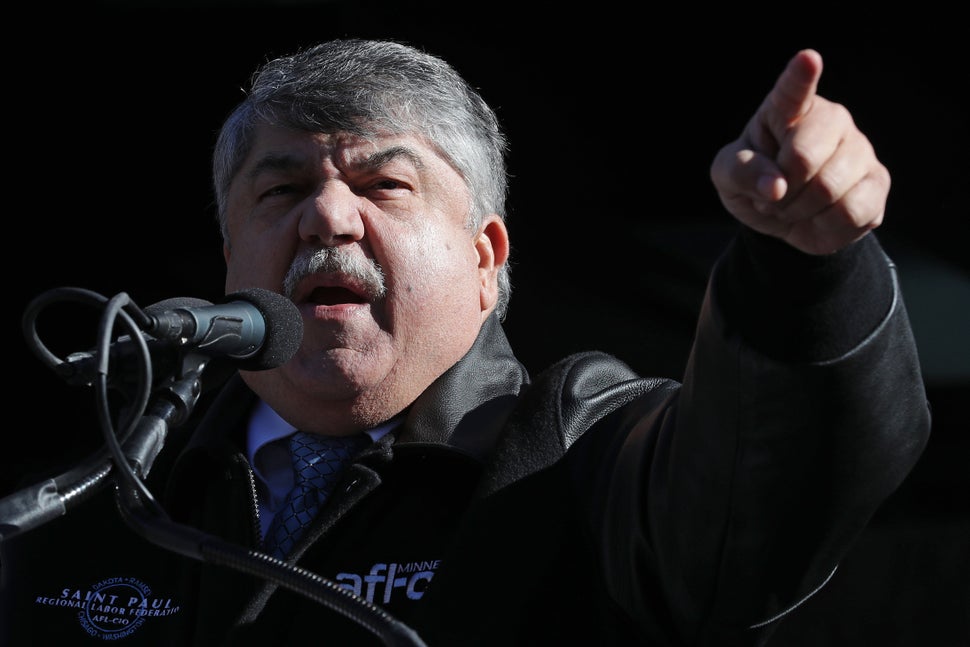
AFL-CIO President Richard Trumka has spoken out against police brutality and joined calls for reform.
Avendaño said she saw Trumka as a pretty strong leader in the wake of Ferguson. At the time, he added his name to a letter sent to the White House from the late civil rights icon Rep. Elijah Cummings (D-Md.) calling for the creation of a commission to implement reforms and a police czar to oversee law enforcement.
Trumka’s signature infuriated the IUPA. The union’s president, Sam Cabral, sent Trumka a scathing two-page missive. Whatever problems the Black community is facing, Cabral wrote, police deserve none of the blame (the full letter can be read here).
“They are not responsible for the single parent families, the unemployment, the school dropout rate or its attendant unacceptable literacy rate among black youth,†he wrote. “They are not responsible for the gangs, black on black crime or the infant mortality rate.â€
Cabral said the federation had no business weighing in on policing and the Black community. “You are using resources, time and credibility on an issue that has nothing what so ever to do with labor,†he wrote. The views laid out in Cummings’ letter “are not reflective of the blue collar American worker who builds homes, fights fires, installs telephones, or teaches students.â€
The letter left plenty of staffers within the federation doubtful they could ever work constructively with the union on reform. The IUPA has since become a booster for Trump and last year endorsed his reelection bid. The union did not respond to interview requests left by HuffPost.
In 2014, Trumka delivered a gutsy speech to the Missouri AFL-CIO taking racism head-on. It included a memorable line ― “our brother killed our sister’s son†― a reference to Darren Wilson, the police officer who was not charged in Michael Brown’s death, and Brown’s mother, Lezley McSpadden, a grocery store worker and member of the United Food and Commercial Workers union. “If we in the labor movement truly want to act as a positive force for change around issues of racism and classism we have to acknowledge our own shortcomings,†Trumka said.
The speech was not what attendees were expecting from a burly, mustachioed white guy who came up through the United Mine Workers of America, said Amaya Smith, who worked at the AFL-CIO for nearly a decade, including as an adviser to Trumka. She now co-owns the Brown Beauty Co-Op, a D.C. beauty boutique devoted to women of color. Smith remembers complete silence ― and palpable awkwardness ― as Trumka spoke. She said she will always respect him for “delivering hard truths to people who needed to hear it.â€
“When I was at the AFL-CIO, I was wildly optimistic we could be the place to have this really difficult conversation about what that means to work together to solve these problems,†Smith said.
But she never saw the serious discussion about law enforcement unions that she believes needs to happen. Still, even she is not sold on the idea of expelling the IUPA.
“Can you use their membership for accountability?†she wondered. “I don’t think they’d be receptive to the message, but I’m not sure folks have tried to have that internal conversation. … The AFL-CIO could use its platform.â€
The anger over police brutality arrived at the AFL-CIO’s front door this week, quite literally. A crowd vandalized its Washington headquarters near the White House during protests on May 31, smashing windows to the lobby and defacing the building with phrases like “fuck the law†and “we matter.†The federation condemned the violence, calling it “disgraceful,†but supported peaceful protesters’ message, with Trumka reiterating support for the Black Lives Matter movement.
It’s not easy to know the intentions of the vandals, and whether there was any more significance to the AFL-CIO being damaged than a nearby tea shop. But Berkley thought at least one person with a can of spray paint had made a deliberate target of the building. The photos from that night aren’t entirely clear, and the building has since been boarded up and decorated with “AFL-CIO supports Black Lives Matter†signs. But one tag appeared to say: “Those who remain silent are part of the problem.â€Â
Calling all HuffPost superfans!
Sign up for membership to become a founding member and help shape HuffPost’s next chapter
From champion of austerity to Europe’s biggest spender – Germany has travelled a long way in just a few months. The notoriously frugal ministry of finance has agreed to spend €130bn – a sum equal to 4% of national income – on more than 50 initiatives to promote growth across the country.
This breathtaking investment programme comes on top of the almost 30% of GDP the government has so far spent on rescuing businesses and protecting jobs during the coronavirus crisis.
The sums have shocked onlookers, dwarfing as they do the funds Germany deployed in the wake of the 2008 financial crash. Yet they are consistent with a broader push by European institutions to co-ordinate more than ever the recovery from recession of the EU economy.
The effort was already under way last year, aimed at counteracting a slowdown in GDP growth: after accelerating through 2017 and 2018, it had started fizzling out. The pandemic has turbocharged the response and brought the EU’s main actors together in a way not seen since the days of François Mitterrand and Helmut Kohl.
German chancellor Angela Merkel has buried her grievances with French premier Emmanuel Macron to produce €500bn of grants for hard-pressed business across the EU. The move circumvented the Bundestag’s refusal to countenance debt sharing across the euro area and, said Macron, overcame the bloc’s failure earlier in the pandemic to show sufficient solidarity.
He said: “What is sure is that this €500bn will not be repaid by the beneficiaries … We are proposing to do real transfers [of money] … that’s a major step.â€
Macron, who, to the annoyance of many in Merkel’s conservative Christian Democratic party, is a supporter of greater financial integration, has seen his tepid relationship with Germany’s chancellor revived somewhat in the past few months.
Last Thursday, the European Central Bank stirred the pot with a generous increase in lending to sovereign nations and the banking sector, joining the US Federal Reserve, the Bank of Japan and the Bank of England in making sure the cost of borrowing remains at all-time lows for years to come.
Stock markets climbed on news of the combined funding packages, and analysts said they expected the financial markets to accelerate back to pre-pandemic levels during the rest of this month.
The German Dax was among several European stock markets to make notable gains. The Dax jumped 3.4% last Friday, taking the week’s increase to more than 10%, and more than a quarter since mid-March.
Helped by surprisingly positive US jobs data last Friday, this jump in stock prices was nevertheless underpinned by an announcement from EU home affairs commissioner Ylva Johansson that travel restrictions were about to be eased.
“I personally believe that we will return to a full functioning of the Schengen area and freedom of movement of citizens no later than the end of the month of June,†she said.
Some countries, such as Austria, are ahead of the pack: after cutting the number of coronavirus cases and deaths dramatically, it has now eased its lockdown so far as to include travel to and from neighbouring Germany and Hungary.
The Schengen security area, which allows free movement among its 26 member states, is often cited as the cornerstone of European economic activity, so the prospect of it reopening was always going to excite investors. All eyes, though, are on Merkel’s Germany, which is the first to go beyond the rescue phase and bring forward a fistful of measures to aid the recovery.
The €130bn package, far from inciting either a rightwing backlash or condemnation from the left for being too weak, has received unexpected praise. The Green party called it “better than we had fearedâ€, though economists did criticise the stimulus package’s short-term thinking.
After spending two days hammering out a deal, Merkel said that because society was facing a “profound upheaval†shaped by climate change and digitisation, “we couldn’t just introduce a traditional stimulus packageâ€.
She added: “It also had to be done with an eye to the future, so that is what we especially emphasised.â€
Across Germany, the recovery package is seen as a defeat for the once all-powerful car lobby, which had reportedly spent weeks urging the government to include a subsidy not just for electric vehicles but also for those with internal combustion engines.
In 2016, Germany launched an inventive scheme that was meant to drive up demand for electric cars: with each purchase of an electric vehicle the buyer would get a €4,000 rebate, half of which was paid for by the government, with the rest funded by carmakers.
Instead of extending the scheme to diesel and petrol cars, as lobbyists had demanded, Merkel’s government decided to increase the rebate for electric vehicles to up to €9,000.
News magazine Der Spiegel cited industry insiders calling the package a paradigm change: “Truth is, the times in which the government fulfils every wish of the car sector are overâ€, it added.
Both the Green party and Merkel’s junior coalition partner, the Social Democratic Party (SPD), claimed the change of tack as a victory. Saskia Esken, the SPD’s joint leader, had defied car industry supporters in her own party and rejected plans for a subsidy for petrol and diesel cars earlier in the week.
“The package is better than we expectedâ€, said Green party joint leader Robert Habeck. “The government has managed to turn a corner just in time and given up on a subsidy for combustion engines.â€
Other countries, including the UK, are still drawing up their recovery packages. The Treasury is known to be circumspect about following in Germany’s footsteps given that Britain’s public finances are in a much weaker position.
However, Britain’s chancellor, Rishi Sunak, was urged last week by a thinktank that has strong connections to the Tory party to take bold action and bring forward a stimulus package that includes tax cuts alongside huge infrastructure spending.
The thinktank, Policy Exchange, said cuts to stamp duty and VAT should be part of a scheme designed to spur spending by both businesses and consumers.
Merkel also put forward a cut in VAT, in a move that made the recovery package a more palatable compromise for many of her MPs.
Economists, though, were more sceptical. “It is completely unclear whether businesses will pass on the VAT reduction to customers at all,†said Sebastian Dullien, director of the Macroeconomic Policy Institute. “In retailing, you already have a lot of threshold prices: items that currently cost €99 are hardly going to go on sale for €97.50.â€
Christian Odendahl, chief economist at London thinktank the Centre for European Reform, cited the temporary cut in VAT the UK government introduced in 2008, pointing out that only “75% of businesses passed [the cuts] on to consumersâ€.
Clemens Fuest, president of the Leibniz Institute for Economic Research in Munich, said the VAT cut risked not providing a lasting stimulus: “It’s a measure that allows you to drive up turnover in the short term. But after that period the whole thing doesn’t work any more, of course. So you could have a problem in 2021 when consumption collapses.â€
France will be keen to follow in Germany’s footsteps. And doing so will be much easier now that every country in the EU is on course to breach the strictures of Brussels’ 3% deficit rule.
The free flow of government funds will not be held up by eurocrats worried by claims of governments spending beyond their means. Borrowing is cheap for all developed countries and few of them are likely to spurn the opportunity.
Ursula von der Leyen, the EU commission chief, has called for restraint from governments that may be considering offering bailouts to ailing businesses and perpetuating huge zombie companies.
But Macron is unlikely to worry too much about that. He has already ditched his stance as champion of private-sector knowhow for a more nuanced approach that embraces the stability of the public sector and businesses that rely on state aid.
It would help him hugely if France could regain its status as the world’s favourite travel destination. Without the return of packed flights and trains full of tourists, thousands of small businesses will go bust, and larger companies will struggle to rebuild their revenues.
Last Friday, Macron called on unions to reform the 35-hour working week. The government expects GDP to drop by 11% this year, in the worst recession since 1944, with the budget deficit expected to rise above 10% of GDP. Unions immediately opposed the idea, saying it represented a pay cut.
Macron, though, understands that his European project will fail if France is dragged back by infighting. He needs to keep pace with Merkel, or many of the gains made in the past three months will be lost.
Spain’s prime minister, Pedro Sánchez, called for a European-style Marshall plan. Photograph: Alberto Di Lolli/AFP/Getty Images
The race to rescue the EU
EU leaders have worked to make sure that Europe’s haphazard response to the 2008 financial crisis – which set the north against the south and almost caused its disintegration – is not going to be repeated. Bailout operations have been larger and more coordinated, but continued resistance in some more conservative quarters to sharing Europe’s wealth and income has persuaded some leaders to battle openly for deeper solidarity.
5 April The Spanish prime minister, Pedro Sánchez, called on Europe to produce a Marshall plan to rebuild the continent’s economies. Referring to the US-funded investment programme put together in 1947 by secretary of state George Marshall, Sánchez said failure to act in solidarity could imperil the union’s future.
“Europe must build a wartime economy and promote European resistance, reconstruction and recovery. Europe was born out of the ashes of destruction and conflict. It learned the lessons of history and understood something very simple: if we don’t all win, in the end, we all lose.â€
6 April Germany’s chancellor, Angela Merkel, warned that the EU faced the biggest challenge since its foundation as she spoke about the economic and political consequences of the coronavirus pandemic. “Everyone has been hit equally by this and it must be in the interest of everyone, and of Germany, that Europe emerges stronger from this test,†she said.
16 April In an interview with the Financial Times, the president of France, Emmanuel Macron, said: “We are at a moment of truth, which is to decide whether the EU is a political project or just a market project. I think it’s a political project … We need financial transfers and solidarity, if only so that Europe holds on.â€
13 MayPaolo Gentiloni, a former Italian prime minister and now the EU’s economy commissioner, said that an uneven economic recovery from the coronavirus crisis posed an “existential threat†to the EU. He said: “What is clear is the uneven level of the recovery and the risks this creates to our single market and the necessary convergence, especially within the euro area. This is something that I could even define as an existential threat to the building of the union,†he told a group of European newspapers, including the Guardian.
27 MayUrsula von der Leyen, the president of the European commission, called on EU countries to back a €750bn (£671bn) recovery plan, saying the union was facing a moment such as it had never seen in its 70-year history. “The crisis has huge externalities and spillovers across all countries and none of that can be fixed by any single country alone.â€
With inter-state travel still banned due to the coronavirus-forced lockdown, Indian cricketers will have to avail the grounds of their respective home states to indulge in running and focus on their skillwork, said national bowling coach Bharat Arun.
Confined to their homes since a nationwide lockdown was enforced to contain the health crisis, the Indian cricketers have not been able to indulge in running which is an important part of their fitness regime.
File image of Bharat Arun. AFP
“Partially now the lockdown is lifted but inter-state travel is going to be a problem. What the players are going to do is, they will be going to their respective hometown, the grounds that are available, they would do their running and they would also combine it with skill-work,” Arun said in Lockdown But Not Out series by FanCode.
Arun said players will take at least a month-and-a-half to achieve match fitness and hoped BCCI can conduct a tournament before they play international cricket.
“It’d take us at least six-eight weeks for us to play international matches, whereby we’d be first working on the skill, and fitness in the camps and then we’ll progress onto match simulations, and hopefully the BCCI can organise a tournament just before we play the international matches, that would be great for us,” he said.
The 57-year-old said the lockdown was an opportunity for the bowlers to recover from niggles and work on their fitness.
“I’m not worried about the bowlers because they’ve had ample time in the last two months, to work on strength and their fitness,” he said.
“Very rarely does an international cricketer, especially our bowlers, would get this kind of time to work on their fitness. Also, it is a wonderful opportunity for them to get over the little niggles, that they may have got over the long season.”
The former all-rounder said he has no doubts that the players will be raring to go once the camp starts.
“I’m very confident that when we regroup, they would be raring to go mentally and physically. They would be really raring to go and that augurs well for them,” he said.
Talking about India’s semi-final exit at last year’s World Cup, Arun said: “Yes, the World Cup loss still hurts us, it’s still hurting us and we’ll probably go all out to see that we leave no stone unturned in our preparation to make sure that we do exceptionally well in the World Cup.
“To win a World Cup, I think we need to really plan well and how far we execute our plan.”
Updated Date: Jun 06, 2020 20:30:50 IST
Find latest and upcoming tech gadgets online on Tech2 Gadgets. Get technology news, gadgets reviews & ratings. Popular gadgets including laptop, tablet and mobile specifications, features, prices, comparison.
If you suspect you or a family member has coronavirus you should call (not visit) your GP or ring the national Coronavirus Health Information Hotline on 1800 020 080.
TOKYO — When the coronavirus arrived in Japan, people did what they normally do: They put on masks.
Face coverings are nothing new here. During flu and hay fever seasons, trains are crowded with commuters half-hidden behind white surgical masks. Employees with colds, worried about the stigma of missing work, throw one on and soldier into the office. Masks are even used, my hairdresser once told me, by women who don’t want to bother putting on makeup.
In the United States, where masks only recently arrived on the scene, they have been a less comfortable fit — becoming an emblem in the culture wars. A vocal minority asserts that nobody can force anyone to put a mask on. Protesters have harassed mask-wearing reporters. The president himself has tried to avoid being seen in one.
As Japan has confounded the world by avoiding the sort of mass death from coronavirus seen in the United States, I began to wonder whether the cultural affinity for masks helped explain some of this success. It also got me thinking about the evolution in my own feelings about face coverings.
A decade ago, before we moved to Tokyo when I became The New York Times bureau chief, my husband, two children and I visited Japan to see family and friends. I had picked up a cough on the plane, and my Japanese godfather pointedly dropped into a convenience store to buy me a packet of masks.
Shame on me, but I declined to wear one — they seemed unsightly and uncomfortable.
Fast forward to early this year, when news of a strange virus started emerging from China, and Japan soon reported its first case.
Advice on masks that I was reading from international experts was mixed, if not outright skeptical. The surgeon general of the United States implored the public in a tweet to “STOP BUYING MASKS!†The Centers for Disease Control and Prevention initially said it was not necessary to wear one if I wasn’t sick.
Still, living in Tokyo, I had grown accustomed to seeing them everywhere. I decided it was better to buy some for me and my family. By then, masks were sold out in most Japanese drugstores, but the Tokyo bureau of The Times managed to procure a small supply that we had to ration.
I was sometimes confused about when to wear one, though I did so when reporting near the Diamond Princess, the cruise ship that was the site of a large coronavirus outbreak, or when I attended crowdednews conferences in unventilated rooms.
It took some getting used to. The mask made my glasses fog. I didn’t like the feeling of my own breath on my face.
But I’m now a convert, especially since Tokyo was placed under a state of emergency in mid-April. I bought handmade cloth face coverings from a Facebook friend in Okinawa. We wash them daily and line them with coffee filters. Even though the emergency declaration was lifted in late May, I still won’t let anyone in my family leave our apartment without putting on a mask.
With paper masks sold out everywhere, the Japanese government sent cloth masks in the mail in April. The initiative, which cost about $400 million, became the butt of jokes, when people discovered the masks were too small to cover most adults’ mouths and noses.
The masks became a symbol of failings in the government’s coronavirus response. In the early months of the pandemic, Japan seemed not to follow much of the conventional epidemiological wisdom, deliberately restricting testing and not ordering a lockdown.
Yet a feared spike in cases and deaths has not materialized. Japan has reported more than 17,000 infections and just over 900 deaths, while the United States, with a population roughly two and a half times as large, is approaching 1.9 million cases and 110,000 deaths.
“Japan, I think a lot of people agree, kind of did everything wrong, with poor social distancing, karaoke bars still open and public transit packed near the zone where the worst outbreaks were happening,†Jeremy Howard, a researcher at the University of San Francisco who has studied the use of masks, said of the country’s early response. “But the one thing that Japan did right was masks.â€
But one of Japan’s most visible responses has been near-universal mask wearing, seen here as a responsible thing to do to protect oneself and others, and as a small price to pay to be able to resume some semblance of normalcy.
Japan’s experience with masks goes back hundreds of years. Mining workers started using them during the Edo period, between the 17th and 19th centuries, to prevent inhalation of dust. The masks were often made from the pulp of plums, said Kazunari Onishi, author of “The Dignity of Masks†and an associate professor at St. Luke’s International University in Tokyo.
Dr. Onishi said that early in the 20th century, the Japanese viewed masks as unattractive, but were persuaded to wear them during the 1918 flu pandemic. More recently, the Japanese public has used masks during the SARS and MERS outbreaks — which also left Japan relatively unscathed — as well as to protect against pollution and pollen.
During the current pandemic, scientists have found a correlation between high levels of mask-wearing — whether as a matter of culture or policy — and success in containing the virus.
Updated June 5, 2020
How many people have lost their jobs due to coronavirus in the U.S.?
The unemployment rate fell to 13.3 percent in May, the Labor Department said on June 5, an unexpected improvement in the nation’s job market as hiring rebounded faster than economists expected. Economists had forecast the unemployment rate to increase to as much as 20 percent, after it hit 14.7 percent in April, which was the highest since the government began keeping official statistics after World War II. But the unemployment rate dipped instead, with employers adding 2.5 million jobs, after more than 20 million jobs were lost in April.
Will protests set off a second viral wave of coronavirus?
Mass protests against police brutality that have brought thousands of people onto the streets in cities across America are raising the specter of new coronavirus outbreaks, prompting political leaders, physicians and public health experts to warn that the crowds could cause a surge in cases. While many political leaders affirmed the right of protesters to express themselves, they urged the demonstrators to wear face masks and maintain social distancing, both to protect themselves and to prevent further community spread of the virus. Some infectious disease experts were reassured by the fact that the protests were held outdoors, saying the open air settings could mitigate the risk of transmission.
How do we start exercising again without hurting ourselves after months of lockdown?
Exercise researchers and physicians have some blunt advice for those of us aiming to return to regular exercise now: Start slowly and then rev up your workouts, also slowly. American adults tended to be about 12 percent less active after the stay-at-home mandates began in March than they were in January. But there are steps you can take to ease your way back into regular exercise safely. First, “start at no more than 50 percent of the exercise you were doing before Covid,†says Dr. Monica Rho, the chief of musculoskeletal medicine at the Shirley Ryan AbilityLab in Chicago. Thread in some preparatory squats, too, she advises. “When you haven’t been exercising, you lose muscle mass.†Expect some muscle twinges after these preliminary, post-lockdown sessions, especially a day or two later. But sudden or increasing pain during exercise is a clarion call to stop and return home.
My state is reopening. Is it safe to go out?
States are reopening bit by bit. This means that more public spaces are available for use and more and more businesses are being allowed to open again. The federal government is largely leaving the decision up to states, and some state leaders are leaving the decision up to local authorities. Even if you aren’t being told to stay at home, it’s still a good idea to limit trips outside and your interaction with other people.
What’s the risk of catching coronavirus from a surface?
Touching contaminated objects and then infecting ourselves with the germs is not typically how the virus spreads. But it can happen. A number of studies of flu, rhinovirus, coronavirus and other microbes have shown that respiratory illnesses, including the new coronavirus, can spread by touching contaminated surfaces, particularly in places like day care centers, offices and hospitals. But a long chain of events has to happen for the disease to spread that way. The best way to protect yourself from coronavirus — whether it’s surface transmission or close human contact — is still social distancing, washing your hands, not touching your face and wearing masks.
What are the symptoms of coronavirus?
Common symptoms include fever, a dry cough, fatigue and difficulty breathing or shortness of breath. Some of these symptoms overlap with those of the flu, making detection difficult, but runny noses and stuffy sinuses are less common. The C.D.C. has also added chills, muscle pain, sore throat, headache and a new loss of the sense of taste or smell as symptoms to look out for. Most people fall ill five to seven days after exposure, but symptoms may appear in as few as two days or as many as 14 days.
How can I protect myself while flying?
If air travel is unavoidable, there are some steps you can take to protect yourself. Most important: Wash your hands often, and stop touching your face. If possible, choose a window seat. A study from Emory University found that during flu season, the safest place to sit on a plane is by a window, as people sitting in window seats had less contact with potentially sick people. Disinfect hard surfaces. When you get to your seat and your hands are clean, use disinfecting wipes to clean the hard surfaces at your seat like the head and arm rest, the seatbelt buckle, the remote, screen, seat back pocket and the tray table. If the seat is hard and nonporous or leather or pleather, you can wipe that down, too. (Using wipes on upholstered seats could lead to a wet seat and spreading of germs rather than killing them.)
Should I wear a mask?
The C.D.C. has recommended that all Americans wear cloth masks if they go out in public. This is a shift in federal guidance reflecting new concerns that the coronavirus is being spread by infected people who have no symptoms. Until now, the C.D.C., like the W.H.O., has advised that ordinary people don’t need to wear masks unless they are sick and coughing. Part of the reason was to preserve medical-grade masks for health care workers who desperately need them at a time when they are in continuously short supply. Masks don’t replace hand washing and social distancing.
What should I do if I feel sick?
If you’ve been exposed to the coronavirus or think you have, and have a fever or symptoms like a cough or difficulty breathing, call a doctor. They should give you advice on whether you should be tested, how to get tested, and how to seek medical treatment without potentially infecting or exposing others.
“I think there is definitely evidence coming out of Covid that Japan, as well as other countries which practice mask-wearing, tend to do much better in flattening the curve,†said Akiko Iwasaki, a professor of immunobiology at Yale.
The scientific evidence on whether a mask protects the wearer from infection is mixed. But experiments show that masks can be effective in blocking the emission of respiratory droplets that may contain the virus, even when someone has no symptoms of illness. And there is some evidence that infected people with no symptoms can still transmit the coronavirus.
“Wearing a simple cloth mask could significantly block speech droplets from being released,†two of the study’s authors, Philip Anfinrud and Adriaan Bax of the National Institutes of Health, wrote in an email.
While it may be possible to establish only correlation, not causation, he said, “if the downside is nothing, and the upside is huge, then you take the bet.â€
Still, most scientists say, masks alone are not enough; social distancing is also needed.
“Many people think that just covering their mouth and nose is enough,†Dr. Onishi said. “If they wear a mask, they think they can go to crowded areas, but that is still very dangerous.â€
My family and I have seen that kind of thinking in action. On a recent weekend, we masked up and went for a bicycle ride in Tokyo. After miles of coasting down quiet residential streets and along a flower-lined path, we took a turn into a surprisingly crowded shopping arcade.
As we wove through the crowds, I spotted a long, tightly packed line for coffee at a cafe. Inside a grocery store, nobody was paying much attention to the distance between customers. At a food stand, a huddle formed around the server’s window.
Coronavirus-related cases and deaths across the region are rising faster than anywhere in the world. And in the worst-hit countries, they show no signs of slowing down. The region has recorded nearly 1.2 million cases and more than 60,000 deaths.
“We are especially worried about Central and South America, where many countries are witnessing accelerating epidemics,” World Health Organization Director-General Tedros Adhanom Ghebreyesus said on Wednesday.
The WHO does not believe Central or South America have reached peak transmission, meaning the number of people getting sick and dying might continue to rise.
Health officials warn countries against reopening their economies too soon, even as nations prepare to reopen or have already done so.
Here’s a look at the outbreaks in three of Latin America’s hardest-hit countries, which account for roughly 60% of the region’s population. And there is a success story as well.
The country has recorded at least 645,771 coronavirus cases and 35,026 deaths.
It recently passed Italy to become the country with the third-highest deaths in the world and will likely surpass the United Kingdom soon.
That means Brazil will have both the second-most cases and deaths in the world, trailing only the United States.
It’s worth noting, however, that Brazil is testing at a far lower rate than the US. That means many cases go unregistered.
In the country’s most populous state of São Paulo, the Health Ministry coordinator says some coronavirus cases have likely been recorded as severe acute respiratory syndrome, or SARS, due to the state’s low Covid-19 testing capacity.
A study released this week by the Federal University of Rio Grande do Sul says Brazil will record 1 million cases and 50,000 deaths by June 20.
Meanwhile, some of Brazil’s big cities are beginning to reopen. Rio de Janeiro is allowing non-essential businesses like churches, car shops and decoration stores to accept customers once again.
Mexico
Two things happened in Mexico this week that seem at odds with each other.
First, Mexico recorded its worst week of the outbreak, both in confirmed cases and deaths.
It recorded more than 1,000 deaths in a single day for the first time. And for three consecutive days, it recorded single-day highs in new cases.
Despite the bleak numbers, and conflicting messages from government leaders, officials have pushed ahead with a phased reopening plan across the country.
Deputy Health Secretary Hugo López Gatell, who leads Mexico’s Covid-19 response, has urged Mexicans to stay home. He has stressed that the country is not out of the woods, even if some sectors of the economy begin to reopen.
“Don’t steal, don’t rob, don’t betray, and that helps a lot with not getting the coronavirus,” he said Thursday.
AMLO, as the President is commonly known, ventured out of Mexico City on Monday for the first time since late March.
He toured the Yucatán Peninsula and inaugurated construction of the so-called Maya Train, an ambitious infrastructure project that will connect cities in five southeastern states.
Mexico has recorded 110,026 cases and 13,170 deaths. But given extremely low testing rates in the country, health officials have said the true number of cases is likely well into the millions.
Peru
People in Callao, Peru, lined up for hours this week to get their oxygen tanks refilled. But once they got to the front of the line, relatives of patients with Covid-19 found skyrocketing prices.
One person told CNN affiliate TVPerú Noticias that oxygen prices have doubled. And the government now admits there’s a problem.
“Our mission is to avoid the development of a black market that is mercantile and uses a pandemic to abuse people,” said Cesar Chaname, a spokesperson for Peru’s public health agency.
Peru continues to grapple with one of Latin America’s worst outbreaks, its 187,400 cases the second highest in the region behind Brazil.
The country has far better testing rates than other countries in the region, something experts say helps understand how bad the outbreak there truly is.
But even with that knowledge, the economic toll has pressured authorities to reopen the economy.
This week officials announced Peru would enter Phase 2 of its reopening plan, where businesses like clothing stores and hair salons can operate again.
Peruvian President Martin Vizcarra said the moves mean roughly 80% of the economy would soon be open.
“We can’t support 100% of the country’s needs with just 50% of the economy’s output,” he said.
Uruguay
People have called Uruguay the New Zealand of Latin America, given the country’s largely successful Covid-19 response.
The country of roughly 3.5 million people borders Brazil, where the worst outbreak in Latin America has played out to devastating effect.
But Uruguay has recorded just 832 cases. It has recorded one death since May 24 and just 23 fatalities in total.
Experts say the reasons for the country’s success are numerous — a robust early response including quarantine measures, a large and efficient system of tracing and isolating those infected, randomized testing and the creation of a crisis response committee.
Consequently, there is less risk as Uruguay begins to reopen its economy.
The country began easing restrictions in early May. On June 1 primary and secondary rural education started again in more than 400 schools, and businesses are also gradually being allowed to reopen.
We use cookies on our website to give you the most relevant experience by remembering your preferences and repeat visits. By clicking “Accept”, you consent to the use of ALL the cookies.
This website uses cookies to improve your experience while you navigate through the website. Out of these, the cookies that are categorized as necessary are stored on your browser as they are essential for the working of basic functionalities of the website. We also use third-party cookies that help us analyze and understand how you use this website. These cookies will be stored in your browser only with your consent. You also have the option to opt-out of these cookies. But opting out of some of these cookies may affect your browsing experience.
Necessary cookies are absolutely essential for the website to function properly. These cookies ensure basic functionalities and security features of the website, anonymously.
Cookie
Duration
Description
cookielawinfo-checbox-analytics
11 months
This cookie is set by GDPR Cookie Consent plugin. The cookie is used to store the user consent for the cookies in the category "Analytics".
cookielawinfo-checbox-functional
11 months
The cookie is set by GDPR cookie consent to record the user consent for the cookies in the category "Functional".
cookielawinfo-checbox-others
11 months
This cookie is set by GDPR Cookie Consent plugin. The cookie is used to store the user consent for the cookies in the category "Other.
cookielawinfo-checkbox-necessary
11 months
This cookie is set by GDPR Cookie Consent plugin. The cookies is used to store the user consent for the cookies in the category "Necessary".
cookielawinfo-checkbox-performance
11 months
This cookie is set by GDPR Cookie Consent plugin. The cookie is used to store the user consent for the cookies in the category "Performance".
viewed_cookie_policy
11 months
The cookie is set by the GDPR Cookie Consent plugin and is used to store whether or not user has consented to the use of cookies. It does not store any personal data.
Functional cookies help to perform certain functionalities like sharing the content of the website on social media platforms, collect feedbacks, and other third-party features.
Performance cookies are used to understand and analyze the key performance indexes of the website which helps in delivering a better user experience for the visitors.
Analytical cookies are used to understand how visitors interact with the website. These cookies help provide information on metrics the number of visitors, bounce rate, traffic source, etc.
Advertisement cookies are used to provide visitors with relevant ads and marketing campaigns. These cookies track visitors across websites and collect information to provide customized ads.