Jimmy Carter calls out police injustice, but says violence is ’not a solution’

Many protests have been largely peaceful, though violent clashes have sprung up as police enforce curfews and clear streets. There have also been several major instances of looting in large cities, and state and municipal governments have reinforced police, at times calling in the National Guard.

Several observers, including President Donald Trump, have used the lootings as justification for employing military force to quell the protests. Some Defense Department officials have express dismay at the prospect of using the U.S. military on American citizens.

Many videos posted online have shown police using violent force against protesters and reporters, even when unprovoked. A notable example was Monday, when law enforcement used smoke canisters, pepper, rubber bullets and flash-bang shells to clear a crowd from Lafayette Square across the street from the White House so that Trump could pose for photos at a nearby church.

Carter’s statement also invoked his own experiences in the deep South, saying: “I know all too well the impact of segregation and injustice to African Americans. As a politician, I felt a responsibility to bring equity to my state and our country.”

Carter said that he has fought as governor of Georgia, president and former president for human rights, saying in his 1971 gubernatorial inauguration, “The time for racial discrimination is over.”

“With great sorrow and disappointment, I repeat those words today, nearly five decades later,” his Wednesday statement read.

Source link

The Takeaway: UAE official warns of ‘even more unstable’ region if Israel annexes West Bank settlements

In a wide-ranging interview for Al-Monitor’s On the Middle East podcast, Yousef Al-Otaiba, the United Arab Emirates Ambassador to the United States, discussed the impact of COVID-19 on the UAE and the region; Iran; Israeli-Palestinian issues and more.

Background: Otaiba has served as the UAE Ambassador to the United States since 2008. In addition to his role as ambassador, he was promoted to the rank of minister in 2017.

Here are just a few highlights of his interview on dealing with COVID-19, Iran and Israeli-Palestinian issues:

On COVID-19:

Whole of Government: With a population of approximately 10 million, the UAE has 35,788 coronavirus cases and only 269 deaths, a fatality rate of 0.7% compared to a global mortality rate among reported cases of 5.9%. Otaiba suggests that the UAE’s “whole of government” approach may be the reason for such a low percentage. The UAE began planning early to deal with the virus, engaging all relevant government agencies. The Emirates has implemented extensive testing (the UAE has already tested 20% of its population); hospitalization for all positive cases; extensive contact tracing; social distancing enforcement and daily cleaning at malls and public places; and stringent and flexible curfews.

Collective Action: The UAE has its own COVID diplomacy, emphasizing collective action and humanitarian aid. It has provided over 657 tons of medical supplies to 62 countries so far. “Unless the entire world is able to deal with the coronavirus, we will not overcome the coronavirus,” said Otaiba, adding, “The view from the [UAE] leadership is that we have to help these countries who don’t have the type of resources or capacity to test, identify and deal with the coronavirus…We have to do this together…We have to tackle the coronavirus everywhere if we are going to overcome this.”

UAE Post-COVID-19: “We were already marching toward a knowledge-based economy, investing in technology and AI and things that address the future. And I think what the coronavirus is doing for us is making these plans go much, much faster…We are accelerating whatever it is we were planning to do anyway.”

On Iran:

A UAE template for civil nuclear development? The US-UAE civil nuclear agreement, negotiated in 2009, has been referred to as the “gold standard” of such agreements. The UAE does not enrich uranium or reprocess nuclear fuel as part of the deal, which makes civil nuclear energy safer and cheaper while eliminating any concerns about weapons development. Iran, in contrast, has insisted on “the right to enrichment” in its civil nuclear program. “I don’t know if Iran’s receptive” to the UAE model, Otaiba said, “but I know it hasn’t really been positioned; it hasn’t been used as a template.”

On diplomacy with Iran: “We need to see what Iran is going to do…I think it’s important to try to de-escalate, to make sure things don’t get any more unstable in what has become a very unstable region. But I don’t know if we’re going to see any change of behavior between now and November,” when the United States holds presidential elections, with regard to negotiating a new nuclear agreement, as the Trump administration is seeking.

On Israeli-Palestinian issues:

Annexation: Otaiba warned that Israeli Prime Minister Benjamin Netanyahu’s plan to annex Jewish settlements in the West Bank and Jordan Valley would make the Middle East “even more unstable,” adding, “It will put an incredible amount of political pressure on our friends in Jordan.”

Trump Peace Plan: “It’s a starting point…and it may or may not produce anything…but we haven’t seen any negotiations,” he said. “Cooler heads need to prevail, and we need to get back to a place where there is some form of dialogue between the sides.”

Palestinian decision to end cooperation with US, Israel: “I don’t think it’s a good move, but I also think the Palestinians have very little options left at their disposal.”

On the PA rejecting UAE COVID-19 assistance: “I honestly don’t know what happened there,” Otaiba said, adding, “I wish I did…We’re trying to help people who desperately need help. I’m disappointed that help will not reach poor Palestinians who need that help…There are 100 ways that could have been handled better.”

Listen here: This is just a small taste of my conversation with Ambassador Otaiba, which also covered Libya, Syria, Yemen and Qatar. You can listen here to the full podcast and sign up for our Al-Monitor podcasts on your favorite platform.


Source link

Coronavirus live updates: Australian death in Bali investigated for Covid-19 as Nev Power appears before Senate – latest

Australia is well-placed to help meet India’s economic aspirations. India is our second-largest source of international students, and Australia benefits from a 700,000-strong Indian-Australian diaspora.

But next month marks two years since former DFAT secretary, Peter Varghese, presented this Government with the India Economic Strategy, which was intended as a blueprint to transform our economic engagement.

Since then the strategy has gathered dust, continuing years of failure by this Government to adequately diversify Australia’s trading economy.

Under Scott Morrison as Prime Minister and Treasurer, Australia has become increasingly reliant on a single trading partner. The only economy that depends more on China than Australia is Hong Kong.

Instead of trade diversification, Scott Morrison and his government have overseen the proportion of Australian trade with China increase by a third – from 19.8 per cent of Australia’s total trade to 26.4 per cent.

In the same period, the proportion of Australia’s trade with Japan, South Korea, Singapore and the US has declined and the proportion of Australia’s trade with India has increased by a measly 0.7 percentage points – from 2.7% to 3.4%.

We recognise that India alone does not provide a magical solution on diversification, but the fact is that India has barely rated a mention by this Government.

Labor launched negotiations with India for a Comprehensive Economic Partnership Agreement in May 2011. The most recent negotiation was 45 months ago, in September 2015.

We hope this week’s virtual summit yields more than headlines aimed at providing a distraction from recent trade issues with China, and instead marks a long overdue shift in emphasis and a serious plan for diversifying Australia’s interests.

Source link

401(k) Plans Move a Step Closer to Pooling With Private Equity

Everyday investors may soon be able to get a piece of private equity action.

The Department of Labor on Wednesday issued a letter that clarifies how, under existing rules, certain retirement plan sponsors, including 401(k)’s, can put money into private equity investments that are usually reserved for the super rich and big institutional investors.

Labor Secretary Eugene Scalia said the new guidance “helps level the playing field for ordinary investors and is another step by the department to ensure that ordinary people investing for retirement have the opportunities they need for a secure retirement.”

But it’s unclear how quickly the managers of big retirement plans will embrace private-equity investments. Vanguard, one of the largest managers of 401(k) plans in the country, declined to comment on the letter. Another major manager, Fidelity, did not respond to a request for comment.

Consumer advocates and some regulators have been wary of giving ordinary investors broader access to investments in businesses that do not adhere to the same disclosure rules as public companies and that could put them at risk.

Even without access to this untapped pool of capital, private equity managers have been able to raise record amounts in recent years. Fund managers in the United States had access to $914 billion as of mid-May, according to the investment data firm Preqin.

Many of those dollars come from wealthy clients, but big pension funds, such as the Texas County and District Retirement System, also put their money into funds managed by private equity firms.

But the move away from traditional pensions and into defined contribution plans means most retail investors don’t have access to those kinds of investments, which proponents say can provide added diversification to an investment portfolio.

“This is a positive step towards helping more Americans gain access to private equity investment,” Drew Maloney, the chief executive of the American Investment Council, which represents the private equity industry, said in a statement.

Private equity investments in new start-ups or in growth businesses can produce high returns. The private equity funds in the top 25 percent for performance earned at least 16.2 percent over the 10 years that ended in September 2018, according to PitchBook.

But that comes with myriad risks.

As the term “private equity” suggests, investments can be opaque. Companies in such portfolios don’t have to disclose as much information as publicly traded businesses. Investors also can’t cash out as easily as they can with public investments. Money is often locked up for eight to 10 years at a time.

And while private equity can score big by investing in the next Facebook, it can also lose money when a company doesn’t get off the ground. According to the same PitchBook data, the bottom 10 percent of funds had negative returns over 10 years.

In November, Andrea Seidt, the Ohio securities commissioner, told the federal Securities and Exchange Commission that a review of 100 enforcement actions over the prior two years — a partial snapshot — showed that more than 1,000 investors had lost in excess of $100 million in private offerings gone wrong.

The private marketplace has become increasingly important as start-ups stay private longer. Also, there are half as many public companies as there were two decades ago, leaving fewer places for everyday investors to store their money.

The Labor Department outlined the new guidance in coordination with the S.E.C. Jay Clayton, the commission’s chairman, said in the statement that the clarification “will provide our long-term Main Street investors with a choice of professionally managed funds that more closely match the diversified public and private market asset allocation strategies.”

The S.E.C. has supported giving smaller investors access to private equity through special investment vehicles that might work like mutual funds. Right now, only accredited investors — those with at least $1 million in assets not including their home, or $200,000 in annual income — can participate in private equity deals.

In December, the agency proposed rules that would relax the accredited investor rules, but it stopped short of figuring out a way to make private equity more widely accessible. The Labor Department’s guidance was a response to Partners Group, a private equity firm with $94 billion in assets under management, and Pantheon Group, which has $49 billion in assets under management and is controlled by Affiliated Managers Group, a publicly listed company that specializes in asset management.

Susan Long McAndrews, a partner at Pantheon, said in a statement that the change was “a critical step toward improving retirement outcomes.”

Tara Siegel Bernard contributed reporting.

Source link

50,000 people moved to safety in Mumbai ahead of Cyclone Nisarga

0


Nearly 50,000 people staying close to the seashore and landslide-prone areas in were either evacuated or they themselves moved to safer locations ahead of ‘Nisarga’, which hit the coast on Wednesday, although the country’s financial capital largely remained unscathed by it.


Nisarga hit the state coast near Alibaug in Raigad district with a wind speed upto 120 kmph on Wednesday afternoon, but weakened in the evening and moved towards north-east Maharashtra, sparing and other areas.


The (BMC) said that since Tuesday it evacuated nearly 20,000 citizens to the temporary shelters and other 30,000 shifted on their own to safer locations in response to its advisory.

Municipal workers use a bulldozer to clear uprooted trees from a road that fell during Nisarga, in Mumbai


The BMC said that the city witnessed 117 incidents of tree fall, nine incidents of wall or portion of house collapse, but there was no report of any casualty or injury due to the cyclone.


BMC sources said that the maximum number of people evacuated by the civic body were from slums and fisherfolk localities along the west coast, including areas like Colaba, Worli, Versova, Malad and Gorai.
mumbai, monsoon, rain, nisarga, clouds, women, shelter


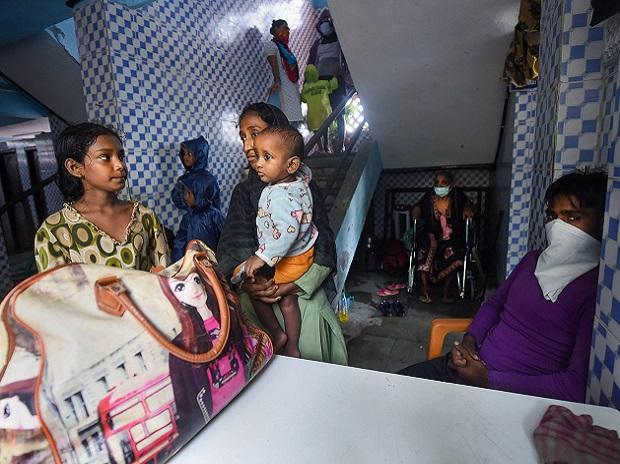
Residents of Geeta Nagar slum take shelter at a safer place during Cyclone Nisarga, in Mumbai


ALSO READ: Cyclone Nisarga LIVE: Worst is over, NDRF teams to stay deployed, says DG


The BMC said that all these evacuated people were moved into 35 schools that were converted into temporary shelters.


In its statement, the BMC said that Municipal Commissioner I S Chahal directed to keep all the evacuees under observation for one day and they will be permitted go to after being screened for temperature and oxygen levels to ensure that they do not have symptoms of Covid-19.

mumbai, monsoon, rain, nisarga, clouds, sea, ships, shipping, high tide


A vessel in the rough sea during Cyclone Nisarga, at Colaba in Mumbai


It said that between 8 am to 6 pm on Wednesday, 117 complaints of tree fall were reported in Mumbai, of which 39 were from south Mumbai, 40 from eastern suburbs and 38 from western suburbs.


It further said that 39 incidents of short-circuit were reported in the city during the same period and nine incidents of house fall, including three were from south and four from western suburbs, were reported on Wednesday.

mumbai, monsoon, rain, nisarga, clouds, marine drive


A group of people pose for pictures at Marine drive during Cyclone Nisarga, in Mumbai


A spokesperson of Ltd, which supplies piped cooking gas to the city, said that a pipeline supplying gas to a society in Ghatkopar West was ruptured due to tree fall, but it was immediately attended and gas supply stopped.


A purported video of falling of scaffolding around a building, said to be from suburban Bandra of Mumbai was being circulated on social media and another video about damage to a temporary rain shed on a building in South Mumbai was reported by the regional news channels.


mumbai, monsoon, rain, nisarga, clouds, tree, jcb


A corporation worker works to clear an uprooted tree that fell on a road during Cyclone Nisarga at Juinagar in Navi Mumbai


ALSO READ: Cyclone Nisarga: Threat to Mumbai has reduced, says Maharashtra minister


The civic body, however, said that no injuries were reported in any of these two incidents.


No other untoward incident was reported.


According to the statement, the BMC’s disaster response machinery will remain on high alert for the next few days until the cyclonic effect has passed from the city.


Quoting the (IMD), the civic body in its statement predicted moderate to heavy rain with strong gusty winds in the city and suburbs along with extremely heavy rainfall at isolated places for Thursday cloudy sky with light to moderate rain for the next 48 hours.


According to the BMC, a high tide of more than four meters is expected on Thursday at 10.57 am.


Source link

AP Top Stories June 3 P

Here are the top stories for Wednesday, June 3: More charges announced in George Floyd case; Esper breaks with Trump over military response to protests; Rosenstein defends role in Russia probe; Museum closed due to pandemic reopens in Florence.


Source link

Snap removes Trump account from curated promotional section

0

SAN FRANCISCO (Reuters) – Snap Inc said it would no longer promote U.S. President Donald Trump’s account in Snapchat’s Discover section, saying his inflammatory comments last week made the account ineligible for the curated section where users explore new content.

“We will not amplify voices who incite racial violence and injustice by giving them free promotion on Discover,” the company said in a statement.

“Racial violence and injustice have no place in our society and we stand together with all who seek peace, love, equality, and justice in America.”

Shares fell 2.4% after the announcement.

Trump’s Snapchat account, which consists mostly of campaign content and does not contain the informal rhetoric he regularly uses on his favored platform Twitter, will remain public and accessible to people who follow it or search for it, Snap said.

Twitter ignited a furor last week by placing labels on several of Trump’s tweets that it said violated its rules on misleading information and glorifying violence.

Facebook declined to take any action on the same posts, prompting an employee protest on Monday.

Chief Executive Evan Spiegel told staffers in a memo on Sunday that Snap would “walk the talk” on divisive content, noting that the Discover section is “a curated platform, where we decide what we promote.”

The company said its decision to remove the president’s content from Discover was made over the weekend.

Reporting by Katie Paul; Editing by David Gregorio

Source link

Coronavirus live updates: UK death toll jumps above 50,000

Sweden should have done more to combat the coronavirus and prevent a much higher national COVID-19 death rate than in neighbouring countries, the man behind the Public Health Agency’s pandemic strategy says.

Nearly 4500 Swedes have died in the outbreak, a higher mortality rate than in Denmark, Norway and Finland, and criticism has been growing over the government’s decision not to impose lockdown measures as strictly as elsewhere in Europe.

Anders Tegnell, the chief epidemiologist at the Public Health Agency, said that in hindsight Sweden should have done more.

State epidemiologist Anders Tegnell of the Public Health Agency of Sweden checks his mobile phone during a news conference on a daily update on the coronavirus Covid-19 situation, in Stockholm, Sweden, on May 27, 2020. (Pontus Lundahl / TT)

“If we were to run into the same disease, knowing exactly what we know about it today, I think we would end up doing something in between what Sweden did and what the rest of the world has done,” Tegnell told Swedish radio.

“Yes, I think we could have done better in what we did in Sweden, clearly.”

While most of Europe, including Norway, Denmark and Finland, closed schools, shops and businesses, bringing much of society to a halt, Sweden has relied more on voluntary measures, social distancing and common-sense hygiene advice to stem the outbreak.

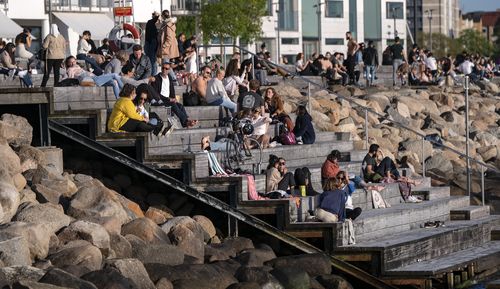
People enjoy the warm evening weather in Malmo, Sweden, Tuesday May 26, 2020. (Johan Nilsson/TT via AP)

Source by [author_name]

Former U.A.W. President Gary Jones Pleads Guilty

The former president of the United Auto Workers Union, Gary Jones, on Wednesday pleaded guilty to embezzling union funds, becoming the highest-ranking union official to admit wrongdoing in a wide-ranging federal investigation that has involved more than a dozen senior union officials and at least three executives from Fiat Chrysler.

Under a cooperation agreement reached with federal prosecutors, Mr. Jones, 63, acknowledged using more than $1 million in union funds for vacation rentals, golf outings, clothing, liquor and expensive meals. According to prosecutors, Mr. Jones spent some $60,000 just on cigars and smoking paraphernalia.

In hearing held via Zoom before the U.S. District Court for the Eastern District of Michigan, Mr. Jones admitted filing expense reports to the U.A.W. that concealed his use of union funds.

“While some of these expenditures related to union activities, others were personal in nature and did not relate to union business,” he said. “I recognize that my actions violated the law as well as my sworn obligation to my fellow union members.”

In a statement, the current U.A.W. president, Rory Gamble, said Mr. Jones and other union officials violated the trust of the union’s members. “Their actions were selfish, immoral, and against everything we stand for as a union,” he said.

As part of the plea agreement with prosecutors, Mr. Jones has agreed to cooperate in the investigation, and forfeit more than $140,000 in cash obtained illegally. He is scheduled to be sentenced Oct. 3. Federal guidelines call for a prison sentence of 47 to 56 months.

The U.S. attorney’s office in Detroit has agreed to seek a lesser sentence if Mr. Jones cooperates fully, said David Gardey, chief of the office’s public corruption unit.

The investigation has uncovered several loosely related schemes carried out by different union and corporate officials. In one case, a union vice president who once held a seat on the board of General Motors received kickbacks from the purchase of U.A.W. branded watches. In another, Fiat Chrysler’s top labor negotiator pleaded guilty to using union funds to buy a Ferrari and renovate his 6,800-square-foot home.

Details revealed in the investigation also led G.M. to file a lawsuit in November that accuses Fiat Chrysler of bribing union officials to get a leg up on G.M. in labor contracts. Fiat Chrysler has said the lawsuit is without merit.

The federal investigation into the U.A.W. began more than five years ago and is still active. Among those still under scrutiny is Mr. Jones’s predecessor, Dennis Williams. A plea agreement in February with a former aide to Mr. Jones indicated that a U.A.W. officer, whom court filings refer to as Official B, had urged using union money in ways that would benefit himself and other officials. Union officials have confirmed that Official B is Mr. Williams. The union also built a luxurious lakeside cabin for Mr. Williams at a U.A.W. resort about 250 miles north of Detroit.

A lawyer for Mr. Williams did not respond to requests for comment.

The U.S. attorney in Detroit, Matthew Schneider, has previously said that he could not rule out a federal takeover of the U.A.W. Another union that was the subject of a corruption investigation, the International Brotherhood of Teamsters, regained its independence in February after 30 years of federal oversight.

The investigation has dealt a big blow to the U.A.W. Mr. Gamble has apologized for its failings and has pledged to reform it. While the union no longer has the power and political influence it wielded decades ago, it remains one of the largest labor groups in the country and is a key player in the U.S. auto industry. The U.A.W. represents about 400,000 workers and is the biggest union at G.M., Ford Motor and Fiat Chrysler.

Mr. Jones pleaded guilty to two counts: for improperly using union funds and tax fraud for not reporting and paying taxes on that illicit income.

His plea agreement is the first time in decades that a union president of national stature has faced such serious criminal charges, said an expert on union corruption, David Witwer of Pennsylvania State University at Harrisburg. Professor Witwer pointed to the 1981 indictment of Roy L. Williams, president of the International Brotherhood of Teamsters at the time, on charges that he had conspired to bribe a senator in hopes of blocking or delaying a trucking deregulation measure.

Three years earlier, Joseph P. Tonelli, at the time the president of the United Paperworkers International Union and a top official with the A.F.L.-C.I.O., was charged along with other union officials for embezzling $360,000 from the union. Both leaders were later convicted.

The plea agreement marks a dramatic fall for Mr. Jones, who joined the U.A.W. as a welder and was elected president in 2018. Last year, he led workers through a 40-day strike against G.M. The strike yielded increased pay and benefits for temporary workers and those with less seniority, a key union goal. In exchange, the union accepted G.M.’s decision to close a plant in Lordstown, Ohio, a move that frustrated some U.A.W. members.

Mr. Jones took a leave of absence a week after that strike ended and resigned a few weeks later as the union moved to oust him.

Noam Scheiber contributed reporting.

Source link

US, Russian troops square off in northeast Syria as Kremlin eyes wider footprint

Jun 3, 2020

American and Russian troops reportedly squared off again in northeast Syria today after a Russian convoy ventured into territory controlled by the US-led international coalition against the Islamic State.

The Rojava Information Center reported that a Russian patrol came face-to-face with an American convoy on a road outside the city of Derik, in Syria’s far northeast corner near the Turkish and Iraqi borders. The standoff blocked local civilian traffic for hours, leading local police authorities to try to intervene, Syrian Kurdish journalist Hoshang Hasan reported.

Other reports said the US convoy prevented the Russians from moving into Derik, thus forcing them to turn back to Qamishli, where Russian forces shares a base with troops loyal to Syrian President Bashar al-Assad.

At least two helicopters, one Russian and one belonging to the US-led coalition, flew over the scene earlier today, the Rojava Information Center said. The US-led coalition did not return a request for comment by publication time.

Although Moscow hasn’t issued a statement on the incident, state-run news agency Sputnik alleged yesterday that a US patrol was turned back at a checkpoint near Tal Tamr, at the edge of an area controlled by the Syrian army.

The standoff is the second reported in the area in just two days; the North-Press Agency said villagers around Derik protested against a Russian patrol Tuesday while a US patrol arrived at the northern entrance to the city to await the Russians. Last week the UK-based Syrian Observatory for Human Rights said the Russian military is building a new military base in Qeser Dib, a village outside Derik, potentially posing a challenge to US influence in the area.

The latest standoffs follow reports that Russia is negotiating with Damascus to expand its military basing in Syria.

American and Russian soldiers have shared a series of tense encounters in northeast Syria, prompting US officials to accuse the Kremlin of testing Washington’s resolve. The two sides coordinate regularly about patrols and areas of operation, but American officials have said the Russians deliberately break those agreements.

Russian forces in support of Assad’s government moved into northeast Syria last year, following US President Donald Trump’s order to pull out all US troops from the country in October 2019 — a decision Trump later reversed. The Assad regime has vowed to retake the country’s northeast, which is controlled by an alliance of Kurdish-led militias backed by the US-led coalition against the Islamic State.

The rival forces are not enemies in the conflict, but their close proximity has led to violence before. In February, a local man was killed when American soldiers stopped at a Syrian regime checkpoint near Qamishli shot back after coming under fire. In early 2018, Russian and pro-regime forces crossed the Euphrates River in Deir ez-Zor and advanced toward a natural gas field occupied by American soldiers. The United States defended the position with air and artillery strikes, reportedly killing hundreds of pro-regime fighters, including Russian mercenaries.

The Trump administration says it remains in Syria’s northeast to keep the country’s oilfields out of the hands of the Islamic State. Defense Secretary Mark Esper has acknowledged the American presence also is aimed at keeping the oil out of the hands of Russia and the Assad regime, which are seeking revenue streams to help pay for the country’s costly nine-year civil war.

State Department officials are leading an international effort to diplomatically and economically isolate the Assad regime in hopes that Russia will force concessions from the Syrian government in line with reforms demanded by the United Nation Security Council.


Source link