Covid commission chief distances himself from leaked report on massive gas expansion

The former Fortescue Metals chief running Scott Morrison’s Covid-19 coordination commission, Nev Power, has distanced himself from a controversial leaked report recommending Australian taxpayers underwrite a massive expansion of the domestic gas industry.

Appearing on Thursday before a Senate committee, Power said the report, revealed by Guardian Australia late last month, should not be considered the view of the National Covid-19 Coordination Commission. He intimated the report was a draft from the manufacturing taskforce that had been superseded by later advice.

The leaked report from the taskforce headed by Andrew Liveris, a former Dow Chemical executive and current Saudi Aramco board member, recommended the government underwrite an increased national gas supply, that government agencies partner with companies to accelerate development of new fields such as the Northern Territory’s vast Beetaloo Basin, and states introduce subsidy schemes for gas-fired power plants.

It also proposed a role for government in helping develop gas pipelines between eastern states and the north, and potentially a $6bn trans-Australian pipeline between the east and west, by either taking an equity position, minority share or underwriting investments.

But Power told the Senate inquiry the commission was not recommending the government subsidise gas.

He did indicate, however, that the commission was looking at subsidised infrastructure. “The commission is not recommending any subsidised delivery of gas or any other energy system, but we have talked about the provision of infrastructure to reduce the costs of transportation and deliver lower costs,” the NCCC chairman said.

Power’s role leading the NCCC has raised concerns among a range of civil society groups about potential conflicts of interest because the commission has heavily promoted gas development as a way to boost economic growth after the coronavirus crisis. The escalating public controversy about commercial conflicts prompted Power to step aside from his position as deputy chairman of a gas company, Strike Energy.

The NCCC chairman told Thursday’s hearing he stood by his view “that we should be looking at competitive gas supply for its potential as a raw material for both existing and new manufacturing industry to preserve and create jobs”. He said he agreed with Alan Finkel, the chief scientist, “that there is a role for gas in firming up renewables as we transition to lower emissions”.

But Power acknowledged there was a “perceived conflict”, given his corporate interests.

He said he had not attended a board meeting of Strike Energy since he joined the commission and “I have not voted on any operational or strategic matters and will not while I am at the NCCC”. But in response to questions from the Labor senator Murray Watt, Power said he “probably” was still being paid a director’s fee.

Asked whether the development of a trans-continental pipeline would benefit Strike Energy, an oil and gas exploration company, Power replied “no, not necessarily”.

Power was asked to confirm whether he remained a shareholder in Fortescue, and whether the proposed pipeline would benefit that company. He confirmed he remained a shareholder in Fortescue, and he acknowledged that FMG had lobbied for a trans-continental gas pipeline when he was the chief executive. But Power said Fortescue would not benefit from the pipeline now, because it had not developed gas interests.

Asked whether he had recused himself from discussions among commissioners about developing gas as part of the Covid-19 recovery, Power replied: “No, I haven’t.”

In response to questions about his remuneration, Power confirmed he was being paid $267,345 to cover his expenses. He said the money was paid into a trust, and he said the trust paid tax in according with tax office rules. Officials from the Department of the Prime Minister and Cabinet said Power was not required to keep receipts to demonstrate expenses.

Power commutes to Canberra on a private aircraft. He told the hearing he piloted the plane, and had periodically given Perth-based government ministers a ride home to the west during the Covid crisis. He had sought and been granted an exemption for travel, because WA has closed the border. Power was also granted an exemption to fly to Queensland to manage his private agricultural interests.

Malcolm Thompson, the deputy chief executive officer of the NCCC, told the hearing commissioners had procedures to declare conflicts of interest. At a hearing of the Senate committee in mid-May, NCCC officials said Liveris was not required to make a disclosure because he was an adviser to the commission, not a commissioner.

But on Thursday, Thompson told the committee Liveris had now been required to make a conflict of interest declaration. He said declarations had also been sought from the chair and all the members of an industrial relations taskforce appended to the commission.

Thompson also indicated the budget for the NCCC had increased from $3m to $5.4m.

Source link

Manushi Chhillar roped in as the brand ambassador of international sportswear brand, Adidas : Bollywood News – Bollywood Hungama

Ethereal beauty Manushi Chhillar, who is set to debut opposite Akshay Kumar in the magnum opus Prithviraj, has been roped in by the world’s biggest fitness and sportswear brand Adidas as the female Brand Ambassador! Manushi, who is a former Miss World 2017 as she brought back the crown and glory to India after 17 years since Priyanka Chopra won the same, is the face to watch out for in Bollywood this year.

Trade and industry are already pinning her as the biggest debut by a newcomer and the hottest girl to come on the big screen! Manushi is a rank outsider to Bollywood and she has prepped intensively for a couple of years before it was decided that Yash Raj Films will launch her as the gorgeous princess Sanyogita in Prithviraj.

Manushi says, “I’m super excited to be a part of the Adidas family. It is an honour to be a part of a legacy brand like Adidas that is synonymous to anything related to sports and fitness. To be among some of the global titans of sports and entertainment industry, as the brand ambassador for India, is a huge moment for me that I will cherish forever.”

Manushi’s Adidas association is her first global brand endorsement deal and the fact that it has happened five months before even her debut is set to release, speaks volumes of how the industry and advertisers are perceiving her. Looks like a star is set to be born!

Also Read: Manushi Chhillar is excited to see how her career shapes up

BOLLYWOOD NEWS

Catch us for latest Bollywood News, Bollywood Movies update, Box office collection, New Movies Release & upcoming movies info only on Bollywood Hungama.

Loading…

Source link

Bhumi Pednekar urges nation to fight coronavirus through anti-spitting campaign : Bollywood News – Bollywood Hungama

0

Bhumi Pednekar is a socially conscious star who has come forward strongly to raise awareness on coronavirus during this lockdown. The versatile actor is now urging the entire nation to fight the COVID-19 pandemic through an anti-spitting campaign that aims to educate people.

Bhumi says, “We have to defeat Coronavirus and everyone has to join hands! Leave the habit of spitting. We have to save the country! Currently, our country is under the threat of Corona and the fatal disease spreads even by spitting!”

She adds, “The way we all have come together to get associated with the Toilet campaign and pledged to make the country clean! Similarly, let’s pledge to make the country Corona free, by avoiding to spit here and there.”

Bhumi has become the face of this campaign for an NGO called Sambandh Health Foundation that is doing exemplary work in the field of hygiene and sanitation across the country.

ALSO READ: Bhumi Pednekar seeks to bring Bollywood together to celebrate World Environment Day

BOLLYWOOD NEWS

Catch us for latest Bollywood News, Bollywood Movies update, Box office collection, New Movies Release & upcoming movies info only on Bollywood Hungama.

Loading…


Source link

German auto stimulus to boost Volkswagen’s electric push

0

BERLIN/FRANKFURT (Reuters) – Germany unveiled sweeping incentives for cheap electric cars and for hybrid vehicles, providing a boost to Volkswagen’s (VOWG_p.DE) electric push while staggered taxes for polluting combustion-engined cars will penalise sports utility vehicles.

FILE PHOTO: A Volkswagen E-Golf electric vehicle is displayed at the Canadian International Auto Show in Toronto, Ontario, Canada February 18, 2020. REUTERS/Chris Helgren/File Photo

Buyer incentives for passenger cars, including a lowering of value added tax to 16% from 19% were included as part of a 130 billion euro ($145.74 billion) stimulus package to speed up Germany’s recovery from the coronavirus.

In addition to a staggered tax on vehicles emitting large amounts of carbon dioxide (CO2), hitting sports utility vehicles, Germany included a 6,000 euro incentive for battery electric cars costing below 40,000 euros.

This brings consumer incentives for electric cars to 9,000 euros once a 3,000 euro manufacturer stipend is included, but the 40,000 price threshold means premium carmakers like BMW, Mercedes, and even Tesla are not eligible for the full amount.

Tesla’s Model 3 retails starting at 43,990 euros in Germany while prices for the Mercedes EQC start at 71,590 euros and Audi’s E-Tron prices start at around 69,900 euros.

The stimulus will benefit mainly cheaper electric cars like Kia’s e-Niro, which starts at 34,290 euros while VW’s new ID3 model will cost 29,990 euros when it launches this summer. Peugeot’s e-208 GT, costing 36,600 euros, will also benefit.

In Germany, electric cars made up 1.8% of new passenger car registrations last year, with diesel and petrol cars accounting for 32% and 59.2% percent respectively. Hybrid cars made up 6.6% of new registrations in 2019.

Germany said its motor vehicle tax will be reformed. From January 2021, cars with an emission of more than 95 grams of CO2 per kilometre will face a staggered tax.

The average vehicle emissions of a new car last year in Germany was around 150.9 grams of CO2 per kilometre.

($1 = 0.8920 euros)

Reporting by Markus Wacket in Berlin and Edward Taylor in Frankfurt; Editing by Michelle Martin

Source link

India’s cyclone response saves lives. Climate resilient infrastructure will save livelihoods

0

Nevertheless, disaster response teams launched a large-scale operation in Maharashtra and Gujarat states ahead of landfall to evacuate more than 100,000 people — including coronavirus patients — from the coast and move them to temporary shelters and other facilities.

Teams were dispatched to go door-to-door urging people living in low-lying areas to seek shelter and educating those who didn’t want to move.

Officials were concerned that storm surges would inundate the low-lying areas — where many people live in flimsy or makeshift housing — and that intense rainfall could lead to deadly flooding.

The response may have averted a bigger disaster as only one person is reported to have been killed in the storm, according to Anupam Srivastava, National Disaster Response Force (NDRF) commandant in Maharashtra.

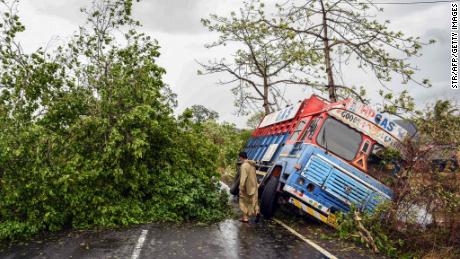
“Apart from tin roofs flying off and treefall there isn’t much damage in the state and we expect to clear the roads by tomorrow,” Srivastava said on Wednesday.

Images show disaster teams on the ground in Maharashtra and neighboring Gujarat clearing trees and other debris from roads after wind speeds of 130 kph (81 mph) hit the region.

A 40 km (24 mile) stretch from Raigad to Alibag towns received the brunt of the damage — where winds stripped buildings of tin roofs and a small number of trees fell on houses.

Cyclones increasing in intensity

Last month, a study released by researchers at the University of Wisconsin in Madison and the US National Oceanic and Atmospheric Administration (NOAA) found that hurricanes, typhoons, and tropical cyclones worldwide are becoming stronger and potentially more deadly as the globe warms due to the climate crisis.

Researchers found that the probability of storms reaching major hurricane status (category 3 or above on the Saffir-Simpson scale with winds in excess of 110 mph or higher), increased decade after decade.

Ahead of landfall, Cyclone Nisarga strengthened to the equivalent of just below a Category 1 Atlantic hurricane, or a severe cyclonic storm in the West Pacific.

It came two weeks after the strongest storm ever recorded in the Bay of Bengal hit India’s east coast and southwest Bangladesh. Cyclone Amphan weakened before making landfall but at one point was the equivalent of a Category 5 hurricane, with wind speeds of up to 270 kph (168 mph).
Amphan was just the second super cyclone to hit the Bay of Bengal since records began. At least 90 people were killed, hundreds of thousands were left homeless and the storm caused an estimated $13.2 billion dollars in damage in the state of West Bengal alone.

Though the damage was extensive, large-scale evacuation efforts appeared to have saved many lives. An ambitious evacuation mounted by India and Bangladesh saw an estimated 3 million people moved to safety across the two countries, according to regional authorities.

In May 2019, another powerful storm struck the eastern Indian state of Odisha as the equivalent of a Category 4 hurricane. More than 1 million people were evacuated before Cyclone Fani struck, killing 89 people.

To compare, during the last super cyclone to hit India in 1999 — which also impacted Odisha state — almost 10,000 people died.

It was a national tragedy that spurred an overhaul of India’s disaster response apparatus — the results of which have been visible in disasters since.

Lives saved, but damage remains extensive

To avoid a repeat of the 1999 tragedy, India created a new disaster response infrastructure.

In 2005, the country introduced new laws to set up what’s called the National Disaster Management Authority, a central agency charged with one thing: responding to and minimizing the impact of disasters.

A year later, in 2006, India established a National Disaster Response Force (NDRF), a specialized corps of highly trained men and women focused on disasters such as cyclones and earthquakes. It’s now comprised of almost 25,000 personnel.

Ahead of cyclones like Fani, Amphan and Nisarga, those specially trained responders worked with volunteers, local officials and NGOs, moving door-to-door along coastal villages asking people to evacuate. Residents who insisted on staying were trained by NDRF staff in the necessary precautions to take.

The Indian Meteorological Department also publishes hourly updates, alerts and forecasts, including on Twitter.

“We have enhanced our preparedness over the time. We deploy the military, paramilitary, armed forces, disaster management teams, disaster relief, to save lives,” Aparna Roy, associate fellow and co-lead on climate change and energy at the Centre for New Economic Diplomacy (CNED) said in May.

But while advanced planning and recovery response has improved, the scale of damage and loss to livelihoods and infrastructure from extreme weather events remains devastating and hugely costly.

“What we have not improved is the resilience of infrastructure that stands the climate impacts,” Roy said.

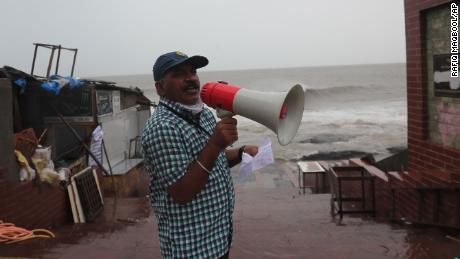
A municipal employee makes a warning announcement by the shore of the Arabian Sea in Mumbai, India, June 3.

“While we relocated a lot of people during Cyclone Fani and the number of casualties were very low, look at the amount of damage to infrastructure that the cyclone has done in the state of Orissa (Odisha) itself,” Roy continued.

Cyclone Fani devastated the livelihoods of about 28 million people, destroyed crops, left millions homeless and caused about $1.81 billion in damage, according to the International Federation of Red Cross and Red Crescent Societies.

“We lost huge amounts of our agriculture land, which is lain barren, useless. We lost a lot of our hospital buildings which stopped functioning during the pandemic because of the damage done from flooding after the cyclone struck. Roads, connectivity, transportation, everything was damaged,” Roy said.

After Cyclone Amphan in May, West Bengal Chief Minister Mamata Banerjee said the storm was a bigger disaster than the coronavirus pandemic, which has now infected more than 200,000 people in India.

“I have never seen such disaster,” Banerjee told reporters. “All areas have faced destruction. Nothing is left.”

Indian Prime Minister Narendra Modi announced that the central government would put forward a $132 million relief package to help those affected by Amphan.

But rebuilding after a devastating storm can take years, Roy said.

Successive cyclones have exposed how vulnerable India’s low-lying coastlines are to disasters and regular flooding continues to damage critical infrastructure.

That’s a risk that’s only going to increase as the climate crisis continues to affect weather patterns, ocean temperatures and sea levels.

India’s preparedness measures have saved lives but there are calls for the country to now focus on protecting the livelihoods of its poorest and most vulnerable who live in these low-lying areas, which suffer the worst damage from cyclones and flooding. It’s a move that would save billions of dollars from averted damage.

Roy said India must look to shoring up its low-lying coastlines, building climate-resilient infrastructure such as pipes, roads, and buildings that can withstand intense storms and other climate disasters.

“Now the imperative for India is not only to have infrastructure that is resilient, functional and that can bounce back after a disaster, but also to have infrastructure withstand and be operational during a crisis,” Roy said.

CNN’s Esha Mitra and Rishabh Madhavendra Pratap in New Delhi contributed to reporting.

Source link

Lockdown is having a terrible effect on our sleep, study shows

0

Lockdown is really not doing us any favours in the bedroom (Picture: Getty)

Brits have barely managed to get a wink of sleep during the lockdown, a study has found.

The poll of 2,254 aged 16 to 75 has revealed that two in five have slept fewer hours a night compared with before the isolation period.

And this has dramatically risen for those who are worried about facing financial difficulties – to 48%.

Half the population confessed that their sleeping pattern has changed for the worse.

Brits finding the pandemic stressful are nearly 50% more likely to get less sleep – than 29 per cent who are enjoying the isolation period.

Sixteen to 24 year olds are most likely to say they are getting less shut-eye – at 46%.

And shockingly, the study suggests it is more of a women’s issue – with 52 per cent having disrupted kip compared to 46 per cent of men.

Women are more affected than men when it comes to disrupted sleep (Credits: Getty Images/iStockphoto)

The group was interviewed by Kings College London and Ipsos MORI from May 20 to 22.

Two in five confessed to having more vivid dreams than usual – since the lockdown measures were introduced on March 23.

And women are 10 percentage points higher than men who experience this – at 43 per cent.

Half the country who find coronavirus stressful have experienced more of these.

Three in ten admitted to dozing longer and waking up less rested.

Gideon Skinner, Research Director at Ipsos MORI, said: ‘Lack of sleep itself may have further knock-on effects on people’s capacity to be resilient in the face of the pandemic, and there are signs that it may be having a disproportionate impact on particular groups: women, younger people, and those facing financial hardship.’

Dr Ivana Rosenzweig, of the Institute of Psychiatry, Psychology and Neuroscience, King’s College London, said: ‘The survey also finds that unrefreshing sleep of longer duration, so called hypersomnia, was reported at a high level, especially by younger people.

‘The associations between depressive symptoms and hypersomnia have been known for some time and again there is a complex two-way relationship between the two, which means they can create a self-perpetuating cycle.’

There was a notable drop in sleep quality from March 23, the day lockdown was announced (Picture: Getty)

Likewise, Simba’s sleep and mood tracking app found 50,000 Brits have experienced an ’emotional corona-coaster’ during the pandemic, as our sleep quality has gradually declined.

Wake-up moods were more erratic during the first two weeks of lockdown, and there was a ‘notable drop’ in sleep quality from March 23 – the day lockdown measures were announced.

One possible reason for this is rising alcohol intake, as data from the tracking app shows we’re drinking more alcohol.

‘When you drink alcohol, your body creates chemicals aldehydes and ketones,’ Cope explains.

‘Aldehydes block the brain’s ability to generate REM sleep.’


Source link

Anderson Cooper Dismantles Kayleigh McEnany’s ‘Like Churchill’ Defense Of Trump

White House press secretary Kayleigh McEnany on Wednesday likened President Donald Trump’s church photo-op stunt to the symbolic images of former British Prime Minister Winston Churchill inspecting the rubble of buildings bombed during World War II.

And CNN’s Anderson Cooper was not having the comparison.

Peaceful protesters were on Monday cleared from around St. John’s Episcopal Church, near the White House, by federal authorities using tear gas so Trump could pose with a Bible as a purported show of strength amid the protests that have erupted following the death of George Floyd.

McEnany claimed during a White House briefing Wednesday that Trump had “wanted to send a very powerful message that we will not be overcome by looting, by rioting, by burning, this is not what defines America” and that the stunt was “a very important moment” to show “resilience,” as other presidents and world leaders have previously done.

“Like Churchill, we saw him inspecting the bombing damage, it sent a powerful message of leadership to the British people,” she claimed. 

(Check out the full video of McEnany’s comments above).

Cooper acknowledged Trump and Churchill were both children of privilege who led their respective countries.

But, for the host of “Anderson Cooper 360,” there the likeness ended.

Cooper noted how Churchill saw combat, was a prisoner of war, wrote books and “one of the greatest orators in modern times.”

“Burned out church, a Bible in his hand, the country divided, and he couldn’t think of anything to say except to ask a bunch of other white guys to stand around him and just take a picture.”

Check out Cooper’s monologue here:


Source link

Long-distance Diplomacy: Was Trump’s 25-minute Chat with PM Modi a Counter-China Strategy Call?

0

File photos of China’s President Xi Jinping, India’s PM Narendra Modi and US President Donald Trump.

India’s Ministry of External Affairs had clarified last week that there are five agreements and protocols in place starting from 1993 between India and China to be able to maintain peace and tranquility on the border after the US President made an offer to mediate or arbitrate on the LAC issue.

  • CNN-News18 New Delhi
  • Last Updated: June 4, 2020, 12:47 AM IST

As the United States engages in a war of words with China over the Covid-19 pandemic and trade issues, and India counters an aggressive Chinese army at the Line of Actual Control (LAC), Prime Minister Narendra Modi and President Donald Trump spoke over the phone on Tuesday evening. A large part of the 25-minute conversation seems to have revolved around China.

The press statement from India said the two leaders exchanged views on the situation on the India-China border. Ministry of external affairs had clarified last week that there are five agreements and protocols in place starting from 1993 between India and China to be able to maintain peace and tranquility on the border after the US President made an offer to mediate or arbitrate on the LAC issue. With this India had pretty much ruled out mediation, yet the US administration has continued to express concern and this was also discussed in the call between the two top leaders.

Significantly, the ministry of external affairs had accused China of “hindering India’s normal patrolling patterns”, in a statement on May 21. In an interview to News18 on Wednesday, defence minister Rajnath Singh said a sizeable number of Chinese troops were at the border. The two countries are in the fourth week of the current stand-off and the situation is yet to be defused.

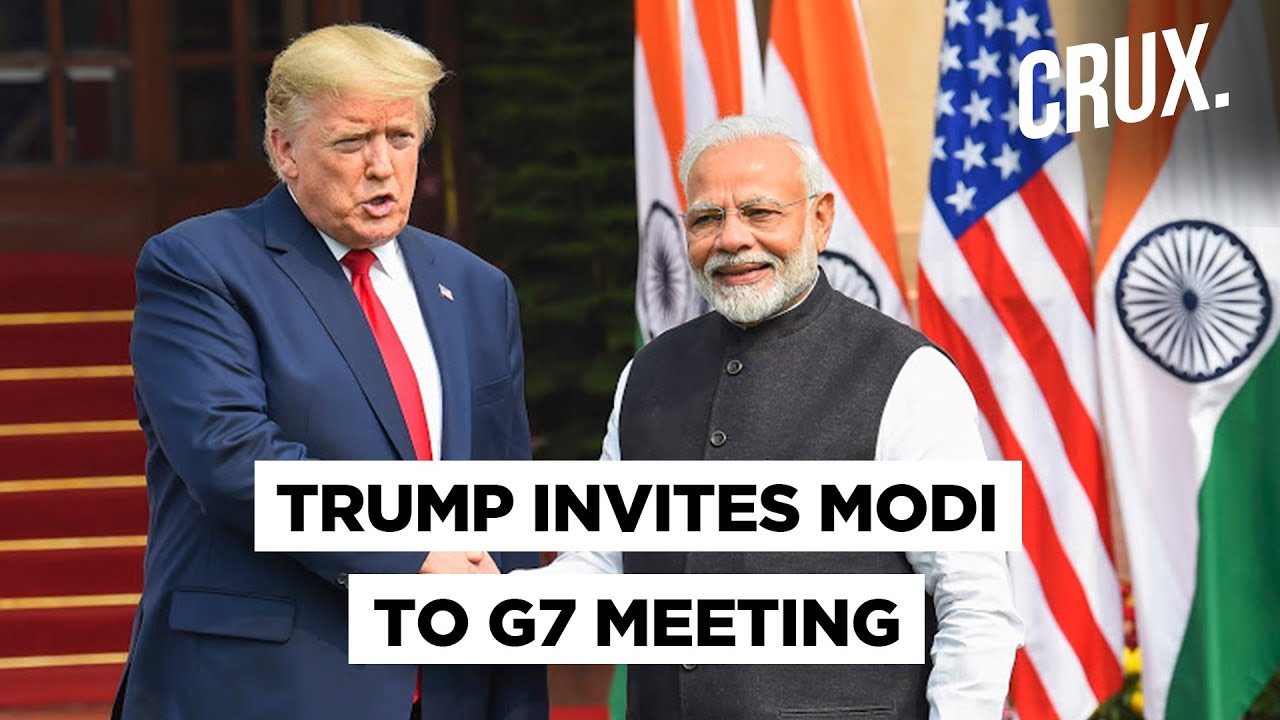
The Indian statement on the phone call also said that President Trump extended an invitation to PM Modi to attend the G7 summit in the US. Last week, Trump announced the postponement of the summit to September or later so as to include countries like India, Australia and South Korea, as currently it is a “very outdated group of countries”. There was no clarity on whether this was going to be a permanent expansion or their engagement would be as invitees.

It is important to note that India was invited to the G7 summit in Biarritz last year as well by France. But, interestingly, the Indian press statement said PM Modi “commended President Trump for his creative and far-sighted approach, acknowledging the fact that such an expanded forum would be in keeping with the emerging realities of the post –Covid world”. India has already indicated that it would like to offer an alternative to countries to shift businesses to India from China in a post-pandemic world. States like Punjab, Gujarat and UP have announced incentives to attract more businesses already.

But analysts believe that it may do India no good joining the “rich boys’ club”. Former diplomat and India’s one-time envoy to Canada Vishnu Prakash said that though the G7 has time and again invited countries, but India’s priorities are vastly different from this group of seven richest countries of the world. He said, “India’s GDP is certainly more than a couple of G7 countries but our per capita income is barely $ 2000. Our concerns are absolutely different. If it is long term then it will be a diluted kind of G20, so I don’t know how it adds value to global framework on economic governance or is it to needle China? I am not sure if it has been thought thorough. It appears like mere tokenism.”

But even before Trump’s call for expansion of the G7, there has been some buzz over such a possible development. The idea was first floated by the United Kingdom that had proposed G7+3 including India, Australia and South Korea. The immediate trigger for the idea was the concern over cyber security in view of the Huawei controversy and the need to reduce dependence on China for 5G technology.

The British high commission in India told News 18: “The security and resilience of our networks is of paramount importance. Following the US announcement of additional sanctions against Huawei, the NCSC (National Cyber Security Centre) is looking carefully at any impact they could have to the UK’s networks. The UK is collaborating with a number of international partners on a range of issues including cyber security.”

The UK has, however, categorically said that Russia will not be welcome. British Prime Minister Boris Johnson’s official spokesperson was quoted in the media saying that any push by President Trump to re-admit Russia would be vetoed by the UK. Canadian Prime Minister Justin Trudeau also spoke at a press conference to say, “Russia was excluded from the G7 after it invaded Crimea a number of years ago, and its continued disrespect and flouting of international rules and norms is why it remains outside of the G7 and it will continue to remain out.”

Russia, on its part, has rooted for China. Foreign ministry spokesperson Maria Zakharova said, “The idea of an expanded G7 summit is in general a step in the right direction, but it does not really mean a true representation. For instance, it is obvious that it is hardly possible to implement serious global initiatives without China.”

Others too have expressed scepticism. Alexey Pushkov, member of Russia’s Federation Council Committee on Constitutional Legislation and State Building, tweeted, “If Trump expects to try to create an anti-Chinese coalition at an expanded G7 meeting, and he wants, in his words, to discuss the future of China, he may be disappointed: few will support such an undertaking. Neither France nor Germany is inclined to this, not to mention Russia. Bad idea.” Pushkov was formerly a member of the committee on defence and security of The Council of Federation of the Federal Assembly of Russia.

While Australia has welcomed the idea and Prime Minister Scott Morrison has said he is keen on it, South Korea has shown hesitation. A source said while it’s a friend of the US but it can’t forget that China is its neighbour. As expected, Beijing has reacted sharply to the developments. The Chinese foreign ministry spokesperson Lijian Zhao said, “Any attempts to seek a small circle against China is doomed to fail and is unpopular.”

Apart from this, PM Modi and President Trump also engaged in taking stock of the Covid-19 pandemic. This at a time when the US has pulled out of the World Health Organization for failing to inform the world on time and showing a “dangerous bias” towards China. India is currently the chair of the Executive Board of the WHO for one year and would play a crucial role in seeking accountability.


https://pubstack.nw18.com/pubsync/fallback/api/videos/recommended?source=n18english&channels=5d95e6c378c2f2492e2148a2&categories=5d95e6d7340a9e4981b2e10a&query=Long-distance,Diplomacy:,Was,Trump’s,25-minute,Chat,with,PM,Modi,a,Counter-China,Strategy,Call?,coronavirus,pandemic,donald,trump,&publish_min=2020-06-02T04:17:05.000Z&publish_max=2020-06-04T04:17:05.000Z&sort_by=date-relevance&order_by=0&limit=2

Source link

HSBC, Standard Chartered publicly support China’s national security law for Hong Kong

0

HSBC (HSBC) and Standard Chartered (SCBFF) on Wednesday signaled support for the bill drafted by Beijing that will be imposed upon the city in coming months. The lenders joined other major businesses in Hong Kong voicing support for the law.

HSBC posted a photo on Chinese social media showing Asia Pacific CEO Peter Wong signing a petition supporting the law’s implementation. HSBC’s London press office confirmed the authenticity of the post.

“We respect and support laws and regulations that will enable Hong Kong to recover and rebuild the economy and, at the same time, maintain the principle of ‘One Country, Two Systems‘,” the post said, referring to the governing principle that gives the city political and legal freedoms unavailable in mainland China.

HSBC is headquartered in London, but was founded in Hong Kong and has a major business presence in China. The bank’s statement comes nearly a week after former Hong Kong chief executive Leung Chun-ying blasted HSBC for its silence.

Leung took to Facebook (FB) on Friday, calling on HSBC to publicly voice its support for the law. He said the bank should know “which side of the bread is buttered.”

Hong Kong and China are by far HSBC’s biggest moneymakers. Last year, the divisions pulled in enough money to wipe out losses in the United Kingdom and keep the company profitable.

HSBC’s Hong Kong listed shares rose 1.6% on Thursday, outperforming the city’s broader Hang Seng Index (HSI), which slumped 0.1%.

Fellow UK-based lender Standard Chartered also weighed in on Wednesday, saying in a statement that China’s proposed national security law for Hong Kong “can help maintain the long-term economic and social stability” of the city.

The proposed national security law would ban sedition, secession and subversion against Beijing in Hong Kong, which last year was roiled by anti-government protests calling for greater democracy and more autonomy from mainland China. Last week, China’s rubber-stamp parliament approved a proposal to impose the law on the city’s behalf, bypassing Hong Kong’s legislature via a rarely used constitutional backdoor.

The law also would enable Chinese national security organs to operate in the city “to fulfill relevant duties to safeguard national security in accordance with the law.”

Leaders in the United States and Britain have criticized the introduction of the law as undermining Hong Kong’s autonomy. The proposal also briefly rattled markets last month, sending the city’s benchmark Hang Seng Index (HSI) to its worst day since 2015. And US firms have expressed concern about what the law could mean for the city’s future as a global business hub, particularly after Washington responded by signaling an intent to end its special economic and trading relationship with Hong Kong.

Even so, HSBC and Standard Chartered are among a growing list of top businesses in Hong Kong that have come out in a show of support for the contentious legislation.

Jardine Matheson, one of Hong Kong’s oldest British trading houses, issued a full-page advertisement on Wednesday in pro-Beijing newspapers Ta Kung Pao and Wen Wei Po, which have strong ties to the Chinese government.

“Establishing the legal framework that upholds national security is very important. It ensures that Hong Kong continues to attract investment, enhance employment opportunities and protect people’s livelihood,” the company said.

Swire Pacific (SWRAY), one of Hong Kong’s richest family-owned business empires, and billionaire Li Ka-shing, founder of telecom and retail conglomerate CK Hutchison, have also voiced support for China’s move.

Swire said that “the enactment of national security legislation will be beneficial for the long-term future of Hong Kong as a world-leading business and financial centre.”

“It is within each and every nation’s [sovereign] right to address its national security concerns,” Li, of CK Hutchison, said in a statement issued last week.

“Meanwhile, [Hong Kong] has the mission-critical task to fortify its citizens’ faith and maintain international trust in the constitutional principle of ‘One Country, Two Systems,'” he added.

— Alexandra Lin contributed to this report.

Source link

German Man Identified As Suspect In Case Of Missing UK Girl Madeleine McCann

0

LONDON (AP) — British police said Wednesday that a German man has been identified as a suspect in the case of a 3-year-old British girl who disappeared 13 years ago while on holiday in Portugal.

The Metropolitan Police did not name the man, but said he is 43 and was in and around the Praia da Luz resort area on the Algarve coast at the time Madeleine McCann disappeared on May 3, 2007.

The long-running case of McCann, who vanished shortly before her fourth birthday, has intrigued Britain for years. Her parents say Madeleine went missing after they had left her and her twin siblings asleep in their holiday complex while they had dinner with friends at a nearby restaurant.

An investigation by British police has identified more than 600 people as being potentially significant. Officers were tipped off about the German suspect following a 2017 appeal, 10 years after the girl went missing.

Police said the suspect, described as white with short, blond hair and a slim build, was linked to a camper van seen in the Algarve in 2007 and was believed to be in the resort area in the days before and after May 3 that year.

Christian Hoppe of Germany’s Federal Criminal Police Office told German public broadcaster ZDF that the suspect, a German citizen, is currently imprisoned in Germany for a sexual crime. At the time of Madeleine’s disappearance he was 30 years old. He spent numerous years in Portugal and has two previous convictions for “sexual contact with girls.”

Hoppe said German police aren’t ruling out a sexual motive. They said whoever abducted the girl may have broken into the holiday apartment and then spontaneously committed the kidnapping.

The suspect is being investigated on suspicion of murder by prosecutors in the German city of Braunschweig, where he was last registered before moving abroad.

Police from Britain, Germany and Portugal launched a new joint appeal for information in the case Wednesday. They asked to come forward anyone who had seen two vehicles linked to the suspect — the Volkswagen camper van and a Jaguar. They also sought information on two Portuguese phone numbers, including one believed to have been used by the suspect on the day of Madeleine’s disappearance.

The new appeal was issued because “the information that we have gained in the course of our investigation increasingly leads us to the conviction that the suspect might have committed the crime,” Hoppe said.

Hoppe added that German police aren’t ruling out additional victims and also are appealing for information from anyone who believes they may have been sexually attacked by the suspect between 1995 and 2007.


Source link