Zuckerberg accused of setting dangerous precedent

0

Image copyright
Getty Images

Mark Zuckerberg is setting a “dangerous precedent” by allowing a post by Donald Trump to remain on Facebook, a group of civil rights leaders has warned.

Their statement followed a video call with the social media giant’s founder.

The US president’s post, about the widespread protests following the death of George Floyd, was hidden by Twitter last week for “glorifying violence”.

Facebook staff also voiced their anger at their employer, with some staging a “virtual walkout”.

In the post, the president wrote he would “send in the National Guard”, and warned that “when the looting starts, the shooting starts”.

Mr Trump shared the same message on Twitter, where it was hidden behind a warning label, prompting an escalating row between Twitter and the White House.

Mr Zuckerberg had previously defended his decision to leave the same post up on Facebook, saying he disagreed with Mr Trump’s words but that people “should be able to see this for themselves”.

After meeting Mr Zuckerberg, three civil rights leaders responded that he was wrong.

“We are disappointed and stunned by Mark’s incomprehensible explanations for allowing the Trump posts to remain up,” they said in a joint statement.

“He did not demonstrate understanding of historic or modern-day voter suppression and he refuses to acknowledge how Facebook is facilitating Trump’s call for violence against protesters.

“Mark is setting a very dangerous precedent for other voices who would say similar harmful things on Facebook.”

Mr Zuckerberg defended his judgement to Facebook staff in a virtual question-and-answer session on Tuesday, according to the New York Times.

It reported the chief executive had said he had made a “tough decision” but the social network’s free speech principles meant that “the right action” was to leave President Trump’s post up.

The newspaper added, however, that some employees had claimed he was acting out of fear of what Republicans might do if Facebook acted otherwise.

‘Important moment’

The joint statement, released on Monday night, was signed by Vanita Gupta, president of the Leadership Conference on Civil and Human Rights; Sherrilyn Ifill, director-counsel of the NAACP Legal Defense and Educational Fund; and Rashad Robinson, president of Color of Change. It has been published online by Axios.

A Facebook spokesman said: “We’re grateful that leaders in the civil rights community took the time to share candid, honest feedback with Mark and Sheryl [Sandberg, Facebook’s COO].

“It is an important moment to listen, and we look forward to continuing these conversations.”

Online therapy firm TalkSpace has pulled out of talks about a partnership deal with the social media giant over its decision to leave the post up.

“We will not support a platform that incites violence, racism, and lies,” chief executive Oren Frank tweeted.

The deal would have been worth “hundreds of thousands of dollars” to TalkSpace, Mr Frank told CNBC.

Former Facebook executive Barry Schnitt wrote an open letter to current staff saying he believed he had been wrong to defend the firm’s approach to freedom of speech in the past.

“Promoting free speech shouldn’t be used as a get-out-of-tough-choices card,” said Mr Schnitt, who was director of corporate communications and public policy for four years.

In leaked audio, Mr Zuckerberg said his initial reaction to the Trump post was “disgust”, reports The Verge.

“This is not how I think we want our leaders to show up during this time,” he is heard to say.

Source link

Big Oil Wanted Changes To Worker Safety Rule. Emails Show Trump Official ‘Agreed.’

0

In December 2017, the Trump administration rolled out a proposal to gut a key offshore drilling safety regulation, adopted in the wake of the Deepwater Horizon oil spill, that the Trump administration had cited to justify its plans to open nearly all U.S. waters to oil and gas development.

Newly released emails show that months earlier, the American Petroleum Institute and six other oil industry groups told top officials at the Department of the Interior that they “did not see the need” for the Obama-era Well Control Rule to include oversight from the department’s main offshore energy enforcement arm, and asked regulators to eliminate whole sections of the regulation, which the Obama administration had finalized in 2016 to prevent the next Deepwater Horizon disaster.

In response to the request, Interior Associate Deputy Secretary James Cason thanked the industry groups for their feedback. And Daniel Jorjani ― a Trump appointee later promoted to serve as the agency’s top lawyer ― emailed back just one word: “Agreed.”

The oil industry’s role in shaping the Trump administration’s rulemaking was never in doubt. In its proposed revision, Interior’s Bureau of Safety and Environmental Enforcement wrote that “oil and natural gas operators raised concerns about certain regulatory provisions that impose undue burdens on their industry” and estimated that the rollback would save industry just shy of $1 billion over a 10-year period.

But the May 17, 2017 email, made public through a Freedom of Information Act request, shows for the first time the extent of industry’s influence over the fine-print details of regulations that are supposed to police it. 

“We appreciate the actions of this Administration to eliminate unnecessary burden and to restore certainty and predictability into the offshore permitting and regulatory regimes,” Holly Hopkins, a senior policy adviser at API, wrote in the email. 

Hopkins works for the nation’s most powerful oil and gas lobby, but also represented six other large industry groups in her letter: the Independent Association of Drilling Contractors, the Independent Petroleum Association of America, the National Ocean Industries Association, the Offshore Operators Committee, the Petroleum Equipment & Services Association, and the U.S. Oil and Gas Association. The National Ocean Industries Association, or NOIA, is a former client of Interior Secretary David Bernhardt, a longtime former lobbyist for oil, mining and agricultural interests.


Daniel Jorjani, a Trump appointee, became the the solicitor of the Interior Department in late 2019.

“Safety is a core value for the oil and natural gas industry,” Hopkins wrote. “We are committed to safe operations and support effective regulations in the area of blowout preventer systems and well control.”

But experts say the changes to the Obama-era rule did the exact opposite, leaving the country’s offshore oil rigs as vulnerable to disaster as they were in April 2010, when BP’s Deepwater Horizon oil rig exploded while the fossil fuel giant was drilling an exploratory well off the coast of Louisiana, releasing more than 200 million gallons of crude into the Gulf of Mexico. 

“What will come of this is we’ll have less safety on offshore oil rigs, which we know could end up putting workers’ lives at risk,” said Jacob Carter, a scientist at the Union of Concerned Scientists’ Center for Science and Democracy. “This is a really good case of the administration ignoring science on behalf of industry.” 

API spokesperson Reid Porter said the suggestions in Hopkins’ email were consistent with the trade groups’ publicly-filed comments.

“This was a process in response to Secretarial Order 3350 that several organizations and experts in the field participated in,” he wrote in an email. “The updated rule reinforced industry actions and a regulatory framework that support safe operations.”

A spokesperson for the Interior Department said the agency carefully reviewed more than 118,000 comments submitted during a public comment period and that the revised rule “incorporated commonsense changes that were based on the best available science, best practices and technological innovations.”

This is a really good case of the administration ignoring science on behalf of industry.
Jacob Carter, a scientist at the Center for Science and Democracy

The Well Control Rule required additional inspection and maintenance of blowout preventers, devices designed to automatically seal a well and stop an uncontrolled release of oil and gas. As HuffPost previously reported, Trump’s Interior Department pointed to the rule and other Obama-era reforms in its controversial plan to open vast areas of the Arctic, Atlantic and Pacific oceans to oil production, writing that the agency has made “substantial reforms to improve the safety and reduce the possible adverse environmental impacts.”

It then turned around and rolled back those very safeguards.

The Trump administration’s overhaul of the Well Control Rule, finalized in May 2019, includes many of the industry groups’ suggested changes, including loosening a provision for real-time monitoring of wells and lifting a requirement that third-party rig inspectors be certified by the Bureau of Safety and Environmental Enforcement. 

“Rulemaking on [real-time monitoring] is premature, we suggest deleting those requirements,” Hopkins wrote in her 2017 email. “Certification,” she added, “can be done by third party organizations; they do not need to be approved by BSEE.”

API’s point person on this particular issue was Katharine MacGregor, then Interior’s acting assistant secretary for lands and minerals management, who has since taken over as the agency’s deputy secretary. During her tenure at the Interior Department, MacGregor has had at least 62 meetings with industry groups pushing for increased offshore drilling access, including API and NOIA, according to a 2019 analysis by industry watchdog group Documented. On its website, NOIA writes that MacGregor “orchestrated myriad congressional hearings and drafted key legislation aimed at expanding access both onshore and offshore” while working as a Republican staffer on the House Natural Resources Committee’s Subcommittee on Energy and Mineral Resources.

Elizabeth Johnson Klein, the Interior Department’s associate deputy secretary under former President Barack Obama, said the oil and gas sector’s criticisms of the Well Control Rule are nothing new and were well-known to Obama’s Interior Department. 

“We just opted to move forward on the side of responsible and safe development, understanding in particular the lessons learned from the Deepwater Horizon explosion, and the numerous recommendations made in the wake of that tragedy to improve oversight of offshore oil and gas activities,” Klein said in an email. 

Read the 2017 emails below.


Source link

People Can’t Stop Watching Videos of Police and Protesters. That’s the Idea.

An officer shoving a protester to the ground. Two New York Police Department cars ramming demonstrators. Police using batons, bicycles and car doors as weapons.

These are becoming defining images of the protests against police brutality of black people that have swept the nation, sparked by the killing of George Floyd in Minneapolis.

Countless videos of these moments have been shared on social media. Among the most-seen of them: a compilation video created on Saturday.

Jordan Uhl, a political consultant and activist in Washington, D.C., wanted to make sure as many people saw these videos as possible. Encouraged by a friend, he edited together 14 clips, including one from a reporter at The New York Times of an officer accelerating and opening a car door that hit protesters. The result is a two-minute, 13-second supercut that he called “This Is a Police State.”

As of Monday night, the video had amassed more than 45 million views from Mr. Uhl’s tweet alone. After he posted a Dropbox link so that anyone could download and share the video, it garnered tens of millions more views. (For context, the video that the birder Christian Cooper recorded of Amy Cooper in Central Park has been viewed 44 million times on Twitter. The viral disinformation video “Plandemic,” which traveled across YouTube, Facebook, Twitter and Instagram last month, was viewed more than eight million times after just over a week online.)

“So many people were posting it to IGTV and Stories and tagging me,” Mr. Uhl, 32, said. “I can’t even keep track of how many people are sharing it.”

He said his intention was to signal-boost the experiences of the protesters and said he made limited intervention in the footage. “I trimmed some of the videos down for time,” Mr. Uhl said, adding that he “didn’t even color correct.” He did, however, add the Twitter handles of the original posters, for credit.

He views the video, focusing solely on what appear to be police misdeeds, as a corrective to what he believes to be an emphasis on covering looting and property damage by media. “I wanted to push back and show how the main story should be that, in response to a mass mobilization against police brutality, the police responded with more brutality,” Mr. Uhl said.

“People are deeply unwilling to acknowledge the abuse from police,” he continued, noting that “the passive language used for police versus the active language used for protesters demonstrate our society’s unwillingness to confront systemic injustice imposed by police.”

Those whose footage appears in the compilation video said they were glad to see their individual clips put into broader context.

Alison Sul, a 21-year-old protester in Texas, said that her video had already been viewed 2.9 million times, but Mr. Uhl’s video provided a new audience.

“The more people who see this stuff, the more accountable the police are going to have to be,” said Nate Igor Smith, 40, a photographer in Brooklyn.

“It doesn’t seem to matter which city you’re in, you’re seeing a lot of the same things happening. I think having one video where you can see things from so many different cities is powerful,” said Arlen Parsa, 33, a documentary filmmaker in Chicago. “It tells a larger story than just what’s happening in one city.”

Mutale Nkonde, a fellow at the Berkman Klein Center for Internet & Society at Harvard University, said that Mr. Uhl’s video “really reinforces that black protests, white protests and all social justice protests generally are not violent in nature. It moves us away from the ‘there are bad people on both sides’ or ‘there are good people on both sides’ argument and really highlights law enforcement’s aggressive attitude toward black people displaying their rights.”

“When there’s one clip you can turn away, when there’s two you start to get a better picture, when you see so many examples it’s impossible to ignore them as anomalies,” said Guthrie Graves-Fitzsimmons, 30, an author in Kentucky who is credited in the video.

In the responses to Mr. Uhl’s initial tweet, a stream of people shared even more clips of police using force against protesters, bystanders and even children. He received so much footage that, on Monday, he posted a second supercut. So far it has garnered more than 825,000 views.

“Other people have said this before me,” Mr. Uhl said, “but none of this is new. It’s just finally being recorded.”


Source link

Police raid scrapyard arresting two men for railway cable theft

Two suspects were arrested after a police raid on a scrapyard found R10 million worth of aluminium suspected to have been stolen from a railyard in North West.

Police arrested a man who had the aluminium cables on the back of his bakkie as well as the owner of the scrapyard.

Police raid scrapyard

Prasa technicians identified the cables as being the stolen property of the passenger rail service prior to the men being taken into custody.

The owner of the scrapyard was charged with failure to keep a proper register of second-hand goods

South African Police Services spokesperson Brigadier Sabata Mokgwabone said: “In a bid to combat the trade in stolen goods, police in Mmakau arrested on Monday, 1 June 2020, two suspects aged 31 and 61 for possession of suspected stolen property, tampering with essential infrastructure and contravention of Section 21 (failure to keep a register) of the Second-Hand Goods Act, 2009 (Act No. 6 of 2009).

“The pair were arrested after the police acted swiftly on information received from the Passenger Rail Agency of South Africa (PRASA) Security Services about suspected illegal activity taking place at a scrap metal business in Mmakau village. 

“On arrival at the scrapyard, aluminium cables were found loaded on a bakkie. 

“The operation also led to discovery of more aluminium cables inside a building.  

“Consequently, the police arrested the driver of the bakkie and the owner of the scrapyard, after identification of the cables by PRASA technicians. The total value of the cables is estimated at R10 million.”

The suspects are expected to appear in the Brits Magistrates’ Court on Wednesday 3 June.

The Provincial Commissioner of North West, Lieutenant General Sello Kwena commended the members and security officers for a sterling job and cooperation which resulted in the success.  

Police raid scrapyard finding cables suspected to have been stolen from Prasa. Photo: Supplied.

SAPS tasked with defending infrastructure

Lieutenant General Kwena cautioned that the SAPS members will leave no stone unturned in ensuring that those who tamper with essential infrastructure are dealt with harshly. 

The General also made an appeal to members of the community to be the eyes and ears of the police and to report at their nearest police stations those who tamper with and steal essential infrastructure such as copper and aluminium cables.

Transport Minister Fikile Mbalula announced at the end of May that Prasa would not resume services at level 3 of lockdown, citing extensive vandalism as one of the reasons the ailing state-owned rail company will not resume operations until at least July.

DMCA.com Protection Status


Source link

Minnesota Files Complaint Against Minneapolis Police In George Floyd’s Death

MINNEAPOLIS (AP) — The state of Minnesota filed a human rights complaint Tuesday against the Minneapolis Police Department in the death of George Floyd by a Minneapolis police officer who pressed his knee into Floyd’s neck for several minutes, even after he stopped moving.

Gov. Tim Walz and the Minnesota Department of Human Rights announced the filing at a news conference Tuesday afternoon.

Widely seen bystander video showing Floyd’s death has sparked protests around the world. The officer, Derek Chauvin, has been fired and charged with third-degree murder and second-degree manslaughter. Three other officers involved were fired but have not been charged.

The department enforces the state’s human rights act, particularly as it applies to discrimination in employment, housing, education, public accommodations and public services. Mediation is one of its first-choice tools, but the cases it files can lead to fuller investigations and sometimes end up in litigation.

The Minneapolis Police Department has faced decades of allegations brutality and other discrimination against African Americans and other minorities, even within the department itself. Critics say its culture resists change, despite the elevation of Medaria Arradondo as its first black police chief in 2017.

Arradondo himself was among five black officers who sued the police department in 2007 over alleged discrimination in promotions, pay, and discipline. They said in their lawsuit that the department had a history of tolerating racism and discrimination. The city eventually settled the lawsuit for $740,000.


Source by [author_name]

Protests over George Floyd’s death: Biden says America is ‘in a battle for its soul’

Joe Biden issued a blistering condemnation of President Donald Trump at a speech in Philadelphia on Tuesday and pledged to offer a break from the “selfishness and fear” that he said have marked Trump’s tenure in office and response to protests against racism and police brutality.

“I won’t traffic in fear and division. I won’t fan the flames of hate. I’ll seek to heal the racial wounds that have long plagued our country, not use them for political gain. I’ll do my job and I’ll take responsibility – I won’t blame others,” Biden said.

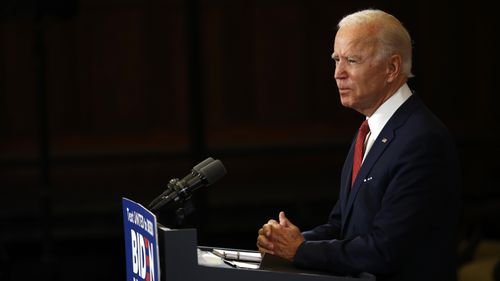
Democratic presidential candidate, former Vice President Joe Biden speaks in Philadelphia, June 2, 2020. (Source: Associated Press)

The former vice president reserved his harshest words for Trump’s trip across Lafayette Square on Monday evening, when police used tear gas and rubber bullets to disperse a peaceful crowd. Trump visited St John’s Church, where he held up a Bible and posed for photographs with staffers and Cabinet members, but did not offer a prayer.

“The president held up the Bible at St John’s Church yesterday. I just wish he opened it every once in a while instead of just brandishing it,” Biden said. “If he opened it, he could have learned something.”

He said lawmakers should outlaw police choke holds, stop transferring “weapons of war” to police departments and increase oversight and accountability of police departments.

“It’s time to pass legislation that will give true meaning to our constitutional promise of legal protection under the law,” Biden said.

“The moment has come for our nation to deal with systemic racism. To deal with the growing economic inequality in our nation. And to deal with the denial of the promise of this nation – to so many.

“I’ve said from the outset of this election that we are in a battle for the soul of this nation. Who we are. What we believe. And maybe most important – who we want to be.”

Source by [author_name]

Turkey ignores its own record, denouncing press clampdown in US protests

Jun 2, 2020

As violent protests triggered by the murder of an unarmed African American man, George Floyd, by a white police officer on May 25 continue across the United States, American and foreign journalists are being targeted by police. Members of Turkey’s state-run TRTWorld news channel were among them. Sally Ayhan, the Washington correspondent of the outlet, was struck by rubber bullets while covering events there. Fellow correspondent Lionel Donovan was similarly injured in his groin while reporting on demonstrations in Minneapolis where Floyd was slain. 

The news prompted an angry response from one of Turkish President Recep Tayyip Erdogan’s top aides. Fahrettin Altun, head of Erdogan’s communications team, aired his ire via Twitter, saying he condemned the attack against Donovan “in the strongest possible terms.” Altun added that “press freedom is the backbone of democracy. I will raise this issue with the relevant US officials without delay.” 

“Thank you for your support,” responded Ayhan, though she didn’t feature in Altun’s tweet.

Many others greeted his opprobrium with mirth. “If anyone asks you ‘How many journalists do you have in jails now in Turkey?’ Or ‘How many newspapers and television stations did you close in the last four years?’ Do you have an answer?” tweeted a certain Mehmet Kurt. 

The Parliamentary Assembly of the Council of Europe said in a May 22 report that there were 95 journalists imprisoned in Turkey, more than in any country in the world, a distinction Turkey has preserved for several years running. On May 8, for example, an Istanbul court charged seven journalists with violating the country’s intelligence laws for reporting on the death of a Turkish National Intelligence Agency asset in Libya, where Ankara has intervened militarily on the side of the internationally recognized Government of National Accord. 

Six of the journalists are in prison and face up to 17 years if convicted of revealing state secrets. A seventh has eluded jail because he is in Germany. A trial date has been set for June 24.

News of the operative’s death was publicized by a member of the Turkish parliament in late February after two of the journalists disclosed the dead officer’s name on Twitter.

Another newsman, Fatih Portakal, was charged on April 30 with breaching Turkey’s banking laws when he suggested in a tweet that the financially stretched government was dipping into savings at private banks for relief. The popular news anchor for Fox News’ local franchise Fox TV faces up to three years should his sentence be upheld.

What was especially egregious for many about Altun’s finger wagging is that he is at the center of the government’s most recent bout of muzzling of the secular opposition’s flagship title, Cumhuriyet. Terror investigations were launched against three Cumhuriyet journalists in April for a story in which they investigated charges that Altun had illegally erected a gazebo on a plot of land adjacent to his house in Kuzguncuk, a trendy village on the Asian side of the Bosporus. The gazebo was demolished by the Istanbul municipality, which was wrested from Erdogan’s Justice and Development Party in a June 30 rerun last year.

The journalists were accused of exposing Altun to terrorist attacks by publishing the whereabouts of his house. 

Cumhuriyet was slapped with a fine, depriving the paper of publishing government tender notices for three months. The advertisements are a big source of income for the media. Cumhuriyet has also been ordered to publish a retraction on its front page for three days running, with the first appearing yesterday.

Berating other countries for the same abuses Turkey showers on its own citizens is by now standard for Erdogan and his vast propaganda machine.

The protests in the United States provide fresh opportunities “to both condemn America and, in doing so, implicitly justify Turkey’s own police brutality and crackdown on the press,” said Nicholas Danforth, a fellow at the Wilson Center’s Kennan Institute. Danforth observed in emailed comments to Al-Monitor, “At the same time some pro-government voices are presenting the protests as a backlash to America’s longstanding racism, others are suggesting they are actually a FETO/PKK-backed deep state conspiracy to unseat Trump.”

FETO refers to the so-called Fethullah Gulen Terror Organization that is allegedly led by Sunni cleric Fethullah Gulen. The Pennsylvania-based Turkish preacher is accused of masterminding the failed 2016 coup to overthrow his former ally, Erdogan. The PKK (Kurdistan Workers Party) is the Kurdish militia that is fighting the Turkish army for self-rule in the predominantly Kurdish southeast. Erdogan and his acolytes support Trump because of his perceived affinity for the Turkish president, which saw US troops withdraw from northern Syria in October, allowing Turkish troops to move in against the PKK’s Syrian franchise that is backed by the Pentagon.

For them, the protests in the United States present “a chance for trolling, whataboutism and outreach to the White House, all rolled into one,” Danforth concluded.


Source link

Donors pledge $1.35bn in humanitarian aid to war-ravaged Yemen

International donors have pledged $1.35bn in humanitarian aid to war-torn Yemen, well below a $2.41bn fundraising target, according to the United Nations.

The videoconference on Tuesday was organised by the UN and Saudi Arabia, a major player in Yemen’s long-running conflict since it first launched a bombing campaign in 2015 to try to push back Houthi rebels who seized the northern half of the country.

More:

It came as some relief groups say they have been forced to stop their work even as the coronavirus pandemic rips through the country.

“A total of $1.35bn in pledges has been announced from a wide range of donors to the humanitarian response in Yemen including to fight COVID-19,” a UN spokeswoman told reporters.

Mark Lowcock, UN emergency relief coordinator, said the global body would continue its fundraising efforts.

“This is not the end,” he added, calling on donors to pay the funds immediately, since “pledges on their own achieve nothing”.

‘Attempt to [gloss over] crimes’

Saudi Arabia pledged $500m in aid to support a UN Humanitarian Response Plan for Yemen.

The United Kingdom, a leading arms supplier to Saudi Arabia, stepped in with a new aid package for Yemen worth $200m. The United States, another weapons provider to the kingdom, said it would offer $225mi, while Germany announced $139.8m in assistance to Yemen.

Abdullah bin Abdulaziz al-Rabeeah, the supervisor of Saudi Arabia’s King Salman Humanitarian Aid and Relief Centre, said he was pleased by the level of attendance, despite the lower than expected pledges.

Al-Rabeeah said the amount raised is a “good response” taking into consideration the coronavirus pandemic and the economic crisis resulting from it.

Yet, critics question the kingdom’s high-profile role in rallying humanitarian support even as it continues to wage a war – as do the Houthis – that has created the world’s worst humanitarian crisis.

The air attacks and fighting on the ground have killed more than 100,000 people and displaced millions of others, pushing the impoverished country to the verge of famine and gutting its healthcare facilities.

A spokesman for the Houthis dismissed the Saudi-led conference as a “silly attempt to [gloss over] their crimes”, according to rebel-run Masirah television.

The Saudi-led military coalition fighting the Houthis killed or wounded 729 children during 2018, accounting for nearly half the total child casualties, United Nations Secretary-General Antonio Guterres said in a report to the UN Security Council (UNSC) in July 2019 that blacklisted the alliance for a third year. The UN report said the Houthis killed and wounded 398 children and Yemeni government forces were responsible for 58 child casualties.

Maysaa Shuja al-Deen, a Yemeni researcher and a non-resident fellow at the Sanaa Center for Strategic Studies, said the kingdom is trying to repair its international image by changing the conversation.

Saudi Arabia “has always tried to change the narrative of the war and present itself as a backer of the legitimate government, not part of the conflict”, she said.

Addressing the conference, Guterres said aid agencies “are in a race against time” in Yemen, warning that “unless we secure significant funding, more than 30 out of 41 major United Nations programmes … will close in the next few weeks”.

“Today’s pledges will help our United Nations humanitarian agencies and their partners on the ground to continue providing a lifeline to millions of Yemenis,” he added.

Yemen has so far confirmed a total of 354 infections and 84 deaths from the coronavirus – but aid groups believe the actual numbers are much higher.

According to data compiled by the International Rescue Committee, Yemen has one of the world’s lowest testing rates, even compared with other conflict-hit countries, at just 31 tests per one million citizens.

Guterres said reports indicate that mortality rates from COVID-19 in Aden, the temporary seat of Yemen’s internationally-recognised government, are among the highest in the world.

“That is just one sign of what lies ahead, if we do not act now,” he added. “Tackling COVID-19 on top of the existing humanitarian emergency requires urgent action. The pandemic is making it even more difficult and dangerous for humanitarian workers to reach Yemenis with life-saving aid,” he said.

Yemen has been in the grip of a devastating power struggle since the Houthi rebels took over the capital, Sanaa, and other cities late in 2014.

The Houthis’s advance on the Saudi-backed Yemeni government seat of Aden prompted Saudi Arabia to form a military coalition in early 2015 and start its ferocious air campaign against the rebels.

Source link

Joe Biden Laces Into Trump for Fanning ‘Flames of Hate’

The country, Mr. Biden said, was “crying out for leadership.”

Mr. Biden’s remarks, which were by turns optimistic about America’s potential and somber about the depth of its challenges, came as his team moved urgently to press a more aggressive case against Mr. Trump at an extraordinarily high-stakes moment for the country, marked by a pandemic, devastating unemployment numbers, racial strife and violent clashes between police and protesters during the demonstrations, which in many cities have led to looting.

Heightening the tensions, in the last several days alone, Mr. Trump has called protesters “terrorists,” spent time in an underground bunker and visited a church for photographs with a Bible, while peaceful protesters were dispersed with tear gas to clear his path. His campaign is increasingly seeking to paint Mr. Biden as sympathetic to those “causing mayhem,” as Mr. Trump’s team put it on Tuesday.

To chart his own vision for the country, Mr. Biden left his home in Wilmington, Del., to travel to Philadelphia. It is the city where the nation’s founding documents were crafted, where President Barack Obama gave his famous speech on race in 2008, and where Mr. Biden held his first large-scale rally of the 2020 campaign, promising to heal the soul of the country and calling for national unity. It is now also a city rocked by riots and growing racial tensions.

In his remarks, which lasted around 20 minutes, Mr. Biden both rebuked his opponent, urging him to consult the Constitution and the Bible instead of eviscerating the “guardrails” of democracy, and also said that defeating Mr. Trump would not be enough to heal the nation’s centuries-old divisions and hatreds as he called for immediate policing reforms.

“We’re a nation in pain,” Mr. Biden said. “We must not let our pain destroy us. We’re a nation enraged, but we cannot let our rage consume us. We’re a nation that’s exhausted, but we will not allow our exhaustion to defeat us. As president, it’s my commitment to all of you to lead on these issues and to listen, because I truly believe in my heart of hearts, we can overcome.”

Source link

Early-morning exercise: Jo’burg’s three golden hours – The Mail & Guardian

From the beginning, the coronavirus showed a penchant for overstepping biomedical boundaries. The bristling, nanometre-wide ball with lethal barbs is both infectious disease and confirmation that humans and pathogens don’t occupy different worlds. We aren’t in here and it out there; rather, we are caught up in an intimate cohabitation.

An early morning game of basketball played in the shadow of Ponte Tower. (Image: Ihsaan Haffejee)

Covid-19 infections have been as social as they have been individual. They have caught us at our most beautiful (scientists cannot agree yet whether the virus is transmitted through people singing), laid low our worship and even legislated our mourning.

But as the virus choked our social worlds, it also, improbably, gave cause for new life.

Under level four of the Covid-19 lockdown, residents of Johannesburg’s high-rise neighbourhoods of Hillbrow and Berea turned their strained affinity with the coronavirus from destruction to creation. For the three hours allowed for public exercise every morning from 6am to 9am, they transformed inner-city parks into kaleidoscopes of activity.

Early-morning constellations

In Ponte Tower’s iconic shadow, the members of a class of about 50 began their mornings stationed 1.5m apart along the perimeter of the Berea Park basketball courts. And, like satellites orbiting the courts, joggers circled them — some in the neon, reflective gear of seasoned runners; many in the muted exercise kits of someone trying this for the first time.

Thami Ntshalintshali, a regular on the outdoor gym equipment in the park’s northeast corner, said he had never seen Berea Park like this. Full to the brim. A cacophony of footfall and laughter. In use.

Thulani Khupe leads people in an early morning exercise routine in Berea, Johannesburg. (Image: Ihsaan Haffejee)

At the heart of Berea Park’s level-four mornings was a stringy Zimbabwean man with a whistle swinging from his neck. Thulani Khupe was young when he first learned to exercise. His father, a heavyweight boxer in Bulawayo, would wake him for early-morning jogs and core workouts. Later in the day, Khupe would show his classmates the moves he had learnt. He hasn’t stopped teaching.

“The economy is not right. These people aren’t working,” he said of the free pilates-style classes he was offering to his Berea and Hillbrow neighbours during the lockdown.

One of his newest students, Bongiwe Ncube, struggled to make it through her first session, which, as with most of Khupe’s classes, focused on balance. Somehow managing a smile through her stiffness, the chef at the University of the Witwatersrand explained that she was there for support. “Sometimes when you’re alone, you take shortcuts,” she said. “At least now I have others. They inspire me to keep moving.”

Another student on her way home after the class, Nomathemba Ngoni, who ordinarily works at a Parkhurst florist, said: “My body felt heavy before. I had not exercised for a while. But my body is feeling happy again.”


The new normal

In the neighbourhoods around the park, prospects for work are often as threadbare as tenancy in the inner city. For many, the lockdown only loosened already flimsy footholds on the city. And for two hostesses at Monte Casino restaurants, it had been especially cruel. Neither Mbali Tshabalala nor Nonhlanhla Mbethe had received a lockdown pay cheque by the time they found out their employers had not registered them with the Unemployment Insurance Fund.

The two friends turned to Berea Park to escape the uncertainty that had crept into their flat, a few blocks away. “It’s a new habit,” said Mbethe. “And in that way we’re grateful.” The two were adamant that their new habit, which begins on the park’s gym equipment before a skipping routine and some jogging, will survive the coronavirus.

Residents otherwise stuck inside small flats in the inner city of Johannesburg make use of the outdoor gym facilities during the morning exercise window. (Image: Ihsaan Haffejee)

If the Covid-19 lockdown fixed Joburg in place, it turned its inner-city parks into public spaces for motion and joy. Whatever “new normal” is established in the coming months and years, these three neon hours under level four, when the inner-city residents could turn away from the nightmare that was towards a dream that might be, should be celebrated.

This article was originally published by New Frame.


Source link