Facebook divided by Zuckerberg’s decision not to moderate Trump

0

Facebook CEO Mark Zuckerberg | Drew Angerer/Getty Images

The Facebook CEO declined to take action against Trump tweets that were interpreted as inciting violence.

The growing employee backlash against Facebook CEO Mark Zuckerberg over his refusal to act on U.S. President Donald Trump’s incendiary tweets about protests is exposing a fracture inside the company over the boss’ commitment to letting politicians speak freely.

Scores of employees across the U.S., including at management level, declined to work on Monday in protest. And many took to social media to express their dissent — a rare act of public defiance of Zuckerberg at a tight-lipped company where many employees revere him.

“I work at Facebook and I am not proud of how we’re showing up. The majority of coworkers I’ve spoken to feel the same way. We are making our voice heard,” Jason Toff, a director of product management, tweeted on Monday.

“The hateful rhetoric advocating violence against Black demonstrators by the U.S. president does not warrant defense under the guise of free expression,” one company official posted on their Facebook profile. The person, a former Republican senior staffer who was among those who took off work, declined to be named out of concern about public recrimination.

The intensity of the reaction is a particularly revealing example of how Zuckerberg’s approach to political involvement is creating as many problems for him as it is solving. Liberals wonder if the man having private phone calls and dinners with Trump is cozying up to the administration, while conservatives allege that Facebook’s efforts to draw lines on certain content smack of bias. In deciding in this latest case not to act against the president of the United States, Zuckerberg may find that he has put himself in the most contentious position yet — risking internal revolt.

The Trump tweet that ignited the debate came early Friday morning, about protests over the death of George Floyd under the knee of a white Minneapolis police officer. “When the looting starts, the shooting starts,” he tweeted in part. Twitter labeled the tweet for “glorifying violence” for threatening demonstrators, though Trump later said he was referring to looters themselves becoming violent. Zuckerberg declined to take action despite what he described in a post as a “visceral negative reaction” to Trump’s post.

The public reaction was swift but expected: many liberal groups denounced the lack of action while many Republicans applauded it. Then as protests against racial injustice swept across American cities and Trump continued to demand an iron-fist response from military and police over social media, anger inside the company started to cross to action.

“Censoring information that might help people see the complete picture is wrong. But giving a platform to incite violence and spread disinformation is unacceptable, regardless who you are or if it’s newsworthy,” tweeted Andrew Crow, Facebook’s head of design for Portal. “I disagree with Mark’s position and will work to make change happen.”

“As allies we must stand in the way of danger, not behind,” product designer Sara Zhang tweeted Monday. “I will be participating in today’s virtual walkout in solidarity with the black community inside and outside FB.”

The New York Times reported Monday that some employees have also threatened to resign and at least one prospective hire declined a job offer. Zuckerberg is moving a weekly discussion with employees from Thursday to Tuesday to assuage concerns, the Times noted.

“We recognize the pain many of our people are feeling right now, especially our Black community,” Facebook spokesperson Andy Stone said in a statement. “We encourage employees to speak openly when they disagree with leadership. As we face additional difficult decisions around content ahead, we’ll continue seeking their honest feedback.”

But Zuckerberg has made it clear that popularity isn’t his objective. He’s acknowledged in numerous public comments that his staunch dedication to free speech and resisting calls to filter inflammatory political rhetoric will never please the company’s growing chorus of critics.

“My goal for this next decade isn’t to be liked, but to be understood,” Zuckerberg told investors in January. “In order to be trusted, people need to know what you stand for.”

Some conservative groups have applauded Zuckerberg’s light-touch to regulation, arguing that political leaders shouldn’t meddle in the affairs of private enterprises and private enterprises shouldn’t meddle in the speech of political leaders.

“If you’re going to make free expression the paramount value and if you’re to say that you don’t believe it’s your role to be fact-checking political speech, both of which I think are right, then this is what that looks like,” said Jesse Blumenthal, who oversees tech policy for the Koch-backed advocacy group Stand Together. “And it’s not surprising to me that people don’t like it, including some of Facebook’s own employees.”

Late Sunday night, however, Zuckerberg followed in the footsteps of Twitter, Amazon, Uber, AT&T and other companies expressing support for the black community following the death of a Minneapolis man named George Floyd and other African Americans killed by police. “We all have the responsibility to create change,” the 36-year-old CEO wrote and, to start, Facebook will dole out $10 million to racial justice groups.

Civil rights advocates who have long prodded Facebook to improve its reputation on race, from hiring more minority engineers and executives to taking a tougher stance on white supremacists, were unimpressed with the late-night missive. Several of those leaders expressed their outrage to Zuckerberg directly in a phone call Monday that left them “disappointed and stunned” by his explanations.

“Mark Zuckerberg thinks he can put a $10 million price tag on our silence. He’s wrong,” tweeted Rashad Robinson, the president of the racial justice group Color of Change, who shared his civil rights concerns with Zuckerberg at a dinner in November.

“You can’t call Trump and let him keep up a statement inciting violence against Black people, refuse to speak to civil rights leaders & Black employees, and then write a check to make it go away,” Robinson continued.

Vanita Gupta, the CEO of the Leadership Conference on Civil and Human Rights, tweeted Monday that Zuckerberg has chosen not to enforce Facebook’s prohibitions on voter suppression and inciting violence, policies that her organization and others had worked with the company to develop. His donation, she wrote, amounts to “#bloodmoney.”

“No amount of money can absolve the fact that his inaction on Trump’s tweets is directly putting Black lives and our very democracy in the line of fire,” Gupta tweeted.

Zuckerberg has cited the black civil rights movement and its leaders, including Martin Luther King Jr., as an inspiration for his views on free expression. Restricting speech often results in minority voices going unheard, he told a crowd at Georgetown University last fall, and he’s proud Facebook offers an open forum. The first #BlackLivesMatter hashtag appeared on Facebook, he boasted.

“What tech companies are now faced with is the extent to which they have been involved in the type of political polarization that we’re seeing in society today,” said Nicol Turner-Lee, a fellow in the Brookings Institution’s Center for Technology Innovation. “Maintaining that level of violence-inducing language in the public domain is not necessarily helpful when there is not a response which carries the same political weight.

“There needs to be a distinction between free and responsible speech, particularly when you are at a crossroads of a chaotic event that is causing more and more civil unrest,” Turner-Lee continued. “Because the problem is not necessarily being addressed by our leadership.”

The reaction to Zuckerberg’s decision marks a contrast to that received by his peer, Twitter CEO Jack Dorsey. Dorsey’s company has earned praise from Democratic lawmakers for adding warning labels to Trump’s tweets in recent days, while drawing the anger of Trump and his allies. Indeed, Trump signed an executive order seeking to curtail social media companies’ legal protections after Twitter indicated two of his tweets on mail-in voting were misleading.

“I’m glad to see Twitter taking action on the President’s attempts to mislead voters, in violation of the platform’s rules,” Democratic Sen. Mark Warner of Virginia tweeted Monday. “It’s a shame that Facebook seems unwilling to stand up for truth on its platform.”

Meanwhile, Facebook’s decision to leave up Trump’s post has been met by rare plaudits from one key corner — Republicans who have railed against the company and its social media rivals over allegations they stifle conservative speech. The warm reaction could mean Facebook and Zuckerberg’s attempts to both privately and publicly woo Republicans is paying off.

Zuckerberg attended a secretive dinner with Trump at the White House last year, igniting accusations from Democratic lawmakers that the tech mogul was cozying up to the administration to ward off regulatory scrutiny. It was one of several sit-downs by the Facebook chief and top political leaders in Washington, including a series of prominent GOP tech critics. He also spoke with Trump by phone Friday.

“I agree with what Mark Zuckerberg said when he said that social media shouldn’t be the arbiter of truth of everything that people say online,” House Minority Leader Kevin McCarthy, who also met with Zuckerberg during his D.C. charm offensive, said at a press conference last week.

Yet despite supporting Facebook’s latest decision on Trump’s divisive messages, don’t expect the tech giant’s most vocal critics on the right to let up the pressure.

Maria Jeffrey, a spokesperson for Sen. Ted Cruz (R-Texas), told POLITICO on Monday that while the company made “the right move” by keeping up the president’s posts, “The fact remains that Silicon Valley billionaires can easily censor, deceive, and manipulate without consequence.”

“[Cruz] will continue working with his colleagues and the Trump administration to protect free speech and hold Big Tech accountable to the American people,” she said.


Source by [author_name]

Tucker Carlson of Fox News Accuses Trump of Being Too Lenient on Protests

In a rare challenge to President Trump on prime-time Fox News, the host Tucker Carlson expressed dismay on Monday at the president’s handling of demonstrations against racism and police brutality around the country — urging Mr. Trump to be more harsh, not less, in cracking down on protesters.

Mr. Carlson, a conservative media star whose voice carries influence with Mr. Trump, starkly accused the president of weakness and warned that his ability to restore order would be “the singular test of his presidency.”

“If you can’t keep a Fox News correspondent from getting attacked directly across from your house, how can you protect my family?” Mr. Carlson said, referring to a Fox News reporter, Leland Vittert, who was swarmed and chased by protesters near the White House over the weekend.

He added, “How are you going to protect the country? How hard are you trying?”

Continuing to address the president directly, he brought up Omarosa Manigault Newman, who gained fame as a contestant on Mr. Trump’s NBC television show, “The Apprentice,” and later served in his administration.

“You can regularly say embarrassing things on television,” Mr. Carlson said. “You can hire Omarosa to work at the White House. All of that will be forgiven if you protect your people. But if you don’t protect them — or, worse, if you seem like you can’t be bothered to protect them — then you’re done. It’s over. People will not forgive weakness.”

Compared to pro-Trump commentators like Sean Hannity, Mr. Carlson has shown a greater willingness to criticize the president for his approach to matters like Iran and the coronavirus.

His words on Monday, however, were particularly stark, especially given the timing. They came as part of a monologue at the start of “Tucker Carlson Tonight,” about an hour after Mr. Trump promised in a Rose Garden address to “dominate the streets” and threatened to deploy military troops to quell the demonstrations that have followed the death of George Floyd, a black man who died after a Minneapolis police officer pinned him to the ground on May 25.

“Good for him,” Mr. Carlson said, of Mr. Trump’s fiery law-and-order speech, adding, in a note of skepticism: “We fervently hope that works.”

He also goaded Mr. Trump over a Twitter post in which the president assured Americans about his own safety after demonstrations by the White House. “Their federally funded bodyguards kept them safe,” Mr. Carlson said of the Trump family. “He did not mention protecting the rest of the nation, some of which was on fire. He seemed aware only of himself.”

As Mr. Carlson spoke on Fox News, Mr. Trump also faced criticism — of a very different sort — on CNN.

The anchor Anderson Cooper, clearly taken aback by Mr. Trump’s militaristic words on Monday, called Mr. Trump a “wannabe wartime president” and questioned how his aggressive approach would ease tensions in an ailing nation.

“The president seems to think dominating black people, dominating peaceful protesters, is law and order,” Mr. Cooper told viewers. “He calls them ‘thugs.’ Who is the thug here? Hiding in a bunker, hiding behind a suit. Who is the thug?”

On a night when curfews were put into effect in a number of American cities, the dueling views of Mr. Trump — airing simultaneously on national cable news networks — seemed to reflect the partisan divides splitting the nation.

Mr. Carlson had incendiary words about the political dynamics of the demonstrations, telling viewers: “Some Democrats have openly embraced it. Really, they don’t have much of a choice. These are their voters, cleaning out the Rolex store. These riots are effectively the largest Joe Biden for president rally on record.”

Mr. Cooper, meanwhile, interviewed Mariann Edgar Budde, the bishop of the Episcopal Diocese of Washington, who expressed outrage that Mr. Trump had staged a photo-op at St. John’s Church by the White House.

“The President just used a Bible and the sacred text of the Judeo-Christian tradition and one of the churches of my diocese without permission as a backdrop for a message antithetical to the teachings of Jesus and everything our churches stand for,” Ms. Budde said.

Fox News and CNN did have one feature in common on Monday: both networks broadcast near-constant live footage of protesters and police clashing on streets in cities all across the United States.

Source link

South Africa: Today’s latest news and headlines, Tuesday 2 June

Never miss a beat when it comes to the latest news in South Africa; review the country’s major headlines on Tuesday 2 June.

Contention surrounding the Western Cape’s defiance of national government’s school reopening timetable heads to court, while Minister Nkosazana Dlamini-Zuma fends off a parliamentary complaint. Meanwhile, President Cyril Ramaphosa is expected to join Health Minister Zweli Mkhize in Cape Town to assess the metro’s response to the surge of coronavirus infections.

TODAY’S LATEST NEWS IN SOUTH AFRICA, TUESDAY 2 June

Western Cape Education Department in hot water

The MEC for Education in the Western Cape, Debbie Schäfer, may soon find herself in court as a result of the province’s move to reopen schools in direct defiance of Minister Angie Motshekga’s new directives. Motshekga, who snubbed a long-awaited media briefing on Sunday night, revealed that Grade 7 and 12 pupils, who were initially expected to return to class on Monday, would be required to stay home until 8 June.

Schäfer and the Western Cape Education Department (WCED) rebelled against Motshekga’s inconsistencies and, in accordance with the gazetted timetable, reopened schools on Monday 1 June. The move divided public opinion, with many criticising the Western Cape — which accounts for the highest rate of infection in South Africa — for acting independently against national government.

While Schäfer and Provincial Premier Alan Winde have defended the decision, the South African Human Rights Commission (SAHRC), which challenged Motshekga to revise the premature return of pupils, has confirmed that it had initiated legal action against the Western Cape Education Department.

The SAHRC has opposed the reopening of classrooms amid concerns of an ever-growing coronavirus caseload and the unpreparedness of schools on a national level.

DA calls on Parliament to discipline Dlamini-Zuma

The Democratic Alliance (DA), which has been fiercely outspoken against government’s prolonged lockdown, has demanded that Minister Dlamini-Zuma be held to account before Parliament’s Joint Committee on Ethics and Members’ Interests. The official opposition party’s Chief Whip, Natasha Mazzone, has argued that Dlamini-Zuma’s handling of the controversial tobacco ban violated parliamentary ethics.

The DA claims that Dlamini-Zuma lied to the public when she announced that 2 000 submissions had been lodged in support of the tobacco ban. This hotly-debated public submission’s process, which was provided as a primary reason for the ban’s continuation, forms part of an ongoing legal battle lodged by the Fair Trade Independent Tobacco Association (Fita).

Fita, which has spearheaded the challenge to have the prohibition of tobacco products overturned, alleges that court documents provided by government show that only 1535 submissions were received and, of those, only 29.6% were in favour of the tobacco ban.

In addition to calling on President Ramaphosa to axe Dlamini-Zuma, the DA wants the Cooperative Governance and Traditional Affairs to stand the test of parliamentary integrity.

Social Relief of Distress grant rollout picks up pace

Over 100 000 unemployed South Africans in May received R350 from the special COVID-19 Social Relief of Distress, SASSA has confirmed.

The 116 867, said the South African Social Services Agency (SASSA) on Monday in a statement, were part of 13 million applications received. However, only 6.3 million of these were valid, complete applications.

SASSA spokesperson Paseka Letsatsi said, to date, over 3.5 million applicants had been checked to confirm if they are either active SASSA grant recipients, were on the UIF database or receive a NSFAS stipend.

“We have received approximately 13 million enquiries/applications about the temporary special COVID-19 SRD grant as at Monday, 25 May 2020.

“About 6.3 million of these were valid, complete applications. The rest were either duplicate applications, incomplete, had inconsistent data, or were just pure enquiries,” said Busisiwe Memela, SASSA Chief Executive.

The agency said a further 1.2 million clients were being finalised through verification by SARS to confirm if they have an income.

“A total of 666 381 clients have been approved and SASSA is awaiting banking details information. Over 1 597 127 have been disapproved, since the applicants have some or other means of income,” read the statement. (Source: SAnews)

Mkhize continues oversight visit in Cape Town

Health Minister Mkhize, who arrived in Cape Town on Monday, will continue his oversight visit in and around the nation’s coronavirus epicentre. Mkhize, who, on several occasions has noted his concern with the country’s warmest hotspot, plans to assess the metro’s readiness ahead of the coronavirus’ inevitable peak.

On Monday, Mkhize engaged with Premier Winde and visited a number of medical sites, including the Cape Town International Convention Centre (CTICC) which has recently been converted into a field hospital equipped with 862.

After cancelling his visit to the area in May — citing a coronavirus scare involving Winde — President Ramaphosa is expected to join Mkhize in the Western Cape this week. Minister Motshekga is also scheduled to arrive in Cape Town to conduct oversight visits at schools.

LATEST WEATHER FORECAST, TUESDAY 2 June

Take a look at weather forecasts for all nine provinces here.

LIVE TRAFFIC UPDATES FOR CAPE TOWN, JOHANNESBURG AND DURBAN

Stay one step ahead of the traffic by viewing our live traffic updates here.

HOROSCOPE TODAY

Free daily horoscope, celeb gossip and lucky numbers for Tuesday 2 June.


Source link

Trump threatens to end protests with military

0

US Park Police stand watch inside Lafayette Square near the White House in Washington, DC on June 1, 2020 as demonstrators protest the death of George Floyd | Olivier Douliery/AFP via Getty Image/AFP via Getty Images

Declaring himself the “president of law and order,” Trump said he would act if local officials couldn’t contain violent demonstrations.

U.S. President Donald Trump on Monday declared himself the “president of law and order” and said he would mobilize every available federal force both “civilian and military” as he vowed to put an immediate end to violent protests that have swept the nation for days.

In a brief statement delivered from the Rose Garden of the White House as law enforcement forces deployed tear gas and cleared out protesters just on the opposite side of Pennsylvania Avenue, Trump ordered governors and mayors to establish “an overwhelming law enforcement presence” until the protests have been quelled, and he threatened to send in the U.S. military to “quickly solve the problem for them.”

As Trump spoke, police also fired rubber bullets at protesters gathered peacefully on the edge of Lafayette Square directly in front of the White House. After his speech and with the square cleared, the president walked across the street for a photo op in front of the the historic St. John’s Episcopal Church, where he held up a Bible.

Peaceful demonstrations began in Minneapolis last week following the death of George Floyd, an unarmed black man who died after being pinned down by a police officer’s knee to the neck for nearly nine minutes. But the protests descended into violence at times and quickly spread from coast to coast, with participants setting fire to and looting businesses, and clashing with law enforcement officers dressed in riot gear.

For the past three days, the uproar has lasted well into the night despite local leaders’ imposing curfews, and has teetered on the president’s front yard and the surrounding areas. Dozens of state leaders have called in the National Guard to restore order, a move Trump cheered and urged other governors to replicate.

“Today, I have strongly recommended to every governor to deploy the National Guard in sufficient numbers that we dominate the streets,” he said from the White House, warning that he would step in if a city or state “refuses to take the actions that are necessary to defend the life and property of their residents.”

Trump on Monday denounced the violence as “domestic acts of terror,” accusing far-left anti-fascist groups of being responsible for the chaos as he threatened to use military force to bring them to a halt.

“The biggest victims of the rioting are peace-loving citizens in our poorest communities, and as their president, I will fight to keep them safe,” Trump said, reading from a teleprompter. “I will fight to protect you. I am your president of law and order and an ally of all peaceful protesters.”

The president’s sharp rhetoric on Monday, though couched in a more elevated tone befitting a nationally televised address, was hardly a departure from the incendiary tweets he fired off all weekend long. It also echoed the blunt instructions he gave the nation’s governors on a call earlier in the day during which he berated them as “weak” and urged them to “get much tougher” on people in their states protesting police violence.

In both instances, the president made little mention of the root cause of the unrest, however, aside from acknowledging that Americans are “rightly sickened and revolted” by Floyd’s death. Trump vowed that justice would be served and that Floyd “will not have died in vain,” but never spoke of the systemic changes protesters say are required to prevent more killings of unarmed black Americans by police.

“But we cannot allow the righteous cries and peaceful protesters to be drowned out by an angry mob,” he continued in the Rose Garden. “The biggest victims of the rioting are peace-loving citizens in our poorest communities, and as their president, I will fight to keep them safe. I will fight to protect you. I am your president of law and order and an ally of all peaceful protesters.”

After threatening to unleash the military on unruly protesters, citing his authority under the Insurrection Act of 1807 to circumvent federal law barring the use of federal troops for domestic law enforcement, the president turned and walked away, but not before dropping a cryptic line.

“Thank you very much. And now I am going to pay my respects to a very, very special place,” he said without further explanation as he headed back into the West Wing.

Immediately after Trump ended his speech, it became clear why police had begun to clear out Lafayette Square a short while earlier. Minutes after leaving the Rose Garden, he emerged from the White House surrounded by a security detail and made his way through a deserted Lafayette Square, statues covered in graffiti from the night before and protesters kept away by police in riot gear and mounted on horses.

Trump made his way across the street to St. John’s, which had briefly caught fire in the previous night’s unrest. According to a press pool report, remnants of the tear gas lobbed at protesters spurred coughing and choking by some in the group, while Trump summoned Attorney General William Barr, his chief of staff, Mark Meadows, and his press secretary, Kayleigh McEnany, as he stood in front of cameras holding up a Bible. After several moments, Trump strode away, back onto the White House grounds.

The Rose Garden address and ensuing photo-op came as Trump faced criticism for shrinking from public view over the weekend, remaining inside the White House except for a trip to Florida for a SpaceX launch on Saturday during which he briefly addressed the violence.

While the president responded to questions from reporters about the killing last week, calling Floyd’s death a tragedy and asking the Justice Department to investigate the episode, he had ignored calls for a formal address to the nation — an idea that divided his advisers — while firing off incendiary tweets online.

The brash language continued on Monday morning’s call with the nation’s governors.

“If you don’t dominate, you’re wasting your time,” Trump told them, according to audio of the teleconference. “They’re going to run over you, you’re going to look like a bunch of jerks.”

In the roughly hourlong call, Trump urged for a greater crackdown on the unrest and repeatedly praised the job the National Guard had done in Minneapolis over the weekend to bring under control what had become at times violent protests, saying that guardsmen “knocked them down … like bowling pins.”

He continually cast the use of force as the only way to deter protesters once and for all, telling the governors that “the harder you are, the tougher you are, the less likely they’re going to be hit.”

“It’s a movement that if you don’t put it down, it’ll get worse and worse,” Trump added, according to audio obtained by The Washington Post.

Trump went further than his calls for greater force, lambasting some governors who he said weren’t heeding his pleas.

“The only time it’s successful is when you’re weak,” he said of the protests. “And most of you are weak.” He later told governors who neglected to call in the National Guard that they were “making yourself look like fools,” naming none but name-dropping cities like Philadelphia, Los Angeles, New York and Washington.

In D.C., he said ominously, “we’re going to do something that people haven’t seen before. And you’re gonna have total domination.”

In the Rose Garden address, the president shed more light on his threat.

“As we speak, I am dispatching thousands and thousands of heavily armed soldiers, military personnel and law enforcement officers to stop the rioting, looting, vandalism, assaults and the wanton destruction of property” in the District, he said. “We are putting everybody on warning, our 7 p.m. curfew will be strictly enforced. Those who threaten innocent life and property will be arrested, detained and prosecuted to the fullest extent of the law.”

He also compared the current moment with the Occupy Wall Street movement, calling the use of force to sweep out those protesters in the wake of the 2008 financial crisis “a thing of beauty.”

“It was an hour of bedlam, but when it was all over it was a beautiful thing and that’s the way it has to end,” Trump told the governors.

He also implored them to carry on with prosecutions of arrested protesters “or they’ll be back.”

“You have to arrest people, and you have to try people, and they have to go jail for long periods of time,” he said, asserting that “you have to do retribution” in order to properly deter future clashes.

Barr told participants that the Justice Department would be using joint terrorist task forces to track instigators at the protests.

He urged them to control crowds rather than react to them, and echoed Trump’s call to “dominate” the scene and “go after troublemakers.”

Only one governor openly objected to the president’s comments on the call.

“I wanted to take this moment, and can’t let it pass,” said Gov. J.B. Pritzker of Illinois, a Democrat, going on to outline his “extraordinary” concern about the president’s “inflammatory” rhetoric, which he said was making the upheaval worse.

“We’ve got to have national leadership in calling for calm,” Pritzker told the president, who responded in kind and accused the governor of mishandling the coronavirus outbreak in his state.

It was at this point Trump also lashed out at criticism that he hadn’t spoken enough about Floyd’s death. Trump complained that he wasn’t receiving enough credit for mentioning it at the SpaceX launch, telling the call participants that “we just sent out a billion-dollar rocket” but that he still mentioned Floyd at the top of his remarks.

“The whole world was disgraced by it, not just our country,” he told the governors of the manner of Floyd’s death. “Nobody can tell me I haven’t spoken about it. I’ve spoken about it at great length. … But I also have to speak about law and order.”

The president ended the call by instructing governors again to utilize the National Guard to clamp down on the protests, telling them that “you’re much better off” with too many defense assets than too few, and “too few is unacceptable.”

“So go out and get ‘em, good luck tonight,” he finished.

The Justice Department did not respond to questions about the involvement of Barr, who was captured by news cameras standing in the park with police just before they began to clear protesters out of the area, in that decision. But a department spokesperson, Kerri Kupec, said Barr was leading Monday night’s efforts in the District, after Trump called the handling of Sunday night’s protests a “disgrace.“

But the move by law enforcement officers to deploy tear gas and fire rubber bullets to enable the president’s photo op immediately sparked outrage.

Mariann Edgar Budde, the diocesan bishop of the Episcopal Diocese of Washington, which oversees St. John’s, tore into the president in a CNN interview on Monday night.

“Let me be clear. The president just used a Bible, the most sacred text of the Judeo-Christian tradition, and one of the churches of my diocese without my permission as a backdrop for a message antithetical to the teachings of Jesus and everything our churches stand for,” she told host Anderson Cooper. “And to do so, as you just said, he sanctioned the use of tear gas by police officers in riot gear to clear the church yard. I am outraged.”

Moreover, she said, the president did not use the church to pray, nor did he address the unrest simmering across the country.

“I just can’t believe what my eyes have seen tonight,” Budde continued. She then blasted what she called an “abuse of sacred symbols for the people of faith in this country to justify language, rhetoric, an approach to this crisis that is antithetical to everything we stand for.”

D.C. Mayor Muriel Bowser also slammed the move, pointing out in a tweet that officers’ clearing of the park came less than half an hour before the city’s curfew went into effect.

“Federal police used munitions on peaceful protestors in front of the White House, an act that will make the job of @DCPoliceDept officers more difficult,” she wrote on Twitter. “Shameful!”

Shia Kapos contributed to this report.


Source by [author_name]

Philadelphia SUV crash kills 2, injures 8 — including 5 children

Two people were killed and eight others injured in Philadelphia on Monday when a speeding SUV went out of control and flipped over several times.


Source link

Police, National Guard clash with protesters to clear streets before Trump photo op

WASHINGTON — Moments before President Donald Trump vowed to use military might to stop rioting, police backed by the National Guard stormed into a peaceful protest outside the White House and scattered a large group of people protesting unprovoked police violence against African Americans.

At the time, none of the protesters or nearby journalists knew the reason for clearing the street. But the purpose became clear as soon as Trump finished his speech in the Rose Garden.

Trump left the podium and walked through Lafayette Square with staff in tow, crossed H Street NW, where the protesters had been assembled, and came to a stop at St. John’s Episcopal Church, a congregation known as the Church of the Presidents, which was damaged by fire during an uprising Sunday.

Outside the church, Trump posed for photos with a Bible. And then he walked back.

It was show of force for demonstration purposes, and it injected danger into what had been a calm protest as those in the street fled mounted police to avoid being trampled, struck by projectiles or gassed. It also came as a surprise to the protesters, who were flanked by police after National Guard and federal agents acted as decoys by advancing from the front in full riot gear.

The protesters had expected to have until a 7 p.m. curfew to voice their criticism, but police moved on them almost a half-hour before that. Washington Mayor Muriel Bowser had announced the 7 p.m. curfew earlier Monday, but it was clear shortly after 6 p.m. that authorities were getting ready for imminent conflict.

Attorney General William Barr walked purposefully between lines formed by U.S. Park Police, National Guard members and law enforcement officers from various federal agencies. The officers put on gas masks, raised shields and moved forward until they were face to face with protesters.

Then they backed off a little, and police rushed in from the east side of the street, firing rubber bullets, pepper spray, tear gas and flash-bang grenades into the crowd.

The curfew was imposed after a chaotic night of violent protests in downtown Washington, in which people started fires — including one in the basement of the church — stole from businesses across the city and vandalized numerous buildings.

Trump’s Rose Garden address to the nation was a vow to use military force to quell the disruptions if local officials did not do so.

Police officers, some on horses, also pushed back protesters around the White House, Lafayette Square and its surrounding blocks moments after Trump’s speech ended, as he and some members of his administration, including Barr and press secretary Kayleigh McEnany, walked from the White House to pay their respects at the fire-damaged church.

The president held up a Bible in front of the sign in front of the church. When asked by reporters whether it was his Bible, he said, “It’s a Bible,” before making brief remarks.

Asked whether the park had been cleared to accommodate Trump’s visit to the church, White House deputy press secretary Judd Deere said: “The perimeter was expanded to help enforce the 7 p.m. curfew in the same area where rioters attempted to burn down one of our nation’s most historic churches the night before. Protesters were given three warnings by the U.S. Park Police.”

Bowser called the police actions “shameful” and said they would make it more difficult for Washington Metropolitan Police officers to keep the peace. Libby Garvey, a member of the Arlington County Board in the Virginia suburbs of Washington, said on Twitter that officers from her jurisdiction were ordered “to immediately leave DC” as a result of the action.

“Appalled mutual aid agreement abused to endanger their and others safety for a photo op,” she wrote.

Earlier, other demonstrators marched down Pennsylvania Avenue toward the White House, with some cursing Trump as they passed the president’s namesake hotel. The hotel, which is several blocks from the White House, was guarded by about two dozen uniformed police officers and metal barricades.

Barr was seen entering the White House complex shortly before Trump spoke. He was greeted by protesters cursing him, as well, after they spotted him.

Just before authorities stormed H Street to clear protesters, Alisha Earle of Washington said she joined the demonstration because she hoped images of police aggression would sway the public the way clips of police using hoses and dogs on civil rights activists did in the 1960s.

“My fear is nothing will change,” said Earle, 43, a South Carolina native who has lived in Washington for most of her adult life.

She said that she does not approve of looting and vandalism but that people who are focused on that element of the uprising rather than the killing of unarmed black men by police “might be part of the problem.”

Bowser previously set a curfew for the city at 11 p.m. ET Sunday, but at a news conference Monday, she told reporters that there had been violent clashes with police and significant property damage among peaceful demonstrations against police violence.

“Tonight, I’m ordering another curfew in Washington, D.C. We want your voices to be heard, but we also want to protect the safety of everyone in our city,” Bowser said. The curfew will last until 6 a.m. Tuesday, and another will be imposed from 7 p.m. Tuesday until 6 a.m. Wednesday.

During the curfew, no resident, unless designated by the mayor, should be out in an alley, a park or any other public place within the city. Essential workers, including health care personnel and credentialed media, are exempt. Voters, poll workers and volunteers participating in Tuesday’s primary election in the city are also exempt.

At a second news conference Monday afternoon, Bowser said that the violence was from people who were “hellbent” on destruction and that it distracted from the peaceful demonstrations.

“Smashing and looting should not be the story,” she said. “Racial justice and healing should be the story.”

Bowser said she disagrees with Trump’s message urging local officials to “get tough” with demonstrators.

“I don’t agree with that type of language, but interests are the same in keeping all parts of D.C. safe,” she said, adding that she had asked for federal assistance in protecting monuments and statues, several of which had been vandalized Sunday night.

“Significant damage” occurred across the city, especially near Lafayette Square adjacent to the White House, Bowser said Monday morning, adding, “We will not allow the continued destruction of our hometown by people who are coming here to protest or by D.C. residents.”

“We certainly empathize with the righteous cause that people are here protesting. Every single American should be outraged by the murder of Floyd. However, smashed windows and looting are becoming a bigger story than the broken systems that got us here,” she said.

Full coverage of George Floyd’s death and protests around the country

Washington Police Chief Peter Newsham said at Monday morning’s news conference that the destruction of property and “looting” Sunday night were “expansive” in the Northeast and upper Northwest parts of the city, as well as the Georgetown area or Northwest Washington. Newsham said that the “antagonists” appeared to be “organized in nature” and that police had to use pepper spray and stingball grenades to control crowd activity.

Police arrested at least 88 people Sunday, half of whom were charged with felony rioting and a number of whom were also charged with burglary, after looting broke out in several parts of the city, Newsham said.

He said a significant number of people were also arrested for violating the city’s curfew Sunday, which began at 11 p.m. ET. The department is not done making arrests, he said, and police can use the city’s CCTV system and government-owned cameras to identify perpetrators.

Asked why a police officer hit a CNN cameraman with a baton Sunday night when he was clearly carrying a camera, Newsham did not provide a specific answer and said only that the department has a thorough system of investigating such issues or that an independent office of police complaints could launch a probe.

Newsham said the curfew was an “inconvenient decision” for many people and would disrupt their lives.

“This is a decision that was forced upon us by the behavior of the people who are intent on coming to our city and destroying property and hurting people,” he said.

Bowser said residents should use “common sense” when thinking about going out during curfew for activities such as walking their dogs.

“We are going to get our city back to normal as soon as possible,” she said.

Jonathan Allen and Rebecca Shabad reported from Washington, and Dartunorro Clark reported from New York.


Source link

Kennedy rapt for grandfather’s AFL Legend status

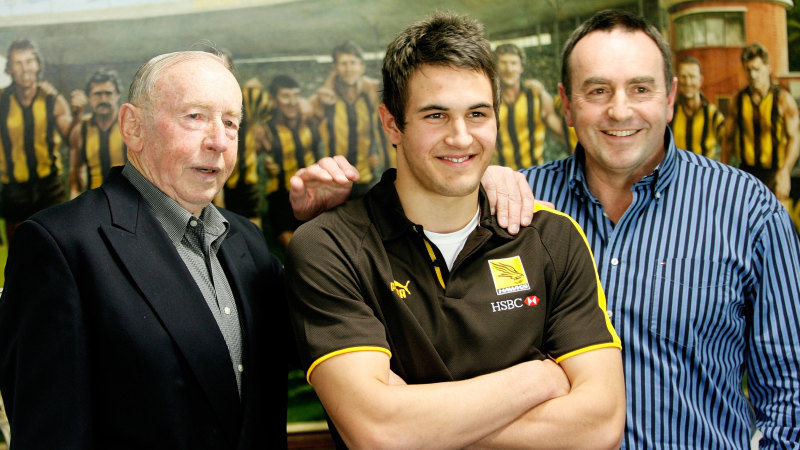
Taken under the father-son rule, Josh made 13 appearances for Hawthorn before finding a home at the Swans and playing a key role in upsetting his former side in the 2012 grand final.

A potential future hall of famer in his own right as a three-time All-Australian and triple best and fairest, Josh was glad his 91-year-old grandfather was still around to celebrate the honour with his family.

Three generations, when Josh Kennedy was taken as a father-son by the Hawks in 2006: John Kennedy snr, Josh, and John jnr.Credit:John Donegan

Not that he was ever the emotional type.

“I know that John snr would be tremendously proud, albeit he may not acknowledge it as much as we feel,” he told reporters in Sydney on Tuesday.

Loading

“He knows that I’m extremely proud and grateful for everything he’s done for us.

“He has his days where he’s struggling a little bit, but this will no doubt give him a bit of a boost and perk him up a little bit.”

Kennedy won four best and fairests during his 164-match playing career for the Hawks between 1950 and 1959, but it was off the field where he made his mark as one of the game’s most brilliant individuals.

Following years as a struggling club after entering the VFL in 1925, Hawthorn emerged as a genuine powerhouse under Kennedy’s tutelage.

He led Hawthorn in 299 games, guiding the club to its first three premierships, and is renowned for his famous “Don’t think, do” quote.

Kennedy later went onto coach North Melbourne 113 times between 1985 and 1989.

After coaching career finished, Kennedy was an AFL commissioner for four years from 1993.

AAP

Most Viewed in Sport

Loading

Source by [author_name]

Hong Kong Bans Tiananmen Vigil for 1st Time, in New Challenge to Protests

0

Hong Kong on Monday prohibited for the first time the annual June 4 vigil to honor victims of the pro-democracy Tiananmen Square protests in 1989, which the Chinese government crushed with deadly force.

The prohibition order was issued by the Hong Kong police force, and came less than a week after the Chinese Communist authorities in Beijing moved to enact new security laws on the former British colony. The order cited the need to enforce social-distancing rules to prevent the spread of the coronavirus as the justification for the ban.

The gathering to remember Tiananmen, held annually since 1990, had become a major rallying point for Hong Kongers worried about what they see as China’s rising repression. In the crackdown 31 years ago on the demonstrations in Tiananmen Square in Beijing and other cities, Chinese soldiers killed hundreds, and possibly thousands, of protesters.

Fears about limits on free speech and political expression have intensified in the past few days, after Beijing defied an international outcry and announced that it would impose new national security restrictions on Hong Kong that could effectively criminalize anything deemed subversive.

Critics called the new restrictions a violation of the “one country, two systems” principle that guaranteed Hong Kong’s way of life for at least 50 years after Britain returned the territory to China in 1997. They also immediately raised conjecture that the Tiananmen vigil might be banned.

The ruling Chinese Communist Party’s brutal putting down of the Tiananmen protests remains one of modern China’s most politically delicate events. Commemorations of the protests are banned on the Chinese mainland. Party propagandists have attempted to erase references to the Tiananmen events from China’s history books.

President Xi Jinping, China’s most authoritarian leader in decades, and other top officials have expressed no remorse about the deadly repression of students who had been camped on Tiananmen Square in 1989. His government also has expressed increased frustration at Hong Kong’s democracy movement, seeing it as a threat to Communist Party control.

Hong Kong’s Tiananmen vigil organizers said they still planned to go to Victoria Park, where the event had been regularly held, even though they expected the police to disperse any gathering. They have asked supporters in Hong Kong and around the world to light candles in their homes or other private places and post the images online.

The organizing body, the Hong Kong Alliance in Support of Patriotic Democratic Movements in China, also planned to set up booths around the city to observe the event, said Lee Cheuk-yan, the group’s chairman. A handful of churches intended to hold special services, he said.

“This is one of the characteristics of Hong Kong. We all came out to support democracy in China in 1989,” Mr. Lee said. “We have continued for 30 years, and people are really shocked that we can be persistent.”

Protesters in Hong Kong have regularly been fined in recent weeks for violating social-distancing rules that prevent gatherings of more than eight people.

Hong Kong has been widely praised for its success in controlling the spread of the virus. The city, with 7.5 million people, has recorded 1,085 cases and four deaths.

But protesters have accused the police of enforcing the social-distancing rules against government critics while ignoring gatherings by establishment supporters or large crowds in bar districts.

Source link

Trump Vowed to Disrupt Washington. Now He Faces Disruption in the Streets.

WASHINGTON — One of the recurring themes of the last three and a half years is that President Trump has disrupted Washington, just as his voters demanded. This is true in a certain sense: The Trump White House has been a chaotic drama, a procession of scandals, leaks, investigations, feuding protagonists and trampled norms.

But one of the overlooked realities of the reality show is that the day-to-day existence of so-called official Washington has felt anything but disrupted. This gilded capital has actually been a serene and lovely place to live, work and visit, at least for those who can afford it. The trend has only accelerated through what until recently was the booming economy of the Trump presidency.

These last months, though, have been something else entirely. The reality has relegated the TV maestro in the White House to something of a sideshow.

In recent nights, the streets around the White House have been clogged with thousands of protesters, demonstrating against the police killing last week in Minneapolis of George Floyd, an African-American man. The crowds have been multiracial and comprised a free-for-all of purposes. Landmark restaurants, offices and a historic church have been burned and vandalized. By Monday, Mayor Muriel E. Bowser had set a curfew of 7 p.m. and activated the National Guard.

“Donald Trump is just a social media personality to us, the guy who told us to drink bleach,” said Artinese Campbell, 33, an African-American woman who has lived her whole life in Washington and who had come downtown Monday afternoon, just a few blocks from the White House, to visit her bank before it was boarded up and closed early in anticipation of another night of protests. She said she was sympathetic to the cause of the protesters but hoped they remained peaceful and had no plans to stick around to find out.

“I think most of us are numb to presidents who come in and talk about ‘change,’” Ms. Campbell said. “Nothing really changes if you’re black in America.”

As with many metropolitan areas ravaged by the coronavirus and the nation’s economic crisis, Washington’s victims have been overwhelmingly working class, black and brown — inhabitants of the so-called real Washington who were priced out of the city years ago and forced to live outside its borders. Hospital workers and Metro drivers have gotten sick. Uber drivers and bus boys have lost their jobs.

They would not, as a general rule, include the patrons of the Oval Room, a landmark expense account restaurant around the corner from the White House that was vandalized over the weekend, its front window tagged in red paint with a message of “The Rich Aren’t Safe Anymore.”

“Run, run, they’re coming,” one young woman yelled late Saturday night to a group of her fellow demonstrators on H Street NW, in response to a loud crack that went off about 200 yards from the White House, just after 10:30 p.m. It was never exactly clear who “they” were, or what people were fleeing or running toward. There were competing chants drowning out each other, masked participants who could have been anyone, a swirling fog of agendas. It was like Twitter in the streets.

One thing was certain: No one was bemoaning the “shattered norms” perpetrated by the Trump administration or celebrating the “peaceful transfer of power” that may or may not occur in a few months. Television pundits have labeled the upcoming election as “existential” to the importance to the country’s direction. But it also felt beside the point — like privilege talking — in the crowds of the last few nights. This chaotic tableau felt so much more urgent, and close to home.

“Say his name” was the most common chant of the protests, a call and response answered with a corresponding “George Floyd,” who died while under arrest last week after a police officer kept his knee on his neck for nearly nine minutes.

During the weekend protests, there were recurrent cries of “I can’t breathe,” a visceral tribute to the last desperate words Mr. Floyd uttered before he lost consciousness. Mr. Trump’s name could be heard in a few chants, generally modified by an expletive. But again, he felt somewhere else, even as he was physically just a few hundred yards away, inside a darkened and barricaded White House.

One block away, on 16th Street NW, the national headquarters of the A.F.L.-C.I.O. were set ablaze during protests Sunday night. TV commentators described the conflagration as a strike against one of the fortresses of the American labor movement, a theoretical ally of the protesters in the struggle for a fairer power structure. Next door, flames engulfed St. John’s Episcopal Church, where two decades of presidents have come to worship — the so-called Church of the Presidents.

Suddenly, though, these monuments to American progress and history felt like quaint abstractions, cherished by official Washington but just another thing to burn down for the Washington disrupters of 2020.

On Monday on a sidewalk across Farragut Square, in front of the boarded up Oval Room restaurant, a protester named Athena Kapsides, a Washington public-school teacher, said that Mr. Trump had in fact inspired a great deal of activism in opposition to his own actions. In that sense, she said, he has been a catalyst for change.

“President Trump himself has tried to present himself as a fighter, but really he only fights for himself,” said Ms. Kapsides, who grew up in the Washington suburbs and wore a T-shirt bearing the likeness of Colin Kaepernick, the former National Football League quarterback who protested police violence against African-Americans by kneeling during pregame renditions of “The Star-Spangled Banner.” Many believe that his statement resulted in his blacklisting from the N.F.L., where he has not played since 2017.

“He’s been a force for disruption,” Ms. Kapsides said of Mr. Trump. “But maybe not always the kind of disruption he planned for.”

As dusk approached near the White House on Monday, a crowd built on the edges of Lafayette Square. Cries of “hands up, don’t shoot” grew in volume and intensity. Marquette Austin, 50, a lifelong resident of Southeast Washington, was passing through on a bike ride with his girlfriend and decided to stop and join.

Mr. Austin represents a different inhabitant of “permanent Washington,” a phrase that gets tossed around in the higher echelons of the federal government and its adjoining private sectors of lobbying, consulting and assorted other white-collar dependents. Few such inhabitants were actually born and raised in Washington, and few of them seem to ever leave once they settle into the warm bath of what Mr. Trump has branded “the swamp.”

Mr. Austin works for the city water department, and said he had seen firsthand how privileged, predominantly white neighborhoods like Georgetown received better service than poorer areas east of the Anacostia River.

“It doesn’t matter if there is a Democrat or Republican in the White House, this is our reality here,” Mr. Austin said. “It does not tend to change. That also feels permanent.”

Source link

Australian beach life at risk as environment drops down agenda

Batemans Bay, Australia – Environmental defender Paul May is worried.

He is worried about climate change. He is worried about a lack of government funding for environmental initiatives. And now he is also worried that the coronavirus pandemic will slow down vital action to protect Australia’s beaches.

“We’re a bit worried – we had the bushfires, and now this latest crisis with coronavirus, the bottom line will suffer,” May said from his home in South Durras, a small town near Batemans Bay on the New South Wales (NSW) south coast.

More:

As a result of COVID-19,  the 2020 UN Climate Summit has already been cancelled, while US President Donald Trump has taken the opportunity to complete his rollbacks of emission regulations despite research indicating a correlation between air pollution and coronavirus deaths.

May is a founding member of the South Durras branch of Landcare, a grassroots movement set up across Australia in the late 1980s to manage environmental issues in local communities. He knows that when governments face financial issues, funding for environmental programmes are often cut because they seem like easy targets.

“The things that get defunded first will be programmes for the environment and the arts,” he said. “Things people think we can survive without. They take our beaches for granted.”

The Australian Coastal Councils Association agrees that the country must act as soon as possible to mitigate the impact of erosion.

“What we’re looking at now is a serious downturn in tourism in Australia with coronavirus,” Executive Director, Alan Stokes, told Al Jazeera.

“But if we lose our beaches, that would be disastrous.”

Nature’s defence 

Sandy beaches are many nations’ first line of defence against storms and floods. Protecting them is especially crucial in urban areas, where beaches are unable to shift inland due to infrastructure and homes.

The sea approaches coastal homes at Collaroy in Sydney in February [James Gorley/EPA]

Beaches do erode naturally and change with storm events, but climate change means that they are altering faster than ever before. New research reported in the journal Nature Climate Change shows that Australia could lose 15,000km of beachfront by 2100.

“Beaches are naturally dynamic environments,” explained Hannah Power, a senior lecturer at the University of Newcastle’s School of Environment and Life Sciences. “They have coped with changes before, but one of the big challenges now is that we’ve built a lot of cities around coastal regions.”

The problem, Power explains, is that humans like to live by the beach, and often this means there is no “buffer zone” between development and the beach itself. The beach cannot transgress inland as it normally would, leading to dramatic scenes such as those on Collaroy-Narrabeen Beach in Sydney in 2016 where pools and houses were left hanging over sharp sand cliffs following a major storm.

“Erosion can happen very quickly in a storm,” Power says. “With storms, sand is transported into the offshore region onto sandbars. When conditions calm down, smaller waves transport sand back onshore. But it takes 10 times longer to bring the sand back than it does to displace it.”

“In developed areas, [what happens] will depend on how we mitigate erosion and what climate change path we take. This means we need to do something immediately.”

The importance of dunes

Power says sand dunes are like savings accounts that “the beach can dip in to when there is a big weather event”. May describes them as “a balance zone”. 


Eroding coastline threatens sea life in England

May was involved in the establishment of Dunecare – Landcare’s predecessor in South Durras – in the 1980s after storms devastated NSW’s beaches and dunes.

“Dunes were seen as a no-man’s land,” May explains. “No one looked after them.”

Dunecare began planting local vegetation on the dunes to secure them, and thanks to their proactive response, the beaches are now in comparatively good shape.

With people like May, South Durras is fortunate. Many areas are not so lucky. Most beach upkeep is funded and managed by local councils and while volunteer groups like Landcare are crucial, their funding comes and goes on government whims.

Volunteer-run programmes also rely heavily on the involvement of residents, meaning that more remote areas such as Victoria’s Gippsland region, devastated by this summer’s bushfires, receive less attention.

Additionally, some residents are torn between protecting beaches and ensuring their financial investments in homes are safe.

“This is an emotional issue,” Power comments. “It’s really tied into Australian culture that we spend time at the beach, we want to live close to the coast. Almost every major Australian town is on an estuary or river.”

May agrees and says people need to realise that these environments are not something that can be taken for granted.

Australia beach

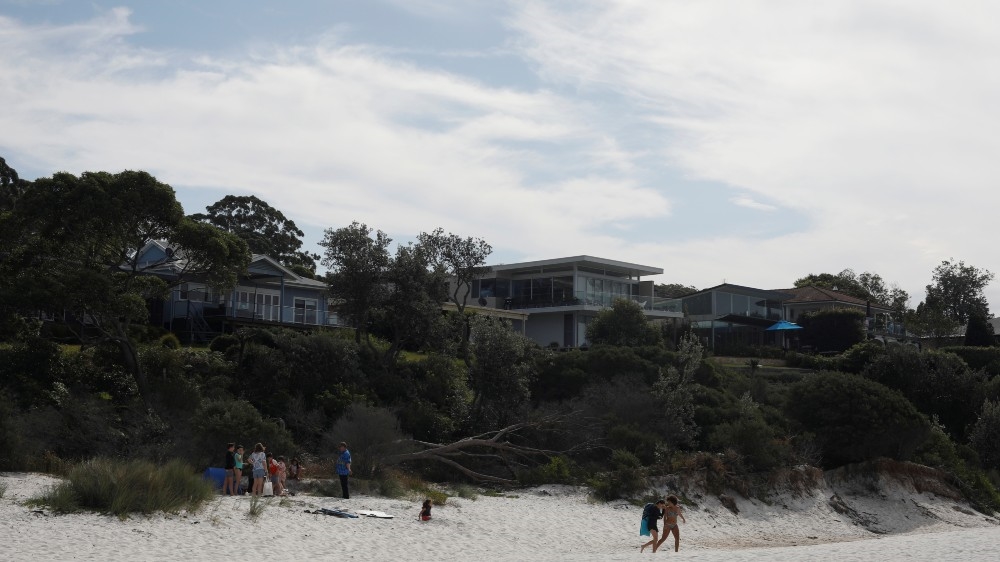
The beach is an integral part of Australian life and many dream of owning a house by the sea [File: Edgar Su/Reuters]

“There are still definitely some selfish attitudes – you know, ‘no coastal block’s good unless it’s got a view’. Historically some local councils even used to allow building on sand dunes, such as on [Queensland’s] Gold Coast.”

Hard decisions

Power says there is still time to act to prevent worse damage to our beaches but the gap is closing fast. 

“The best thing we can do would be to take clear, significant, defined action to reduce our carbon emissions,” she argues. “But because there is momentum in the climate system, we will see sea-level rise even if we could turn off all carbon emissions tomorrow … so we need to plan effectively.”

Community-based decision making is key, and difficult options such as planned retreat – where a town moves inland away from the coast – could be considered in some areas.

“We could do nothing, for example, which is very affordable but has very significant consequences,” Power said. “We could do planned retreat. We could undertake soft engineering such as beach nourishment, putting sand onto the beach from somewhere else to replace that lost to erosion. Or we could do hard engineering like sea walls.”

Australia WA erosion

Coastal erosion defences at Port Beach in Perth last month as Western Australia braced for its wildest autumn weather in years [Richard Wainwright/EPA]

Communities at urban locations like Collaroy-Narrabeen Beach or Port Beach in Fremantle, Western Australia, will have to make serious decisions fast.

“Rising sea temperatures are responsible for increasingly extreme severe weather events and that means wave energy is that much greater,” said the Australian Coastal Councils Association’s Stokes.

“At Collaroy-Narrabeen, for example, we saw a 100m-wide (109 yard-wide) beach reduced down to 25m. Meanwhile, Port Beach has been so severely eroded that it has threatened buildings.”

More than 650,000 Australian dollars ($439,720) has been allocated by the state and city governments to build a rock wall as an interim measure to protect infrastructure around Port Beach.

Western Australian Transport Minister Rita Saffioti said this would buy time to develop and implement a long-term approach. However, many are worried that government responses are lacking both speed and sufficient funding.

“The Intergovernmental Panel on Climate Change (IPCC) is predicting up to a 0.8m sea level rise by 2100. We need to seriously start planning now on how we’re going to respond to that,” Stokes said. 

“The federal government says under the constitution, this is a state problem, but the state government doesn’t have the funds – the commonwealth has the funds, the states have got the power and the councils have got the problem.”

Australia beach dunes

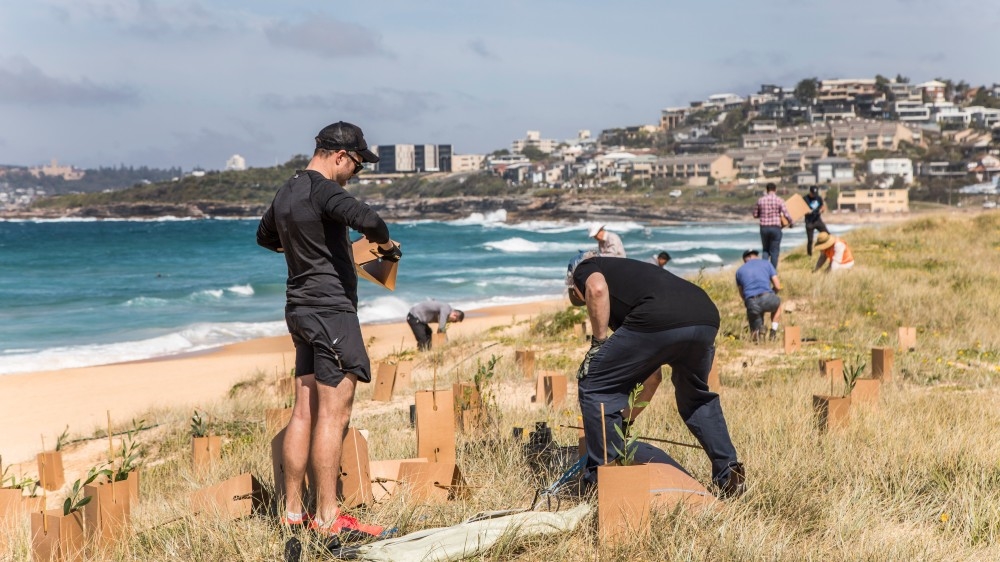
Volunteers plant new vegetation to preserve land dunes at Curl Curl in Sydney last year. Experts say dunes are ‘nature’s defence’ [Landcare/Supplied]

University of Newcastle’s Power acknowledges that hard decisions will have to be made.

“Everyone wants to maintain their sandy beaches as they are but we can’t realistically do this everywhere … But if the sea level rises even just half a metre, over 50,000 homes could be exposed across Australia.”

Source link