CONWAY, S.C. — The first mention of the coronavirus pandemic was a joke.
A master of ceremonies was explaining to a crowd of more than 100 people why the keynote speakers — home-state Senators Lindsey Graham and Tim Scott — were running a bit late.
“You have to understand, they haven’t got to do any politicking for a while,†said the M.C., Robert Rabon of the Horry County Republican Party. “They’re like a kid in a candy store — they’re going wild!â€
And with that passing mention, South Carolina Republicans returned to the normal rhythm of the campaign trail, coronavirus all the same.
The outdoor gathering here on Thursday was a send-off event for Cleo Steele, a longtime Republican Party operative in Horry County, who is retiring to Ohio. Speakers shared the same microphone. Local and state political candidates greeted voters with handshakes and squeezed tight for pictures. Of all the people gathered outside the county Republican office — many of them senior citizens — fewer than a dozen wore masks.
“Social distancing guidelines are recommended,†the invitation had said. “Hand sanitizer and face masks will be available.†In reality, according to interviews with more than a dozen attendees, the event was an active rejection of behavior that the hyper-conservative crowd has come to associate with liberal enemies in recent months — wearing masks and gloves, staying six feet away from other people, avoiding physical touch.
To treat the coronavirus as something to be feared, they said, was a political act incongruous with their values.
Dwayne “Duke†Buckner, who is challenging Mr. Graham in the Republican Senate primary next month and came to the event to meet voters, said he had recently stopped adhering to public health guidelines, which he described as overly burdensome.
“You can quote me on this,†Mr. Buckner said. “When the good Lord calls you home, a mask ain’t going to stop it.â€
August Savello, 49, said he followed Dr. Steven Hotze, a Republican activist who has published videos such as “Coronavirus Mass Hysteria,†and preferred to do his own research rather than listening to state and federal public health officials like Dr. Anthony S. Fauci.
“A virus is a virus is a virus, and there’s viruses around us all the time,†he said. “My father had it and he’s 79 years old. He said it was like a bad flu.â€
That the event was held the same week that the pandemic’s death toll in the United States crossed 100,000 reflected the different realities of the virus along political, racial and geographic lines. In densely populated urban centers, more likely to be inhabited by Democrats and racial minorities, high infection rates have completely upended daily life and made social distancing largely nonnegotiable. Here in coastal Horry County, which includes Myrtle Beach and is overwhelmingly Republican, news of relaxed restrictions on social gatherings was treated with relief.
State data shows that Horry County has nearly 400 confirmed cases of coronavirus, below the state’s per capita average. Black South Carolinians, meanwhile, have contracted more than half of the state’s total cases, though they make up less than 30 percent of the state’s population. The crowd at the event was almost all white.
Michael LaPierre, a right-wing Senate candidate who came to the event with dozens of supporters who pestered Mr. Graham, said he had no reservations about extending handshakes and taking pictures, or as he put it, “pressing flesh and kissing babies.â€
“We wipe our hands and take precautions,†said Mr. LaPierre, who is 70 and lives with his 99-year-old mother-in-law. “But I spent 28 months in Vietnam and crashed six times in a helicopter. I’m going to die when I’m going to die.â€
During the program, Ms. Steele, seated in a wheelchair, was presented with commendations from Mr. Graham and Mr. Scott, as well as awards from local and state Republicans. Speakers posed for pictures with the honoree, hugging her close as they applauded her years of service. Aides to Mr. Graham and Mr. Scott wore masks. The senators did not.
Behind the outdoor podium, a full-fledged marketplace of pro-Trump merchandise attracted a gaggle of customers. In the center sat a bronze bust of the president, which some rubbed for luck and posed with for pictures.
At the program’s conclusion, Mr. Rabon called up more than a dozen state and local candidates, who introduced themselves to the audience, shared a portion of their political platform, and returned to the crowd for meet-and-greets.
“Candidates — State House, State Senate, and the House — line up,†Mr. Rabon said. “Don’t take a long time.â€
He coughed into the microphone, and passed it to the first speaker.
Please note: Uzalo went off-air Friday 8 May as the production catches-up on filming new episodes because of the production shutdown caused by the lockdown. These teasers for the upcoming action are still relevant.
Uzalo returns to SABC1 on Monday, 15 June after its break to catch-up on new episodes. The action picks up directly from where things left off.
In today’s episode of Uzalo: Nkunzi pushes to make sure he gets what he wants, Nomcebo threatens an angry Qhabanga, and Sbu tries to follow Fikile’s advice, in vain.
The story follows the family whose wealth was built in the murky criminal underworld, as well as the more wholesome Mdletshe family who’s day to day life, is pretty much centred around the KwaMashu Kingdom Church.
How to watch the latest episode of Uzalo
The soapie airs every weeknight on SABC 1 and you can watch on your TV or online. After the episode airs, the episodes are also made available on YouTube for seven days. Episodes are also posted right here on thesouthafrican.com as soon as they become available.
Uzalo production team
Executive Producer and creator:Â Duma Ndlovu Executive Producer:Â Gugulethu Zuma-Ncube Executive Producer:Â Pepsi Pokane Series Producer:Â Mmamitse Thibedi Head Writer:Â Phathutshedzo Aldrean Makwarela Storyliners:Â Yolanda Mogatusi, Lehasa Moloi, Zolisa Singwanda Head Director:Â Alex Yazbek Directors:Â King Shaft Morapama, Bruce Molema
Covid-19 has had a severe effect on the socioeconomic life of all of South Africa’s inhabitants. It is vital that they all receive protection in the form of healthcare, humanitarian aid and social welfare. Refugees and asylum seekers, too, look to the government for protectionÂ
These individuals are protected in South Africa by the Refugees Act of 1998. They are entitled to work in South Africa to sustain themselves and improve their quality of life during their stay.Â
But they have been excluded from a number of Covid-19 aid packages. Before President Cyril Ramaphosa announced that South Africa would be moving to level 3 of the lockdown, all inhabitants had to close down their non-essential businesses and stay home.Â
Medical services were offered to all people without discrimination based on nationality. The equal treatment was inevitable because Covid-19 does not differentiate between nations, nationalities or classes. The government’s health responses had to include migrants to prevent a nationwide calamity.Â
The government recognised that many people who could not generate an income because of the lockdown regulations would not be able to feed themselves and their families. Food parcels were distributed. But there were reports that these parcels were distributed based on nationality and political affiliation.Â
Since politics played an important role in the provision of humanitarian relief, vulnerable migrants fell through the cracks. This had an even greater effect on the lives of refugees and asylum seekers as they could not access food security.Â
The most vulnerable, however, are asylum seekers who are excluded from the social grant scheme and social relief of distress grants (unemployment grants). These schemes are designed to assist the vulnerable and unemployed to feed themselves. The exclusion of asylum seekers from these Covid-19 humanitarian relief schemes is a concern because their humanitarian needs must be protected in line with the twin rights to life and human dignity as envisaged by the Refugees Act.
In this regard, economic relief measures designed to pay salaries for employees, to save jobs or to insulate businesses should have considered the plight of asylum seekers and refugees.Â
They should benefit from the temporary employer-employee relief scheme (Ters), administered by the department of employment and labour through the Unemployment Insurance Fund (UIF). But refugees and asylum seekers have struggled to get their salaries through Ters because some employers told them that the no-work-no-pay principle applied.Â
Difficulties further arose in situations where companies have used the lockdown to retrench employees. Like other retrenched employees, refugees and asylum seekers should benefit from the UIF because they have contributed to the fund. It is problematic, therefore, that their exclusion has been justified by the employment and labour department, which claims that its computer system is not designed to capture the numbers appearing on their status permits.Â
This problem persists regardless of the fact that the Equality Court in the 2017 case of Saddiq vs Department of Labour and Other ordered the department to fix its computer system to capture the numbers appearing on these permits.Â
Refugees and asylum seekers in informal and formal sectors are more vulnerable, especially since relief schemes designed to respond to stressed small and medium-sized businesses were limited to citizens. As a result, they have no access to the debt relief finance scheme, the business growth/resilience facility, the tourism relief fund for small, medium and micro enterprises, the relief funding for distressed businesses, the employer relief fund or the national empowerment fund support, which could have helped their businesses survive this period of economic distress. Â
On top of this, there has been a political campaign to bar migrants from participating in small business sectors and from employment in certain sectors of the economy. It appears that the minister of small business development, Khumbudzo Ntshavheni, the minister of finance, Tito Mboweni, and the director general of employment and labour, Thobile Lamati, are spearheading this campaign, which could encroach on the rights and freedoms of refugees and asylum seekers to participate in economic activities in the future.Â
Although permitted to work, the right to work for refugees and asylum seekers is restricted by section 22 of the Constitution, which takes away the right to choose their trade, occupation or profession freely. The right is further restricted in terms of the Employment Equity Act (EEA) of 1998 and the Immigration Act of 2002. Although the equity Act requires employers to prioritise employment of designated groups (Africans, women and people with disabilities) through the implementation of affirmative action, the immigration laws require employers to employ migrants on conditions that (i) the person is highly skilled or possesses a critical skill and (ii) that there is no available suitable citizen to be employed in that position.Â
Refugees and asylum seekers do not fall within the designated groups because they were not affected by past practices. It is unfortunate that nothing in the Refugees Act exempts them from these restrictive employment measures. Alternatively, they have had to create their own small businesses to survive.Â
The state’s attempt to bar refugees and asylum seekers from operating small businesses was successfully challenged in the 2015 case of Somali Association of South Africa vs Limpopo, Department of Economic Development, Environment and Tourism in which the Supreme Court of Appeal (SCA) interpreted the right to work to mean the undertaking of business or employment. Although asylum seekers’ right to participate in economic activities is still debated rather controversially in the political arena, the SCA in the 2004 case of Minister of Home Affairs vs Watchenuka has affirmed that they should work to protect their dignity.
In this difficult time, the government should desist from viewing refugees and asylum seekers as “economic migrants†and show its commitment to protect them as it has promised to do in terms of the Refugees Act and align its Covid-19 responses accordingly.
Covid-19 has had a severe effect on the socioeconomic life of all of South Africa’s inhabitants. It is vital that they all receive protection in the form of healthcare, humanitarian aid and social welfare. Refugees and asylum seekers, too, look to the government for protectionÂ
These individuals are protected in South Africa by the Refugees Act of 1998. They are entitled to work in South Africa to sustain themselves and improve their quality of life during their stay.Â
But they have been excluded from a number of Covid-19 aid packages. Before President Cyril Ramaphosa announced that South Africa would be moving to level 3 of the lockdown, all inhabitants had to close down their non-essential businesses and stay home.Â
Medical services were offered to all people without discrimination based on nationality. The equal treatment was inevitable because Covid-19 does not differentiate between nations, nationalities or classes. The government’s health responses had to include migrants to prevent a nationwide calamity.Â
The government recognised that many people who could not generate an income because of the lockdown regulations would not be able to feed themselves and their families. Food parcels were distributed. But there were reports that these parcels were distributed based on nationality and political affiliation.Â
Since politics played an important role in the provision of humanitarian relief, vulnerable migrants fell through the cracks. This had an even greater effect on the lives of refugees and asylum seekers as they could not access food security.Â
The most vulnerable, however, are asylum seekers who are excluded from the social grant scheme and social relief of distress grants (unemployment grants). These schemes are designed to assist the vulnerable and unemployed to feed themselves. The exclusion of asylum seekers from these Covid-19 humanitarian relief schemes is a concern because their humanitarian needs must be protected in line with the twin rights to life and human dignity as envisaged by the Refugees Act.
In this regard, economic relief measures designed to pay salaries for employees, to save jobs or to insulate businesses should have considered the plight of asylum seekers and refugees.Â
They should benefit from the temporary employer-employee relief scheme (Ters), administered by the department of employment and labour through the Unemployment Insurance Fund (UIF). But refugees and asylum seekers have struggled to get their salaries through Ters because some employers told them that the no-work-no-pay principle applied.Â
Difficulties further arose in situations where companies have used the lockdown to retrench employees. Like other retrenched employees, refugees and asylum seekers should benefit from the UIF because they have contributed to the fund. It is problematic, therefore, that their exclusion has been justified by the employment and labour department, which claims that its computer system is not designed to capture the numbers appearing on their status permits.Â
This problem persists regardless of the fact that the Equality Court in the 2017 case of Saddiq vs Department of Labour and Other ordered the department to fix its computer system to capture the numbers appearing on these permits.Â
Refugees and asylum seekers in informal and formal sectors are more vulnerable, especially since relief schemes designed to respond to stressed small and medium-sized businesses were limited to citizens. As a result, they have no access to the debt relief finance scheme, the business growth/resilience facility, the tourism relief fund for small, medium and micro enterprises, the relief funding for distressed businesses, the employer relief fund or the national empowerment fund support, which could have helped their businesses survive this period of economic distress. Â
On top of this, there has been a political campaign to bar migrants from participating in small business sectors and from employment in certain sectors of the economy. It appears that the minister of small business development, Khumbudzo Ntshavheni, the minister of finance, Tito Mboweni, and the director general of employment and labour, Thobile Lamati, are spearheading this campaign, which could encroach on the rights and freedoms of refugees and asylum seekers to participate in economic activities in the future.Â
Although permitted to work, the right to work for refugees and asylum seekers is restricted by section 22 of the Constitution, which takes away the right to choose their trade, occupation or profession freely. The right is further restricted in terms of the Employment Equity Act (EEA) of 1998 and the Immigration Act of 2002. Although the equity Act requires employers to prioritise employment of designated groups (Africans, women and people with disabilities) through the implementation of affirmative action, the immigration laws require employers to employ migrants on conditions that (i) the person is highly skilled or possesses a critical skill and (ii) that there is no available suitable citizen to be employed in that position.Â
Refugees and asylum seekers do not fall within the designated groups because they were not affected by past practices. It is unfortunate that nothing in the Refugees Act exempts them from these restrictive employment measures. Alternatively, they have had to create their own small businesses to survive.Â
The state’s attempt to bar refugees and asylum seekers from operating small businesses was successfully challenged in the 2015 case of Somali Association of South Africa vs Limpopo, Department of Economic Development, Environment and Tourism in which the Supreme Court of Appeal (SCA) interpreted the right to work to mean the undertaking of business or employment. Although asylum seekers’ right to participate in economic activities is still debated rather controversially in the political arena, the SCA in the 2004 case of Minister of Home Affairs vs Watchenuka has affirmed that they should work to protect their dignity.
In this difficult time, the government should desist from viewing refugees and asylum seekers as “economic migrants†and show its commitment to protect them as it has promised to do in terms of the Refugees Act and align its Covid-19 responses accordingly.
Manipulating information was a feature of human history long before modern journalism. An early example dates back to Ancient Rome, when Antony met Cleopatra and his political rival Octavian set out to discredit him with fake news slogans written on coins (imagine an antique form of Twitter if you must).Â
The smear campaign was a success and Octavian became the first Roman emperor. They say when in Rome, do as the Romans do, unless of course the Romans are spending their time spreading disinformation for political gain.Â
Fast forward to the 20th century, and we have George Orwell describing his vision of a disheartening dystopian society in his novel Nineteen Eighty-Four, where bureaucrats from the Ministry of Truth and the Thought Police distort reality by spreading misinformation and rewriting history.Â
At present, largely thanks to the spread of social media and wearable technology, Orwell’s prediction of omnipresent surveillance seems to be frighteningly accurate. But whereas his fears were well founded, assaults on the integrity of truth have occurred in a manner which he could not possibly have foreseen.Â
Simply put, it’s not so much a problem of concerned citizens being lied to as it is a problem of being regularly misled by the truth. As Samuel Johnson put it: “It is more from carelessness about truth than from intentional lying, that there is so much falsehood in the world.â€
Today, the weaponisation of information has developed into an arms race of national and international disinformation spread through partisan news agencies and social media platforms on an unprecedented scale. The proliferation of new technological tools makes the manipulation of content relatively straightforward, and social media channels drive ‘alternative facts’ pushed by populist politicians and untrustworthy corporate agencies.Â
In addition, the nature of social media has limited quality control standards for determining what constitutes legitimate news and these platforms have become fertile ground for sock-puppet networks and troll armies.Â
There are many instances when social media content has been produced by public relations (PR) companies working on behalf of political actors or entire governments themselves and this article deals with one of the most notorious examples: The case of Bell Pottinger in South Africa.
In 2017, investigative journalists acquired a trove of emails and files, subsequently named the Gupta leaks, which appeared to confirm the allegations of the state being captured by the Gupta family. In the emails, the London-based public relations firm Bell Pottinger stood accused of promoting a racially divisive campaign using a variety of media channels to advance a harmful narrative, which could be neatly summarised into two slogans: white monopoly capital and economic apartheid. Bell Pottinger’s blatant abuse of race as a sensitive issue may have had untold consequences, as renewed racial tensions had the potential to destabilise South Africa.Â
The campaign appears to have started when pressure on the Gupta family increased halfway through 2016, after  claims of state capture in the final report of the outgoing Public Protector Thuli Madonsela. Bell Pottinger’s brief was to design a targeted campaign to deflect attention away from the revelations of state capture.Â
To achieve this end, the firm used both the domestic and international media by packaging the story into content which could then be widely spread in order to legitimise the narrative for the South African audience. The campaign spread misinformation via websites, social media messages and a paid Twitter army which attacked journalists, business people and politicians with offensive messages and photoshopped images, designed to intimidate and counter their investigations.Â
The goal of the PR campaign was to use creative political communication techniques in a consistent manner in order to promote white monopoly capital and economic apartheid as scapegoats for South Africa’s troubles, and in so doing, divert attention away from the “Zuptasâ€, (a moniker referring to the relationship between former president Jacob Zuma and the Gupta family) and the failings of the ANC. The most destructive part of the campaign was not spread by word of mouth, but through an unprecedented online onslaught. Bell Pottinger created an intricate web of fake social media accounts, which attacked those individuals who had played a leading role in exposing state capture or dared to challenge the Guptas’ shadowy dealings and the prevailing narrative.Â
For example, the campaign acted to shape the political discourse by driving the narrative of white monopoly capital and economic apartheid on multiple media platforms, ranging from fake Twitter accounts and hate-filled website articles, to newspapers and television news channels partisan to the Zupta network.Â
The Bell Pottinger campaign was said to have been just one part in the construction of the Gupta family’s propaganda empire that included The New Age and ANN7, a multifaceted online strategy using social media and the allegiance of several outspoken public commentators such as Black First, Land First (BLF) leader Andile Mngxitama.Â
Astroturfing was another method employed by Bell Pottinger during its social media campaign which involved the use of bots to disseminate well-directed false information and pointed propaganda with the aim of mimicking organic public reaction.Â
Usually, sophisticated social media automation techniques are used to rapidly conjure up armies of fake accounts, which are almost indistinguishable from real people, pretending to represent waves of genuine public opinion.Â
Technology was also used to create ‘deepfake’ videos and other forms of content to discredit journalists, and particularly female reporters. For instance, prominent editor Ferial Haffajee was targeted in a campaign of online harassment during this time, which saw her image manipulated to produce false impressions of her moral character, along with the hashtag of #pressitute. Former finance minister Pravin Gordhan was also the target of a Twitter crusade by the former government spokesperson and Gupta ally Mzwanele Jimmy Manyi. Â
Although Bell Pottinger stood accused of creating and disseminating fake news, much of the inflammatory content the firm promoted was factually accurate. More than two decades after 1994, the majority of the country’s wealth remains in the hands of the white minority. According to French economist Thomas Piketty, who analysed South Africa’s income distribution in 2015, many of the same structures of racial inequality which were prevalent during apartheid are still present today.Â
Building on this reality, Bell Pottinger utilised convincing research, case studies and statistics to demonstrate that economic apartheid still existed. Indeed, parts of the speeches, social media posts and slogans that Bell Pottinger created contained some important partial truths.Â
For example, few South Africans would disagree that the need for economic emancipation should be a priority on the government’s agenda. The deceitful motive of the campaign, however, was to use these partial truths to deliberately deflect attention away from state capture, rather than answer critical questions regarding economic inequality.Â
Essentially, Bell Pottinger was hired by the Guptas to pervert an essential debate about the transfer of economic power to a broader section of society as a means of alleviating poverty and inequality. At the centre of this political project was a rhetorical commitment to radical economic transformation. The term ‘radical economic transformation’ had been used repeatedly to give ideological legitimacy to what can only be described as a political project carried out by a powerful elite to capture state-owned enterprises.Â
The case of Bell Pottinger also demonstrated how state capture was in large part assisted by the involvement of international parties who acted as professional enablers to help facilitate the transfer of stolen funds through complex corporate structures out of South Africa to the Gupta’s financial safe havens across the globe.Â
In a country already plagued with serious socioeconomic issues, this manufactured narrative of economic apartheid directly undermined the work of years of reconciliation. The campaign has been described as the first large-scale fake news propaganda war in South Africa, and caused visible national discontent, eventually leading to the collapse of the infamous London firm which was put into administration.Â
The great irony is that a public relations agency renowned for its ability to reshape reality was ultimately unable to save its own reputation. This is why we should not forget the role played by journalists who uncovered state capture and demonstrated the crucial corrective function of journalism in a democratic society.Â
We owe it to ourselves and our young democracy to become more responsible in consuming media by challenging the multifaceted information disorder which threatens to reduce public discourse to a means of misinformation.
Every individual or organisation has interests, and it is to be reasonably expected for communicators to select those truths that further their cause. But this can be done in an ethical or a deceptive manner. Ultimately, information is like a box of matches, a morally neutral but fundamentally powerful tool whose manner of use determines its impact for good or ill.
It would be wise to end by taking some final words of advice from Orwell’s Nineteen Eighty-Four protagonist, Winston Smith, who desperately tries to resist the government’s lies by telling himself: “There was truth and untruth, and if you clung to the truth even against the whole world, you were not mad.â€Â
HuffPost reporters around the world are tracking the pandemic and the measures being taken to flatten the curve of transmission.
Read the latest updates on the coronavirus pandemic below. (To see the latest updates, you may need to refresh the page. All times are Eastern. For earlier updates on the pandemic, go here.)
A Tyson Foods pork processing plant in Storm Lake, Iowa, is temporarily halting operations after 22% of the plant’s 2,500 workers tested positive for COVID-19.
Iowa Department of Public Health Deputy Director Sarah Reisetter told the Des Moines Register that 555 of the plant’s 2,517 employees tested positive, which the company blamed on “a delay in COVID-19 testing results and team member absences related to quarantine.“
Tyson said it plans to reopen next week after a “deep cleaning and sanitizing of the entire facility.â€
Mayra Lopez, vice president of the Storm Lake League of United Latin American Citizens of Iowa, told the Register that Tyson could have done more to prevent the outbreak.
A meeting with Tyson earlier this month regarding the company’s efforts was “very short, very scripted, and very vague,†she said, though she agreed a lack of adequate testing was at least partly to blame.
“We finally, finally have the testing we’ve been waiting for,†she said. “I don’t think people are getting results quickly enough. I’ve heard Tyson employees waiting as long as a week to hear back if they have a confirmed case. By the time they get the results, it could be too late and they’ve passed it on to someone else.â€
Meat processing plants have become COVID-19 hot spots in rural communities across the country. As of last week, an estimated 17,000 workers in processing plants across the United States have fallen ill and 66 have died.
New York Gov. Andrew Cuomo said Friday New York City is on track to begin a phased reopening on June 8, once hospital capacity and contract tracing are at sufficient levels to sustain the COVID-19 recovery.
The city has been hit hard by the coronavirus. Of the U.S.’s nearly 102,000 confirmed deaths, roughly a fifth — 21,415 — have been in the city alone, according to data tracked by Johns Hopkins University.
Much of the rest of the state already began relaxing restrictions on May 15.
This year’s Boston Marathon, initially postponed from its traditional April date to September, will not be held in-person this year, Boston Mayor Marty Walsh (D) announced Thursday. Walsh said organizers have deemed it “not feasible,†given the continued threat of COVID-19′s spread, especially through large events.
Any marathon runner who had entered will receive a full refund, and is invited to run a virtual marathon from Sept. 7-14. Organizers will also hold a series of virtual events that week in lieu of the in-person race, which is a major event for the city.
Another 2.1 million people applied for unemployment benefits across the country last week, bringing the total number to around 41 million since the crisis dramatically worsened in March.Â
Not all of that number are still jobless. Around 21 million are currently receiving unemployment aid, the Labor Department reported Thursday, providing a rough count of the unemployed.
 The increase in applications, however, suggests businesses are cutting staff even as all 50 states work to reopen at least some parts of their economies.Â
In April, the national unemployment rate reached nearly 15%, which is the highest since the Great Depression. While businesses work on reopening with added restrictions to prevent spread of the coronavirus, the question remains of how quickly customers — some spooked by threat of the virus, others struggling economically — will come back.Â
The economy is thought to be shrinking by 40% in the April-June quarter, according to the Associated Press.
Trump tweeted a message of condolence Thursday, a day after the confirmed COVID-19 U.S. death toll surpassed 100,000.
“We have just reached a very sad milestone with the coronavirus pandemic deaths reaching 100,000,â€Â his account tweeted. “To all of the families & friends of those who have passed, I want to extend my heartfelt sympathy & love for everything that these great people stood for & represent. God be with you!â€
The delayed acknowledgement is in keeping with Trump’s messaging throughout the crisis. He spent months publicly downplaying the severity of the pandemic, even as deaths soared.
In April, Trump patted himself on the back and predicted the death toll would top out at around 60,000. “It looks like we’ll be at about a 60,000 mark, which is 40,000 less than the lowest number thought of,â€Â he said at the April 19 briefing. The U.S. passed that threshold one week later.
Of the 13 hours Trump spent talking at the daily coronavirus briefings (which have since been canceled), he spent just 4.5 minutes expressing condolences for coronavirus victims, a Washington Post analysis found.
People who come into close contact with someone with COVID-19 will be told to self-isolate for two weeks as the British government launches its coronavirus tracing system in England.
Under the Test and Trace program, a team of 25,000 contact tracers will work out who those infected with coronavirus have been in contact with in a bid to control local flare-ups.
Everyone who tests positive for the virus will be asked to share details about who they have seen and where they have been with the tracers. This person’s close contacts will then receive an email or a text, telling them they must stay at home for 14 days – even if they don’t have any symptoms – to avoid unknowingly spreading the virus. Anyone with coronavirus symptoms should still self-isolate at home, along with their household, and get tested for COVID-19.
Britain, which has the second-highest death toll from the virus globally, abandoned a strategy of testing and tracing in March when the virus started spreading exponentially and there was insufficient capacity to test more than a fraction of those with symptoms.
The government says there is now enough capacity for all who need tests to get them. It is aiming to provide test results within 24 hours. Read moreÂ
The first lady posted a tweet calling for those protesting the police killing to be peaceful and offering condolences to Floyd’s family. Floyd, who was Black, died after a white police officer knelt on his neck.
“Our country allows for peaceful protests, but there is no reason for violence,†the first lady wrote. “I’ve seen our citizens unify & take care of one another through COVID19 & we can’t stop now. My deepest condolences to the family of George Floyd. As a nation, let’s focus on peace, prayers & healing.â€
Our country allows for peaceful protests, but there is no reason for violence. I’ve seen our citizens unify & take care of one another through COVID19 & we can’t stop now. My deepest condolences to the family of George Floyd. As a nation, let’s focus on peace, prayers & healing.
Trump’s call for unity stood as a stark contrast to her husband’s tweets threatening to escalate the Minneapolis violence with the National Guard and evoking bellicose tough-cop lines from the 1960s. One of the president’s tweets early Friday was flagged by Twitter for “glorifying violence.â€
Some people on Twitter, including CNN’s Chris Cilleza, pointed out that the first lady’s tweet showed more sensitivity than her husband.
What if the president had just sent this tweet? Rather than one using racially coded language (“thugs”) and issuing a direct threat of violence against protesters? https://t.co/KJObggH9aK
Why then is your husband calling for shooting the looters. Do you agree. If you don’t, could you have a word with him if you see him in the next couple of days?
Your husband cheered on white people storming the Michigan State Capitol armed with assault weapons so they could get a haircut https://t.co/9Mc6eB2epY
Colin Kaepernick’s mother weighed in, noting that the president wasn’t very fond of peaceful protests.Â
The man who peacefully protested against systemic racism and police brutality was called a “Son of a Bitch” by your idiot husband and lost his job. Let’s not focus on peace and prayers, let’s focus on change! https://t.co/GiX1QANOKZ
United States Attorney Erica H. MacDonald held a press conference along with police and FBI on their investigation into the death of George Floyd.
Wochit
MINNEAPOLIS – Former Minneapolis police officer Derek Chauvin was arrested Friday, days after video circulated of him holding his knee to George Floyd’s neck for at least eight minutes before Floyd died.
Hennepin County Attorney Mike Freeman said Chauvin was in custody and facing third-degree murder and manslaughter charges. Subsequent charges are possible and charges for the other officers involved are anticipated, Freeman said.
The arrest comes after Minneapolis residents awoke Friday to smoke billowing, fires burning and police lining their streets after another intense night of protests following Floyd’s death.
Protests, some violent, also cropped up across the nation. Demonstrations are anticipated in many cities Friday night and through the weekend.
Vice President Joe Biden said he spoke with Floyd’s family: “With our complacency and silence, we are complicit in perpetuating these cycles of violence.”
Floyd and Chauvin knew each other before the fatal encounter – they worked together at a bar, a city official and a bar owner said.
Floyd’s family has hired a medical examiner to conduct an independent autopsy, their Ben Crump attorney says.Â
President Donald Trump criticized the city’s mayor, called protesters “thugs” and said “when the looting starts, the shooting starts.” Twitter later put a public interest notice on that tweet saying it violated rules about “glorifying violence.”
Protests and rallies took place  across the country overnight. In Louisville, Kentucky, a protest to demand justice for Breonna Taylor, who was shot and killed by police in March, turned violent. Seven people were shot but are expected to recover.
Here’s what we know Friday:
County attorney says Chauvin facing murder, manslaughter charges
Hennepin County Attorney Mike Freeman said that his office was still reviewing evidence in Floyd’s death that but they have “sufficient admissible evidence to prove the case beyond a reasonable doubt” on both a third-degree murder and a manslaughter charge.
Asked why Chauvin was not arrested and held before charges filed, Freeman said, “This is by far the fastest we’ve ever charged a police officer.”
Freeman would not comment on what specific piece of evidence led to Chauvin’s arrest but said that his office had reviewed footage of Floyd’s death and the officer’s body-worn camera, spoken to witnesses and obtained a preliminary report from the medical examiner.
“We have now been able to put together the evidence that we need. Even as late as yesterday afternoon, we didn’t have all that we needed,” Freeman said.
Freeman said he would not speculate about the three other officers involved in Floyd’s arrest but said he anticipates charges.
Activists speak out on the other 3 officers
Activists said that one arrest was not enough. At a press conference inside Minneapolis city hall, attended by former NBA payer Stephen Jackson and actor Jamie Foxx, community members called for the arrest of all four officers involved in the incident.
“We are not satisfied with one officer,” said lawyer and minister Nekima Levy Armstrong. “All of them were complicit in his murder, and they all need to help held accountable, just as if it was four black men that killed somebody.”
Biden, Obama speak outÂ
Former Vice President Joe Biden, in a video address Friday, said he spoke with George Floyd’s family, saying, “It’s time for us to take a hard look at the uncomfortable truths. It’s time for us to face that deep open wound in this nation.”
Added Biden: “With our complacency and silence, we are complicit in perpetuating these cycles of violence.”
In a statement, former President Barack Obama said he, his friends and millions of other Americans share “anguish” after Floyd’s death.
While it’s natural to want the U.S. to return to “normal” amid the coronavirus, Obama said “normal” for many Americans is “being treated differently on account of race.”
“This shouldn’t be ‘normal’ in 2020 America. It can’t be ‘normal,'” he added. “If we want our children to grow up in a nation that lives up to its highest ideals, we can and must be better.”
Minnesota Gov. Walz: ‘It’s time for us to clean our streets’
Minnesota Gov. Tim Walz called on the public to end violent protests and looting that take away peaceful demonstrations honoring Floyd.
“As we put a presence in the street to restore order, it is to open that space to seek justice and heal after what happened,” Walz said at a news conference.
Walz addressed criticism about a lack of police presence overnight during the protests, saying that the local leadership needed to make specific requests as to the mission for state troopers and national guard members.
“You will not see that tonight,” Walz said. “There was no social control. … That is an abject failure that cannot happen.”
“The chapter that has been written this week is one of our darkest chapters,” Walz said.
Minnesota Attorney General Keith Ellison echoed the governor’s message of addressing structural problems within policing in the state, adding that prosecution of the officers involved in Floyd’s arrest alone will not lead to justice.
“We’re not just going to fix the windows and sweep up the glass,” he said. “We’re going to fix a broken society.”
Floyd, Chauvin worked security at same bar
George Floyd and fired police officer Derek Chauvin knew each other before the fatal encounter during which Chauvin held his knee to Floyd’s neck for at least eight minutes as Floyd said he could not breathe, a city official and a bar owner said.
Minneapolis City Council Vice President Andrea Jenkins told CNN and MSNBC that Floyd and Chauvin were long time co-workers who worked security at the same bar, El Nuevo Rodeo.
Speaking with KSTP-TV, former bar owner Maya Santamaria said Chauvin worked off-duty security outside for 17 years while Floyd worked inside the bar. Santamaria said she sold the club a few months ago.
George Floyd’s family has hired a medical examiner to conduct an independent autopsy, the family’s lawyer said Friday.
“We’ve just spoken recently with the district attorney,†attorney Ben Crump said in a press conference. “We’re going to take custody back of his body, and we’re bringing in Dr. Michael Baden to perform an independent autopsy.â€
Crump said the family suspected city authorities of trying to establish a false narrative through the autopsy report.
“The family does not trust anything coming from the Minneapolis Police Department. How can they?†Crump said.
Baden is a forensic pathologist known for investigation high-profile deaths, including that of Jeffrey Epstein. Baden did not immediately respond to a request for comment.
Also Friday, the families of Breonna Taylor, Ahmaud Arbery and Floyd issued a joint call for a congressional hearing and a national task force aimed at ending racial violence and increasing police accountability in the U.S.
“While we are grateful for the outpouring of love and support, it’s important that now – more than ever – we use our voices to enact change, demand accountability within our justice system and keep the legacies of Breonna, Ahmaud and George alive,†the families said in a joint statement.
Minneapolis woke up to burnt buildings, streets heavy with police
Multiple fires burned across Minneapolis on Friday morning as armed National Guard members and police blocked intersections in the epicenter of the protest zone. A small army of heavily armored Minneapolis State Patrol troopers took back control of the Third Precinct area overnight, after protesters and rioters overran the police substation and set it ablaze.Â
The Minneapolis Fire Department, protected by at least 100 officers, fought to contain a fire at the MIGIZI Native American youth center, doors away from a liquor store that was burned to its framing overnight.
The Minneapolis Police Department said Friday that the areas within three blocks around its Third Precinct building would be closed until further notice “for public safety reasons.”
“It’s just so frustrating to watch things burn. It’s such a feeling of helplessness,†said Andrew Papacosta, 61, who lives in an apartment adjacent to the burned-out liquor store.
Papacosta said he and his neighbors protected their building for the two previous nights but fled the area Thursday when it became too unsafe.Â
“We just knew that once the sun went down … it’s tough because there’s this feeling of dread. I haven’t slept in three days,†he said. “I totally applaud the protesters protesting the death of George Floyd. But I also live in this community and it’s so sad to see the peaceful protests transform overnight into mayhem.â€
More news on the police death of George Floyd
CNN reporter Omar Jimenez and crew released after being arrested
Gov. Tim Walz apologized Friday for the arrest of a CNN reporter and crew. “IÂ take full responsibility. There is absolutely no reason something like this should happen,” he said.
Correspondent Omar Jimenez was reporting live on “New Day” when police advanced toward him and his crew. Jimenez told police that he was a reporter, showed his credentials and asked where they would like him and the crew to stand so they could continue reporting and be out of their way.
“Put us back where you want us. We are getting out of your way,” Jimenez said. “Wherever you want us, we will go. We were just getting out of your way when you were advancing through the intersection.”
A response by police could not be heard as Jimenez explained the scene. An officer then told Jimenez he was under arrest. Jimenez asked why he was under arrest, but was taken from the scene. The rest of the crew was then arrested as the live shot continued with the camera on the ground.
CNN said later Friday that Jimenez had been released and that Minnesota Gov. Tim Walz apologized for his arrest.
“There was a moment, minutes after it happened where things started to sink in a little bit,” Jimenez said on CNN after his release. “I was just as confused as you.”
“They eventually came back with our belongings … unclipped our handcuffs and that is when we were led out,” he said, adding, “There was no, ‘Sorry, this is a big misunderstanding.'”
Protest erupted in Louisville with 7 shot overnight
Gunfire erupted after hundreds of protesters took to the streets demanding justice for Taylor – one of several deaths of unarmed African Americans drawing national attention in recent weeks.
It began as a peaceful demonstration with several hundred people marching through downtown, chanting Taylor’s name and calling for the officers involved in her death to face charges. But as the sun set, tensions rose. Police in riot gear clashed with hundreds of protesters outside of Louisville Metro Hall, officers releasing clouds of tear gas and firing a barrage of rubber bullets at the crowd.
By the end of the evening, dozens of vehicles and buildings had sustained property damage. Crowds shook a police prisoner transport van, nearly toppling it. As of Friday afternoon, the police department said there were no leads in the case.
– Mandy McLaren, Darcy Costello, Cameron Teague Robinson, Bailey Loosemore and Sarah Ladd
Demonstrators gathered across the country Thursday night to demand justice for George Floyd. Denver, Los Angeles, New York, Columbus and Memphis, among other cities, saw crowds convene, chanting “I can’t breathe” and “No justice, no peace.”
In Phoenix, hundreds of peoples rallied around City Hall and then marched through downtown to the state Capitol and back for hours throughout Thursday evening into the early morning hours of Friday. Chants continued through the night with relative calm. Later in the evening, rocks and water bottles were lobbed at police, who fired back with pepper spray and rubber bullets.
New Yorkers massed in Union Square and marched through the streets chanting “I can’t breathe†and waving signs with slogans including “Police brutality and murder must stop.†In Denver, hundreds of demonstrators stood in the downtown streets and chanted as darkness fell outside the Colorado State Capitol, where protesters spray-painted graffiti and broke car windows. Police in riot gear fired gas canisters and used rubber bullets.
– Perry Vandell in Phoenix, Jim Woods in Columbus and The Associated Press
Hours after hundreds of protesters flooded Minneapolis streets – shouting “I can’t breathe†and “no justice, no peace; prosecute the police†– a group of demonstrators overran MPD’s Third Precinct, setting “several fires” and forcing officers to evacuate “in the interest of the safety,” according to a police statement.
Protesters celebrated – cheering, honking car horns and setting off fireworks – as fires scorched at the precinct. For hours, police ceded the area to the protesters as windows were smashed, fires lit and buildings looted.
Protesters could be seen setting fire to a Minneapolis Police Department jacket, according to the Associated Press.
Video from Minnesota Public Radio reporter Max Nesterak shared on Twitter showed large crowds around the precinct with rubble and debris thrown about. Nesterak tweeted that Postal Service vehicles were being hijacked.
In nearby St. Paul, more than 170 businesses were damaged or looted after dozens of fires were set, the city’s police department said. No serious injuries were reported.
Trump calls Mayor Jacob Frey ‘weak,’ Twitter responds with notice
As the city was erupting, President Donald Trump lashed out on Twitter, calling the city’s mayor “very weak†and saying that “thugs are dishonoring the memory of George Floyd.â€Â
In a tweet just before 1 a.m. ET, Trump said he couldn’t “stand back & watch this happen to a great American City.”
“A total lack of leadership,†Trump tweeted. “Either the very weak Radical Left Mayor, Jacob Frey, get his act together and bring the City under control, or I will send in the National Guard & get the job done right.â€
Twitter later put a public interest notice on that tweet.
“This Tweet violated the Twitter Rules about glorifying violence. However, Twitter has determined that it may be in the public’s interest for the Tweet to remain accessible,” the social media company posted.
Target closes 24Â stores in Minneapolis-St. Paul area ‘until further notice’Â
After multiple videos of looters causing chaos inside a Target store circulated on social media Wednesday night, the Minneapolis-based retailers on Thursday announced closures for 24 of its stores in the Minneapolis-St. Paul area.Â
All of the closures are “until further notice,†Target said in a statement.Â
“We are heartbroken by the death of George Floyd and the pain it is causing our community,†the company said. “At this time, we have made the decision to close a number of our stores until further notice. Our focus will remain on our team members’ safety and helping our community heal.â€
Earlier Thursday, dozens of businesses across the Twin Cities boarded up their windows and doors in an effort to prevent looting.
Contributing: Associated Press; Jordan Culver, Joel Shannon, Erick Smith, Cara Richardson and Steve Kiggins, USA TODAY.
Read more about George Floyd, the shooting and other news
CLOSE
Family and friends want to remember George Floyd as a kind, friendly and goofy man. The 46-year-old security guard was killed after an arrest.
USA TODAY
Read or Share this story: https://www.usatoday.com/story/news/nation/2020/05/29/minneapolis-death-george-floyd-protests-escalate-police-precinct-fire/5279830002/
The CDC has revised its guidance to church leaders, deleting a warning about the risk of spreading the coronavirus through choirs and singing. In this photo from last summer, a choir sings at Christ Cathedral in Garden Grove, California.
Leonard Ortiz/MediaNews Group/Orange County Register via Getty Images
hide caption
toggle caption
Leonard Ortiz/MediaNews Group/Orange County Register via Getty Images
The CDC has revised its guidance to church leaders, deleting a warning about the risk of spreading the coronavirus through choirs and singing. In this photo from last summer, a choir sings at Christ Cathedral in Garden Grove, California.
Leonard Ortiz/MediaNews Group/Orange County Register via Getty Images
The Centers for Disease Control and Prevention has removed its advice that told houses of worship to limit choir activities, despite a recent report that warned singing in a choir posed a high risk of transmitting the virus that causes COVID-19.
The warning about singing was part of new guidance for leaders of faith-based organizations that the CDC posted to its website last Friday. But the guidance disappeared over the weekend, apparently because the White House had not approved it.
The initial version of the CDC’s published guidance included the sentence, “The act of singing may contribute to transmission of COVID-19, possibly through emission of aerosols.”
That warning highlighted a risk that had been identified by U.S. public health officials. But the sentence was later deleted because it had been published by mistake, a federal official tells NPR.
“CDC posted the wrong version of the guidance,” the official said, adding, “The version that is currently up on the website is the version cleared by the White House.”
The CDC’s advice to religious leaders was initially posted on the same day President Trump called for all 50 states to allow churches to reopen, after weeks of forced closures due to the coronavirus. The president’s comments came after some church leaders said they planned to defy shutdown orders.
The entry on limiting choirs and singing had stated:
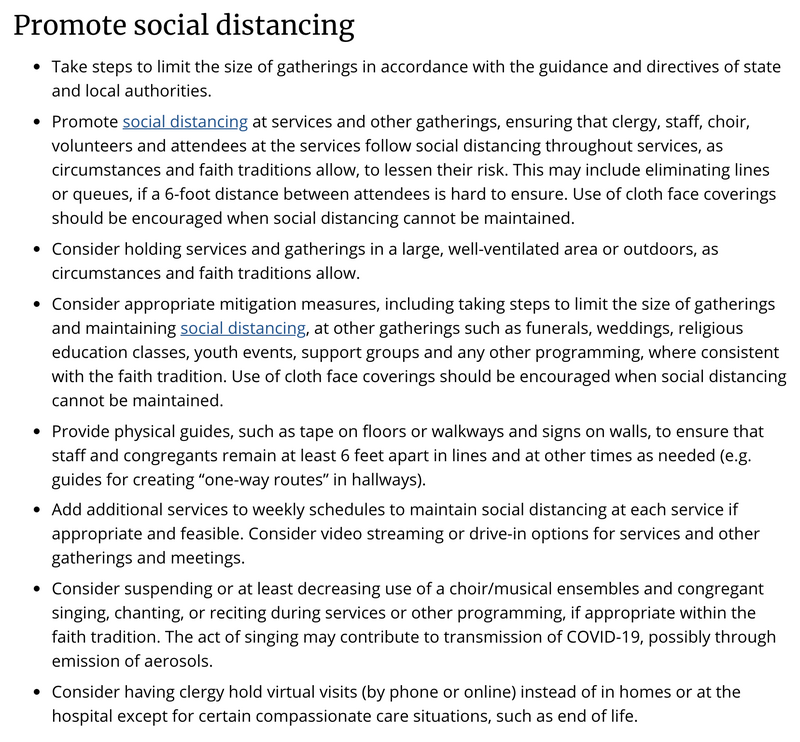
“Consider suspending or at least decreasing use of a choir/musical ensembles and congregant singing, chanting, or reciting during services or other programming, if appropriate within the faith tradition. The act of singing may contribute to transmission of COVID-19, possibly through emission of aerosols.”
That language is now only visible in a web archive of the agency’s site. The current guidance instead calls for social distancing among church staff, choirs, and congregants, “as circumstances and faith traditions allow.”
The CDC has previously highlighted the risk of singing in choirs. Just two weeks ago, it published a report that deemed a choir practice in Skagit County, Wash., to be “a superspreading event.” With only one person out of 61 known to have been symptomatic at that March 10 practice, researchers said, 53 coronavirus cases were identified.
That report stated:
“Choir practice attendees had multiple opportunities for droplet transmission from close contact or fomite transmission, and the act of singing itself might have contributed to SARS-CoV-2 transmission. Aerosol emission during speech has been correlated with loudness of vocalization, and certain persons, who release an order of magnitude more particles than their peers, have been referred to as superemitters and have been hypothesized to contribute to superspeading events. Members had an intense and prolonged exposure, singing while sitting 6–10 inches from one another, possibly emitting aerosols.”
News of the revision to advice for religious institutions comes one week after the agency was scrutinized for changing the way it describes the spread of the virus. The CDC changed the prominence of its guidance about surface spread of the coronavirus, saying that the main means of transmission is person-to-person.
A CDC entry on social distancing had originally recommended suspending or reducing the use of singing and choirs in church services. The entry was later revised, and the warning about choirs was removed.
CDC / Screenshot by NPR
hide caption
toggle caption
CDC / Screenshot by NPR
A CDC entry on social distancing had originally recommended suspending or reducing the use of singing and choirs in church services. The entry was later revised, and the warning about choirs was removed.
CDC / Screenshot by NPR
The guidance on choirs had been part of a section titled “Promote social distancing” – a section that has now been cut from eight entries to five.
In another change, the first entry in that section now includes a reference to the First Amendment, which guarantees the freedom of religion and speech. Here’s how the sentence now reads, with the newly added phrase in bold:
“Take steps to limit the size of gatherings in accordance with the guidance and directives of state and local authorities and subject to the protections of the First Amendment and any other applicable federal law.”
We use cookies on our website to give you the most relevant experience by remembering your preferences and repeat visits. By clicking “Accept”, you consent to the use of ALL the cookies.
This website uses cookies to improve your experience while you navigate through the website. Out of these, the cookies that are categorized as necessary are stored on your browser as they are essential for the working of basic functionalities of the website. We also use third-party cookies that help us analyze and understand how you use this website. These cookies will be stored in your browser only with your consent. You also have the option to opt-out of these cookies. But opting out of some of these cookies may affect your browsing experience.
Necessary cookies are absolutely essential for the website to function properly. These cookies ensure basic functionalities and security features of the website, anonymously.
Cookie
Duration
Description
cookielawinfo-checbox-analytics
11 months
This cookie is set by GDPR Cookie Consent plugin. The cookie is used to store the user consent for the cookies in the category "Analytics".
cookielawinfo-checbox-functional
11 months
The cookie is set by GDPR cookie consent to record the user consent for the cookies in the category "Functional".
cookielawinfo-checbox-others
11 months
This cookie is set by GDPR Cookie Consent plugin. The cookie is used to store the user consent for the cookies in the category "Other.
cookielawinfo-checkbox-necessary
11 months
This cookie is set by GDPR Cookie Consent plugin. The cookies is used to store the user consent for the cookies in the category "Necessary".
cookielawinfo-checkbox-performance
11 months
This cookie is set by GDPR Cookie Consent plugin. The cookie is used to store the user consent for the cookies in the category "Performance".
viewed_cookie_policy
11 months
The cookie is set by the GDPR Cookie Consent plugin and is used to store whether or not user has consented to the use of cookies. It does not store any personal data.
Functional cookies help to perform certain functionalities like sharing the content of the website on social media platforms, collect feedbacks, and other third-party features.
Performance cookies are used to understand and analyze the key performance indexes of the website which helps in delivering a better user experience for the visitors.
Analytical cookies are used to understand how visitors interact with the website. These cookies help provide information on metrics the number of visitors, bounce rate, traffic source, etc.
Advertisement cookies are used to provide visitors with relevant ads and marketing campaigns. These cookies track visitors across websites and collect information to provide customized ads.