A one-and-a-half-year-old daughter of a migrant labourer and a pregnant woman died at coronavirus quarantine centres in two districts of Chhattisgarh, officials said on Thursday.
While the pregnant woman died in Gariaband district on Thursday morning, the death of the child was reported from Gaurela-Penrda-Marwahi district on Wednesday, they said.
Bhagwati Yadav (27), a migrant worker, died in the quarantine centre set up by Dharnighoda village panchayat. She had returned with her parents from Telangana on May 14.
She was shifted to the district hospital in Raipur for treatment but brought back to the quarantine centre on May 21, a local official said.
“She was under observation but this morning she died. The body was sent for postmortem to Mainpur and the report is awaited,” he said.
A one-and-a-half-year-old girl died at the quarantine centre at Tikarkala village under Gaurela police station area, a local police official said.
Her father had returned to Bilaspur on May 17 from Bhopal by a Shramik special train. He was shifted to a quarantine centre in Pendra from where he escaped on May 18 to his native village, he said.
When residents of his village complained about it to local officials, Singh was shifted to the quarantine centre in Tikarakala with his wife and the infant daughter, the police official said.
On Wednesday, after breastfeeding the child, the mother went for taking a bath leaving the child behind. When she returned, she found the child was hiccuping and having problem breathing, he said.
The girl was rushed to a local Community Health Centre where doctors declared her brought dead, the official said.
Her swab sample was sent for coronavirus test. “Prima facie it seems the child choked to death due to air blockage after milk entered her nose. But the exact cause of death will be known after post-mortem report comes,” said Dr Abhimanyu Singh, Nodal Officer (COVID-19) of the district.
Government’s controversial tobacco ban is now facing numerous challenges on all fronts, with AfriForum being the latest party to enter the legal fray.
As South Africa awaits official word from Minister Nkosazana Dlamini-Zuma and the National Coronavirus Command Council (NCCC), on regulations which will govern the risk-adjusted strategy at Level 3 lockdown, the battle to unban tobacco builds more momentum.
While Dlamini-Zuma and President Cyril Ramaphosa attempt to fend off a strong legal challenge brought by the Fair Trade Independent Tobacco Association (Fita), other organisations and political parties are readying their responses in anticipation of government gazetting the continued ban on cigarettes.
Cigarette ban faces heavy fire
AfriForum confirmed that its legal counsel, represented by Daniël Eloff, had written a letter of demand addressed to Dlamini-Zuma as the Minister of Cooperative Governance and Traditional Affairs and chair of the NCCC. Ernst Roets, Head of Policy and Action at AfriForum, has argued that the protracted prohibition of tobacco under lockdown lacks rational or scientific reasoning. Â
As such, AfriForum has called for the sale and purchase of tobacco to be permitted under Level 3 lockdown. Roets added:
“If the Minister does not respond adequately to AfriForum’s letter by 3 June 2020, further legal action will be considered.â€
AfriForum added that allegations of collusion between Dlamini-Zuma and self-confessed illicit cigarette smuggler, Adriano Mazzotti, remained a major concern.
Bruised AfriForum eyes another courtroom showdown
The latest challenge laid down by AfriForum follows a series of courtroom setbacks. The organisation, which, together with trade union Solidarity, fought vehemently against Tourism Minister Mmamoloko Kubayi-Ngubane, was ultimately unable to overturn the B-BBEE requirements attached to COVID-19 relief funding.
AfriForum has since embarked on similar legal recourse involving the Department of Small Business Development’s BBE requirements.
DA’s Steenhuisen on ‘irrational’ prohibition
The Democratic Alliance (DA), which launched a serious legal challenge during Level 4 lockdown, has also called on Ramaphosa to provide clarity regarding consultative processes which have been cited as primary factors in determining regulations. Reacting to President Ramaphosa latest speech, Dean Macpherson, the DA’s Shadow Minister of Trade and Industry, wrote:
“In President Ramaphosa’s speech, he said that he had consulted “widely†in the move to Level 3. While the DA by and large supports this, it is important he provides us with the list of who he consulted with.
Did he consult with tobacco companies? Did he consult with hairdressers on their continued exclusion from operating and did he consult with the liquor industry on the reduced trading hours which will lead to long queues outside bottle stores?â€
The DA has been critical of government’s continued cigarette ban, with party leader, John Steenhuisen, stating that “there is no rational argument for the continued ban on cigarettesâ€.
The Trump administration is preparing an executive order intended to curtail the legal protections that shield social media companies from liability for what gets posted on their platforms, two senior administration officials said early Thursday.
Such an order, which officials said was still being drafted and was subject to change, would make it easier for federal regulators to argue that companies like Facebook, Google, YouTube and Twitter are suppressing free speech when they move to suspend users or delete posts, among other examples.
The move is almost certain to face a court challenge and is the latest salvo by President Trump in his repeated threats to crack down on online platforms. Twitter this week attached fact-checking notices to two of the president’s tweets after he made false claims about voter fraud, and Mr. Trump and his supporters have long accused social media companies of silencing conservative voices.
White House officials said the president would sign the order later Thursday, but they declined to comment on its content. A spokesman for Twitter declined to comment.
Under Section 230 of the Communications Decency Act, online companies have broad immunity from liability for content created by their users.
But the draft of the executive order, which refers to what it calls “selective censoring,†would allow the Commerce Department to try to refocus how broadly Section 230 is applied, and to let the Federal Trade Commission bulk up a tool for reporting online bias.
It would also provide limitations on how federal dollars can be spent to advertise on social media platforms.
Some of the ideas in the executive order date to a “social media summit†held last July at the White House, officials said.
Although the law does not provide social media companies blanket protection — for instance, the companies must still comply with copyright law and remove pirated materials posted by users — it does shield them from some responsibility for their users’ posts.
Along with the First Amendment, Section 230 has helped social media companies flourish. They can set their own lax or strict rules for content on their platforms, and they can moderate as they see fit. Defenders of the law, including technology companies, have argued that any move to repeal or alter it would cripple online discussion.
But as conservatives have claimed that social media companies are biased against them and overmoderate their political views, Republican lawmakers have increasingly pushed to modify the statute.
Senators Marco Rubio of Florida and Josh Hawley of Missouri also chimed in this week after Twitter applied its new fact-checking standard to the president. Both lawmakers have been critics of the protections that technology companies enjoy under Section 230, and they renewed their calls to alter it.
The president has long favored Twitter as a means to reach his supporters, posting personal attacks and previewing policy. This week, Mr. Trump repeatedly spread a debunked conspiracy theory about the MSNBC host Joe Scarborough and the death of a woman who worked for him in his congressional office years ago. The woman’s widower has pleaded with Mr. Trump to stop.
The president ignored the widower’s request and denounced Twitter, claiming in a tweet that the social media company was trying to tamper with the November presidential election.
On Wednesday, he continued to criticize the company, accusing it of stifling conservative views. “We will strongly regulate, or close them down, before we can ever allow this to happen,†Mr. Trump tweeted.
A spokesperson for YouTube declined to comment on the executive order. Representatives for Facebook did not immediately respond to a request for comment.
But Mark Zuckerberg, the company’s chief executive, appeared to be pre-emptively trying to soften any blowback from the White House. In a taped television interview scheduled for Thursday morning with Fox, he cast aspersions on Twitter’s willingness to fact check Mr. Trump on its platform in real time.
“I just believe strongly that Facebook shouldn’t be the arbiter of truth of everything that people say online,†Mr. Zuckerberg said. “Private companies probably shouldn’t be, especially these platform companies, shouldn’t be in the position of doing that.â€
Courts have often ruled in favor of technology companies, upholding their immunity. It is not clear that the executive order would alter judges’ views on the law.
“It’s unclear what to make of this because to a certain extent, you can’t just issue an executive order and overturn on a whim 25 years of judicial precedent about how a law is interpreted,†said Kate Klonick, an assistant law professor at St. John’s University who studies online speech and content moderation.
Ms. Klonick, who said she had seen a draft version of the order, said that it was “likely not going to be upheld by a court.â€
Mike Isaac and Dai Wakabayashi contributed reporting.
Major League Baseball played its first night game under GE floodlights in 1935. Nick Holonyak, an engineer, developed the first visible light-emitting diode, or LED, at a GE lab in 1962. And the company’s connection to the light bulb was captured in its ubiquitous television commercials, which promised, “We bring good things to life.”
The uncoupling struck some as a pivotal moment, as if Kellogg had jettisoned its cornflakes business or Ford had stopped making cars.
Still, for years GE had been shifting away from that part of its business as it sought to focus on high technology, said Joseph Bower, a professor emeritus at Harvard Business School. In that sense, he said, the sale was symbolically significant but did not signal a major shift in the company’s strategy.
“Iconic is the right word because it is not a fundamental change to GE,” he said. “I suspect it could have been done a long time ago because, as GE looked at its portfolio, its consumer businesses like toasters and things like that weren’t good, profitable businesses.”
GE sold its lighting business to Savant Systems, a home automation company based in Massachusetts. GE did not disclose the terms but said the lighting division’s headquarters would remain in Cleveland and its more than 700 employees would transfer to Savant upon completion of the sale. The deal also included a licensing agreement to allow Savant to use the GE brand.
Closing chapter
Thomas Alva Edison (1847-1931), who developed the first electric light bulb, in his laboratory in New Jersey in this undated photo. Credit:AP
The transaction represented a closing to GE’s opening chapters in the second Industrial Revolution. The company traces its roots to Edison’s experiments in his laboratory in Menlo Park, New Jersey, which made him the first recipient of a US patent for an incandescent lamp in 1880.
It was one of 1093 US patents Edison received, more than any other inventor in American history.
In 1892, the company Edison had established to market his products, the Edison General Electric Co., merged with a competitor, the Thomson-Houston Electric Co., to form a new firm, the General Electric Co.
Edison would not remain part of the company for long. In 1893, he sold his stake in General Electric for a reported $US1.5 million, or more than $US430 million ($650 million) in today’s dollars, according to GE.
Over the next century, the company would become a bellwether of the American economy, turning out jet engines, locomotives, gas turbines — and lots and lots of light bulbs.
For nearly 130 years, GE Lighting was at the forefront of every major lighting innovation, from the dawn of incandescent bulbs to the first energy-saving fluorescent bulb, introduced in 1974, according to the company.
But the business began to dwindle with the proliferation of LEDs, which need to be replaced less frequently because they are longer-lasting and more energy-efficient than traditional incandescent lights. Industry data showed that LEDs outsold all other types of bulbs for the first time in 2017.
GE, which reported $US95 billion in revenue last year, has not disclosed for several years what portion of its business comes from lighting. But Bower said light bulbs were “not really significant for a very big, big company.”
Loading
H. Lawrence Culp Jr., GE’s chairman and chief executive, called the sale “another important step in the transformation of GE into a more focused industrial company.”
“Together with Savant, GE Lighting will continue its legacy of innovation, while we at GE will continue to advance the infrastructure technologies that are core to our company and draw on the roots of our founder, Thomas Edison,” he said.
Two migrant workers who returned a few days ago to the district committed suicide, police said on Thursday. People close to the two deceased said that both were facing financial problems.
Suresh (22) committed suicide by hanging from a tree in his Lohara village under Mutondh police station area on Wednesday, SHO Mutondh Ramendra Tiwari said.
The body has been sent for post-mortem examination and investigations are on, the SHO said. According to the family, Suresh was working in Delhi and had returned home 5 days ago. He had no money and was under immense stress, they said.
In a similar incident in Sindhan Kala village under Pailani police station area, Manoj (20) who had returned from Mumbai 10 days ago committed suicide by hanging in his room. His neighbour said that Manoj was working in a private company as security guard which closed down because of the lockdown. His parents had died long ago and he was living alone and had no money to buy ration.
SI incharge of Pailani, Baljeet Singh, said the body was handed over to the villagers after postmortem examination. The villages are saying that the deceased committed suicide because of financial problems and an investigation has been started , Baljeet Singh added.
Channel 10 ‘MasterChef Australia: Back To Win’s ‘Best Dish’ week continues.
As ’MasterChef Australia’s ‘Best Dish’ week continues, Thursday appears to be the episode viewers have been waiting for with magical fairytales and fables-themed challenge.Â
A new promo shows judges Andy Allen, Melissa Leong and Jock Zonfrillo absolutely blown away by a mystery dish that Andy describes as “specialâ€.Â
“If there was ever a plate of food that has come through this kitchen that says, ‘I Am Back To Win’, it’s this dish,†added Melissa.Â
Fans have been quick to start guessing who the cook is behind his secret creation, and so far Reynold Poernomo and Jess Liemantara have appeared to be the frontrunners.
“I would love to say Jess but no one can beat Reynold when it comes to technique and presentation!!!†one viewer wrote on Instagram. “So maybe it’s him? If that’s a desert that is!â€
“FINALLY. There’s a lot of pressure on this dish’s shoulders after all the build up! I hope it’s from Jess,†another commented on Facebook.
Some detective work by eagle-eyed fans appeared to suggest it will be Reynold because of the bowl featured in the clip.Â
“Its reynold. I can see from the bowl he used. He made dessert with tree branches on it and he used that bowl (sic),†said one viewer.
“I’m thinking Reynolds he has used round bowls before in desserts. Here’s hoping (sic),†said another.Â
The five contestants set to compete in the immunity challenge on Thursday night are Reynold Poernomo, Jess Liemantara, Poh Ling Yeow, Khanh Ong and Brendan Pang.Â
‘MasterChef Australia: Back To Win’ continues at 7:30pm.Â
Protesters in Minneapolis on Tuesday filled the intersection in the street where a black man named George Floyd died in police custody. Protesters later damaged the windows of a police precinct and a squad car. Police responded with tear gas. (May 27)
AP Domestic
Protesters clashed with police in Minneapolis. They chanted for justice in Memphis. They stopped freeway traffic in Los Angeles.
The death of George Floyd continued to ripple across the U.S. on Wednesday night as the calls became louder for the arrest of the white police officer who knelt on his neck for several minutes in a “horrifying” video that spread across social media this week.
While hundreds of protesters took to the streets, police chiefs from coast to coast expressed their outrage with Floyd’s death.
“Do not defend the undefendable, attempt to justify the unjustifiable or excuse the inexcusable,” Miami Police Chief Jorge Colina said on Twitter. “George Floyd should be alive today.”
“The lack of compassion, use of excessive force, or going beyond the scope of the law, doesn’t just tarnish our badge – it tears at the very fabric of race relations in this country,” Los Angeles Police Chief Michel Moore said in a statement posted to Twitter.
Minneapolis: Police, protesters clash; looters raid Target, Dollar Tree, other stores
Protests in Minneapolis devolved into chaos on Wednesday night. Reports of fires came from around the city and videos of looters inside of stores quickly spread on social media. Several people shared video of people taking products from a local Target.Â
A Cub Foods, a Dollar Tree and an AutoZone store also showed signs of damage and looting, and windows of businesses in nearby strip malls were reported to be smashed out.
At least one person was killed. Police spokesman John Elder told USA TODAY that the department was investigating a homicide near the area where a reporter from the Star-Tribune newspaper tweeted that a looter had been shot and killed by a pawn shop owner.
As the protests stretched into the evening, Police Chief Medaria Arradondo urged calm. In an interview with KMSP-TV, he noted the internal investigation as well as the FBI’s investigation of Floyd’s death and said they offer a chance at justice.
“Justice historically has never come to fruition through some of the acts we’re seeing tonight, whether it’s the looting, the damage to property or other things,†he said.
Minnesota Gov. Tim Walz, meanwhile, called the situation “extremely dangerous” on Twitter and urged people to leave the area.
Memphis: George Floyd’s death was ‘nail in the unfortunate coffin for America’
A silent demonstration to protest the death of Floyd, as well as Breonna Taylor and Ahmaud Arbery, turned into verbal confrontations with Memphis police and counter-protesters.
The rally began with about 40 people holding signs reading “Black Lives Matter,†“Stop killing black people†and “Silence is violence.†Protesters were largely silent, with occasional chants of “no justice, no peace†and the names of black men and women who had been killed by police officers.
Passing drivers — and one ambulance — honked in support and waved or gave thumbs-up.
Within an hour, however, the protesters were met by two counter-protesters, who identified themselves as members of the Facebook group Confederate 901.
Theryn C. Bond, a prominent local activist and former Memphis City Council candidate, confronted the counter-protesters, who occasionally jeered at the crowd to “go out for a jog” — a reference to Aubrey’s slaying.
“I was so impressed to see so many white allies,” Bond said. “Because sometimes we think, ‘Everybody doesn’t get it.’ And I think with the recent murder of George Floyd by police… I think this was the proverbial nail in the unfortunate coffin for America to really understand what we mean when we say, ‘Black Lives Matter.'”
Los Angeles: Protesters block 101 freeway, smash windows of California Highway Patrol cruisers
Hundreds of people protesting Floyd’s death while in police custody blocked a Los Angeles freeway and shattered windows of California Highway Patrol cruisers in a rally organized by Black Lives Matter.
Demonstrators gathered in the late afternoon on downtown streets and, eventually, dozens of them moved onto U.S. 101 despite police efforts to keep them from walking into the lanes.
When a CHP patrol car arrived, demonstrators surrounded it. The car’s window was smashed and it jerked forward and moved away with several protesters who had jumped onto the hood. Television news footage showed one man finally hopping or jumping from the side of the moving car and then flopping onto the ground.
A second CHP car arrived and was attacked, with one demonstrator hurling what appeared to be a wooden skateboard through the back window before it moved off.
At its rally’s peak, hundreds of people gathered outside the Los Angeles County Hall of Justice. The demonstration was mostly peaceful and no arrests were immediately made, Los Angeles police Officer Mike Lopez said.
Contributing:Â Corinne S. Kennedy, Micaela A. Watts and Samuel Hardiman, The Commercial Appeal (Memphis, Tenn.);Â The Associated Press.
It was the pandemic, Twitter says, that freed the company to attach fact-check warnings to a pair of U.S. Present Donald Trump’s tweets this week.
Critics have complained for years that Twitter lets Trump run wild on the platform. But the company had generally taken a hands-off approach to the president, partly because of a company policy that considers it in the public’s interest to know what world leaders are thinking, and partly because Twitter judged many of Trump’s tweets to fall into a gray area not covered by its rules banning specific behaviors like abuse or posting hateful content.
Twitter says the coronavirus outbreak prompted it to re-evaluate its approach to these gray-area tweets and treat some of them as potentially dangerous.
“Covid was a game changer,†said Twitter spokesperson Katie Rosborough.
“We now have the tools in place to label content that may contain misleading claims that could cause offline harm,†said Rosborough. Those tools include the warning labels attached to Trump’s tweets that link to a Twitter “Moment,†or collection of content, explaining objections to his post.
Twitter has in recent months been quietly laying the groundwork for further questioning of Trump’s tweets.
Twitter has not yet defined what generally counts as offline harm, but in the case of coronavirus-related content, it has identified tweets like those that advocate protecting yourself from the virus using methods public health authorities say are ineffective.
Now Twitter is applying a similar metric to non-coronavirus-related tweets by the president of the United States.
On Tuesday, Twitter added warning labels to two Trump tweets claiming, without evidence, that mail-in ballots, like those being used in California amid the pandemic, are likely to be “substantially fraudulent.†The labels directed users to a link to “get the facts about mail-in ballots.â€
That decision has triggered a high-pitched confrontation with Trump, who vowed Wednesday to take “big action†against social media companies that he accuses of silencing conservatives. White House Press Secretary Kayleigh McEnany later said Trump will sign an executive order Thursday aimed at social media companies, amid a flurry of calls from GOP allies for reducing the companies’ protections from lawsuits.
But Twitter has in recent months been quietly laying the groundwork for further questioning of Trump’s tweets — possibly setting the stage for even harsher collisions with a president and his supporters already raging against the San Francisco company.
That said, Twitter has at least one reason to not be as shaken by such threats as bigger players in social might be. Unlike Facebook and Google, the company is too small to trigger the scrutiny of federal antitrust authorities who could be leaned on by an angry president.
The company has made other recent moves in the political arena meant to inoculate it against complaints that it’s destabilizing democracy in the United States but that have also served to anger some on the right, including banning political advertising altogether.
The coronavirus lesson for Twitter was that the company’s trust and safety team, which is charged with taking action on inappropriate posts, could selectively challenge tweets that don’t violate its stated rules — the black-and-white laws of Twitter that gets tweets deleted for specific behaviors like encouraging violence — but that wade into grayer territory, where by misleading or confusing people they can cause real-world harms. In those cases, the supposed worst-of-the-worst get tagged with additional context from around the web, summarized by a specialized Twitter content team.
Under the new approach, for example, Twitter added warning labels to tweets alleging that the novel coronavirus was spread not by human contact but the wireless technology 5G.
“Our research has shown people don’t want us to decide what’s true for them, but they want us to provide further context when possible,†Rosborough said.
In the case of the Trump tweets on mail-in ballots, part of the harm calculation was their timing: Trump was calling mail-in ballots “fraudulent†right at the moment some U.S. states are using them to administer elections amid the pandemic, the company said.
On the left, many argue that Twitter is only taking the weakest possible action in response to rampant misinformation.
But while Twitter may see the decision as a natural evolution, this week’s tagging of the Trump tweets about mail-in ballots marks a change in the company’s posture toward the president, and could be the beginning of a new escalation of tensions. It was the very first application of Twitter’s new approach on misinformation to tweets not having to do with COVID-19 — much as, back in February, the company first applied a three-day-old policy on so-called synthetic media to a tweet from Trump aide Dan Scavino featuring a clipped video of Joe Biden.
And the Trump warning labels have significantly ratcheted up tensions between Trump and Twitter.
Trump denounced Twitter over its flagging of his mail-in-ballot tweets, and POLITICO’s Playbook reported Wednesday afternoon that the White House is working on a threatening letter to the company. Twitter declined to comment on both that would-be missive and the reports of an imminent executive order.
Trump speaks during a Fox News virtual town hall | Jim Watson/AFP via Getty Images
On the left, many argue that Twitter is only taking the weakest possible action in response to rampant misinformation from the White House and ignoring many tweets that are just as egregious. The same day that Twitter decided Trump’s voting tweets went too far, it declined a request by the husband of a deceased Florida woman whom Trump had suggested with no evidence had been murdered by MSNBC host Joe Scarborough. The company said the decision to leave Trump’s Scarborough quotes alone was made quickly, as they were judged to not be in violation of any of Twitter’s existing policies.
But Twitter left a hint this week that it may continue to expand the categories of tweets it evaluates with this new approach to tweets like the one Trump levied at Scarborough.
In expressing sympathy to the widower, Twitter gave a bit of insight into its thinking in a line that looked at first like a throwaway: “We’ve been working to expand existing product features and policies so we can more effectively address things like this going forward, and we hope to have those changes in place shortly.â€
Skeptics will say that Twitter remains, as it has been throughout its 14-year existence, haphazard about how it creates, articulates and enforces its policies. And its new handling of misleading tweets isn’t likely to do much to quiet those concerns. For one thing, the policy isn’t articulated anywhere in the site’s stated rules.
Rep. Ro Khanna, a Democrat representing a considerable slice of Silicon Valley, gave voice to some of that argument in a tweet of his own Wednesday: “This disagreement is exactly why we need thoughtful policies to consistently limit misinformation, instead of ad hoc fact checks whenever the headlines push Twitter hard enough.â€
Twitter first announced its approach to coronavirus misinformation in March, just as the COVID-19 crisis was heating up, in a blog post from its head of policy and legal, Vijaya Gadde, and customers lead Matt Derella.
Trump speaks during a press briefing with members of the White House Coronavirus Task Force team | Drew Angerer/Getty Images
Twitter said then it would expand its definition of the kind of “harm†that could get a tweet knocked off the service to include those that conflict with public health authorities’ stated guidance on the coronavirus. By way of example, Twitter said that could encompass tweets suggesting that social distancing doesn’t work to slow the spread of the virus.
Twitter quickly tested out that new policy on at least one world leader: At the tail end of March it deleted coronavirus-related tweets from Brazilian President Jair Bolsonaro, judging them to be so harmful that they didn’t even merit protection under Twitter’s policy of placing a label on rule-breaking tweets by world leaders. (Twitter’s announcement of that policy last June was immediately assumed by many observers to be targeted at Trump.)
On May 11, Twitter announced that in addition to its flagging of questionable coronavirus content, “we may use these labels and warning messages to provide additional explanations or clarifications in situations where the risks of harm associated with a Tweet are less severe but where people may still be confused or misled by the content.â€
That post sets up three categories of tweets where it might step in: “misleading information,†“disputed claims†and “unverified claims.†The Trump tweets on mail-in ballots, the company said, were the first instance since the implementation of the new approach in which it became aware of a piece of misleading information posted by the president concerning enough to take on under the new framework.
South Korea has reported its biggest spike in new coronavirus cases in nearly two months, raising fears of a second wave of disease in a country widely praised for containing the initial outbreak.
The Korea Centers for Disease Control and Prevention (KCDC) announced 79 new cases on Thursday, saying 67 of the new infections were in the Seoul metropolitan area, where about half of South Korea’s 51 million people live.
More:
It was the third straight day of rising infections and the largest increase since April 5, when authorities announced 81 cases.Â
Health Minister Park Neung-hoo pleaded for all residents in the greater capital area to avoid unnecessary gatherings and urged companies to keep sick employees off work. He said at least 69 cases this week have been linked to a cluster of infections at a logistics facility operated by Coupang, one of the country’s largest online shopping firms, in Bucheon, west of Seoul.
Kim Gang-lip, the vice health minister, said around 4,100 workers and visitors to the building were under self-isolation, with more than 80 percent tested so far. “We are expecting the number of new cases linked to the warehouse to continue rising until today as we wrap up related tests,” he told reporters.
According to the KCDC, the new cases brought the country’s total as of midnight on Wednesday to 11,344 with 269 deaths.
Pedestrians in face masks cross a street in Seoul as the authorities rushed to control new clusters of coronavirus [Kim Hong-Ji/Reuters]
South Korea’s robust programme of testing earlier this year was credited with helping keep the number of deaths comparatively low in a global pandemic that has now killed more than 350,000 people. And unlike many countries, South Korea did not impose a strict lockdown to control the new virus.Â
But Yonhap news agency said this week’s surge in new infections has put South Korea’s fight against the virus “in trouble”.
The warehouse cluster appears linked to an outbreak that emerged in several Seoul nightclubs and bars in early May, according to the KCDC, and comes as the country seeks to ease social distancing rules, reopen schools, and keep new infections in check.
KCDC Director Jeong Eun-kyeong said the country may need to reimpose social distancing restrictions, saying it was becoming increasingly difficult for health workers to track transmissions amid increasing public activity.
“The number of people or locations we have to trace are increasing geometrically,” she said during a briefing on Wednesday afternoon.Â
“We will do our best to trace contacts and implement preventive measures, but there’s a limit to such efforts. There’s a need to maximise social distancing in areas where the virus is circulating, to force people to avoid public facilities and other crowded spaces.”
Health officials said on Thursday they would be conducting on-site inspections of logistics centres across the country, to develop better policies for preventing outbreaks at such facilities.
Coupang, backed by Japanese tech conglomerate SoftBank Group, said it closed the Bucheon facility on Monday. It said on Thursday it had also closed a separate facility in Goyang, in the Seoul suburbs, after an employee there tested positive.
“As soon as the employee’s diagnosis was confirmed, Coupang sent home and self-quarantined employees who had contact with the employee,” the company said in a statement.
The spreading outbreak and warehouse closures come as Coupang and other e-commerce firms scramble to keep up with a surge in orders as more people opted to shop from home during the coronavirus outbreak, despite the absence of a strict lockdown.
In February, March and April, sales of South Korean online retailers including Coupang jumped 34 percent, 17 percent and again 17 percent, respectively, from the same months a year ago, according to trade ministry data.
No planes in the sky, empty hotels and deserted attractions: with the world at a standstill, the tourism industry has been one of the industries worst-hit by the Covid-19 pandemic. International arrivals this year could be down by 80% compared with 2019, according to the World Tourism Organization, and more than 100 million jobs are under threat.
“Of course, it’s completely devastating – but it’s also provided a much-needed chance for introspection,†said Sam Bruce, founder of Much Better Adventures, a co-founder of campaigning group Tourism Declares a Climate Emergency. “Things needed to change. It’s an opportunity for everyone from tourist boards to tour operators to reset and to look at how things can be better – for the planet, for local communities and for travellers.â€
In Venice – one of the most overtouristed cities, with an estimated 25 million foreign visitors a year – officials are using the pause to rethink “an entire Venice systemâ€, with sustainability and quality tourism at its core, said Paola Mar, the city’s councillor for tourism. Part of the plan is to lure locals back to live permanently in the city. The mayor is in discussions with universities, aiming to offer tourist rentals to students, and old buildings are being restored for social housing. Measures to control visitor numbers – including a tax on day trippers, which was due to be introduced in July – will go ahead next year, while the debate around cruise ships continues.
“Our goal is to trigger a renaissance of the city,†said Mar. “We want to attract visitors for longer stays and encourage a ‘slower’ type of tourism. Things can’t go back to how they were.â€
A sign in Amsterdam’s Leidseplein counting the days until bar terraces are allowed to reopen. Photograph: Remko de Waal/EPA
City authorities in Amsterdam – which was struggling to cope with an estimated 18.3 million overnight tourist stays in 2019 – are also quietly hopeful that the pandemic will be a catalyst for change. Last week the mayor urged extreme caution in reopening to tourists, while nonprofit group Amsterdam&Partners believes the tourist hiatus pushes to the top of the agenda plans to cut numbers, give Amsterdam back to locals and attract the “right†kind of visitor , and has launched a sustainability taskforce to map the way forward.
“We are working with partners to discuss how we can restart in a more sustainable and responsible way,†said Amsterdam&Partners spokeswoman Heleen Jansen. “The main focus is that we want a sustainable visitor economy that doesn’t harm the livability of our city. If you have the right balance between living, working and visiting, you can have the right visitor economy. That’s what went wrong in the last years in the old city centre, and we have to entice locals to discover their city centre again.â€
Meanwhile, the suddenly empty streets of Barcelona have made local businesses and the tourist board re-evaluate their priorities too. “While we couldn’t continue at the speed things were, this is showing us that no tourists is no good either – there needs to be a more moderate way,†said Mateo Asensioof the Barcelona tourist board. “Our first task is getting locals back out into the city, then the domestic market and our neighbours. When the international market returns, we’ll focus more on specific sectors. It’s an opportunity to change the rules.â€
With the world’s “new normal†including social distancing, an increased fear of crowds and busy places – and the future of airlines in the balance – over-tourism may not be a pressing issue for some time.
Other changes in cities around the world include reshaping in favour of cyclists and pedestrians: Athens is accelerating plans for a car-free historic centre, Berlin is introducing 14 miles of new bike lanes, and Paris is also significantly increasing its bike lanes, to ease potential overcrowding.
Destinations likely to see the first surge in visitor numbers are remote coastal and rural areas, places seen as “safeâ€, said Patricia Yates, acting CEO of Visit Britain/Visit England. It will be longer before cities bounce back.
Quieter coastal areas, such as the Gower in Wales, will see the first rise, says Visit Britain. Photograph: Phil Rees/Rex
“Our weekly consumer sentiment surveys show that the domestic market is very nervous – so we will be focusing initially on reassurance,†she said. “But beyond that we will be looking at promoting areas outside the honeypots. What is needed is destination management to rebuild tourism more slowly and keep residents, visitors and businesses that depend on tourists happy – it’s quite a balancing act.â€
Some of the progress made on sustainable tourism is likely to go into reverse at first, she added – with people eschewing public transport in favour of car travel and infection control measures leading to more single-use plastic.
Many tour operators, however, believe the pandemic could engender a positive change in client behaviour. Intrepid Travel CEO James Thornton said: “During this hibernation period we’ve seen the benefit to nature and the climate – fish spotted in Venice’s clearer canal water, the Himalayas visible in India – and people have had time to reflect. I think customers will be more aware of the impact of travel on the environment and the communities they visit, and make more considered choices.â€
A renewed focus on slower travel, including train journeys and cycling, as well as keeping experiences as local as possible and offering more off-season departures are part of Intrepid’s post-Covid plans, with wilderness and wellness trips tipped to be of most interest.
The Runkerry Trail in Northern Ireland: slower travel could include more trains and bikes. Photograph: David Lyons/Alamy
Launching new adventures in even more remote destinations to assist with economic recovery is on the agenda for Much Better Adventures when tourism opens up again. “The crisis has shown just how much communities in less-developed parts of the world rely on tourism,†said Sam Bruce. “We will look to spread tourism to areas that would genuinely benefit. But it has to be done in the right way. We risk a flood to remote places that aren’t prepared and could be taken advantage of.
“I’m hopeful that a new, slower tourism will emerge – but the recovery needs to be slow enough for the industry to make the right decisions as it rises from the ashes.â€
G Adventures founder Bruce Poon – who has just published Unlearn: The Year the Earth Stood Still,an e-book looking at the impact of the pandemic on tourism – believes the industry can emerge as a stronger force for good.
“People will travel again. We don’t yet know when, but we know that they will. I want to challenge everyone who travels to ‘unlearn’ what they think they know. We have the opportunity to use this reset to be more conscious about how we can improve, as individuals and as a wider travel community.â€
The biggest issue in the move to a more sustainable tourist industry, though, is air travel – aviation accounted for 2% of global carbon emissions in 2019 and was one of the fastest-growing polluters. With airlines grounded, emissions from aviation declined by about 60% in early April compared with 2019, according to the journal Nature Climate Change.
With the pause likely to be temporary, campaigners from Greenpeace to Flight Free are demanding that airline bailouts come with strict conditions on their future climate impact and say Covid should be the catalyst for greening the world’s airlines.
But in a race for economic recovery, rebuilding the industry quickly could sideline climate change and aviation issues, said Justin Francis of Responsible Travel, who is calling for a “green flying dutyâ€, with more regulation and tax revenues invested in renewable fuels.
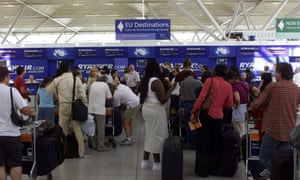
Queues at Stansted Airport: many people were ‘hooked on short breaks’, says Responsible Travel. Photograph: Graham Turner/The Guardian
The cost of flights is likely to rise in the long term, he added. “Short term, the where and how we travel has had to change. But new, more entrenched, norms could form from that. Many people were hooked on frequent short breaks, but key to more sustainable tourism is taking far fewer flights – we may now see a return to longer, less frequent holidays, with more time spent getting to know a place, and a rise in slower forms of travel.â€
Whatever happens, it’s unlikely travel will ever be the same as in pre-Covid days. An industry known for its resilience will find a new way forward, adapting to an unknown global market, but whether sustainability can be at the heart of a new model of tourism is hard to predict.
“Tourism will be smaller, and so more sustainable per se. Fewer flights means less C02, fewer guests means less waste, and there will be much more focus on localism, at least initially,†said Graham Miller, professor of sustainability in business at the University of Surrey.
“How the nature of the product changes, however, remains to be seen. There are huge vested interests to contend with – like the cruise industry in Venice and big businesses – but it feels like the moment we have been waiting for. If we are going to redesign tourism, this is about the best chance we can wish for.â€
We use cookies on our website to give you the most relevant experience by remembering your preferences and repeat visits. By clicking “Accept”, you consent to the use of ALL the cookies.
This website uses cookies to improve your experience while you navigate through the website. Out of these, the cookies that are categorized as necessary are stored on your browser as they are essential for the working of basic functionalities of the website. We also use third-party cookies that help us analyze and understand how you use this website. These cookies will be stored in your browser only with your consent. You also have the option to opt-out of these cookies. But opting out of some of these cookies may affect your browsing experience.
Necessary cookies are absolutely essential for the website to function properly. These cookies ensure basic functionalities and security features of the website, anonymously.
Cookie
Duration
Description
cookielawinfo-checbox-analytics
11 months
This cookie is set by GDPR Cookie Consent plugin. The cookie is used to store the user consent for the cookies in the category "Analytics".
cookielawinfo-checbox-functional
11 months
The cookie is set by GDPR cookie consent to record the user consent for the cookies in the category "Functional".
cookielawinfo-checbox-others
11 months
This cookie is set by GDPR Cookie Consent plugin. The cookie is used to store the user consent for the cookies in the category "Other.
cookielawinfo-checkbox-necessary
11 months
This cookie is set by GDPR Cookie Consent plugin. The cookies is used to store the user consent for the cookies in the category "Necessary".
cookielawinfo-checkbox-performance
11 months
This cookie is set by GDPR Cookie Consent plugin. The cookie is used to store the user consent for the cookies in the category "Performance".
viewed_cookie_policy
11 months
The cookie is set by the GDPR Cookie Consent plugin and is used to store whether or not user has consented to the use of cookies. It does not store any personal data.
Functional cookies help to perform certain functionalities like sharing the content of the website on social media platforms, collect feedbacks, and other third-party features.
Performance cookies are used to understand and analyze the key performance indexes of the website which helps in delivering a better user experience for the visitors.
Analytical cookies are used to understand how visitors interact with the website. These cookies help provide information on metrics the number of visitors, bounce rate, traffic source, etc.
Advertisement cookies are used to provide visitors with relevant ads and marketing campaigns. These cookies track visitors across websites and collect information to provide customized ads.