
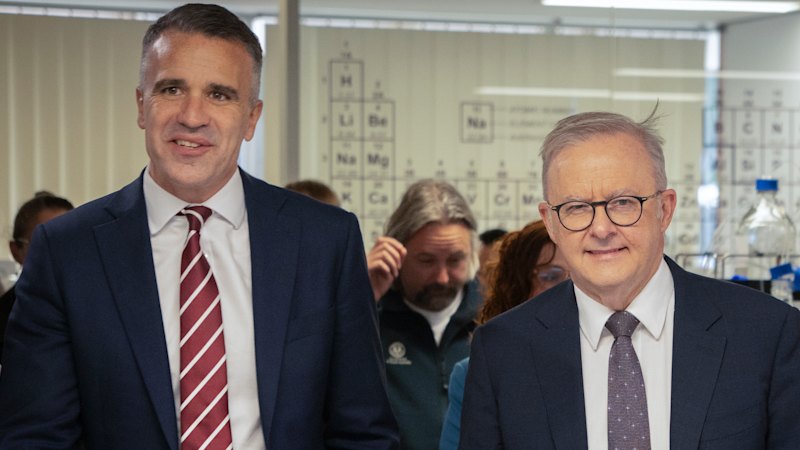
States have privately warned Canberra that deep cuts to the intake of international students will hurt an already slowing economy, creating another roadblock for Prime Minister Anthony Albanese as he tries to reduce the rate of migration.
As Albanese stepped in to head off a debate about refugee cuts, state sources said premiers discussed the financial consequences of recent cutbacks on student visas at a meeting before national cabinet in Sydney on Wednesday.
Victorian Premier Ben Carroll raised the issue, according to sources familiar with the talks, as states sought to influence Labor’s upcoming migration overhaul, which is expected to tighten a range of rules for students and other temporary migrants.
Carroll expressed concern that any new measures to slow down the inflow of students beyond those enacted in the past year would cause economic pain, a view supported by South Australia Labor Premier Peter Malinauskas, who has been warning about student cuts for months.
“This is not a popular thing to say, but I think the debate that we’re having around migration in the country is self-defeating,” Malinauskas said on Thursday. “I worry it will represent a big opportunity cost because we’ll be turning away economic projects, we’ll be turning away creating new wealth for the country, growing productivity.
“We don’t have a migration crisis – we’ve got a housing crisis.”
Pushing in the other direction was NSW Labor Premier Chris Minns. Minns, who has clashed with Albanese previously, said the record-high net migration rate after the pandemic created “major infrastructure and services problems”.
“[We] can’t rely on that to drive productivity and growth in our economy. We have to be broader than that,” Minns said, echoing the view of economists and the Coalition who argue that Australia’s GDP growth has been propped up by migration.
Speaking alongside Malinauskas at News Corp’s Bush Summit, Minns added: “That means reducing red tape. It means building new housing. It means being more efficient with energy and infrastructure.”
Federal sources said states including Victoria and NSW had also been complaining behind the scenes about a reduction in the amount of skilled workers individual states can select to work in specific industries. In the budget, Labor changed the composition of the permanent program, which issues visas to 185,000 people a year, to reduce the number of state and territory nominated regional visas from 33,000 to 14,110.
The multi-pronged pushback from state premiers presents another complication for Labor as it seeks to address growing concern about migration, underscored by One Nation’s rise, by lowering net migration from 300,000 to 225,000. This masthead has previously reported that Labor was considering a funding boost for deportations, tougher family visa rules, capping the number of backpackers, curbing the appeal rights of asylum seekers and limiting visa options for international students.
Home Affairs Minister Tony Burke is due to make an announcement in coming weeks after he abruptly cancelled an appearance at the National Press Club this month when he was expected to put forward Labor’s plan.
The government also created a messy debate on refugee numbers on Thursday. Albanese denied a report that Labor would drop the intake from 20,000 to 13,750, saying at the Bush Summit that people should not “believe everything you read”. However, this masthead was told by government figures weeks ago that the intake would drop after it had grown to accommodate Ukrainians fleeing Russia’s invasion.
Albanese released a statement on Thursday afternoon after refugee advocates raised the alarm. “The refugee intake needs to be renewed in the coming budget as the 20,000 places was available for four years,” the prime minister said.
“This intake number remains government policy and will be continued in future years, consistent with Australia’s humanitarian commitments, and sits beside our strong border security measures.”
The party’s platform was amended at last month’s national conference to remove a goal of progressively increasing the intake to 27,000 places. Instead, it said: “Labor will seek, in the short term, to maintain Australia’s government-funded humanitarian intake numbers at 20,000 places per year while also continuing to aspire to achieving 27,000 places per year.”
Albanese, speaking earlier, said: “There is a current spike in the support for One Nation, quite clearly, but we’ve responded. We started lowering the numbers well before that occurred.”
The budget papers also said the government would give more permanent visas to onshore applicants, rather than people still living overseas, to reduce net migration. Recently, about 60 per cent of skilled visas and 40 per cent of family visas have been given to people already in Australia.
This masthead revealed this month that Labor had secretly slowed visa processing for backpackers while pausing applications from more than 24 countries.
The government has been using so-called “planning allocations” to control international student numbers, slowing down the visa approval process once a university reaches 80 per cent of its target. It also boosted entry requirements for English language skills.
The student boom has moderated from its post-pandemic high, and this year’s planning allocation of 295,000 places is 8 per cent below the post-pandemic peak. But overseas students remain a persistent political issue for Labor given thousands have stayed longer than their visa expiry date.
The government is taking other quiet measures to reduce demand, such as limiting appeal rights for rejected student visas, and hiking fees.
Temporary graduate visa fees were lifted from $2300 to $5750 within six months, while student visa fees are $2500, up from $710 two years ago. Working holidaymaker visa fees increased from $670 to $840 for first visas and $1000 for further visas, while partner visa fees rose from $9365 to $11,710.
Cut through the noise of federal politics with news, views and expert analysis. Subscribers can sign up to our weekly Inside Politics newsletter.
 Paul Sakkal is Chief Political Correspondent. He previously covered Victorian politics and won a Walkley award and the 2025 Press Gallery Journalist of the Year. Contact him securely on Signal @paulsakkal.14.Connect via X or email.
 Natassia Chrysanthos is Federal Political Correspondent. She has previously reported on immigration, health, social issues and the NDIS from Parliament House in Canberra.Connect via X or email.
From our partners
Discover more from PressNewsAgency
Subscribe to get the latest posts sent to your email.