
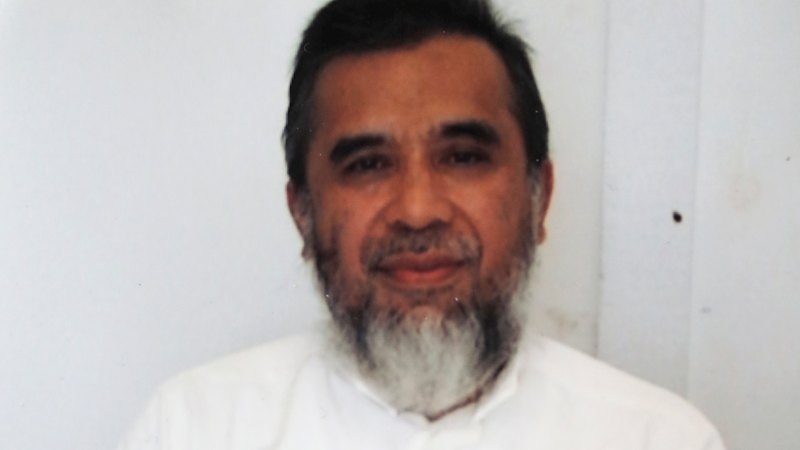
Washington: Prosecutors will seek a life sentence on US soil in the long-awaited military trial of alleged Bali bombing mastermind Encep Nurjaman, better known as “Hambali”, and say they will never entertain a pre-trial agreement that would repatriate him to Indonesia.
Family and friends of the 202 people killed – including 88 Australians – were recently told the trial should begin in just over a year from now, after more than 20 years of interrogation, imprisonment and delays.
“I can see closure finally coming,” said Jan Laczynski, who lost five friends when a car bomb exploded outside the Sari Club in Kuta on October 12, 2002. “This is possibly the end of this nightmare. But at the same time, a lot of people have been disappointed before.”
In a recent video conference with families, parts of which were obtained by this masthead, US military commission prosecutors said Hambali’s trial is likely to start late in the 2027 American summer – a year or so from now. The briefing was first reported by the ABC.
Hambali’s defence team has been given until September 9 to file any final motions to compel evidence discovery relating to the offences, and until December 2 to file any discovery motion related to sentence mitigation, documents show.
The prosecutors told family members there were now few pre-trial administrative processes left to complete. They also appeared to rule out any pre-trial agreement that would allow Hambali, 62, to be repatriated to Indonesia or serve his sentence elsewhere.
“OCP [the Office of the Chief Prosecutor] will never endorse the repatriation of Hambali,” one of the prosecutors said in the briefing. “We intend to get a life sentence, and we intend him to serve that sentence under US control for the rest of his life.”
Last year, Indonesia’s justice minister, Yusril Ihza Mahendra, suggested the country was looking into ways to have its citizen repatriated after 20-plus years of incarceration without trial. But the US prosecutors said the Indonesian government had clarified that it was not the case.
“Indonesia doesn’t have that desire, we don’t have that desire,” they told the families.
Ronald Flesvig, public affairs director at the Office of Military Commissions, confirmed prosecutors intended to seek the maximum penalty of life in prison if Nurjaman is convicted. He also said all pre-trial motions were expected to be complete by May or June 2027.
Evidence against Hambali
The trial will feature evidence from two of Hambali’s alleged co-conspirators, Mohammed Nazir bin Lep and Mohammed Farik bin Amin, who were repatriated to Malaysia late last year after pleading guilty before the military commission to multiple offences and providing testimony against the accused mastermind in a pre-trial agreement.
Prosecutors said they hoped to submit evidence collected from Australian terrorist Jack Roche, who in 2004 was convicted of conspiring to blow up the Israeli embassy in Canberra in 2000. He was the first person charged under Australia’s post-2002 terrorism laws.
Roche served his jail sentence and has since died, the US military prosecutors said. But he provided statements about Hambali to the Australian Federal Police and US Federal Bureau of Investigation in 2004 and 2005 respectively.
“We’re going to ask to allow those law enforcement agents to be able to testify,” prosecutors said.
Hambali’s chief defence counsel, Todd Fanniff, said it was possible a plea agreement could be reached but “nothing is being negotiated at this time”.
Laczynski said that in the video briefing, prosecutors made clear the families would have input in any decision about a plea deal. “They’re going to be including us, finally.”
Relatives to attend trial
Relatives and friends will also be able to submit victim impact statements in writing, in court or by video link from a secure site in the US.
Travelling to Guantanamo is complicated. Court attendees would typically fly to Washington, then to Guantanamo from a navy air base, and must stay there for at least one week. But several surviving relatives or friends, including Laczynski, expressed interest in attending the trial.
Nurjaman, or Hambali, also known by the name Riduan Isamuddin, was a senior leader of the now-defunct terrorist group Jemaah Islamiyah. He was apprehended in a joint operation in Thailand in 2003 and spent three years in CIA custody at secretive locations typically known as “black sites”.
He was taken to Guantanamo Bay in 2006, but it was only in 2021 that the US military charged him over the Bali nightclub bombings, as well as a 2003 bombing of the JW Marriott hotel in Jakarta.
Hambali is one of just 15 men still detained at Guantanamo, according to a New York Times project that tracks activity at the US military prison in Cuba. He is one of seven who are charged with war crimes but who are yet to be tried.
The cases are extremely complex, in part owing to the sensitivity of information regarding the CIA black sites where detainees were tortured, and the admissibility of evidence thereby gained.
Another military trial is set to begin at Guantanamo in October, that of Abd al-Rahim al-Nashiri, a Saudi Arabian national imprisoned there in 2006 and accused of plotting the bombing of the USS Cole in 2000, which killed 17 American sailors. Nashiri was charged in 2011.
Get a note directly from our foreign correspondents on what’s making headlines around the world. Sign up for our weekly What in the World newsletter.
 Michael Koziol is the North America correspondent for The Age and Sydney Morning Herald. He is a former Sydney editor, Sun-Herald deputy editor and a federal political reporter in Canberra.Connect via X or email.
From our partners
Discover more from PressNewsAgency
Subscribe to get the latest posts sent to your email.