
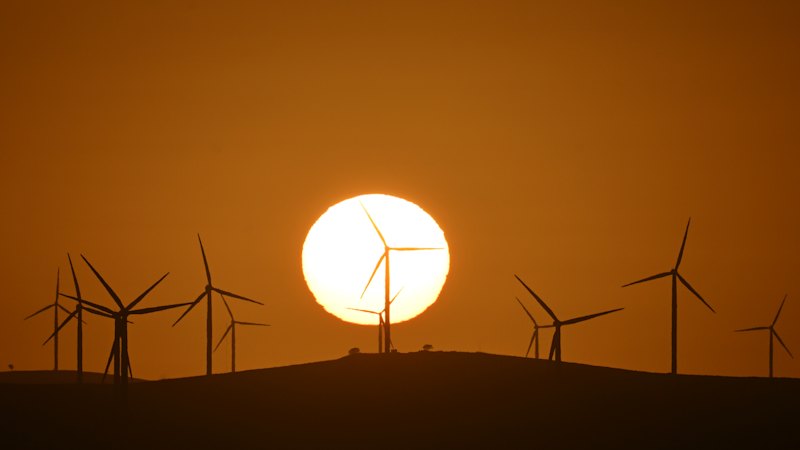
No extra money will be spent on the Albanese government’s ambitious rollout of renewables across the electricity grid next year, in an attempt to claw back savings in the next federal budget, even as Australia falls short of its target to reach 82 per cent green energy by 2030.
The push to halt spending on the nation’s net zero agenda will reverse the trend since Labor came to power in 2022, as successive federal budgets have injected billions of dollars into wind and solar farms, including $2 billion for the nation’s green bank in 2025.
Renewable energy projects – and the poles and wires to connect them to the grid – must be rolled out at speed and scale to reduce greenhouse gases to reach Australia’s commitment under the Paris Agreement to cut emissions at least 62 per cent by 2035.
This masthead has confirmed via several sources, speaking on the condition of anonymity, that new spending measures on the renewable rollout have been ruled out in the federal budget, due to be handed down on May 12.
Senior officials, including Department of Prime Minister and Cabinet secretary Steven Kennedy, have argued that additional support for the renewables rollout is already available through the environmental law reforms designed to speed up project approvals.
As revealed by this masthead, ministers have been instructed to find significant savings in all their portfolios, and Climate Change and Energy Minister Chris Bowen is trying to ringfence a number of big-spending energy transition initiatives.
He is also the lead negotiator at this year’s COP climate conference in Turkey, with the task of urging nations to lower emissions and set more ambitious targets.
Treasury is considering a move to recoup $3 billion by winding back the generous fringe benefit waiver for EV leases, one of the most popular programs overseen by Bowen.
Sales of electric vehicles have tripled in three years and transport emissions fell in the December quarter, the sector’s first-ever reduction in the sector outside of COVID lockdowns.
The popular Cheaper Home Battery program, which since July has had its funding more than double to $7 billion, is set to install 500,000 units across the country in its first year. It delivers generous subsidies, and speculation is mounting that it may be wound back in the budget. But industry sources say this is unlikely, given it was modified in December and the scheme’s success will help the broader energy transition.
Slugging foreign investors with a capital gains tax of up to 30 per cent on the sale of wind, solar and battery projects is another budget measure under Treasury’s consideration.
The government’s signature manufacturing program, the $22.7 billion Future Made in Australia fund administered by the Industry portfolio, is also under the microscope. It includes the $1 billion Solar Sunshot program and $523 million in support for the Battery Breakthrough Initiative to establish local manufacturing.
The block on additional funding for wind and solar farms follows warnings from analysts including Rystad Energy and the Grattan Institute that Australia will fall short of its 2030 target as projects are mired in delays caused by investor jitters, planning disputes and construction cost blowouts.
Bowen rejects this claim, insisting that the target of 82 per cent green energy by the end of the decade will be delivered by the flagship Capacity Investment Scheme. The government does not disclose the amount of taxpayer money set aside for the scheme, but it increased the size of the pot by 25 per cent last year.
“In three short years, our reliable renewables plan has unlocked record levels of investment in Australia’s energy grid,” Bowen said.
“Our practical approach to energy is harnessing the nation’s natural advantages to deliver more affordable and more reliable energy for our country, powering new jobs in our regions and suburbs and securing billions of dollars in global investment.”
Green energy expanded from 35 per cent of electricity in the grid in 2022 to 43 per cent in 2025.
However, the Australian Energy Market Operator has warned that clean energy is not rolling out quickly enough to keep electricity supply and prices stable as more coal-fired power stations are expected to close.
The government said it has committed more than $70 billion over the next two decades to cut emissions across all sectors of the economy.
Cut through the noise of federal politics with news, views and expert analysis. Subscribers can sign up to our weekly Inside Politics newsletter.
 Mike Foley is the climate and energy correspondent for The Age and The Sydney Morning Herald.Connect via email.
From our partners
Discover more from PressNewsAgency
Subscribe to get the latest posts sent to your email.