

A toxic mix of hundreds of chemicals has been detected at three illegal waste sites across the country.
The Environment Agency has said it is “carefully considering” Sky News’ testing, which has found chemicals posing a “serious health risk” to humans.
Over the last six months, Sky News has worked with scientists from Oxford Indices to conduct testing of air, water and soil at the sites.
But what chemicals have been detected, and where?
Three huge dumps, in Gloucester, Wigan and Ranskill, near Doncaster, were investigated.
At Over Farm in Gloucester, where 100,000 tonnes of waste have been festering for more than seven years, analysis of fumes found almost four times as many chemicals as emissions from an average car exhaust.
The chemicals in Gloucester were consistent with burning or heated fuels and oils, plastics, tyres, resins, paints or solvents, food waste, fragranced products and chlorinated materials.
The dump regularly combusts, and fire crews were called to the site in the last few weeks.
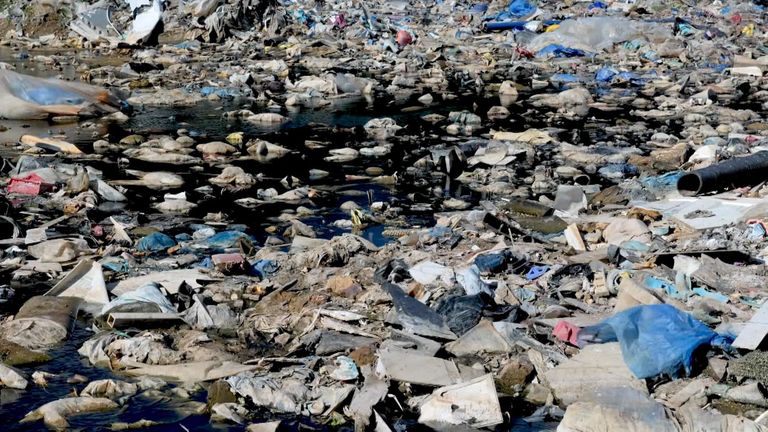
Rubbish dumped in Ranskill, near Doncaster, where a strong match for the chemical carbon tetrachloride was detected
Meanwhile, at the 55,000-tonne dump in Ranskill, there was a strong match for the pesticide thanite, and at Wigan, the pesticide demeton-O may be present.
Neither of those chemicals has been approved for use in the UK for decades, as they pose a danger to human and animal life.
At Ranskill, a strong match for the chemical carbon tetrachloride was detected in the air – a volatile compound banned in consumer products that can cause liver and kidney damage, as well as being linked to cancer.
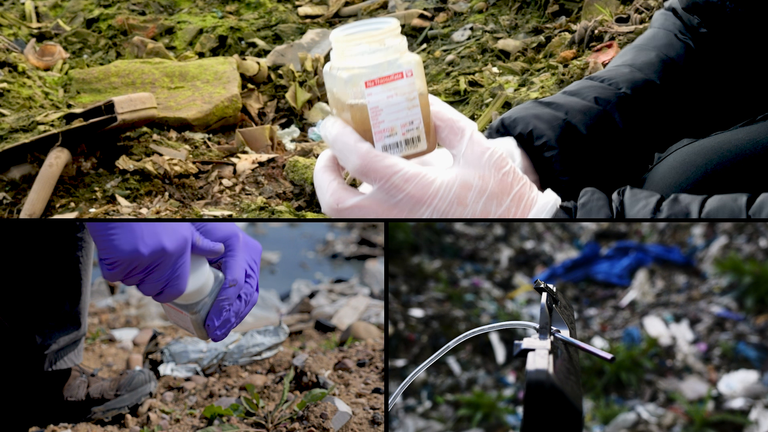
Sky News has tested air, soil and water at three of the UK’s biggest illegal dumps over the last six months
While a footprint was also found at Wigan for P-tert amylphenol, which disrupts the endocrine system and has a “chronic aquatic toxicity” classification.
Across all three sites, the majority of chemicals found in the water samples were above the predicted no-effect concentration (PNEC) levels – the scientific measure above which there may be harmful effects on the environment.
Ranskill had the most polluted water, with 49 chemicals, followed closely by Gloucester, which was sampled from a floodplain that runs into the River Leadon and River Severn.
Triisopropyl phosphate, a chemical used in plastics which is “very toxic” to aquatic life, was found in the water at all three sites.
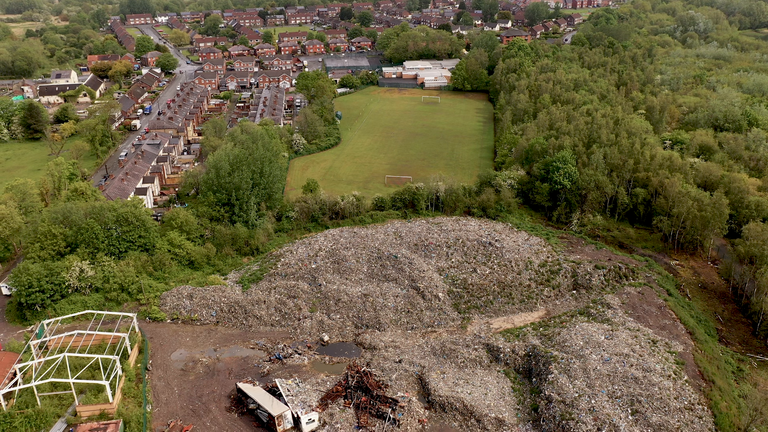
The dump in Bickershaw, Wigan is a stone’s throw from a primary school and a residential road
How did we test the chemicals?
Sky’s testing was a semi-quantitative rapid screening of air, water and soil samples that provided a chemical fingerprint for further testing.
The chemicals found were compared to international databases to find the strongest match.
The samples were collected at source, meaning our results do not account for dilution, as the chemicals travel by air or water away from the site.
What has the response been?
One of the country’s leading public health toxicologists has called for more intensive monitoring and academic study.
Dr Ian Mudway, the associate professor of environmental toxicology at Imperial College London, told Sky News: “Some of the strongest science which has come out is about how very low-level chemical exposures in populations over the long term have health effects which nobody predicted they would have.
“There is no argument that you should ignore this and hope the problem goes away.”
How dangerous are these illegal waste sites?

For the first time, we’ve scratched the surface on just what risk these huge illegal waste sites may pose to the general public.
Our findings are not only concerning because of the possible chemicals identified, but also the very nature of these sites means what is dumped there is not being properly managed or intensely monitored.
These are not legal waste plants – no risk assessment was done when the criminal gangs tipped tens of thousands of tonnes of rubbish, earning them millions.
That means the risk these chemicals pose is intensified.
What the science tells us is the longer these mountains of waste linger, the higher the potential environmental and health risk; nearly every time we visited the Gloucester site, the rubbish, which is metres high, was self-combusting, setting on fire deep underground, releasing dangerous smoke.
All the more reason to monitor and clear them.
The government says people should never enter these locations because of the potential harm.
But in many places, these dumps are where people walk their dogs, close to where kids play, and we now have initial evidence to suggest how dangerous they may be.
From local residents to leading scientists, the call now is for the Environment Agency to urgently carry out more intensive testing to understand whether the risks Sky News has identified may actually be harming residents and the wider environment.
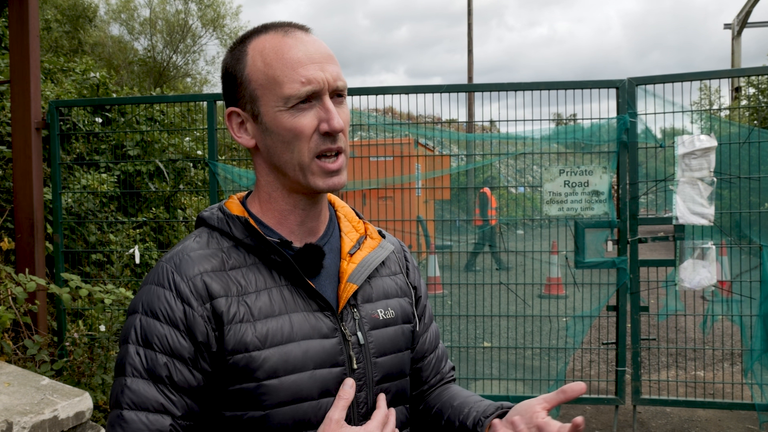
Dr Patrick Byrne, an academic specialising in environmental pollution at Liverpool John Moores University
Dr Patrick Byrne, an academic specialising in environmental pollution at Liverpool John Moores University, said the huge number of chemicals found was “more concerning to me than, let’s say, one specific chemical at a very high concentration that we know to be harmful”.
“That is because environmental science and toxicological studies tell us that it’s mixtures of contaminants that are the most difficult to investigate but probably have the largest impacts in terms of human health and ecosystems,” he said.
Read more from Sky News:
Woman injured in suspected stabbing
Anti-police protests erupt in Bologna
The Environment Agency said its scientists will “carefully consider these findings”, adding that “waste crime is an absolute disgrace that harms our communities and blights our environment”.
“That’s why we’re taking tougher action than ever before to crack down on the criminal gangs behind it,” a spokesperson added.
“Through our Waste Crime Action Plan, we’re giving the Environment Agency police-style powers, investing £45m to boost enforcement, and making criminals pay for the damage they cause.”
Discover more from PressNewsAgency
Subscribe to get the latest posts sent to your email.