
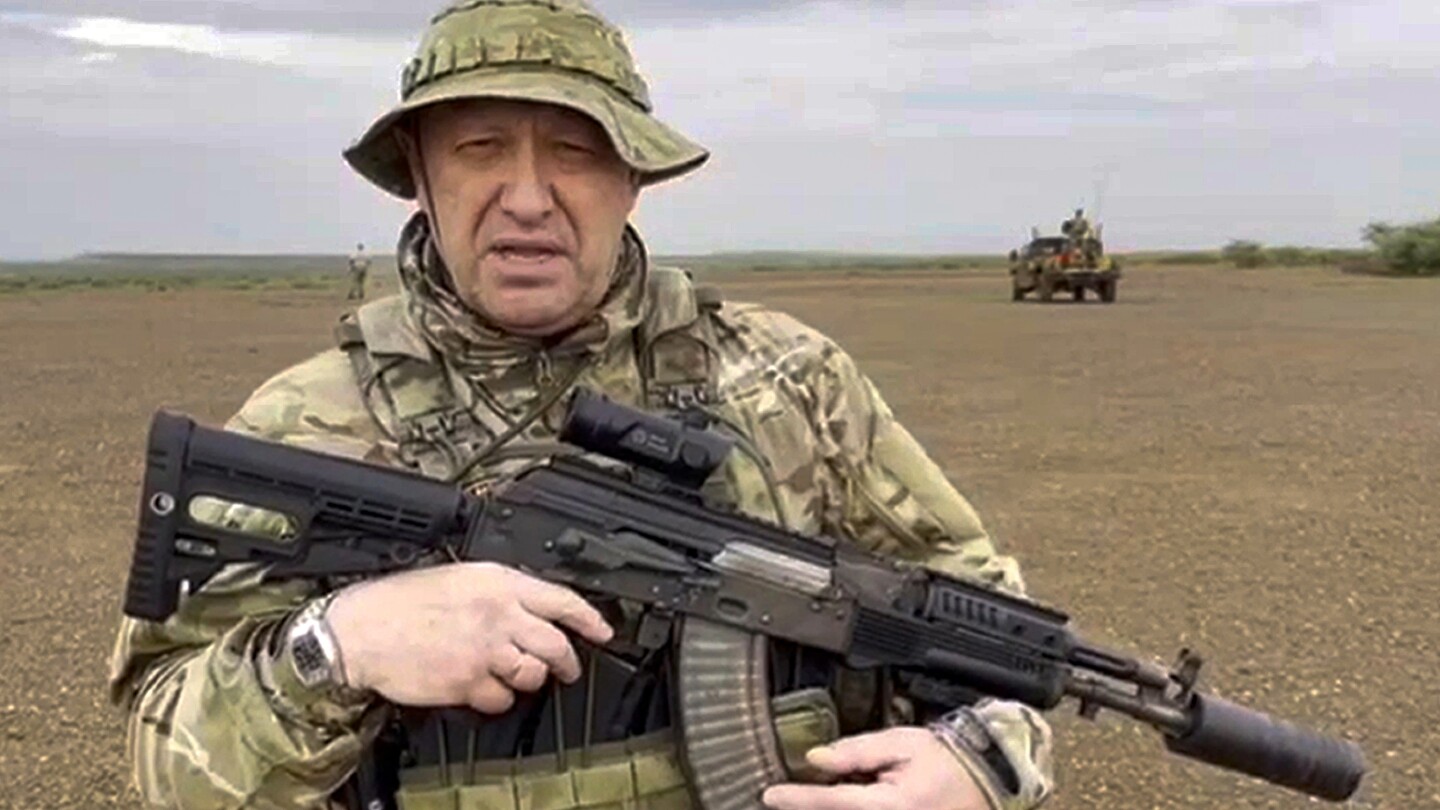
The Wagner Group’s presence stretches from the ancient battlefields of Syria to the deserts of sub-Saharan Africa, projecting the global influence of the Kremlin with mercenaries accused of using brutal force and profit from the mineral wealth that they seized.
But that was under Yevgeny Prigozhin, who in what could have been his last video posted earlier this week appeared in a military uniform and wielding an assault rifle from an unidentified dry and dusty plain as he boasted that Wagner is “doing make Russia even bigger on all continents.” and Africa even freer”.
On Wednesday, a private jet carrying Prigozhin and his top lieutenants from the mercenary group crashed northwest of Moscowtwo months after leading an armed rebellion who challenged the authority of President Vladimir Putin. There is widespread speculation that Prigozhin, who is presumed dead, was the target of his uprisingalthough the Kremlin has denied its involvement.
That accident has raised questions about the future of the Wagner Group.
In African countries where Wagner provided security against groups like al Qaeda and the Islamic State, officials and commentators predict that Russia will likely maintain its presence, bringing the forces under new leadership.
Others, however, say Prigozhin built deep personal connections that Moscow might find it hard to quickly replace.
Africa is of vital importance to Russia – economically and politically.
This summer, Wagner helped secure a national referendum in the Central African Republic that consolidated presidential power; he is a key partner of the Malian army in the fight against the armed rebels; and he contacted the Niger military junta that wants his services after a coup.
Expanding ties and undermining Western influence in Africa is a top priority as the Kremlin searches for new allies amid its war in Ukraine, where Wagner’s forces also helped win a key battle. Africa’s 54 nations are the largest voting bloc at the UN, and Moscow has actively worked to rally their support for its invasion.
Linda Thomas-Greenfield, the US ambassador to the UN, said Friday that Wagner’s forces “are destabilizing and we have encouraged countries in Africa to condemn their presence and their actions.”
On Thursday, the Republican Front of the Central African Republic, allied with the ruling party, reiterated its support for Russia and Wagner, saying they were “determined to fight alongside the African people in their struggle for self-determination.”
Wagner’s forces have served as personal bodyguards for President Faustin Archange Touadera, protecting the capital Bangui from rebel threats and helping to secure a constitutional referendum on July 30 that could extend his power indefinitely.
Central African activist and blogger Christian Aime Ndotah said the country’s cooperation with Russia would not be affected by the new leadership of Wagner, who has been “well established” there for years.
But some in the Central African Republic denounce mercenaries, and the UN peacekeeping mission there criticized them in 2021 for human rights abuses.
“The security of a State is its sovereignty. The security of a State cannot be entrusted to a group of mercenaries”, said Jean Serge Bokassa, former Minister of Public Security.
Nathalia Dukhan, a senior researcher at The Sentry, predicted that the Kremlin will try to bring Africa closer to its orbit.
“Wagner has been a successful tool for Russia to efficiently and brutally expand its influence,” he said. “In the midst of all the turmoil between Putin and Prigozhin, the Wagner operation in Central Africa only deepened, with more direct involvement from the Russian government.”
High-ranking Wagner operatives have established relationships in Mali and the Central African Republic and understand the terrain, said Lou Osborn of All Eyes on Wagner, a project focused on the group.
“They have a good reputation that they can sell to another Russian contender. It would not be surprising if a new organization took over them,” Osborn said, noting that Russian military contractors in Ukraine, such as Redut and Convoy, have recently expressed a desire to do business in Africa.
Redut was created by the Russian Defense Ministry, which has tried to bring Wagner under its control. Following the June riot, Putin said the mercenaries could sign contracts with the ministry and continue to serve under one of the group’s top commanders, Andrei Troshev. It was not clear how many troops they accepted, but media reports put the figure at a few thousand.
The Kremlin could still face challenges in maintaining the strong presence in Africa that Prigozhin helped establish.
Putin’s former speechwriter, Abbas Gallyamov, argued that Prigozhin may have been allowed to continue his later activities because Russian authorities had to find people to take over his work.
“Time was needed to create new channels, new control mechanisms over those projects,” he said. “And it is not a fact that they have succeeded in that. They may have failed and the Kremlin may lose some of those projects.”
The British Ministry of Defense said Prigozhin’s disappearance “would almost certainly have a profoundly destabilizing effect on the Wagner Group.”
“His personal attributes of hyperactivity, exceptional audacity, drive for results and extreme brutality permeated Wagner and are unlikely to be matched by any successor,” he said.
On Friday, Kremlin spokesman Dmitry Peskov declined to comment on Wagner’s future.
For Prigozhin, who created Wagner in 2014, his missions were not simply to promote Russia’s global influence. His contractors in Syria, Libya, Sudan and elsewhere tapped into those countries’ mineral and energy wealth to enrich themselves.
Central African Republic lawmaker and opposition leader Martin Ziguélé said Wagner was active in gold mining, timber and other industries, without paying taxes.
“We can only conclude that it is looting,” he said.
Prigozhin struck a deal with Putin after the rebellion in which Wagner’s mercenaries relocated to Belarus in exchange for an amnesty, and the mercenary boss has spoken repeatedly since then about expanding his activities in Africa. He was seen courting African officials at a recent summit in St. Petersburg.
He was quick to welcome last month’s military coup that ousted Niger’s president, Mohamed Bazoum. The junta contacted Wagner, but the group’s response was unclear and there is no visible Russian mercenary presence there, aside from crowds waving Russian and Wagner flags at protests.
While US officials did not confirm that Russia or Wagner had any role in the coup, there are fears that the Kremlin could take advantage of it to weaken Western positions in West Africa, where mercenaries are active in Mali and are suspected of having a presence in Burkina. faso.
Residents of Niger say Prigozhin’s presumed death will not stop Russia from trying to expand its influence.
“We believe that Russia wants to have a base here and be popular. It’s obvious they want to be here,” Niamey tailor Baraou Souleimanin told The Associated Press. Since the coup, he said he has sewn more than 150 Russian flags in a month.
“We pray that Allah strengthens the relationship with (Wagner) to continue the agreement. If the relationship is good and strong, it is possible that they will continue the deal even after his death, ”he said on Thursday.
In neighboring Mali, a military junta that seized power in 2020 expelled French troops, diplomats and the media and ordered the end of a decade-long UN peacekeeping mission.
Although not officially recognized by the Malian authorities, Wagner’s forces are known to operate in the rural north, where rebel groups and extremists have eroded state power and tormented communities.
Human Rights Watch says the Mali army, along with suspected Wagner mercenaries, committed summary executions, looting, enforced disappearances, and other abuses.
“What we have experienced through Wagner is the massacre of our people,” said Ali Nouhoum Diallo, a former speaker of the National Assembly.
Youba Khalifa, a Timbuktu resident, said Wagner’s presence in Mali would not change after Prigozhin because “they are going to replace him with another leader.”
Although Prigozhin had told his troops in Belarus that their new mission would be in Africa, several thousand of them trained the Belarusian army near the Polish border, prompting Warsaw to reinforce his forces there. However, there were signs that the mercenaries were preparing to withdraw to Russia.
The Belarusian Hajun, a group that monitors Russian troops in Belarus, said on Thursday that satellite images showed more than a third of the tents in a Wagner camp had been dismantled, a sign of a possible exodus. Still, President Alexander Lukashenko insists that his country will house some 10,000 soldiers.
This arouses strong objections from the Belarusian opposition, which demands its withdrawal.
“Prigozhin’s death should put an end to Wagner’s presence in Belarus, which will reduce the threat to our country and its neighbors,” exiled opposition leader Sviatlana Tsikhanouskaya told the AP.
___
Sam Mednick in Niamey, Niger; Zane Irwin in Dakar; Jean Fernand Koena in Bangui, Central African Republic; Edith M. United Nations Leaders; Baba Ahmed in Baba; and Yuras Karmanau in Tallinn, Estonia contributed.
Discover more from PressNewsAgency
Subscribe to get the latest posts sent to your email.