

Gurgaon-based Ayaan Arya picked up a job in the middle of 2020 and scored high, despite the pandemic-induced lull, with some out-of-the-box thinking and smart execution. At 32, he was quite content with the perks and work-from-home flexibility that his job with a global IT services major provided. During the lockdown, he learnt to compartmentalise his responsibilities at office and home with disciplinarian rigour and realised that he could devote more time to himself without the job consuming him. He decided to settle down, get married and is now, a new father. But since offices globally are returning to old, aggressive ways, his included, and retracting some of the privileges, Arya has decided to bow out of the rat race. Not because he is less skilled or a slacker, in fact, he can deliver faster in less time, but has chosen to prioritise work-life balance and is content to do only as much as the job requires without going overboard with it.
‘Journeys of Clay and Fire’, a ceramic exhibition, brings traditional pottery and conceptual art together
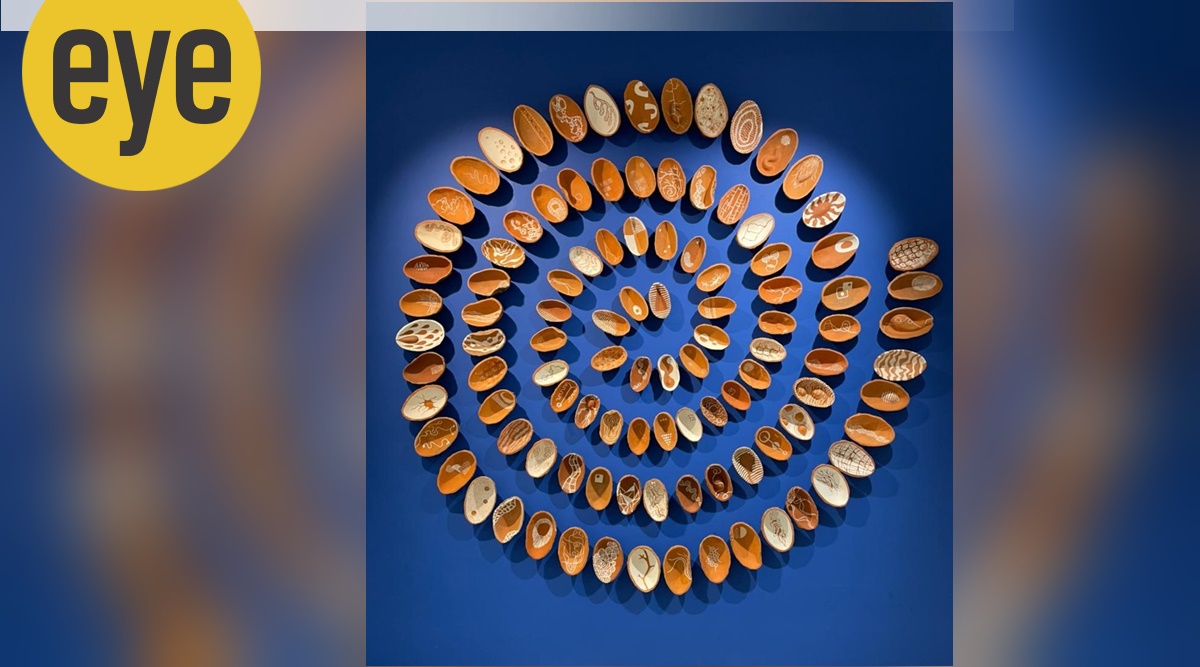 Ceramic work by Ela Mukherjee. (Credit: British Council India)
The well-known English ceramicist Gordon Baldwin often speaks of how clay allows him to think and make connections with other parts of his life. The ability to cast, coil, slip, dip, glaze, throw, fire, before something emerges that has the stamp of memory and purpose are journeys that clay affords. That’s why for Chennai-based K Gukan Raj working with clay feels like a process of a lifetime. His search for new techniques and methods in ceramic took him to UK sculptors such as Sandy Brown and Micki Schloessingk, through a Charles Wallace India Trust (CWIT) grant in 2013. And though he attended many workshops with potters from different nationalities, returning to watch people from Tamil Nadu using their hands to build with clay, became a visceral learning experience. It proved to him that clay was a tough master. His large glazed stoneware collection is part of the exhibition “Journeys of Clay and Fire”, curated by Delhi-based sculptor Kristine Michael, showing at the British Council, New Delhi, till November 29. This group show on ceramics, presented by CWIT in collaboration with the British Council, presents a varied offering of contemporary ceramics and spotlights the revival of artisanal pottery to sustain communities.
Mumbai band Bombay Brass on their love of baraats, blending the city’s cosy jazz with a bunch of influences and providing a background score in a Mira Nair miniseries
 The Bombay Brass group (Credit: Bombay Brass)
Thirty-four year-old Mumbai-based saxophonist Rhys Sebastian knows how to throw a party. Frontman of Bombay Brass – a Mumbai-based 11-piece floating jazz outfit which has found inspirations in the varied sound of an Indian baraat, funk-and-soul legend Maceo Parker, Hindustani classical music, and noted composer duo Shankar-Jaikishen – Sebastian turns the band’s concerts into a riot of sorts, thanks to his slick showmanship. He dances in slo-mo, carries a tune while lying flat on his back, and walks in the aisles, asking the audience to intone and repeat some of the passages – including a few incredible originals, without a note out of sync.
The winged neighbours one meets on a morning walk
 The tree pies (Credit: Ranjit Lal)
When I step out of the house at around 5.30 am, it’s still dark and even the birds have not stirred. I wonder which will be the first to awaken this morning. Alas, the winner was a crow, who muttered a harsh caw as it flew from its roost, disgruntled, no doubt, at having to awaken so early. For many past mornings, the koels have been the first, rising with a hysterical bubbling call as if they have put a dastardly conspiracy into motion. A couple of mornings ago, tree-pies broke the silence with their musical if throaty calls, asking for “thocolate?” first thing in the morning.
What the success of Mani Ratnam’s ‘Ponniyin Selvan: 1’ tells us about historical fiction
 Trisha Krishnan as the Chola princess Kundavai in Ponniyin Selvan: 1
(Source: Trisha Krishnan/Instagram)
Right after watching Mani Ratnam’s latest Tamil film “Ponniyin Selvan: 1”, Chennai-based commerce graduate Anjali called it an “ode to book lovers”. A history buff, she has read Kalki Krishnamurthy’s five-volume magnum opus “Ponniyin Selvan” (written in the 1950s), which presents the role of women in influencing kings and running a kingdom. She says that this cinematic adaptation, co-written by Ratnam, Elango Kumaravel and B Jeyamohan, not only stays true to the source material, but elevates it.
The success of the film has generated discussions on historical fiction, and how it functions as a way of reimagining and reviving narratives. Stories in this genre is usually set in an era at least 50 years before its time of writing, and may or may not have characters based on real life.
How a new play gives a fresh perspective to the Tibet-China conflict
 A scene from the play Pah-La
In 2013, an award-winning playwright from Bengaluru, Abhishek Majumdar, began to investigate one of the biggest protests that took place in Tibet against Chinese rule. It was led by hundreds of monks and started in March 2008, a few months before the Olympic Games in Beijing. There were reports of protesters clashing with the police, vehicles being burnt, looting and violence. Then, on February 27, 2009, a young monk named Tapey set himself on fire in Ngawa — the first instance of self-immolation as a way of resistance in Tibet.
Discover more from PressNewsAgency
Subscribe to get the latest posts sent to your email.