
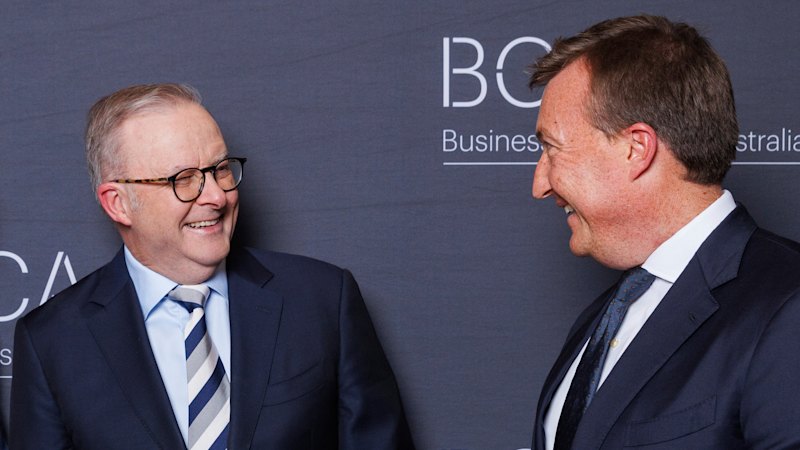
Big business is plotting a union-style campaign to convince “Betty from Blacktown” that Australia’s hard-to-grasp productivity problem hits family budgets, as corporate leaders put Prime Minister Anthony Albanese on notice at an annual get-together of political and business elite.
After years of claims that it has been hoodwinked into close co-operation by Labor, the Business Council of Australia has joined 30 peak bodies, including pharmacists, farmers, builders and accountants, to make a louder argument for economic reforms that lead to better living standards.
The new Alliance of Industry Associations is considering an online campaign that would begin next year and run up to the 2028 election, according to sources familiar with the plans. The moves are driven in part by anxiety about left-wing populist influencers generating support for higher taxes and heavier regulations on social media, which is feeding through to policymaking.
With Prime Minister Anthony Albanese sitting in the crowd at Tuesday night’s annual BCA dinner, the organisation’s chief executive Bran Black will say: “Where we believe policies are taking our nation in the wrong direction, the BCA will say so”.
“Australia cannot tax, regulate or redistribute its way to higher living standards,” he said, according to speech notes.
Black argues that “Betty from Blacktown” cares little about productivity partly because “productivity and investment [are] words that belong to someone else’s conversation”. But the average voter does care about the cost of living, Black says, creating an imperative to explain how macro factors make it harder to get by.
“Too often, we collectively fail to explain why it matters, and critically, why its absence or reduction affects people’s lives day to day.”
This year’s BCA dinner will be held three months after Labor’s ambitious reform budget, which scrapped negative gearing and overhauled the way capital gains are taxed. A downturn in house prices – predicted to hit up to 15 per cent – and warnings that tax changes might sap investment in high-growth firms at a time of weak investment have sparked one of the most incendiary fights between Labor and the corporate sector since Albanese came to power in 2022.
Albanese will also address the dinner but Opposition Leader Angus Taylor, who hopes to recruit big business to his fight against Labor’s budget measures, will be absent as he cycles through Queensland in the Pollie Pedal charity event.
The prime minister will not mention Labor’s heavily debated tax changes in the segment of his speech provided to this masthead on Monday. Instead, he will talk up an area of agreement with the corporate world: artificial intelligence.
Albanese, whose headline speech on AI was warmly welcomed by corporations last month, will seek support for his rules on data centres’ use of energy and water at a national cabinet meeting on Wednesday. National consensus on AI, which the Coalition has backed, will be key to driving growth and sovereignty, the prime minister will argue.
“Our national economic success and strongly performing national institutions will help us see off the populist challenge now on the march across the globe,” he will say, alluding to One Nation.
“Australia’s economy and democracy are in an excellent place. By working intelligently together, we will keep them there.”
Black will call for “balance” between safety and innovation in the government’s approach to AI.
Independent MP Allegra Spender, who co-founded the party Community Strong Australia in June, on Monday pleaded with Labor to rethink its CGT changes. Spender wants the government to come up with another way to make the CGT discount less generous. Instead of the old 50 per cent discount, Spender said Labor should pick a lower, flat discount, rather than an inflation-adjusted model that critics say will hamper growth.
“The government deserves credit for taking on tax reform, but I am concerned with their approach to CGT, and I will continue to urge them to commit to return all taxes raised as marginal income tax cuts. Their preferred inflation-adjustment method for CGT is inappropriate for businesses and for rewarding risk-taking more broadly,” she said.
“If we want to effectively combat inflation and sustainably grow Australians’ real wages in the future, then we need to find ways to lift productivity. In a globally competitive market for talent and capital we need a regime that is broadly competitive and doesn’t discourage risk-taking more than other countries.”
Cut through the noise of federal politics with news, views and expert analysis. Subscribers can sign up to our weekly Inside Politics newsletter.
 Paul Sakkal is Chief Political Correspondent. He previously covered Victorian politics and won a Walkley award and the 2025 Press Gallery Journalist of the Year. Contact him securely on Signal @paulsakkal.14.Connect via X or email.
From our partners
Discover more from PressNewsAgency
Subscribe to get the latest posts sent to your email.