
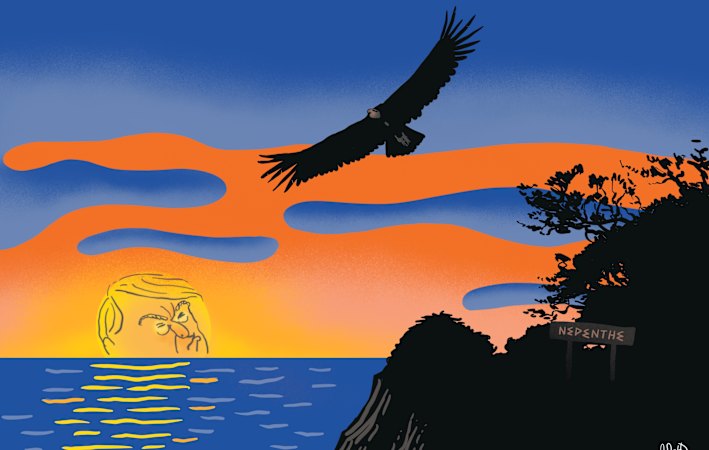
There are times when electronic communications delivering a confusion of soul-sapping developments – often from a US president’s tweeting finger and amplified by populist boosters around the world – feels so dispiriting that the fantasy of a remote island free of the internet and mobile phone coverage beckons almost irresistibly.
A simpler alternative to such a dream is to retreat to the memory of some pleasurable time when all seemed right with the world.
I was put in mind of this when a colleague mentioned she was preparing for a road trip in the US.
She and her family plan to drive between San Francisco and Los Angeles on California’s Highway One, a route that follows the state’s most spectacularly beautiful strip of the Pacific coast.
Nepenthe, my memory prompted.
The day of the condor.
Nepenthe is a Greek word meaning, loosely, “removing grief”.
You’ll find it in Homer’s Odyssey, where Helen of Troy uses nepenthe as an anti-sorrow drug. Edgar Allan Poe’s poem The Raven uses it as a metaphor for relief from his lost love, Lenore: “Quaff, oh quaff this kind nepenthe and forget this lost Lenore!”
Neither of those classical examples came to mind with my memory of Nepenthe, however.
It was the recollection of a trip years ago that turned thoughts nostalgic – a trip along Big Sur, a mind-blowing stretch of Highway One that winds along wild coastal cliffs, over the dizzying Bixby Creek Bridge – a 1930s arch that everyone wants to photograph – and past canyons disappearing deep into forested mountains and plunging to the sea.
Along there you’ll find a near vertical driveway that leads to a restaurant called Nepenthe.
It is an old place with a stone terrace and fireplace perched 250 metres above the Pacific Ocean. It has views to forever.
Even more intoxicating is the knowledge of the legends who have danced on that terrace, drunk too much, fallen in and out of love and hunched in corners scribbling words that live forever.
If America ever had a proper bohemia in the wild, here it is.
I am remembering Nepenthe because it represents to me a happy, relaxed place and time in an America long before a corrupt president installed a cabinet of unsuitable weirdos and nasty drunks, and reduced even the White House, once the symbol of a great democracy, into a trashy, glitzed-up gin joint surrounded by a construction zone.
My first trip overseas was to the US almost half a century ago when a good plain man named Jimmy Carter was president.
I fell in love with the place: its irrepressible energy, its natural beauty, its hospitable people. I drove along Big Sur alone, stupefied by its grandeur.
I returned to the US a few times over the decades, and my initial impressions barely altered, despite finding myself increasingly confronted by the social disparity between rich and poor and white and black, and by Americans’ ideological insistence that unforgiving capitalism was superior to all other systems.
Today, I’m pretty sure I wouldn’t find myself welcomed to the USA. I certainly couldn’t overlook what it has become under Donald Trump.
The outside chance that I might be rumbled and forcibly deported for something uncomplimentary I have written about Trump, his henchmen or his regime, doesn’t appeal.
And so I content myself taking a vicarious US trip of the memory to the terrace above the ocean at Big Sur that became an enchantment when a wild creature returned from the dead.
My wife and I visited Nepenthe one June day 20 years ago. An ocean mist lurked in the canyons, strung itself along the cliffs and hung among the forests of the mountains. Intermittently, a warm sun clawed its way through.
We took a table on the terrace and ordered wine.
Like the Cafe de Flore or Deux Magots in Paris, where you might imagine yourself surrounded by the ghosts of Simone de Beauvoir, Jean-Paul Sartre, Ernest Hemingway and Albert Camus, Nepenthe reminds us that it was once the hangout of famous vagabonds, artists, writers, poets, Beatniks, hippies and film stars.
Henry Miller (Tropic of Cancer and Tropic of Capricorn), Jack Kerouac (On the Road and Big Sur) and the French diarist Anaïs Nin, Miller’s lover for a while, came to calm their restless spirits and were among those who wrote of it.
Elizabeth Taylor and Richard Burton drank and danced there while making the film The Sandpiper. Steve McQueen and Kim Novak were fans.
Orson Welles and Rita Hayworth bought the original place – a log house – on a whim during World War II. Hayworth measured the house for curtains. Neither returned. They were divorced in 1947.
A couple entranced by the beauty of the place, Lolly and Bill Fassett, moved in with their five children and, declaring that such splendour must belong to everyone, set about transforming it into a centre of Big Sur hospitality.
A student of Frank Lloyd Wright, Rowan Maiden, was the architect.
And then the Beat generation discovered it.
As my wife and I sat there with our glasses of wine all those years later, from the cliffs below arose on the ocean’s updraft the shape of a bird so large it defied belief.
Its wings seemed the spread of a small plane. It soared elegantly towards us without moving those great outstretched spans.
Those around us on the terrace rose as one, mouths open.
“It’s a condor,” someone cried.
The bird swept over, giving us the eye and casting a giant shadow.
“You are blessed,” a waiter said.
And so we were.
Californian condors, America’s biggest bird, went extinct in the wild in 1987. A small number of those captured and raised in captivity were released in the 1990s.
And there we were.
Visited by Big Sur’s rarest and most majestic bird, risen from the dead.
At Nepenthe. Where no grief was permitted.
All felt right with the world.
Back then.
Get a weekly wrap of views that will challenge, champion and inform your own. Sign up for our Opinion newsletter.
 Tony Wright is an associate editor and special writer for The Age and The Sydney Morning Herald.Connect via email.
From our partners
Discover more from PressNewsAgency
Subscribe to get the latest posts sent to your email.