
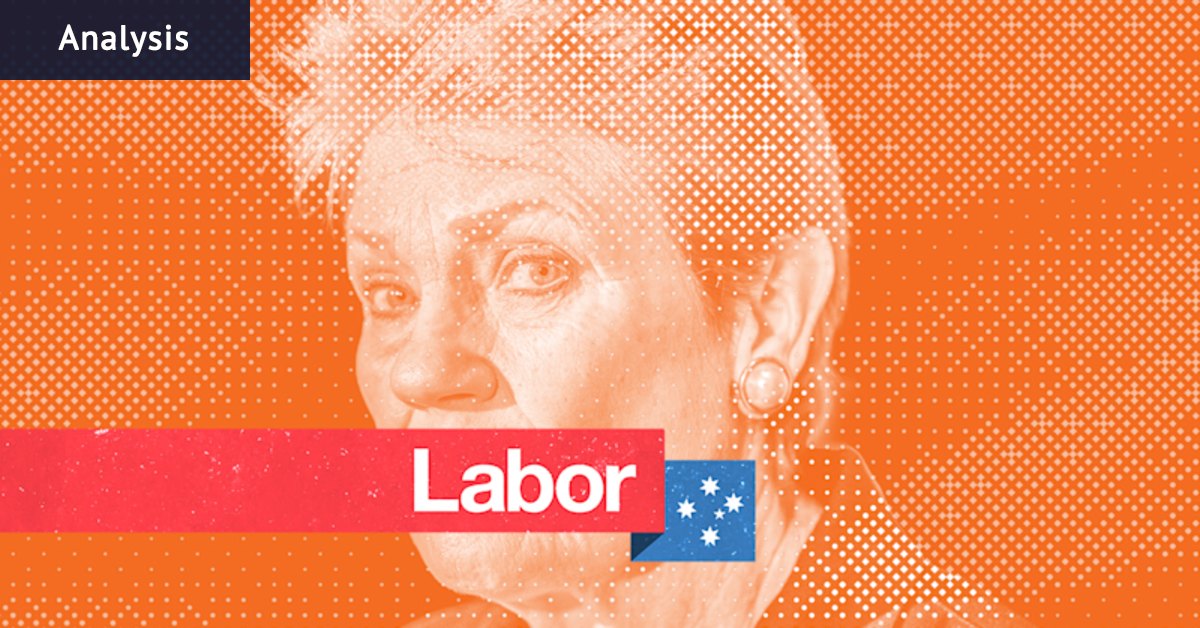
Labor’s faithful gathered in Adelaide to celebrate its 50th National Conference, a record haul of federal seats and an election victory that gave Anthony Albanese political capital few prime ministers have enjoyed.
But the mood of confidence now carries an uncomfortable undercurrent.
For all the talk of Labor’s return to dominance, delegates know the next political battle may not be against the type of conservative coalition the party has spent more than a century defeating.
It may be against a movement that has rarely featured in Labor’s traditional playbook: Pauline Hanson’s One Nation.
The speeches were filled with references to progress, nation-building and Labor’s claim to represent the optimistic, egalitarian instincts of the Australian character. Yet beneath the applause was a recognition that the political landscape has shifted.
Once dismissed as a fringe protest party, One Nation is now matching Labor’s primary vote in federal and state polling and has become a force capable of reshaping the contest for working-class and regional voters – some of the constituencies the ALP has historically relied upon.
Former treasurer Wayne Swan, who lost his Queensland seat of Lilley in 1996 – the same year Hanson was elected to Oxley – is delivering one of the clearest warnings.
Swan, who will speak at a Chifley Research Centre fringe event on the rise of populist politics on Friday, argues Labor’s greatest political challenge is no longer simply defeating the Coalition but confronting the broader wave of anger, distrust and grievance fuelling populist movements across the Western world.
Swan says Labor must resist the temptation to retreat into cautious managerialism.
“This moment does not call for antiseptic centrism,” Swan says. “It does not call for tepid incrementalism.”
He warns against those who believe the answer to the rise of the right is to occupy a supposedly safe middle ground, constantly adjusting positions in the hope of offending nobody. It’s hard to not read it as a criticism of the current PM.
“Some now counsel that the answer to right-wing populism is to retreat to what they like to call the radical centre, trimming and hedging in the hope of offending no one,” Swan says. “I say the radical centre, so defined, is neither radical nor a centre. It is a bunker.”
For Swan, the contest is ultimately about whether politics can still deliver economic security for ordinary Australians at a time when many voters feel left behind.
“The times, once again, require us to be steadfast,” he said. “They require us to be what our movement has always been at its best, advocates for the economic interests of working people and the middle class.”
Swan, who stood down as federal ALP president after eight years this week, framed the contest as one between competing visions of society.
“When you peel back the layers of obfuscation and camouflage, the core agenda of our opponents is about as appealing as asbestos,” Swan says. “Strip away the culture war and the scapegoating of the neighbour, and what remains is a simple proposition: give up on democracy, so that a few can plunder.”
South Australian Premier Peter Malinauskas, who confronted a rampant One Nation in his state in March, offered a different warning. In a stirring speech he warned of Labor becoming so consumed by the challenge of populism that it loses sight of why voters elected it.
He said the party needed to recognise that “the current upending of anti-Labor forces” brought clear, omnipresent and undeniable risks for the party.
Labor’s answer, Malinauskas argued, was not to chase its opponents into a politics of anger but to offer a competing vision of national confidence.
Australia, he said, was not defined by grievance but by co-operation.
“Any movement bound by pessimism is ultimately bound for nowhere at all,” he said.
Albanese used his conference address to argue One Nation was no longer a standalone protest movement but part of a broader conservative alliance.
“Beyond One Nation’s personality clashes, policy confusion, conspiracy theories and candidate chaos, and regardless of who leads the Liberals to the next election, in every way that matters, the Liberals, Nationals and One Nation are already a coalition,” he said.
He accused the parties of embracing “attention-seeking culture wars imported from overseas” and sought to define Labor against a politics of outrage.
“We choose progress over protest. We choose purpose over chaos. We choose unity over division. We choose outcomes over outrage.”
The challenge for Labor is that One Nation’s appeal extends beyond individual policies. It reflects a broader disruption of the political order – a challenge to institutions, experts and political leaders that has reshaped elections across the democratic world.
As Labor celebrates its history from a position of historic electoral strength, its next great test is unlikely to be whether it can defeat a weakened Coalition. It is whether it can convince Australians that its answer to the politics of grievance is something more compelling than simply managing it.
Cut through the noise of federal politics with news, views and expert analysis. Subscribers can sign up to our weekly Inside Politics newsletter.
Go deeper on Labor’s national conference
 Rob Harris is the national correspondent for The Sydney Morning Herald and The Age based in Canberra. He is a former Europe correspondent.Connect via email.
From our partners
Discover more from PressNewsAgency
Subscribe to get the latest posts sent to your email.