
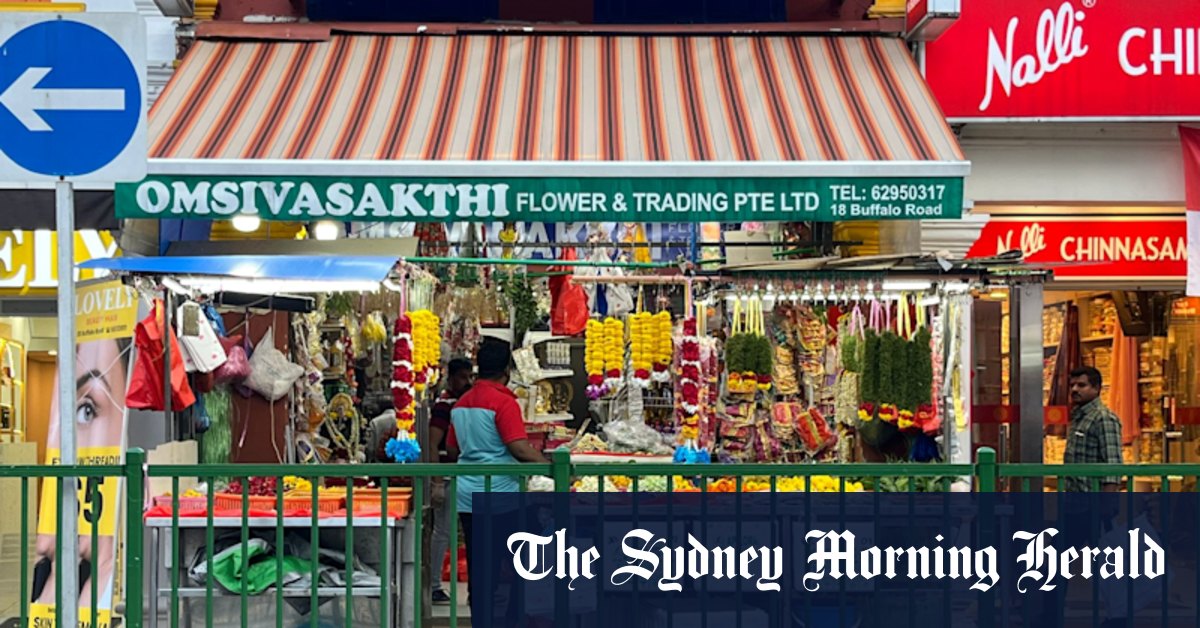
For one day a week, the men – part of the near-invisible low-wage backbone of Singapore’s construction and labouring industries – swap their PPE for regular clothes and occupy an identity beyond just a “worker”.
“In Singapore, everything is very expensive, but the workers’ salaries are very cheap,” says Shakher, a 35-year-old labourer from Punjab in north-west India.
A tailor mends clothes outside his store in Little India.Credit: Lisa Visentin
He doesn’t live in a dormitory but in a condo a few train stops away, where he bunks with six other workers. The average monthly salary for a construction worker, he says, is about $S800 ($970) to $S900, though Singapore has no officially mandated minimum wage. Like most migrant workers, his employer covers the cost of his accommodation, but he has to pay for his daily meals himself.
“Whatever I don’t spend, I send home. Not saving,” Shakher says. “I’m not thinking [whether] life is good or not good. It’s not easy work, but I am thinking about how I support my family.”
He says he often feels shunned by Singaporean society, where his status as a migrant worker is easily identifiable by his dirty boots and sweaty clothes after long, hot days labouring in the sun.
“If there are 100 people, five people are good and talk nicely to you, and 95 have an attitude of dislike,” he says. “We are humans. If the workers are not here, how to improve buildings? How to improve the country?”

Satnam Singh, 34, a lorry driver from Punjab, says Singapore has been a better place to work than Dubai.Credit: Lisa Visentin
His friend Satnam Singh, 34, a driver who ferries workers between job sites in open-air lorries, is more sanguine. He says Singapore is a better place to work than Dubai, where he spent three years as a migrant worker. He left when he was not paid for five months.
“In Singapore, if there is any accident, or if bosses haven’t paid, the government will respond. They help you,” he says.
Singapore’s Indian community makes up about 9 per cent of the country’s residents, the smallest of the three major ethnic constituencies, behind Chinese (74 per cent) and Malays (13.5 per cent). These figures do not include temporary migrant labourers, mostly from India, Bangladesh and China, who number more than 450,000 and account for a third of all foreign workers in Singapore.
Loading
For the Singaporean government, racial harmony is core business. It pursues this through policies of state-enforced multiracialism, such as ethnic quotas for public housing blocks to prevent racial clusters from forming, and mandated minority representation in electoral contests. The country has four official languages: English, Chinese, Tamil and Malay. Public incidents of overt racism and violence are rare.
Of the 4000 Singaporeans surveyed by the Institute of Policy Studies think tank in 2024, two-thirds rated racial and religious harmony as high, though more than a quarter of residents indicated they distrusted racial groups other than their own.
While this top-down enforcement of race relations is championed by many Singaporeans as key to the country’s social cohesion, it is regularly questioned by younger generations and academics. They ask whether such policies foster denialism about everyday racism and stifle difficult conversations about hard-to-shift prejudices.
Property platforms have cracked down on the listings that once featured “No Indians, No PRCs [People’s Republic of China]”, but surveys, media reports and discussions in online forums suggest racial discrimination remains a persistent issue.
“Is there true racial harmony in SG or only racial tolerance?” one popular thread on Reddit asks. There are many others like it, filled with anecdotal tales of discrimination in the rental and employment markets.

Ramesh Manickam, 33, has lived and worked in Little India for a decade. Credit: Lisa Visentin
But the plight of migrant workers is even further removed from national discussions about race and class due to their social isolation. Low wages, and the fact they are housed together by their employers, give them little opportunity to mix with the wider Singaporean community.
It was in Little India in 2013 that Singapore confronted its first riots in 40 years. About 300 migrant workers raged on the streets, torching an ambulance and flipping police cars, after an Indian labourer was killed by a bus. At the time, the government stared down suggestions that long-simmering worker grievances about pay and treatment were a factor in the riot, saying it was a spontaneous event fuelled by alcohol. It stepped up heavy policing around the Indian enclave in the aftermath and imposed alcohol sales restrictions.
“Because of that [incident], we have a black mark,” says Ramesh Manickam, a 33-year-old shop assistant and skilled-visa holder from Tamil Nadu, the same Indian state that was home to the deceased worker.
Loading
Manickam arrived in Singapore two years after the riots. While he has heard chatter among other foreign workers about brushes with discrimination, he’s never personally experienced it in the years he’s lived and worked in Little India.
“Now, people are more understanding,” he says. “Singapore is much better than other countries.”
Get a note directly from our foreign correspondents on what’s making headlines around the world. Sign up for our weekly What in the World newsletter.
Discover more from PressNewsAgency
Subscribe to get the latest posts sent to your email.