
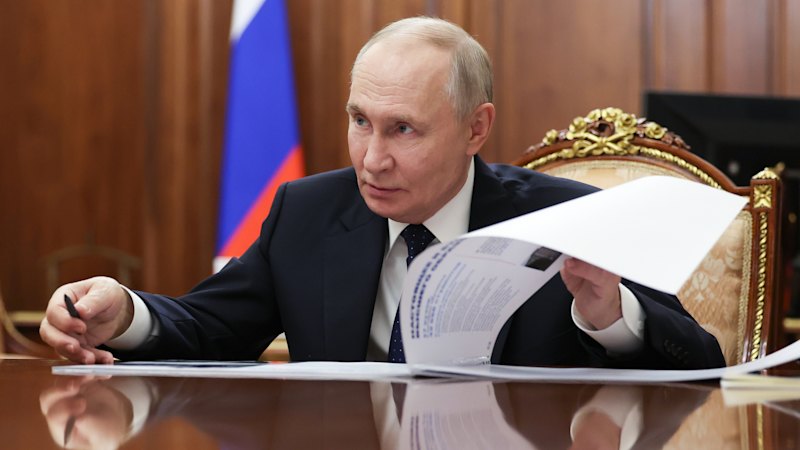
Australia should play a lead role in efforts to force Vladimir Putin to face a Nuremberg-style trial to hold him accountable for launching the war in Ukraine, one of the Russian president’s leading antagonists in Europe has argued.
Estonian Foreign Minister Margus Tsahkna also used a visit to Australia to ask the Albanese government to consider joining a plan to impose a sweeping travel ban on former Russian soldiers who participated in the war against Ukraine.
Tsahkna urged Australia to follow the European Union by imposing stricter restrictions on Russian “blood oil” entering the nation via third countries as a parliamentary inquiry probes ways to toughen Australia’s sanctions regime against Russia.
Estonia, which shares a 295-kilometre land border with Russia, has been one of Ukraine’s most steadfast supporters since Putin launched his full-scale invasion in 2022.
The European Union has called for a special tribunal to be created to charge Putin and other Russian leaders with the crime of aggression against Ukraine.
The last time such a charge was brought to justice was during the Nuremberg trials held after World War II.
“We are asking Australia to join and become the leading country in the region because these efforts cannot be restricted only to Europe,” said Tsahkna, who met this week with Foreign Minister Penny Wong and Home Affairs Minister Tony Burke.
“It’s not about Europe, it’s not about Ukraine, it’s about our world order. It’s about looking into our children’s eyes and saying that actually we’re standing for our values.”
Although Putin would do everything in his power to avoid being put in the dock, he said the democratic world must seek to hold him legally accountable.
“The leaders of Nazi Germany eventually faced justice, and nobody believed it could happen. So it is possible,” he said. “I would be very happy to see Putin at the Hague in front of a special tribunal.
“We need him to face up to the crimes he has committed, this is our duty.”
Australia has backed the establishment of a special tribunal for the crime of aggression against Ukraine.
Tsahkna said Australia could play an important role by corralling other countries in the Indo-Pacific to support the tribunal, which would be separate to the International Criminal Court’s investigations into crimes against humanity and war crimes committed in Ukraine.
Mark Ellis, the head of the International Bar Association, has argued the proposed tribunal “represents a vital mechanism for upholding the post-Second World War international legal order”.
Estonia is pushing for Europe to ban entry to all Russian veterans of the war against Ukraine, with Tsahkna warning that battle-hardened “ex-prisoners and rapists” could flood Western countries when the war ends.
Australia should consider following suit, he said.
“These ex-combatants may be a threat to Australia’s domestic security as well,” he said.
Tsahkna recently slapped down his nation’s president’s calls for Europe to re-enter diplomacy with Moscow, saying it would be disastrous for Ukraine’s war effort.
He urged Australia to make every possible effort to prevent Russian-origin oil from entering the country, arguing this was crucial to cut off funding sources for Putin’s war effort.
“Europe was totally dependent on Russian energy imports just a few years ago, so it is possible,” he said.
This masthead’s “Blood Oil” series, published last year, highlighted the vast quantities of Russian-origin oil that have flowed into Australia since the start of the war.
Last month, the Department of Foreign Affairs and Trade sanctions office issued new advice to companies on how to ensure they were not contravening Australia’s current sanctions regime on Russian-origin oil.
While not going as far as campaigners would like, the updated advice uses tougher language and includes significantly more detail than the previous official advice of June 2025.
The Ukrainian-Australian community wants the government to match the European Union by changing the definition of sanctioned goods to include all petroleum products derived from Russian crude.
Tsahkna said that while Estonia backed the US and Israel’s strikes against Iran, he was concerned that the surge in global oil prices was helping fund Putin’s war against Ukraine.
The Trump administration announced this week it would temporarily allow the sale of Russian oil that is at sea, easing economic sanctions against Russia.
“The bad part of the story is that the increase in the oil price is actually directly supporting the Russian war machine,” he said.
The benefit of the war, he said, is that Putin’s global allies were rapidly disappearing, following the removal of Venezuelan president Nicholas Maduro, Syrian president Bashar al-Assad and Iranian supreme leader Ali Khamenei.
An exception, he said, was Chinese President Xi Jinping.
“It would only one phone call from President Xi to Putin to stop the war there,” he said. “It’s something we need to address.”
Cut through the noise of federal politics with news, views and expert analysis. Subscribers can sign up to our weekly Inside Politics newsletter.
 Matthew Knott is the foreign affairs and national security correspondent for The Sydney Morning Herald and The Age.Connect via X, Facebook or email.
From our partners
Discover more from PressNewsAgency
Subscribe to get the latest posts sent to your email.