
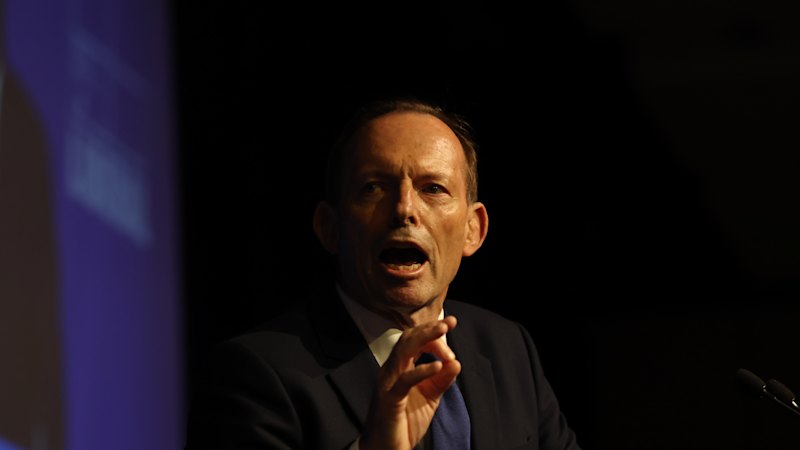
Liberal Party president Tony Abbott has backed Pauline Hanson’s last-ditch attempt to challenge a court ruling that she racially vilified a Greens senator, saying the law posed a risk to free speech.
Hanson announced on Saturday she would seek leave to appeal to the High Court after the Federal Court upheld a judgment that she had breached section 18C of the Racial Discrimination Act when she told Mehreen Faruqi to “piss off back to Pakistan”.
Asked about the bid on Saturday, Abbott aligned the Liberals with One Nation on the issue of free speech.
“Certainly on the conservative side of politics we all believe in free speech,” he told reporters in Toowoomba.
“And frankly, section 18C [as it] is currently constituted is a risk to free speech – as we’re seeing.”
Section 18C makes it unlawful to offend, insult, humiliate or intimidate another person or group because of their race or ethnicity.
Australia’s complex and contentious hate speech laws have long been a thorny topic for the Coalition and, while Angus Taylor’s opposition is not lobbying for change, Abbott’s comments breathe new life into his decade-old campaign to wind back section 18C.
Abbott failed to scrap the protections against offending, insulting and humiliating as prime minister in 2014, after the push fractured relations with Australia’s Muslim community, was rejected by Jewish groups, and proved unpopular with the wider public.
“Leadership is about preserving national unity on the essentials and that is why I have taken this position,” Abbott said of the election-promise back-down at the time.
More recently, the Coalition imploded over Labor’s emergency hate speech laws following last year’s Bondi Beach atrocity, caught between wanting to strengthen protections for Jews and preventing religious groups from being snagged in tougher anti-vilification laws.
Taylor, appearing alongside Abbott at a press conference ahead of the annual Pollie Pedal charity cycle, said the court case was a matter for Hanson but that free speech was important for debate.
“Australians have long been able to resolve disputes effectively by thrashing them out,” the opposition leader said.
Home Affairs Minister Tony Burke called on the opposition to explain which elements of speech it felt were being infringed.
“If the Liberal Party thinks there should be more racist things that they’re allowed to say, tell us what they are because otherwise this is just some weird esoteric debate,” Burke said in Canberra.
“Whatever your views are of the framing of laws or anything like that, I think it’s pretty hard to say we should have more racist hate speech than we currently have.”
Asked whether it was appropriate for there to be legal ramifications for insulting someone, Burke said the law had been developed over years of court decisions and did not have “a low threshold”.
Hanson, whose party has shelled out $800,000 in legal fees in four years, said she was launching the High Court challenge to protect the principle of free speech.
“This case is not about giving politicians special rights. It is about the right of regular Australians to take part in the political debates that shape their country without being frightened into silence,” she said in a statement.
“Too many Australians are afraid to speak honestly about immigration, race, religion, Indigenous policy and other important issues because they worry they will be called racist, dragged through a complaints process or taken to court.”
Hanson’s resurgent minor party wants to enshrine free speech in the Constitution.
Leading constitutional law expert Anne Twomey said earlier this month that Hanson had a case to argue in the High Court, calling the Federal Court’s judgment “very muddy” in parts.
Twomey questioned why the appeal court had not referenced relevant cases that dealt with freedom of political communication, and said Hanson’s case should be considered by the nation’s highest court.
“These are important constitutional issues that, in my view, have not been given proper analysis and judgment they deserve,” the professor emerita of constitutional law at the University of Sydney said in a video posted to social media.
Faruqi said after her Federal Court victory that the win was for “every single person out there who has been told to go back to where you came from”.
On Saturday, she said Hanson had dropped a key pillar of her argument – that she had not breached the act – and would instead focus on the question of constitutionality.
“Senator Hanson, having conceded that she broke the law by being racist, is now shamefully trying to dismantle the legal framework that protects people from racist hate speech,” Faruqi said.
Start the day with a summary of the day’s most important and interesting stories, analysis and insights. Sign up for our Morning Edition newsletter.
 Brittany Busch is a federal politics reporter for The Age and Sydney Morning Herald.Connect via email.
From our partners
Discover more from PressNewsAgency
Subscribe to get the latest posts sent to your email.