
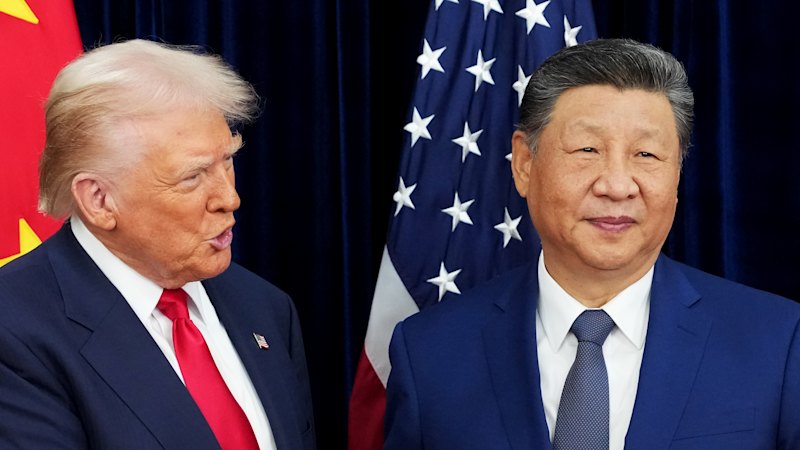
Beijing: President Donald Trump is set to arrive in Beijing on Wednesday for his highly anticipated summit with Chinese leader Xi Jinping, with the Iran war, trade and artificial intelligence the key talking points of their high-stakes meeting.
Trump arrives in Beijing under pressure to end the Iran war, which has triggered a global energy crisis, and injected fresh tensions into the summit due to Beijing’s close diplomatic ties with Tehran as the largest buyer of Iranian oil.
Many analysts regard the Middle East conflict as having shifted leverage further in China’s favour since the two leaders sealed a truce in their trade war in Busan, South Korea in October.
As he departed Washington for Beijing on Tuesday (US time), Trump downplayed the prospect of the war hanging over the summit talks.
“I don’t think we need any help with Iran. We’ll win it one way or the other, peacefully or otherwise,” he told reporters before boarding Air Force One.
The US president is expected to seek “wins” on trade by locking in Chinese purchases of American food and aircraft, saying he’ll be talking with Xi about trade “more than anything else”.
Other US officials have indicated the Iran war will be a key agenda item, including US Treasury Secretary Scott Bessent, who this month urged China to help reopen the Strait of Hormuz.
The war, launched by the US and Israel in February, has drained US military stockpiles, worsened cost-of-living pressures for Americans ahead of crucial midterm elections in November, and eroded US standing on the international stage.
“The Chinese are acutely aware that this is a major concern for the Americans, and as a result, it’s a substantial source of leverage for Beijing,” said Evan Medeiros, from the Asia Group, and a former China advisor on the Obama administration’s National Security Council.
“The question is: is Trump willing to pay whatever price Beijing puts on their Chinese co-operation on the Iran issue?”
Xi is widely expected to use the talks to emphasise China’s claims to Taiwan, and seek to convince Trump to roll back US weapons sales to the democratic island or changing the US’s official stance towards Taiwan independence from “does not support” to “opposes”.
Trump’s visit comes days after Taiwan’s opposition-controlled parliament approved only two-thirds of a $40 billion special defence budget, which included US weapons sales, while second arms package is reportedly in the pipeline.
“We firmly oppose the United States engaging in any form of military ties with China’s Taiwan region, and firmly oppose the United States selling weapons to China’s Taiwan region,” Zhang Han, a spokesperson for China’s Taiwan Affairs Office, said on Wednesday.
Accompanying Trump is a bevy of America’s top chief executives, including Apple’s Tim Cook, Tesla and SpaceX boss Elon Musk and chipmaker Nvidia’s boss Jensen Huang, who was a last-minute addition to the travelling party.
He is also accompanied by family members Eric and Lara Trump and cabinet officials including Secretary of State Marco Rubio. One notable name absent from the travel party is first lady Melania Trump, who is not accompanying the US president.
Her absence, first reported by the South China Morning Post, would suggest the serious nature of the visit, with pageantry giving way to hard-nosed negotiations.
The Trump administration is hoping to begin the process of establishing a “Board of Trade” with China to address differences between the countries. The board could help prevent the trade war ignited last year after Trump’s tariff hikes, an action China countered through its control of rare earth minerals. That led to a one-year truce last October.
Despite Trump’s outward confidence, China appears to be entering the meeting from “a much stronger place,” said Scott Kennedy, a senior advisor on Chinese business and economics at the Centre for Strategic and International Studies, a Washington think tank.
China would like to reduce tech restrictions on accessing computer chips and find ways to reduce tariffs, among other goals.
“But even if they don’t get much on any of those things, as long as there’s not a blow-up in the meeting and President Trump doesn’t go away and look to re-escalate, China basically comes out stronger,” Kennedy said.
With AP
Get a note directly from our foreign correspondents on what’s making headlines around the world. Sign up for our weekly What in the World newsletter.
 Lisa Visentin is the North Asia correspondent for The Sydney Morning Herald and The Age based in Beijing. She was previously a federal political correspondent based in Canberra.Connect via X or email.
From our partners
Discover more from PressNewsAgency
Subscribe to get the latest posts sent to your email.