Sunak: Situation would be worse without our actions
The chancellor, Rishi Sunak, has responded to today’s borrowing figures:
“Whilst it’s clear that the coronavirus pandemic has had a significant impact on our public finances, things would have been far worse had we not acted in the way we did to protect millions of livelihoods.
“Over time and as the economy recovers, the government will take the necessary steps to ensure the long-term health of the public finances.â€
Reuters UK
(@ReutersUK)Sunak says of soaring borrowing: things could have been far worse https://t.co/4B4bQZOb9f pic.twitter.com/O567otmLQV
Capital Economics: UK can afford to provide more help
Paul Dales of Capital Economics predicts that the UK deficit could hit an unprecedented £390bn by the end of the financial year — but that’s no reason not to provide more economic help:
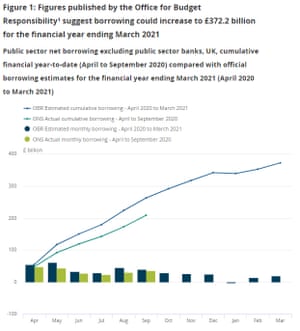
Public sector net borrowing (exc. Banking groups) of £36.1bn (consensus £33.6bn) was the third highest since records began in 1993. Even so, borrowing in the fiscal year to date is 20.6% below the OBR’s July projection.
But the stuttering recovery and further fiscal support are likely to mean that the pace of borrowing is higher than the OBR expected in the second half of the fiscal year. As a result, the budget deficit may eventually reach £390bn this year (19.6% of GDP), some £18bn more than the OBR’s £372bn projection. But with 10-year gilt yields currently just 0.19%, the markets don’t seem to care one bit.
Overall, low inflation and low gilt yields give the Bank of England and the Chancellor the green light to do more to support the economy.
UK public finances: snap reaction
Channel 4’s Helia Ebrahimi points out that Britain has now racked up six months of record-breaking borrowing in a row.
Helia Ebrahimi
(@heliaebrahimi)More staggering numbers on U.K. govt borrowing
Deficit was £208.5bn in first 6 months of year, highest ever @ONS says each of the 6 months were records
But….borrowing has actually been lower than the Office for Budget Responsibility (the UK fiscal watchdog) had forecast, points out the Institute For Fiscal Studies.
Institute for Fiscal Studies
(@TheIFS)Today’s @ONS figures show government borrowing exceeded £208bn between April and September 2020.
This compares to £31bn in the same period last year and is more than in any year on record. But it is £54bn, or one-fifth, less than the @OBR_uk’s ‘central’ scenario projection. pic.twitter.com/5hDvf990sx
Economist Julian Jessop also points out that the national debt is undershooting the official projections, so the UK isn’t out of firepower:
Julian Jessop
(@julianHjessop)FWIW, government borrowing continues to *undershoot* the latest official estimate from the OBR. Indeed, actual borrowing in April to September was £54.2 billion lower than projected.
(Useful for anyone arguing against tax rises, or for a few million extra for Manchester…) pic.twitter.com/9BQo9dCzX1
Another astonishing fact – since April, the UK has borrowed almost four times as much as the previous financial year.
The ONS says:
The coronavirus (COVID-19) pandemic has had an impact on public sector borrowing that is unprecedented in peacetime.
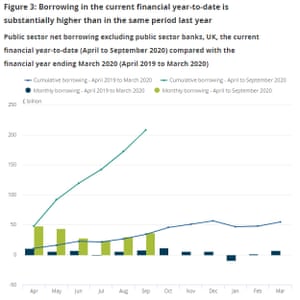
Provisional estimates indicate that the £208.5 billion borrowed in the first half of the current financial year (April to September 2020) was nearly four times the £54.5 billion borrowed in the whole of the last full financial year (April 2019 to March 2020).
UK borrowing: the key charts
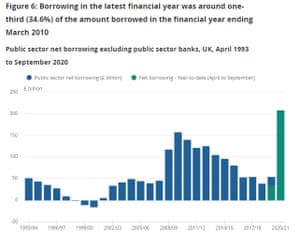
With deft understatement, the ONS points out that the £36bn borrowing in September was ‘substantially’ higher than a year ago (about six times higher!)
Photograph: ONS
Indeed, it’s nearly as much as the UK borrowed in the whole of the 2018-19 financial year:
Photograph: ONS
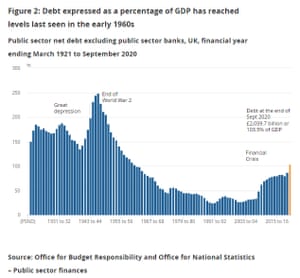
And the big picture…. the UK debt pile is now the largest since 1960, when measured as a share of GDP:
Photograph: ONS
UK inflation rises to 0.5% as Eat Out deals end
We’re also just learned that Britain’s inflation rate picked up last month.
The consumer prices index rose to 0.5% in September 2020, up from 0.2% in August.
The ONS reports that rising transport and restaurant prices pushed the cost of living up, as the government’s half-price meal deal ended.
It explains:
- Transport costs, and restaurant and café prices, following the end of the Eat Out to Help Out scheme, made the largest upward contributions (of 0.23 and 0.21 percentage points, respectively) to the change in the CPIH 12-month inflation rate between August and September 2020.
- This was partially offset by smaller downward contributions from furniture, household equipment and maintenance; games, toys and hobbies; and food and non-alcoholic beverages.
Rising inflation will be a blow to struggling households, especially those facing a drop in income due to the Covid-19 restrictions.
But the UK’s inflation target is 2%, so this won’t worry central bankers (who are more concerned about rising unemployment and the economic damage of Covid-19).
Helia Ebrahimi
(@heliaebrahimi)U.K. inflation 0.5% in Sept up from 0.2% in Aug; end of Eat Out to Help Out meant restaurant prices spiked says @ONS
Inflation still well below 2% so no barrier here to @bankofengland pumping more £ into economy next month
Introduction: Another month of record borrowing
Good morning, and welcome to our rolling coverage of the world economy, the financial markets, the eurozone and business.
Britain has racked up another month of unprecedented borrowing, as the economic cost of Covid-19 continues to mount.
Figures just released show that public sector net borrowing hit £36.1bn in September 2020, a record level for the month, and more than economists expected.
That’s £28.4bn more than in September 2019, and the third-highest borrowing in any month since records began in 1993 — following April and May this year.
It means that since April (the start of the financial year) the UK has borrowed around £208.5bn to cover the cost of protecting the UK economy from the pandemic.
That’s £174.5bn more than a year ago — and the highest borrowing in any April to September period since records began in 1993. Every month since April has seen record borrowing.
UK public finances to September 2020 Photograph: ONS
September’s borrowing has pushed the UK national debt up to £2,059.7, or around 103.5% of GDP — the highest debt to GDP ratio since 1960.
This includes billions spend on PPE equipment, the job retention scheme that saw millions of workers paid by the government, and lost tax receipts as the economy locked down.
The ONS explains:
- Central government tax receipts are estimated to have been £37.7bn in September 2020), £6.0bn less than in September 2019, with large falls in Value Added Tax (VAT), Business Rates and Corporation Tax receipts.
- Central government bodies are estimated to have spent £77.8bn on day-to-day activities (current expenditure) in September 2020, £18.1bn more than in September 2019; this includes £4.9bn in Coronavirus Job Retention Scheme (CJRS) and £1.0bn in Self Employment Income Support Scheme (SEISS) payments.
Fortunately, Britain can borrow cheaper than ever before.
Ten-year UK gilts trading at an interest rate below 0.2%, showing solid demand for UK debt, and meaning that the cost of servicing the Covid-19 borrowing will be historically low.
More details and reaction to follow…
The agenda
- 7am BST: UK inflation data for September
- 7am BST: UK public finances for September
- 12pm BST: US weekly mortgage approvals data
- 1.10pm BST: Bank of England deputy governor Sir Dave Ramsden speaks on “UK Monetary Policy: Issues and Outlookâ€
Related
Discover more from PressNewsAgency
Subscribe to get the latest posts sent to your email.