

The President of Uzbekistan, Shavkat Mirziyoyev, this week participated in the most important annual public event in Russia: the May 9th celebration of the victory of the USSR over Nazi Germany in 1945.
Russian President Vladimir Putin has turned “Victory Day” into a grand ceremony, where the leaders of former Soviet nations show up to reconfirm their alliances.
Some of them, including Mirziyoyev, also have a taste for the political longevity that Putin seems to want.
After Russia’s constitution was amended in 2020 to “nullify” Putin’s previous terms, nothing more than his own mortality prevents the septuagenarian from presiding over 13 more Victory Day parades.
Mirziyoyev, who has ruled Central Asia’s most populous nation since 2016 and was re-elected in 2021, followed in Putin’s footsteps.
Just a few hours before flying to Moscow, he Announced an early presidential vote scheduled for July 9.
Elections would follow referendum on April 30 which amended the constitution of Uzbekistan, removed Mirziyoyev’s previous terms, and extended future terms to seven years.
Such amendments have become common in the post-Soviet states.
Standing next to Mirziyoyev during the Victory Day parade were Belarusian President Alexander Lukashenko and Tajik leader Emomali Rahmon, who have extended their terms through constitutional amendments twice.
So did Mirziyoyev’s staunch predecessor, Islam Karimov, who ruled Uzbekistan after its independence in 1991 until his death in 2016.
“It is absolutely obvious that Mirziyoyev also intends to rule (his) nation for the rest of his life,” Alisher Ilkhamov, the Uzbekistan-born head of Central Asia Due Diligence, a London-based group, told Al Jazeera.
Another Victory Day participant, Kazakh President Kassym-Jomart Tokayev, seemed modest by comparison.
Last year, he amended Kazakhstan’s constitution and was re-elected, but only for one term, until 2029.
‘Mine, yours, ours’
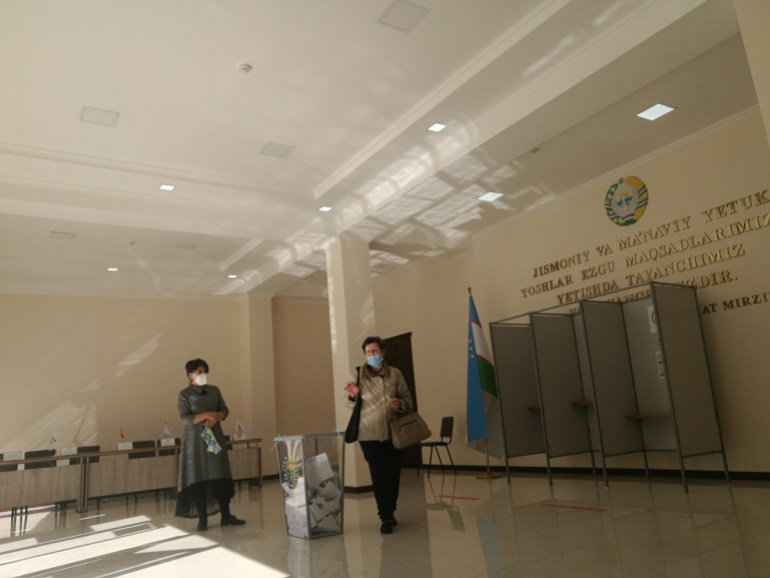
Before the referendum, the Mirziyoyev government trained 140,000 activists to educate average Uzbeks about the reform.
Preschool children in a kindergarten were filmed chanting the campaign’s main slogan: “The constitution is mine, yours, ours!”, while a billboard featured a woman whose “life begins after 30″, that is, after April 30.
Subway advertisements urged passengers to “lean off the doors and lean on the constitution”, while all mobile phone users received daily text messages reminding them to vote.
As a result, official turnout reached nearly 85 percent and 90 percent of voters approved the amendments.
“It was obvious to the people around me why all this is done, so they felt deeply indifferent,” Timur Karpov, a human rights activist and owner of an art gallery in the Uzbek capital Tashkent, told Al Jazeera. .
But despite the reported violations in Tashkent, he did not doubt the high turnout.
“Such events always take place with a large turnout, especially when one is lured with (free) plov,” a traditional Uzbek dish of rice, carrots and meat that was handed out at many polling stations, he said.
The “annulment” will allow Mirziyoyev to remain in the Aq Saray (White Palace), the presidential residence, for 14 more years, until 2040, when he will be 84 years old.
From reformer to autocrat?
Mirziyoyev’s recent steps contrast with the dawn of his government.
For 13 years, he served as Karimov’s prime minister, keeping a low profile and distancing himself from the excesses of his temperamental boss.
One of them was the 2005 order to gun down a crowd of protesters in the eastern city of Andijan, which became the largest and bloodiest crackdown by the former USSR against a popular revolt.
Another was a decades-long practice of forcing Uzbek farmers to grow cotton and sell it to the government at a low fixed price.
Every fall, millions of government employees and college and high school students were herded into cotton fields for weeks at a time as part of one of the world’s largest forced labor systems.
The practice made Uzbekistan a major importer of raw cotton and created one of the worst man-made. environmental disasters in History.
Mirziyoyev dismantled “cotton slavery” by allowing farmers to sell raw fiber at market prices and promoting the domestic textile industry.

He carried out sweeping and long-awaited reforms that cut and simplified taxes, removed barriers to business, and allowed hundreds of thousands of Uzbeks to
solve your bureaucratic problems through direct petitions on the Mirziyoyev website.
He also purged the prosecutor ranks and security agents, closed a notorious jail where prisoners said two dissidents had been boiled alive, and released thousands of political and Muslim prisoners jailed for alleged “extremism.”
But the reforms were soon halted.
“Parliamentary development has been suspended, the (presidential) administration usurped the government’s functions, the Cabinet cannot independently resolve even potato cultivation issues,” the Tashkent-based political blogger told Al Jazeera. Timur Numanov.
For him, the early vote is an attempt to prevent the emergence of charismatic competitors and initiate unpopular reforms, such as the introduction of market prices for natural gas and public services.

“What is going to change in two months (before the vote on July 9)? Exactly, nothing, no new party is going to emerge, nor is there going to be an unexpected alternative candidate, ”he said.
Uzbekistan was one of the largest exporters of natural gas to the former USSR.
But the construction of gas-consuming chemical plants limited exports and caused severe shortages in the domestic market.
During the unusually cold winter last year, many Uzbeks had to cut down trees and start fires next to their apartment buildings to keep warm and cook.
In recent years, a construction boom has sent property prices soaring, but thousands of Uzbeks have been offered small compensation for their apartments and houses being demolished to make way for luxury condominiums or business centers.
“I got a two-bedroom apartment for the five-bedroom house my father built 43 years ago,” a resident of the eastern city of Ferghana told Al Jazeera on condition of anonymity. “What reforms are we talking about?”
Discover more from PressNewsAgency
Subscribe to get the latest posts sent to your email.