

expected
By David Zahn, CFA, FRM, Head of European Fixed Income, Franklin Templeton Fixed Income
Bond prices have been struggling this past year due to rising inflation and interest rate increases. David Zahn, head of European fixed income at Franklin Templeton Fixed Income, shares his outlook for the UK economy and why he thinks now is a good time to consider investing in government bonds.
A year has passed since the “mini-budget” of the short-lived Trussonomics era. So now seems like a good time to check out the UK and British gilts.
Back then, there was a lot of concern because bond yields were high. But what’s interesting is that today, yields are actually higher than they were a year ago, and the BOE is still talking about raising interest rates.
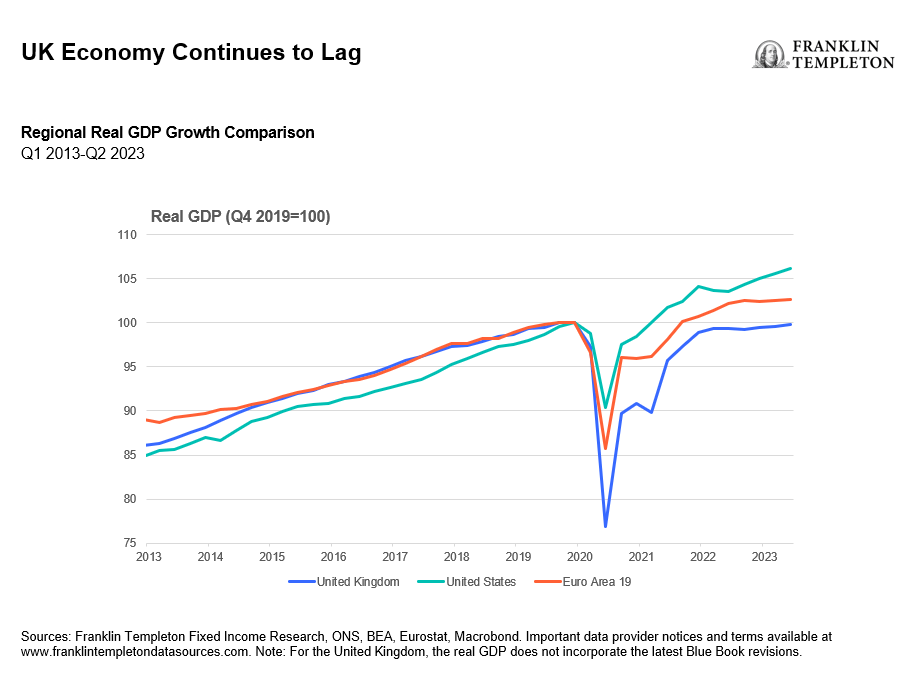
Currently, the UK economy is not looking so good. The growth is low, inflation is high and the BOE was left behind in the adjustment. The UK economy continues to lag behind its Western and eurozone peers. The country suffered a deeper decline due to COVID-19 in 2020, and the recovery since then has been poor.
A shrinking British labor market and higher wages
The UK job market shrank significantly after Brexit and during the pandemic many people decided to leave the UK and return to their home countries.
For some people who want to return, it is proving difficult and the UK job market has not recovered from the exodus. Additionally, many people left the workforce completely and have not returned.1
That said, a tight labor market is good for those who are employed, as it means wages will rise. Salaries in the United Kingdom have been high compared to those in Europe, but not as high as those in the United States. But it also means that the cost of goods will remain high.
Inflation Cooling and BOE Rate Actions
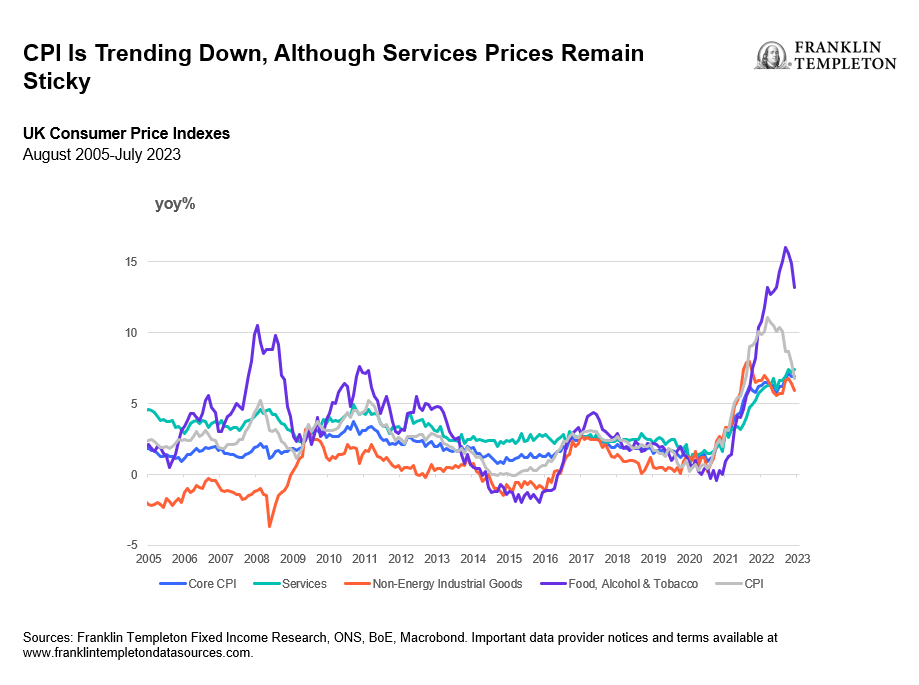
While inflation remains a concern, it appears the BOE rate hikes are having an effect. Rate rises are taking longer to hit the UK economy as many mortgages and business loans now have fixed rates.
Food, alcohol and tobacco prices peaked at around 16% in 2022, but have declined in 2023. Along with caps on energy prices, the overall consumer price index (CPI) also should continue with a downward trend.
The biggest question is when the BOE will start thinking about reducing interest rates. Looking at the major global central banks (the BOE, the European Central Bank, the Bank of Japan and the US Federal Reserve), we believe the UK may be the first to see rate cuts, given its weak economy.
It’s also worth noting that government bond investors should also take into account what’s happening in the US and Europe: UK and US interest rates are more correlated than most people think.
Implications of current UK economic conditions for investors
With increased uncertainty surrounding the UK economy, we believe most asset classes (including credit, equities and sovereign bonds) are likely to experience volatility in the coming quarters and even years.
One positive aspect of government bonds is that at this point in the cycle, they are yielding considerably more than they have in recent years.
The UK yield curve is currently inverted, but that’s not new – it’s been that way for some time. In our analysis, the yield curve could invert further as UK economic growth is expected to remain weak. That being the case, we believe that it is not too early for the BOE to start thinking about easing.
British bonds have once again become an attractive proposition
In our view, UK bonds look attractive at the moment because they offer high yields with very low default risk – UK bonds offer the highest yields in the G7. And the BOE has shown that it can print money when it needs to.
Furthermore, if the government stabilizes after the next election, the UK is likely to appear more attractive to many investors, attracting foreign asset flows.
UK domestic investors looking for high returns with relatively low risk could also find government bonds attractive.
Conclusion
In our view, now is a good time to consider increasing allocations to gilts. We believe that an actively managed government debt portfolio can offer diversification, higher return potential and potential downside mitigation.
What are the risks?
All investments involve risks, including the possible loss of principal. Fixed income securities involve interest rate, credit, inflation and reinvestment risks, and possible loss of principal. As interest rates rise, the value of fixed income securities falls.
International investments are subject to special risks, including currency fluctuations and social, economic and political uncertainties, which could increase volatility. These risks are magnified in emerging markets.
Investing in a concentration of certain securities, regions or industries is subject to greater volatility.
Currency management strategies could lead to losses if currencies do not perform as expected.
Active management does not guarantee profits or protect against market declines.
1. Sources: Franklin Templeton Fixed Income, ONS, Macrobond. Important notices and terms about data providers available at www.franklintempletondatasources.com.
Discover more from PressNewsAgency
Subscribe to get the latest posts sent to your email.