

India’s IT ministry has sought answers from X (formerly Twitter) as close to 250 flights operated by Indian airlines have received hoax bomb threats this month. All these threats have been through X, with people familiar with the matter saying that the people posting them appear to be doing so from the anonymity of VPNs or virtual private networks.
The IT ministry met virtually with representatives from airlines and social media platforms including X and Meta on Wednesday, and according to people present at the meeting, joint secretary Sanket S Bhondve, who chaired the meeting, asked the representatives of X what the platform was doing to prevent such false threats.
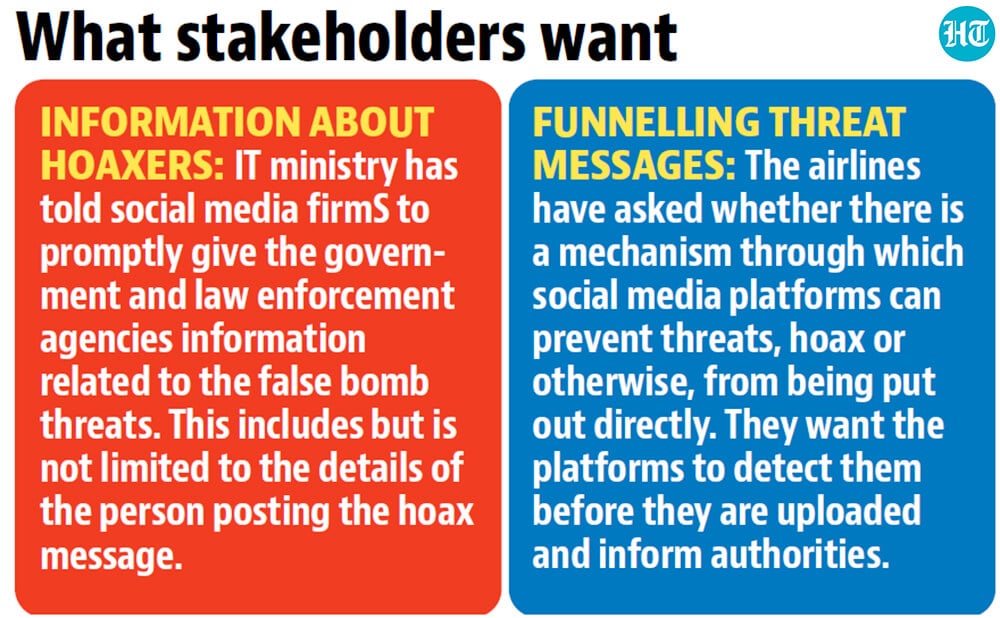
“The IT ministry told the social media companies to promptly give the government and law enforcement agencies information related to the bomb threats. This includes, but is not limited to the details of the person posting the hoax message,” a person who attended the meeting said on condition of anonymity.
HT reached out to X for a response but did not get one immediately.
Under Section 66F of the IT Act, which addresses cyber terrorism, calls and messages made over digital channels and intended to manipulate or interfere with critical infrastructure can be classified as cyber terrorism. It wasn’t immediately clear whether the posts on X alleging bombs had been placed on aircraft, have been defined as cyber terrorism by the IT ministry.
The hoax alerts came from X accounts that had mostly been created recently and appeared to have been set up for the purpose of making those posts. Two of the accounts that HT could identify were @schizobomber777 and @adamlanza111. The second account, its handle apparently inspired by the name of a 2012 school mass shooter in the US, was created more recently and continued tweeting the fake bomb alert messages on at least two days – Friday and Saturday, by when the issue had already become a serious problem.
It is unclear why X did not implement any additional safeguards once the bomb hoaxes began following a similar pattern since the Monday before — newly created accounts, warning of “bombs” and “explosions” and tagging a set of 7 Indian airline handles. Since Elon Musk took over, the company has been criticised for unravelling its trust and safety operations that oversaw monitoring and action against its service’s abuse.
HT has sent X a detailed questionnaire.
Legal experts said that 66F of the IT Act, when used with Sections 351 and 353 of the Bharatiya Nyaya Sanhita or BNS, dealing with criminal intimidation including threats aimed at instilling fear, and statements amounting to public mischief, are adequate to deal with such hoaxes.
Civil aviation minister Ram Mohan Naidu Kinjarapu told news channel India Today that the IT Department was “strongly pursuing these cases”. “Most threats coming through social media. We are trying to find these hoaxers through IP address,” he said.
The spate in hoaxes has increased the carriers’ burden as a number of flights have had to be diverted, delayed, or subjected to searches after posts on social media said they had bombs on board. Some of the threats have led to serious outcomes. Last Thursday, an Air India flight from Mumbai to London was intercepted by Royal Air Force fighter jets after receiving a bomb threat. Two days before that, Singapore Armed Forces scrambled two fighter jets to escort an Air India Express plane, which took off from Madurai, away from populated areas following a bomb threat. On Tuesday, the Nepalese Army rushed its bomb squad to the Kathmandu airport after a Vistara flight from Delhi got a bomb threat.
“The airlines have asked the government whether there is a mechanism through which social media platforms can prevent bomb and terror threats, hoax or otherwise, to be uploaded publicly. The airlines want social media companies to proactively detect them before they are uploaded and report them to the relevant authorities,” another person aware of the discussions said.
At least one Indian airline, Air India, attended this meeting but HT did not get a response from the carrier till the time of going to press.
Aviation experts said that airlines and security agencies cannot afford to ignore such threats, but also pointed to the risk of their guard slipping in the wake of repeated false alarms.
Security experts said that the issue is actually sector-agnostic, pointing out that the threats could have been received by banks, say, or schools. The important thing, they added, is for the IT platform involved – in this case X – to crack down on such threats, by making it impossible for people to post them. That isn’t happening, they added.
Discover more from PressNewsAgency
Subscribe to get the latest posts sent to your email.