AUGUSTA, Georgia, April 10 : LIV Golf’s Bryson DeChambeau headlined the list of players who missed the cut at the Masters on Friday after the two-times U.S. Open champion carded a costly triple-bogey on the final hole at Augusta National.
DeChambeau reached the par-four 18th one shot inside the four-over par cut line but needed two shots to get out of a greenside bunker before carding a seven that ended his week.
DeChambeau, who briefly held the lead early in the final round of last year’s Masters, had arrived at the year’s first major fresh off two consecutive wins on the LIV Golf circuit but was unable to transfer that form to Augusta National.
Other notables to miss the cut were 2025 U.S. Open winner J.J. Spaun, former British Open champion Cameron Smith of LIV, and a pack of former Masters champions including Danny Willett Bubba Watson, Zach Johnson, Fred Couples, Jose Maria Olazabal, Mike Weir, Vijay Singh, and Angel Cabrera.
According to Augusta National, 54 players, including competitors from 15 different countries, made the 36-hole cut from a starting field of 91.
Nasa’s Artemis II crew splashed down in the Pacific Ocean near San Diego, California early Saturday, marking their return to Earth after a lunar flyby mission.The Orion spacecraft carrying the crew completed a successful splashdown. A joint Nasa and US military recovery team was on site to receive the astronauts and provide medical support.Following liftoff on April 1, the 10-day mission sent four astronauts on a flyby around the Moon, testing life-support, navigation and propulsion systems in deep space without landing, Nasa said. The mission also paves the way for a potential crewed Moon landing in 2028.The mission made history by setting a new record for the farthest distance humans have travelled from Earth, reaching 406,771 kilometres on the far side of the Moon. This surpasses the previous record of 400,171 kilometres set by Apollo 13 in 1970.During the flyby, the astronauts spent several hours capturing images and describing views as they looped around the Moon before beginning their journey back to Earth.Commander Reid Wiseman, pilot Victor Glover, mission specialist Christina Koch and Canada’s Jeremy Hansen reentered Earth’s atmosphere at speeds of up to Mach 33 — 33 times the speed of sound — marking a return to velocities not seen since Nasa’s Apollo missions of the 1960s and 1970sThe crew did not plan to take manual control except in an emergency, with their Orion capsule, named Integrity, operating in a fully autonomous modeLead flight director Jeff Radigan said he expected a degree of “irrational fear that is human nature,” particularly during the six-minute communication blackout before parachute deploymentThe recovery ship USS John P Murtha was positioned off the coast of San Diego to receive the crew, supported by military aircraft and helicoptersThe last joint reentry operation by Nasa and the US Defense Department for a lunar crew was during Apollo 17 in 1972.
Nasa’s Artemis II spacecraft has returned to Earth after completing its historic, record-breaking journey around the Moon.
Just after 1am BST, the Orion module separated from the rest of the craft and plummeted down into the Pacific Ocean – after reentering our atmosphere at almost 25,000 miles per hour and enduring temperatures of 2,760C.
It had earlier slowed down from that incredible speed to to just 20mph for a safe landing.
The craft successfully deployed its parachutes and made its way into the sea off Southern California.
Speaking from the USS John P Murtha, Nasa chief Jared Isaacman vowed it would not be a “once in a lifetime moment” – and that today was only the beginning.
“It’s a huge moment for everybody,” he said. “We are back in the business of sending astronauts to the Moon, bringing them back safely and to set up for a series more.
“I mean, this is not a once in a lifetime thing. No, it’s not. This is just the beginning. We are going to get back into doing this with frequency, sending missions to the Moon until we land on it in 2028 and start building our base.”
PICTURED: The Orion capsule floats in the Pacific after splashdown
|
NASA
Mission Control, meanwhile, called the landing “a perfect bullseye splashdown”.
But on Saturday – or Friday afternoon, at 5.07pm local time – the manned mission made it back home in one piece.
The crew’s homecoming cleared a critical final hurdle for the Lockheed Martin-built LMT.N Orion spacecraft, proving it would withstand the extreme forces of re-entry from space.
At the peak of re-entry stress, as expected, intense heat and air compression formed a red-hot sheath of ionised gas, or plasma, that engulfed the capsule.
This cut off radio communications with the crew for several minutes.
PICTURED: The moment Nasa’s Artemis II spacecraft splashed down in the Pacific
|
NASA
Cheers then broke out in Houston as comms were re-established with the crew five minutes before splashdown.
Commander Reid Wiseman broke the team’s silence by saying: “Houston, we have you loud and clear.”
“What a journey,” he said as the crew splashed down. “We are stable one, four green crew members.”
Nasa labelled their return a “textbook touchdown”.
On the space agency’s live feed, an announcer can be heard saying the four astronauts are “in great condition” and “all in excellent shape”.
Earlier, the gumdrop-shaped capsule was captured splitting off from the service module above our planet
|
NASA
Crewmembers Reid Wiseman, Victor Glover, Christina Koch and Jeremy Hansen have captivated the world since blasting off from Florida on April 1
|
REUTERS
PICTURED: The four crew members on their record-breaking journey around the Moon
|
NASA
The team of four captured incredible images of the Moon and the Earth – like this one
|
REUTERS
Since Artemis II blasted off on April 1, Mr Wiseman, Victor Glover, Christina Koch and Jeremy Hansen have captivated the world with their extraordinary images of the Moon and the Earth, and their updates from their journey into space.
They reached a maximum distance of approximately 252,760 miles from our planet on Monday, shattering a record that had stood for more than half a century.
In total, the quartet travelled some 694,392 miles across two Earth orbits.
It marked the first crewed test flight in a series of Artemis missions which aim to start landing astronauts on the lunar surface, starting in 2028.
GB News understands President Donald Trump, who personally congratulated the team after they broke the distance record, was watching the splashdown from the Trump Winery in Virginia.
Japan’s energy security has long hinged on Middle Eastern oil. The Iran war simply exposed how breakable that lifeline had become.
While a two-week ceasefire agreed on Tuesday promises some relief by reopening the Strait of Hormuz to tanker traffic, analysts say the shock has laid bare vulnerabilities Tokyo cannot easily paper over.
As an archipelago nation with no cross-border pipelines, Japan draws more than 95 per cent of its crude from the Middle East and routes the bulk of it through the very chokepoint that Iran shut.
The result was an energy squeeze sharper than almost anywhere else in the G7, with domestic oil prices at their highest since 2008 and Tokyo forced into the largest strategic reserve release in its history.
“This latest geopolitical shock once again highlights the structural tension in Japan’s energy strategy,” said Parul Bakshi, a visiting research fellow at The Oxford Institute for Energy Studies.
“The real test will be whether Japan can convert this moment of vulnerability into a catalyst for long-term energy transformation.”
Analysts say that transformation will require retooling refineries to handle non-Middle Eastern crude, including barrels from the United States and Canada, and restarting more nuclear power plants 15 years after the Fukushima disaster.
NEW YORK, April 10 : A federal judge on Friday blocked Arizona from continuing its criminal case against prediction market Kalshi, according to the Commodity Futures Trading Commission, which sued to prevent states from regulating the industry.
The CFTC announced the ruling in a press release following a hearing before U.S. District Judge Michael Liburdi in Arizona.
The agency said the court granted its request for a temporary restraining order barring the state from continuing to pursue criminal charges against CFTC-regulated designated contract markets.
“Arizona’s decision to weaponize state criminal law against companies that comply with federal law sets a dangerous precedent, and the court’s order today sends a clear message that intimidation is not an acceptable tactic to circumvent federal law,” CFTC Chairman Michael S. Selig said in a statement.
Kalshi and the Arizona Attorney General’s Office did not immediately respond to emails seeking comment on the ruling.
The criminal case against Kalshi is the first against the company by a state amid an escalating battle between state gaming regulators and prediction market operators.
President Donald Trump’s administration sued Arizona, Connecticut and Illinois on April 2 to stop what it called their unlawful efforts to regulate prediction markets because they may violate state gambling laws.
Attempts by states to shut down “event contracts” offered by companies such as Kalshi, Polymarket, Crypto.com and Robinhood (HOOD.O) violate the CFTC’s exclusive authority to regulate national swaps markets, the government said.
Arizona countered in a court filing federal law does not strip states of their “traditional power over sports betting.”
Arizona Attorney General Kris Mayes filed criminal charges against Kalshi on March 17, accusing it of operating an illegal gambling business and unlawfully allowing people to place bets on elections.
Kalshi denied wrongdoing after the charges were filed and said its business was different from sportsbooks and casinos.
NEW YORK: Wall Street stocks rose sharply over the week and oil prices fell as a fragile truce was struck between the United States and Iran, with ceasefire talks due to start in Islamabad on Saturday (Apr 11).
For the week, all three major US indices advanced by more than three per cent. Oil prices retreated once again on Friday. For the week, they tumbled by approximately 13 per cent.
The New York Stock Exchange closed mixed for the day Friday – the Dow Jones shed 0.6 per cent, the Nasdaq gained 0.4 per cent, and the broader S&P 500 index was flat, slipping 0.1 per cent.
“Markets are trading on a cautious tone ahead of the US-Iran ceasefire talks,” Elias Haddad of Brown Brothers Harriman (BBH) said in a note.
“For financial markets, the key issue is whether peak shipping security fear is now behind us.”
Official sources say the talks in Islamabad will cover Iran’s nuclear enrichment and the free flow of oil through the Strait of Hormuz.
Since the ceasefire took effect, US President Donald Trump has voiced displeasure at Iran’s handling of the strategic strait, which was meant to be reopened.
“The key issue for the oil market is whether ship traffic through the Strait of Hormuz will resume,” Carsten Fritsch of Commerzbank said in a note. “So far, there are no signs of this happening.”
Inflation in the United States rose sharply in March, government data showed Friday, as higher energy prices due to the war hit Americans hard. Prices rose 3.3 per cent from a year earlier.
White House spokesperson Kush Desai responded by saying the US economy “remains on a solid trajectory.”
Add articles to your saved list and come back to them anytime.
Nationality is a funny thing.
You could take anyone in the world, put them in a packed Murrayfield with the stirring Flower of Scotland playing, and they’d swear they were ready to lay down their lives to repel the invading English, Braveheart style.
But there must be a distinction between feeling Scottish, Irish or Welsh and actually being Scottish, Irish or Welsh, and rugby has lost its way in defining that gap.
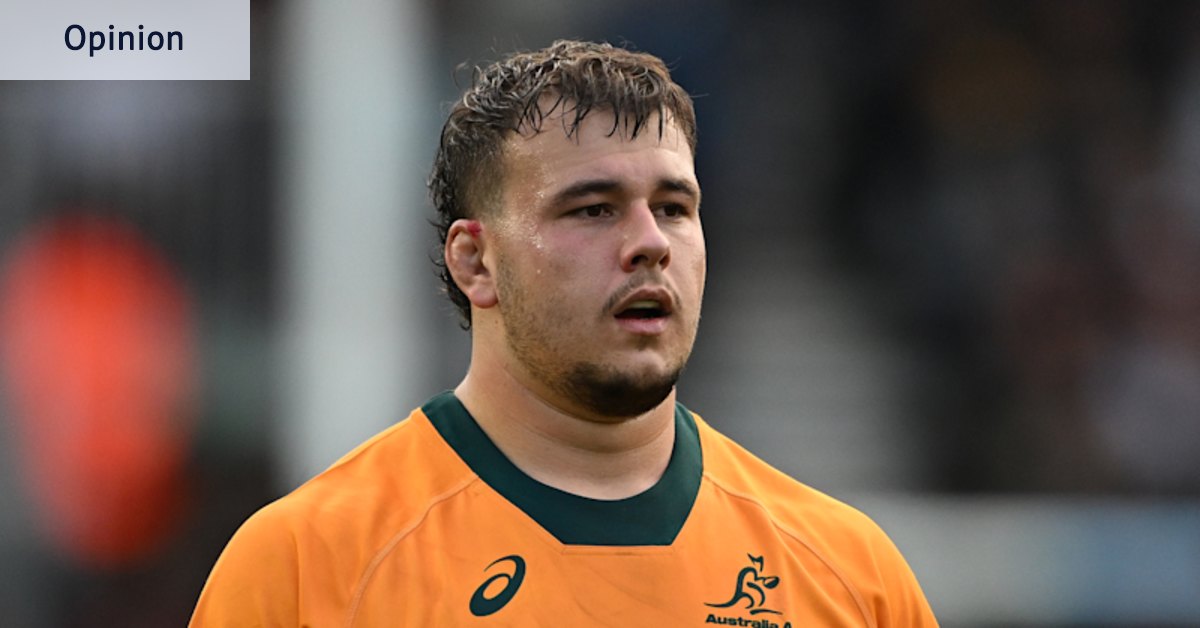
Prop Massimo De Lutiis will stay at the Queensland Reds after a recruitment attempt by Ireland.Getty Images
Frankly, World Rugby’s grandparent eligibility rule has simply become an extraction tool for northern hemisphere teams – particularly the Celts – to raid the south for players they had no part in developing.
The recent re-signing of Reds prop Massimo de Lutiis with Rugby Australia until 2029 is a win for the Wallabies, but the mini soap opera has once again exposed how the grandparent rule is outdated and absurdly weighted towards the Six Nations countries.
I grew up in Ulster, the province keen to lure de Lutiis, so on a selfish level I should have cheered his potential move, but the truth is that Big Mass is about as Irish as a suntan.
In fact, those who qualify for their adopted countries under the five-year residency rule show a deeper connection to their new homelands than those who simply qualify by virtue of a single grandparent.
It’s a rule that should only apply to the Pasifika countries, as a way to repay the game’s debt to them. But northern hemisphere countries play the heritage game because there is no cost involved – it’s a no-brainer for them to run ancestry checks on all the Super Rugby squads each year.
The only way to stop this is to either retire the grandparent rule – complicated due to the Pasifika countries – or impose a cost on those who still want to use it.
The difficulty lies in agreeing on a cost: essentially deciding a player’s worth.
But a young tighthead prop such as de Lutiis is potentially worth $10 million and the Irish should have been on the hook if they had successfully signed him.
Queensland prop Massimo De Lutiis.Getty Images
That seems like a lot of money in a sport lacking a transparent transfer market and a clear way to value players, but it’s not if you follow the logic.
At just 22 years old, de Lutiis could easily be a 10-year Test player. The prizemoney for winning the Six Nations alone over that period would be £65 million ($125m) – and that doesn’t include any other performance-related revenue such as sponsorship and broadcast earnings.
And what does everyone say about good tighthead props? They’re invaluable. You simply won’t win any competition without at least one world-class No.3.
Had Ireland been able to secure de Lutiis for nothing, it would have been an act of larceny, and it would have been impossible to quantify the value lost to Australian rugby against the value gained by the Irish.
Over a 10-year period, de Lutiis could have played 100 Tests for Ireland (and the British and Irish Lions), resulting in the $10m figure – a set fee of $100,000 every time he pulled on a green jersey.
That is how you value a player: stagger the payments based on Test appearances so the national union that lost the player is duly compensated and the union that recruited him pays a price.
This would also solve the issue of plausible deniability that exists in Europe regarding recruitment, particularly in France.
The French Rugby Federation’s stance is that it can’t stop French clubs from plundering young Australian talent, and is not directly involved in their recruitment of young Australian stars such as Heinz Lemoto.
That is technically true, but Les Bleus will ultimately benefit if Lemoto qualifies for France later, following in the footsteps of Emmanuel Meafou.
Australian talent Heinz Lemoto went to France.Getty Images
Rugby Australia may never stop the free-market flow of young Australians to the rich Top 14 clubs, but it would certainly soften the blow if they pocketed $100,000 each time an Australian played for France.
In my experience, the northern hemisphere has an extraordinary lack of understanding regarding the urgency of this issue for countries such as Australia.
Former Rebels coach Dave Wessels gets it. Wessels, who is now general manager of high performance at SA Rugby, recently had a shot at Ireland for poaching a few South African schoolboys with Irish heritage.
But he is fighting the assumption up north that anyone who had a pint of Guinness in Dublin or a Brains in Cardiff is basically Irish or Welsh anyway, so what’s the harm?
But the harm is real, and de Lutiis won’t be the last young Super Rugby player to field a tempting overseas offer, leaving the union that developed him with nothing.
You have reached your maximum number of saved items.
Add articles to your saved list and come back to them anytime.
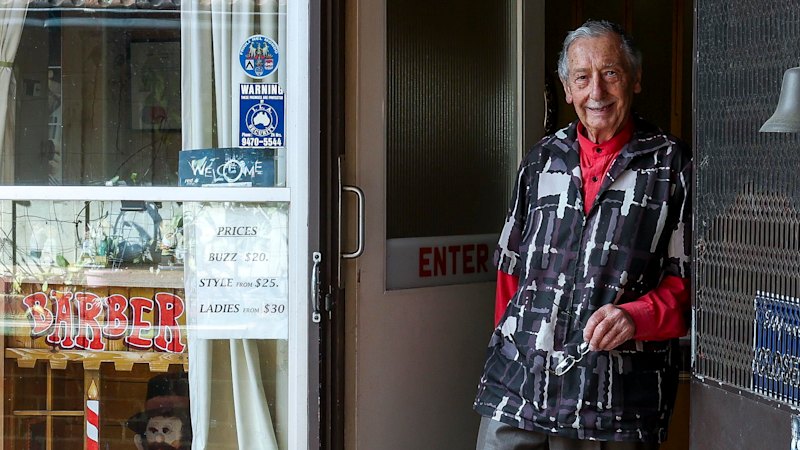
A hairdresser’s best attribute, says 85-year-old Dante Alessio, is the ability to listen. And customers have aired all manner of life’s ups and downs in his home salon over the past 55 years.
“We were their confidants,” he said.
Barber Dante Alessio at his home and salon in Thornbury.Eddie Jim
One day, a 75-year-old client amazed Dante and his wife Rita by announcing she was getting married. After being single all her life, the client had met a lovely widower at her retirement village.
The Alessio’s did her hair for her wedding, and attended the ceremony at a Preston church, which was beautiful, Rita said.
Now, as he prepares to retire after a remarkable stretch of 74 years in the trade, Dante says it’s the people he will most miss.
Opened in 1971, the Alessios’ salon, Dan’s Hair Cuts, sits at the rear of a brick veneer home on Darebin Road in Thornbury. With a barber’s sign out the front, the house is a local landmark.
The sign outside Dante and Rita’s home has made it a local landmark.Eddie Jim
For decades as they raised their four daughters, Rita would wash clients’ hair, sweep the floor, answer the phone and make coffee while Dante cut hair.
But on April 18, the house will go to auction, marking the end of an era.
Ken Barbuto, who lives around the corner, said he will miss “ducking in for a trim” and having a chat about Italy and “what we’ve been up to”.
“The first time I walked in here was like walking into a bit of history,” Barbuto said.
Happy memories: Dante and Rita Alessio, centre, in red and blue tops, with their parents and four daughters – baby Reina, and Alina, Gilda and Sonia – outside their Thornbury home and salon, circa 1972.
Bev Maskill, a customer for 45 years, comes every week for a wash and blow dry. “I sit there and have a bit of a laugh and a chat,” she said. “Dante and Rita are my friends, not business acquaintances.”
In the early days, the salon was known as Dante Coiffure, and most of his customers were women. With perms in vogue, he spent hours setting hair in rollers, applying smelly chemicals, and washing and drying. There was also blue rinses, and “sets” – where hair was washed, styled, dried and combed.
The salon’s changed its name to Dan’s Hair Cuts around 1990 and over time, the clientele has also changed too. In 2026, Dante says over 95 per cent of his customers are men who mostly get $25 cuts.
Most are regulars. “I know what they want, they don’t have to tell me, and they’re happy,” Dante says.
Barber Dante Alessio and wife Rita at their Thornbury home. Eddie Jim
Growing up in Buja, in north-eastern Italy, Dante started hairdressing in his father Ettore’s salon in 1951, when he was just 11 years old.
A year later, Ettore left for Australia, with Dante and his mother eventually joining him in 1956.
He and Rita married in 1964, and seven years later when Ettore retired, the couple opened their Thornbury salon.
Though Dante has said he intends to keep working until the property’s settlement, the Alessio family is still deciding what to do with the salon’s equipment, which includes three vintage hair dryers.
Dante Alessio is set to close his salon after 55 years when he and his wife Rita sell their house. Eddie Jim
One of Dante and Rita’s daughters will keep a barber’s chair that Ettore imported from Italy, and which dates back to 1928.
Kew resident Cath Whitehead told The Age that her family had been getting their hair done by Dante and his father, Ettore, for four generations.
“It’s sad,” Whitehead said. “Dante is such a hard worker. He was always caring, interested in what was happening in everyone’s lives, and strived to do excellent job.”
AUGUSTA, Georgia, April 10 : Justin Rose feels no different in his bid to go one better than last year’s heartbreaking Masters runner-up finish, but the Englishman will need to find a new gear after defending champion Rory McIlroy built a massive cushion atop a crowded leaderboard.
Rose, who lost to McIlroy on the opening hole of a sudden-death playoff at last year’s Masters, was in a three-way share of fourth place after a three-under 69 on Friday left him at six under on the week and six shots back of the Northern Irishman.
The 45-year-old Englishman, a three-time Masters runner-up, said the passage of time has done nothing to dull either his edge or his ambitions.
“No, I feel the same, which is good,” he said. “I think if I can feel the same, that means I’m doing a lot of other good things because I’m not feeling older and stuff like that. I feel the same. I feel in good form. I feel in good spirits.”
The 2013 U.S. Open champion added that while the desire to win is burning as brightly as ever, he was wary of the trap of trying too hard.
“I don’t really need to try any harder; know what I mean? I think trying harder is – I just think the experience in that is probably trying harder ain’t going to help me,” he said. “So that’s probably the dance I’m doing with myself.”
But now Rose will need a significant McIlroy stumble over the weekend to have a chance of finally slipping on the Green Jacket.
Rose’s round was anything but straightforward. He opened with a bogey after an errant tee shot and then found his ball nestled under a bush at the fifth, threatening to derail his afternoon entirely before a par save steadied the ship.
He then caught fire around the turn, picking up his first birdie of the day at the seventh before making three consecutive birdies that included a run through the par-four 11th to briefly move into the lead. A bogey at the notoriously treacherous 12th was offset by a four-foot birdie putt at the par-five 15th.
“I felt like the round could have gone either way,” Rose said.
“I’m under a bush on No. 5, already one-over for the round. I felt like momentum was definitely going the wrong way at that point in my round, so I think I did a good job of digging in at that point and rebuilding the round, so I give myself a lot of credit for finding that momentum and finding that good play.”
new video loaded: What the Cease-Fire Means for Iran
Emerging from weeks of U.S. and Israeli airstrikes, an emboldened Iran has 10 demands for talks during the tenuous cease-fire, according to Iranian state media. Our reporter Erika Solomon assesses Iran’s position.
By Erika Solomon, Christina Thornell, David Seekamp and Joey Sendaydiego
We use cookies on our website to give you the most relevant experience by remembering your preferences and repeat visits. By clicking “Accept”, you consent to the use of ALL the cookies.
This website uses cookies to improve your experience while you navigate through the website. Out of these, the cookies that are categorized as necessary are stored on your browser as they are essential for the working of basic functionalities of the website. We also use third-party cookies that help us analyze and understand how you use this website. These cookies will be stored in your browser only with your consent. You also have the option to opt-out of these cookies. But opting out of some of these cookies may affect your browsing experience.
Necessary cookies are absolutely essential for the website to function properly. These cookies ensure basic functionalities and security features of the website, anonymously.
Cookie
Duration
Description
cookielawinfo-checbox-analytics
11 months
This cookie is set by GDPR Cookie Consent plugin. The cookie is used to store the user consent for the cookies in the category "Analytics".
cookielawinfo-checbox-functional
11 months
The cookie is set by GDPR cookie consent to record the user consent for the cookies in the category "Functional".
cookielawinfo-checbox-others
11 months
This cookie is set by GDPR Cookie Consent plugin. The cookie is used to store the user consent for the cookies in the category "Other.
cookielawinfo-checkbox-necessary
11 months
This cookie is set by GDPR Cookie Consent plugin. The cookies is used to store the user consent for the cookies in the category "Necessary".
cookielawinfo-checkbox-performance
11 months
This cookie is set by GDPR Cookie Consent plugin. The cookie is used to store the user consent for the cookies in the category "Performance".
viewed_cookie_policy
11 months
The cookie is set by the GDPR Cookie Consent plugin and is used to store whether or not user has consented to the use of cookies. It does not store any personal data.
Functional cookies help to perform certain functionalities like sharing the content of the website on social media platforms, collect feedbacks, and other third-party features.
Performance cookies are used to understand and analyze the key performance indexes of the website which helps in delivering a better user experience for the visitors.
Analytical cookies are used to understand how visitors interact with the website. These cookies help provide information on metrics the number of visitors, bounce rate, traffic source, etc.
Advertisement cookies are used to provide visitors with relevant ads and marketing campaigns. These cookies track visitors across websites and collect information to provide customized ads.