Sunday, April 19, 2026

Eclipse season 2020 has arrived! Catch 2 lunar eclipses and a ‘ring of fire’ this summer

0

During June and early July, it is eclipse season once again. In the coming weeks, there will be three eclipses that take place: one of the sun and two of the moon. 

But none of these events will be visible (or in one case, readily evident) from North America; the two lunar eclipses will hardly be noticed, if at all. Only the solar eclipse will be worthwhile to journey to if you wish to see it. Sadly, however, because of travel restrictions due to the COVID-19 pandemic, it’s not likely anyone will be able to attempt a pilgrimage to see it. 


Source link

U.S. states lean toward breaking up Google’s ad tech business: CNBC

0

FILE PHOTO: A 3D printed Google logo is seen in this illustration taken April 12, 2020. REUTERS/Dado Ruvic/Illustration

(Reuters) – The U.S. state attorneys general investigating Alphabet Inc’s Google for potential antitrust violations are leaning toward pushing for a breakup of its ad technology business as part of an expected suit, CNBC reported on Friday, citing sources.

The Justice Department and nearly all state attorneys general have opened investigations into allegations that Google has broken antitrust laws. The federal probe focuses on search bias, advertising and management of Google’s Android operating system.

Google’s shares were up 1.6% on the day.

Google spokeswoman Julie Tarallo McAlister said the company continued to engage with the Justice Department and the Texas attorney general’s office.

“We don’t have any updates or comments on speculation. The facts are clear: Our digital advertising products compete across a crowded industry with hundreds of rivals and technologies, and have helped lower costs for advertisers and consumers,” Tarallo said.

Reuters and others reported in mid-May that state attorneys general led by Texas were likely to file an antitrust lawsuit against Google later this year. The Justice Department is also moving toward bringing a case as soon as this summer, The Wall Street Journal reported then.

Google on Thursday announced several leadership changes, including expanding senior vice president Prabhakar Raghavan’s oversight to search engineering in addition to development of the company’s ads systems. Several antitrust complaints against Google center on the company’s promotion of its own services in the search engine, and how it charges for search ads. In his expanded role, Raghavan can control the entire canvas of Google’s search engine, including organic results and ads.

Google, Facebook Inc, Amazon.com Inc and Apple Inc are under a series of probes into allegations that the tech behemoths use their clout to unfairly defend their market share.

The federal probe of Google focuses on search, advertising and management of its Android operating system.

Reporting by Munsif Vengattil in Bengaluru, Paresh Dave in California, Diane Bartz in Washington; Editing by Saumyadeb Chakrabarty and Leslie Adler

Source link

Kylie Jenner tops Forbes’s richest celebrities list a week after being accused of lying about her net worth

Kylie Jenner may have had her billionaire status stripped by Forbes, but the financial news outlet still puts her at the top of its highest-paid celebrities list.

The lip-kit mogul, 22, topped Forbes’s 2020 Celebrity Top 100 for pulling in $590 million over the last 12 months. Her earnings were largely due to selling a 51 percent stake ​in Kylie Cosmetics to Coty, for which she pulled in $540 million before taxes.

The article made sure to note that for years Jenner has “exaggerated” the “size of her business,” something the publication recently called out in a scathing article (Inside Kylie Jenner’s web of lies — and why she’s no longer a billionaire) shaming her and her momager, Kris Jenner, over business practices. The story claimed they were “inflating the size and success” of Kylie Cosmetics “for years,” going so far as to showing false tax documents to the outlet.

Forbes said with the new information, Jenner is not a billionaire, having a recalculated net worth of just under $900 million — which is obviously nothing to sneeze at.

Amid the brouhaha, Jenner lashed out at Forbes on Twitter, saying she never ”asked for any title or tried to lie my way there.” She said the outlet’s story calling her out had a “number of inaccurate statements and unproven assumptions,” but she didn’t specify exactly what they were or attempt to set the record straight.

Keeping the big bucks in the family, No. 2 on Celebrity Top 100 is Kanye West, the husband of Jenner sibling Kim Kardashian. The rapper and designer’s Adidas deal for his Yeezy sneaker brand helped him earn $170 million over the 12 months and push his personal net worth to over a billion ($1.3 b).

Tyler Perry, Howard Stern and Dwayne “The Rock” Johnson were among the celebrities also in the top 10, which also included several sports stars.

Read more from Yahoo Entertainment:

Source link

What to expect from entente between Moscow, Ankara in Libya

Jun 5, 2020

The United States is stepping up pressure on Russia amid Moscow’s intensified involvement in the Libyan conflict and its growing role in propping up Khalifa Hifter, the rebellious field marshal who commands the self-styled Libya National Army. In particular, the State Department commended the Maltese government’s May 26 announcement of its seizure of $1.1 billion in counterfeit Libyan currency printed by Russia’s Goznak and ordered by a central bank from eastern Libya affiliated with Hifter. Washington believes that this incident once again highlights Russia’s destabilizing role in Libya and the importance of countering the Kremlin.

Goznak replied that the Libya Panel of Experts under the UN Security Council did not regard the shipment of such banknotes from Russia as a breach of the sanctions regime.

In turn, Gen. Stephen J. Townsend, commander of the US Africa Command (AFRICOM), told Tunisian Defense Minister Imed Hazgui during a May 28 telephone call that he was ready to deploy the US Security Force Assistant Brigades in Tunisia, citing concerns about Russia’s activities in Libya. Tunisian and American officials also agreed to cooperate to ensure regional security and counter the escalation on the ground in response to Moscow’s heightened military activity.

“As Russia continues to fan the flames of the Libyan conflict, regional security in North Africa is a heightened concern. We’re looking at new ways to address mutual security concerns with Tunisia,” read the AFRICOM statement.

Earlier, on May 26, AFRICOM reported that Russia had allegedly flown fighter jets to the air bases controlled by Hifter’s air force. AFRICOM representatives said that Russia had dispatched up to 14 MiG-29 and Su-24 fighters to Libya. However, the data provided by Libyan Interior Minister Fathi Bashagha seems more plausible. He said six Russian MiG-29s and two Su-24s are now at the disposal of the Eastern Libyan military forces.

Although Russia undoubtedly had something to do with the supply to Libya, the jets in question can no longer be considered Russian as they have been handed over to Hifter’s air force and now belong to it. Therefore, it can only be a matter of Russia breaching the arms embargo rather than proper military deployment in Libya. Consequently, the Turkish air defense systems deployed in Libya can destroy these fighters without causing direct confrontation with Russia. Turkey’s Hawk missile systems at Libyan military bases and G-class frigates (ex-Oliver Hazard Perry class) equipped with Standard anti-air missiles off the Libyan coast significantly reduce the possibility of these jets being used. One should bear in mind that the MiG-29 is first and foremost a fighter-interceptor with very limited combat capabilities that can threaten Turkish drones flying over the LNA positions more than GNA ground units and military facilities.

In addition, it cannot be ruled out that the jets were deployed to Libya from the arsenals of President Bashar al-Assad’s air force rather than from Russia. The dispatch of the Syrian MiG-29 was reportedly negotiated in April. Russia handed over a group of advanced MiG-29s to the Syrian air force on May 30, at the Russian Khmeimim air base. Syria may have received the fighters in return for those sent to Hifter. Thus, Russia is trying to use Syria to protect itself from possible sanctions for dealings with Hifter. According to some reports, Syrians and Palestinians residing in Syria are now increasingly recruited to engage in military operations in Libya on the side of the LNA. Specifically, the Palestinian Liwa al-Quds militia loyal to Assad is poised for deployment to Libya and it appears that the fighters will be able to replace Russian mercenaries. The plan is indicative of Russia’s intentions to conceal its pro-Hifter role, reassigning it to the Syrian regime. Such tactics resonate with the UAE, the major sponsor of the field marshal that is also mending fences with an economically desperate Syria. In fact, Abu Dhabi may lend a financial hand to Damascus.      

Involved in the recruitment of Syrians and the supply of warplanes for Hifter, Russia, however, does not seek to turn the tide of war. Moreover, the measures taken are not supposed to allow the LNA to launch an offensive against Tripoli. Rather, they are to ensure the army’s continued combat effectiveness amid its military setbacks, to prevent the collapse of the front and to check the advance of the GNA and Turkish forces.

Moscow is consistent in its plan to withdraw political support for Hifter, who constitutes a major impediment to the peace process launched at the Berlin conference on Libya. Apart from wanting Tobruk and Tripoli to engage in direct talks, Russia seeks to see the promotion of House of Representatives speaker Aguila Saleh’s peace plan prepared by Russian experts. Ankara, in turn, realizes that it will be hardly possible to get the upper hand over the LNA while it is supported by Russia. Thus, Moscow and Ankara must have agreed on the necessity to relaunch the Berlin peace process kick-started in January 2019, but on their terms, which would secure a leading role for Russia and Turkey in the Libyan settlement.

In a May 18 phone call between the two countries’ leaders, both Putin and Erdogan highlighted “the need for the quick resumption of an indefinite truce and inter-Libyan dialogue based on the decisions of the Berlin international conference.” Shortly after the statement, the Russian mercenaries pulled back from the front line near Tripoli, with the Wagner Group forces leaving Tarhuna for Bani Walid and Juffra. The step could make Hifter more receptive to the peace initiatives, having stripped him of support and shown the futility of further attempts to capture Tripoli. With no Russian military support, the LNA had to withdraw from many key points near the capital city. It’s possible that Moscow did so partly to satisfy GNA leader Fayez Sarraj’s demands. Back in January 2019, at the Moscow negotiating table, he conditioned his consent on a cease-fire and talks with the opposing party upon the LNA’s return to the line of departure.

As Jalel Harchaoui, a research fellow in the Hague-based Conflict Research Unit of the Clingendael Institute, told Al-Monitor, “The withdrawal of Russian mercenaries reflects a one-time entente between Moscow and Ankara. The Wagner Group has taken away its contribution to Hifter’s offensive in the south of Tripoli. At the same time, it strengthened the defense of Jufrah and Sirte, knowing that it effectively has the option to block any potential GNA incursion into the south.”

Undoubtedly, other states involved in the Libya crisis are uncomfortable with the steps taken by Russia and Turkey. In addition to the United States, other parties concerned will try to prevent the Russia-Turkey tutelage over the peace process. Russia has not become part of an anti-Turkey alliance announced by Egypt that includes Greece, Cyprus, the UAE and France to confront Turkish moves in Libya and the Eastern Mediterranean. Russia may also have covert areas of common interest with Turkey in the region. For example, implementing the Turkish-Libyan agreement on maritime boundaries could hamper the construction of Egypt-Cyprus-Israel gas pipelines to Europe. Russia will have fewer competitors for the gas it supplies to the EU via Turkey.


Source link

Thai NGOs Urge Government Not to Buy Power from Sanakham Dam in Laos

0

A dam planned for construction by Laos on the Mekong river will have negative impacts not only on Lao villages but also in nearby Thailand, a coalition of Thai environmental groups says, adding that the government in Bangkok should cancel plans to buy electricity from the controversial project.

The 684-megawatt Sanakham dam would be the country’s seventh large dam on the Mekong River, joining the currently operational Xayaburi and Don Sahong dams. In various stages of planning are four dams: Pak Beng, Pak Lay, Luang Prabang, and Phougnoi.

Transboundary impacts feared when the Sanakham dam goes into operation in 2028 include fluctuating water levels on the Mekong’s mainstream resulting in flooding and droughts, a reduction in fish stocks on the river, and the displacement of over a thousand villagers from their land, experts say.

The Thai government should now urgently review its agreements to buy power from the dam and cancel its support, 51 Thai organizations from the People’s Network of the Isaan Mekong Basin said in a joint statement following a May 29 teleconference.

“The Thai government should be concerned about the Mekong dams, and especially about the impacts [that we’ve seen] over the last few years,” Suwit Kulapwong—head of the Isaan Human Rights and Environmental Association and representative from the People’s Network—told RFA’s Lao Service this week.

I think the government should take action against the dam now,” Suwit said, noting that the dam will be built in Vientiane province’s Sanakham district, “only two kilometers from the northeastern Thai border in Loei province.”

“I think that the Thai government should take a close look at the Sanakham dam, because it’s so close to the Thai border,” agreed Montri Chanthawong of the Mekong Butterfly environmental group.

“It’s only two to three kilometers away. And when the dam closes or opens, the water level will go up or down from four to five meters, and this will affect an area with a 100-kilometer radius all the way down to the Chiang Khan and Pakchom districts,” he said.

Participation in impact studies on Mekong river dams should be opened more widely to the residents of affected areas on both sides of the border, a member of the Love Chiang Khan Group, an environmental organization in Thailand’s Loei province, urged.

“Local people from both the Lao and the Thai sides should be allowed to take part in a real environmental, cultural, and social impact assessment, and in a real discussion about their concerns,” he said.

Concerns in both countries

Villagers on both sides of the border meanwhile voiced fears over the likely impact of the dam’s construction in their area, with one Thai riverbank farmer saying that losses from the dam’s operations will outweigh the benefits.

“The dam will destroy the ecosystem. It shouldn’t be built,” he said.

“We can’t oppose this project,” added a villager in Sanakham district, on the Lao side of the border. “If the district or the government has decided to build the dam, we can’t do anything about it.”

“But if the Thais oppose it, it might not be built,” he said.

An Environmental Social Impact Assessment of the Sanakham dam project prepared by the dam’s builder, the Datang Sanakham Hydropower Company, a subsidiary of China’s Datang International Power Generation Company Ltd., states that 20,000 Lao and Thai villagers will be affected by the operation of the dam, which is set to begin construction later this year.

In addition, 1,127 people in three Lao villages will be displaced, with flooding foreseen on land belonging to 1,808 residents of three districts in Vientiane province and Xayaburi province.

Though most of the electricity eventually generated by the Sanakham dam will be exported to Thailand, Thailand itself may not need the extra power, the Save the Mekong Coalition said in a June 2 statement.

“Thailand has a major over-supply of electricity, which has increased even more due to the economic fall-out from the COVID-19 pandemic,” Save the Mekong said.

“The COVID-19 pandemic has also highlighted the importance of the Mekong’s farmlands, forests, rivers, wetlands and fisheries as a safety net during times of crisis. Local people’s continued access to rivers and natural resources are critical to ensuring a more healthy and equitable recovery from the pandemic.”

Laos has built dozens of hydropower dams on the Mekong and its tributaries in its quest to become “the battery of Southeast Asia,” exporting the electricity they generate to other countries in the region, and is preparing to build scores more dams in the years ahead.

Though the Lao government sees power generation as a way to boost the country’s economy, the projects are controversial because of their environmental impact, displacement of villagers, and questionable financial arrangements.

Reported by RFA’s Lao Service. Translated by Max Avary. Written in English by Richard Finney.


Source link

Facebook says it found no foreign interference targeting U.S. protests

0

(Reuters) – Facebook Inc said on Friday it had seen no evidence of coordinated foreign interference on its platforms targeting U.S. anti-racism protests, after the U.S. attorney general said foreign groups were trying to exacerbate the situation.

FILE PHOTO: A 3D-printed Facebook logo is seen placed on a keyboard in this illustration taken March 25, 2020. REUTERS/Dado Ruvic/Illustration/File Photo

“We have been actively looking and we haven’t yet seen foreign interference or domestic coordinated inauthentic behavior targeting these protests,” said Nathaniel Gleicher, Facebook’s head of cybersecurity policy, in a call with reporters.

“We want to caution people against jumping to conclusions without clear evidence of foreign interference.”

U.S. Attorney General William Barr said on Thursday that foreign groups were using disinformation campaigns like those mounted by Russia during the 2016 presidential election to widen divisions in U.S. society.

Protests broke out around the country after George Floyd, an unarmed black man, died after a white police officer pressed a knee into his neck while detaining him in Minneapolis.

“Some of the foreign hackers and groups that are associated with foreign governments are focusing in on this particular situation we have here, and trying to exacerbate it in every way they can,” Barr said.

Twitter Inc declined on Friday to comment on Barr’s statements. A spokesman said the company was taking proactive action on any coordinated attempts to disrupt the public conversation on the issue.

Gleicher said Facebook had reached out to its partners in government.

Facebook on Thursday said it would start labeling Russian, Chinese and other state-controlled media outlets and later this year will block any ads from such outlets that target U.S. users.

Reuters reported on Tuesday that Facebook had suspended accounts associated with white nationalist groups after some advocated bringing weapons to the protests. Facebook also removed accounts falsely claiming allegiance to antifa in order to bring discredit to the anti-fascist movement.

Reporting by Elizabeth Culliford; Editing by Richard Chang and David Gregorio

Source link

WeWork co-founder McKelvey to leave company by June end- Technology News, Firstpost

0

(Reuters) – WeWork co-founder Miguel McKelvey will leave the company at the end of June, a spokesman for the troubled office-sharing start-up said on Friday.

McKelvey’s exit comes as WeWork, majority owned by SoftBank Group Corp, was hit hard by the COVID-19 pandemic which affected its core business and weighed heavily on its occupancy rates.

“After 10 years, I’ve made one of the most difficult decisions of my life … at the end of this month, I’ll be leaving WeWork,” said McKelvey, who founded WeWork with Adam Neumann in 2010.

Since taking over as WeWork’s chairman, SoftBank executive Marcelo Claure has overhauled the office-sharing startup’s top management and brought in several executives including CEO Sandeep Mathrani, as part of his broader strategy to turn around WeWork.

Since Claure took over, a number of top executives including co-CEOs Artie Minson and Sebastian Gunningham have also left the company.

WeWork has gone through a tumultuous period since abandoning its initial public offering in September and was forced to push out co-founder Adam Neumann last year, after SoftBank and other shareholders turned on him over his management style, his numerous conflicts of interest and his handling of the IPO.

SoftBank is currently embroiled in a legal dispute with a special committee on WeWork’s board comprising two board members, Bruce Dunlevie and Lew Frankfort, after the Japanese company backed out of a $3 billion tender offer that was part of its bailout package for the startup.

The WeWork board last week appointed another special committee comprising new board members Alex Dimitrief and Frederick Arnold to decide on the validity of the previous special committee.

To date, SoftBank has invested more than $13.5 billion in WeWork.

(Reporting by Noor Zainab Hussain and Anirban Sen in Bengaluru; Editing by Shounak Dasgupta)

This story has not been edited by Firstpost staff and is generated by auto-feed.

Find latest and upcoming tech gadgets online on Tech2 Gadgets. Get technology news, gadgets reviews & ratings. Popular gadgets including laptop, tablet and mobile specifications, features, prices, comparison.


Source link

What the 1960s civil rights protests can teach us about fighting racism today

0

Day after day, protests have
arisen in cities across America. The outrage was sparked by video of a white
police officer kneeling on the neck of George Floyd, even as the 46-year-old
black man begged for breath. Floyd was arrested May 25 for allegedly trying to
buy cigarettes with a counterfeit $20 bill and died after being pinned to the
ground for eight minutes and 46 seconds by the Minneapolis officer’s knee.

That spark easily found both
fresh and long-simmering fuel. Among recent events, white men killed a black
jogger, a white woman called the police on a black birder in New York’s Central Park (SN: 6/4/20) and the pandemic has taken a disproportionate toll on black
people
(SN: 4/10/20). Those events underscore centuries of racism that has
limited black people’s access to housing, health services, education and jobs.

The anger, anguish and calls for racial justice that first boiled over in Minneapolis quickly spread coast to coast. While many protests have been peaceful, some have turned violent — instigated sometimes by looters, sometimes by individuals among the protesters and sometimes by law enforcement using force to disperse crowds.

Whether these protests will help
dismantle systemic racial inequities in the United States remains to be seen.
But some lessons and parallels can be drawn from the civil rights protests in
the 1960s, says Princeton University political scientist Omar Wasow. His
research shows that the media covered civil rights protests in the ’60s in
different ways depending on whether protestors were peaceful or violent. And
that coverage shaped public opinion and behavior at the ballot box.

When protestors remained
peaceful, particularly in the face of aggression and violence, the resulting
images shocked a complacent nation into action. But when the protestors
themselves turned violent, even in self-defense, the media message shifted from
a framing around civil rights to one around the need for control, Wasow finds. For
example, Martin Luther King Jr.’s assassination on April 4, 1968, triggered a
week of violent protests around the country. Those protests helped Republican candidate Richard Nixon, campaigning on law and order, prevail over
Democratic candidate Hubert Humphrey, lead author of the 1964 Civil Rights Act,
in the November presidential election, Wasow reports May 21 in the American
Political Science Review.

Princeton University political scientist Omar Wasow’s recent research on civil rights protests in the 1960s suggests that nonviolent protest, especially in the face of aggression, is the best tactic for advancing protesters’ cause.Willi Wong

“An ‘eye for an eye’ in
response to violent repression may be moral, but this research suggests it may
not be strategic,” he writes.  

Science News
talked with Wasow about his findings and how they apply to the current
protests. The interview has been edited for length and clarity.

SN: What was your big question about the protests of the 1960s?

Wasow: A large body of political science finds marginal groups have no
influence. I wanted to see if protesters actually influence politics. I found
that protests could be very influential through their effect on media. If you
think about it, almost nobody directly observes a protest. The way a protest
reaches us is through the news. That coverage varied if the protest was violent
or nonviolent. A nonviolent protest [that made the news] predicted a front-page
headline the next day that mentioned civil rights. When protests escalated to
violence, that predicted a front-page headline with a word like “riot.”

So
a protest influenced media coverage and that coverage influenced public opinion,
or how people responded to survey questions such as: What is the most important
problem in America today?

As
protest activity mobilizes, the percentage of Americans who say civil rights is
the most important problem in America increases. When protests turn violent,
public opinion shifts to concerns about crime and riots.

SN: How
did you evaluate the link between violent versus nonviolent protest and later voting?

Wasow: In the early part of the 1960s, most civil rights protests used nonviolent tactics even when met with police violence. Those events were followed [later in the decade] by a wave of protests that often escalated to protester-initiated violence, peaking when Martin Luther King Jr. was assassinated in April 1968.[That coincides with] a big shift in public opinion. In the early part of the 1960s, survey respondents say the most important problem in America is civil rights. But in the late 1960s, we see a spike in concern for crime and riots. That’s a puzzle. Are those shifts at all associated with protest activities on the ground?

In political science, voting is a really important outcome, so that’s what I looked at. The basic framework is we have a county and it is “treated” or “not treated” by a protest. A county is [considered] treated if there is a protest within 100 miles and within two years of an election. I looked at two conditions. Under one, I compared counties treated with nonviolent protests to counties that experienced no nonviolent protests. In the other, I compared counties treated to violent protests to those with no violent protests. I wanted to know: Do the treated counties vote differently than the not treated counties?

In the primary models, I estimate the
effect of protests on voting across the 1964, 1968 and 1972 presidential
elections. These models compare each county to itself over time. In addition,
to try and make better “apples to apples” comparisons, I also used a method
called matching that only compares counties with and without protests that are
very similar on variables such as percent black or percent foreign born.
Another thing I looked at are counties that are 90 percent white. I find that
counties close to nonviolent protest between 1960 and 1972 see increased
Democratic vote share. Conversely, counties close to violent protest vote more
for the Republican Party. That’s likely because, following the 1964 Civil
Rights Act, Democrats tend to be seen as the party of civil rights and
Republicans as the party of law and order.

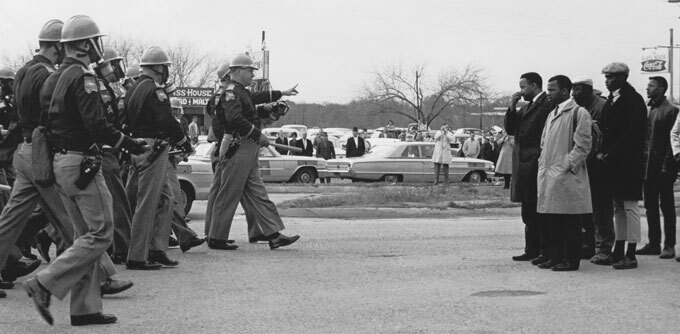
Selma march in 1965
On March 7, 1965, protestors marched from Selma to Montgomery, Ala., to draw attention to black voting rights. Historical records show that the activists knew police might retaliate, but hoped that images juxtaposing peaceful protestors against violent police might shock the nation. Soon after this photo was taken, police teargassed and beat the protestors. That event and others helped precipitate passage of the Voting Rights Act.Spider Martin/National Archives photo/Flickr (CC BY-NC 2.0)

SN: Could something besides protests have influenced
those election results? 

Wasow:
If we had godlike powers, we could
randomly assign which counties to treat with violent or nonviolent protests and
then see what happens in the November vote. Obviously we can’t do that, but we
can look for possible natural experiments. Martin Luther King Jr.’s
assassination in April 1968 sparked many violent protests across the
country, so I could compare what happens when counties did or did not
experience violent protests.

What
I do here, which builds on work by some economists, is use rainfall as
something that might predict protest activity. There’s a lot of work that shows
protest activity is sensitive to weather. More rainfall equals less likelihood
of protest activity. Less rainfall equals more likelihood of protest activity.

Counties that experienced less rainfall were much more likely than those with more rainfall to experience protests following Martin Luther King Jr.’s assassination. So there’s two steps in the process: rainfall’s effect on protest and protests’ effect on voting. If rainfall can predict voting, the only plausible path is through protest activity. There’s not another plausible explanation.

I
also conducted a placebo test. That’s because rainfall is associated with
geography, and geography is also associated with voting behavior. So I asked: Does
rainfall before Martin Luther King Jr. is assassinated influence voting in
November? That’s a placebo, like a sugar pill, because we shouldn’t expect it
to have any effect. I find that rainfall before King’s assassination does not
predict voting in November. I also look in the last two weeks of that April after
most violent protests ended. And again, the rainfall in that period doesn’t
predict voting in November. It’s not just rainfall in April. It’s rainfall in
one week of April that predicts voting in November. That allows me to say it’s
not just geography, it’s not just the South is rainier. I make the case that experiencing
a violent protest caused people to vote for order in November.  

SN: What role do journalists play in shaping the
narrative around protests?

Wasow: I scanned thousands of newspaper pages and created a
corpus of articles about protests and then asked: If a protest had been
categorized as nonviolent, what sorts of words are commonly used? And similarly,
if a protest had been categorized as violent, what are some of the most common
words?

Nonviolent
protests seem to be covered as if they were traditional attempts to redress
grievances, seek rights. So the words we see are “civil rights,”
“demonstration,” “march,” words that suggest this is a legitimate claim for
rights. When there were violent protests, the words that were commonly used
were things like “riot” and police.”

The
key idea here is people are protesting because they’re angry about some
injustice, but the kinds of tactics employed will focus the media’s attention
on that injustice or, in some cases, shift the focus away from that injustice.
That’s why tactics matter so much. The approach tells the media what to pay
attention to and by telling the media what to pay attention to, protestors are
telling the country what to pay attention to. This finding was revelatory for
me. I didn’t start out thinking this was a study of media.

SN: Do those findings apply to today, given the media
has changed a lot since the ’60s? 

Wasow: Media are much more fragmented than they were in the
1960s. Everybody has their own unique media feed. That’s going to mean that following
the news may be a more siloed experience, where some people are very focused on
activist violence while other people will be much more focused on police
violence. Depending on which channel you watch, depending on who your friends
are on social media, you may be getting very different narratives.

To
be clear, that’s not entirely different from the ’60s. Most of the Southern
media was pro-segregation, and media outside of the South tolerated Jim Crow
and was not interested in the concerns of black people. The idea that there
might be two different visions of what’s happening was not so unlike a black
press that covered the concerns of black people and a white press that was
indifferent or even hostile to those concerns.

SN: What kind of impact could violent protests have on
the 2020 election?  

Wasow: It’s hard for people to appreciate that there’s a set
of voters who are open to concerns about racial equality, but it’s not their
top priority. They also are very concerned about order. Think of somebody who
might be an Obama-turned-Trump voter. In the ’60s, there were people who
supported the Democratic candidate after the passage of the Civil Rights Act [in
July 1964]. But they joined the law and order coalition after the period
between 1964 and 1968 when there was a lot more violent protest. These voters
are influential because they move between parties and because they are in swing
states.

On
the one hand, some whites today have become much more concerned about racial
equality and center their conversation on the underlying injustice against
George Floyd. But it might also be possible that more whites move toward the
law and order coalition and support Trump. I think it’s too early to tell.

SN: Recently,
newspapers have run images of the police taking a knee in solidarity with
protestors. How do you think such imagery affects media attention?

Wasow: My model suggests that peaceful events don’t usually
get as much press because they are less dramatic. But I had to simplify the
model [for this study]. A slightly more complicated version of the model is
that violence is just one way of creating drama. Seeing police behave in a
counter-stereotypic way is dramatic. And consistent with my theory, nonviolent
protest can be effective if it’s able to do something that captures the
attention of the media. Violence is one way of creating spectacle, but it’s not
the only way.

SN: Critics
have said your study puts too much responsibility on protestors. What do you
think?

Wasow: What’s important is the causal story I’m trying to tell. A story that says “this is all about white moderates” deprives the protesters of their agency. I want to begin the story with, despite overwhelming odds, this subordinate group at the margins of society has power. And the question is: How can they use that power to advance their interests most effectively?

SN: What is your advice to today’s protesters?

Wasow: There are two kinds of deep narratives in which we
talk about protests: a rights-, or justice-, framed story or a crime story. That
was true in the ’60s and that’s true now.

In
the 1960s, leaders of the civil rights movement were incredibly focused on how
to get their message out to the whole country and used protest as a means to
gain influence. What they found was that large, peaceful demonstrations without
conflict didn’t interest the press. A New York Times reporter covering a
march in Mississippi said something along the lines of “no blood, no guts, no
glory.” The key idea is that nonviolence was often not enough to generate the
kind of attention that was necessary to create a national crisis.

To
create a sense of crisis, it became necessary to engage in this very strategic
kind of nonviolent protest, which was for protestors to become the object of
state violence. Activists picked places like Birmingham and Selma because there
were these police chiefs with a hair trigger for violence who would engage in
brutal repression in front of cameras. That would shock the conscience of these
otherwise indifferent or even hostile actors outside the South. It changed
public opinion.

If
you’re an activist on the ground thinking about and angry about this injustice
against George Floyd and a long history of police violence in this country
against African Americans, if you want to put that at the center of the
national conversation, it’s important to be thinking about this: Is what we are
doing on the ground elevating the justice frame or elevating the riots frame?

Source link

The day in pictures

A look at the day’s best photographs from around the world.


Source link

EU countries still fighting over mandatory relocation of migrants

0

Migrants walk to a registration camp after crossing the Greek-Macedonian border | Dimitar Dilkoff /AFP via Getty Images

Commission prepares latest proposal on migration, but old divisions remain.

With the European Commission preparing to put forward its latest proposal on reforming the bloc’s migration rules, countries have resumed fighting over the topic of mandatory relocation.

In three documents seen by POLITICO, EU countries put forward different viewpoints on mandatory relocation of refugees within the bloc, which they’ve been at odds over since the 2015 migration crisis. Then, the Commission led by Jean-Claude Juncker pushed for a mandatory relocation system for asylum seekers but faced resistance from a group of Eastern European countries led by Hungary.

The Commission is now trying again to reform the EU asylum system and is expected to make a presentation later this month — which may be a strategic communication rather than a legislative proposal — on what it wants to do.

The debate is the same as it was in 2015 with the only difference being that “some member states have toughened their positions because of new governments,” said one diplomat, referring to countries such as Estonia, which now has a far-right anti-immigration party, EKRE, in its coalition.

In a two-page document dated June 4, five Mediterranean countries (Cyprus, Greece, Italy, Malta and Spain) call for “a mandatory relocation mechanism entailing the distribution among all Member States of all those who enter the territory” of a European nation, including as a result of search and rescue (SAR) operations at sea.

“We need to find common solutions that will strengthen Europe rather than put forward positions that reawaken old disagreements”— Karl Nehammer, Austria’s interior minister and Mattias Tesfaye, Denmark’s interior minister

The proposal from the Mediterranean countries comes as EU government are negotiating the next long-term EU budget. Frontline states have often accused Eastern European countries of being net beneficiaries of EU money while refusing to take in asylum seekers, while countries from the north and east have accused those in the south of letting migrants irregularly move to other EU countries (so-called “secondary movements”).

In the same document, the five Mediterranean countries touch upon another controversial point when they ask “to overcome the criterion of the responsibility of the country of first entry,” the cornerstone of the so-called Dublin regulation that makes the country of arrival responsible for the asylum claim. “Over the years its application has failed to ensure a fair burden sharing between Member States by concentrating the burden in just a few of them,” they wrote. 

But, highlighting how divisive the issue is, in a four-page letter also dated June 4 and seen by POLITICO, the interior ministers of Austria and Denmark rejected this call.

“We need to find common solutions that will strengthen Europe rather than put forward positions that reawaken old disagreements,” wrote Karl Nehammer, Austria’s interior minister (from the center-right People’s Party) and his Danish counterpart Mattias Tesfaye (a social democrat who is the face of the center-left party’s new hard line on migration).

“Automatic and mandatory relocation of migrants and asylum seekers, including after SAR operations, is such a position,” they said in the letter sent to Margaritis Schinas and Ylva Johansson, the two commissioners in charge of migration. Mandatory relocation “not only carries the risk of establishing a pull factor which will increase irregular migration to Europe” but it will also “endanger the possibilities of finding common ground on a new asylum and migration policy as a whole.”

The two ministers call for a compromise: “While showing solidarity should be mandatory, Member States should be given flexibility when it comes to concrete solidarity measures,” they said, suggesting solidarity can be provided in other forms and not only by taking in asylum seekers.

That’s also basically the line of many Central European and Baltic countries.

In another four-page letter, dated June 3 and sent to the same commissioners, but this time by the interior ministers of Austria, the Czech Republic, Estonia, Hungary, Latvia, Poland, Slovakia and Slovenia, they don’t deny that they have to provide help but call for the mandatory part to be “border procedures” and not the relocation (“we must reiterate our strong objection to mandatory relocation of asylum seekers and migrants in any shape or form,” they said).

They support the idea of providing solidarity in other forms and talk about “further strengthening of solidarity with the front-line Member States with extended financial, technical, operational and expert support provided by the EU, its agencies and Member States.”


Source by [author_name]