Sunday, May 17, 2026

Sesajal takes minority stake in Rhythm Superfoods

0

Dive Brief:

  • Mexico-based Sesajal, a producer of oils, grains and seeds, took a minority stake in plant-based snack brand Rhythm Superfoods, according to a release sent to Food Dive. Terms of the deal were not disclosed.
  • Rhythm Superfoods intends to use the investment to drive growth and expand capacity, as well as increase marketing and product innovation.
  • General Mills’ venture arm 301 Inc, Blueberry Ventures and the CircleUp Growth Fund are other investors in the plant-based snack company.

Dive Insight:

With its stake in Rhythm Superfoods, Sesajal takes a step further into the health and wellness space, which is growing along with consumer interest in free-from, organic and better-for-you products. With the snacking sector, in particular, 47% of consumers are looking for functionality to meet their nutritional needs when buying snacks, according to the Mondelez State of Snacking Report. 

Rhythm Superfoods caters to this segment with its organic and non-GMO plant-based snacks that feature clean label options like dehydrated beets, carrots and kale alongside sweeter options like mango bites, crunchy pineapple and chewy watermelon slices. The investment by Sesajal could help both companies. 

Sesajal is focused on ingredients sourcing, something that is important to Rhythm Superfoods since the company uses minimal ingredients to craft its snacks. The Cauliflower Bites feature a short list of ingredients, including organic cauliflower, organic high oleic sunflower oil and sea salt. Its Naked Beet Chips boast just one ingredient: organic beets. Having a partnership with a company that has 30 years of experience sourcing high-quality ingredients is an attractive relationship for a brand looking to expand capacity and increase product innovation but is dependent primarily on the quality of one vegetable to make its product.

Rhythm Superfoods, which is based in Austin, Texas, already does business with Mexico and sources many of its ingredients from the country. The startup’s proximity to the southern border of the U.S. as well as its familiarity with the Mexican business landscape will help facilitate the relationship between the two countries as well as open the door to a potential expansion.

Sesajal has experience taking minority stakes in companies and helping develop them to the point where it is able to make an acquisition. The Mexican corporation took a 50% stake in Chosen Foods in 2015 before fully acquiring them in 2017. Rhythm Superfoods, although it hasn’t made a mention of aspirations to be subsumed by another company, appears to be ripe for an acquisition.

General Mills’ VC arm already invested twice in the brand. In 2016, 301 Inc led the $3 million Series C financing round for Rhythm Superfoods before committing to leading an even larger $6 million Series D funding round in 2017. Although to date General Mills has not acquired any of the brands that it has made investments in through its VC arm, the parent company is known for making acquisitions to help reorient its portfolio to align with the evolving consumer preferences. The CPG giant scooped up Annie’s in 2014, Epic Provisions in 2016 and Blue Buffalo in 2018. The company did, however, recently tell Food Dive that it has put its M&A on hold.

As it stands, Rhythm Superfoods now has access to a large, international network of suppliers and distributors in addition to a pile of investment cash. The company has the opportunity to expand its presence, by beginning to build an even larger fan base for its better-for-you products and potentially making itself a more attractive target for a future acquisition.
Source link

Unilever and Johnson & Johnson Retreat on Pushing Lighter Skin

0

Nina Davuluri, the first Indian-American to win the Miss America pageant in 2014, has been working to fight colorism for years — particularly after she woke up the day after her victory and said she read an Indian newspaper headline that said: “Is Miss America too dark to be Miss India?” She has been working on a documentary since 2018 that set out to explore why so many cultures believe lighter skin is better and how it affects people’s lives.

“Colorism is a form of racism — not all of it, but part of it,” Ms. Davuluri said. “Ultimately, companies are creating these products that do prey on these archaic notions of colorism and they’re also paying celebrities millions of dollars to advertise for these whitening products.”

She created a petition this month calling on Procter & Gamble, Unilever, L’Oreal and Johnson & Johnson to stop making skin whitening products and what she deemed racist ads, and instead create inclusive products.

“You have to have accountability to recognize that you can’t just say this in one part of the world — it really has to be a holistic standpoint from your entire company,” she said, referring to the companies’ public statements about equality.

In India, colorism has also long been reinforced by a much older tradition: matrimonial ads. Alongside categories like education and caste, skin-tone options like “fair,” “dusky,” and “wheatish” would often appear in newspaper advertisements as parents sought matches for their children.

Shaadi.com, one of the world’s largest matrimonial sites, recently came under fire after a user, Meghan Nagpal, discovered the “skin tone” filter on the site. The company initially said it was simply providing a service many parents wanted, prompting outrage in a Facebook group for South Asian women. One of the women, Hetal Lakhani, started a petition, which led to the site taking down the filter.

The filter was “non-functional and barely used,” the company said in statement. “We do not discriminate based on skin color and our member base is as diverse and pluralistic as the world today is.”

The recent changes give Ms. Lakshmi hope that things are moving in the right direction.

“Things are getting better,” she said. “Ending these creams, stopping the advertisements, and just not referring to people based on these kinds of things is going to go a long way. Hopefully, my daughter’s generation will grow up free from the shackles of color prejudice, at least to some degree.”

Contact Priya Arora at priya.arora@nytimes.com and Sapna Maheshwari at sapna@nytimes.com.


Source link

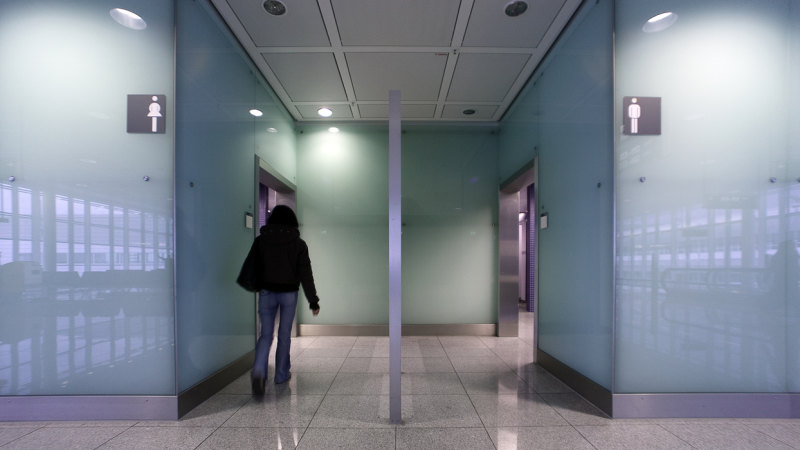
A guide to using public bathrooms during the pandemic

0

We know they can be infectious by touch. We wipe and potentially contaminate everything we touch with microbes that come from stool, like norovirus and E. coli, before our hands get washed.

Bathrooms can also be infectious by air. With some respiratory viruses, like influenza, if enough infectious particles are airborne, breathing in a previously shared airspace can pose a hazard. The best example is measles. If someone with measles enters a room, the air is potentially infectious for two hours.

Loading

Bathrooms have another unique hazard: toilet plume. With each flush, the toilet releases an invisible army of microbes into the environment, where they land on walls (which you may touch while hovering over the seat — more on that later), the toilet seat, the floor and the toilet and door handles.

We’ve known about toilet plume for some time. A new study suggests potentially infectious particles continue to be airborne for about one minute after each flush, and toilets can continue to generate an infectious plume several flushes after the original contaminated flush.

It’s truly the unwelcome gift that keeps on giving.

So, what about the coronavirus?

In general, contact with contaminated surfaces is not believed to be a primary method of coronavirus infection, but this is still understudied. While shared bathrooms can increase the spread of gastrointestinal infections, we don’t know how bathrooms play a role in the transmission of a respiratory virus, like the coronavirus, that has also been identified in stool.

We also don’t know the risk — if any — posed by coronavirus aerosols in the toilet plume, so admittedly there are a lot of unknowns.

What we do know is that there are certain bathroom behaviours that will help protect you from many nefarious microbes.

Here’s a handy checklist for shared bathroom use.

The best defences against bathroom contagions are a mask, social distancing, limiting the surfaces you touch with your hands and hand hygiene.

  • Consider larger bathrooms with multiple stalls because they have more air circulation.
  • If someone exits a bathroom stall or a single bathroom right before you, try waiting at least 60 seconds before entering — especially if the toilet seat lid is up, signifying more plume.
  • Skip the paper toilet seat covers. They are likely placebo — we have no idea if they offer protection from bacteria or viruses — and they could easily be contaminated with toilet plume, so touching them with your hands could be a source of infectious transmission.
  • If you need to dispose of a menstrual product in one of those little containers, touch the lid with a wad of toilet paper and sanitise your hands after. Those lids are among the worst surfaces in the bathroom stall: touched by many unwashed hands and showered with infectious plume.
  • If the toilet has a lid, close it before you flush so it traps the plume. Think of the lid as a mask for the toilet.
  • If an automated toilet is flushing, step back because those things spray.
  • How you dry your hands after washing probably doesn’t matter; paper towels or dryers are likely equal. But do avoid shared, reusable hand towels.
  • Get out of there quickly. Chatting in bathrooms is the new smoking in bathrooms — it’s a relic of the past. If you have to open a door to exit, use hand sanitiser after you leave.

But what if you can’t find a bathroom or the one you find is gross?

  • First, try to avoid needing a bathroom. If you’re heading out, modify your water intake. Remember, eight glasses of water a day is a myth.
  • For women, you can try squeezing and relaxing your pelvic floor muscles very quickly (each contraction and relaxation should take one to two seconds) five times. These are called quick flicks and will relax the bladder, suppressing the urge. This may buy you some time.
  • Going to the bathroom outdoors should be a last resort. If everyone starts using the outdoors as an outhouse, the smell of urine will be intolerable, and people will get sick unnecessarily because appropriate sanitation is vital in containing many infectious diseases.
  • If you are caught outdoors with no other option but the ground, try to get 60 metres away from foot traffic — and beware of plants like poison ivy! Use hand sanitiser when you’re done afterward.

And what about, God help us, the airplane bathroom?

Airplane bathrooms are some of the worst. On a long flight, they may go a long time without cleaning; they’re also cramped, and the turbulence may lead to water or urine spray.

Sometimes you don’t even have to use an airplane bathroom to be exposed to the germs you would find in one. In one study, passengers sitting in the aisle seat may have been infected by an unwell passenger as they made their way down the aisle to the bathroom and back.

We don’t know the risk of catching COVID-19 after entering a small airplane bathroom right after someone who is infected with the coronavirus, but, as I mentioned above, you should wait to enter a bathroom that someone has just exited — especially if the toilet seat is up — and then get out fast.

The airplane industry likes to say its bathrooms are as clean as those in any office building (data partly funded by the industry). And they are probably as clean as any bathroom with a facility-to-user ratio of between 1:50 and 1:75, and where the bathroom and sink are in a small closet exposed to turbulence and cleaned every four to 18 hours.

Loading

And please, have a seat (or raise it).

I have one final request, particularly of women (up to 85 per cent of whom report avoiding this): Please sit down. Sitting directly on the toilet seat isn’t going to put you at risk for a sexually transmitted infection, so don’t hover. This often leaves urine on the seat, which means you or the next person has to wipe the toilet seat — the surface with the most exposure to the infectious plume — before sitting. This also goes for those who stand: Please raise the seat.

Here’s a golden rule for shared bathroom etiquette now and always: Think not just of yourself, but of the seven or so people who will be using it after you.

The New York Times

Get our Morning & Evening Edition newsletters

Most Viewed in Lifestyle

Loading

Source by [author_name]

Here’s How Cabbage Became Lockdown’s Hottest Vegetable

0

Early in coronavirus isolation, around the middle of March, The New Yorker food writer Helen Rosner turned away from a Zoom call to grab the chicken she had roasting. “It was like the golden light of heaven shining out of my oven,” she told HuffPost. But the gasps heard through the ether weren’t for the bird: they were about the schmaltzy cabbage underneath.

Cabbage popularity spikes each year around St. Patrick’s Day. But this year, instead of searches for the rugged green tumbling back to the usual year-round low levels, Google Trends shows that people kept looking for cabbage recipes through the end of March, into April, and even now. The summer sun brings strawberries into stores, yet Americans still want cabbage ― 50% more than they did at this time last year.

Scrolling social media, the vegetable screams its too-cool-for-school status—under roasted chickens in Rosner’s version (codified and popularized by food blogger and comfort food queen Deb Perelman of Smitten Kitchen), butter-braised and tossed with pasta by The Takeout writer Allison Robicelli, in former Saveur editor Alex Testere’s illustrated newsletter, and even freshly plucked from the garden by Oprah herself.

But the vegetable of the moment lacks the usual eye-catching colors or over-the-top calorie count of most Instagram darlings. It cooks to the color of a dirty napkin and supplies health benefits galore. Packed with fiber and nutrients, cabbage climbed to the top of lockdown cooking popularity for the most utterly mundane reason: practicality. Cabbage lasts basically forever in the fridge, costs almost nothing and works just as well as a star centerpiece of a main dish or shredded and cooked down to near invisibility.

Eater writer Jaya Saxena saw the writing on the wall even before the pandemic, predicting in December that “cabbage is your next great vegetable crush.” Watching where it intersects with comfort, wellness and cuisines from around the world that so many Americans love to appropriate, along with a forecast economic recession, she warned: “Get ready to be sick of it by 2021.”

Rosner’s “cabbage epiphany” about the vegetable’s versatility and usefulness hit just a little earlier, during the romaine recalls, when an airport salad replaced the lettuce with thinly sliced cabbage. “That was the moment for me, when I switched it into my regular rotation,” she said.

Though Rosner has been cooking through a cabbage or two each week lately, one of the advantages of cabbage is that there is no need to do so. In “The Book of Greens,” chef Jenn Louis says that properly stored wrapped in plastic in the crisper drawer of a refrigerator, cabbage can last at least a month — far longer than most greens.

Cabbage shows up in Louis’s book brined in okonomiyaki (a Japanese savory pancake), rolled around arborio rice and pork, in a salad with carrot leaves and dates, in Irish-style colcannon, and ultra-sweet, charred with miso and lime. “I love how versatile it is,” she said, but she favors the deep flavors of roasting it. In summer, she recommends throwing it whole onto a campfire for an hour, then peeling away the outer leaves to eat the sweet inside.

“It’s such an underutilized ingredient,” said Maneet Chauhan, the Nashville-based chef and owner of Chauhan Ale & Masala House and others. At home, she shreds and sautés cabbage with curry leaf, turmeric and mustard seed. “It’s really typical,” she said of how she uses it in Indian cooking. A recent dish of cabbage kofta was a big hit with her kids ― chopped, fried in a spiced chickpea batter, and served in a basic curry sauce. She always adds a cabbage and onion slaw to her flatbread rolls, includes it in her fried rice, and stuffs it into parathas, pancakes and omelets.

“You can really celebrate the texture,” Chauhan said of what she loves about cabbage ― as long as you take care not to overcook it. “It should be just enough to get that crunch.” But she’s also drawn to what she describes as the slightly fruity, sulfur, oniony flavor. “It goes so well with Indian spices.”

Those flavors haven’t always been in favor. “Of course, if you prepare it by boiling it in the most boring possible way” Rosner said, “that’s when you get this farty, limp green garbage that merits being a punchline.” Like broccoli, Brussels sprouts and so many other vegetables that have had bad reputations in American popular culture, she noted, “if you cook it deliciously, it ends up being delicious.”

But that reputation isn’t completely unfounded. All that healthful fiber in cruciferous vegetables like cabbage also bring on gas in many cases. In Louis’s book, she even mentions that it was used as a laxative in ancient Greece. (In some people, cabbage also triggers migraines ― but cabbage leaves can also relieve them.) But listen, most people are stuck inside right now, with the people who know them best. So, dig into a gratin, throw stir-fry over rice, or learn to make emergency kimchi. Because in the words of a great children’s book, “toot, toot, toot, I’m a train!”


Source by [author_name]

NHL/NHLPA talks on CBA include escrow cap, salary deferral for players – Sportsnet.ca

0

New York Rangers star (and Hart Trophy candidate) Artemi Panarin dropped a bomb on Thursday afternoon with a fiery social media post.

That begged the question: “What has him so upset?”

During a time of COVID-19 spikes, rising numbers of positive tests across all sports and the clock ticking closer to the scheduled July 10 opening of NHL camps, players will be soon voting on a CBA extension.

According to multiple sources, the potential agreement between the NHL and NHLPA caps escrow at 20 per cent for the 2020-21 season. Original guesstimates were escrow at 35 per cent if this year did not finish, 27-28 even if it did.

But there is a second layer: a one-season-only 10 per cent salary deferral by every player. I’m told this is not a rollback. Players will be returned that money in the future. The benefit to them is the escrow on it would be lower.

These are elements of a much more complicated puzzle. One source compared it to a “payment plan you might negotiate with your credit card company.” From an ownership perspective, every dollar owed the teams on the 50-50 revenue split will be repaid over the balance of the CBA.

As part of the agreement, the salary cap will be kept close to the current $81.5 million for the next three seasons. There is potential for it to go up $1 million in 2022-23.

Since it is a CBA, the NHLPA’s constitution mandates that every player gets a vote. It is expected, as The New York Post’s Larry Brooks reported Thursday, that Return to Play will be intertwined with the CBA, meaning players will be voting on both safety and financial protocols at the same time. A simple majority is enough for a “yes.”

It’s a big, big decision. There’s 700-plus players and I’d be lying if I told you I spoke to enough of them to know how they’re going to vote. The fact that many have returned from Europe or are making plans to do so is being taken as a positive sign.

But, over the past few weeks, there have been several emotional calls amongst NHLPA membership. It’s not easy, with so much unknown about the lasting effects of COVID-19. (The NHL and NHLPA are working on “opt-out” language for those who don’t want to play.) One team was leaning against returning until a passionate speech from one of its most respected players turned the tide. Several players (and some agents) have said they will never have more leverage than now, and should wield it.

Panarin’s in that camp, apparently.

Now, not every player feels that way, and many agents don’t either. His post was not met with universal approval, with several calling it “misguided.” They also don’t like the union showing public strife, because it shows weakness. What it does reveal is the conflicting feelings running through union membership.

“I would tell you that I probably wouldn’t be comfortable voting at this particular time,” Carey Price told Montreal reporters on Thursday. “There’s still a lot of questions that need to be answered…The NHL and the NHLPA are trying to make the best of a very difficult situation. So, moving forward – and I’d like to play – we have a lot of questions that need to be answered and a lot of scenarios that need to be covered before I vote yea or nay.”

In March, the NFLPA went through a very public battle before voting on its new CBA. Prominent stars like Aaron Rodgers, JJ Watt and Russell Wilson publicly declared “no.” Their side lost 1,019-959, extending the agreement to 2030. That’s razor-thin for such a vote.

Those who know more than I do think this will follow a similar pattern. We’ll find out over the next few days.


Source link

Row over medical scheme merger – The Mail & Guardian

0

The Council of Medical Schemes (CMS) has stepped in to halt the proposed merger of black-owned Sizwe Medical Aid and Hosmed Medical Scheme, in what may be a serious blow to the much-needed transformation of the sector.

On June 8 the council’s registrar, Sipho Kabane, wrote to the two schemes ordering them to suspend their amalgamation processes, saying he had been presented with the report of an inquiry by the council’s compliance and investigations unit. “Serious findings” were contained in the scheme’s management report for the year ending December 2019.

Kabane said he was applying his mind to the reports, after which he might have to hold further consultations with the council and the schemes.

Should the merger go ahead the new entity, with nearly 78 000 members, would become the eighth-largest open medical scheme in South Africa. It would give black capital a major foothold in an industry seen as largely untransformed.

Kabane’s intervention was criticised by sources in the schemes and the council, who accused him of not following proper procedures.

They argued that he had allowed the schemes to go through the balloting of members — who had approved the merger — and the preparation of exposition documents, which cost them millions of rands each.

They said he should have warned the schemes of possible obstacles before they embarked on the merger process.

Sources at the CMS said that in a series of letters, Kabane had failed to decline, confirm or ask Sizwe to modify the exposition documents, as required in terms of the Medical Schemes Act, and had instead asked the two schemes to halt the merger.

“The registrar is asking the schemes to agree to an unlawful step,” the one CMS source said. “There is no provision for suspension of an amalgamation in the Medical Schemes Act.

“This invites scrutiny of motive and the responsible exercise of supervisory power by a public official.”

In a meeting with the Mail & Guardian, Kabane claimed not to be aware of the suspension letter, and asserted that the merger was ongoing and in line with the processes prescribed in relevant legislation.

He refused to comment in detail on the apparent impasse between the council and the schemes, saying the matter was sub judice because legal letters had been exchanged between the schemes’ lawyers and the CMS.

He denied scuppering the amalgamation, saying that the process was continuing.

“All mergers in the industry are governed by section 63 of the Act, which details how the process should unfold. The merger has not been approved yet, and the registrar has not stopped any part of it from unfolding,” said Kabane.

After Sizwe wrote to Kabane asking for clarity on the suspension, the registrar said in a follow-up letter that the scheme had not disclosed the proposed merger in its 2019 annual financial statements and had failed to tell its members of the amalgamation in its annual financial statements, a “material subsequent event”.

He also said there was an issue with the trustees’ remuneration for training, travel and accommodation and that telephone and other costs “cannot be fully reconciled to the return”.

Another matter Kabane raised regarding the suspension of the merger was that the company’s solvency, as per the annual financial statement (AFS) of 37.6%, was incorrectly calculated and did not agree with the annual return of 36.5%.

“For purposes of calculating the solvency, unrealised gains can be deducted from members’ funds but unrealised losses cannot be added back as per Circular 13 of 2001,” the letter said. “The prior year solvency is also not correctly calculated on the AFS. This was also queried last year and the scheme has continued to calculate it in the same manner on the AFS.

“As a result of the above material issues and the commitment of the scheme to ensure previous concerns have been addressed, the annual financial statements of Sizwe Medical Fund for the year ended 31 December 2019 is rejected.

“The scheme is requested to prepare and submit a new set of … statements to the CMS. Any previous copies issued must be retracted.”

One of the CMS insiders said that if the council had real concerns about the scheme, a merger should have not been allowed in the first place.

“In the past, if a medical scheme was facing an investigation
CMS did not allow schemes to publish the exposition document if it might impact the merger,” the source said.

“Once the exposition is published it is up to the members to vote for or against the merger and to make any representations to the registrar. None of the above has happened.”

The source said Kabane had changed his mind based on “very old information and without considering representations”.

Kabane refused to confirm whether he wrote the suspension letter, saying the scheme wrote many letters to both parties. When given a date of the letter concerned so that he could check his records, he declined to do so.

“On the details, I’m not prepared to comment because there are ongoing engagements between both schemes and their legal representatives. I don’t want to go to the media and start saying things when these discussions have not been completed,” he said.

According to Sizwe’s chief executive officer, Simon Mangcwatywa, the CMS created the impression that the merger would go ahead by accepting its exposition papers and publishing a circular on May 26.

“The exposition document contains everything. When that was approved it meant that CMS had done its own due diligence, looking at everything, and had satisfied itself and were giving the merger its blessing,” he said.

“Then at the end of the process we suddenly get an email saying we need to halt everything without a single reason why.

“We were told to suspend the process because of issues it is looking into, but nothing about which issues or people. This was accompanied by a threat that if you don’t halt this process we are going to take action.”

Mangcwatywa said that neither of the two schemes was facing “insolvency issues”, but they were now unable to plan for 2021.

“When the thing started we asked to meet CMS to say: ‘Look, as the regulator we respect you and we would like you to walk with us through this process so we don’t find documents or hear things in the corridors.’ That meeting never happened.”

Mangcwatywa said that in the sector “there isn’t really a lot of what you can call African-led or African-managed schemes. Having two black-managed giants coming together and forming a much bigger group that will feature in the top 10 medical schemes would be a huge milestone.”

He said the worry has been the fact that previous merger attempts had been scuppered by politics in the CMS and the industry. “There has been a lot of politics that went into stopping the previous mergers. It was not numbers, it was not finances, it was not solvency ratio. It was really politics that came into play.

“I am hoping we will not fall down that hole again of not wanting the scheme to go ahead.”

Hosmed chief executive Malema Pitsoane said he could not comment because the matter was still with the registrar.


Source link

West Bengal: Covid toll crosses 600-mark, fatality rate drops marginally

0

By: Express News Service | Kolkata |

Updated: June 26, 2020 6:20:39 am


The test positivity rate rose slightly to 3.56%.. (Representational)

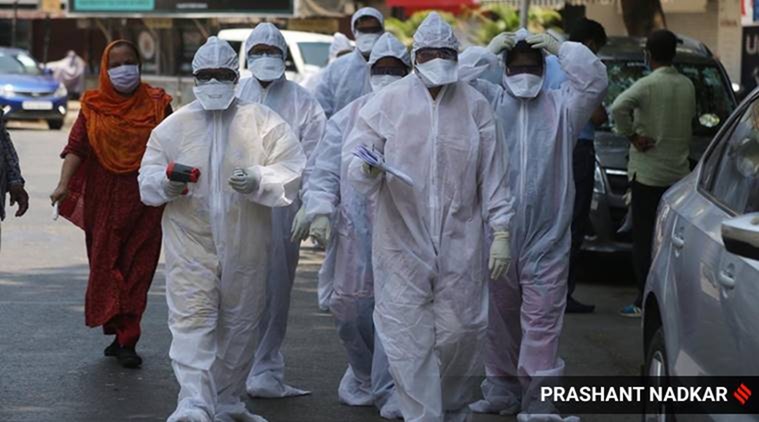
The Covid-19 toll in the state crossed 600 on Thursday, rising to 606 with the deaths of 15 people, and the case count increased by 475 to 15,648, while the total number of discharged patients crossed the 10,000 mark.

Kolkata, North 24 Parganas, and Howrah, which form the epicentre of the disease in the state, reported the bulk of the latest deaths and infections, with nine deaths and 322 new cases. South 24 Parganas and Darjeeling recorded two deaths each, while one patient each died in Uttar Dinajpur, and Paschim Medinipur.

The fatality rate in the state has consistently declined since June 11, when it was 4.52%. On Thursday, it was 3.87%. It is still higher than the fatality rates in Delhi and Tamil Nadu and UP, which, along with Maharashtra and Gujarat, are the only states to have reported more deaths than Bengal.

Meanwhile, the discharge rate further improved to 65.12% — the national figure is 58.18% — with 488 patients leaving hospitals. Overall, 10,190 people have recovered from the disease. The downward trajectory of the active case count continued as it came down to 4,852.

According to the health bulletin, in which figures are updated till 9 am, 9,492 samples were examined in 24 hours, taking the total to 4,39,258.

The test positivity rate rose slightly to 3.56%.

The health department said 34,059 migrant returnees were in special government quarantine centres, 7,865 people were in institutional quarantine, 98,751 people were in home isolation, and 495 people were in safe homes.

📣 The Indian Express is now on Telegram. Click here to join our channel (@indianexpress) and stay updated with the latest headlines

For all the latest India News, download Indian Express App.

© The Indian Express (P) Ltd

Source link

House Passes Police Reform Bill

0

WASHINGTON ― Exactly one month after George Floyd was killed in police custody, House lawmakers returned to the Capitol on Thursday to pass a sweeping police reform bill in Floyd’s name. 

The bill ― the George Floyd Justice in Policing Act of 2020 ― passed largely along party lines, 236-181, with all Democrats and three Republicans voting yes, and 180 Republicans and independent Justin Amash of Michigan voting no.

Speaker Nancy Pelosi (D-Calif.) said Thursday that the House was honoring Floyd’s life “and the lives of all those killed by police brutality, and pledging: Never again.”

Pelosi said the legislation would fundamentally transform the culture of policing to address systemic racism, curb police brutality and bring accountability to police departments. 

“It will save lives,” she said.

But, as Republicans repeatedly reminded Democrats on Thursday, the bill is highly unlikely to become law.

The measure is a collection of a number of policing proposals composed by the Congressional Black Caucus and written in conjunction with Black Sens. Cory Booker (D-N.J.) and Kamala Harris (D-Calif.). 

The bill would ban chokeholds for federal police and the use of “no-knock” warrants — which enable law enforcement to enter a property without notifying the owner ― in federal drug cases, and would make federal money for state and local governments contingent on establishing similar policies.

The legislation would also establish a national registry of police misconduct. It would end the practice of qualified immunity, which prevents citizens from suing individual officers in civil courts. And it would forbid money going to police departments that have not implemented policies to eliminate racial profiling.

Republicans take issue with some of those changes, and many have made it clear they absolutely won’t go along with ideas like ending qualified immunity. Republicans have their own bill ― written in the Senate by Black Republican Tim Scott of South Carolina ― that differs in a number of ways from the House bill. 

Scott’s bill would ban chokeholds meant for “incapacitation” but would allow them when federal guidelines authorize deadly force, such as when someone is holding a gun. The House bill would simply ban chokeholds and classify them as a civil rights violation.

Scott’s bill would require all law enforcement agencies to report their use of “no-knock” warrants to the attorney general. The House bill would outright end “no-knock” warrants.

And Scott’s bill wouldn’t address qualified immunity at all.

“That bill has about as much teeth as a newborn baby,” Rep. Cedric Richmond (D-La.), a former chairman of the CBC, said on the House floor Thursday in reference to the Senate measure.

“There is a difference of policing in this country, and we’re just asking to fix it,” Richmond added. 

That [Senate] bill has about as much teeth as a newborn baby.
Rep. Cedric Richmond (D-La.)

On Thursday, a number of Black representatives referenced having “the talk” with their children — instructing them to do whatever the police say and to prioritize their safety at the expense of their rights.

“I had to have the talk with my two sons. And I knew what to say, word for word, because my father had the same talk with me decades ago,” Rep. Hakeem Jeffries (D-N.Y.) said. “And nothing has changed.”

Instead of addressing these issues, Republicans focused on procedural and political complaints with the policing bill. They argued that, if Democrats were serious about producing a measure that could pass the GOP-controlled Senate and get President Donald Trump’s signature, they would have allowed amendments to the House bill and wouldn’t have blocked the Senate from taking up Scott’s bill in that chamber on Wednesday. 

Republican Rep. Dan Crenshaw of Texas said there was a lot of agreement in the bill, and when he first read the legislation, he was “pleasantly surprised.” 

“If we voted on this section by section, I believe there are sections where there would be an overwhelming bipartisan majority for some necessary and crucial reforms,” Crenshaw said. “There’s other parts where, if we just worked together and made some changes, we’d likely get to yes on a lot of these.”

But, Crenshaw said, while the bill doesn’t defund the police, it would lead to less policing.

Other Republicans were more direct in their criticism. Many said reforms like ending qualified immunity would lead to a rash of police resignations, and many just made general comments about how all lives matter.

“White lives matter. Hispanic lives matter. Asian lives matter. Native American lives matter. Quite frankly, all lives matter. Police officers’ lives matter, too,” Rep. Debbie Lesko (R-Ariz.) said.

Those sorts of arguments didn’t warrant much of a rebuttal from Democrats, but Democratic leaders did address arguments about process, countering that Republicans were the ones uninterested in a bill becoming law.

Judiciary Chairman Jerrold Nadler (D-N.Y.) detailed how Democrats had offered the bill 18 days ago, asked Republicans if they would support the legislation if they adopted their amendments, and asked to see the amendments Republicans planned to offer before the Judiciary Committee markup so that they could potentially work with them on specific language to address their concerns. 

But Republicans wouldn’t share the text, and the Trump administration has yet to reach out to try and work with Democrats.

“If there were a serious and good faith effort to enact legislation, the White House would seek to work with both sides of the aisle, and both sides of the Capitol. That has not happened thus far,” Nadler said.

The bill will now wait for Senate action, as Senate Majority Leader Mitch McConnell (R-Ky.) has made it clear he won’t take up the House bill.

House Majority Leader Steny Hoyer (D-Md.) suggested the Senate pass its bill and that the two chambers go to a conference committee to work out their differences. He said that the House bill’s lead author, Congressional Black Caucus Chairwoman Karen Bass (D-Calif.), had told him she was more interested in a bill that could become law than a political messaging device.

As it stands now, however, Senate Democrats say Scott’s bill is unworkable and that their concerns can’t be addressed by amendments.

With Republicans and Democrats unwilling to bend either way, it’s likely that no police reforms will pass in the remaining six months of this Congress.


Source by [author_name]

Covid-19 deepens the educational divide – The Mail & Guardian

0

There are an estimated 258-million children, adolescents and youth not in school across the globe. Sub-Saharan Africa accounts for 31% of them.

That number is contained in the United Nations Educational, Scientific and Cultural Organisation (Unesco) 2020 Global Education Monitoring Report that was released this week.

The report, titled “Inclusion and Education: All means All”, said that, all over the world, children face different forms of discrimination that hinder them from accessing education. The report noted gender identity, sexual orientation, wealth, displacement and attitudes as some of the barriers to accessing education.

In sub-Saharan Africa, for example, in countries such as Zimbabwe and Zambia, teachers may fear teaching children with albinism based on the myths surrounding people living with the condition.

The Unesco report notes that in Gulf countries, stateless children and youth are prohibited from enrolling in public-education institutions, and that Rohingya in Myanmar, who are internally displaced, or refugees have had no access to formal public schools. In Europe, Roma children are likely to be placed in special schools. In Latin America, learners do not learn the history of African descendants; if they do, it is a misrepresented version.

The report also found that, globally, 42% of lesbian, gay, bisexual, transgender and intersex learners said they were ridiculed, insulted and threatened at school by their peers because of their sexual orientation.

“About 37% reported feeling rarely or never safe at school, with the highest prevalence in the Arab States and sub-Saharan Africa,” the report said.

The report said Covid-19 has added new layers of exclusion, and that responses to the virus had not paid attention to including all learners. “About 40% of low- and lower-middle-income countries have not supported learners at risk of exclusion, such as the poor, linguistic minorities and learners with disabilities.”

With the closure of schools, learning has moved to online platforms across the world, but the report said only 12% of households in the least-developed countries have internet access at home, which means learners in these households have lost out.

Other mediums that have been used for teaching and learning include lessons broadcast on radio but, according to the report, in Ethiopia only 7% of households own a radio; the figure is 8% in the Democratic Republic of the Congo.

In her foreword, Unesco director general Audrey Azoulay said the Covid-19 pandemic has deepened societal inequalities that are a barrier to quality education.

“The current crisis will further perpetuate these differences in forms of exclusion. With more than 90% of the global student population affected by Covid-19 related school closures, the world is in the throes of the most unprecedented disruption in the history of education,” she said.

“Social and digital divides have put the most disadvantaged at risk of learning losses and dropping out. Lessons from the past — such as with Ebola — have shown that the health crises can leave many behind, in particular the poorest girls, many of whom may never return to school.”


Source link

Ford focuses on interior with revamped F-150 truck

Ford Motor Company revamps the F-150 pickup truck, the top-selling vehicle in America, with a lighter aluminum body instead of the customary steel. (June 25)


Source link