Friday, May 15, 2026

North Korea tests limits of diplomacy amid sanctions squeeze

In February 2018, Kim Yo Jong was the friendly face of North Korea, smiling and waving as she joined the crowds in South Korea at the Winter Olympics in Pyeongchang.

The two Koreas had entered the stadium together at the opening ceremony and fielded a joint women’s ice hockey team. Kim was not only the first member of the North’s ruling family to visit the South, but also shook President Moon Jae-in’s hand. Relations were set to improve.

This month, however, it was Kim, the younger sister of the country’s leader Kim Jong Un, who was repeatedly cited in bellicose warnings directed at South Korea, apparently over the leaflets floated across the border or along the river by defector groups, but really about the North’s increasing frustration about Seoul’s inability to deliver on cooperation promises or convince the United States to ease crippling economic sanctions.

The events were a “manufactured crisis”, said Ramon Pacheco Pardo, a reader in international relations at King’s College London and an expert on the two Korean Peninsula.

On Wednesday, the eve of the 70th anniversary of the start of the Korean War, state media reported that Kim Jong Un had instead decided to suspend the military actions his sister had threatened.

“North Korea feels that it hasn’t received the concessions it was looking for from South Korea and the United States at the summits over the past few years,” Pacheco Pardo told Al Jazeera. “The heightening of tensions is to signal displeasure at what has happened and that something different is needed.”

State media reported, Kim’s step back reflected an analysis of “prevailing conditions”.

Uneasy truce 

North and South have been stuck in an uneasy truce since 1953 when an armistice brought an end to the fighting in which millions of civilians had died and militaries on all sides had suffered heavy casualties. A peace treaty has never been formalised, and in recent decades, Pyongyang has lurched between engagement, isolation and the kind of headline-grabbing act exemplified by its decision to blow up the joint liaison office in Kaesong.

That move – a week after Pyongyang said it had severed all communication links with Seoul – effectively signalled the end of the Panmunjon Declaration and the latest round of engagement which had begun in 2018 under Moon.

It was “an attempt to make a clean break with the Moon administration,” noted a commentary in 38 North, a website devoted to the analysis of North Korea from the Stimson Center in Washington, DC.

The heightened rhetoric followed a series of missile tests last year after the second summit between Kim and US President Donald Trump broke down over sanctions relief, and a later attempt to revive denuclearisation talks foundered. Kim had set a yearend deadline for the US to shift its stance.

North Korea grabbed world attention when it blew up the joint liaison office it set up with South Korea in the border town of Kaesong last week [KCNA via Reuters]

In targeting Seoul, and dismissing Moon’s offer of envoys, Pyongyang might have been hoping that the president, who has made inter-Korean cooperation a cornerstone of his administration, would lean on the US to ease some of the sanctions imposed as a result of the North’s nuclear testing.

Instead, the South responded more forcefully than usual, saying that by criticising Moon, Kim had “fundamentally damaged the trust between the two leaders”. The unification minister resigned.

Seoul priorities

Jay Song, an academic at the Asia Institute at the University of Melbourne, says the internal politics in the South also requires scrutiny, and notes that the Unification Ministry cannot do anything without a green light from the National Security Council in the presidential Blue House.

“The National Security Council are internationalists [and] prioritise the Republic of Korea-US alliance over the Unification Ministry’s ethno-nationalist mandate on improving inter-Korean relations,” said Song, who is the Korea Foundation senior lecturer in Korean Studies. “The choice for South Korea is not an easy one, especially when the North wants to be a nuclear state.”

South Korea has struggled with how to deal with its northern neighbour since the end of Japanese colonisation led to the partition of the Korean Peninsula between the Soviet Union-backed North and the US-backed South.

Pyongyang, which has long dismissed Seoul as a “puppet” of the US, sent its troops across the 38th parallel on June 25, 1950, in a move that led to UN intervention, the mobilisation of US and Commonwealth forces, and brought in Chinese troops fighting in support of the North Koreans.

China was worried then, as it is now, about maintaining a buffer state, while the US continues to station some 28,500 troops in the South. The Demilitarised Zone (DMZ) between the two countries remains one of the world’s most heavily-fortified frontiers, despite calming measures that were part of the 2018 agreement.
Korean War

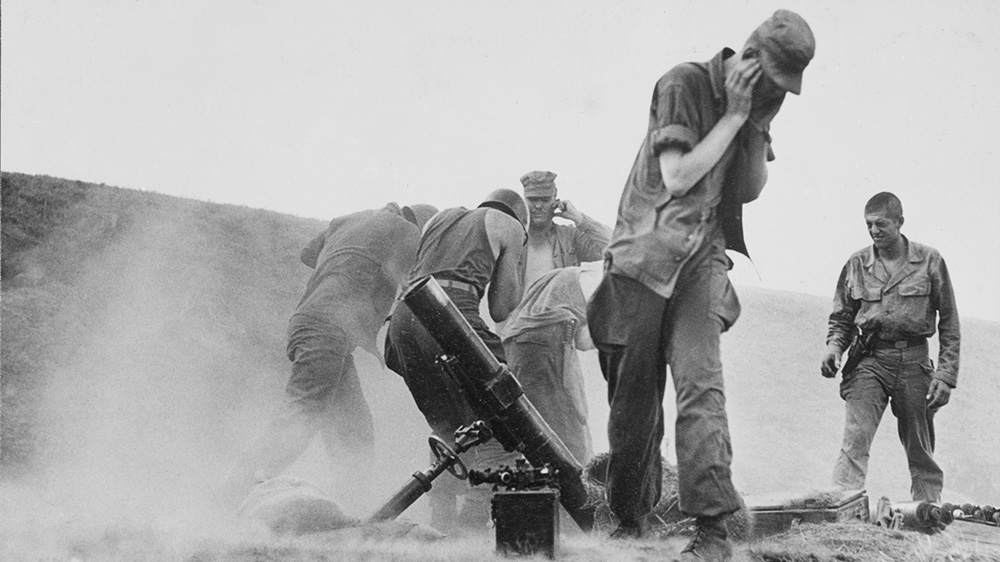
United Nations forces hold their ears while firing mortars at Communist positions on the Naktong River front in South Korea, in August 1950. The Korean War began on June 25, 1950 when North Korean troops crossed the 38th parallel into the South [File: AP Photo/Max Desfor]

Under the deal, the two sides agreed to remove soldiers from some border areas, withdraw loudspeakers used to broadcast propaganda messages from North to South – moves Pyongyang this month said it would reverse – and curb the activities of defectors and activists floating balloons of propaganda leaflets from South to North.

Amid the escalation, South Korea again promised legal action to put an end to the leafleting, but the sanctions make it difficult for Moon to deliver on the economic initiatives envisaged in 2018 without the backing of the US.

Even before Kim’s move to step back from provocations, analysts noted that while the posturing was helping Kim Yo Jong burnish her credentials for leadership in a patriarchal and militarised regime, the decision to map out its planned steps suggested some flexibility – an opportunity for her brother to “refrain from directly engaging in hostilities in order not to exhaust the chance that he could still meet with President Moon and President Trump to make a deal in the future”, said Lami Kim, a professor of Asian Studies at the US Army War College.

“The wording of the announcement, certainly in Korean, makes clear that this is a temporary decision,” KCL’s Pacheco Pardo observed. “So the announcement leaves the door open for further de-escalation, but also for re-escalation.”

Trump disappointment

After the heady days of the Singapore and Hanoi Summits, Trump now seems to have lost interest in North Korea, focused instead on shoring up his own position in a bruising battle for re-election in November amid the world’s worst coronavirus outbreak and public anger over police brutality and systemic racism.

Even during the Singapore summit, if former national security adviser John Bolton is to be believed, Trump’s focus was merely on the optics, wanting to know how many journalists were expected to attend the final news conference.

“That’s what he was focused on,” Bolton said in an interview with ABC News on Sunday. “That he had this enormous photo opportunity – first time an American president has met with the leader of North Korea.” 

Kim Jong-un

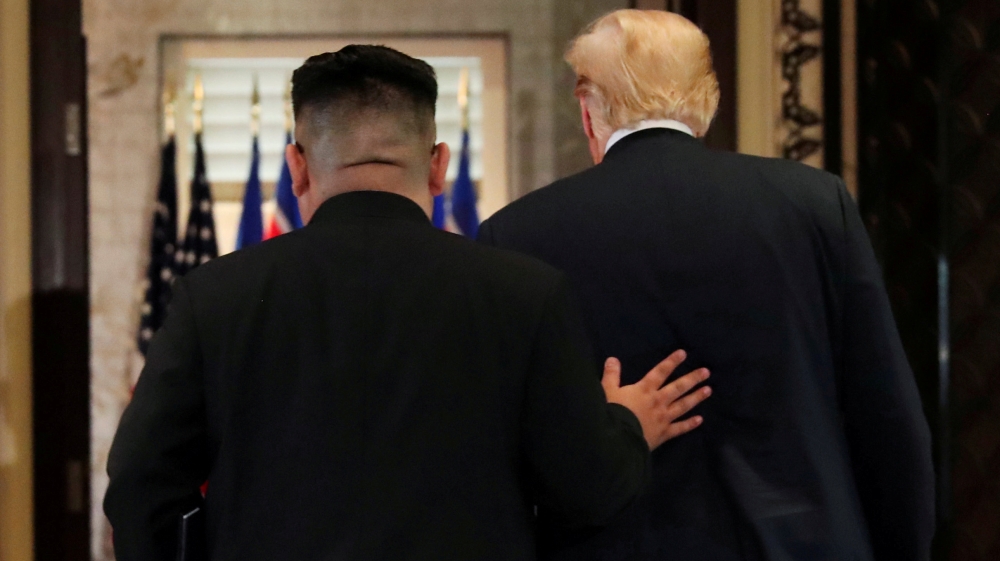
Kim and Trump leave their historic summit in Singapore, after signing documents that acknowledged the progress of the talks and pledged to keep the momentum going. Trump’s former national security adviser John Bolton says the president was preoccupied with the optics of the event [File: Jonathan Ernst/Reuters]

“Like many other countries around the world, North Korea has probably realised that this president is not going to deliver,” said Pacheco Pardo. “But they don’t want to completely break with the US.” 

China remains North Korea’s biggest ally and satellite images shared by the Stimson Center suggest trade may have resumed at the border, after months of closure as a result of the coronavirus pandemic. 

“The outbreak of COVID-19 suspended tourism and trade with China, taking the country’s economy close to a breaking point,” said the US Army War College’s Kim. “It is still too early to give up on diplomacy, not because KJU is a trustworthy leader, but because the dire economic situation in North Korea make economic inducements highly appealing.”

In Pyongyang, the regime feels it has made sufficient concessions – taking steps to destroy its nuclear facility in Yongbyon and returning the remains of soldiers who were killed during the war – to deserve some concessions.

Some 147 sets of remains arrived back in Seoul from Hawaii on Wednesday, some of which were discovered as a result of the 2018 initiative, but if the South had hoped the two-year-old detente was a sign that the cycle of provocation and engagement had been consigned to the past, the events of the past few weeks have shown there is still a long way to go.

Source link

With COVID-19 Cases Rising, Some States Slow Their Reopening Plans

Sally Beauty’s in Salt Lake City is one of many establishments across the country requiring patrons to wear face coverings. Utah Gov. Gary Herbert previously paused the state’s reopening, but tweeted on June 22 that he has “no plans to shut down Utah’s economy.”

Rick Bowmer/AP


hide caption

toggle caption

Rick Bowmer/AP

Sally Beauty’s in Salt Lake City is one of many establishments across the country requiring patrons to wear face coverings. Utah Gov. Gary Herbert previously paused the state’s reopening, but tweeted on June 22 that he has “no plans to shut down Utah’s economy.”

Rick Bowmer/AP

Updated at 10:47 p.m. ET

As the number of new coronavirus cases surges each day in many parts of the country, some states are hitting pause on their plans to reopen.

Dr. Anthony Fauci of the National Institutes of Health said in a Capitol Hill hearing on Tuesday that while states may not need to revert to the strictest possible measures, some may want to consider adjusting their reopening plans.

“I wouldn’t necessarily say an absolute shutdown, lockdown, but if someone is going from gateway to phase one to phase two and they get into trouble in phase two, they may need to go back to phase one,” he said.

Several governors, largely in the South and West, have opted to postpone the next phase of their states’ reopening in light of growing case and hospitalization numbers. States including Oregon announced last week they would temporarily hold off on decisions about moving forward, while North Carolina, Louisiana and Kansas have announced timeline delays in recent days.

“The pandemic is not over, we are still in the middle of the first wave of COVID,” Nevada Gov. Steve Sisolak said Wednesday.

“Due to the data and time needed for evaluation of contact tracing and impacts of this new face covering directive, any discussion of entering Phase 3 will be tabled,” Sisolak said.

“It is clear that COVID is alive and well in Louisiana, and as we see more people testing positive and admitted to hospitals, we simply are not ready to move to the next phase, and ease restrictions further as businesses open widely,” Gov. John Bel Edwards said on Monday, noting the state had surpassed 3,000 deaths and 50,000 positive tests.

He said Louisiana will remain in Phase Two, which it entered on June 5, for another 28 days.

That same day, Kansas officials urged local communities to stay in Phase Three of the state’s reopening plan. That was a guideline rather than a requirement because in May, Gov. Laura Kelly transferred reopening decisions to local officials. Kelly has recommended remaining in Phase Three until at least July 6 — two weeks later than initially planned — because of an “increase in disease spread.”

And on Wednesday, North Carolina Gov. Roy Cooper announced the state will “pause and continue” its Safer at Home Phase 2 for another three weeks, citing an increase in daily case counts and hospitalizations.

“The numbers we see are a stark warning, and I’m concerned,” he wrote in a tweet. “As we have watched and studied and dissected these numbers in recent weeks, that concern has grown.”

Earlier in June, Oregon Gov. Kate Brown put all pending county applications for further reopening on hold for seven days. And in Utah, Gov. Gary Herbert extended existing health risk guidance from June 5 to 12, saying case and hospitalization increases “give us pause.” Both governors have since allowed certain areas to progress with their reopenings.

According to an NPR analysis, 27 states are seeing a rise in new daily cases.


Source link

A Winner on Election Day in November? Don’t Count on It

0

“That suggests something’s wrong,” he said.

“The need to take a longer time to process and count these ballots is a sign of the process working,” Mr. Masterson added. “It is in no way an indication of anything malicious.”

In the presidential race, the vote margins in most places are expected to be wide enough to allow media organizations, such as The Associated Press, to project winners of individual states even before all the votes are tabulated. But delays are widely expected in at least some key states, which could leave the country in momentary political limbo if neither candidate has reached the 270 electoral votes required to win the presidency.

David Scott, deputy managing editor for The A.P., said how long it takes to call the presidential race in November will depend on the closeness of the race and whatever rules states impose between now and Election Day. The A.P. will have to account for the huge wave of mail-in votes, especially after incorrectly declaring two races in Georgia were headed to runoffs this month.

In a sign of its cautious approach, the organization has not yet declared that Representative Eliot L. Engel, Democrat of New York, lost on Tuesday, even as he trails his challenger, Jamaal Bowman, by nearly 27 percentage points.

“I’ve been saying to anyone who will listen that I do not think we will know who won the presidential election on Nov. 3,” said Matthew Weil, director of the elections project at the Bipartisan Policy Center, a think tank.

Mr. Weil pointed to three states in particular he expected to be hot spots for slow counting trouble: Michigan, Pennsylvania and Wisconsin. Those three states, which were key to Mr. Trump’s victory in 2016, are seen by both the Trump and Biden campaigns as linchpins to the path to victory.

And all three of those states have one rule in common: they do not currently allow the tabulating of mail-in ballots until the day of the election, though election officials are pressing to relax those restrictions.

Source link

Coronavirus live news: WHO warns of global oxygen shortage as cases rise by 1m per week


Volunteers in the UK, Brazil and South Africa receive first doses of experimental vaccine


Dutch brothels can reopen on 1 July


Australia’s Qantas airlines will sack 6,000 workers as part of a plan to recover from the coronavirus pandemic that will also see it go to the market for an additional AU$1.9bn (US$1.3bn) in funding.


A Qantas plane takes off from Kingsford Smith International Airport in Sydney.

A Qantas plane takes off from Kingsford Smith International Airport in Sydney. Photograph: Loren Elliott/Reuters

An additional 15,000 workers will remain stood down “for some time”, until domestic and international flights resume, said the airline’s chief executive, Alan Joyce. Qantas has about 30,000 workers.

It’s a bitter blow for workers, and the entire airline sector, which is already dealing with the collapse into administration of the Qantas rival Virgin Australia.

Qantas has talked up its prospects during the crisis, raising money by mortgaging its planes to keep going. But today’s announcement is a recognition that it is anything but immune to the effects of a crippling shutdown that has already pushed Virgin to the brink.


WHO warns pandemic has not yet reached its peak in the Americas


Summary

Updated


Source link

North Korean City of Chongjin on Lockdown After New COVID-19 Outbreak

0

A new COVID-19 outbreak at two major factories in the North Korean industrial center of Chongjin has prompted authorities to close off the country’s third largest city, a drastic step not seen in Pyongyang’s initial extensive responses to the pandemic in January, sources told RFA.

While North Korea publicly claims that it has not confirmed a single case of the coronavirus within its borders, RFA reported in January that the government told people in a series of lectures that the virus had spread in three parts of the country, including North Hamgyong province. Chongjin, an industrial center with a population of 625,000, is the provincial capital.

“Since the beginning of this month, coronavirus is again spreading in and around Chongjin, causing an emergency at the provincial quarantine center,” a resident of North Hamgyong, who requested anonymity for security reasons, told RFA’s Korean Service Sunday.

“The provincial quarantine center and law enforcement authorities quickly imposed a ban on the movement of residents, saying it is to prevent the spread of infection,” said the source.

The new outbreak emerged last week among steel and construction workers, alarming citizens in Chongjin’s Songpyong district, according to the source.

“It’s been reported that about 10 patients with symptoms are workers at the Kim Chaek Iron and Steel Complex and the Second Metal Construction Complex,” the source said.

“[Those complexes] are supersized facilities with tens of thousands of employees. The companies are large enough to run hospitals on their own, but they are unable to provide proper treatment other than merely isolating the patients,” the source added.

“Because several workers came down with severe pneumonia-like symptoms at the plants, the provincial committee temporarily suspended operations,” the source said.

The lockdown affects more than Chongjin and North Hamgyong. Citizens from neighboring Ryanggang province had been entering the coastal province to try to find food, as shortages at home left many hungry, according to a Ryanggang resident who requested anonymity to speak freely.

“As the food situation in Ryanggang has become difficult these days, the provincial party has been allowing people to move to other regions to get food, but now movement into North Hamgyong, especially Chongjin, is completely prohibited,” the second source said.

The second source said the Ryanggang authorities have completely stopped issuing travel passes for those wishing to go to Chongjin.

“Even when the coronavirus was in full swing, they never stopped us from trying to go to a specific city. But Chongjin is now a no-movement zone, so the situation seems to be serious now,” the second source said.

Though North Korean media often keeps citizens in one part of the country in the dark about happenings in other parts of it, news of Chongjin’s lockdown has spread to Ryanggang despite the movement ban.

“The situation in Chongjin is frequently reported through our mobile phones,” the second source said.

“Not only have we heard that residents’ movement has been restricted, news that the large factories have been shut down has also spread to Ryanggang,” the second source said.

“If they are not letting people move around and they can’t report to work at those factories, it’s going to be hard for them to make a living,” said the second source.

“The authorities are only enforcing their lockdown, ignoring the residents’ livelihood. I can only imagine how much trouble the people of Chongjin are going through.”

North Korea suffered a huge economic shock in January when the COVID-19 pandemic forced a shutdown of its border with China, its main source of food and other supplies, and the largest market for North Korean goods and labor, even under sanctions aimed at denying Pyongyang cash for its nuclear and missile programs.

RFA attempted to contact the World Health Organization (WHO) regarding the spread of COVID-19 inside North Korea, but those inquiries went unanswered as of Wednesday afternoon. The WHO’s coronavirus statistics are based on the self-reporting of each member state.

Reported by Jieun Kim for RFA’s Korean Service. Translated by Leejin Jun. Written in English by Eugene Whong.


Source link

NYC marathon canceled because of coronavirus fears

The New York City Marathon, the world’s largest marathon, was canceled Wednesday because of the coronavirus pandemic. Officials said the race posed too many health and safety concerns for runners, volunteers, spectators and others. (June 24)


Source link

Scores of Rohingya Rescued from Stranded Boat off Indonesia’s Aceh Province

0

Fishermen rescued nearly 100 Rohingya after their boat broke down off Indonesia’s Sumatra Island, but the fishing boat that picked them up got stranded after running into its own technical problems, police in Aceh province said Wednesday.

The Indonesian fishing crew saw the Rohingya boat with 94 people onboard drifting at sea and moved them onto their own boat late Monday, according to North Aceh police chief Tri Hadiyanto. The fishermen’s boat broke down while trying to reach the shore, he said.

“Today police, the military and local officials came to the site of the boat, which is four nautical miles off the coast,” Hadiyanto told BenarNews, referring to the broken down fishing boat.

Meanwhile in nearby Malaysia, the coast guard chief said that an unknown number of Rohingya had died and their bodies were thrown overboard from a boat before it was towed to Langkawi Island earlier this month. Malaysian authorities have detained the 269 Rohingya who were on that boat.

In Aceh, a community leader, Muhammad Hasan, said local officials had agreed to transfer the 94 rescued Rohingya once they reached the shore of the northwestern Indonesian coast.

“The plan is to evacuate them to the Syamtalira Bayu fish market, because there are shelters there,” Hasan told BenarNews, an RFA-affiliated online news service.

Footage shared by the local civil protection agency showed rescuers approaching the fishing boat, which carried what the man in the video described as “Burmese people.”

“We’re seeing children and women. We will pick them up and rescue them,” the voice in the video said.

Police said 15 men, 49 women and 30 children were rescued. The Rohingya boat’s origin and the destination were not immediately known.

The 94 people were hungry and weak when they were discovered in waters off the Indonesian coast, the Associated Press quoted a local official as saying.

Lilianne Fan, spokeswoman for the Geutanyoe Foundation, a humanitarian charity established in Aceh in 1999, praised the community for offering to support the refugees.

“Once again, the fishermen of Aceh show us true humanitarianism, rescuing Rohingya refugees whose boat was sinking,” she said in a Facebook post, adding that villagers were preparing food for those on the boat. “To help others, regardless of background, religion, nationality, is an obligation and a tradition that must be respected.

“Our Aceh team has been coordinating closely with the courageous fishermen and the local government in this response and stands ready to provide assistance,” she said.

About 1 million Rohingya who fled from Myanmar’s Rakhine state are sheltering in refugee camps in and around Bangladesh’s Cox’s Bazar district. U.N. investigators have accused Myanmar’s military of carrying out killings and other atrocities against the stateless Rohingya during a 2017 offensive, which forced more than 730,000 across the border into Bangladesh to join thousands who had previously fled there.

Groups of Rohingya have packed onto boats and set sail for Malaysia and other locations in search of asylum, but have often been turned away.

In Jakarta, Indonesian Foreign Affairs Minister Retno Marsudi said the human rights situation in Rakhine came up during a meeting of ASEAN foreign ministers on Wednesday.

Retno said she urged leaders of the Association of Southeast Asian Nations to facilitate a voluntary, safe and dignified repatriation plan for Rohingya refugees.

“Repatriation is still a priority for Indonesia. We must continue to try to bring them back to their homes, the Rakhine state,” Retno said at an online press conference.

Late last year, ASEAN leaders agreed to form an ad hoc task force to help repatriate the Rohingya refugees from Bangladesh to Myanmar.

On Wednesday, the director of the Indonesian office of Amnesty International, Usman Hamid, called on the government to allow the Rohingya boat people to land in Aceh.

“This is really concerning. There are many children and women in the group,” Usman told BenarNews. “They must be given basic needs such as food, clothing, clean water and adequate shelter.”

Malaysian coast guard chief: ‘Some of them had died at sea’

On June 8, Malaysian authorities towed a disabled boat ashore and detained 269 Rohingya after dozens jumped overboard and began swimming to Langkawi, an island off the northwest coast of peninsular Malaysia. The landing marked the first time that Rohingya had been allowed to disembark in Malaysia for more than two months.

Two days later, Mohd Zubil Mat Som, the chief of the Malaysian Maritime Enforcement Agency (MMEA), the country’s coast guard, told BenarNews that another Rohingya boat carrying 300 people was sheltering north of Langkawi off the Thai island of Koh Adang. Thai officials at the time said their navy could not locate a boat.

On Wednesday, Mohd Zubil said the boat carrying 269 had been carrying more than 300 Rohingya. He referred to the boat as number 2 – adding the Rohingya had left boat number 1 which had been carrying more than 800 before the transfer. Officials have not located the boat which apparently had been carrying as many as 500 refugees.

“We were informed that over 300 individuals were transferred onto Mother Boat 2, but some of them had died at sea and they were thrown overboard. This we got through the interviews with the 269,” he told reporters in Putrajaya.

Asked about the number of deaths, Mohd Zubil said, “I’m not sure, they said about 300-plus while 269 arrived here. You can figure it out yourself.”

Throughout the region, meanwhile, countries have closed their borders to foreigners in recent months over fears tied to the COVID-19 pandemic. Human rights groups have raised alarms about the impact of such policies on boatloads of Rohingya and have urged countries in the region to allow the boats to land.

In April, hundreds of Rohingya men, women and children were said to be starving when brought ashore in Bangladesh following a nearly two-month failed journey to Malaysia during which dozens died, officials and survivors said.

Chris Lewa, the coordinator of the Arakan Project, an NGO that advocates for the rights of Rohingya people, told BenarNews last week that it was aware then of a Rohingya boat still at sea with hundreds of people on board.

“As far as we know, there is only one boat remaining at sea with as many as 500 aboard. Reportedly a large trawler carrying about 800 sailed from the Bay of Bengal early April and these passengers were divided into two boats at sea sometimes in May,” Lewa said.

“One of these two boats is the one intercepted with a damaged engine in Malaysia on 7 June. We are not aware of any other boat unless the large trawler decided to again divide passengers into smaller boats,” Lewa told BenarNews.

Reported by BenarNews, an RFA-affiliated online news service.


Source link

Cybulski slow plays Josi, Werenski crushes Dunn | EA Sports NHL 20 Tournament – Sportsnet.ca

0

{* mergeAccounts *}


Source link

Britain’s ‘blindingly cool’ engineering innovation

0

Image copyright
Ted Humble-Smith

Image caption

The CT scanner as envisioned by Ted Humble-Smith: “It’s a hell of an invention”

Presentational white space

Ted Humble-Smith is a conceptual still-life photographer. He’s well known for his fashion work. Ted can take a lipstick or a watch and with his extraordinary vision and skill turn the beautiful into something even more gorgeous.

But speak to him for just a few minutes and it’s clear he sees not just the colour and form of his subjects, but the engineering that underpins their design.

In fact, it’s obvious Ted has a passion for it. He points to the 4-inch stiletto heel.

“Everyone laughs when I talk about it,” he told me. “But you have this thing that’s so elegant, so beautiful – and yet at the same time, there has to be some serious engineering and mathematics in there as well.

“Eight stones at least is going through a square centimetre. These are big loads but you rarely see people snap their heels these days.”

Ted has just put his inquisitive eye to a project for the Royal Academy of Engineering.

He’s produced a series of images to celebrate the 50th anniversary of the MacRobert Award, which honours examples of remarkable British innovation. From the aerodynamic design of the Severn Bridge to the composite wing of an Airbus jet.

2019 winner: Bombardier, for developing an innovative, resin-infused advanced composite wing

Image copyright
Ted Humble-Smith

Image caption

2019 winner – Bombardier: The company developed a resin-infused advanced composite wing that now features on the Airbus A220

Presentational white space

The photos are clearly conceptual in nature but the ideas that went into their creation are drawn directly from conversations with the engineers involved.

Ted took their explanations, extracted the essence and then reimagined his subjects. His favourite photo – at the moment; the choice changes – is the EMI X-ray brain scanner, the world’s first computed tomography (CT) machine to be used in a clinical setting (MacRobert winner: 1972).

An illuminated, transparent skull is cut through by a rotating disc. The visual narrative describes the process through which X-rays are able to build a picture of the brain, slice by slice.

“It’s a hell of an invention,” says Ted. “When you consider that if you wanted to look inside someone’s brain previously, you basically had to take it out, slice it on a bacon slicer and then put it on a lightbox. The CT scanner is phenomenal.”

1989 winner: British Gas, for the 'intelligent pig', allowing internal inspection of operational pipelines

Image copyright
Ted Humble-Smith

Image caption

1989 winner – British Gas: There’s a hidden realm under our feet where “intelligent pig” devices inspect pipelines

Presentational white space

Ted builds many of the objects he photographs. At first glance, you might think he’s done everything in a software package on his computer. You’d be wrong.

Ted uses models that have been lit in interesting ways and captured under different exposures. For sure, some image frames have been stacked and any scaffolding, such as rods and wires, has been digitally erased. But you’d be able to hold his MacRobert models in your hands.

Witness the picture he produced of Quantel Paintbox (MacRobert winner: 1988). Wholly apposite in this context.

1988 winner: Quantel Ltd, for the Paintbox television graphics system and the Harry video editing system

Image copyright
Ted Humble-Smith

Image caption

1988 winner – Quantel Ltd: TV weather forecasters were among the first to adopt Paintbox. It allowed them to dump magnetic stick-on clouds on their maps

Presentational white space

Paintbox revolutionised computer graphics on TV and film. It enabled the industry for the first time to properly digitise colour and really play with it on our screens (see the Dire Straits video Money for Nothing).

In his image, Ted encodes this in his mind’s-eye as paint flying around curved plastic sheets. “You can freeze liquids in photography now so well. I wanted it to look like paint was exploding on to the screen. So, you can do it in a very complicated way with robots and paint cannons, or you can do it in the slightly haphazard fashion that we did. Basically, you fling paint around.”

A wonderful mess in the studio made for a striking image.

In the studio

Image copyright
RAENG

Image caption

A photo shoot in Ted’s studio can get very messy

Ted’s images for the MacRobert 50th anniversary are being showcased in an online exhibition the Royal Academy of Engineering has developed with the National Science and Media Museum in Bradford. You can see it here. And for a taste of the sort of images Ted is best known for, take a look at the gallery on his website.

The finalists for the 2020 MacRobert award have just been announced. There are three on the shortlist and they are all recognised for contributing innovation to a greener future. They are:

  • Babcock’s LGE business (Fife, Scotland), which has developed a system called ecoSMRT to capture “boil off” from the tanks holding the liquefied natural gas on board transport ships, reducing emissions.
  • Jaguar Land Rover (Warwickshire) for developing its I-PACE battery-electric sports utility vehicle (SUV)
  • JCB (Staffordshire) for developing and manufacturing the world’s first volume-produced fully electric digger (19C-1E).

2002 winner: CDT, for Light-emitting polymers

Image copyright
Ted Humble-Smith

Image caption

2002 winner – CDT: Plastic electronics underpin our smartphones. Richard Friend’s patent is projected on to curved plastic sheets (courtesy of GREAT Campaign/IPO)

Presentational white space

Prof Sir Richard Friend is the chair of the judging panel. He’s also himself a past winner for his work on “plastic electronics” – technology that has attained ubiquity in the touchscreens of our mobile phones.

He told me: “The shortlisted companies this year are splendid examples of things you might have thought the UK wasn’t the natural place for their innovations to emerge. We sometimes write ourselves out of being world players in quite a few technologies. There’s no reason for it and the MacRobert award keeps presenting with cases that are very obviously world-beating.”

It’s a theme emphasised by Ted Humble-Smith, who confesses to have gone on something of a conversion during his photographic projects.

“I started out quite despondent about where Britain was in the world – that the UK never seems to do anything anymore,” he recalled. “But then I started talking to the present-day people and it just gave me a whole new belief that actually there’s some blindingly cool stuff happening in the UK. The UK does make and innovate some incredible things.”

1969 winner: Rolls-Royce, for the Pegasus engine used in the Harrier aircraft

Image copyright
Ted Humble-Smith

Image caption

1969 winner – Rolls-Royce: The Pegasus engine enabled the Harrier jet to take off and land vertically

Presentational white space

and follow me on Twitter: @BBCAmos


Source link

Survey: Women Are Rethinking Having Kids As They Face Pandemic Challenges

Roughly 40% of women surveyed by the Guttmacher Institute said they changed their plans on when to have children, or how many to have.

PeopleImages/Getty Images


hide caption

toggle caption

PeopleImages/Getty Images

Roughly 40% of women surveyed by the Guttmacher Institute said they changed their plans on when to have children, or how many to have.

PeopleImages/Getty Images

Whether it’s online-only consultations, closed pharmacies or having to wonder whether going into an office is safe, the coronavirus has upended access to health care. And it has presented particular challenges for women and reproductive health.

A new survey released Wednesday by the Guttmacher Institute, a research group that advocates for reproductive rights, finds 34% of women said the pandemic was causing them to delay getting pregnant, or to have fewer children. A slightly smaller proportion of the roughly 2,000 women who responded to the survey also said they were struggling to access birth control during the pandemic.

“What we heard from them very clearly was that due to the COVID-19 pandemic, far fewer women want to get pregnant. And at the same time, contraception is harder for them to get,” said Laura Lindberg, the study’s lead researcher, in an interview with NPR’s All Things Considered. “Those two opposing forces mean that people are going to have a harder time delaying pregnancies during the crisis, even as more people say they don’t want to get pregnant right now.”

The problems highlighted by the survey were especially pronounced among women of color. While 29% of white women said they were struggling to access birth control, among Black women and Latinas, the figures were 38% and 45%, respectively.

“Black and Hispanic women were more likely to face delays or were unable to get contraception or other care than were white women,” says Lindberg. “This is what health care inequities look like in action.”

Here are excerpts from the interview.

The COVID-19 pandemic has highlighted these existing racial disparities … Is what we’re seeing in terms of access to contraception, is it different, or worse, than before the pandemic?

I think it’s certainly worse than before the pandemic. Couple of things are going on. So one is cost. If you’ve lost your job right now, you may have lost your health insurance, and that limits the kind of providers you can go to or access. Transportation, child care, physically leaving your home are all more difficult right now. That’s for individuals.

For the health care providers side, we know the clinics and pharmacies and health care providers have been closed or haven’t been providing as much care because of COVID-19. It’s harder to get contraceptive care right now than ever before.

At the same time that many women were having more difficulty accessing contraception, they were also reporting a desire to use birth control more consistently and to delay childbearing in many cases. Why?

We found that about one-third of women said that they wanted to either delay childbearing or even have fewer children than they had prior to the pandemic. … Women are making decisions in a time of uncertainty. The pandemic has really been a disruption in our lives. I mean, imagine, what is September going to look like if schools don’t fully reopen? What’s September going to look like for a working woman if infant child care no longer exists or is double the price?

What is the upshot of this? Fewer children in the next year?

Usually, I’m not willing to do a crystal ball prediction, but in this case, I think it’s pretty clear we’re going to have a baby bust, not a baby boom. Women are clearly expressing a desire to delay childbearing right now. And although we’re only in the first few months of this pandemic, as more time passes, I think the fuller effects are still going to unfold. … Overall, there’ll be a decline in fertility, but we need to be concerned about individual women who can’t get the contraception they need to achieve their own fertility goals.

Listen to the full interview at the audio link above.

Source link