Some days back, lovebirds Ali Fazal and Richa Chadha decided to raise funds for buying PPE Kits for the frontline workers who continue to make our lives better during the global pandemic. Last night, Ali took to Instagram to share that a bunch of PPE kits were donated to Amravati’s Rupal hospital.
He shared a photo of the box of kits that has ‘made possible by the fans of Ali and Richa’ written on it. It further mentions that the box contains 30 PPE kits. “A BIG THANK YOU TO ALL THOSE WHO JOINED US ! It is such a satisfying feeling when you see it play out. I want to thank everyone who contributed here to make this happen. Thanks to all you generous people! Many of whom were my friends and fans . I am glad we could be of some help. I know its not enough, and the work needs to keep going. This year is badshit crazy, as we all prep for the cyclone hit today, i just want to say, be strong and lets face this too.. we will need more hands,” he wrote.
Earlier, actor Vidya Balan and producer Atul Kasbekar together urged everyone to contribute for PPE kits while Vidya herself pledged 1000 of them. Earlier, superstar Akshay Kumar also donated Rs 3 crores to Brihanmumbai Municipal Corporation for the manufacturing of PPE kits.
Banksy is making a powerful statement against systemic racism with his latest piece.
The British street artist on Saturday morning released a new painting of a shrine to an anonymous Black figure.
A lit candle has set the American flag on fire.
Scroll across to see the full picture:
Banksy explained in a statement accompanying the image how “at first I thought I should just shut up and listen to black people about this issue.â€
“But why would I do that?†he asked. “It’s not their problem. It’s mine.â€
“People of colour are being failed by the system. The white system,†Banksy continued. “Like a broken pipe flooding the apartment of the people living downstairs. This faulty system is making their life a misery, but it’s not their job to fix it. They can’t — no-one will let them in the apartment upstairs.â€
“This is a white problem,†Banksy concluded. “And if white people don’t fix it, someone will have to come upstairs and kick the door in.”
A study funded by the WHO concluded this week that respirator masks, like the N95, are better than surgical masks for health care workers. It also found that face shields, goggles and glasses may offer additional protection from the coronavirus.
But the WHO did not budge from its previous recommendations for medical workers, saying that respirator masks are only needed if such workers are involved in procedures that generate virus-laden aerosols — droplets smaller than 5 microns.
Apart from those circumstances, transmission of the virus so far has only been demonstrated for larger droplets and by contact, said Dr Benedetta Allegranzi, an infectious disease expert and technical lead for the WHO.
While studies have shown that viral RNA is present in the air in some health care settings, “transmission is different, and it has not been demonstrated,” she said.
“It is disappointing that the WHO is dismissing that latest evidence that N95s are far more effective than surgical masks in protecting health care workers from COVID-19 exposure,” said David Michaels, an epidemiologist at George Washington University who headed the Occupational Safety and Health Administration during President Barack Obama’s administration.
“If the problem is the shortage of N95s, the WHO should acknowledge that and not pretend that medical masks are equally effective.”
Sign up to our Coronavirus Update newsletter
Get our Coronavirus Update newsletter for the day’s crucial developments at a glance, the numbers you need to know and what our readers are saying. Sign up to The Sydney Morning Herald’s newsletter here and The Age’shere.
The Six Nations group are reportedly considering inviting the Brave Blossoms and the Springboks to take part in a festival of rugby in the 2020/21 season.
It is believed that the event could be staged entirely in London and would feature two pools of four teams with each featuring three sides from the Six Nations and one invited guest.
Springboks and Japan could join Six Nations teams for festival
The proposed event might give SA Rugby the opening they need to explore an expanded relationship with the Northern powers, which has been encouraged by ex-players, coaches and pundits.
A global pandemic might ultimately reshape the face of the future of international rugby and open up a lucrative relationship between South Africa and Europe.
RFU Chief Executive Bill Sweeney told the Daily Mail: “There’s another option of possibly bringing in additional invitational sides. It’s an opportunity to be creative and maybe create some type of festival of rugby.â€Â
Springboks in festival of rugby: South Africa’s Makazole Mapimpi (L) tackles on of Japan’s Saffas Kotaro Matsushima during the friendly rugby match between Japan and South Africa at the Kumagaya Rugby Stadium in Kumagaya on September 6, 2019. (Photo by CHARLY TRIBALLEAU / AFP)
England were slated to travel to Japan for a two-Test tour in October but the logjam created by the suspension of the July international window and the postponement of the Rugby Championship has thrown those in doubt.
The Springboks Tests against Scotland were tentatively rescheduled for an October international window.
These elements have come together to create the possibility of an eight-team ‘Festival of Rugby’ which would exclude the All Blacks and the Wallabies.
All Blacks and Wallabies
The Trans-Tasman rivals could be the first to stage international rugby, but the fates might conspire to ensure that the two nations look to form relationships with their Pacific island neighbours.
New Zealand, Argentina, Tonga and Australia had been scheduled to visit England in November, but all four could be left on the out if the proposed festival goes ahead.
Of the Southern powers, South Africa play the game in a way that is closest to the fashion of the North. South Africans are littered across all the major leagues in Europe and Japan.
The Lions Tour in 2021 provides further motivation for Ireland and the home unions to want to get a closer look at the World Champion Springboks.
The Brave Blossoms and the Springboks were the big winners at the 2019 World Cup. The hosts were an unstoppable force in the group seeing off three teams who may reasonably have seen Japan as the weakest team in the pool. That force ultimately ran into Rassie Erasmus’ immovable objects. Despite the scoreboard showing a comfortable win for the Springboks the match was one fraught with tension with Japan seemingly coming within one pass of cracking open the Bok defence.
There is no denying that a ten-team tournament would go a long way towards quenching rugby fans desire for something a little bit different as the international game resumes.
Jamie Joseph’s Japan are a team that everyone wants to play against because of the incredible brand of rugby they have played, and the Springboks are the heavyweight prizefighters of the sport with Bill in their clutches.
Joe Biden clinched the Democratic presidential nomination | Jim Watson/AFP via Getty Images
Former vice president clinches delegates needed for Democratic nomination after caucus victory in Pacific.
Joe Biden clinched the Democratic presidential nomination on Saturday with a big caucus victory on the U.S. island territory of Guam in the western Pacific.
According to the Democratic Party of Guam, Biden, the former vice president, received 27o votes, or 70 percent, beating Vermont Senator Bernie Sanders, who received 118 votes, or 30 percent.
That outcome gave Biden five of Guam’s seven delegates to the Democratic national convention and — more importantly — pushed him across the numerical threshold of 1,991 delegates needed to formally secure the nomination to challenge President Donald Trump.
Biden, branded “Sleepy Joe” by the incumbent occupant of the White House, was apparently still awake when the results came in from Guam, shortly before midnight Eastern Daylight Time on Friday and promptly declared victory on Twitter.
Sanders suspended his campaign in April, leaving Biden as the presumptive Democratic nominee. The party convention is scheduled to be held in Milwaukee in August.
In the weeks leading up to the District of Columbia’s primary election, a powerful interest group repeatedly hammered council candidate Janeese Lewis George with an attack that in the past has proved devastating: She was soft on crime and unsupportive of the D.C. police force.
“They get up every morning and serve their city,†a campaign mailer delivered to homes across Ward 4, D.C.’s northernmost council district, warned over a picture of five D.C. Metro Police Department officers. “If Janeese Lewis George is elected, THEY WON’T.â€Â
On the opposite side, it cited a tweet Lewis George posted in October 2019: “I will absolutely divest from MPD,†it said, leaving off a key part of Lewis George’s platform: that she would “put money into violence interruption programs†instead.Â
Democrats for Education Reform sent at least 4 mailers about JLG’s calls for police divestment to Ward 4 voters, in an effort to boost Todd. Here’s one that came just before the election, as protests broke out nationwide. pic.twitter.com/XZImwTJe0M
But the timing made the mailer less of an attack than an argument in favor of Lewis George: It arrived in mailboxes as protests over police killings of Black people, including George Floyd in Minneapolis, broke out nationwide and sparked calls for massive overhauls of police departments across the country. Lewis George, who had argued that D.C. should demilitarize its police and pull money from law enforcement budgets to invest in other social services and crime prevention programs, might not have been able to produce a better piece of campaign literature for herself.
Normally, a local council race would have little resonance outside the city or district where it took place. But the mailers and the protests in Washington and nationwide transformed the election into the “first major referendum on policing†in the country since the demonstrations began, said Tahir Duckett, a civil rights attorney in Washington.
The result was clear: On Tuesday, just 24 hours after federal and D.C. police violently cracked down on protests across Washington, Lewis George appeared to have easily defeated incumbent Councilman Brandon Todd ― although the election hadn’t yet been officially called by Friday, she held a seemingly insurmountable 12-percentage-point lead in the Democratic primary race, which in D.C. serves as a de facto general election.Â
The resounding victory will give Lewis George a powerful voice over a police force that ranks among the nation’s largest, relative to the local population. But it’s also a reminder, criminal justice reform advocates say, that although city councils are often overlooked, perhaps no level of government has more direct power to affect the immediate and sweeping changes to American police departments that protesters and activist groups, including Black Lives Matter, have demanded.
“Mayors and city councils are where it’s at,†said Kate Chatfield, the senior adviser for legislation and policy at The Justice Collaborative, which advocates for wholesale reform of America’s policing and criminal justice systems. “The federal government sucks up so much media attention and energy, but [policing] is a local issue, by and large.â€
Alongside mayors, city councils draft and approve metropolitan budgets that determine police funding, giving councilmembers the authority to cut funding for police and spend it on other public services instead, as activists calling to “defund the police†have demanded. In most jurisdictions where police forces are unionized, it’s also the city council’s role to bargain the contracts that, right now, play a massive part in shielding police from accountability.Â
That means city councils can fix “a big chunk†of the country’s problems with policing, Chatfield said, even if some broader reforms will require state and federal action.
Already, councilmembers in cities experiencing protests have taken action or have pledged to do so. The Los Angeles City Council has proposed cutting $150 million from the police budget; in Minneapolis, City Council President Lisa Bender and others have pledged to “disband our police department and start fresh with a community-oriented, non-violent public safety and outreach capacity,†Councilman Steve Fletcher wrote for Time this week.Â
Yasin Ozturk/Anadolu Agency via Getty Images
Text is projected Thursday on a building in downtown Washington during a protest over police brutality sparked by the May 25 death of George Floyd, a Black man who died after a white police officer in Minneapolis knelt on his neck.
The Los Angeles council changes, which restored police funding to its pre-COVID-19 pandemic levels, are smaller than many activists desired. The District of Columbia’s council, meanwhile, is considering an emergency bill that would ban police from using chokeholds, the sort of meager and incremental changes that don’t go as far as many reform advocates say is necessary.
The election of progressive members like Lewis George, however, could push cities like Washington ― which has in the past spent more per capita on police than any other city, according to a 2015 study ― toward more dramatic overhauls, and similar candidates have a chance to follow in her footsteps elsewhere.Â
In Louisville, Kentucky, the issues highlighted in protests over the police killing of Breonna Taylor, a 26-year-old Black woman, could boost the efforts of city council candidates running on similar platforms, including Jecorey Arthur, a 28-year-old musician, educator and activist who is running in the June 23 Democratic primary for an open seat on the Louisville Metro Council.
“I’ve been talking about divest and invest for the past few months now, before any of this popped off,†he told HuffPost this week. “Because it’s not new.â€
One of seven Democratic candidates for the seat he’s seeking, Arthur has participated in the the protests that have blanketed downtown Louisville for the last nine days. He said he’s noticed a change in how people approach a campaign message that has focused on Louisville’s deep history of segregation, racism, inequality and police brutality.Â
Another candidate for the seat, Robert LeVertis Bell, has also called for cutting police budgets. In a March interview with Jacobin, LeVertis Bell criticized Louisville’s “bloated police budget†and blamed politicians who “are afraid to say no to the police department†for it.Â
Early in his campaign, Arthur said, people “told me not to speak about race as much as I was because Louisville was not ready to have that conversation†― even in a city council district that has a Black majority.
“But as we see in this moment, everyone is having the conversation,†Arthur said. “Everyone is willing to listen.â€
To criminal justice reform advocates, it’s not surprising that Lewis George’s opponent in D.C. or the interest groups backing him seized on her comments about divesting from police ― or that those efforts failed.
Democrats and Republicans have long conflated “policing†with “public safety,†in part because large shares of voters have, too. But local and national polling had shown that the public’s views of policing and criminal justice had begun to shift even before the protests, thanks to the work of Black Lives Matter and organizers and activists. Majorities of Americans oppose increasing the number of police on streets and favor criminal justice reform efforts to reduce the prison population and end harsh sentencing practices. In some big cities, polls have shown that residents favor comprehensive approaches to issues like homelessness and drug use, preferring increased investments in affordable housing, mental health care and other intervention programs instead of criminalization.Â
“The public wants the problems addressed,†Chatfield said. “That said, I think elections like [Lewis George’s] reveal that when offered alternatives, the public also recognizes that incarceration doesn’t work and that policing doesn’t work. I think Americans have, by and large, moved well past where the politicians are.â€
Yasin Ozturk/Anadolu Agency via Getty Images
A sign to divest in the police department is held up during a Washington, D.C., protest over the death of George Floyd, an unarmed, handcuffed Black man who died after a white Minneapolis police officer knelt on his neck for nearly nine minutes.
Democrats for Education Reform, a pro-charter school advocacy group that backed Todd and sent the mailers, had polling suggesting that Lewis George was most vulnerable on policing and crime-related issues, the president of its D.C. chapter told the Washington City Paper.Â
But the protests have had a dramatic effect on Americans’ views of policing ― a majority now believes the police treat white and Black Americans differently ― and the violent response from police to demonstrations in Washington almost certainly shaped the race’s later stages. In a city where crime has topped residents’ list of concerns, the protests may have only helped convince voters that D.C.’s heavy investments into policing were doing little other than subjecting Black residents to more brutality and violence.Â
Lewis George, whose district is majority Black and Latino but has a growing white population, won precincts across the area, including in neighborhoods that have been hit by recent crime spikes.Â
Louisville’s Metro Council is currently considering an incremental police reform bill that disappointed activists. To Arthur, it bolstered his argument that the area needs a young representative who understands what residents want and need.Â
Much like Lewis George, who backed paid family leave, raising the minimum wage for service employees, and investing in affordable housing and health care access, Arthur argued that Louisville needs to overhaul its approach to policing and make economic investments in communities like his own, where rates of poverty among Black residents have risen even as the city around it has grown and developed.Â
“Police reform does not reform the issue of race, because as long as we are living in poverty, we will have crime. And as long as we have crime, we will have a heavy police presence,†Arthur said. “So we can fix policing all day long. We can fire these cops and do all sorts of work in the police department itself. But until we address poverty, we will never address racism. The police are just really a symptom of racism, and it’s going to take a full-fledged approach. That includes reparations. That includes investing in our communities and divesting from our police department.â€
The election won’t attract nearly as much attention as the Senate primary that will choose a Democratic nominee to face Senate Majority Leader Mitch McConnell. But when it comes to fixing the problems Louisville’s protests have raised, it might be just as important.Â
Calling all HuffPost superfans!
Sign up for membership to become a founding member and help shape HuffPost’s next chapter
In the wake of the deaths of George Floyd, Breonna Taylor and Ahmaud Arbery, Asian American activists and social justice organizations have made renewed calls for solidarity and allyship with Black communities.
A deeper and often more difficult step for Asian Americans has been acknowledging and frankly discussing the anti-Blackness engrained in their own communities. But some are trying to begin that work.
Anti-Black racism in Asian communities is tied to the “model minority†myth, which white political leaders, particularly in response to the civil rights movement in the 1960s, wielded in order to drive a wedge between Asian Americans and other people of color. Many Asian immigrants internalized that mentality, operating under the false impression that being a “good†immigrant could help them assimilate into whiteness and align themselves with white people.
If we hope to end this violence — all of it — we must reckon with our complicity in this tangled web of white supremacy, and our responsibility to dismantle it.†Densho
At its absolute worst, this dynamic has resulted in high-profile incidents of violence. Following the Los Angeles police brutally beating Rodney King, Korean shop owner Soon Ja Du shot and killed Black teenager Latasha Harlins, the two catalysts for the 1992 LA riots.Â
One of the former Minneapolis police officers involved in Floyd’s death was a Hmong American named Tou Thao — who, as seen in the widely viewed video footage, did nothing to stop white then-officer Derek Chauvin from killing Floyd. (On Wednesday, Thao and two other former officers were charged with aiding and abetting murder.)
It takes a lot of work to untangle and eradicate this, acknowledging that Asian Americans have faced their own racism throughout history — including during the current COVID-19 crisis — but have also sometimes instigated anti-Black racism, as many activists and social justice organizations have pointed out in recent weeks.
“The anti-Asian violence being directed at our communities during this pandemic is inextricably linked to the anti-Black violence that allows the police to murder unarmed civilians like George Floyd and Breonna Taylor, that teaches the Amy Coopers of the world to weaponize their white tears to summon those same police, that teaches us to stay silent while those same police commit those same murders as if that will somehow protect us,†said Densho, an organization that works to preserve the history of Japanese American incarceration during World War II, in a statement. “If we hope to end this violence — all of it — we must reckon with our complicity in this tangled web of white supremacy, and our responsibility to dismantle it.â€
HuffPost spoke to a number of Asian Americans grappling with how to start these often painful and messy conversations with their family members. Many were younger Asian Americans who were born in the U.S. or immigrated here as children, trying to engage their older immigrant parents — with varying results.Â
While some said Floyd’s death catalyzed the conversation, many said they’ve been having these tough conversations for years, as they themselves have gotten older and started to interrogate this internalized anti-Blackness.
“It’s important to know that I personally was very racist as well. Like, I don’t think any of us ever want to say the words in that format. But the truth is, if you harbor racism, you are racist in that moment,†said Angeli Patel, who is Indian American. By college, she started to grapple with it, and “after sort of confronting it myself, I didn’t wait. I kind of just immediately started to confront my parents.â€
MANDEL NGAN via Getty Images
A protester holding a sign reading “Black Lives Are All Of Our Lives” in Chinese and “When Black Lives Are Threatened, All Of Our Lives Are Threatened” in English at Lafayette Square next to the White House on May 31, 2020.
For Asian Americans, anti-Black racism routinely comes up in coded terms during everyday conversations. Several people recounted that some of their early memories of what they now know to be anti-Blackness came when their parents would associate Black people with criminality, such as warning against going to “a rough neighborhood†because it was “unsafe.â€Â
“At the time, I really only interpreted that as parental concern for my well-being,†Cara Harbstreet, who is Korean American, said of her mother. “And now in hindsight, I have seen that statements like that [were] really her own internalization of this anti-Blackness that I think she absorbed not only from assimilating into white culture, but also those biases that stem from being Asian as well.â€
Vaidehi Gajjar recalled that one of the first moments she remembers questioning her Indian immigrant parents’ anti-Black racism came as a child, when their home was burglarized. Her parents automatically assumed it was one of their Black neighbors.Â
“I remember asking like, ‘How do you know it was them?’ And they were never able to give me a real answer to that,†she said. “It was just: ‘We know it’s them.’â€
In trying to start conversations about anti-Blackness with their parents, several people said they’ve had a hard time getting at the issue specifically. Instead, they’ve found other entry points, such as talking about the model minority trope; colorism in East and South Asian cultures, where lighter skin is valorized; or systemic racism more broadly.
“When I take it on a systems level, then he is more likely to engage with me,†Diana Lieu, whose family immigrated from Taiwan, said of her father. “Other times, I’ll point out something that feels more personal to him. And in those conversations, he definitely shuts down, and we fight about it, and it’s not as productive.â€
Patel said placing history in a personal context has helped her talk to her mother about the centuries of racism against Black people.
“I explained to her, like, ‘Imagine like coming to this country, and people tell you that you can’t own land, or you can’t have money. Would you even immigrate here?’†Patel said. “And she’s like, ‘Absolutely not.’ And it really hit her.â€
In 2016, a group of activists created Letters for Black Lives, an introductory statement explaining the Black Lives Matter movement. It has been translated into many different languages to help people engage family members who might have limited English skills on these complex topics. There are also lists of simple analogies to help explain why “all lives matter†is not the correct response.
It’s hard to see what kind of impact you can make within your own sphere of influence. But having these conversations with family can help in the long run, and is doing the work of fighting anti-Black racism.†Luann Algoso
These conversations can take many forms, but almost everyone suggested approaching the issue of Asian anti-Blackness with their families gradually and in casual, more informal settings. Some people said they have been waiting for when it’s possible to see their relatives in person, while others have found it more effective to talk over email or text message — like Lieu, who said she has been texting her parents in Chinese.
“It gives me space to really think about things, and also, they can go back and reread it and dwell on it,†she said.Â
But it can be difficult to talk about these issues on a conceptual level because many Asian Americans don’t have “an understanding of shared trauma, of shared oppression†across communities of color, said Luann Algoso, who has been trying to bring up these issues with her Filipina mother and Cambodian in-laws.Â
“Even having the discussion of why things are the way they are with family members can be distressing,†she said. “My family has played into the model minority mentality. It’s like, ‘Well, that’s them, not us, so why do we have to get involved with other people’s issues?’â€
Dismantling anti-Blackness in Asian communities also involves trying to dismantle other deep-seated prejudices, such as colorism. Skin-whitening treatments are popular in many Asian cultures. As Gajjar noted, lighter-skinned South Asians are considered to be more valuable and tend to be in a higher social class than darker-skinned South Asians.
“Just the fact that South Asians are willing to go against their own people … that just kind of shows you that inherent sort of anti-Blackness that we have built into our culture and our communities,†she said. “The problem starts there.â€Â
Chris Tuite/ImageSPACE/MediaPunch/MediaPunch/IPx
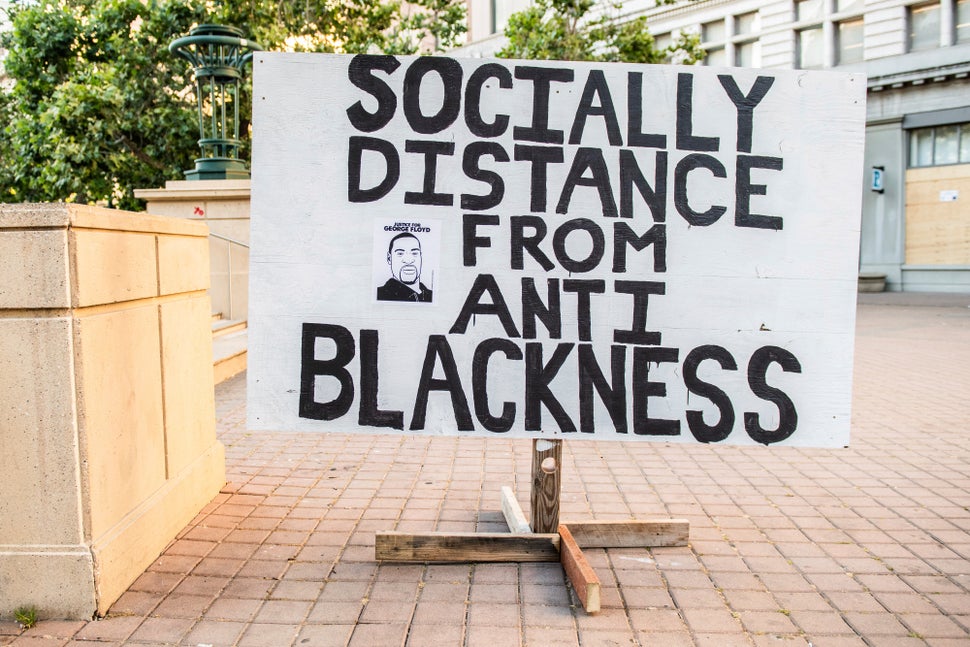
A sign at City Hall in Oakland, California, on June 2, 2020, after the police killing of George Floyd.
For some Asian Americans, another challenge in these conversations is puncturing family members’ positive associations with law enforcement and explaining why feeling comfortable contacting the police is itself a form of privilege.Â
“That’s been one of the more challenging aspects of bringing up these topics with her,†Harbstreet said of her mother. “To recognize the fact that there are positive experiences and stories involving the police, that doesn’t negate the fact that these systematic and institutional policies are still unfairly benefiting certain groups and really harming others.â€
Some people whose family members have had negative interactions with police said they have been able to use those as jumping-off points — while acknowledging their experiences are nowhere near as grave as what Black and Latinx people face in encounters with law enforcement.Â
Rachel Yi recounted a conversation she had last week with her Korean immigrant mother, who brought up an incident involving Yi’s older sister getting injured in an encounter with police.
“It’s actually a privilege that we have as Asian people because if she was Black, then she actually could have been shot and killed in that incident,†Yi recalled telling her mother. “My mom was silent for a few moments. And then she was like, ‘Yeah, I think you’re right.’â€
In navigating these emotionally draining personal conversations, several Asian Americans with backgrounds in social justice advocacy and community organizing said they’ve been able to take lessons from their professional experience. Algoso, who has a master’s degree in conflict resolution, said that she has learned how “to have a really intense conversation, being able to sit in the conflict and be uncomfortable, and commit to continuing the conversation at a later time.â€Â
It’s going to take a long time. I am sure that it will happen, slowly. It’s growth, right? We have to have a growth mindset.†Kalpana Galagali
Patel, a lawyer, and her boyfriend, Tarun Galagali, who has worked in civic engagement and on the congressional campaign of Rep. Ro Khanna (D-Calif.), put out a call on social media over the weekend to fellow South Asian Americans about starting these conversations. According to Galagali, nearly 150 people responded, and the two plan to hold Zoom trainings to provide some tools and strategies, drawing from their own experiences trying to educate their parents over the years.
“There are different ways of reaching them where they’re at,†Galagali said of his experience reaching out to voters. “If you do your best to communicate to that person where they’re at, they can evolve.â€
For Asian immigrant parents, it can take years of deep reflection and patience to reach a greater understanding. Galagali’s mom, Kalpana, said her evolution on racial issues came from conversations with her son as well as from her experience as a public school teacher.
“We are all immigrants coming from a different place, and we carry certain baggage,†she said. “I’m not blaming anybody else … I was ignorant. I didn’t know many things about this country. And I started to learn a lot from my son.â€
Galagali — who wrote a Medium post this week urging her fellow Indian immigrants to reflect on their own anti-Black biases — said it’s important for Asian immigrants, who “tend to stay within our groups for the comfort level,†to leave that comfort zone.
“It’s going to take a long time. I am sure that it will happen, slowly,†she said. “It’s growth, right? We have to have a growth mindset.â€
As slow as progress can often feel, nearly everyone said they believe it’s vital to keep trying to have these conversations, even if they seem frustrating and futile at first.
“It’s hard to see what kind of impact you can make within your own sphere of influence,†Algoso said. “But having these conversations with family can help in the long run, and is doing the work of fighting anti-Black racism.â€
Calling all HuffPost superfans!
Sign up for membership to become a founding member and help shape HuffPost’s next chapter
When the coronavirus hit Europe, Sweden did not lock down its economy. With the death toll exceeding that in neighboring countries, the epidemiologist behind Sweden’s strategy is expressing regret.
NPR’s Scott Simon speaks to Kaiser Health News journalist, Sarah Varney, about Lost on the Frontline, a new series documenting the stories of coronavirus health care workers.
Boris Johnson, his chief adviser Dominic Cummings, the chancellor, Rishi Sunak, and the business secretary, Alok Sharma, are said to support the measure, the Times reported on Saturday.
Sunday trading laws were introduced under the Sunday Trading Act 1994, which limits shops with retail space over 280 square metres to a maximum of six hours of trading.Â
New legislation would enable larger supermarkets to open for more than six hours on Sundays, a plan the chief whip, Mark Spencer, believes Labour and more traditionally minded Conservative MPs would oppose.
Joe Dromey, a Labour and Co-operative party councillor in Lewisham, south London, tweeted:
Joe Dromey (@Joe_Dromey)
Scrapping Sunday trading laws will do little to boost the economy, but it will cause a lot of disruption to the lives of low paid retail workers who have kept the country going through this crisis.
David Cameron’s attempt to abolish Sunday trading laws in 2016 failed after 27 Tory MPs rebelled.
Some supermarkets that have local convenience stores unaffected by Sunday trading laws are opposed to reform but others, including Asda and Morrisons, are said to be in favour.
James Lowman, the chief executive of the Association of Convenience Stores, said longer Sunday trading could hurt small shops and undermine efforts to keep staff safe during the pandemic.
“The majority of the public are in favour of the existing Sunday trading regulations, which strike the right balance between the needs of shop workers, consumers, high streets, small shops and supermarkets,†he said.
“Changing the current laws would serve only to displace trade from the local shops that have been keeping communities going during this pandemic. If anything, local shops and other retailers have been reducing the number of opening hours in their business to keep their staff safe whilst restocking and cleaning stores, and we expect non-essential retailers to operate with limited hours when they reopen later this month.
“There are many measures that have been recommended through high street reviews and task forces in recent years that could support the recovery of high street businesses, but at no point has a change to Sunday trading regulations been considered and with good reason. To upset the balance that has been struck on opening hours on Sundays would put small shops at risk, with increased costs but no guaranteed benefits for their larger counterparts.â€
Polling conducted by Populus on 7 May showed that 58% of consumers support the existing Sunday trading regulations, compared with 21% who did not.
Rayhan Haque, the founder of the London Good Work Commission, which was established by London Plus, the hub body for the capital’s 120,000 voluntary organisations, said: “Any plans to suspend Sunday trading laws is a bad idea. Sundays give independent shops and smaller retailers, who have been hit the hardest from the economic meltdown, a rare chance to compete with big corporate supermarkets. This also normalises a seven-day working culture, exactly the opposite of the better work-life balance people want post Covid-19.â€
Rayhan Haque (@RayhanHaque14)
Bad idea. Sundays give independent shops and smaller retailers a rare chance to compete with big corporate supermarkets.
This also normalises a seven day working culture – exactly the opposite of what people want.
The neoliberal platform 1828 said: “With this act in place, even if shops had the ability to open for longer on a Sunday, workers would still have the right to finish early or not work at all. Abolishing Sunday trading laws merely allows those who want to work more hours the ability to do so. It would, therefore, encourage job creation for those who need it and the subsequent economic benefits that come with this.â€
Downing Street’s plans to revive the economy include streamlining licensing laws so that cafes and restaurants can serve food outside, doing away with the present 28-day minimum statutory consultation period and encouraging councils to pedestrianise streets to accommodate new outdoor markets.
We use cookies on our website to give you the most relevant experience by remembering your preferences and repeat visits. By clicking “Accept”, you consent to the use of ALL the cookies.
This website uses cookies to improve your experience while you navigate through the website. Out of these, the cookies that are categorized as necessary are stored on your browser as they are essential for the working of basic functionalities of the website. We also use third-party cookies that help us analyze and understand how you use this website. These cookies will be stored in your browser only with your consent. You also have the option to opt-out of these cookies. But opting out of some of these cookies may affect your browsing experience.
Necessary cookies are absolutely essential for the website to function properly. These cookies ensure basic functionalities and security features of the website, anonymously.
Cookie
Duration
Description
cookielawinfo-checbox-analytics
11 months
This cookie is set by GDPR Cookie Consent plugin. The cookie is used to store the user consent for the cookies in the category "Analytics".
cookielawinfo-checbox-functional
11 months
The cookie is set by GDPR cookie consent to record the user consent for the cookies in the category "Functional".
cookielawinfo-checbox-others
11 months
This cookie is set by GDPR Cookie Consent plugin. The cookie is used to store the user consent for the cookies in the category "Other.
cookielawinfo-checkbox-necessary
11 months
This cookie is set by GDPR Cookie Consent plugin. The cookies is used to store the user consent for the cookies in the category "Necessary".
cookielawinfo-checkbox-performance
11 months
This cookie is set by GDPR Cookie Consent plugin. The cookie is used to store the user consent for the cookies in the category "Performance".
viewed_cookie_policy
11 months
The cookie is set by the GDPR Cookie Consent plugin and is used to store whether or not user has consented to the use of cookies. It does not store any personal data.
Functional cookies help to perform certain functionalities like sharing the content of the website on social media platforms, collect feedbacks, and other third-party features.
Performance cookies are used to understand and analyze the key performance indexes of the website which helps in delivering a better user experience for the visitors.
Analytical cookies are used to understand how visitors interact with the website. These cookies help provide information on metrics the number of visitors, bounce rate, traffic source, etc.
Advertisement cookies are used to provide visitors with relevant ads and marketing campaigns. These cookies track visitors across websites and collect information to provide customized ads.