Flashy Nigerian Instagrammers ‘caught with $40m in cash’

0

Image copyright
mrwoodbery

Image caption

Olalekan Jacob Ponle, known as “mrwoodbery” to his Instagram followers, flaunted his wealth

The day after his 29th birthday in May, Olalekan Jacob Ponle posted a picture on his Instagram standing next to a bright yellow Lamborghini in Dubai.

“Stop letting people make you feel guilty for the wealth you’ve acquired,” he admonished, wearing designer jewellery and Gucci clothes from head to toe.

A month later, the Nigerian, who goes by the name “mrwoodbery” on Instagram, was arrested by Dubai Police for alleged money laundering and cyber fraud.

The most famous of the dozen Africans nabbed in the dramatic operation was 37-year-old Ramon Olorunwa Abbas, “hushpuppi” or just “hush” as he was known by his 2.4 million Instagram followers.

Police in the emirate say they recovered $40m (£32m) in cash, 13 luxury cars worth $6.8m, 21 computers, 47 smartphones and the addresses of nearly two million alleged victims.

Mr Abbas and Mr Ponle were both extradited to the US and charged in a Chicago court with conspiracy to commit wire fraud and laundering hundreds of millions of dollars obtained from cybercrimes.

The two have not yet been asked to plead and are presumed innocent until proven guilty.

“I think there’s probably a certain arrogance when they believe they’ve been careful about maintaining anonymity in their online identities, but they live high on the hog and get careless on social media,” said Glen Donath, a former senior prosecutor in the US Attorney’s Office in Washington, DC.

It is a spectacular crash for the two Nigerian men who extensively documented their high-flying lifestyle on social media, raising questions about the sources of their wealth.

They unwittingly provided crucial information about their identities and activities for American detectives with their Instagram and Snapchat posts.

They are accused of impersonating legitimate employees of various US companies in “business email compromise” (BEC) schemes and tricking the recipients into wiring millions of dollars into their own accounts.

On Instagram, hushpuppi said he was a real estate developer and had a category of videos called “Flexing” – social media lingo for showing off. But the “houses” were actually a codeword for bank accounts “used to receive proceeds of a fraudulent scheme”, investigators allege.

“Our value system in Nigeria needs to be checked, especially the emphasis we place on wealth, no matter how you got it,” the economist Ebuka Emebinah told the BBC from New York.

“It’s a culture where people believe that results speak for you. We don’t place as much emphasis on the process and this has built up over time.”

English Premier League team targeted

In April, hushpuppi renewed his lease for another year at the exclusive Palazzo Versace apartments in Dubai under his real name and phone number.

“Thank you, Lord, for the many blessings in my life. Continue to shame those waiting for me to be shamed,” he captioned an Instagram picture of a Rolls-Royce just a fortnight before he was arrested.

“Abbas finances this opulent lifestyle through crime, and he is one of the leaders of a transnational network that facilitates computer intrusions, fraudulent schemes (including BEC schemes), and money laundering, targeting victims around the world in schemes designed to steal hundreds of millions of dollars,” the Federal Bureau of Investigations (FBI) said in an affidavit.

In one case, a foreign financial institution allegedly lost $14.7m in a cyber-heist where the money ended up in hushpuppi’s bank accounts in multiple countries.

The affidavit also alleged that he was involved in a scheme to steal $124m from an unnamed English Premier League team.

The FBI obtained records from his Google, Apple iCloud, Instagram and Snapchat accounts which allegedly contained banking information, passports, communication with conspirators and records of wire transfers.

About 90% of business email compromise scams originate in West Africa, research from American email security firm Agari shows.

‘Yahoo boys’

The complaint against Mr Abbas and Mr Ponle describe tactics that resemble what the company calls Vendor Email Compromise tactics, where scammers compromise an email account and study communication between a customer and a vendor.

Larry Madowo

Larry Madowo

The ‘Nigerian prince’ trope has become shorthand for deception”

“The scammer would gather contextual details, as they watched the legitimate email flow,” explains Crane Hassold, Agari’s senior director of threat research.

“The bad actor would redirect emails to the bad actor’s email account, craft emails to the customer that looked like they are coming from the vendor, indicate that the ‘vendor’ had a new bank account, provide ‘updated’ bank account information and the money would be gone, at that point.”

Mr Ponle, known online as “mrwoodberry”, used Mark Kain in emails, according to the FBI.

He is accused of defrauding a Chicago-based company into sending wire transfers of $15.2m. Companies in Iowa, Kansas, Michigan, New York, and California are also said to have fallen victim.

The cash trail allegedly disappeared after his accomplices, called money mules, converted the money into the cryptocurrency bitcoin.

Email scams have become so prevalent globally, and so deeply linked to Nigeria, that the fraudsters have a name in the country: “Yahoo boys”.

They try to convince a recipient to wire money to the other side of the world or they go “phishing”, stealing a user’s identity and personal information for fraud.

The FBI warns against the Nigerian letter or “419” fraud – emails promising large sums of money, called advance fee scams. The “Nigerian prince” trope has become shorthand for deception.

How a 419 and romance scam works

Image copyright
Getty Images

  • An individual may contact you via e-mail, explaining he needs help to transfer money
  • Will tell you that political turmoil or a natural disaster makes it difficult for him to make the transfer
  • Will ask you to give him your financial details so that he can transfer the money into your account
  • This allows him to access and steal from your account
  • Be careful what you post on social media and dating sites as scammers use the details to better understand you and target you

A Washington, DC-based attorney, Moe Odele, finds it frustrating as a Nigerian because it ignores the “systemic failures that have led to brilliant Nigerian youths engaging in these scams”, in the country and abroad.

“They see it as an easy way out in a country that offers them limited options and, in many cases, no options at all,” she says.

“But there are also many brilliant Nigerians are represented in world stages from education to pop culture.”

How Nigeria suffers

Last month, the US Treasury Department blacklisted six Nigerians among 79 individuals and organisations in its Most Wanted cybercriminals list. It accused them of stealing more than $6m from American citizens through deceptive global threats like BEC and romance fraud.

You may also be interested in:

Media playback is unsupported on your device

Media captionNigerian kids recreate Money Heist scene

Ayo Bankole Akintujoye – founder of Nigeria-based Bootcamp, a start-up incubation initiative – faults the international attention on Nigeria alone.

“A lot of Nigerians are doing fantastic things all over the world, but they don’t get as much media mileage as the guys doing bad things. It affects all the guys doing legitimate stuff especially in the tech space,” he said.

“A lot of foreign companies don’t ship to Nigeria, many payment platforms don’t accept payments from us because it has ruined our image.”

In its internet crime report for 2019, the FBI said it had received more than 460,000 complaints of suspected cyber fraud, with losses of more than $3.5bn reported. More than $300m was recovered, it said.

However, many online fraudsters don’t get caught and even fewer end up going to jail.

Mr Donath says the cases are challenging because they happen overseas and tend to be quite sophisticated.

“They’re time-consuming, highly document-intensive, and in many federal criminal cases, you have the difficulty of walking a jury through a chronology of relevant facts,” said the partner at law firm Clifford Chance.

If convicted, Mr Abbas and Mr Ponle could be locked up for up to 20 years.


Source link

What the papers say – July 8

0

The Chancellor’s plans to get the economy moving, Amber Heard and Johnny Depp in court and car parking charges for NHS staff are among the stories making headlines.

Source link

Facebook Boycott Organizers Call Mark Zuckerberg Meeting A ‘Disappointment’

Civil rights organizers calling for an advertising boycott of Facebook said their meeting on Thursday with company CEO Mark Zuckerberg and COO Sheryl Sandberg was ultimately a “disappointment.”

In a scathing statement on the Stop Hate for Profit website, which urges brands to pull Facebook advertising for the month of July, organizers said it “was abundantly clear in our meeting today that Mark Zuckerberg and the Facebook team is not yet ready to address the vitriolic hate on their platform.”

“Zuckerberg offered the same old defense of white supremacist, antisemitic, Islamophobic and other hateful groups on Facebook that the Stop Hate for Profit Coalitions, advertisers and society at large have heard too many times before,” the statement reads. 

The group continued: “Zuckerberg offered no automatic recourse for advertisers whose content runs alongside hateful posts. He had no answer for why Facebook recommends hateful groups to users. He refused to agree to provide an option for victims of hate and harassment to connect with a live Facebook representative … And he did not offer any tangible plans on how Facebook will address the rampant disinformation and violent conspiracies on its platform.”

Stop Hate for Profit’s website lists 10 major demands, including that Facebook submit to regular independent audits and delete public and private groups focused on disinformation, conspiracy theories and white supremacy.

According to the group’s statement, Facebook made no attempt to address the majority of these demands during the meeting, aside from the request to hire a civil rights consultant — though neither Zuckerberg nor Sandberg would commit to that role being at the C-suite level, Stop Hate for Profit said.

“None of this is hard,” the statement said of the demands, “especially for one of the world’s most innovative companies whose founder coined the term move fast and break things. Mark Zuckerberg, you aren’t breaking things, you are breaking people.”

Members of the Stop Hate for Profit collective, including Color of Change President Rashad Robinson, who had previously accused Zuckerberg of an “arrogant” unwillingness to police hate speech, reiterated their disappointment on social media. 

In a Facebook post prior to the meeting, Sandberg acknowledged that the company “has to get better at finding and removing hateful content” but was adamant that it had made progress and would release a two-year independent civil rights audit on Thursday.

The NAACP, one of the advocacy groups comprising Stop Hate for Profit, said in a statement to HuffPost it “await[ed] the release of tomorrow’s civil rights audit report” and would continue to “hold Facebook accountable and work for real change.” 

Companies currently participating in Stop Hate for Profit’s initiative to remove Facebook ads for July include Adidas, Ben & Jerry’s, The North Face, Unilever and Verizon (which owns Verizon Media, HuffPost’s parent company). 


Source by [author_name]

Texas Sets State Record With More Than 10,000 New Coronavirus Cases Reported Tuesday

Patients can get COVID-19 diagnostic and antibody tests at a converted vehicle inspection station in San Antonio, as the state reports a record number of hospitalizations and single-day case increases.

Eric Gay/AP


hide caption

toggle caption

Eric Gay/AP

Patients can get COVID-19 diagnostic and antibody tests at a converted vehicle inspection station in San Antonio, as the state reports a record number of hospitalizations and single-day case increases.

Eric Gay/AP

Texas reported more than 10,000 new coronavirus cases on Tuesday, smashing its previous record for single-day increases and becoming latest state to reach this grim milestone.

Florida did so earlier in this month and New York in April.

Tuesday’s 10,028 confirmed cases eclipse Texas’ previous record of 8,258, which it set on Saturday.

Hospitalizations are also reaching record highs, with the state surpassing 8,000 hospitalizations for the first time over the weekend. According to the nonprofit COVID Tracking Project, Texas has more than 9,200 hospitalized patients as of Tuesday.

At least two South Texas counties — Hidalgo and Starr — announced over the weekend that their hospitals had reached full capacity.

The mayors of Houston, Austin and San Antonio have also warned in recent days that hospitals in their cities are at risk of reaching their limits in the coming weeks.

“People should take this extraordinarily seriously,” Dr. Marc Boom, president and CEO of the Houston Methodist hospital system, told NPR on Sunday. “And what we need right now in Houston – and I think we’ve been seeing over the last number of days – is people to really change their behaviors dramatically.”

Texas has taken some measures to reserve hospital capacity and resources. In late June, Gov. Greg Abbott ordered hospitals in eight counties to suspend elective surgeries and procedures.

Aid is also coming from outside the state: About fifty soldiers from Fort Carson Army Base in Colorado are heading to the San Antonio area, where they will begin working in civilian hospitals later this week.

Abbott was initially reluctant to sound the alarm when cases began to spike in mid-June, but has since issued statewide orders designed to slow the spread of the virus.

By the end of June, he had rolled back some of the state’s reopening plan by closing bars and tightening restrictions on certain businesses. He also reversed course on the subject of face coverings, and issued a mask mandate that took effect in much of the state on Friday.

The state reported 60 new deaths on Tuesday, bringing its cumulative total to 2,715.


Source link

Niece’s book says Trump views ‘cheating as a way of life’

Donald Trump waves to staff members of the Trump Taj Mahal Casino Resort in 1990. To his left is his mother, Mary, and his father, Fred. (Charles Rex Arbogast / Associated Press)

Donald Trump’s upbringing in a deeply dysfunctional family makes him a uniquely destructive and unstable leader for the country, his estranged niece writes in a scathing new book, perhaps the most personal in a series of deeply unflattering tell-all accounts about the president.

Mary Trump, a clinical psychologist, describes her uncle as deeply insecure and unscrupulous, saying he paid a friend to take his SAT so he could get into college. She accuses him of “twisted behaviors” and “cheating as a way of life,” citing a lifelong habit of lying.

“Donald is not simply weak, his ego is a fragile thing that must be bolstered every moment because he knows deep down that he is nothing of what he claims to be. He knows he has never been loved,” writes the 55-year-old daughter of the president’s eldest brother, Fred.

The Times obtained an early copy of her 240-page book, “Too Much and Never Enough: How My Family Created the World’s Most Dangerous Man.” It is scheduled to be released on July 14.

The book, which portrays the president as almost pitifully desperate for affirmation, provides a harsh contrast to Trump’s self-made image as a tough and successful businessman. It also represents an extraordinary breach in the wall of secrecy that he has erected around his life.

More than any modern president, Trump has gone to extraordinary lengths to conceal or distort major details of his private life, barring his schools from releasing transcripts, refusing to disclose his tax returns or detailed health information, and requiring employees and others to sign nondisclosure agreements to prevent release of unflattering material about his business and personal affairs.

The author says the president’s late father, Fred Sr., was domineering and a “high-functioning sociopath,” and his late mother, also named Mary, was “emotionally and physically absent.” They left Trump, she argues, without empathy and “fundamentally incapable of acknowledging the suffering of others.”

“Honest work was never demanded of him, and no matter how badly he failed, he was rewarded in ways that are almost unfathomable,” she writes.

“Now the stakes are far higher than they’ve ever been before; they are literally life and death. Unlike any previous time in his life, Donald’s failings cannot be hidden or ignored because they threaten us all,” she adds.

Although the president’s family sued to try to block release of the brutal personal account, a New York appeals court ruled that publisher Simon & Schuster may distribute the book.

It remains the focus of a legal battle, however. Trump, the fourth of five siblings, argues that in writing the book, his niece violated a nondisclosure agreement that she signed two decades ago as part of the settlement of a bitter dispute over the family fortune.

She has told the court that Trump lied about his net worth and other business affairs during the negotiations and that the confidentiality agreement should be declared invalid.

Sarah Matthews, a White House deputy press secretary, said the allegation that Trump paid someone to take the College Board admissions test for him “is completely false.” Trump enrolled at Fordham University in 1964 but transferred two years later to the Wharton School at the University of Pennsylvania, graduating with a bachelor’s degree in business.

Matthews also said “the president describes the relationship he had with his father as warm and said his father was very good to him.”

According to the book, the Trump family was caustic, cold and calculating.

“Donald suffered deprivations that would scar him for life,” Mary writes, and he developed personality traits that included “displays of narcissism, bullying, grandiosity.”

He also became practiced at bending the truth, a precursor to becoming a president who has uttered and tweeted thousands of falsehoods since taking office.

“For Donald, lying was primarily a mode of self-aggrandizement meant to convince other people he was better than he actually was,” Mary writes.

According to her account, Trump got his older sister, Maryanne, to complete his school homework, and he paid a friend to take his College Board admissions test.

“That was much easier to pull off in the days before photo IDs and computerized records,” Mary writes. “Donald, who never lacked for funds, paid his buddy well.”

Mary Trump relies on her training as a clinical psychologist to analyze the president. She blames him for the unraveling of her father, Fred Jr., who died in 1981 at age 42 after struggling with alcoholism.

Fred Jr., often called Freddy, had been expected to take over the family real estate business, but he was uninterested, and Fred Sr. ended up favoring Donald instead.

“Donald, following the lead of my grandfather and with the complicity, silence, and inaction of his siblings, destroyed my father,” Mary writes.

Freddy became a commercial airline pilot, disappointing his father, who described him as a “bus driver in the sky.” While Fred Jr. was living in Massachusetts with his wife, Donald visited and berated him for his alleged failings.

“You know, Dad’s really sick of you wasting your life,” Donald said, according to the book.

Fred Jr.’s drinking worsened, and an attempt to return to the family business didn’t pan out. At the end of his life, no family members accompanied him when he was taken to the hospital, Mary writes. She says Donald went to the movies the night his brother died.

According to the book, Trump internalized Fred Sr.’s treatment of Freddy.

“He had plenty of time to learn from watching Fred humiliate his older brother and Freddy’s resulting shame,” Mary writes. “The lesson he learned, at its simplest, was that it was wrong to be like Freddy: Fred didn’t respect his oldest son, so neither would Donald. Fred thought Freddy was weak, and therefore so did Donald.”

Trump, not known for introspection, has expressed rare doubts about his treatment of his older brother. “I do regret having put pressure on him,” he told the Washington Post last year.

After Fred Sr. died in 1999, Mary and her brother, known as Fritz, were angered to learn that they would inherit far less than they expected. When they challenged the will, the Trump family cut off their medical insurance — a devastating blow to Fritz, whose new son was born with cerebral palsy and needed constant care.

Mary and Fritz eventually settled for less money than they felt they were entitled to, but the legal sparring had consequences down the road.

In the book, Mary reveals herself as the key source for the New York Times’ investigation into Trump’s alleged tax fraud as he inherited his father’s real estate empire. She communicated with one of the reporters using an untraceable phone and visited her former lawyer’s office to collect computer files and nineteen boxes of documents.

The book also describes unflattering comments made by Maryanne, Trump’s older sister and a retired federal judge. When he announced he was running for president, Mary writes, Maryanne dismissed him as “a clown.” And when he started to build support among evangelical voters, she was outraged.

“The only time Donald went to church was when the cameras were there,” Maryanne said, according to the book. “It’s mind boggling. He has no principles. None!”

Trump’s well-documented lewdness extends to his interactions with his niece, she says. After asking Mary to help ghost write one of his books, he refused to grant an interview but provided her with “an aggrieved compendium of women he had expected to date but who, having refused him, were suddenly the worst, ugliest, and fattest slobs he’d ever met.”

Around that time, Mary went with her uncle to Mar-a-Lago, his Florida resort. She writes that when he spotted her in a bathing suit, the future president looked at his 29-year-old niece “as if he’d never really seen me before” and told her “you’re stacked!”

Several former senior members of Trump’s inner circle have also shared withering criticism of the president as he seeks reelection.

Last month, John Bolton, Trump’s third national security advisor, released a scorching behind-the-scenes account of what he viewed as the president’s incompetence and servile behavior toward authoritarian leaders.

Source link

Juventus stunned by AC Milan comeback – European round-up

0

Lecce also beaten by Lazio in Serie A as Atletico Madrid are held in La Liga

Last Updated: 08/07/20 12:25am


Juventus slipped to a surprise defeat against AC Milan

Juventus missed the chance to take a big step toward a ninth successive Serie A title as they let a two-goal lead slip in a 4-2 loss at AC Milan.

Juventus could have extended their lead at the top of the table to 10 points with a win and a tight first half finished goalless after Zlatan Ibrahimovic had a goal ruled out for offside shortly before the break.

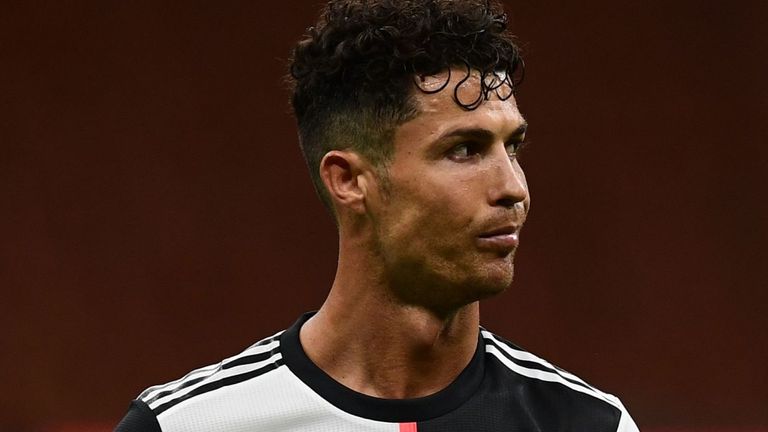
But Adrien Rabiot broke the deadlock two minutes after the restart by curling a strike into the top-right corner with Cristiano Ronaldo doubling Juventus’ lead six minutes later.

However, Milan turned the match around completely in the space of five minutes.

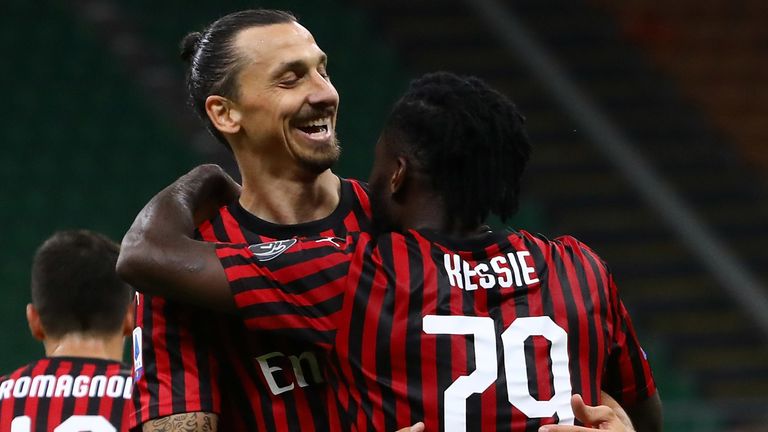
Zlatan Ibrahimovic was among the scorers for Milan

Zlatan Ibrahimovic was among the scorers for Milan

Ibrahimovic converted a penalty in the 62nd minute following a handball from Leonardo Bonucci before two quickfire goals from Franck Kessi and substitute Rafael Leo.

Milan extended their advantage 10 minutes from full time when Giacomo Bonaventura capitalised on an error from Juventus defender Alex Sandro to set up Ante Rebic.

Elsewhere in Serie A, Lecce missed a penalty and also had a goal disallowed, but still managed an upset win over title-chasing Lazio.

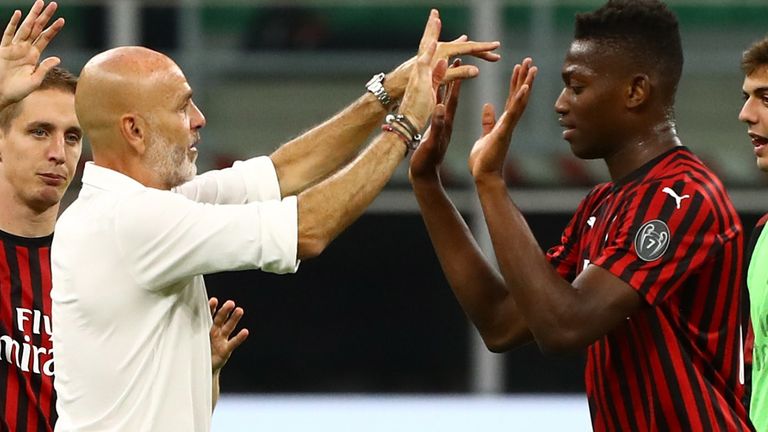
Goalscorer Rafael Leo celebrates with Stefano Pioli at full-time

Goalscorer Rafael Leo celebrates with Stefano Pioli at full-time

Fabio Lucioni and Khouma Babacar scored for Lecce after Felipe Caicedo had given Lazio an early lead.

Lazio’s bad night was made worse when defender Patric was sent off for biting Giulio Donati in an incident that could lead to a lengthy ban.

Lazio were just a point behind Juventus when the season was halted because of the coronavirus pandemic. They had been on a record unbeaten run of 21 games but the Roman side have lost three of their five matches since the season resumed.

La Liga: Atleti held by Celta

Alvaro Morata scored for Atletico Madrid on Tuesday

Alvaro Morata scored for Atletico Madrid on Tuesday

Atletico Madrid were held to a 1-1 draw with relegation-threatened Celta Vigo, missing the chance to get closer to a Champions League spot.

Alvaro Morata put Atletico ahead in the first minute at the Balaidos Stadium, converting a cross from Angel Correa, but Fran Beltran equalized for the hosts with a neat volley in the 49th minute, hitting the top corner with a shot that lobbed over Atletico goalkeeper Jan Oblak.

Diego Simeone’s team are three points ahead of fourth-place Sevilla and nine ahead of fifth-place Villarreal, extending their unbeaten run to 15 games.

It was the second straight draw for Celta, who opened a seven-point gap to the relegation zone but could lose some ground depending on other results.

Elsewhere, 19-year-old South Korea midfielder Lee Kang-in scored in the 89th minute to help Valencia end a four-game winless streak with a 2-1 victory over Real Valladolid.

Lee scored with a low left-foot shot from outside the area to keep Valencia in the fight for a Europa League spot. They are one point behind seventh-place Real Sociedad with three games to go. Valladolid, who have two wins since the break, stay in 13th place.

A Super 6 for Newcastle?

Do not miss your chance to land the £250,000 jackpot for a sixth time this season on Wednesday. Play for free, entries by 6pm.


Source link

Coronavirus: Free parking for NHS staff ‘cannot continue indefinitely’, health minister says

0

NHS healthcare workers need clarity over the future of free hospital parking after a health minister announced funding for it “cannot continue indefinitely”, a Liberal Democrat MP has said.

Health Secretary Matt Hancock said on 25 March that the government would cover the parking costs of NHS staff who were “going above and beyond every day” during the coronavirus outbreak in England.

But health minister Edward Argar has since said the government is looking at how long this support will “need” to go on.

In response to a written question from Labour MP Rachael Maskell, he said: “The provision of free parking for National Health Service staff by NHS Trusts has not ended and nothing has changed since the announcement on 25 March.

“However, free parking for staff has only been made possible by support from local authorities and independent providers and this support cannot continue indefinitely.”

Image:
Edward Argar has said support for free parking for NHS staff ‘cannot continue indefinitely’

Mr Argar said the government wants to make good on its promise of free hospital parking for the disabled, frequent outpatient attendees, and parents of sick children who are staying overnight and nightshift workers.

He continued: “Implementation of this commitment has been on hold whilst the NHS has been managing the COVID-19 pandemic and devoting its hospital parking capacity to staff and other facilities necessary for managing the pandemic.”

File photo dated 16/12/2019 of Liberal Democrat MP Layla Moran
Image:
Liberal Democrat MP Layla Moran has said the government ‘must provide clarity’

:: Listen to the Daily podcast on Apple Podcasts, Google Podcasts, Spotify, Spreaker

Liberal Democrat leadership candidate Layla Moran has called for clarity and said NHS workers must not be “saddled with extortionate parking charges”.

She said: “Removing parking charges for staff at the outset of COVID-19 was the right move. Our healthcare workers deserved to have certainty that they could get to work without extra charges or hassle.

“Now the government must provide clarity and ensure our workers are not saddled with extortionate parking charges. We also need to see more efforts to promote green transport options for our healthcare workers.”

Source link

6 Dead, 1,500 Infected As Coronavirus Ravages California’s San Quentin Prison

Half a dozen inmates have died and more than 1,300 inmates have been infected by the coronavirus at San Quentin State Prison in Northern California, as advocates urge Gov. Gavin Newsom to release more prisoners. 

In late May, San Quentin prison had zero confirmed cases of the virus among its around 4,000 inmates. But after more than 120 prisoners were transferred in from another facility in Chino — 25 of whom later tested positive for COVID-19 — an outbreak began that has grown to devastating proportions in recent weeks. As of Tuesday, 1,369 people incarcerated at San Quentin and 184 staffers had tested positive, adding up to more than 1,500 infected with the virus, per the state’s tracking tool. Only 13 inmates with active cases have been released so far. 

Prisoners advocates and state politicians have been calling for Newsom to release more inmates in response to the crisis.

On Monday, the Democratic governor said that his administration has been working on the issue “every single day for the last three weeks” and that it was a “top priority.” His plan is to bring the prison’s population down to about 3,000 inmates over the “next few weeks” and he was “individually” reviewing cases, Newsom said.

It was not clear if all of the inmates to be removed to reduce San Quentin’s population would be released from prison entirely or if some would be transferred to other facilities. The governor’s office and the state’s Department of Corrections and Rehabilitation did not immediately respond to HuffPost’s request for further comment. 

Last week, 20 inmates at San Quentin went on a hunger strike to protest its inhumane conditions, including dirty, cramped cells, amid the COVID-19 pandemic.

Juan Moreno Haines, a journalist incarcerated in San Quentin who said he’s tested positive for COVID-19, told The Appeal last week that people were still locked up with others in cells ― a practice that ignores social distancing recommendations. Haines wrote in The Appeal in late June that prisoners were “reluctant to report when they’re sick” out of fear of being sent into the “punishing conditions” of solitary confinement.

On Tuesday, state legislators and other officials, including San Francisco District Attorney Chesa Boudin (D) and state Sen. Scott Wiener (D), called for Newsom to release “medically vulnerable” and aging inmates from San Quentin, as well as those “deemed a low risk to public safety.” They also urged the governor to “dramatically reduce” prison populations across the state to less than half of current capacity. 

Throughout California’s prisons, there have been over 5,000 confirmed coronavirus cases so far, and 29 inmates have died. 

The state prison system has released 3,500 incarcerated people through “expedited” parole processes since March, per the corrections department. At San Quentin, the department has said it is taking measures to reduce the spread of the coronavirus, including having staffers’ temperatures checked before entering and reducing the number of people in common areas.

California overall has seen a steady increase in coronavirus cases in recent weeks, with more than 277,000 confirmed cases and more than 6,000 dead as of Monday. The state has hit a seven-day average of 7,800 new cases per day, and hospitalization rates have increased by 50% over the last two weeks, per the governor. 

After being one of the earliest states to shut down businesses and direct residents to shelter in place, California began reopening in May. But it has since had to walk back reopenings in several areas as new cases ballooned. 

The U.S. continues to lead the world with more than 2.9 million confirmed cases and over 131,000 dead from COVID-19 so far. Some of the country’s worst outbreaks have been in congregant settings like nursing homes, meatpacking plants, Amazon warehouses and other prisons nationwide.

“The virus is here and it’s getting worse by the day,” Charles Lawrence, then an inmate at Pendleton state prison in Indiana, wrote in a letter in mid-April, later shared with HuffPost. “It’s only a matter of time before it claims a life.” Just over two weeks later, Lawrence died from the coronavirus.

“Protect human beings behind bars,” Lawrence’s wife, Sanya, told HuffPost last week. “Their lives matter, too.”


Source link

Intellasia East Asia News – HK national security law: city’s leader Carrie Lam denies she was ever kept in dark by Beijing over new legislation

0

Hong Kong’s leader has said she was not kept in the dark as Beijing imposed the national security law on the city, and central government officials had briefed her and sought her opinion on the legislation.

On Tuesday, Chief Executive Carrie Lam Cheng Yuet-ngor also said the police’s power was not expanded under a series of new implementation rules laid down by the government the day before.

Under the new rules, Hong Kong police can raid premises without a court warrant, order internet firms to remove content or seize relevant devices, and demand information from political groups operating outside the city.

Chief Executive Carrie Lam meets the press at the government’s headquarters. Photo: K.Y. Cheng

Get the latest insights and analysis from our Global Impact newsletter on the big stories originating in China.

But at a 45-minute press conference on Tuesday, Lam said the law had been misrepresented as being draconian and undermining “one country, two systems”, the principle under which the city is governed.

She also said the notion Hong Kong officials were kept in the dark before it was enacted was wrong.

Rather than enlarging police power, the implementation rules were meant to limit such powers in law enforcement, Lam said.

“Apart from the powers under the current ordinance, Article 43 of the new law already empowered the police to adopt seven measures in safeguarding national security,” she said. “If we do not write down these implementation rules, the police’s power and measures would be almost absolute.

“It was exactly because we felt we need to protect and respect human rights, that we created the implementation rules… to stipulate under what circumstance could the measures be adopted, and who can approve it.”

Countering those who said the legislation was draconian, Lam said it was “relatively mild” compared with similar laws in some other countries.

“I have not seen widespread fears among Hong Kong people in the past week,” she said. “The national security law will restore stability, and help ensure the majority of Hong Kong people would exercise their rights and freedoms without being intimidated or attacked.”

The chief executive was asked if Hong Kong’s civil liberties, including press freedom, would be undermined by the new rules.

“I hope you will be assured that in the fundamental principles of this particular piece of legislation, Article 4, the respect and preservation of human rights is one of the guiding principles, and I will just explain that even the implementation details, they are designed and devised in order to protect and respect human rights,” she said.

Lam earlier dismissed suggestions that Beijing officials had kept her in the dark.

“The National People’s Congress Standing Committee has listened to opinions, including that of myself and the city’s government,” she said.

Lam believes remarks she made two weeks ago fuelled the misrepresentation of her relationship with Beijing over the drafting of the new law.

“I answered a question here, and [the reporter] assumed that I know nothing and said, ‘you guys have not seen the law’,” she said

“I only answered that at the moment, ‘we have not seen the complete details of the proposed legislation’. This was used to suggest that I know nothing about the law, and have not seen any provision until the law was passed on June 30.

“This was really far from what I meant, and [those critics’] ability to imagine and exaggerate things really impressed me.”

On one country, two systems, Lam said allegations were made that the law “signifies the death” of the principle, or put it in jeopardy.

“The answer from me is exactly the opposite. The national security law aims to affirm and improve the implementation of one country, two systems by addressing risks of undermining national security,” she said.

On Monday, China’s ambassador to London, Liu Xiaoming, said Britain’s plans to give British National (Overseas) passport holders in Hong Kong a path to British citizenship amounted to “gross interference in China’s internal affairs”.

Asked to comment on London’s offer, Lam said she believed Beijing would “respond and handle [the situation] seriously”, but had no information on what action the central government might take.

https://sg.news.yahoo.com/hong-kong-national-security-law-063336327.html


Tags:

Category: Hong Kong


Print This Post

Source link

Intellasia East Asia News – HK national security law: top US diplomat criticises legislation on programme by city’s public broadcaster

0

America’s top diplomat in Hong Kong went on a radio programme by public broadcaster RTHK on Monday to criticise Beijing’s national security law for the city, barely a week after the controversial legislation came into effect.

In response, the city’s government revealed on Monday night that Chief Secretary Matthew Cheung Kin-chung and Secretary for Security John Lee Ka-chiu met US Consul general to Hong Kong and Macau, Hanscom Smith, earlier in the day to express grave concern over the matter.

Smith had accused China of using the legislation to erode Hong Kong’s fundamental freedoms and create an atmosphere of coercion and self-censorship.

Get the latest insights and analysis from our Global Impact newsletter on the big stories originating in China.

“We want to create an atmosphere that is as free and open as possible, that allows… everyone in Hong Kong to be able to operate in a way that’s free of coercion and intimidation and is consistent with what [they] were promised in the [Sino-British] Joint Declaration,” he said.

“Hong Kong has been a successful economy precisely because of its openness and transparency. When you start undermining that with opaque measures [of] extraterritoriality, vaguely defined criteria, then you start to undermine what makes Hong Kong work.”

You can’t have one country and two economic and financial systems. Fundamental political and social freedoms are very closely linked to economic success

Hanscom Smith, US consul general

After the programme, he said it would be a tragedy if Hong Kong’s popular anti-government protest slogans fell foul of the law.

In a statement issued on Monday evening, a government spokesman said the implementation of the “one country, two systems” principle in Hong Kong was entirely an internal matter of Beijing and no other state or legislature had the right to intervene.

“Social unrest, the failure of the rule of law and a lack of protection for corporate assets and personal safety are genuine factors that would undermine investors’ confidence.

“As a matter of fact, these were the factors that led to the fall of Hong Kong’s international rankings in the past year. The US has its own national security legislation, but we have never heard that such legislation affected the economic development and business environment of the US,” the spokesman said.

Reacting to Smith’s comments, Ip Kwok-him, a Hong Kong deputy to China’s top legislature, the National People’s Congress, said the fact that Smith was able to criticise Beijing on a public broadcaster showed that Hong Kong still enjoys a high degree of freedom.

“It was quite rare for the US consul general to speak on any local radio programme, I think Beijing’s foreign ministry is going to have a word about it,” he said.

“The US is a major target of the national security law, and Washington must be upset about the legislation. Under this context, Smith must represent his government in speaking up, or he could be fired.”

The controversial legislation Beijing tailor-made for Hong Kong outlaws acts of secession, subversion, terrorism and collusion with foreign forces in the city’s affairs, and carries a maximum penalty of life imprisonment.

Criticising the law alone does not constitute any of the four offences of the new law, as everyone can have his or her own views

Priscilla Leung, Basic Law Committee member

The law was enacted just before Hong Kong marked the 23rd anniversary of its return to Chinese rule on July 1, sparking concerns over the fate of the one country, two systems principle that has guided the city’s governance since 1997.

Asked if Smith could be breaking the new law, Basic Law Committee member Priscilla Leung Mei-fun said it was not unlawful to criticise anyone.

“Criticising the law alone does not constitute any of the four offences of the new law, as everyone can have his or her own views. You can’t say they are provoking hatred towards authorities unless there are substantial acts,” she said.

In an interview with the Post on Thursday, Smith said the US consulate in Hong Kong would continue to interact with the city’s opposition politicians, even with foreign interference outlawed under the new legislation.

Washington imposed visa restrictions on Chinese officials last month and banned exports of defence equipment and sensitive US technology to Hong Kong while reacting to the new law, prompting Beijing to announce tit-for-tat visa restrictions on American individuals.

The US Congress this month passed the Hong Kong Autonomy Act, which penalises Chinese officials who erode Hong Kong’s autonomy as well as banks and firms that do business with them, sending it to the White House for President Donald Trump’s signature.

“It’s very important for us to highlight the fact that to the extent that mainland China starts treating Hong Kong more like the mainland, then the way we treat Hong Kong has to reflect that as well,” Smith told the state broadcaster on Monday.

He warned that the erosion of Hong Kong’s autonomy by Beijing would undermine the city’s success as an international business hub.

“I think we’re troubled by the provisions of the national security legislation that refer to foreign collusion. There’s been an ongoing propaganda campaign by Beijing to point to foreign scapegoats… We reject those accusations. Of course what’s happening in Hong Kong reflects [their people’s] own interests and concerns.

“Hong Kong, to be successful, has to maintain what sets it apart from mainland China and that includes [its] openness, transparency, protection of intellectual property, free expression and all of these attributes that have been the cornerstones of the success of this city,” Smith said.

“You cannot divorce these fundamental freedoms from Hong Kong’s success as an economic hub. In other words, you can’t have one country and two economic and financial systems. Fundamental political and social freedoms are very closely linked to economic success.”

https://sg.news.yahoo.com/hong-kong-national-security-law-070004946.html


Category: Hong Kong


Print This Post

Source link