Monday, April 20, 2026

George Floyd: Minnesota governor to fully mobilise National Guard

The governor of Minnesota has said he plans to fully mobilise the state’s National Guard and promised a massive show of force to help quell civil unrest following days of protests over the police killing of George Floyd.

Walz said he was moving quickly to mobilise more than 1,000 more guardsmen, for a total of 1,700, and was considering the potential offer of federal military police. But he warned that even that might not be enough, saying he expected another difficult night on Saturday.

“We do not have the numbers,” Walz said. “We cannot arrest people when we are trying to hold ground.”

More:

Walz blamed much of the destruction in Minneapolis on Friday night on well-organised, out-of-state instigators whose goal was to “destabilise civil society”.

“The situation in Minneapolis is no longer in any way about the murder of George Floyd, it is about attacking civil society, instilling fear and disrupting our great cities,” Walz said during a press briefing on Saturday.

The Pentagon on Saturday ordered the army to put military police units on alert to head to the city on short notice at President Donald Trump’s request, according to the Associated Press news agency, citing three people with direct knowledge of the orders who did not want their names used because they were not authorised to discuss the preparations.

Protests erupted in cities across the US, including in New York City, Atlanta, Washington DC and Denver  [Michael Ciaglo/Getty Images/AFP]

Nationwide protests

The death on Monday in Minneapolis of George Floyd has sparked demonstrations, some peaceful and some of them violent, in many cities across the nation, including one in Washington DC, on Friday.

From Minneapolis to New York City, Atlanta and Washington, angry protesters took to the streets over the treatment of minorities by law enforcement.

The demonstrations broke out for a fourth night despite prosecutors announcing on Friday that the policeman involved in Floyd’s death, Derek Chauvin, had been arrested on third-degree murder and manslaughter charges.

Graphic video footage taken on an onlooker’s cellphone and widely circulated on the internet shows 46-year-old Floyd – with Chauvin’s knee pressed into his neck – gasping for air and repeatedly groaning, “Please, I can’t breathe,” while a crowd of bystanders shouted at police to let him up.

Three other officers have been fired and are being investigated in connection with Monday’s incident, which reignited rage that civil rights activists said has long simmered in Minneapolis and cities across the country over persistent racial bias in the US criminal justice system.

In Detroit late on Friday, a 19-year-old man was shot dead at a demonstration by a suspect who fired from a sports utility vehicle then fled, local media reported. Police made no immediate comment.

Many of the protesters chanted, “No justice, no peace,” and some carried signs that read, “End police brutality” and “I won’t stop yelling until everyone can breathe”.

Thousands of demonstrators also filled the streets of New York City’s Brooklyn borough near the Barclays Center arena. Police armed with batons and pepper spray made scores of arrests.

In lower Manhattan, demonstrators at a “We can’t breathe” rally demanded legislation to outlaw the chokehold used by a city police officer in the 2014 death of Eric Garner, who was also Black.
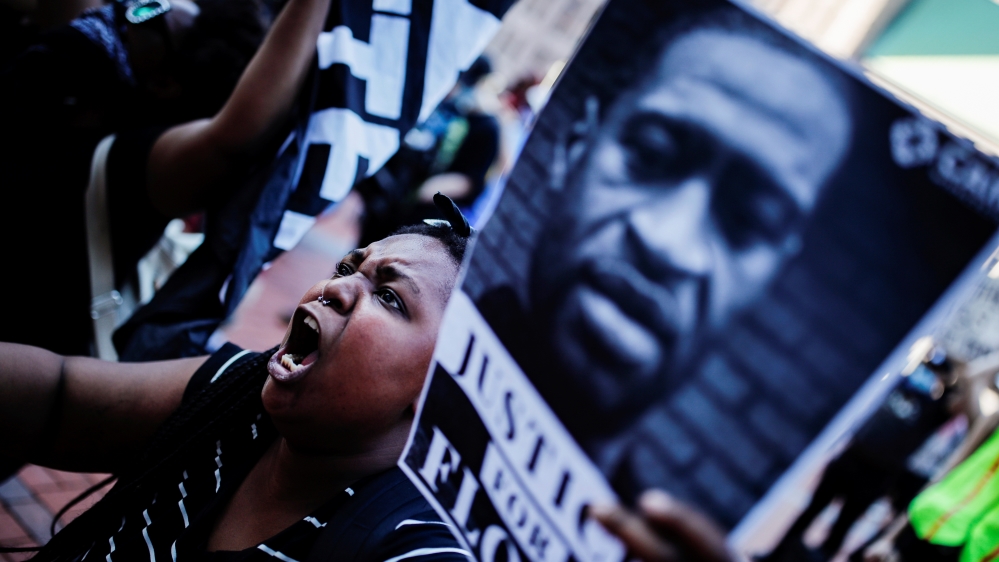
A protester reacts while gathering with others outside the city hall in Minneapolis

Angry protesters took to the streets over the treatment of minorities by law enforcement[Carlos Barria/Reuters]

White House demonstration

In Washington DC, police and secret service agents deployed in force around the White House before dozens of demonstrators gathered across the street in Lafayette Square.

President Donald Trump said early on Saturday that he had watched the protest from his window, and, if the demonstrators had breached the fence, “they would have been greeted with the most vicious dogs and most ominous weapons, I have ever seen.”

“That’s when people would have been really badly hurt, at least,” Trump wrote on Twitter. “Many Secret Service agents just waiting for action.”

Trump accused Washington DC Mayor Muriel Bowser of refusing to send police to help the US Secret Service, although the Washington Post reported that city officers did help control the later gathering.

The mayor’s office and the DC police did not immediately respond to requests for comment.

On Friday, Trump drew a warning from Twitter and condemnation from Democrats after posting a comment that “looting leads to shooting,” suggesting protesters who turned to looting could be fired upon.

Source link

Dominic Cummings row: senior health official says lockdown rules ‘apply to all’

England’s deputy chief medical officer has said that the lockdown rules “are clear and they have always been clear”, in the strongest condemnation yet by a senior health official of Dominic Cummings’ lockdown breach.

It comes as the government’s own science advisers broke cover over its decision to ease lockdown measures, with a growing number expressing concerns about plans for England from Monday.

As people flocked to beaches and beauty spots and temperatures soared over the weekend, Jonathan Van-Tam warned at the daily press briefing on Saturday that the country was at a “very dangerous moment” describing coronavirus as “a coiled spring ready to get out if we don’t stay on top of it”.

Van-Tam urged the public not to “tear the pants” out of government guidance, saying the country would have to move slowly out of the lockdown as fears grow that the warm weather and easing of restrictions could lead to a decline in compliance.


He urged the public to adhere to the latest guidelines, saying the virus could infect many more people, and warning that with the current R rate between 0.7 and 0.9 the country had to move slowly.

During the conference Van-Tam was asked to comment on the controversy surrounding Cummings, the government’s senior political aide, and whether he had breached the rules of the lockdown by travelling to see his family during the height of the pandemic in the UK. While the chief scientific officer, Patrick Vallance, said on Thursday that he did “not want to get involved in politics”, Van-Tam said he was “quite happy” to answer the question.

“In my opinion the rules are clear and they have always been clear,” he said. “In my opinion they are for the benefit of all. In my opinion they apply to all.”

Earlier in the day one of the government’s scientific advisers warned that the Cummings affair has eroded trust in its authority, while a growing number of other government advisers voiced unease over the decision to lift England’s lockdown, warning that loosening restrictions could easily lead to a second wave.

Prof Robert West, a member of the scientific pandemic influenza group on behaviours (SPI-B) that advises Sage (the Scientific Advisory Group for Emergencies), said the decision by Cummings to travel from London to Durham during the full lockdown would have an impact on people adhering to the latest rules.

The UCL scientist said: “Trust in authority telling you to do things is very important when it comes to people adhering to those rules. When people see something like the Cummings affair … that’s not a recipe for trust.”

R, or the ‘effective reproduction number’, is a way of rating a disease’s ability to spread. It’s the average number of people on to whom one infected person will pass the virus. For an R of anything above 1, an epidemic will grow exponentially. Anything below 1 and an outbreak will fizzle out – eventually.

At the start of the coronavirus pandemic, the estimated R for coronavirus was between 2 and 3 – higher than the value for seasonal flu, but lower than for measles. That means each person would pass it on to between two and three people on average, before either recovering or dying, and each of those people would pass it on to a further two to three others, causing the total number of cases to snowball over time.

The reproduction number is not fixed, though. It depends on the biology of the virus; people’s behaviour, such as social distancing; and a population’s immunity. A country may see regional variations in its R number, depending on local factors like population density and transport patterns.

Hannah Devlin Science correspondent

It came as the culture secretary Oliver Dowden announced that football, tennis, horseracing, Formula One, cricket, golf, rugby and snooker would start up again. Groups of up to six people from different households will be able to exercise together from Monday, while maintaining a distance of 2 metres, he said.

Billed as the recovery of British sport, the move will allow teams to play together and take part in conditioning and fitness sessions which do not involve physical contact.

“Today I am also glad to confirm that we are relaxing the rules on exercise further so that from Monday people will be able to exercise with up to five others from different households, crucially, so long as they remain two metres apart,” he said. “The British sporting recovery has begun.”

Dowden added that the government has published guidance to allow elite sport to resume behind closed doors, with guidelines on how to get athletes back into socially distanced training and then back into close-contact training.


‘Football is coming back’: competitive sport to return next week, says UK culture secretary – video

Boris Johnson has announced a gradual easing of the lockdown in England from Monday, when friends and relatives will be able to meet in parks and gardens in socially distanced groups of six.

“Happy Monday” will also signal the reopening of schools – allowing children in nurseries, early-years settings, reception, year 1 and year 6 to return to class – as well as more shops, with outdoor retail and car showrooms able to resume operations.

Van-Tam agreed that it was a “dangerous moment” and that scientists were right to urge caution but he added that scientific opinions always vary to some extent “across the piste”.

He went on to urge the public to continue to comply with the guidance saying that otherwise the virus could get out of control.

“Don’t see this as a curve that’s the same going up as it is down, it’s quite easy for it to go up, [but] it’s quite hard to get the brakes on to go back down,” he said.

“So I really hope that people will follow the advice that’s given to the letter, and not any further than that, to make sure we’re never in that position again.”

Source link

In Days of Discord, a President Fans the Flames

WASHINGTON — With a nation on edge, ravaged by disease, hammered by economic collapse, divided over lockdowns and even face masks and now convulsed once again by race, President Trump’s first instinct has been to look for someone to fight.

Over the last week, America reeled from 100,000 pandemic deaths, 40 million people out of work and cities in flames over a brutal police killing of a subdued black man. But Mr. Trump was on the attack against China, the World Health Organization, Big Tech, former President Barack Obama, a cable television host and the mayor of a riot-torn city.

As several cities erupted in street protests after the killing of George Floyd, some of them resulting in clashes with the police, Mr. Trump made no appeal for calm. Instead in a series of tweets and comments to reporters on Saturday, he blamed the unrest on Democrats, called on “Liberal Governors and Mayors” to get “MUCH tougher” on the crowds, threatened to intervened with “the unlimited power of our Military” and even summoned his own supporters to mount a counterdemonstration.

The turmoil came right to Mr. Trump’s doorstep on Friday night as hundreds of people protesting Mr. Floyd’s death and the president’s response gathered outside the White House. Some threw bricks and bottles at Secret Service and United States Park Police officers, who responded with pepper spray. The image of the White House surrounded by police in riot gear fueled the sense of a nation torn apart.

Mr. Trump praised the Secret Service for being “very cool” and “very professional” but assailed the Democratic mayor of Washington for not providing city police officers to help. While governors and mayors have urged restraint, Mr. Trump seemed more intent on taunting the protesters, bragging about the violence that would have met them had they tried to get onto White House grounds.

“Big crowd, professionally organized, but nobody came close to breaching the fence,” the president wrote on Twitter. “If they had they would have been greeted with the most vicious dogs, and most ominous weapons, I have ever seen. That’s when people would have been really badly hurt, at least. Many Secret Service agents just waiting for action.”

His suggestion that his own supporters should come to the White House on Saturday foreshadowed the possibility of a clash outside his own doors. “Tonight, I understand, is MAGA NIGHT AT THE WHITE HOUSE???” he wrote on Twitter, using the acronym for his first campaign slogan, “Make America Great Again.”

Asked about the tweet later, he denied encouraging violence by his supporters. “They love African-American people,” he said. “They love black people. MAGA loves the black people.”

Mayor Muriel E. Bowser of Washington responded in kind on Saturday morning, saying her police department will protect anyone in Washington, including the president, but called him a source of division. “While he hides behind his fence afraid/alone, I stand w/ people peacefully exercising their First Amendment Right after the murder of #GeorgeFloyd & hundreds of years of institutional racism,” she wrote. “There are no vicious dogs & ominous weapons. There is just a scared man. Afraid/alone …”

The days of discord have put the president’s leadership style on vivid display. From the start of his ascension to power, Mr. Trump has presented himself as someone who seeks conflict, not conciliation, a fighter, not a peacemaker. That appeals to a substantial portion of the public that sees in him a president willing to take on an entrenched and entitled establishment.

But the confluence of perilous health, economic and now racial crises has tested his approach and left him struggling to find his footing just months before an election in which polls currently show him behind.

“The president seems more out-of-touch and detached from the difficult reality the country is living than ever before,” said Carlos Curbelo, a former Republican congressman from Florida who has been critical of Mr. Trump. “At a moment when America desperately needs healing, the president is focused on petty personal battles with his perceived adversaries.”

Such a moment would challenge any president, of course. It has been a year of national trauma that started out feeling like another 1998 with impeachment, then another 1918 with a killer pandemic combined with another 1929 given the shattering economic fallout. Now add to that another 1968, a year of deep social unrest.

It is fair to say that 2020 has turned out to be a year that has frayed the fabric of American society with an accumulation of anguish that has whipsawed the country and its people. But in some ways, Mr. Trump has become a combatant on one side of the divide rather than a mender of it, a totem for the nation’s polarization.

“I am daily thinking about why and how a society unravels and what we can do to stop the process,” said Timothy Naftali, a presidential historian at New York University. “The calamity these days is about more than Trump. He is just the malicious con man who lives to exploit our vulnerabilities.”

As the nation has confronted a coronavirus pandemic at the same time as the greatest economic catastrophe since the Great Depression, whatever unified resolve that existed at the beginning of the twin crises quickly evaporated into yet another cultural clash. And the president has made everything into just another partisan dispute rather than a source of consensus, from when and how to reopen to whether to wear a mask in public.

Mr. Trump led no national mourning as the death toll from the coronavirus passed 100,000 beyond lowering the flags at the White House, posting a single tweet and offering a passing comment on camera only when asked about it. Rather than seek agreement on the best and safest way to reopen the country, he threatened to “override” governors who prevented places of worship from resuming crowded services.

“Crisis leadership demands much more from the White House than irresponsible threats on social media,” said Meena Bose, director of the Peter S. Kalikow Center for the Study of the American Presidency at Hofstra University.

Mr. Trump’s initial response to the rioting in Minneapolis, where a police officer has been charged with murder after kneeling on Mr. Floyd’s neck for nearly nine minutes as he cried out that he could not breathe, underscored the president’s most instinctive response to national challenges. Threatening to send in troops, he wrote early Friday morning that “when the looting starts, the shooting starts.”

Only after a cascade of criticism did he try to walk it back, posting a new tweet 13 hours later, suggesting that all he had meant was that “looting leads to shooting” by people in the street.

“I don’t want this to happen, and that’s what the expression put out last night means,” he said, a reformulation that convinced few if any of his critics.

Democrats have decried the president’s handling of the multiple crises confronting the nation. “America is reeling from 100,000 deaths and rising. Forty million have filed for unemployment. Our communities are hurting from senseless murders and years of racism and injustice,” Senator Chuck Schumer, Democrat of New York and the minority leader, said on Friday. “But President Trump is only interested in scapegoating and divisiveness when he should be leading.”

Even some of Mr. Trump’s usual allies were distressed at the original shooting tweet. Geraldo Rivera, the television and radio host who often spends time with Mr. Trump at the president’s Mar-a-Lago club in Florida, decried “the recklessness” of that message and called on the president “to self-censor himself.”

“Come on, what is this, sixth grade?” Mr. Rivera said on Fox News. “You don’t put gasoline on the fire. That’s not calming anybody.” He added: “All he does is diminish himself.”

But many of the president’s defenders rejected the idea that he had mishandled the crises, pressing the argument that Democrats and the news media were to blame for the turmoil in the streets, which spread from Minneapolis to New York, Atlanta, Washington, Louisville, Portland and other cities.

“Keep track of cities where hundreds of millions of dollars in property damage and serious injuries and death will take place,” Rudolph W. Giuliani, the former New York mayor who has served as Mr. Trump’s personal lawyer, wrote on Twitter on Friday night. “All Democrat dominated cities with criminal friendly policies. This is the future if you elect Democrats.”

Bernard B. Kerik, the former New York City police commissioner who was pardoned by Mr. Trump for tax fraud earlier this year, amplified the point on Twitter. “It should be no surprise that every one of these cities that the anarchist have taken over, are the same cities run by leftist Democrats with the highest violence, murder and poverty rates,” he wrote on Twitter. “They can’t handle their cities normally, so how are they going to deal with this?”

Mr. Trump, who this past week retweeted a video of a supporter saying that “the only good Democrat is a dead Democrat” (though the supporter insisted he meant that in a political sense), picked up the theme on Friday night and again on Saturday morning.

After crowds attacked CNN’s Atlanta headquarters with rocks, the president offered no sympathy or condemnation. Instead, he made clear he thought it was just deserts for a network that has aggravated him so much, retweeting a message that said: “In an ironic twist of fate, CNN HQ is being attacked by the very riots they promoted as noble & just.”


Source link

Hunting and game drives allowed as tourism sector opens up at level 3

Hunting and game drives are among the few leisure activities authorised to return under level 3 of the lockdown.

South Africa’s public and private game parks may open for self-drive excursions.

Hunting and game drives can resume

National Parks will begin reopening and welcoming back their staff of rangers and tour guides.

Hiking will also be allowed in National Parks under the terms of level 3 of the national lockdown as announced by the Minister of Tourism Mmamoloko Kubayi-Ngubane on Saturday 30 May.

“The past two months of lockdown have been difficult for the tourism sector,” Kubayi-Ngubane said.

“We continued to see many businesses in the sector fighting for survival, and our projections showed that almost 600,000 jobs were at risk if the sector doesn’t come into operation by September 2020. 

“This reality led to both government and private sector working together to be both innovative and putting protocol guidelines to get the sector back into operation.”

Leisure travel between provinces remains prohibited and while hotels and other accommodation are allowed to open without a permit, overnight stays for anything other than work are prohibited. 

Tourism sector allowed activity at level 3

Kubayi-Ngubane detailed how the sector would be opened up from 1 June.

  • Restaurants for delivery or collection of food. “Restaurants with liquor licences are allowed to sell alcohol only for takeout and delivery. In this area there’s been an outcry that they must be allowed for onsite consumption. We are in discussions with restaurants so that whatever solution is provided in this regard for sit-down doesn’t perpetuate the inequality and we are confident that in our next submission to NCCC this will be considered.”
  • Professional services – eg, tourist guides, tour operators, travel agents, tourism information officers will be allowed to come back to operations. Professional services, including the training of nature guides and other related services that are able to ensure safe distance will be allowed.
  • Public and private game farms will be allowed for self-drive excursions.
  • Hiking will be allowed in compliance with existing guidelines and not in groups.
  • Accommodation activities will be allowed, except for leisure. Establishments will no longer require a letter from minister to operate. They will be required to ensure that they accommodate those in permitted services and keep records for inspections by the department.
  • Hunting and gaming activities will also be allowed.

Prohibited activities

According to the minister the following economic activities would remain prohibited under level 3:

  • Conferences, events, entertainment activities (such as festivals) will still not be permitted. “It must be noted that some of the conference venues have been used in the fight against the pandemic and as such are allowed to be operational, including being used for distribution points of social relief measures.”
  • Casinos will still not be permitted.
  • Leisure travel will not be permitted.


Source link

George Floyd protesters in their own words: ‘We are human beings that want justice’

For many of the thousands of protesters in cities across the country, there seems to be one primary demand — justice for George Floyd’s death and an end to police brutality against African Americans.

“The injustice has been going on for so long,” said Ben Hubert, 26, who lives in the Minneapolis area. “It’s been swelling for years.”

“That could be my father; that could be my brother. That could be me,” one Atlanta protester, a black man, told NBC News of his thoughts when he saw the video of a Minneapolis police officer kneeling on Floyd’s neck as Floyd pleaded, “Please, please, please, I can’t breathe.”

“It just happened too many times,” the Atlanta protester said.

Floyd died in police custody Monday after he was pinned to the ground for over eight minutes. Derek Chauvin, the since-fired officer who knelt on his neck despite pleas from Floyd and onlookers, was arrested and charged Friday with third-degree murder and manslaughter. Three other officers were also involved in Floyd’s detainment.

Public officials around the country decried the violence and chaos that broke out at many demonstrations Friday night, with the Minnesota governor saying “wanton destruction” in his state came from people who live elsewhere. About 80 percent of the arrests in the Twin Cities on Friday night were of people from outside Minnesota, officials said.

The Minnesota governor said demonstrations that were peaceful earlier in the week, after video of Floyd’s death came out on Tuesday, have devolved and no longer have anything to do with Floyd or a demand for racial justice.

Protesters near Barclays Center following a rally over the death of George Floyd on May 29, 2020, in Brooklyn, N.Y.Frank Franklin II / AP

But not everyone in protests around the country appeared to engage in violence, and some who spoke to the media said their message is simple: “We are human beings that want justice for our people,” as one demonstrator in the nation’s capital told NBC Washington.

Another protester, Anzhane Laine, said that until Chauvin is convicted “there will no peace until we get justice.”

“I spent all day crying because it’s completely unfair,” Laine said. “We have yet another innocent man being killed by a police officer.”

Those who gathered outside the White House chanted, “Don’t shoot” and “Black lives matter.” Many people held up signs that read, “We stand together #BLM” and “We r not thugs,” in reference to President Donald Trump’s labeling protesters as “thugs” in a tweet early Friday.

Some demonstrations have turned violent and even deadly. In Atlanta, vehicles were set on fire and buildings, including the CNN Center, were vandalized during a Friday night protest. Police officers fired tear gas into the massive crowds as they tried to get people to leave.

In New York City, officers pepper-sprayed a crowd after a police vehicle was set on fire, and in Louisville, Kentucky, — where Breonna Taylor was shot and killed by officers executing a search warrant — seven people were shot during a Thursday night protest.

Circumstances of the Louisville shootings were not immediately clear, and police said officers were not involved.

In Detroit, a 19-year-old man was killed after someone in a van fired shots into a crowd of protesters. A police spokesperson said an officer was not involved. And a security officer with the Federal Protective Service of the Department of Homeland Security was killed in Oakland and another injured after someone in a vehicle opened fire around 9:45 p.m. on Friday, the FBI said.

Demonstrators said that despite tensions running high in some cities, they hope the message of why they are gathering does not get lost.

“It keeps happening. No matter what’s done, no matter how many protests it keeps happening,” an Atlanta protester told NBC News, adding, “It’s always been happening, but now it’s just recorded and getting seen more.”

Associated Press contributed.

Source link

‘Football is coming back’: competitive sport to return next week, says UK culture secretary – video

Competitive sport behind closed doors will restart in the UK from Monday at the earliest, Oliver Dowden, the secretary for digital, culture, media and sport, has announced, with horse racing set to return in the north-east of England next week.

The government has left it to each sport to decide when they will return, and has published guidance on how to get athletes back into physically distanced training before returning to close-contact training

Source link

Donors to expect temperature checks and health questionnaires as Trump looks to resume fundraising events: report

As President Donald Trump sets to resume in-person fundraising events in June after a months-long hiatus due to the coronavirus outbreak, donors can expect temperature checks and health questionnaires before entering events, according to a recent report from The Hill.

While he has pushed for the nation to begin reopening, the president has also begun making trips to swing states like Florida and Michigan to encourage his message.

Trump has said he wants to resume campaign rallies, but large gatherings have yet to be permitted by most states. The last in-person rally the campaign hosted was back on March 2 in Charlotte, North Carolina.

As the campaign tries to revive efforts for his reelection while following social distance guidelines, Trump’s upcoming events are expected to limit the number of attendees as well as enforce health checks and cleaning protocols at the event sites.

A campaign official confirmed to The Hill that Trump is scheduled to host two events on June 8 in Dallas and June 13 in New Jersey, each expecting about 25 people–the latter being an outdoor event at his golf course, Trump National Golf Club Bedminster.

Attendees will need to test negative for a coronavirus test on the day of the event in order to enter. They will also be required to complete a health questionnaire and pass a temperature screening, which will be conducted by the White House medical unit and Secret Service.

The White House declined Newsweek‘s request for comment.

The president’s fundraising committee, Trump Victory, is set to pay for the tests.

The New Jersey fundraiser will cost individual donors $250,000 each, while couples wanting to attend the event in Dallas will need to contribute $580,600.


President Donald Trump speaks to supporters during a reelection campaign rally on March 2, 2020 in Charlotte, North Carolina. The event was the last in-person rally Trump hosted before an abrupt months-long pause due to the coronavirus.
Brian Blanco/Stringer

The Republican National Committee (RNC) has also been pushing for their party’s convention in Charlotte, North Carolina to go on as planned in August. RNC chairwoman and the president of the convention committee, Marcia Lee Kelly, wrote to North Carolina Governor Roy Cooper earlier this week asking him to approve of safety measures for the event.

In his response, Cooper asked the RNC to elaborate on how they plan to implement their safety measures. He asked them detailed questions, including if testing would be limited to the first night of the convention or if they would extend into the rest of the four-day event.

He noted that “while North Carolina is now in Phase 2 of easing restrictions, this past week, we had our highest day of new lab confirmed COVID-19 cases in the state, and we have increasing numbers of people hospitalized with COVID-19.”

Cooper said in his statement on Friday that the state continues to support the hosting of the Republican National Convention if it can be done safely.

Newsweek reached out to the Trump campaign for comment but did not hear back before publication.

Source link

Tourism minister: R30m set aside for tour guides

The Department of Tourism has established an additional financial relief mechanism aimed at supporting tourist guides who are just some of the casualties in the sector, as a result of the nationwide lockdown.

Minister Mmamoloko Kubayi-Ngubane said the department had allocated R30m for the initiative over a period of two to three months.

The beneficiaries of the scheme will include tour guides who are registered with the registrar in terms of the Tourism Act as well as tour guides who are not employed by any company and freelancers and independent contractors without job security.

The scheme is only an addition to the R200m the department has channelled towards small businesses in the sector who risk going belly up as a result of the lockdown. The Tourism Relief Fund sparked a legal battle against government from Afriforum and Solidarity.

Both the lobby group and union had approached the courts, arguing that the BBBEE codes which have been cited as a requirement for businesses to qualify for the fund, were racist and discriminatory towards white-owned businesses.

“Tourism services supports other economic sectors. As parts of the economy opening up, the tourism activities that are supportive have to re-open. As some strategic sectors of the economy will need to operate during lockdown, such sectors will need tourism services, even before the sector is fully opened for leisure. This includes key elements that would facilitate travel of persons for permitted purposes”, Kubayi-Ngubane said.

The closing date for applications for the Fund is Sunday, 31 May 2020.

To date, more than 6 000 completed applications for grant assistance have been received from across the country.

Hotels and game reserves allowed to operate

The minister also announced that certain work and economic activities in the tourism sector could return under level 3 including travel agents and tourism information centres.

Game farms will also be permitted to reopen for self-drive excursions from Monday, however group tours are prohibited. Accommodation activities are allowed, except for leisure and establishments will no longer require a letter from the minister to operate. They are required to ensure that they accommodate those in the permitted services and keep records for inspections by the department. Hunting will also be permitted.

Hospitality, which forms part of the tourism sector, remains closed under level 3, with some conditions including restaurants. Under the new restrictions, restaurants can be open but only for collections, deliveries and drive-thrus. Sit-down services will remain prohibited.

Leisure travel, casinos, conferences, events and entertainment activities are still disallowed.


Source link

Cummings and Johnson evil geniuses? Hardly, we’re in the hands of the lazy and the incompetent | Nick Cohen

Foreigners can sometimes see a country with the greatest clarity. British politicians and journalists, who think themselves sophisticated, watched Dominic Cummings’ press conference in the Downing Street rose garden on Monday – along with countless citizens outraged by elite double standards. To my knowledge, only one viewer saw the trick Cummings was pulling. It wasn’t an opposition MP or hot-shot reporter but Jens Wiechers, a data protection consultant from Cologne.

Wiechers had the wit to do what the Cummingses of this world hate above all else: check. He found that, for all his inflated reputation, Cummings is nothing more than a sneaky little cheat.

The context of his charlatanism matters because it connects the Cummings-Johnson administration to the global attempt to delegitimise criticism. A section of the UK right is desperate to shift blame for this government’s inability to govern to “the media”. Online mobs hounded television reporters last week, as government loyalists rallied behind the banner of #scummedia.

Cummings gave them the marching orders. He wanted Tories to believe he was not a hypocrite who broke the lockdown his government instructed others to obey. Rather he was the victim of “numerous false stories in the media about my actions and statements regarding Covid”. Journalists, he continued, claimed he had opposed the lockdown and “did not care” about the mass deaths. Nothing could be further from the truth, the radical disrupter of the stodgy status quo explained. He possessed a prescience that bordered on the magical. He could prove he cared because as long ago as last year he “wrote about the possible threat of coronaviruses and the urgent need for planning”.

Viewers might have wondered why, if Cummings was warning about coronaviruses in 2019, his government had failed so abjectly to protect the British in 2020. You saw it coming, and still messed up? They might have thought twice before believing the man who gave us the outright falsehood that Brexit would deliver £350m to the NHS in the 2016 referendum campaign.

They didn’t doubt him because lies are so common in contemporary politics they blow past us like dust in the wind. No one checked, apart from Wiechers. “In retrospect, I could pretend I knew not to believe Cummings and Johnson,” he told me from Germany, where he watches British and American public life with a horrified fascination. “But I began by wondering what he had written on his blog last year.”

He found that Cummings had posted on 4 March 2019 on the dangers of the Sars coronavirus in a wider piece on pandemics. Or so he wanted us to believe. The post struck Wiechers as a lazy piece of writing filled with extracts from the work of others. The now suspicious Wiechers checked Cummings’ blog on the Wayback Machine, a digital library that tracks changes to billions of web pages. It showed Cummings had added the reference to coronaviruses between 9 April and 3 May 2020. Further research showed Cummings’ own site recorded that the post was edited at 8:55pm on 14 April precisely, the day Cummings told the public he had returned from his trip to Durham.

The man’s deviousness was breathtaking. His evidence that the media were running “false stories” against him was a false story. As striking was his ridiculous vanity: Cummings cared so neurotically about his reputation as a prophet that he forged the record so it appeared that he was warning of the “urgent need” to plan for a corona pandemic while the minds of lesser men and women were elsewhere.

The vanity is more than striking, it is essential to the right’s attempt to maintain its power. Supporters of strongmen do not want populist leaders who are “just like us”. They want to believe their heroes are smarter and better. The manufacture of the myth of exceptional talent is as important to the strongman as the ability to turn their voters against journalists, judges and any other independent group that might check them. Liberals should not laugh at Trump’s boast that he is a “very stable genius”. Trump has persuaded his core supporters to believe that he is a superman, who can master any problem and cut any deal, ever since he first ran for president.

Boris Johnson spent years showing off his superficial understanding of the classics by picking up Latin phrases from his well-thumbed dictionary of quotations and dropping them into his articles. A little learning was not a dangerous thing for him but a smart career move. It convinced conservative-inclined voters that Johnson had enjoyed the education of the old imperial ruling class and was not the lightweight he appeared to be. The fact that hardly any educated person studies Latin and Greek today made it easier for Johnson to bluff his way to the top when so few could see the vacuity behind the pose.

His administration has presided over thousands of needless deaths. It has never got on top of the virus. A terrible recession is all but upon us, and it’s likely that Tory zealotry will destroy the chance of a decent deal with the European Union that a broken country needs. Now more than ever, Johnson wants Conservatives to believe in the illusion of his talent.

Unlike Trump and Johnson, Cummings is not trying to fool the public but fool the fool who employs him – not the hardest of tasks, I grant you. He sinks to the level of the petty cheat because he must convince Johnson that he is a political mastermind.

Don’t be fooled as well. Too many liberals see Cummings as a manipulative demon with supernatural powers, when the most frightening thing about him, and Johnson, is their pathetic inability to control events. They are not evil geniuses but lazy, dogmatic and incompetent men, whose shabbiness is revealed as much by their little deceits as grand blunders. Don’t inflate them into monsters, who can never be beaten. Draw courage from their littleness. 

•Nick Cohen is an Observer columnist

Source link

What Top Conservatives Are Saying About George Floyd and Police Brutality

In her typical appearances on Fox News, Jeanine Pirro, a former Republican district attorney, reserves her highest dudgeon for castigating liberals and lamenting the demise of law and order.

But on Friday’s “Fox & Friends,” Ms. Pirro’s voice nearly broke as she described the agonizing final moments of George Floyd, the black man who died after a Minneapolis police officer ignored his pleas and pinned him to the ground during a routine stop.

“George Floyd was begging, saying he couldn’t breathe, saying please, please,” Ms. Pirro told viewers. “This man who put his knee on the neck of George Floyd does not deserve to be free in this country.”

Even right-wing stars like Rush Limbaugh hedged their assessments early on, as the officer’s lethal force drew more condemnation in some corners of the right than the ensuing riots and the burning of a police precinct. “I can’t find a way to justify it,’’ Mr. Limbaugh said of the officer’s actions.

The chilling circumstances of Mr. Floyd’s death — particularly the graphic, indisputable video of his arrest — have, at least for now, posed a political quandary among some conservative politicians, media stars and President Trump, whose usual instinct is to focus on blaming liberals for promoting lawlessness.

The ongoing protests in Minneapolis and around the country may still alter conservative views. On Fox News on Friday night, Tucker Carlson began his show with a graphic calling the Minnesota protesters “Criminal Mobs,” and wondered aloud why Republicans were not reacting more intensely against the violence in Minneapolis. Sean Hannity and Laura Ingraham condemned the demonstrators for, in Mr. Hannity’s words, “exploiting” Mr. Floyd’s death.

The law enforcement community is one of Mr. Trump’s most loyal constituencies, and he and his allies are in uncharted territory as they weigh expressions of solidarity with the nation’s police forces against grappling with the horror of Mr. Floyd’s death.

Initially, Mr. Trump issued a brutal law-and-order message early Friday morning, tweeting, “When the looting starts, the shooting starts.” His implication that protesters should be shot by law enforcement drew enormous blowback from Democratic leaders and other critics; some 14 hours later, he said his tweet had been misinterpreted, and later talked about the “good people” who were demonstrating in Mr. Floyd’s honor.

“They were protesting for the right reasons,” Mr. Trump told reporters at the White House on Friday evening, in relatively subdued remarks for a president best-known for bluster and vitriol. “They were protesting in honor of a man, George Floyd, where something happened that shouldn’t have happened.”

Aides to Mr. Trump said on Friday they saw little advantage in further inflaming a situation that had already turned violent across several cities. They were mindful, too, of avoiding any further alienation of African-American voters, ahead of an election where even marginal shifts in support could help him eke out a victory in November.

By Saturday morning, however, Mr. Trump had shifted tone again, writing in a tweet that any “protesters” — he put the word in quotes — who behaved out of line at the White House would face a “hard” response by Secret Service and “the most vicious dogs, and most ominous weapons, I have ever seen.”

Casting itself as the upholder of law-and-order has been a perennial Republican Party strategy in times of racial disharmony and social unrest, from the 1967 riots in Detroit and Newark to Ferguson, Mo., in 2014.

But the stark footage of a white police officer kneeling on the neck of Mr. Floyd as he pleaded and moaned “I can’t breathe” produced an unusual moment when those on either side of the nation’s split-screen politics were, publicly at least, evincing a common cause.

The moment may be fleeting.

In an appearance on Fox News on Friday evening, Senator Ted Cruz of Texas faced tough questions from Mr. Carlson — one of Mr. Trump’s favorite anchors — about why the senator was quick to denounce Mr. Floyd’s death as “a horrific act of police brutality.”

“In this instance, we have a video of the incident,” Mr. Cruz said. “What we saw was wrong.”

Mr. Carlson pushed back, asking Mr. Cruz if he believed it was fair to bring a murder charge against the officer who arrested Mr. Floyd.

“Why doesn’t anybody stand up for the rest of us, for civilization?” Mr. Carlson asked.

The exchange, between two pillars of the conservative establishment, threw into relief the tensions that had played out on cable TV and talk-radio this week.

On his syndicated radio show on Thursday, Mr. Limbaugh expressed dismay at the actions of the police. “Look, you people in law enforcement know I’m at the top of the list of people who support you and understand how hard your jobs are,” he told listeners. “I still — given all of that, do not … I cannot find a way to explain that. I can’t find a way to justify it. I don’t care what the guy did.”

But Mr. Limbaugh also mocked the Democratic mayor of Minneapolis, Jacob Frey, who had made a tearful plea for unity.

“This is a blue state where this happened; this is a state run by Democrats; this is a state run by leftists,” Mr. Limbaugh told listeners. “Don’t forget, these are the people who have been promising their African-American voters this stuff’s gonna stop for 50 years. They don’t fix anything.”

Senator John Kennedy, the Louisiana Republican, appearing on Fox News on Friday, called Mr. Floyd’s death a “murder,” but he also said “the people who are trying to burn down Minneapolis should be prosecuted to the full extent of the law.”

J. McCauley Brown, the Republican Party chairman in Kentucky, said in an interview that “it’s unfortunate there are some people who are getting violent.” But he called Mr. Floyd’s death “tragic,” adding, “I can understand totally why people are protesting.”

Among some conservatives, condemnation of the Minnesota police officers was often entwined with disdain for perennial targets of the right: big city Democratic politicians, the media, the Black Lives Matter movement and others who conservatives have blamed for helping stoke the violence. On Friday, the Drudge Report blared a headline in capital letters: “Unrest Spreads in U.S.A.”

The president’s campaign manager, Brad Parscale, seized on the backlash to Mr. Trump’s “looting” tweet to attack “the media, Joe Biden, and the Democrats,” ticking off a triumvirate of Republican boogeymen.

In a campaign statement, Mr. Parscale wrote that Minneapolis was “in chaos” and, without evidence, accused Democrats and the media of capitalizing on the tragedy as “a political opportunity and a chance to make money” — both offenses that Mr. Trump and Mr. Parscale himself are often accused of.

Donald Trump Jr., the president’s son, wrote on Twitter that “what happened to George Floyd was disgusting.” But he quickly added: “There’s never an excuse for the type of violent riots unfolding now. No American should ever have to watch their own community burn to the ground.”

For years now, some Republicans have sought to turn the issue of racial inequality and injustice to their political advantage. The president — who famously courted African-Americans to take a chance on him in 2016 by asking “What the hell do you have to lose?” — has long believed that he could appeal to black voters by blaming Democrats for chronic problems in predominantly black communities like poverty, crime and poor schools.

The president’s decision to call the Floyd family and express his condolences suggested that he did not view this episode as the kind of racially fraught cultural battlefront he would otherwise barrel into.

And with the nation on edge, the gravity of the situation had not been lost on Mr. Trump’s team. At a Friday morning meeting, two White House aides, Brook Rollins and Ja’Ron Smith, argued it would be tone-deaf for Mr. Trump to roll out new initiatives, even those related to the coronavirus, in the next few days that did not pertain to the fallout from Mr. Floyd’s death.

All that could change, especially if the situation continues to deteriorate in cities like Minneapolis, and if cable news — closely monitored by Mr. Trump — is filled with images of violence and carnage.

“Give it 24 or 48 hours,” Charlie Sykes, a longtime conservative radio star who now opposes Mr. Trump, said in an interview. “This is the president who ran as the law and order president. It is almost irresistible.”

Mr. Sykes said it was inevitable that the conservative media outrage machine would ramp up as the right-wing playbook reasserts itself, after the short-term caution in the aftermath of a horrific murder caught on tape.

Indeed, by Friday evening, Mr. Hannity was warning viewers about “radical rioters exploiting this death of Mr. Floyd, committing crimes, justifying crimes, threatening more violence.” To analyze the protests, Ms. Ingraham brought on a provocative guest: Mark Fuhrman, the former Los Angeles police detective infamous for his role in the O.J. Simpson murder trial.

For now, Republican officials continue to see two problems at hand, each of which they believe is serious and urgent. “I understand the protesters are frustrated and they want swift justice, and I feel that for them,” Laura Cox, Republican Party chairwoman in Michigan, said in an interview.

But, Ms. Cox added, “When it starts to be about breaking into police precincts, that’s problematic.”


Source link