Friday, April 17, 2026

George Floyd: Black man dies after US police pin him to ground

A Black man who yelled “I cannot breathe” as a white Minneapolis police officer pinned him down with his knee in the US state of Minnesota died late on Monday, police confirmed, drawing outrage from community members and leaders, and leading to the officers’ termination. 

Video of the incident shows the police officer pinning down George Floyd, believed to be in his 40s, to the pavement with his knee on the man’s neck for several minutes. Floyd was identified by prominent civil rights lawyer Ben Crump, who said he had been retained by the Floyd family. 

More:

Floyd can be heard saying in the video: “Please, please, I cannot breathe.”

The officer tells Floyd to “relax”.

Floyd responds: “I can’t breathe. Please, the knee in my neck.”

The officer continues to hold down Floyd with his knee for several minutes, with Floyd pleading and asking for water.

“My stomach hurts. My neck hurts. Please, please. I can’t breathe,” Floyd cries out, while moaning and trying to cough.

Floyd eventually appears motionless under the officer’s knee.

Those who were watching the incident unfold can be heard begging police to move off Floyd.

“He’s not f****** moving,” an onlooker can be heard saying. “Get off of his f****** neck.”

It is unclear what happened before and after the video was taken.

FBI to investigate

Minneapolis Police Chief Medaria Arradondo said during a news conference on Tuesday that the four officers involved in the incident were now “former employees”. 

The city’s mayor, Jacob Frey, confirmed that the officers had been terminated, saying “this is the right decision for our city”. 

In a statement earlier on Tuesday, the Minneapolis Police Department said its officers were responding to a “report of a forgery in progress”.

“After [the suspect] got out [of his car], he physically resisted officers,” the statement said. “Officers were able to get the suspect into handcuffs and note he appeared to be suffering medical distress.”

He was then transported to a nearby medical centre where he died a short time later, the department said.

The Minnesota Bureau of Criminal Apprehensive (BCA) said it was “investigating the circumstances surrounding an incident”.

It added that it was sharing information with the FBI, which “is conducting a separate federal civil rights investigation at the request of the Minneapolis Police Department.”

Arradondo has said he requested the FBI involvement after receiving additional information “from a community source”. He did not elaborate. 

The police officers involved in the incident were wearing body cameras, the Minneapolis police department said. The footage has not been made publicly available. 

‘Trauma on trauma’

Community members and leaders have expressed outrage over the incident, with many drawing comparisons to Eric Garner, an unarmed Black man who died in 2014 after being placed in a chokehold by New York City police and pleading: “I can’t breathe.” That incident sparked nationwide protests. 

“We all watched the horrific death of George Floyd on video as witnesses begged the police officer to take him to the police car and get off his neck,” Crump, the Floyd’s lawyer, said in a statement on Tuesday.

“This abusive, excessive and inhumane use of force cost the life of a man who was being detained by the police for questioning about a non-violent charge,” he added. “How many ‘while Black’ deaths will it take until the racial profiling and undervaluing of black lives by police finally ends?”

Nekima Levy Armstrong, a local lawyer and prominent activist, wrote on Facebook that this “is trauma on trauma on trauma”.

“We can’t escape police violence even in a global pandemic,” she added.

Minneapolis Mayor Frey called the incident “wrong on every level”.

“Being black in America should not be a death sentence,” he said in a Facebook post.

“This officer failed in the most basic, human sense,” he added. All I keep coming back to is this: this man should not have died … To our Black community, to the family: I’m so sorry.”

Others said that while the firing of the officers involved was a good first step, they should also be prosecuted. 

The actions of the officers involved are inexcusable and warrant swift consequences,” said Leslie Remond, the president, Minneapolis chapter of the National Association for the Advancement of Colored People (NAACP). 

“Their actions represent a dangerous precedent set forth by the racist, xenophobic, and prejudicial sentiment in our society against Black people. We witnessed a violation of our human rights, and we must hold all involved criminally accountable for the death of Mr Floyd,” she said in a statement.  

Hundreds of protesters rallied in Minneapolis later on Tuesday to express outrage and demand greater action. Organisers urged participants to wear masks and adhere to social distancing guidelines due to the coronavirus pandemic.

Protesters chanted “I can’t breathe” and “no justice, no peace” as they moved from the intersection where Monday’s incident occured to the police precinct where the officers involved worked. 

Video of the protests showed police using tear gas on demonstrators. Police said some protesters damaged police vehicles and a window of a precinct.  

String of police killings

Monday night’s incident comes on the heels of several cases of Black men and women being killed by police or former law enforcement across the US.

The FBI is investigating the police shooting death of Breonna Taylor in Louisville, Kentucky. Taylor, a Louisville emergency medical technician, was killed by police in the early hours of March 13 as she laid in her bed. Police said they were serving a warrant as part of a drug investigation when they returned fire from the apartment. Taylor’s boyfriend said he was firing in self-defence, believing his home was being broken into. No drugs were found in the apartment. One officer was injured.

The US Department of Justice is weighing possible hate crime charges in the US state of Georgia over the shooting death of Ahmaud Arbery, an unarmed Black man, and the police handling of the case.

Arbery was killed in February as he ran through a predominantly white neighbourhood in Glynn County, Georgia. The arrests of Gregory McMichael, a retired investigator for the local prosecutor’s office, and his son, both of whom are white, came more than two months after the incident and only after a video of the shooting went viral, raising questions about the handling of the case. Police have also since arrested the man who filmed the incident.

The Georgia Bureau of Investigation is also investigating the shooting death of Yassin Mohamed, a Sudanese American man, who was killed by police on May 9 after having “several altercations” with law enforcement in the 24 hours before his death. Police say they fired on Mohamed after he charged officers with a large rock. The Council on American-Islamic Relations in Georgia has condemned the incident and called for answers, including whether Mohamed was suffering from mental health issues.

According to the Washington Post Fatal Force database, more than 1,000 people have been shot and killed by police in the last year. According to the database, Black Americans are killed by police at a disproportionate rate. 

African American adults are nearly six times as likely to be imprisoned or jailed than white adults, according to the Sentencing Project watchdog group.

These racial disparities have given rise to Black Lives Matter, which was founded in 2013 and seeks to end police violence and build local power to intervene in violence inflicted on Black communities.


Source link

Our pandemic shopping habits are here to stay. Brands are racing to adapt

0

“We need to stay very close to consumers and their habits, needs and desires, more now than ever,” the company’s chief financial officer, Jon Moeller, said during an earnings call last month.

The early evidence suggests the shift to online buying is accelerating, consumers are buying more products for their health and home, and they are becoming increasingly cost conscious while choosing to save more.

On a call with analysts last month, Nestlé (NSRGY) CEO Mark Schneider said the company is “working overtime” to understand what the economic crisis means for each of its product categories. Nestlé is the world’s largest food and drinks company, making everything from breakfast cereals such as Cheerios, to Maggi instant noodles, Häagen-Dazs ice cream, Nescafé coffee and San Pellegrino water.

“To me that is super interesting work because clearly this is not going to be a quick recovery,” Schneider said. “This is going to be a several quarter, if not several year kind of process, where it is safe to expect some changed category dynamics.”

In an environment where nearly everything changed overnight, consumer goods companies need to figure out which new buying patterns are temporary, likely to end along with lockdowns or the arrival of a vaccine, and which will linger, reshaping the way consumers spend their money for years to come.

“We’re assessing market by market whether we need to make changes to our core products, prices and pack sizes,” said Hanneke Faber, president of foods and refreshment at Unilever (UL), which makes Lipton tea, Dove soap, Hellmann’s mayonnaise and Ben & Jerry’s ice cream.

There’s no “playbook” for this recession, she told CNN Business. “It will require us to be extremely agile and flexible for the foreseeable future.”

E-everything

While a lot is still unknown, it’s clear that some lifestyle changes and shifts in spending patterns are going to outlast social distancing measures. For example, some consumers opted to shop online because physical shops were closed or to avoid crowds, and now that they have made the leap, it’s unlikely that they will revert to their old ways entirely.
“Early lessons from China suggest that three to six percentage points of online market share will be “sticky,” driven by older generations newly comfortable with digital channels and by new consumer segments,” partners at consulting firm McKinsey wrote in a research paper.

Their research found that the three largest UK grocers added more than 500,000 new delivery slots in the space of a few weeks, an increase of more than 30%.

With so many consumers staying home, Nestlé has seen increased demand for Nescafé coffee during the pandemic.

Nestle’s e-commerce sales globally shot up 30% in the first three months of the year, while Procter & Gamble reported 35% growth in online sales over the same period.

The coronavirus crisis is likely to be a “breakthrough event” for online sales of food and beverages, as people who previously would not have bought groceries online discover how convenient it is, said Schneider, Nestle’s CEO.

E-commerce is unlikely stay at the very high level it is at now, but “we’ve reached a higher plateau to grow from,” said Jack Neele, a portfolio manager at Dutch financial services firm Robeco.

Health and hygiene

As with online shopping, health and wellness was a growing lifestyle trend well before the coronavirus hit, and it has only gained momentum during the pandemic. Consumers are wiping surfaces and washing their hands more than ever before, while sales of orange juice, considered beneficial to health because it’s high in vitamin C, have soared.

“We’re pretty confident that anything in the space of health and wellbeing is going to enjoy sustained strength,” Unilever CEO Alan Jope told analysts last month.

Unilever has seen higher sales of products such as Lipton Immune Support, as well as drinks that contain zinc and vitamin C, said Faber. The company is moving quickly to roll these out around the world, and health will remain a priority for product innovation, she added.

“We will serve what will likely become a forever altered health, hygiene and cleaning focus,” said Procter & Gamble’s Moeller, noting that US consumers are washing their clothes more frequently, adding up to more laundry loads per month.

Procter & Gamble has noted an increase in the number of weekly laundry loads in the United States.

Nesting at home

Even when lockdowns are lifted and restaurants, bars and cinemas reopen, there’s a sense that people won’t be in a hurry to go out again.

“There may be an increased focus on home: more time at home, more meals at home, more cleaning at home,” said Moeller.

With unemployment at sky high levels, many consumers will simply have smaller budgets for leisure. They may also decide to keep saving more money in order to weather the recession. Recent data from the Bank of England and European Central Bank show that household savings rates shot up in some of Europe’s biggest economies in March. The same was true in the United States, where savings rates jumped to their highest level since 1981.

For others who have spent time and money upgrading their homes and gardens, or have picked up new hobbies, the prospect of staying in is more appealing than it was before.

Streaming and pay TV: Bad economic times could make the battle for bucks much tougher

“Staying in is the new going out,” according to the McKinsey report. “Once restrictions are lifted, we expect consumers to continue spending more time at home, driven by a desire to save money, persistent safety concerns, and a new-found pleasure in nesting.”

The growth in online sales of bread machines in the United States was second only to disposable gloves in March, up 652% compared with a year earlier, according to data compiled by retail technology company Stackline. Online sales of weight training equipment (+307%), craft kits and projects (+117%), and table tennis tables (+89%) reflect that many consumers were finding new ways to keep themselves entertained at home.

In a nod to this trend, Nestlé USA last week launched a new range of health conscious ready meals. Faber, the Unilever executive, described the trend as “cocooning.”

Unilever estimates that 15% of restaurants that have gone bankrupt in China during the crisis will never reopen. This is likely to be repeated elsewhere if social distancing rules remain in place, with restaurant and bar owners saying their business models simply don’t work without volume and traffic.

Value and trust

The coronavirus recession is forecast to be the worst in several decades, meaning businesses and consumers will be cash-strapped for the foreseeable future.

Even in wealthy countries, value and affordability will be increasingly important, said Unilever’s Jope. He pointed to the company’s ability to offer products at the “incredible low price” it can in countries such as India as a “gigantic strength.”

“In Europe, we can count on stepped up negative pricing pressure as economies… go into the doldrums,” he said.

It's not just Amazon: Why the pandemic will make Aldi and Dollar General more dominant

In the same vein, Procter & Gamble said it is in a better position to weather the economic downturn because its portfolio is focused on daily use items. “We have never faced the level of unemployment that we’re like to see in this country [the United States] and potentially in others, and we don’t know how long that will occur for,” said Moeller.

There are already signs that consumers are trading down, favoring cheaper private label products to the benefit of retailers like Costco (COST), Walgreens (WBA) and CVS (CVS). Sales at discount stores, such as Dollar General (DG) and Aldi, are also enjoying a lift.

But, at least for now, Nestlé, Unilever and Procter & Gamble are confident that consumers will balance price against value, choosing the established brands that they are familiar with and experimenting less.

“People will go back to big, trusted brands,” said Unilever’s Faber. “They simply can’t afford to spend money on products they’re not sure of.”

Source link

Wikipedia’s Jimmy Wales On Fake News During The Pandemic

0

AsianScientist (May 28, 2020) – Besides the coronavirus, we are concurrently fighting another viral threat—fake news and misinformation. This ‘infodemic’ of misinformation ranges from conspiracy theories about the origins of the virus to unproven treatments that have caused fatalities.

Since the start of the year, Wikipedia has become the go-to source for COVID-19 medical and health information—it has had more than 100 million views on COVID-19 articles, safeguarded by a group of editors called Wikimedia Medicine, which has experience from past public-health scares such as the 2003 SARS outbreak.

Join Wildtype Media Group CEO Juliana Chan as she chats with Jimmy Wales, co-founder of Wikipedia and one of TIME Magazine’s “The 100 Most Influential People in the World.”

In this session, Jimmy will discuss the spread of fake news and misinformation during the pandemic, and the importance of digital literacy when consuming COVID-19 information.

Date:
Wednesday, June 3, 2020

Time:
9:00 am US Eastern Time
2:00 pm UK time
9:00 pm Singapore/Hong Kong Time

Please register here.

———

Copyright: Asian Scientist Magazine.
Disclaimer: This article does not necessarily reflect the views of AsianScientist or its staff.


Source link

Digital financial services could fast-track UN SDGs – The Mail & Guardian

COMMENT

The world is going through unprecedented challenges caused by a novel, rapidly transmitted coronavirus. Experts predict difficult times ahead with shrinking economies, loss of life and livelihoods and some structural changes — a new normal. 

Change is afoot in Africa as governments work tirelessly to identify their most vulnerable citizens for emergency disbursements. Banks, mobile money operators and Fintech firms are providing innovative solutions to meet their client needs and this may be a significant opportunity for lasting positive change. 

The increased adoption of digital financial services being observed could lead to the accelerated achievement of several United Nations Sustainable Development Goals (SDGs).

Access to financial services creates new possibilities. The efficiency gain improves business opportunities and alleviates poverty. The coronavirus outbreak is encouraging adoption of digital financial services and mobile money operators have made it easier for individuals to register. The pandemic, according to GSMA, may be a catalyst for high adoption of mobile money. 

Those individuals who previously did not have access to financial services are also getting included in the financial system and some African regulators are aiding the process. For example, Bank of Ghana recently relaxed mobile money KYC requirements by allowing all registered SIM holders to use existing mobile phone registration details to onboard digital financial services. 

It is feasible to conclude that financial inclusion rates may improve in a post-pandemic world. To be sure, there are other structural barriers such as access to data service, electricity and smartphones which limit adoption of digital financial services.

The crisis has spurred an increase in the use of digital payments. For example, in Nigeria there was a 34% increase in digital payments in March 2020 compared with the same period last year. The use of contactless payments have been recommended by the World Health Organisation warning that cash as banknotes may be spreading the coronavirus. Seeking to avoid the exchange of cash and close personal contact, more SMEs have adopted digital payments. 

In a post Covid-19 world, it is expected that the use of contactless payments will remain as entrepreneurs become accustomed to a new normal. The increased use of digital collection solutions creates a treasure trove of transaction data which may be analysed for lending decisions, giving small-scale enterprises access to affordable credit. 

According to Global Entrepreneurship Monitor, the highest rate for entrepreneurship for women is found in sub-Saharan Africa with 22% of females running businesses. Access to financing has long been a challenge faced by women entrepreneurs, however with the rapid adoption of mobile money and other digital financial services, alternative data such as airtime purchase patterns, social media posts and geospatial data are being used to assess eligibility for loans. Studies have found that more women get access to credit when alternative scoring models are used. 

Governments are also going digital, for example Togolese authorities are making monthly electronic payments to the country’s most vulnerable citizens affected by measures implemented to fight the virus outbreak. Named “Novissi” which means solidarity in the local dialect, Ewe, the initiative is a money transfer program in which eligible citizens receive funds from the government into digital wallets. This cash transfer helps the poor with their immediate needs but also may become the basis of programs to identify the most vulnerable. 

Cash-to-cash international remittances are expensive, a big contributor to the costs being the costs of moving and handling cash and maintaining an agent network. With advances in technology and the ubiquity of mobile devices, an end-to-end digital international funds transfer is now possible. 

According to a recent report from the World Bank, the cost of remittances to Africa remains the highest in the world at 8.9% and some of the most expensive remittances corridors are in Southern Africa with fees as high as 20%. Today there are several remittance apps serving African corridors including Mukuru, Rapidtransfer and WorldRemit with fees for transfers into bank accounts as low as 3%.

The lockdown of commercial hubs forced businesses to become innovative about how to serve customers through alternative channels. E-commerce companies delivering essential goods are experiencing a surge in demand and these shopping habits are likely to stay with consumers into the future. In South Africa, a recent Nielsen study on the impact of the lockdown on consumer behaviour found a sharp increase in South Africans shopping online with 37% of respondents stating that they were shopping more online. 

In Nigeria, restaurants accustomed to hosting corporate events and serving the well-heeled elite on their premises have quickly adopted delivery services to stay afloat. 

Daniel Maison, CEO of Kenyan e-commerce platform Sky.Garden, in an interview said that “basket sizes have increased as customers directing more of their spending power towards online shopping”.

The year 2030, the target year for achievement of UN SDGs, is just around the corner. In Africa, we have an opportunity to accelerate the attainment of some targets by rapid adoption of digital financial services leveraging technology for payments and collections. 

These will not necessarily outweigh the impact on health and education, for example, but progress in times of uncertainty is critical. The pandemic has caused many challenges but may also have presented some opportunities.

Osahon Akpata is the chief operating officer of Group Consumer Bank, Ecobank Transnational Incorporated


Source link

Donald Trump Must Clamp Down on China’s Interference in Hong Kong, Lawmaker Says

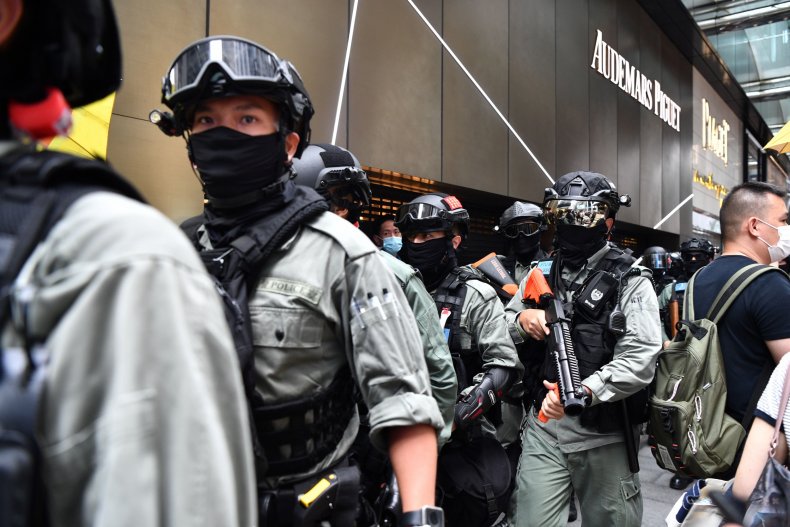
Thousands of police in Hong Kong were deployed to quell protests against a law criminalizing the ridicule of China’s national anthem as concerns grow that Beijing is tightening its control over the semi-autonomous territory.

Riot police gathered around the Legislative Council on Wednesday while the law had its second reading which, if passed, could mean a jail sentence and a fine of up to 50,000 Hong Kong dollars ($6,449) for anyone who misuses or insults China’s national anthem, the BBC reported. Officers fired pepper pellets and made around 300 arrests in several locations.

It comes only days after unrest was sparked by a national security law which China’s ruling Communist Party is seeking to impose. Critics fear the law could spell an end to the “one country, two systems” framework in place since the 1997 British transfer of Hong Kong’s sovereignty that gave it a high degree of autonomy.

Hong Kong’s Chief Executive Carrie Lam denies the security law will curtail the rights of Hong Kongers.


A man is detained by Hong Kong riot police in the Central district of downtown Hong Kong on May 27, 2020. Hong Kong’s legislature debated a law that bans insulting China’s national anthem.
ANTHONY WALLACE/Getty Images

One pro-democracy lawmaker in Hong Kong has said that pressure from the U.S. against China is key to their cause.

“Maybe if a decision from Donald Trump is made concerning sanctions or other measures against China, that may release some of the political pressure from the protesters’ side,” Eddie Chu Hoi-dick told Newsweek.

“Hong Kong people are not able to win this fight on our own and so we seek support from different countries of the world,” he said, adding, “the U.S. has held an interest in preserving Hong Kong’s status quo.”

“I think it is just a matter of time that something serious will happen and what that will do to the whole movement and international reaction to that is something that is not clear for now.

“There is always the danger it will become out of control as protests around the world are when they are violently suppressed by the government,” Hoi-dick said.

For his part, President Donald Trump hinted at action from the U.S. government when he was asked at a White House news briefing if he planned sanctions against China, saying on Tuesday, “We’re doing something now. I think you’ll find it very interesting.”

White House Press Secretary Kayleigh McEnany said Trump finds it hard to see “how Hong Kong can remain a financial hub if China takes over.”

Hong Kong protests
Hong Kong riot police in the Central district of downtown Hong Kong on May 27, 2020. Tension is growing over moves by Beijing to increase its control of the semi-autonomous city.
ANTHONY WALLACE/Getty Images

Opponents of the national anthem law have been fighting against it for more than a year and protesters have used its second reading as a chance to oppose the security law which would ban “treason, sedition, secession and subversion” and is expected to be rubber stamped by China’s National Party Congress (NPC).

Chu says both laws are “the two sides of the same coin” and are viewed as part of one overall move from Beijing to exert control.

“That struggle against this national anthem ordinance has triggered a chain reaction from Beijing and one of the results is the national security ordinance.”

The next flash point could be June 4, when commemorations are expected to be held around Hong Kong marking the anniversary of the 1989 Tiananmen Square massacre.

Kindling the tensions is the cancellation of an annual candlelight vigil in Victoria Park that attracts tens of thousands of people, but which has in effect been banned after authorities announced COVID-19 restrictions on mass gatherings, The Guardian reported.

Director of the British-based non-governmental organization, Hong Kong Watch, Johnny Patterson, said a worrying development was the actions that police have taken towards peaceful protesters.

“I think the police are increasing the cost of protesting for the moderates,” he told Newsweek.

“There will be a ramping up of protests but the police have been given a license to crack down on protesters so we don’t have the right to peaceful assembly in any meaningful way in Hong Kong at the moment. Whether or not protests are on the same scale as in the past remains to be seen.”