Tuesday, April 21, 2026

George Floyd protesters: No justice unless all four cops charged

Protesters in the United States city of Minneapolis welcomed Friday’s murder charge against the white officer who knelt on the neck of George Floyd, an unarmed black man, but demanded the three other officers involved be arrested as well.

“It’s an absolute outrage because it isn’t just one officer who is responsible for the murder of George Floyd,” said Ayaan Dahir, a Minneapolis resident and activist. “They all need to be arrested and charged.”

More:

Floyd died on Monday after policeman Derek Chauvin pinned him to the ground as he repeatedly pleaded: “I can’t breathe.”

An eight-minute video of the incident shows bystanders urging Chauvin to get off of Floyd, but the officer continues to pin him down even as he goes motionless.

Chauvin, who was fired after the incident, was arrested on Friday, more than three days after Floyd died. He was charged with third-degree murder and manslaughter.

“We have evidence, we have the citizen’s camera’s video, the horrible, horrific, terrible thing we have all seen over and over again, we have the officer’s body-worn camera, we have statements from some witnesses,” said Hennepin County Attorney Mike Freeman in announcing the charges.

A protester reacts while gathering with others outside the city hall in Minneapolis, Minnesota [Carlos Barria/Reuters]

Three other officers involved were fired but have not been charged, angering protesters and community leaders who have demanded all four officers be held accountable.

“The unfortunate situation here is that because police are involved,  the law protects them as well as the system,” said Jaylani Hussein, the director of the Minnesota chapter of Council on American-Islamic Relations.

“If they didn’t listen to George’s cries for help, they should have listened to the bystanders who were there witnessing this unfortunate situation,” Hussein told Al Jazeera. “All four need to be arrested and offered no bail.”

Protesters undeterred by curfew

The killing of Floyd has set off angry protests in Minneapolis and in major cities across the US.

Protesters in Minneapolis rallied on Friday night, despite a city-imposed curfew that began at 8pm (01:00 GMT).

Some protesters said they will continue to defy the curfew until all the officers involved in Floyd’s death are arrested, local media reported.

“They can’t arrest us all,” one protest leader was quoted as saying.

The Minnesota Freedom Fund, an organisation that pays bail for low-income individuals who are arrested, encouraged protesters planning to stay past curfew to write the group’s and partner group’s phone numbers on their arms in case of arrest.

Friday’s curfew, which will last until 6am (11:00 GMT) on Saturday and begin again later that night, was announced after three nights of protests rocked Minneapolis, with thousands taking to the streets to demand justice for Floyd and an end to police violence.

While the protests started peacefully, they descended into chaos, with fires and looting. Police have responded to protesters with tear gas and non-lethal projectiles. Protesters also say police have antagonised them even when they are marching peacefully. At one point a cable television crew was arrested – an incident for which authorities later apologised.
Minneapolis

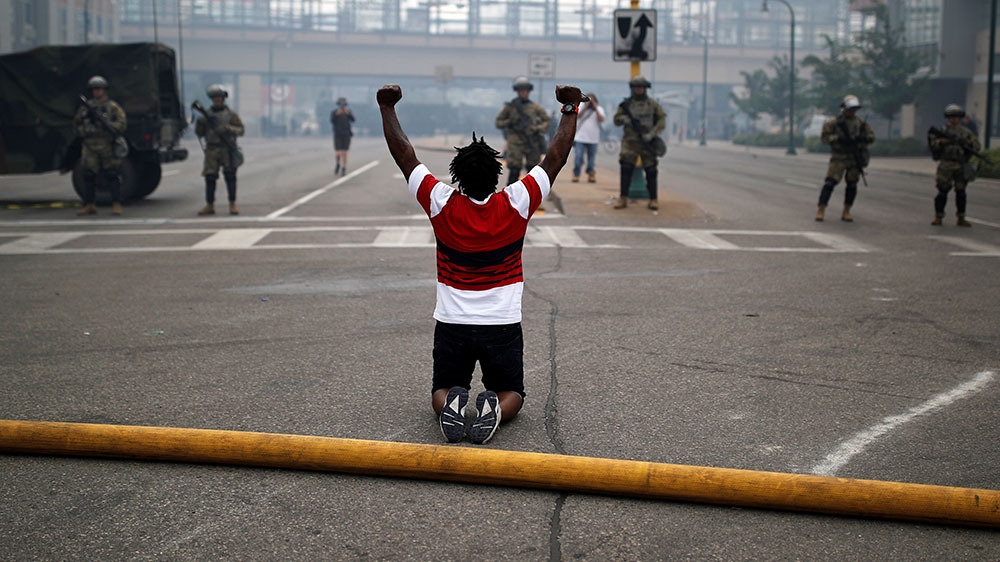
A man reacts as he confronts US National Guard members guarding an area of Minneapolis, Minnesota [Carlos Barria/Daylife]

On Thursday night, officers retreated from a police precinct as protesters overran the building, chanting, “no justice, no peace”. Some set fires in the building. Protesters rallied outside a different police building on Friday, a livestream by Unicorn Riot, an independent media organisation showed. 

“It’s very clear that there is a lot of anger, not just about the death of George Floyd, but all the people who have been killed by police,” Dahir told Al Jazeera.

Responding to the violence, Minnesota Governor Tim Walz declared a state of emergency and dispatched the National Guard to the city. National Guard members could be seen in Minneapolis and neighbouring Saint Paul by mid-Thursday.

In addition to charges brought against all the officers, protesters are also demanding a special prosecutor be named in the case, saying they do not trust Hennepin County Attorney Freeman and pointing to the fact it took more than three days for an arrest to be made.

“That arrest of the officer should have happened since day one. And everything that has happened since, I hold Mike Freeman directly responsible,” Dahir said.

“What’s been happening – this uprising, this rebellion – is something that organisers have been saying for years was going to happen eventually,” Dahir said. “This isn’t something that can be undone. It’s not an accident, it’s not a coincidence, it is something that has been brewing for a long time and this is the straw that broke the camel’s back.”

Source link

What Trump, Biden and Obama Said About the Death of George Floyd

You know, I just had an opportunity to speak with the Floyd family, a group of them, most of them. They’re a close, decent, honorable family, loving one another. And once again we heard the words, and they heard them, “I can’t breathe” — an act of brutality so elemental, it did more than deny one more black man in America his civil rights and his human rights. It denied him of his very humanity. It denied him of his life, depriving George Floyd as it deprived Eric Garner of one of the things every human being must be able to do: breathe. So simple, so basic, so brutal.

You know, the same thing happened with [Ahmaud] Arbery, the same thing happened with Breonna Taylor, the same thing with George Floyd. We’ve spoken their names aloud. We’ve cried them out in pain and in horror. We’ve chiseled them into long-suffering hearts. They’re the latest additions to the endless list of stolen potential wiped out unnecessarily. You know, it’s a list that dates back more than 400 years. Black men, black women, black children.

The original sin of this country still stains our nation today, and sometimes we manage to overlook it. We just push forward with the thousand other tasks in our daily life, but it’s always there, and weeks like this, we see it plainly that we’re a country with an open wound. None of us can turn away. None of us can be silent. None of us can any longer, can we hear the words “I can’t breathe” and do nothing. We can’t fail victims, like what Martin Luther King called “the appalling silence of good people.”

Every day, African-Americans go about their lives with constant anxiety and trauma, wondering who will be next. Imagine if every time your husband or son, wife or daughter left the house, you feared for their safety from bad actors and bad police. Imagine if you had to have that talk with your child about not asserting your rights, taking the abuse handed out to them so, just so they can make it home. Imagine having police called on you just for sitting in Starbucks or renting an Airbnb or watching birds. This is the norm black people in this country deal with. They don’t have to imagine it. The anger and frustration and the exhaustion is undeniable.

But that’s not the promise of America. It’s long past time that we made the promise of this nation real for all people. You know, this is no time for incendiary tweets. It’s no time to encourage violence. This is a national crisis, and we need real leadership right now. Leadership that will bring everyone to the table so we can take measures to root out systemic racism. It’s time for us to take a hard look at the uncomfortable truths. It’s time for us to face that deep open wound we have in this nation.

We need justice for George Floyd. We need real police reform to hold cops to a higher standard that so many of them actually meet, that holds bad cops accountable and repairs relationships between law enforcement and the community they’re sworn to protect. We need to stand up as a nation with the black community, with all minority communities, and come together as one America.

That’s the challenge we face. You know, it’s going to require those of us who sit in some position of influence to finally deal with the abuse of power. The pain is too immense for one community to bear alone. I believe it’s the duty of every American to grapple with it, and to grapple with it now. With our complacency, our silence, we are complicit in perpetuating these cycles of violence.

Nothing about this will be easy or comfortable, but if we simply allow this wound to scab over once more without treating the underlying injury, we’ll never truly heal. The very soul of America is at stake. We must commit as a nation to pursue justice with every ounce of our being. We have to pursue it with real urgency. We’ve got to make real the promise of America, which we’ve never fully grasped: that all men and women are equal, not only in creation but throughout their lives.

Again, George’s family, thanks for taking the time to talk to me. I promise you, I promise you, we’ll do everything in our power to see to it that justice is had in your brother, your cousin’s case. I love you all, and folks, we’ve got to stand up. We’ve got to move. We’ve got to change.

I want to share parts of the conversations I’ve had with friends over the past couple days about the footage of George Floyd dying face-down on the street under the knee of a police officer in Minnesota.

The first is an email from a middle-aged African-American businessman.

“Dude I gotta tell you the George Floyd incident in Minnesota hurt. I cried when I saw that video. It broke me down. The ‘knee on the neck’ is a metaphor for how the system so cavalierly holds black folks down, ignoring the cries for help. People don’t care. Truly tragic.”

Another friend of mine used the powerful song that went viral from 12-year-old Keedron Bryant to describe the frustrations he was feeling.

The circumstances of my friend and Keedron may be different, but their anguish is the same. It’s shared by me and millions of others.

It’s natural to wish for life “to just get back to normal” as a pandemic and economic crisis upend everything around us. But we have to remember that for millions of Americans, being treated differently on account of race is tragically, painfully, maddeningly “normal” — whether it’s while dealing with the health care system, or interacting with the criminal justice system, or jogging down the street, or just watching birds in a park.

This shouldn’t be “normal” in 2020 America. It can’t be “normal.” If we want our children to grow up in a nation that lives up to its highest ideals, we can and must be better.

It will fall mainly on the officials of Minnesota to ensure that the circumstances surrounding George Floyd’s death are investigated thoroughly and that justice is ultimately done. But it falls on all of us, regardless of our race or station — including the majority of men and women in law enforcement who take pride in doing their tough job the right way, every day — to work together to create a “new normal” in which the legacy of bigotry and unequal treatment no longer infects our institutions or our hearts.

Source link

Reports: Children among the dead after Syrian rebels clash in Turkish-held Afrin

May 29, 2020

Fighting among Turkey-backed Syrian rebel groups in the Turkish-controlled city of Afrin in northern Syria left several civilians dead Thursday, including two children, according to war monitors. 

Fierce clashes between the Hamzat Division and the Ahrar al-Sham and Jaish al-Islam factions erupted Thursday, said the UK-based Syrian Observatory for Human Rights. Three civilians, including two children, were killed in the gunfire, the monitoring group said. 

Elizabeth Tsurkov, a fellow in the Middle East Program at the Foreign Policy Research Institute, wrote on Twitter that the fighting started after a group of fighters from the Hamzat Division walked into a shop run by a man displaced from Syria’s southwestern Ghouta region. 

“They asked to purchase something for 300 lira [$0.16] on credit. The owner of the shop refused. In response, the Hamzat shot up the place & tossed a grenade, killing the shop owner and his son,” she wrote. 

Afrin has been in the hands of Syrian fighters trained and equipped by Turkey since March 2018, when the Free Syrian Army captured the city from the Kurdish People’s Protection Units (YPG) militia, which Turkey considers an offshoot of the banned Kurdistan Workers Party. 

Human rights groups have since documented the wide-scale persecution of locals by Turkish proxies, including forced conversions among the Yazidi religious minority. 

“The current situation for Yazidis remaining in the Afrin is dire as they are forced to hide their identity, unable to practice their faith, and remain frightened for their safety,” the Yazidi advocacy group Yazda said in a statement today. 

Yazidi activist and Nobel laureate Nadia Murad accused Turkey and its affiliated rebel groups of an ethnic cleansing campaign in Afrin. 

“They are kidnapping women, killing civilians, and destroying houses and shrines,” she said on Twitter. “To date, the international community has failed to bring attention to these crimes.” 

Turkey denies war crimes were committed by its proxies. 

Afrin was also the site of a deadly truck bombing last month. The YPG denied responsibility after Turkey accused the militia of carrying out the attack that killed more than 50 people.


Source link

Tension escalates into violence in fiery Atlanta rally

For a fourth day, Americans took to the streets to decry the death of George Floyd, whose demise in the custody of Minneapolis police Monday was captured on video.

Protesters set a police car on fire, struck officers with bottles, vandalized the headquarters of CNN, and broke into a restaurant in downtown Atlanta as a demonstration that started peacefully quickly changed tone Friday evening.

An Atlanta Police car burns as people protest in Atlanta, Georgia on May 29, 2020.Dustin Chambers / Reuters

Some used barricades to break police vehicle windshields and jumped from car to car. Hundreds of the protesters confronted police outside CNN headquarters. They spray-painted the large, iconic CNN logo outside the building, breaking a windowed entrance. One protester climbed on top of the sign and waved a “Black Lives Matter” flag to cheers from the crowd.

Some demonstrators pelted officers who came over with bottles, striking some of them. Other bottles thrown at authorities exploded behind the police line, but no officers appeared to get hit. Protesters chanted, “Quit your jobs.”

CNN broadcast scenes from the building’s lobby where law enforcement had been positioned. At one point, some small explosions that appeared to be firecrackers thrown by protestors into the building pushed CNN’s Nick Valencia to retreat farther into the building.

At least nine police vehicles were damaged during a demonstration there, according to NBC affiliate WXIA. As fires burned at multiple places in the city, the College Football Hall of Fame was vandalized, according to the station.

Atlanta Mayor Keisha Lance Bottoms delivered an impassioned address to demonstrators, urging them not to burn down a city with a deep legacy of African American advancement.

“This city that has had a legacy of black mayors and black police chiefs,” Bottoms said. “if you care about this city then go home. This won’t change anything.”

“We are better than this,” she said.

The crowd also spoke out against the deaths of Ahmaud Arbery, fatally shot while he was jogging, and Breonna Taylor, killed by police during a raid of her home.

In Washington, D.C., the White House was put on lockdown as demonstrators gathered at nearby Lafayette Square. Some buildings in the area were tagged with graffiti.

In the New York City borough of Brooklyn a police ban was burned as a crowd surrounded it, according to NBC New York. Multiple people were arrested across the city.

In Los Angeles, demonstrators gathered near City Hall and in South L.A. Demonstrators appeared to attack a police officer who able to get away, according to video broadcast by NBC Los Angeles.

Protesters later blocked one the 110 freeway downtown.

Hundreds of people marched on the Las Vegas Strip and chanted, “No justice, no peace!” and “Black lives matter,” NBC affiliate KSNV reported.

In Charlotte, North Carolina, scheduled to host the Republican National Convention in August, multiple arrests have been made amid demonstrations, NBC affiliate WCNC reported.

Demonstrations were also expected to take place in Boston, Chicago, Dallas, Denver, Houston, Louisville, Kentucky, Milwaukee, Wisconsin, and Oakland, California.

In Minneapolis, where a third night of demonstrations erupted into riots Thursday night, protesters returned to the streets and blocked interstate 35W, according to NBC affiliate KARE.

Floyd, 46, was killed after Officer Derek Chauvin put his knee on his neck for more than 8 1/2 minutes after police were called to a report of counterfeit money used at a market.

Chauvin was arrested and charged with murder Friday. He faces charges of third-degree murder and manslaughter, Hennepin County Attorney Mike Freeman announced.

The Associated Press and Jason Abbruzzese contributed.


Source link

‘Facing the Darkest Hour’: Hong Kong’s Protest Movement in Crisis

0

HONG KONG — Protesters have deleted their social media accounts, afraid that their messages could be used against them under China’s new national security laws. Young parents have scoured the internet for instructions on emigration. Organizers have planned rallies, only to cancel them at the last minute in the face of impenetrable police blockades.

Hong Kong’s protest movement — which last year cowed the local government and humiliated the authorities in Beijing who direct it — is in crisis. The tactics that had pushed officials to retreat at times are suddenly inadequate against an aggressive police force, fear of the coronavirus and a Chinese Communist Party that has run out of patience. Many protesters feel they have exhausted their options.

“It’s the beginning of the end,” said Michael Mo, a protest organizer and local official.

The Chinese government’s plan to impose security laws on Hong Kong that could curtail the city’s civil liberties has left the freewheeling and decentralized opposition movement seeking not only a next move, but a new vision.

Its campaign for democracy was always a long shot, targeting a local government whose leadership is only accountable to Beijing. But China’s direct intervention has made the challenges even more explicit, forcing a more fundamental reckoning about how to fight back, what the goal is — and whether it is even worth it to try.

Further complicating their calculus, the protesters, a jumble of students, teachers, politicians and activists, find themselves at the center of a fight between China and the United States. China’s leader, Xi Jinping, sees the security push as necessary to protect the country’s sovereignty, while President Trump has cast it as an encroachment on civil liberties, moving on Friday to strip away some of Hong Kong’s privileges with the United States.

Some protesters say they will continue to march, futile though it may be, while others who had thrown Molotov cocktails say they now prefer boycotts or strikes. Some want to preserve Hong Kong’s relative autonomy from China, while others have joined the once-taboo call for outright independence.

Many are pinning their hopes on the United States’ pressure on China, but others fear they will become pawns in their rivalry.

What binds many of the protesters together, more than anything, is weariness and dread.

Their demands for universal suffrage — which would allow for direct elections of Hong Kong’s chief executive and all lawmakers — and for a more accountable police force remain unmet, despite months of demonstrations. Now that Beijing has escalated the fight, many protesters realize that they may not be able to do the same.

“We tried almost everything we could think of last year,” said Alex Tang, 32, a labor organizer. “Maybe we will come up with something better later. But in this moment, the people just feel tired.”

The movement’s wounded condition has been most evident in the place where it first showed its strength: the streets.

Protests against the national security laws in the past week drew thousands, demonstrating that months of pandemic-induced stasis had not dampened their anger. But the turnout fell far short of the hundreds of thousands — and at times, more than a million — who attended some of last year’s marches.

Many demonstrators have been deterred by the police’s increasingly forceful response. Last year, peaceful protesters were given wide latitude, and when clashes erupted, they raged for hours. Protesters lobbed bricks and gasoline bombs, while officers responded with tear gas and rubber bullets.

Now, swarms of anti-riot officers, under the command of a new police chief appointed by Beijing, scatter even peaceful demonstrators with water cannons and pepper spray from the outset. On Wednesday, protesters called off a rally at the legislature after hundreds of police officers preemptively surrounded the complex.

When the protesters poured into the streets instead, the police detained them en masse, in some cases within an hour. More than 360 were arrested on Wednesday on top of 180 earlier in the week.

Organizers have acknowledged that for some, the cost of protesting may now be too high.

“My gut feeling is that it might let really peaceful protesters, average Joes, stay at home instead,” Mr. Mo said of the pending security laws. “They are afraid of being arrested, harassed by police.”

Google searches for the word “immigration” in Hong Kong spiked after the national security announcement, an indication that some residents may be searching for an exit strategy. So many protesters, fearing future arrests, deleted their accounts on Telegram, a messaging app that others began urging people to stay online.

“If you are timid, you will lose your whole life,” a widely circulated message said. “Only if you bravely face everything will there be a turning point.”

But the alternatives to street protests seem increasingly risky.

Activists suggested that labor unions and boycotts of pro-Beijing businesses could offer new avenues for resistance. That approach had worked in August, when large numbers of air traffic controllers called in sick, forcing the cancellation of more than 200 flights.

In February, even as the coronavirus made large gatherings impossible, a medical workers’ strike helped force the government to close parts of the border with the mainland.

Some protesters fear that the security laws, which will be sweeping in scope, could target unions and nongovernmental organizations, many of which formed out of last year’s protests.

The language of the security plan, which China’s legislature approved on Thursday, is broad: China could impose laws punishing any “acts and activities” that threaten national security, according to state media. The Global Times, a state-run tabloid, suggested that tweets critical of Beijing could run afoul of the rules.

Officials in Hong Kong and Beijing have dismissed fears of overreach, promising to uphold Hong Kong’s relative autonomy. But on the mainland, the party has accused church leaders, union leaders and other organizers of undermining state security.

Timing is also not on the unions’ side. The pandemic has further battered Hong Kong’s economy, and some workers are reluctant to strike when unemployment is high, said Mr. Tang, the labor organizer, whose union of information technology workers is one of the newly formed groups.

That could change if the global recession, on top of a crackdown, worsens the deep income inequalities fueling many young protesters who feel that they have little to lose.

“If you just give them some time, and the environment is getting worse, they may just say, ‘Screw it. I’ll go out anyway,’” Mr. Tang said.

In perhaps the clearest sign of how Beijing’s latest move has forced many protesters to reassess their strategy, calls for independence for Hong Kong — once a fringe idea — have become common at recent demonstrations.

Historically, most democracy supporters had dismissed the idea of independence as impractical and needlessly divisive, pointing to Hong Kong’s cultural and economic ties with China. They pushed instead to preserve the city’s high degree of autonomy enshrined in the “one country, two systems” political formula enacted in 1997 after Britain returned Hong Kong to China.

But activists said the new push by Beijing proved that the status quo was untenable, and that it had jolted awake protesters who thought they could work within the system.

“Maybe they still had some hope in the coming election, or they still had some optimistic expectation in the future of the movement,” said Ventus Lau, 26, a prominent organizer who identifies as a member of the protests’ “radical” wing, referring to legislative elections in September.

The brazenness of the security laws, which bypassed Hong Kong’s government, was “a very good reminder” for those people, he continued.

“We’re already facing the darkest hour,” Mr. Lau said. “And we will continue to fight.”

Still, independence remains a deeply fraught, risky topic. Beijing has said that the national security laws would target secession. Candidates for elected office can be disqualified for supporting independence.

Several protesters who have joined the recent pro-independence chants said the calls were largely symbolic.

“When I call for independence, I am simply expressing a wish for the things I am supposed to have,” such as human rights and free expression, said Win Kwan, a 50-year-old clerk at Sunday’s protest. “We keep coming out to marches and protests, but it seems like we hadn’t gotten anything.”

Many protesters’ true hope, they said, rested with the international community, as they no longer believed that Hong Kongers’ own actions would have any effect on Beijing. In addition to appealing to the United States and Britain, other protesters have lobbied the United Nations and European Union to condemn the Communist Party.

Many protesters welcomed the United States’ move this week announcing that it no longer saw Hong Kong as significantly autonomous from China — a designation that, though intended to punish the mainland, would also jeopardize the city’s position as a global commercial hub. Mr. Trump moved forward on Friday with plans to revoke the city’s special status with the United States, as well as to sanction Chinese and Hong Kong officials seen as responsible for the erosion of freedoms in the semiautonomous region.

It is unlikely that such moves would sway the party. Beijing sees many of the city’s activists as colluding with hostile foreign forces bent on using Hong Kong to infiltrate the mainland — a threat that the security laws expressly seek to quash.

The protesters know they are in for a long fight.

“Just because we might not see the results in our lifetime doesn’t mean that our efforts would disappear,” said Alice Chan, a 35-year-old high school teacher who attended Sunday’s protest. “Everything we do now is building the foundation for the generations to come.”

Elaine Yu contributed reporting.


Source link

ON THIS DAY IN HISTORY: Joan of Arc burned at the stake in the Hundreds’ Year War

TODAY IN HISTORY: Joan of Arc burned at the stake in the Hundreds' Year War

Source by [author_name]

A Justice Dept. Skeptical of Police Abuse Cases Vows to Investigate Floyd Death

WASHINGTON — Attorney General William P. Barr on Friday labeled the images of the death of George Floyd, a black man in Minneapolis whom a white police officer knelt on for nearly nine minutes, as “harrowing” and “deeply disturbing” and vowed that the federal investigation into his death would proceed quickly.

“I am confident justice will be served,” Mr. Barr said in a statement as protesters across the country condemned the actions of the officer, Derek Chauvin, who was charged Friday by the local authorities with third-degree murder and manslaughter.

But the Trump administration’s years of inaction on police violence and President Trump’s embrace of law enforcement have made civil rights advocates wary of the Justice Department’s involvement in the Floyd case. The administration has largely dismantled police oversight efforts, curbing the use of federal consent decrees to overhaul local police departments. Mr. Barr has said that communities that criticize law enforcement may not deserve police protection, and Mr. Trump has encouraged officers not to be “too nice” in handling suspects.

Advocates for police overhaul said in interviews on Friday that they were in a difficult position: After denouncing the federal government’s retreat from police accountability — and civil rights enforcement more broadly — they are now wary of its intentions.

“Our confidence in a federal intervention in cases like this is wholly dependent on the track record of the administration that is stepping in,” said Derrick Johnson, the president of the N.A.A.C.P. “This administration lacks credibility when it comes to addressing issues of justice, fairness and race.”

Mr. Barr said that any federal charges would be “based on the law and facts,” and that they would not come until after local charging decisions.

To bring federal civil rights charges in the Floyd case, prosecutors have to meet a difficult bar: proving that Mr. Chauvin intended to violate Mr. Floyd’s civil rights and acted on that wish, Mr. Johnson said. Prosecutors are often reluctant to bring such cases because they are so difficult to win.

“We are confronted with the stark reality this family may not see justice, even with the prevailing evidence in broad daylight from multiple camera views that there was no resisting, no physical provocation, that he was subdued and cuffed, that he said he can’t breathe, and that blood was coming out of his mouth,” Mr. Johnson said.

Mr. Barr’s announcement suggested no broader investigation into possible abuses in the Minneapolis Police Department, a move that local activists have demanded. Congressional Democrats also asked the Justice Department this week to open an investigation into the police. The city has a history of accusations of police abuse, and in 2017, an officer in a Minneapolis suburb was found not guilty of manslaughter in the death of Philando Castile, a black motorist.

Under President Barack Obama, the Justice Department aggressively sought to combat excessive use of force by the police. The department and local police departments signed 14 consent decrees, court-enforced agreements detailing remedies like additional police training or data collection.

The Justice Department under Mr. Obama most likely “would have looked at Minneapolis given the pattern of problems that were apparent,” said Jonathan Smith, a former department official who negotiated several of the decrees.

Justice Department findings typically prompted the consent agreements. Police in Ferguson, Mo., where the fatal shooting in 2014 of an unarmed black teenager by a white officer set off a national debate over the use of police force, fined and arrested African-Americans in part to balance the city’s budget, the department found. It concluded that the Baltimore police were more concerned with accumulating statistics than reducing violent crime.

Mr. Trump’s first attorney general, Jeff Sessions, moved to rein Justice Department efforts to investigate patterns of allegations of misconduct by the local police.

The department under Mr. Trump has entered into consent decrees with the police in Ville Platte and the sheriff’s office in Evangeline Parish, La., based on an investigation opened in 2015, and opened a so-called pattern-and-practice investigation into the police in Springfield, Mass. It has also pursued abuses in prison systems in Alabama and New Jersey.

But critics said that the department’s overall approach did little to address allegations of police misconduct.

“They’ve just really been dismissive about the fact that police abuse happens, and the fact that it’s a problem the federal government can and should do something about,” said Christy E. Lopez, a former deputy chief in the special litigation section of the civil rights division during the Obama administration.

She pointed to comments that Mr. Trump made in 2017 to the police on Long Island, suggesting that they should not protect the heads of suspects ushered into police cars. At the time, police departments around the country distanced themselves from the president’s position.

“It’s been the tenor of this entire administration and of the D.O.J.,” Ms. Lopez said. “That absolutely sends a message to police officers on the street.”

Mr. Sessions repeatedly argued that criticism of the police or excessive oversight could damage the morale of officers, harming their ability to control crime. Mr. Barr, in his own public comments, has stressed that abuses reflect “bad apples” more than systemic breakdowns.

Minority communities have long criticized Mr. Barr’s full-throated support of law enforcement, beginning with his first stint as attorney general under President George Bush, when he advocated on behalf of maximum sentencing laws that laid the groundwork for high rates of incarceration among black people.

Civil rights groups, including the N.A.A.C.P., opposed his confirmation last year. During his confirmation hearing, Mr. Barr defended his record but said that such a strict approach on sentencing was now unnecessary.

Critics wary of the Justice Department’s intervention in the Floyd case also pointed to statements Mr. Barr made over the past year in which he backed the police and cast protesters as endangering public safety.

He warned in December that critics of the police risked losing law enforcement protection, saying, “If communities don’t give that support and respect, they may find themselves without the police protection they need.” And he said last summer that officers were unfairly scrutinized when people resisted arrest while the fact that suspects who resisted arrest, endangering themselves and the police, “frequently goes without mention.”

“The cynicism that people have is well-grounded,” said David Rudovsky, a civil rights lawyer in Philadelphia and a senior fellow at the University of Pennsylvania Law School who has long worked on police accountability cases.

The burden in the Floyd case is on law enforcement “to show that they can actually do a credible investigation,” he said.

Mr. Barr’s defenders pointed to his first stint as attorney general, when the acquittals of four white Los Angeles police officers in the beating of a black motorist, Rodney King, incited protests and riots in Los Angeles and across the country.

The Justice Department intervened, charging the officers with violating Mr. King’s civil rights. Federal prosecutors secured guilty verdicts against two of the officers, and many civil rights advocates said that the federal government had helped secure justice for Mr. King.

“Bill did take a very personal interest in the case,” said George Terwilliger, Mr. Barr’s top deputy at the time. “The damage that can be done to law enforcement interests when officers engage in criminal acts can’t be underestimated.”

Mr. Terwilliger said that every attorney general should have a record of solid support for police, “but that doesn’t mean that when law enforcement authority is abused, that you’re going to lay down.”

Mr. Floyd’s death has echoes of the death of Eric Garner, who died after an officer on Staten Island wrapped his arm around Mr. Garner’s neck. The encounter was captured on video and Mr. Garner’s dying words of “I can’t breathe” became a rallying cry for demonstrations.

A local grand jury voted not to indict the officer, Daniel Pantaleo, and the Justice Department declined to charge him after a five-year investigation, saying it could not prove beyond a reasonable doubt that he had willingly and knowingly violated Mr. Garner’s civil rights. The New York Police Department ultimately dismissed Mr. Pantaleo over his use of an illegal chokehold on Mr. Garner.

Source link

In A Bone To Evangelicals, CDC Drops Warning About COVID-19 Risks In Choirs

The federal Centers for Disease Control and Prevention on Friday suddenly dropped its warning about the risk of choirs spreading COVID-19 at religious services after being told to do so by White House officials, The Washington Post reported.

The warning was omitted even though choirs can become “super-spreader” events infecting large groups of people at once. Singing can increase the intensity of “aerosol emission” of the coronavirus. Nearly all 61 members of a choir in Washington state became infected with COVID-19 after a single rehearsal in March, a CDC study found. Two people died. 

The CDC just last Friday issued safety guidelines for restarting religious services. It recommended then that religious communities “consider suspending or at least decreasing use of choir/musical ensembles and congregant singing, chanting, or reciting during services or other programming.” (The original guidelines are available via web archive.)

The “act of singing may contribute to transmission of COVID-19, possibly through emission of aerosols,” the CDC warned.

But those guidelines suddenly vanished. 

Sources told the Post that the CDC was ordered by White House officials to make the change.

But a source insisted to NPR that the CDC “posted the wrong version of the guidance,” adding: “The version that is currently up on the website is the version cleared by the White House.”

The guidelines no longer recommend suspending choirs. Now the CDC simply urges that faith-based organizations promote “social distancing at services and other gatherings, ensuring that clergy, staff, choir, volunteers and attendees at the services follow social distancing … to lessen their risk.”

Communicable disease expert Lea Hamner of Skagit County Public Health, the lead author of the CDC Washington choir report, told NPR she is worried about the changes — and reopening houses of worship.

“As a public health official, I would strongly encourage that religious services continue to happen remotely or in cars,” she wrote in an email. Large group gatherings should “not take place unless strict safety measures are put in place such as physical distancing, wearing face coverings or masks, providing tools for excellent hand hygiene, and not attending while ill,” she added.

President Donald Trump last week deemed houses of worship “essential places that provide essential services” that he said must be reopened “right now.” He threatened to “override governors” if they ignored his demand.

Sources told Politico that he made the move to shore up support from the religious right, which was beginning to slip away. 

The choir changes were also a push by White House officials not to alienate the evangelical community, the Post reported, regardless of increased health risks.

The CDC earlier this month issued a report warning about “super-spreader” events where the coronavirus might be “highly transmissible in certain settings, including group singing events.” The study detailed the contagion of 52 of 61 singers at a single choir practice in Washington state in March.

“Choir practice attendees had multiple opportunities for droplet transmission from close contact … and the act of singing itself might have contributed to SARS-CoV-2 transmission,” the study noted. “Aerosol emission during speech has been correlated with loudness of vocalization, and certain persons, who release an order of magnitude more particles than their peers, have been referred to as super-emitters and have been hypothesized to contribute to super-spreading events. Members had an intense and prolonged exposure, singing while sitting 6–10 inches from one another, possibly emitting aerosols.”

Other events at houses of worship also risk spreading the coronavirus. A CDC study last week revealed that COVID-19 cases first contracted by a pastor and his wife ended up spreading to 35 others who attended events at their rural Arkansas church. Three people died.  

An additional 26 cases in the community occurred among people who had contact with those who participated in the church events. One of them also died.

“This outbreak highlights the potential for widespread transmission of … the virus that causes COVID-19, both at group gatherings during church events and within the broader community,” the study warned. “These findings underscore the opportunity for faith-based organizations to prevent COVID-19 by following local authorities’ guidance and the U.S. Government’s Guidelines.”

A HuffPost Guide To Coronavirus


Source link

Stocks Climb After Trump Speaks on China

Stocks staged a late-day rebound on Friday, climbing after President Trump gave a long-awaited news conference on China without laying out any new tariffs or sanctions against the country.

Investors had spent most of Friday bracing for Mr. Trump to unveil new measures aimed at punishing China, after Beijing moved to strengthen its authority over Hong Kong, a semiautonomous Chinese city that enjoys special trade and financial relations with the United States.

Mr. Trump said that he would ask his administration to revoke special privileges afforded to Hong Kong, including on trade and law enforcement, and that it would impose sanctions on certain Chinese officials. Both those measures have been discussed by other administration officials and lawmakers in recent days.

“My announcement today will affect the full range of agreements we have with Hong Kong,” he said, including “action to revoke Hong Kong’s preferential treatment as a separate customs and travel territory from the rest of China.”

The S&P 500 posted a small gain for the day, the last trading session in May, leaving the benchmark stock index up more than 4.5 percent for the month. Technology companies, which are particularly sensitive to tension with China because the country serves as an important manufacturing hub and market, rallied.

Combined with a 12.7 percent gain in April, it was the best two-month jump for the markets in 11 years, a rise that reflects investors focus on the return of economic activity in regions were locked down in an attempt to fight the coronavirus, as well trillions of dollars’ worth of monetary and fiscal stimulus that has surged into financial markets and consumer bank accounts in recent weeks.

“The market has sort of intuitively decided that the worst of the Covid risk is behind us,” said Steve Sosnick, chief strategist at Interactive Brokers in Greenwich, Conn.

That may prove incorrect. There’s no guarantee that current efforts to reopen will go smoothly. Experts say infections could begin to rise again as people begin to return to their normal activities. A second wave of infections in the fall remains a possibility.

Jerome H. Powell, the chair of the Federal Reserve, said that central bankers saw the need to use their tools “to their fullest extent” as coronavirus lockdowns shuttered economies around the world and caused U.S. unemployment to soar.

“We felt called to do what we could,” Mr. Powell said on Friday, during a Princeton University webinar. “We crossed a lot of red lines that had not been crossed before, and I’m very comfortable with — this is that situation in which you do that, and you figure it out afterward.”

The Fed has taken a variety of actions to support the economy, including cutting interest rates to near-zero, rolling out unlimited bond purchases and introducing a variety of emergency lending measures to keep credit flowing to businesses and state governments.

The central bank’s efforts have come at a time of dire economic need. Economists are bracing for a deep plunge in output in the second quarter, which runs from April through June, and most predict only a gradual recovery over the remainder of the year. It could be months or years before output climbs back to its precrisis level and the unemployment rate falls to the 50-year lows that prevailed before the coronavirus came to the United States.

More than 40 million people, the equivalent of one out of every four American workers, have filed for unemployment benefits since mid-March, based on data released this week. A report next Friday is expected to show that the unemployment rate jumped to 19.5 percent in May, based on the median estimate in a Bloomberg survey of economists.

Government infusions to Americans’ bank accounts led to a surge in personal income in April, the Commerce Department reported Friday, but the coronavirus-related economic shutdown still caused a steep decline in consumer spending.

Personal income rose overall by $1.97 trillion, a gain of 10.5 percent in March and 11.7 percent from the previous April. The drop-off in wages was offset by nearly $3 trillion in government transfer payments. Of that, $360 billion was unemployment benefits and $2.6 trillion was “other” — reflecting the checks of up to $1,200 a person that the federal government sent to most households.

That extra cash did not translate, at least immediately, into spending on consumer goods, which was down 13.6 percent from March. The decline was spread across all major categories — durable goods, nondurable goods and services.

“It’s not every year you get these kinds of crazy swings,” said Greg Daco, chief U.S. economist at Oxford Economics. “It requires a bit of coolheadedness to understand what is transitory and what is permanent.”

Government payments, which pumped up personal income “are a one-time shot,” he said, adding, “If you take these benefits out, then you are left with a massive loss of income.”

On the other hand, lingering fear is likely to restrain spending on social activities and discretionary for a while. There are signs that spending had begun to rebound slightly in May, Mr. Daco added, but there’s a long way to go before activity returns to precrisis levels.

“You might see strong growth numbers on spending but we’re coming out of a deep hole,” he said.

There is widespread agreement that the United States economy will soon begin to recover from coronavirus lockdowns. The big debate is whether that rebound will resemble a V, a W, an L or a Nike Swoosh.

Increasingly, economists and analysts are penciling in another glyph: a question mark, writes Jeanna Smialek.

Forecasters often label their expectations for a post-recession rebound with letters — a “V” suggests a rapid recovery, a “W” a double-dip, and so on — but that’s hard to do this time around. As all 50 states begin to open up and consumers trickle out of their homes, the path ahead is wildly uncertain, making prognostication dicey.

It isn’t just Wall Street forecasters eschewing the alphabet in favor of a range of what-if’s. From the Federal Reserve to the White House, analysts have suggested that posing confident prognostications is probably more misleading than helpful. John C. Williams, president of the Federal Reserve Bank of New York, said during an appearance last week that it was important for policymakers to prepare for every eventuality, rather than focus on one type of recovery.

Google has rescinded offers to more than 2,000 people who had agreed to work at the company as temporary and contract workers.

Google employs more than 130,000 contractors and temp workers, a shadow work force that outnumbers its 123,000 full-time employees. Google’s full-time staff are rewarded with high salaries and generous perks, but temps and contractors often receive less pay, fewer benefits and do not have the same protections, even though they work alongside full-timers.

Many of the contract and temp candidates who had agreed to work at Google before the pandemic took hold in the United States were let go without any severance or financial compensation. This came after weeks of uncertainty as Google repeatedly postponed their start dates during which time they were not paid by Google or the staffing agencies through which they were recruited.

Some of the would-be contractors left stable, full-time jobs once they received an employment offer at Google and are now searching for work in a difficult labor market. Some, who are Americans, said the rescinded offers had complicated and, in some cases, delayed their ability to receive unemployment benefits because they left their last jobs voluntarily, according to several of the workers facing this quandary.

In mid-April, a company spokeswoman said that Google intended to bring on the people who it had already hired but who had not started.

But this did not seem to apply to contractors or temp workers for Google and Alphabet, which has a market capitalization of near $1 trillion. It made $6.8 billion in profit in the first three months of 2020, despite what it called “a significant and sudden slowdown” in advertising.

“If these people were promised jobs at Alphabet, which is worth a trillion dollars, it seems like the company has a responsibility to take them on,” said Ben Gwin, who works as a data analyst in a Google office for HCL America, a contracting agency. “It’s not like Google can’t afford it.”

The Centers for Disease Control and Prevention announced sweeping new recommendations on the safest way for American employers to reopen their offices to prevent the spread of the coronavirus.

Among the guidelines:

  • Employees should get a temperature and symptom check on arriving at work.

  • Desks should be six feet apart. If that isn’t possible, employers should consider erecting plastic shields around desks.

  • Seating should be barred in common areas.

  • Face coverings should be worn at all times.

If followed, the guidelines would lead to a far-reaching overhaul of the corporate work experience. They even upend years of advice on commuting, urging people to drive to work by themselves, instead of taking mass transportation or car-pooling, to avoid potential exposure to the virus.

The recommendations run from technical advice on ventilation systems (more open windows are most desirable) to suggested abolition of communal perks like latte makers and snack bins.

The country’s largest dollar-store chains reported their latest quarterly results on Thursday, blowing away expectations for sales and profits. These discounters generally thrive during periods of high unemployment and weak economic growth, and the coronavirus crisis is no exception.

“We do very good in good times and we do fabulous in bad times,” said Todd J. Vasos, the chief executive of Dollar General. His company reported a 28 percent rise in sales in its latest quarter.

Dollar Tree reported an 8 percent rise in revenue over the same period. “In 2008, folks lost jobs, too, and they needed us and they found us,” said Gary M. Philbin, the chain’s chief executive.

For the year, both companies’ stock prices are up nearly 20 percent, easily outperforming the S&P 500 and nearly doubling the rises recorded by Walmart and Target.

Dollar General said it had hired more than 50,000 people since mid-March, and Dollar Tree hired more than 25,000 over a similar stretch. Both are paying special bonuses for workers during the pandemic; Dollar General said these totaled $60 million in its latest quarter. Still, working conditions at these stores have faced criticism, before and since the coronavirus outbreak.

The French carmaker Renault said on Friday that it would cut nearly 15,000 jobs worldwide and drastically reduce production as it tries to deal with “the major crisis facing the automotive industry.”

About a third of the job cuts would be in France, Renault said. The company, which is partly owned by the French government, indicated it is likely to close several factories while it cuts the number of cars it produces annually to 3.3 million, from four million. Renault will also pull out of China, where it has failed to get much traction.

Renault has been hit hard by the pandemic. Renault sales in the European Union, its most important market, fell almost 80 percent in April, when dealerships were closed and most buyers were not leaving their homes.

The U.S. dollar has gained about 7 percent this year against a basket of major currencies. But with interest rates at rock-bottom levels, the Fed’s printing presses revving up and the government borrowing enormous sums for stimulus spending, today’s DealBook newsletter asks: Can it retain its haven status?

A recent research note by Gregory Daco at Oxford Economics found that since 1973, the dollar has appreciated an average of 6 percent in the past six recessions, in line with its performance during the current downturn. Mr. Daco expects the dollar to remain strong this year, but not for the usual reasons.

Unlike in past recessions, when investors flocked to the safety of Treasury bonds, foreign investors dumped U.S. government debt at a record rate in March, which would normally push the dollar down. But since the Fed flooded the markets with stimulus, the U.S. stock market has, unusually, become a “safe refuge,” Mr. Daco writes, propelled by tech stocks whose businesses are benefiting from stay-at-home orders.

  • Ascena Retail Group, the owner of Ann Taylor, Loft and Lane Bryant, said on Thursday that “the uncertainty created by Covid-19 requires us to evaluate all options available to protect the business and its stakeholders,” sending its shares down on Friday. The company, which also owns Justice, said that its revenue plummeted 45 percent in the quarter that ended May 2 and it had reopened only 450 of its 2,800 stores as of May 27.

  • Nordstrom, the top-performing department store in the United States, said on Thursday that its net sales fell 40 percent to $2 billion in the first quarter, and that it posted a net loss of $521 million. Digital sales accounted for more than half of its total net sales during the quarter. The retailer closed stores on March 17 and started reopening in early May. It said it now has about 40 percent of its locations open.

  • Costco Wholesale said on Thursday that its net sales rose 7.3 percent to $36.5 billion in its quarter ending May 10 and that it posted a net profit of $838 million, as the pandemic prompted customers to stock up on goods. The warehouse chain, which has more than 500 U.S. locations, said its income took a hit from a $283 million pretax charge “from incremental wage and sanitation costs related to Covid-19.”

Reporting was contributed by Nelson D. Schwartz, Ben Casselman, Niraj Chokshi, Daisuke Wakabayashi, Jason Karaian, Jeanna Smialek, Matt Richtel, Kate Conger, Jack Ewing, Mike Isaac, Maggie Haberman, Kevin McKenna, Mohammed Hadi and Carlos Tejada.

Source link

George Floyd Updates: Minneapolis Is Under Curfew as Protests Continue Nationwide

Fired officer is charged with third-degree murder after George Floyd’s death.

The former police officer who was seen on video using his knee to pin down George Floyd, a black man who later died, has been arrested and charged with murder, the authorities announced on Friday, after days of growing unrest in Minneapolis escalated with the burning of a police station and protests that drew attention from the White House.

The former Minneapolis police officer, Derek Chauvin, who is white, was arrested by the Minnesota Bureau of Criminal Apprehension on Friday, the authorities said. Mr. Chauvin, 44, was charged with third-degree murder and second-degree manslaughter, Mike Freeman, the Hennepin County attorney, announced on Friday afternoon.

Mr. Floyd’s relatives said in a statement that they were disappointed by the decision not to seek first-degree murder charges.

Third-degree murder does not require an intent to kill, according to the Minnesota statute, only that the perpetrator caused someone’s death in a dangerous act “without regard for human life.” Charges of first- and second-degree murder require prosecutors to prove, in almost all cases, that the perpetrator made a decision to kill the victim.

Mr. Chauvin was also charged with second-degree manslaughter, a charge that requires prosecutors to prove he was so negligent as to create an “unreasonable risk,” and consciously took the chance that his actions would cause Mr. Floyd to be severely harmed or die.

An investigation into the other three officers who were present at the scene on Monday was ongoing, Mr. Freeman said.

The developments came after a night of chaos in which protesters set fire to a police station in Minneapolis, the National Guard was deployed to help restore order, and President Trump injected himself into the mix with tweets that appeared to threaten violence against protesters.

The tensions in Minneapolis reflected a growing frustration around the country, as demonstrators took to the streets to protest the death of Mr. Floyd and other recent killings of black men and women.

Mr. Floyd, 46, died on Monday after pleading “I can’t breathe” while Mr. Chauvin pressed his knee into Mr. Floyd’s neck, in an encounter that was captured on video.

Gov. Tim Walz of Minnesota, a Democrat, expressed solidarity with the protesters during a news conference on Friday, but said that a return to order was needed to lift up the voices of “those who are expressing rage and anger and those who are demanding justice” and “not those who throw firebombs.”

President Trump, who previously called the video of Mr. Floyd’s death “shocking,” drew criticism for a tweet early Friday that called the protesters “thugs” and said that “when the looting starts, the shooting starts.” The comments prompted Twitter to attach a warning to the tweet, saying that it violated the company’s rules about “glorifying violence.”

The president gave his first extensive remarks on the protests later on Friday at the White House, declaring that “we can’t allow a situation like happened in Minneapolis to descend further into lawless anarchy and chaos. It’s very important, I believe, to the family, to everybody, that the memory of George Floyd be a perfect memory.”

Addressing his earlier Twitter comments, Mr. Trump said, “The looters should not be allowed to drown out the voices of so many peaceful protesters. They hurt so badly what is happening.”

The spectacle of a police station in flames and a president appearing to threaten violence against those protesting the death of a black man in police custody, set against the backdrop of a coronavirus pandemic that has kept many people from engaging with one another directly for months, added to the anxiety of a nation already plagued by crises.

The protests — some peaceful, some marked by violence — have spread across the country, from Denver and Phoenix to Louisville, Ky., and Columbus, Ohio, with more expected on Friday night.

Mayor Jacob Frey of Minneapolis imposed an 8 p.m. curfew to try to stem the escalating violence that has engulfed the city for the last three nights.

The curfew will extend through the weekend, according to the mayor’s order, expiring at 6 a.m. each morning. During the hours of the curfew, people are prohibited from traveling on public streets or gathering in a public place.

But even as the curfew was taking effect on Friday evening, protesters were defying it, gathering in the streets around the police station that was burned a night earlier.

They chanted, “No justice, no peace, prosecute the police!”

Law enforcement officials fired tear gas into the streets and patrolled in military vehicles.

Governor Walz, who activated the National Guard on Thursday as local police appeared to lose control over angry demonstrators, also extended the curfew to St. Paul and said guardsmen would return to the streets in anticipation of more protests.

In the unrest on Thursday night, more than 160 buildings were destroyed, damaged or looted, The Star Tribune reported. Nearly all businesses in the Seward neighborhood of Minneapolis were shut on Friday, many protected with plywood.

During a 90-minute news conference on Friday, the governor said officials should have anticipated that the protests could become violent, but he said it was unrealistic to expect law enforcement to stop people from coming out to demonstrate, even amid the social-distancing orders that have been imposed during the coronavirus pandemic.

“Watching what happened to George Floyd had people say, ‘To hell with staying home,’” he said. “The idea that we would go in and break up those expressions of grief and rage was ridiculous.”

Camille J. Gage, 63, an artist and musician who joined the protests, said she was relieved that Mr. Chauvin had been charged. “How can anyone watch that video and think it was anything less?” she said. “Such blatant disregard for another living soul.”

Kelsey Lindell, 27, an executive producer for a local film company, said all four officers at the scene of the incident should be arrested, charged and punished for murder. “I want to see a higher charge for all the officers,” she said, “but the biggest thing for me is that this guy gets jail time.”

Mr. Walz acknowledged that the Minneapolis police had lost the trust of city residents, but he implored residents to see the National Guard as a peacekeeping force meant to keep “anarchists” from taking over and destroying more of the city.

“I need to ask Minnesotans, those in pain and those who feel like justice has not been served yet, you need to help us create the space so that justice will be served,” the governor said. “It is my expectation that it will be swift.”

Days of protests had intensified on Thursday night when the Minneapolis Police Department’s Third Precinct station house was overrun by a crowd of protesters, with some people tossing fireworks and other items at officers, while the police fired projectiles back.

Officers retreated in vehicles just after 10 p.m. Thursday local time as protesters stormed the building — smashing equipment, lighting fires and setting off fireworks, according to videos posted from the scene.

Mr. Frey said at a news conference Friday morning that he had made the call for officers to flee the Third Precinct, saying, “The symbolism of a building cannot outweigh the importance of life.”

Mr. Frey, a Democrat, said he understood the anger of the city’s residents but pleaded with people to stop destroying property and looting stores. “It’s not just enough to do the right thing yourself,” he said. “We need to be making sure that all of us are held accountable.”John Harrington, the commissioner of the Minnesota Department of Public Safety, said that arrests had been made related to looting on Thursday night, but that he did not know how many. The arrests included people breaking into the grocery stores, Targets and pharmacies, he said.

A demonstration turned destructive in Atlanta on Friday night, as hundreds of protesters took to the streets, smashing windows and clashing with the police.

They gathered around Centennial Olympic Park, the city’s iconic tourist destination. People jumped on police cars. Some climbed atop a large red CNN sign outside the media company’s headquarters and spray-painted messages on it. Some threw rocks at the glass doors of the Omni Hotel, eventually breaking the glass. Others shattered windows at the College Football Hall of Fame, where people rushed in and emerged with branded fan gear.

Jay Clay, 19, an Atlanta resident and graphic designer, watched the protests from across a street with a mixture of curiosity and solidarity.

“After all this injustice and prejudice, people get fed up,” Mr. Clay said. “I wanted to come down and check it out. But this feels like it’s getting out of hand.”

Mayor Keisha Lance Bottoms pleaded for calm as the demonstrations unfolded.

“It’s enough. You need to go home,” she said. “We are all angry. This hurts. This hurts everybody in this room. But what are you changing by tearing up a city? You’ve lost all credibility now. This is not how we change America. This is not how we change the world.”

Bernice King, the youngest daughter of the Rev. Dr. Martin Luther King Jr., also spoke at the news conference, invoking her father’s legacy.

“Violence in fact creates more problems. It is not a solution,” Ms. King said. She said she felt and understood the anger of protesters but added, “There are people who would try to incite a race war in this country. Let’s not fall into their hands and into their trap. There’s another way.”

As the protests went on, police officers in riot gear were gathering. By 9:30 p.m., tear gas canisters were launched, and a wave of protesters ran back toward the park.

Chanting “Hands up! Don’t shoot,” and “I can’t breathe,” thousands of protesters gathered in cities across the country on Friday, the third consecutive day of mass demonstrations after Mr. Floyd’s death.

In Washington, a large crowd gathered and chanted outside the White House, prompting the Secret Service to temporarily lock down the building. Video on social media showed demonstrators knocking down barricades, confronting police officers and spray painting other buildings nearby.

In Denver, hundreds of protesters converged on Civic Center Park, waving signs and chanting as Sam Cooke’s “A Change Is Gonna Come” played over a loudspeaker. Some thrust fists in the air and scrawled messages on the ground in chalk, according to a live broadcast of the event by ABC News.

Bus and rail service into and out of downtown Denver was suspended in response to the protest Friday and another one planned for Saturday, which is expected to draw more than 10,000 people, according to the Regional Transportation District in Denver.

The agency said it had suspended the service “to ensure the safety of our staff and our riders.”

In Houston, a march in downtown Houston briefly turned chaotic as the windows of a police SUV were smashed and protesters were arrested. At one point, officers holding batons encircled a downtown street as other officers arrested a demonstrator who was on the ground.

In Milwaukee, protesters shouted “I can’t breathe” — echoing Mr. Floyd’s anguished plea and the words of Eric Garner, a black man who died in New York Police Department custody in 2014. The protesters briefly shut down part of Interstate 43, a major highway in Milwaukee, according to WTMJ-TV. A Milwaukee police spokeswoman referred questions to the county sheriff’s office, which did not immediately respond to messages.

In Detroit, a small crowd gathered outside police headquarters, declaring, “Black is not a crime.”

Leading the crowd in a chant, Mary Sheffield, a member of the Detroit City Council, proclaimed, “I’m fired up. I’m fed up.” She said what she saw on her television and how the country values black lives is unacceptable.

“To be honest with you, I’m tired of rallying. I’m tired of marching. I’m tired of asking. I’m tired of arguing. I’m just tired,” she said. “We must come to a point where we are demanding now. We are demanding justice.”

Later, the demonstration in Detroit swelled to more than 1,000, as protesters marched on major thoroughfares leading downtown, blocking traffic along the way.

In San Jose, Calif., protesters marched through that city’s downtown before blocking Highway 101, standing across at least five lanes of traffic, according to NBC News Bay Area.

Tensions flared in New York for the second night in a row as thousands of protesters stormed the perimeter of Barclays Center in Brooklyn, trading projectiles of plastic water bottles, debris and tear gas and mace with police officers.

The protest had begun peacefully Friday afternoon, with hundreds chanting, “Black lives matter,” and, “We want justice,” in downtown Manhattan. But the demonstrations took a turn in Brooklyn.

Police officers with twist-tie handcuffs hanging from their belts stood next to Department of Corrections buses and squad cars with lights flashing, encircling the perimeter. A police helicopter and a large drone whirred in the hot air overhead.

Protesters were later seen throwing water bottles, an umbrella and other objects at officers, who responded by shooting tear gas into the crowd.

Earlier in the evening, several hundred people filled Foley Square near the city’s criminal courthouses. After a man in a green sweatshirt crossed a police barricade, he was swarmed by officers while protesters screamed. He was led away on foot in handcuffs.

“It was kind of his mistake,” said Jason Phillips, 27, of Queens. “But they were trying to push him back, and as they pushed him back, he slipped, and they took that as some type of threat.”

Despite the frustrations of demonstrators on Friday, the police said the number of people detained was much smaller than the night before, when 72 people were arrested.

In a probable cause affidavit released on Friday after the charges against Mr. Chauvin were filed, prosecutors said that the former officer held his knee to Mr. Floyd’s neck for more than eight minutes. “Two minutes and 53 seconds of this was after Mr. Floyd was non-responsive,” the affidavit said.

But preliminary results from an autopsy indicated that Mr. Floyd did not die from suffocation or strangulation, prosecutors wrote, and that “the combined effects” of an underlying heart condition, any potential intoxicants and the police restraint likely contributed to his death. He also began complaining that he could not breathe before he was pinned down, the affidavit said.

The officers’ body cameras were running throughout the encounter, prosecutors said.

Four officers responded to a report at about 8 p.m. on Monday about a man suspected of making a purchase from a store with a fake $20 bill, prosecutors said. After learning that the man was parked near the store, the first two responding officers, who did not include Mr. Chauvin, approached Mr. Floyd, a former high school sports star who worked as a bouncer at a restaurant in Minneapolis.

Mr. Floyd, who was in a car with two other people, was ordered out and arrested. But when the officers began to move him toward a squad car, he stiffened and resisted, according to the affidavit. While still standing, Mr. Floyd began to say he could not breathe, the affidavit said.

That was when Mr. Chauvin, who was among two other officers who arrived at the scene, got involved, prosecutors said. Around 8:19 p.m., Mr. Chauvin pulled Mr. Floyd out of the squad car and placed his knee onto Mr. Floyd’s neck area, holding him down on the ground while another officer held his legs. At times, Mr. Floyd pleaded, the affidavit said, saying, “I can’t breathe,” “please” and “mama.”

“You are talking fine,” the officers said, according to the affidavit, as Mr. Floyd wrestled on the ground.

At 8:24 p.m., Mr. Floyd went still, prosecutors said. A minute later, one of the other officers checked his wrist for a pulse but could not find one. Mr. Chauvin continued to hold his knee down on Mr. Floyd’s neck until 8:27, according to the affidavit.

The other officers, who have been identified as Thomas Lane, Tou Thao and J. Alexander Kueng, are under investigation. Mr. Freeman, the county attorney, said he expected to bring more charges in the case but offered no further details.

Ben Crump, a civil rights lawyer representing Mr. Floyd’s family, released a statement on Friday calling the arrest of Mr. Chauvin “a welcome but overdue step on the road to justice.” But he said the charges did not go far enough.

“We expected a first-degree murder charge. We want a first-degree murder charge. And we want to see the other officers arrested,” said the statement, which was attributed to Mr. Floyd’s family and to Mr. Crump.

“The pain that the black community feels over this murder and what it reflects about the treatment of black people in America is raw and is spilling out onto streets across America,” the statement said.

Mr. Crump and the family said they want Minneapolis — and other cities across the country — to fix deficiencies in policies and training that they said permitted Mr. Floyd’s death and others like it.

Among the areas they said they want addressed are the use of appropriate, nonlethal restraint techniques, the ability to recognize the medical signs associated with the restriction of airflow, and the legal duty to seek emergency medical care and stop a civil rights violation.

“For four officers to inflict this kind of unnecessary, lethal force — or watch it happen — despite outcry from witnesses who were recording the violence — demonstrates a breakdown in training and policy by the city,” the statement said. “We fully expect to see the other officers who did nothing to protect the life of George Floyd to be arrested and charged soon.”

Mr. Floyd’s family is being forced “to explain to his children why their father was executed by police on video,” they said.

Richard Frase, a professor of criminal law at the University of Minnesota, said it was reasonable for prosecutors to charge Mr. Chauvin with third-degree murder, as opposed to a more severe form of murder, which would require proving that Mr. Chauvin intended to kill Mr. Floyd.

Professor Frase said the case against Mr. Chauvin appeared to be even stronger than the one that Hennepin County prosecutors brought against Mohamed Noor, a former Minneapolis police officer who shot and killed Justine Ruszczyk in 2017.

Mr. Noor was charged with the same combination of crimes, third-degree murder and second-degree manslaughter, and was convicted of both.

In that case, Professor Frase said, the officer had seemingly panicked and fired a single shot. “There’s a question of whether he even had time to be reckless,” he said, referring to Mr. Noor. “Here, there’s eight minutes.”

The criminal complaint against Mr. Chauvin, Professor Frase said, did not identify any specific motive for officers to kill Mr. Floyd, which he said essentially ruled out first or second-degree murder unless additional evidence surfaced.

Professor Frase said he expected Mr. Chauvin’s lawyers to seize on the preliminary autopsy findings that showed that Mr. Floyd had not died of asphyxiation, which could form the basis for an argument that there was no way Mr. Chauvin could have expected him to die. But Professor Frase said another common strategy used by police officers facing charges of brutality — arguing that they were in harm’s way — may be unlikely to convince a jury.

“In this case, there was nobody but Mr. Floyd in danger,” he said. “And there was all that time when it seems there was no need to keep kneeling on his neck like that.”

A government drone in the skies over Minneapolis stokes civil liberties concerns.

A Predator drone operated by the federal Customs and Border Protection agency flew a surveillance mission over Minneapolis on Friday morning as the city reeled from days of escalating violence, stoking suspicion and prompting criticism from civil liberties groups.

An agency spokesman said in a statement that the unmanned aircraft “was preparing to provide live video to aid in situational awareness at the request of our federal law enforcement partners in Minneapolis.”

But after more than an hour flying in a holding pattern at 20,000 feet over the city, according to publicly available flight data, the drone returned to its base in North Dakota. “The requesting agency determined that the aircraft was no longer needed,” the statement said.

In recent years, U.S. government agencies have used surveillance aircraft to monitor protests in American cities. The American Civil Liberties Union, which is suing the Baltimore Police Department to block its surveillance plane program, called on Friday for Customs and Border Protection to immediately halt the use of its drone over Minneapolis.

“This rogue agency’s use of military technology to surveil protesters inside U.S. borders is deeply disturbing,” Neema Singh Guliani, a lawyer for the group, said in a statement.

The tweet from President Trump suggesting that protesters in Minneapolis could be shot violated Twitter’s rules against “glorifying violence,” the company said on Friday, escalating tensions between the president and his favorite social media megaphone and injecting Mr. Trump into a growing crisis over police abuse and race that will be another test of his ability to lead an anxious nation.

The company prevented users from viewing Mr. Trump’s message, which contained the phrase, “when the looting starts, the shooting starts,” without first reading a brief notice describing the rule violation and also blocked users from liking or replying to Mr. Trump’s post. But the site did not take the message down, saying it was in the public interest for the president’s words to remain accessible.

Mr. Trump attempted to explain his earlier tweets in new postings on Friday afternoon. “Looting leads to shooting,” he said, pointing to incidents in Minneapolis and Louisville, Ky., during protests in both places this week. “I don’t want this to happen, and that’s what the expression put out last night means.”

When a reporter at the White House later asked whether Mr. Trump was aware of the racist history of the phrase he had used, Mr. Trump said he had heard it for years, but said he was not aware that it had been used by Walter E. Headley, a former Miami police chief, during a news conference in December 1967. The chief’s comment further inflamed racial tensions in that city, and riots broke out the following year.

“When there’s looting,” Mr. Trump said, explaining the intentions behind his tweet, “people get shot and they die.”

Mr. Trump also said that he had spoken to members of Mr. Floyd’s family, calling them “terrific people.”

Mr. Trump had begun tweeting about the unrest in Minneapolis around 1 a.m., as cable news showed a Minneapolis police station engulfed in a fire set by protesters. He called the protesters “thugs.”

Chief Headley attracted national attention in the late 1960s for using shotguns, dogs and other heavy-handed policies to fight crime in the city’s black neighborhoods. “We haven’t had any serious problems with civil uprising and looting, because I’ve let the word filter down that when the looting starts, the shooting starts,” he said in 1967, adding, “we don’t mind being accused of police brutality.”

When asked about Mr. Trump’s tweet on Friday, Governor Walz said, “It’s just not helpful.” “Anything we do to add fuel to that fire is really, really challenging,” he added.

Obama and Biden addressed Mr. Floyd’s death.

Former President Barack Obama on Friday called on the nation to work together to create a “new normal” in which bigotry no longer infects institutions, while former Vice President Joseph R. Biden Jr. used a short speech to call for “justice for George Floyd.”

In a statement posted to Twitter, Mr. Obama said, “It’s natural to wish for life ‘to just get back to normal’ as a pandemic and economic crisis upend everything around us.” But for millions of Americans, being treated differently because of race is “normal,” Mr. Obama said, referencing two other recent cases: Ahmaud Arbery, who was killed after two men confronted him while he was running in South Georgia, and Christian Cooper, who was bird watching in Central Park when a woman called police to say she was being threatened.

“This shouldn’t be ‘normal’ in 2020 America,” Mr. Obama said, adding,

“It falls on all of us, regardless of our race or station, to work together to create a ‘new normal’ in which the legacy of bigotry and unequal treatment no longer infects our institutions or our hearts.”

Mr. Biden, the presumptive Democratic presidential nominee, rebuked President Trump for his response to the protests in Minneapolis.

“This is no time for incendiary tweets,” Mr. Biden said in a brief speech delivered via livestream. “It’s no time to encourage violence. This is a national crisis, and we need real leadership right now. Leadership that will bring everyone to the table so we can take measures to root out systemic racism.” He did not mention Mr. Trump by name.

Describing the United States as “a country with an open wound,” Mr. Biden called for “real police reform” so that “bad cops” are held accountable.

Mr. Biden said he had just spoken with members of Mr. Floyd’s family, and he addressed them as he concluded his speech. “I promise you, I promise you, we’ll do everything in our power to see to it that justice is had in your brother, your cousin’s case,” he said.

Gov. Andrew M. Cuomo of New York, who has risen on the national political stage for his coronavirus response, spoke up in defense of the protesters in Minnesota.

“I stand figuratively with the protesters,” he said on Friday. “I stand against the arson and the burglary and the criminality and I think all well-meaning Americans stand with the protesters. Enough is enough.”

Reporting was contributed by Victoria Bekiempis, Katie Benner, Nicholas Bogel-Burroughs, Audra D.S. Burch, Maria Cramer, Julie Davis, Sopan Deb, Richard Fausset, Thomas Fuller, Katie Glueck, Russell Goldman, John Eligon, Matt Furber, Maggie Haberman, Christine Hauser, Jack Healy, Thomas Kaplan, Michael Levenson, Dan Levin, Neil MacFarquhar, Eric Melzer, Sarah Mervosh, Elian Peltier, Katie Rogers, Edgar Sandoval, Marc Santora, Derrick Bryson Taylor, Neil Vigdor, Mike Wolgelenter and Raymond Zhong.


Source link