Tuesday, April 21, 2026

Explained: Why George Floyd’s death has sparked violent protests in the US

0

By: Explained Desk |

Published: May 30, 2020 11:42:59 am


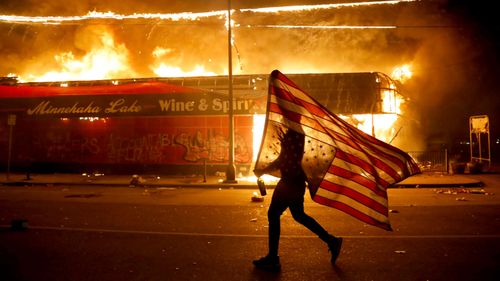
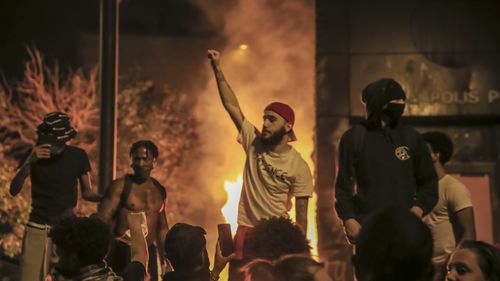
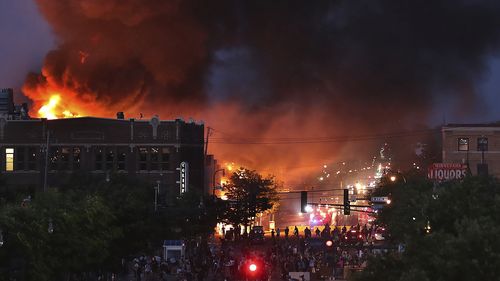
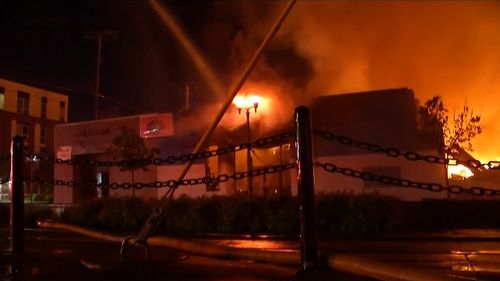
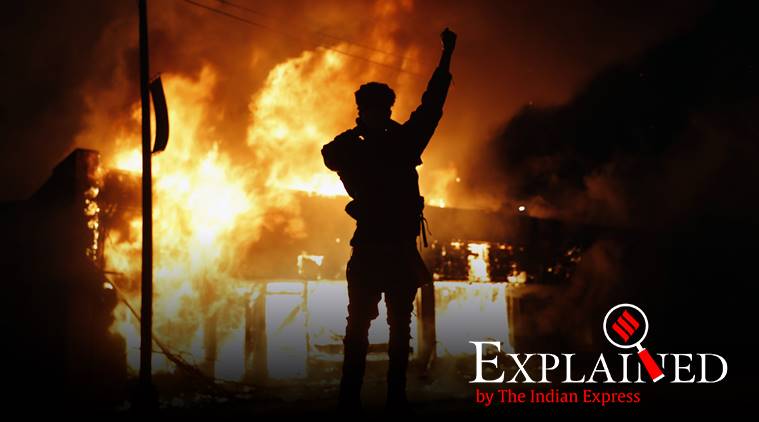
In this May 29, 2020, photo, a check-cashing business burns during protests in Minneapolis. Protests continued following the death of George Floyd, who died after being restrained by Minneapolis police officers on Memorial Day. (AP Photo/John Minchillo)

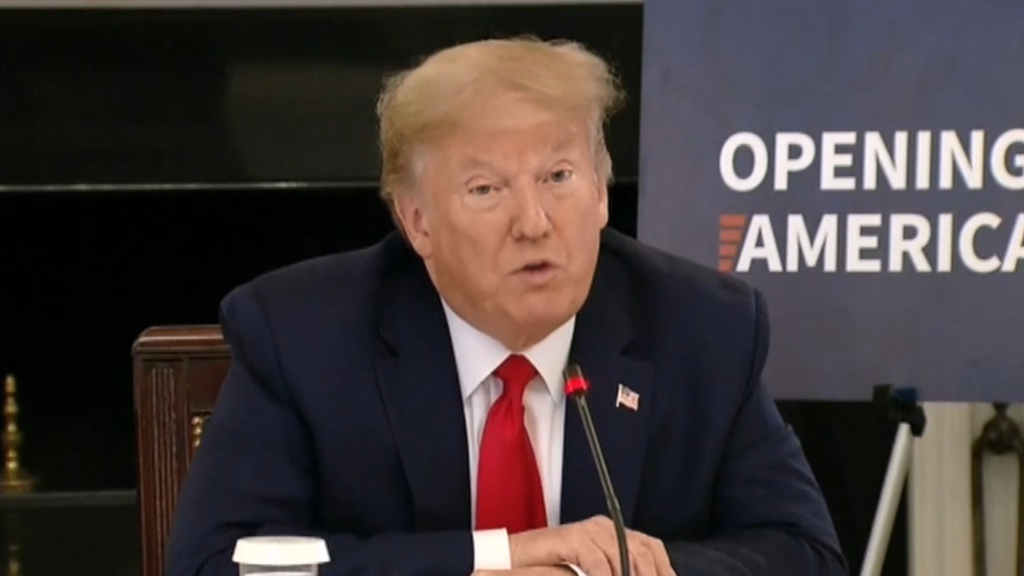
US President Donald Trump threatened the use of force in dealing with protests against the death of George Floyd, referring to participants as “thugs” on Twitter. “Any difficulty and we will assume control but, when the looting starts, the shooting starts,” the president said Friday.

Within hours, Twitter flagged the post for “glorifying violence” but let it remain visible in the public’s interest “to remain accessible.”

Floyd, a 46-year-old African American man, died in Minneapolis on Monday while he was being restrained by the police. Video footage of the incident, which was broadcast by the media and went viral on social media platforms, showed an officer kneeling on Floyd’s neck as he gasped for breath.

Four policemen have since been fired, and the Federal Bureau of Investigation (FBI) has been called in to conduct a federal civil rights probe. The officer who pinned him to the ground, Derek Chauvin, has been charged with third degree murder.

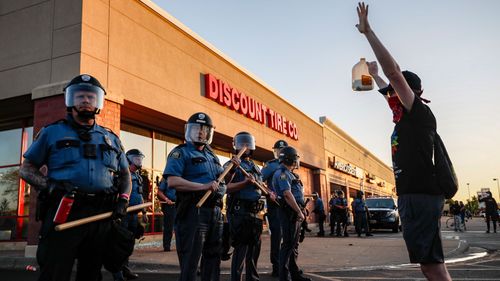
The death has triggered violent unrest in Minneapolis, leading to a state of peacetime emergency being declared in Minnesota state as well as the activation of its National Guard. Protests have also taken place in other parts of the US, including in California, New York, Ohio and Colorado.

The incident once again brought to the fore concerns over the law enforcement’s bias against the African American minority, with Floyd’s death being cited as the most recent incident of racially-driven police brutality.
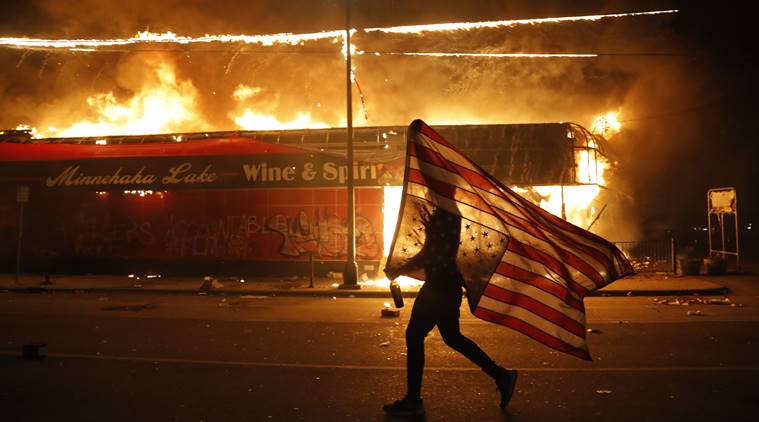
Explained: Why George Floyd’s death has sparked violent protests in the US A protester carries a US flag upside, a sign of distress, next to a burning building Thursday, May 28, 2020, in Minneapolis. (AP Photo: Julio Cortez)

George Floyd’s death

Floyd, a Minnesota resident, was arrested on Monday after he was accused of using a counterfeit $20 note at a local deli. According to the police, Floyd “physically resisted” the arrest after he was told to exit his car, a claim that was belied by mobile phone footage recorded by several passers-by. A white police officer then went on to restrain Floyd, and kneeled on his neck for at least seven minutes despite the 46-year-old gasping for breath and repeatedly saying “I can’t breathe”. The officer remained in that position even after Floyd became unconscious. His unresponsive body was then taken to a hospital, where he was pronounced dead.

The local chapter of the National Association for the Advancement of Colored People (NAACP) called the incident “public lynching without a rope.”

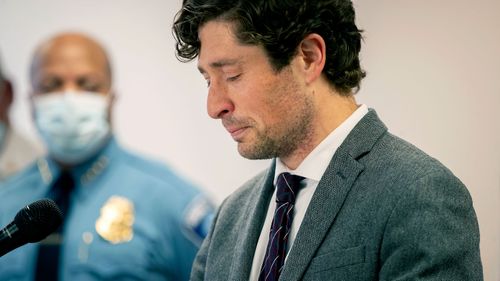
Minneapolis Mayor Jacob Frey said, “Being black in America should not be a death sentence. For five minutes, we watched a white officer press his knee into a black man’s neck… When you hear someone calling for help, you’re supposed to help. This officer failed in the most basic, human sense.”

Race and police violence in the US

Floyd’s repeated cry for help, “I can’t breathe”, while being restrained prompted comparisons between the incident and the death of Eric Garner in 2014. Garner, an unarmed African American man, had uttered the same words 11 times as he was held in a chokehold by a police officer in New York City before he died.

‘I can’t breathe’ has now become a rallying cry among protesters.

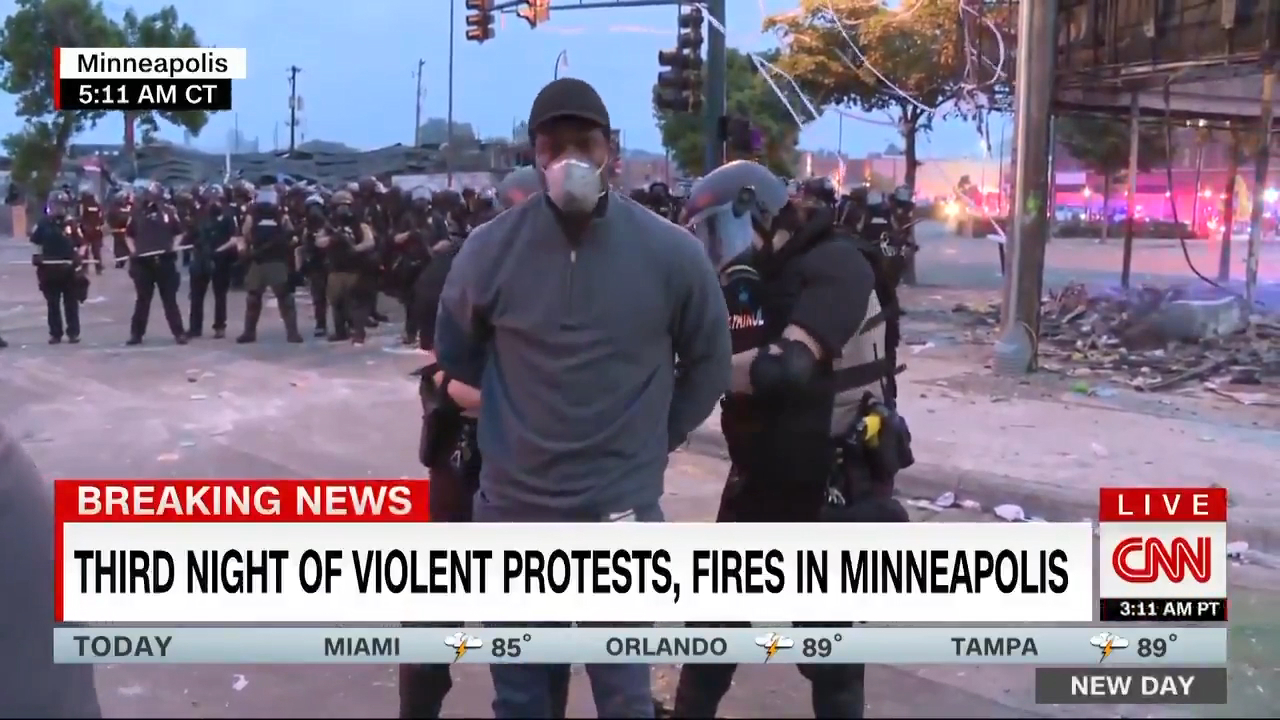
Also read | CNN crew arrested while reporting on Minneapolis protests

Other high profile deaths include the 2016 shooting of Philando Castile, a 32-year-old black man shot seven times at close range during a traffic stop, also in Minnesota, just after he had informed the police officer, Jeronimo Yanez, that he was carrying a gun. Yanez was acquitted of all charges in 2017. The incident became viral after Castile’s girlfriend streamed part of the incident on Facebook.

Another incident from 2016 that caused a furore was when police pinned to the ground and shot 37-year-old Alton Sterling outside a convenience store in Louisiana where he was selling CDs.
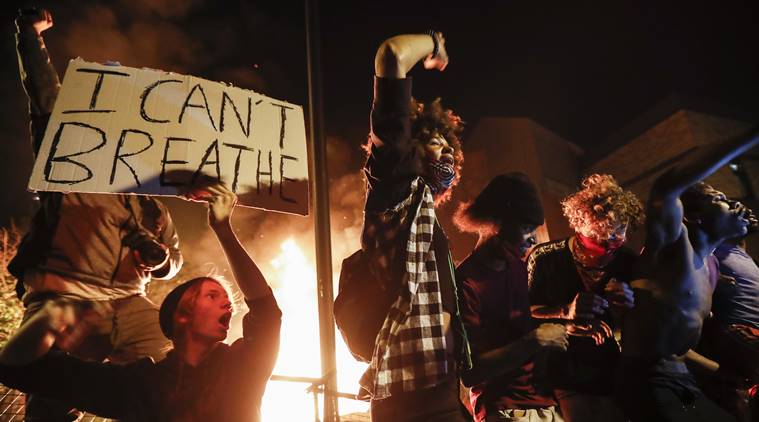
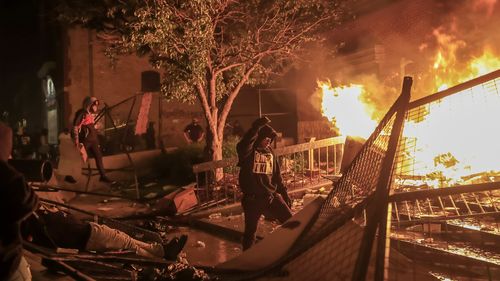
Explained: Why George Floyd’s death has sparked violent protests in the US Protestors demonstrate outside of a burning Minneapolis 3rd Police Precinct, Thursday, May 28, 2020, in Minneapolis. (AP Photo: John Minchillo)

According to a study conducted by The Guardian in 2016, the rate of fatal shootings by the police per million people was the highest for the Native American (10.13) and Black (6.6) racial groups; white people had a rate of 2.9. A Washington Post database showed that African Americans were 2.5 times more likely to be killed by a police officer than white people.

📣 Express Explained is now on Telegram. Click here to join our channel (@ieexplained) and stay updated with the latest

A study in the American Journal of Public Health from 2018 also found the mortality rate by police for black men to be much higher– at 1.9-2.4 per 1 lakh people compared to 0.6-0.7 for white men.

The Black Lives Matter (BLM) movement

In 2013, after the acquittal of a civilian who fatally shot teenager Trayvon Martin in Florida the year before, the hashtag #BlackLivesMatter began trending on social media, and a movement against systemic violence against the African American community sprung up.

Black Lives Matter achieved national fame in 2014 during protests against the deaths of Eric Garner and Michael Brown– the latter also being a case of fatal police shooting. The movement, started by three African American women, expanded across the US and invited public interest internationally. BLM is largely decentralised and does not have a formal hierarchy.

The movement has been criticised by alt-right commentators in the US. Some of BLM’s opponents have responded with their own counter-campaigns such as “All Lives Matter” and “Blue Lives Matter”.

📣 The Indian Express is now on Telegram. Click here to join our channel (@indianexpress) and stay updated with the latest headlines

For all the latest Explained News, download Indian Express App.

© The Indian Express (P) Ltd


Source link

Mayhem in Minneapolis: Officer charged with murder in death of George Floyd

Anguish and anger over the death of George Floyd erupted across the US hours after the former Minneapolis officer seen in video with his knee on Floyd’s neck was arrested and charged with murder.

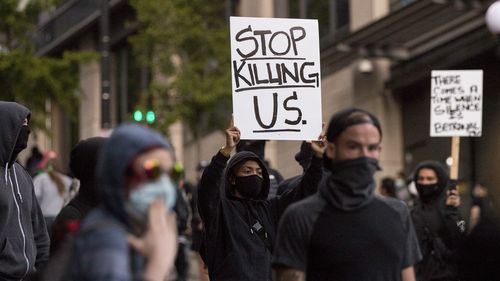
Demonstrators funneled their anguish in cities like Atlanta, New York and Washington into chants, signs and outbreaks of violence, smashing windows and setting vehicles ablaze.

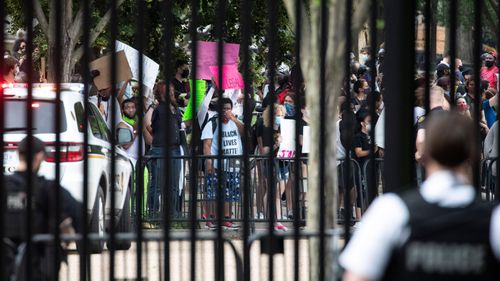
A large group of protestors gathered outside the gates of the White House in Washington, chanting George Floyd’s name and demanding justice for his death at the hands of police. It lead to the White House going into lockdown.

People march from the George Floyd vigil at Peninsula Park towards the Justice Centre downtown in Portland, Oregon. (Dave Killen/The Oregonian via AP)
Demonstrators march at 5th Avenue and Marion Street in downtown Seattle to show solidarity with Minneapolis and protesting police brutality. (Amanda Snyder /The Seattle Times via AP)
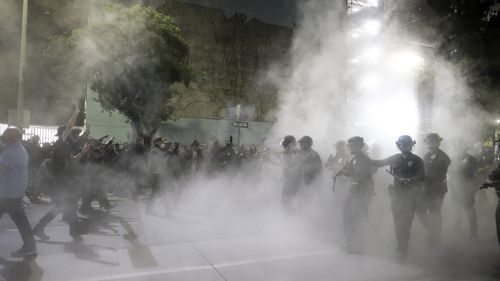
Police officers fire rubber bullets during a protest over the death of George Floyd in Los Angeles. Floyd died in police custody Monday in Minneapolis. (AP Photo/Ringo H.W. Chiu)

There were also chants of “I can’t breathe”, the words Mr Floyd said as a police officer kneeled on his neck before he died.

In Minneapolis a gas station is on fire, with the city in curfew and emergency services fearful of reaching areas to put out the flames.

• In one of the most chaotic protests Atlanta has seen in years, demonstrators smashed windows of police cars outside CNN Center, which houses Precinct 5 of the Atlanta Police Department. At least one squad car was set on fire. Police in riot gear helped other force protesters back to Centennial Olympic Park.

A check-cashing business burns Friday, May 29, 2020, in Minneapolis. (AP/AAP)

• Minneapolis and St. Paul are under a curfew instituted after days of protests marked by looting and arson. Few people paid attention.

• In Washington, DC, a protest outside the White House briefly caused the building to be placed on lockdown. It has since been lifted and the Secret Service has reopened entrances and exits to the White House campus for both staff and media.

• In New York, protesters and police clashed in various incidents Friday night outside the Barclays Center with protesters throwing water bottles, what appeared to be a bottle of paint and more at police officers. At least 12 people were arrested, police said.

• Detroit Police have arrested nine people, one of whom tried to run over an officer with a car, Chief James Craig said.

• Protests also took place in at least 25 other cities, including Boston, Chicago, Dallas, Denver, Las Vegas, Los Angeles and New Orleans.

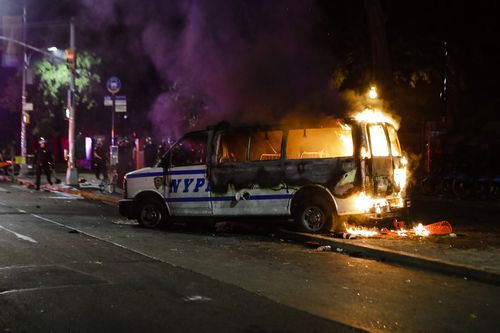
Police officers control the crowd after a Police vehicle is set ablaze after protesters rally at the Barclays Center over the death of George Floyd, a black man who was in police custody in Minneapolis Friday, May 29, 2020, in the Brooklyn borough of New York. Floyd died after being restrained by Minneapolis police officers on Memorial Day. (AP Photo/Frank Franklin II) (AP/AAP)
A US Secret Service officer stands inside the fence at the White House as demonstrators protest the death of George Floyd, a black man who died in police custody in Minneapolis, Friday, May 29, 2020, in Washington. ((AP Photo/Alex Brandon))

Derek Chauvin charged with murder

A Minnesota prosecutor charged Derek Chauvin with third-degree murder and manslaughter in the restraint death of Floyd on Friday afternoon (Saturday morning AEST).

Hennepin County Attorney Mike Freeman said he may yet bring more charges against the ex-officer.

Floyd, 46, died in the city he moved to for a better life, his last moments caught on video. (CNN)

The arrest comes the morning after protesters torched a police station that officers abandoned during a third night of violence.

Livestream video showed protesters entering the building and burn it to the ground.

The message from the President has been taken as a call to arms for a nation on the edge.

“Trump said when the looting starts, the shooting starts, and everyone is taking that as a threat,” a protester told 9News US correspondent Time Arvier.

“We are not out here to loot, we are not out here to do none of the chaos and stuff, we are just out here to protest and stand up for a life that was lost, that was taken unjustly.”

The violence isn’t expected to subside any time soon with protesters predicting the riots will continue until all four officers are convicted.

A protester carries a US flag upside, a sign of distress, next to a burning building in Minneapolis. (AP)
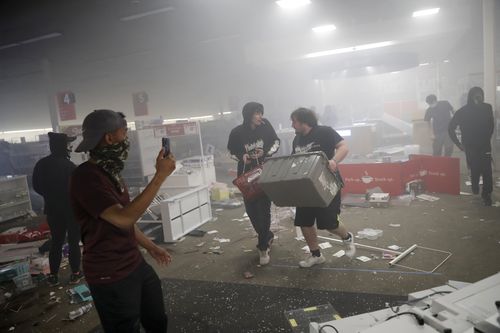
People enter a looted Office Depot Friday, May 29, 2020, in Minneapolis. Protests continued following the death of George Floyd, who died after being restrained by Minneapolis police officers on Memorial Day. ((AP Photo/John Minchillo))

“People are still going to act out. People are still mad. People have to release their anger, you know. It is the people who are supposed to protect us that did this,” another protestor said.

Floyd’s death ignites protests around the US

Although Minneapolis remains the epicentre of the protests, a number of other cities have all erupted in fury.

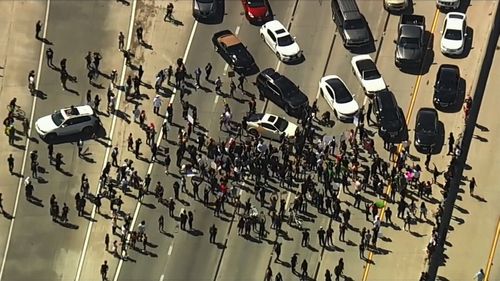
In the latest events sparked by Floyd’s death, hundreds of protestors shut down a major highway in San Jose in California.

Helicopter video showed traffic at a standstill on the southbound lanes of 101 in San Jose highway while some protestors were seen attacking cars.

Protestors block major highway in San Jose. May 30, 2020. (9News)
May 29, 2020 – Atlanta – After a peaceful march the Georgia State Capitol that swelled into the hundreds, protestors returned to the area around the Centennial Olympic Park and CNN center where some confronted police, who sprayed some demonstrators with pepper spray. They carried signs and chanted their messages of outrage over the death of George Floyd in Minneapolis. Alyssa Pointer / alyssa.pointer@ajc.com (AP/AAP)
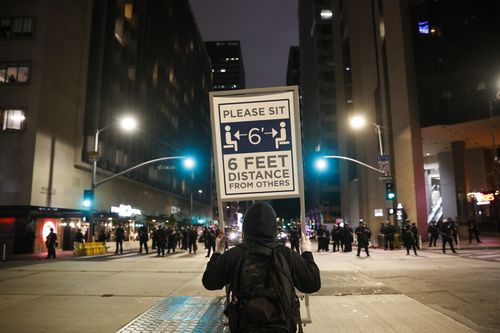
A protester holds a sign advising social distancing in front of police officers during a protest over the death of George Floyd Friday, May 29, 2020, in Los Angeles. Floyd died in police custody Monday in Minneapolis. (AP Photo/Jae C. Hong) (AP/AAP)

In Ohio, officers have used pepper spray on protestors after a statehouse came under attack.

Seven people have been shot in Kentucky as the violence escalated overnight.

Concerning scenes from New York were also captures overnight with at least 72 people arrested.

Other locations impacts include Pheonix, Denver, Louisville, Memphis and Columbus.

Family of George Floyd speak out

Floyd’s uncle Selwyn Jones denounced the violent protests following his nephew’s death, calling them “absolutely outlandish”.

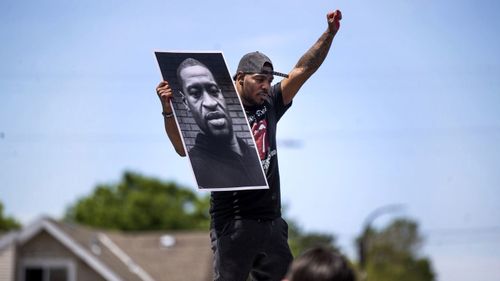
Tony L. Clark holds a photo of George Floyd on Thursday in Minneapolis.
Tony L. Clark holds a photo of George Floyd on Thursday in Minneapolis. (AP)
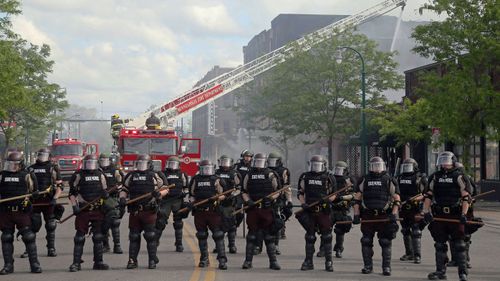
Minnesota state troopers provide protection as firefighters battle a fire after another night of protests, fires and looting over the arrest of George Floyd who died in police custody in Minneapolis. (AP)

“I think that is absolutely outlandish for them to destroy their own city, their own home, to make a point,” Jones told the Rapid City Journal in South Dakota.

“I don’t think the point that they’re trying to make is the point that we’re trying to make.”

Jones, who plans to attend peaceful demonstrations on Saturday, said people who have reacted with violent protest and looting are “taking advantage of a bad situation to express anger”.

Earlier, as smoke still drifted over Minneapolis on Friday morning, the state’s governor admitted an “abject failure” in response to a week of violent protests, and called for swift justice for police involved in the death of Mr Floyd.

The fires in US cities are still burning

This morning, US President Donald Trump said the death of George Floyd “should never have happened”.

“We are determined that justice be served,” he said.

But he also warned against further unrest.

“We can’t allow a situation like what happened in Minneapolis to descend into lawless anarchy and chaos,” Mr Trump said.

Minnesota Governor Tim Walz said the state would take over the response and that it’s time to show respect and dignity to those who are suffering.

“Minneapolis and St Paul are on fire. The fire is still smoldering in our streets. The ashes are symbolic of decades and generations of pain, of anguish unheard,” Walz said.

“Now generations of pain is manifesting itself in front of the world — and the world is watching.”

Political leaders raise their voice

Earlier, Presumptive Democratic presidential nominee Joe Biden said he had spoken with the family of George Floyd and is calling for justice.

In a brief appearance online the former Vice President blamed systemic racism, which he called “an open wound” on American society, for Floyd’s death. He says it’s time for deep and lasting police reform.

Biden also took an indirect swipe at President Donald Trump without naming him, saying it was, “No time for incendiary tweets. No time to incite violence.”

Protesters burn the Minneapolis Police Department 3rd Precinct during protests. (AAP/TANNEN MAURY)

A night of flames and violence

Dozens of fires were also set in nearby St Paul, where nearly 200 businesses were damaged or looted.

Protests spread across the US, fuelled by outrage over Floyd’s death, and years of violence against African Americans at the hands of police.

Demonstrators clashed with officers in New York and blocked traffic in Columbus, Ohio, and Denver.

Trump threatened to bring Minneapolis “under control”, calling the protesters “thugs” and tweeting that “when the looting starts, the shooting starts”.

The tweet drew another warning from Twitter, which said the comment violated the platform’s rules, but the company did not remove it.

Trump also blasted the “total lack of leadership” in Minneapolis.

A visibly tired and frustrated Minneapolis Mayor Jacob Frey made his first public appearance of the night early Friday at City Hall and took responsibility for evacuating the precinct, saying it had become too dangerous for officers.

As Frey continued, a reporter cut across loudly with a question: “What’s the plan here?”

“With regard to?” Frey responded. Then he added: “There is a lot of pain and anger right now in our city. I understand that … What we have seen over the past several hours and past couple of nights here in terms of looting is unacceptable.”

He defended the city’s lack of engagement with looters — only a handful of arrests across the first two nights of violence — and said, “We are doing absolutely everything that we can to keep the peace.”

He said National Guard members were stationed in locations to help stem looting, including at banks, grocery stores and pharmacies.

May 29, 2020 – Atlanta – After a peaceful march the Georgia State Capitol that swelled into the hundreds, protestors returned to the area around the Centennial Olympic Park and CNN center where some confronted police, who sprayed some demonstrators with pepper spray. They carried signs and chanted their messages of outrage over the death of George Floyd in Minneapolis. Alyssa Pointer / alyssa.pointer@ajc.com (AP/AAP)

CNN reporter and crew arrested

The Minnesota State Patrol said the journalists were among four people arrested as troopers were “clearing the streets and restoring order,” and they were released after being confirmed to be media members. CNN said on Twitter that the arrests were “a clear violation of their First Amendment rights.”

Firefighters worked Friday to contain a number of blazes as National Guard troops blocked access to streets where businesses had been damaged. They marched side by side and block by block as they expanded a perimeter around a heavily damaged area.

Protests first erupted Tuesday, a day after Floyd’s death in a confrontation with police captured on widely seen citizen video. In the footage, Floyd can be seen pleading as officer Derek Chauvin presses his knee against him. As minutes pass, Floyd slowly stops talking and moving.

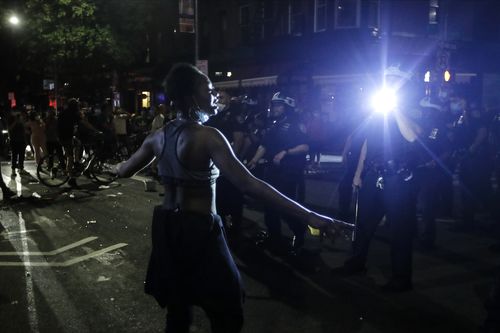
Police officers face off with protestors near Barclays Center after a rally over the death of George Floyd, a black man who was in police custody in Minneapolis Friday, May 29, 2020, in the Brooklyn borough of New York. Floyd died after being restrained by Minneapolis police officers on Memorial Day. (AP Photo/Frank Franklin II) (AP/AAP)

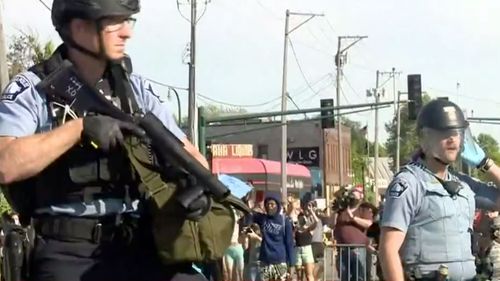
Governor Tim Walz activated the National Guard at the Minneapolis mayor’s request. The Guard tweeted minutes after the precinct burned that it had activated more than 500 soldiers across the metro area. A couple dozen Guard members, armed with assault-style rifles, blocked a street Friday morning near a Target store that has sustained heavy damage by looters.

The Guard said a “key objective” was to make sure firefighters could respond to calls, and said in a follow-up tweet that soldiers would assist the Minneapolis Fire Department. But no move was made to put out the 3rd Precinct fire. Assistant Fire Chief Bryan Tyner said fire crews could not safely respond to blazes at the precinct station and some surrounding buildings.

Minneapolis Mayor Jacob Frey speaks during a news conference in Minneapolis, Minnesota. (AP)

Earlier Thursday, dozens of businesses across the Twin Cities boarded up their windows and doors in an effort to prevent looting, with Minneapolis-based Target announcing it was temporarily closing two dozen area stores. Minneapolis shut down nearly its entire light-rail system and all bus service through Sunday out of safety concerns.

By Thursday night, hundreds of demonstrators returned to the Minneapolis neighbourhood at the centre of the violence. Demonstrators carried clothing mannequins from a looted Target and threw them onto a burning car.

Elsewhere in Minneapolis, thousands of peaceful demonstrators marched through the streets calling for justice.

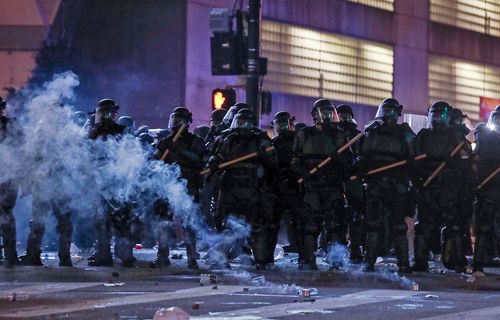
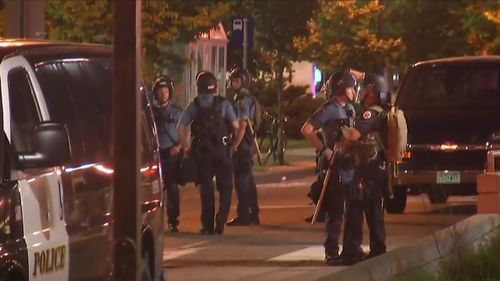
Protestors demonstrate in front of police in riot gear in St. Paul, Minnesota. (AP)

‘We’re burning our own neighbourhood’

Local leaders repeatedly urged demonstrators to avoid violence.

“Please stay home. Please do not come here to protest. Please keep the focus on George Floyd, on advancing our movement and on preventing this from ever happening again,” tweeted St Paul Mayor Melvin Carter, who is black.

Erika Atson, 20, was among thousands of people who gathered outside government offices in downtown Minneapolis, where organisers had called for a peaceful protest. Many protesters wore masks because of the coronavirus pandemic, but there were few attempts at social distancing.

Atson, who is black, described seeing her 14- and 11-year-old brothers tackled by Minneapolis police years ago because officers mistakenly presumed the boys had guns. She said she had been at “every single protest” since Floyd’s death and worried about raising children who could be vulnerable in police encounters.

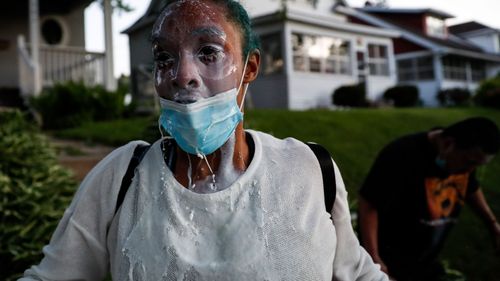
A protestor douses her face with milk after being exposed to tear gas fired by police in St. Paul, Minnesota. (AP)
Protesters burn the Minneapolis Police Department 3rd Precinct during protests over the Minneapolis, Minnesota arrest of George Floyd, who later died in police custody. (AAP/TANNEN MAURY)

“We don’t want to be here fighting against anyone. We don’t want anyone to be hurt. We don’t want to cause any damages,” she said. “We just want the police officer to be held accountable.”

The group marched peacefully for three hours before another confrontation with police broke out, though details were scarce.

After calling in the Guard on Thursday, Walz urged widespread changes in the wake of Floyd’s death.

“It is time to rebuild. Rebuild the city, rebuild our justice system and rebuild the relationship between law enforcement and those they’re charged to protect,” Walz said.

Among the casualties of the protests: a six-story building under construction that was to provide nearly 200 apartments of affordable housing.

Seen from Hiawatha Avenue, a large fire burns Thursday, May 28, 2020, in Minneapolis. (David Joles/Star Tribune via AP)
Protestors demonstrate outside of a burning Minneapolis 3rd Police Precinct in Minneapolis. (AP)

“We’re burning our own neighbourhood,” said a distraught Deona Brown, a 24-year-old woman standing with a friend outside the precinct station, where a small group of protesters were shouting at a dozen or so stone-faced police officers in riot gear. “This is where we live, where we shop, and they destroyed it.”

“What that cop did was wrong, but I’m scared now,” Brown said.

Others in the crowd saw something different in the wreckage.

Protesters destroyed property “because the system is broken,” said a young man who identified himself only by his nickname, Cash, and who said he had been in the streets during the violence. He dismissed the idea that the destruction would hurt residents of the largely black neighbourhood.

“They’re making money off of us,” he said angrily of the owners of the destroyed stores. He laughed when asked if he had joined in the looting or violence. “I didn’t break anything.”

Protesters are continuing to clash with police with an official department building being set alight, forcing officers to flee. (AP)
A police building was set alight by protesters in Minneapolis near where Geroge floyd died earlier this week. (AP)

In New York City, protesters defied New York’s coronavirus prohibition on public gatherings Thursday, clashing with police, while demonstrators blocked traffic in downtown Denver and downtown Columbus. A day earlier, demonstrators had taken to the streets in Los Angeles and Memphis.

In Louisville, Kentucky, police confirmed that at least seven people had been shot Thursday night as protesters demanded justice for Breonna Taylor, a black woman who was fatally shot by police in her home in March.

Anger over the killing extended to Africa, where the head of the African Union Commission on Friday rejected “continuing discriminatory practices against black citizens of the USA.” In a series of tweets, Moussa Faki Mahamat urged the “total elimination” of all forms of racism in the US.

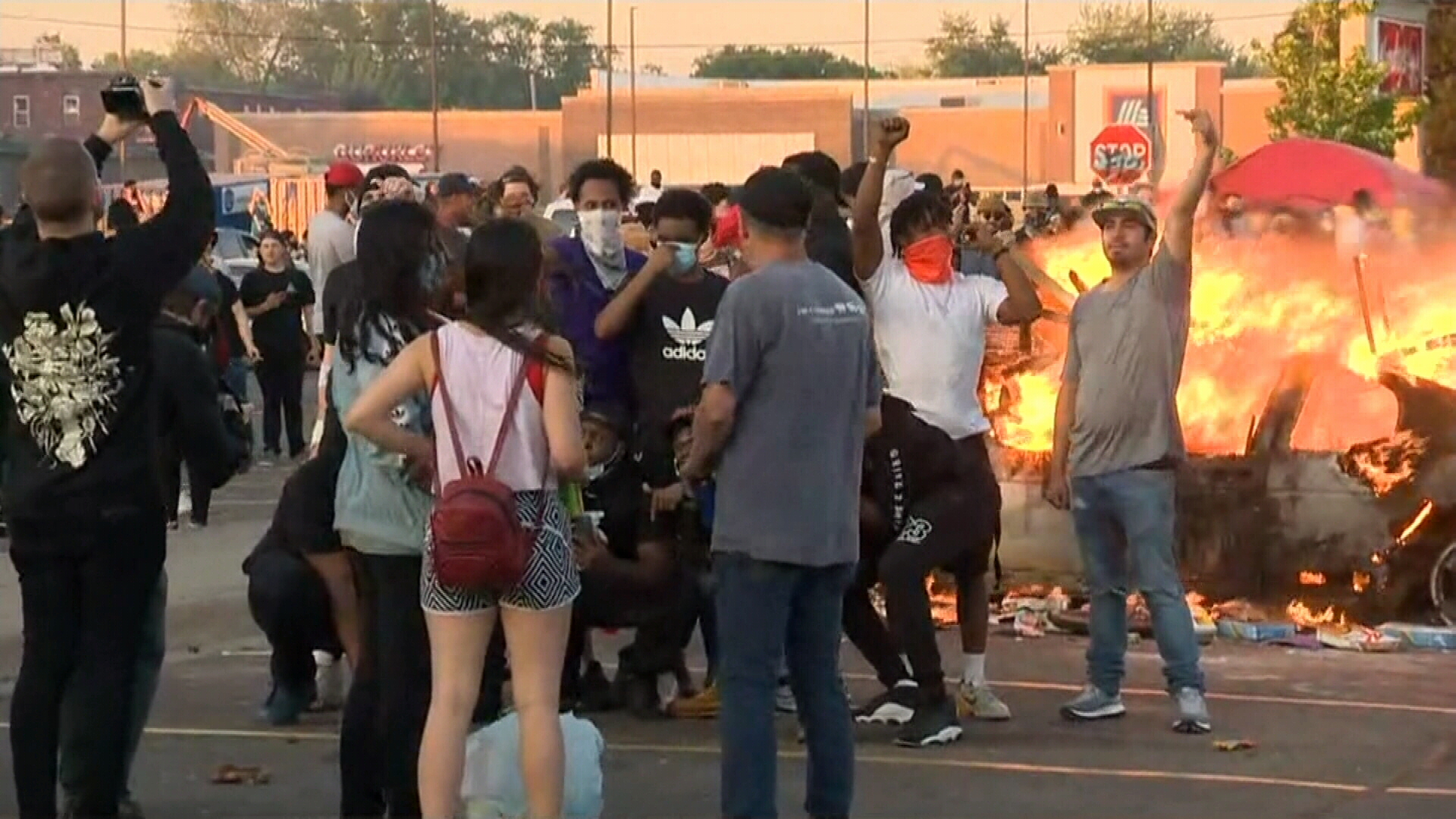
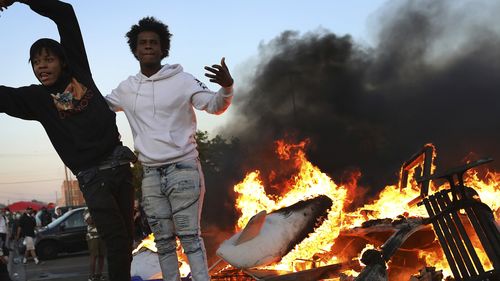
Young men stand atop a burning car in the Target parking lot E. Lake St. during a third night of unrest following the death of George Floyd while in Minneapolis police custody. (Edward Washington,cq/Star Tribune via AP)

In Mississippi, the mayor of the community of Petal resisted calls to resign following his remarks about Floyd’s death. Hal Marx, a Republican, asked on Twitter: “Why in the world would anyone choose to become a police officer in our society today?” In a follow-up tweet, he said he “didn’t see anything unreasonable.”

The city on Thursday released a transcript of the 911 call that brought police to the grocery store where Floyd was arrested. The caller described someone paying with a counterfeit bill, with workers rushing outside to find the man sitting on a van. The caller described the man as “awfully drunk” and said he was “not in control of himself.”

Asked by the 911 operator whether the man was “under the influence of something,” the caller said: “Something like that, yes. He is not acting right.” Police said Floyd matched the caller’s description of the suspect.

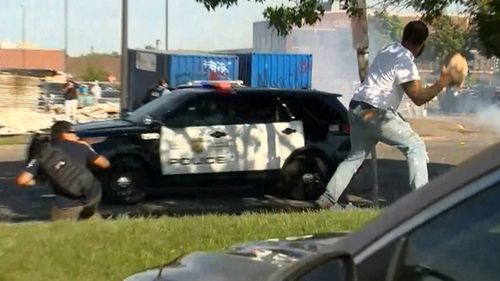
A protester hurls a huge rock at a police car after a stabbing during Minneapolis riots.
A protester hurls a huge rock at a police car after a stabbing during Minneapolis riots. (9News)
Armed police respond after a man was stabbed during riots in Minneapolis.
Armed police respond after a man was stabbed during riots in Minneapolis. (9News)

State and federal authorities are investigating Floyd’s death.

Chauvin, the officer who knelt on Floyd’s neck, was fired Tuesday, along with three other officers involved in the arrest.

“It can’t be ‘normal.’ If we want our children to grow up in a nation that lives up to its highest ideals, we can and must be better,” Obama said in a statement.

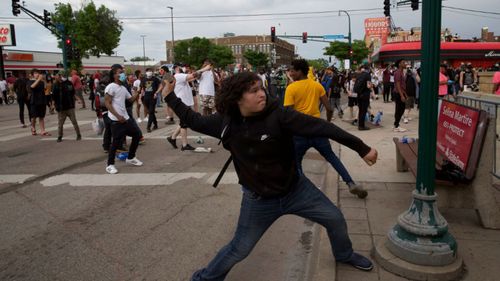
A protester throws an object at police during the violence. (AP)

Obama said it will mainly fall on officials in Minnesota to ensure Floyd’s death is fully investigated “and that justice is ultimately done”.

“But it falls on all of us, regardless of our race or station — including the majority of men and women in law enforcement who take pride in doing their tough job the right way, every day — to work together to create a ‘new normal’ in which the legacy of bigotry and unequal treatment no longer infects our institutions or our hearts,” Obama continued.

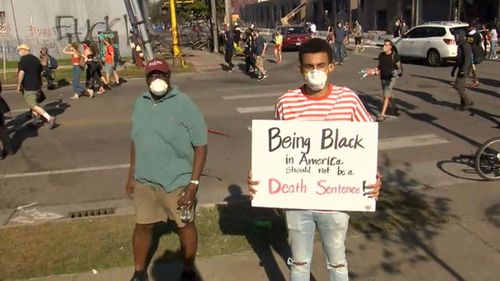
A man holds a sign as riots over the death of George Floyd escalate,
A man holds a sign as riots over the death of George Floyd escalate, (9News)

Reported with CNN and AP

Source by [author_name]

Global report: new clues about how coronavirus formed as US severs ties with WHO

Scientists claim to have unearthed more clues about how the new coronavirus could have spread from bats through pangolins and into humans as the number of infections worldwide neared six million.

Writing in the journal Covid-19 Science Advances, researchers said that an examination of the closest relative of the virus found that it was circulating in bats but lacked the protein needed to bind to human cells.

The US-based scientists said this ability could have been acquired from a virus found in pangolins – a scaly mammal that is one of the most illegally trafficked animals on the planet.

Dr Elena Giorgi, one of the study’s lead authors, of Los Alamos national laboratory, said people had already looked at the pangolin link but scientists were still divided about their role in the evolution of Sars-Cov-2, the virus that causes Covid-19.

“In our study, we demonstrated that indeed Sars-Cov-2 has a rich evolutionary history that included a reshuffling of genetic material between bat and pangolin coronavirus before it acquired its ability to jump to humans,” she said, adding that “close proximity of animals of different species in a wet market setting may increase the potential for cross-species spillover infections”.

The study still doesn’t confirm the pangolin as the animal that passed the virus to humans, but it adds weight to previous studies that have suggested it may have been involved.

However, Prof Edward Holmes, an evolutionary biologist at the University of Sydney in Australia, said more work on the subject was needed. “There is a clear evolutionary gap between Sars-Cov-2 and its closest relatives found to date in bat and pangolins,” he said. “The only way this gap will be filled is through more wildlife sampling.”

The findings came as Donald Trump announced that the US was severing its ties with the World Health Organisation because it had “failed to reform”.

In a speech at the White House devoted mainly to attacking China for its alleged shortcomings in tackling the initial outbreak of coronavirus, Trump said: “We will be today terminating our relationship with the World Health Organization and redirecting those funds to other worldwide and deserving urgent global public health needs.”

The US is the biggest funder of the global health body, paying about $450m in membership dues and voluntary contributions for specific programmes.

It comes as deaths in the US climbed to more than 102,000 with 1,747,000 infections, by far the biggest total in the world.

It emerged on Friday that one person who attended the controversial mass pool parties in the Ozarks last weekend had tested positive for the virus. Authorities said they wanted to inform other people who were also at the gatherings of the risk.

There was another large spike in deaths in Brazil, where more than 27,000 people have died from the disease and which has the world’s second highest number of cases on 465,000.

There were also big surges in reported deaths in Russia and Iran on Friday. The former suffered its biggest daily increase in deaths – 232 in 24 hours – bringing the nationwide total to 4,374 while the latter identified more coronavirus cases in a day than in any time since early April; 2,819 more people tested positive on Friday.

Egypt registered 1,289 new cases and 34 deaths, the health ministry has said, marking another record of daily increases on both counts despite stricter curfew rules.

Other developments across the world include:

  • A leading UK government adviser has warned that it is too early to lift lockdown restrictions as planned next month because the number of new infections is still too high. John Edmunds, a professor of infectious disease modelling at the London School of Hygiene and Tropical Medicine, said he wanted the level of new cases to “driven down further” before larger gatherings are allowed as the government has said it wants to do. Tory MPs are still being bombarded by constituents with calls for Boris Johnson’s top adviser to quit after he appeared to breach lockdown rules.

  • Restrictions continue to be lifted to some degree across Europe, with thousands flocking to open-air cinemas to see films together for the first time in weeks.

  • In Australia, where states are expected to move to relax the rules to allow gatherings of more people from Monday, anti-vaccine protesters gathered in several cities to warn that they believed Covid-19 was a “scam”.

  • Also in Australia, scientists are examining the sewage waste in a town in Queensland where a 30-year-old man died this week from the virus. Nathan Turner is the youngest victim in the country so far and the case has baffled experts because he had not left the remote town of Blackwater.

Source link

Louisville Cop Fires Pepper Pellets At TV Journalist During Live Broadcast

A Kentucky police officer was filmed calmly squeezing off pepper pellets at a TV news reporter in the middle of a live broadcast on protests in downtown Louisville Friday night over recent killings during police actions there and in Minneapolis.

Reporter Kaitlin Rust’s camera operator filmed the officer aiming straight at both of them during a report on WAVE 3 News. Rust began screaming: “I’m getting shot! Rubber bullets! Rubber bullets!”

“Katie, are you OK?” asked the news anchor back at the station. 

“It’s OK, it’s OK. It’s those pepper bullets,” Rust responded. Pepper balls contain chemicals similar to pepper spray and are shot in pellets. She was apparently struck during the broadcast, according to the news station.

Asked who the police were aiming at, Rust responded: “At us! Directly at us!” — though she had no idea why.

Though hundreds of protesters were gathered nearby, Rust and the camera operator were in a clearing, and there didn’t appear to be any problems in the immediate area. Rust had told the news anchors that she had followed police directions about where to stand. 

A police spokesperson confirmed that Rust had likely been struck by pepper balls because the department doesn’t use rubber bullets, WAVE 3 reported. But apparently no explanation for the shooting was provided.

Early Friday in Minneapolis, Minnesota State Patrol officers arrested CNN correspondent Omar Jimenez, his producer and two members of his crew while they were broadcasting live from protests there over the death Monday of George Floyd, a Black man who stopped breathing as a white police officer knelt on his neck.

Cameras kept rolling as Jimenez was placed in handcuffs and taken away after politely telling officers the crew would go wherever they instructed. The crew was released about two hours later. 

Louisville has been wracked by protests over the deaths of Floyd and of Breonna Taylor, a black EMT in Louisville. Taylor was fatally shot in her home by plainclothes police who were executing a “no-knock” search warrant in a drug case March 13. The man they were seeking reportedly didn’t live in the building and was already in custody.

Seven people were shot and two were hospitalized at protests Thursday night in Louisville, WAVE News reported. Protests appeared to be growing violent late Friday.

Earlier in the day, Louisville Mayor Greg Fischer announced no-knock warrants would be suspended.


Source by [author_name]

Why Modi is still the only game in town for India

0

During his campaign, Modi faced questions about India’s mixed economic performance in the previous five years, but he won over voters with promises to shore up national security and by pushing a Hindu nationalist agenda.

In the past six months, he’s faced two significant challenges: nationwide protests over a controversial citizenship law, which led to violent attacks on Muslims, and the threat of thousands of deaths from the coronavirus pandemic.

His handling of the latter has earned praised at home and abroad. But the biggest test is arguably to come — reopening the country while keeping its 1.3 billion people safe.

Element of surprise: a Modi hallmark

At 8 p.m. on March 24, Modi gave just four hours’ notice of a nationwide coronavirus lockdown, sending millions of people scrambling for groceries, medicines and other essentials.

Perhaps worst affected were the millions of migrant workers who travel from rural areas to work in cities each year. In the lockdown, work suddenly dried up, leaving many of them stranded without pay. Many were forced to walk vast distances due to the public transport shutdown — and not all of them made it.

Modi’s sudden decision — accompanied by poor planning and execution — left local administrations confused over what was and wasn’t allowed, such as exemptions for online grocery deliveries amid the halt on all e-commerce operations.

“This is a part of his governing style and it can work during normal times but it’s not a good way to operate in a time of crisis where you throw surprises at 1.3 billion people,” said Vivek Dehejia, a professor of economics at Carleton University in Ottawa.

This, of course, was not the first time Modi has made a snap announcement. On November 8, 2016, Modi declared 500 rupee ($7.50) and 1,000 rupee ($15) notes worthless, which made up about 86% of the cash in circulation, in a bid to switch the country to digital payments to stop corruption and tax evasion.

“In each case, there was a four-hour window for people to react and absolute pandemonium broke out,” said Dehejia.

The result was massive lines at banks, change was nearly impossible to find, and some businesses resorted to barter, with India’s poor and most vulnerable bearing the biggest impact. People in remote places missed the window to exchange years’ worth of savings in old currency notes.

“You need to think about the consequences and how this will impact millions of people,” said Meghnad S, an associate editor for Newslaundry, an independent online news outlet.

Distracting from the economy

“Good days are coming,” was Modi’s campaign slogan, as he secured his first term in 2014 on the back of grand plans for the country’s economy.

But the lacklustre figures had little bearing on the 2019 election results, which saw Modi return to power with a bigger mandate.

India’s unemployment rate hit 8.75% in March, up from 7.03% in May last year — and is even higher after the coronavirus shutdown.

Furthermore, during his term, his government has committed funds to vanity projects, such as the world’s tallest statue or bullet trains, when priorities such as healthcare, infrastructure and sanitation persist.

And with the economic destruction wreaked by the pandemic things are unlikely to improve.

As the country nears the end of a near 10-week lockdown, as of Friday, India had more than 165,000 confirmed coronavirus cases and more than 4,700 deaths.

In his last national address on May 12, Modi announced an additional financial package to help the economy.

The new stimulus package, along with previous measures taken by the Indian government, would account for about $266 billion, which is around 10% of the country’s GDP, according to Modi.

His government later said this would include $40 billion to help small businesses affected by the outbreak, $20 billion to strengthen the agricultural industry and $5 billion for migrant workers and small-scale farmers.

Furthemore, for many Modi’s demonetization strategy built a narrative that he is a strongman who took on black money, and therefore has taken successful economic action.

“Despite the amount of pain caused, a lot of people still love the fact he did something like that,” says Vivek Kaul, an economic commentator and author. “If the idea was to get black money out, there are lots of ways to do that, but that would have involved a lot of work.”

Promoting Brand India

Modi is renowned as a master of public relations.

He’s become known for his bear hug-embraces of world leaders, while his slogan “Make in India” signaled his intention to rebrand the country as the world’s next manufacturing hub. In February, he packed the world’s largest cricket stadium for a rousing welcome rally for the US President Donald Trump, taglined “Namaste Trump.”

Modi’s flair for PR has been evident during the pandemic, with India promoting its role as a global leader in pharmaceuticals.

A number of world leaders lined up to thank India for its work supplying generic drugs like hydroxychloroquine to meet a rise in demand during the pandemic — including President Trump.

“Extraordinary times require even closer cooperation between friends. Thank you India and the Indian people for the decision on HCQ. Will not be forgotten!” Trump tweeted.

Modi responded: “Times like these bring friends closer. The India-US partnership is stronger than ever … We shall win this together.” Medical journal The Lancet has since reported that Covid-19 patients treated with hydroxychloroquine are more likely to die or develop dangerous irregular heart rhythms.

Modi also heavily promoted the country’s decision to fly 20,000 citizens home from foreign countries during the pandemic. According to Meghnad, from Newslaundry, it was an example of Modi’s external PR efforts to present India’s success to the world — internal migrants’ troubles during the lockdown received much less attention.

Dehejia believes there is “a huge cognitive gap between the rhetoric and the reality” of Modi’s vision of India as a growing economy and an important player in international affairs, after recent events dented the country’s soft power and image as a vibrant democracy.

“This was well before the (coronavirus) crisis when anti-CAA (Citizenship Amendment Act) protests were taking off. That was not good for India’s brand as a liberal democracy. The migrant crisis has further damaged the brand,” says Dehejia.

Marginalizing Muslims

Modi has not been shy about his pro-Hindu religious policies and has lived up to pledges made on the campaign trail.

Last August, he made the surprise decision to scrap a constitutional provision that granted Jammu and Kashmir relative autonomy, which sent the region into turmoil and saw tens of thousands of new troops deployed.

Then in November, his government granted Hindus permission to build a temple at the centuries-old Ayodhya holy site, previously claimed by Hindus and Muslims. The next month, India passed a bill to give Indian citizenship to immigrants from three neighboring countries — but not if they are Muslim.

Activists stage a candlelight vigil ahead of the Supreme Court verdict on the Ayodhyas Ram Janmabhoomi case, in Bangalore on November 7, 2019.

The pandemic has provided more opportunity to marginalize Muslims, after a March gathering in New Delhi of the Tablighi Jamaat, a conservative Muslim missionary group, resulted in a large cluster of cases.

Reports of Islamophobic attacks, both online and on the streets, began to surface, with Muslims being accused of spreading the virus.

Some members of his ruling Bharatiya Janata Party (BJP) began comparing the incident to terrorism.

On Twitter, the head of the BJP’s information and technology unit, Amit Malviya, called the gathering part of an “Islamic insurrection” while Mukhtar Abbas Naqvi, the BJP’s Minister for Minority Affairs accused the event organizers of a “Talibani crime.”

Like previous incidents, most recently seen in February when violent communal clashes broke out in the capital New Delhi, the government failed to take stringent action.

“Modi did put out a tweet on harmony but it felt like an afterthought. There’s a lack of communication and it’s more obvious because otherwise he tweets about everything under the sun,” said Meghnad, from Newslaundry.

“Obviously, they (Tablighi Jamaat) are at fault and action should be taken but to paint an entire community and the conflation of the actions of a few is ridiculous. The government should actively come out but they let it turn into the monster that it did,” he added.

Priorities on spending

While Modi’s government has announced $266 billion in relief packages during the pandemic, Dehejia, from Carleton University, points out that much of what was announced in a week-long series of press conferences by Finance Minister Nirmala Sitharaman had already been committed.

“Part of the Modi government brand has been to make these big announcements over things that they’ve already been doing or what previous governments have done and brand it as a new package … The amount of new money committed is essentially quite small,” he said.

Sitharaman’s penultimate press conference highlighting reforms to sectors such as mining, defense and the country’s space program raised eyebrows over the relevance of the announcement during the current situation.

“Tone-deaf is the only charitable explanation,” said Dehejia. Many felt more should have been invested in the country’s creaking healthcare infrastructure, which has been an issue regardless of the party in power.

According to the World Bank, in 2017, India allocated around 3.5% of its GDP towards health. This compares to the United States, which spent 17% of its GDP on healthcare and poorer nations such as Sierra Leone and Afghanistan, which set aside 13.4% and 12% respectively in the same year.

Looking ahead, spending wisely and investing in the right parts of the economy will be crucial — though experts say Modi has such a strong mandate that he’s essentially free to do what he wants.

And India’s next election isn’t due until 2024.

The bigger issue is the lack of credible opposition. The 2019 election dealt a sharp blow to the India’s main opposition Congress party, which won just 52 seats compared to the BJP’s 303. To win, a party needs 272 elected seats out of 543.

The result marked the Congress party’s second-worst showing ever in a general election.

“A crisis of any kind greatly empowers the incumbent. Whether it’s Trump’s nightly news conferences or Boris Johnson’s or Modi’s announcements, that’s what’s visible to the public and opposition parties struggle to make an impact or appear on the evening news,” said Dehejia.

“What is the credible alternative at the national level? Modi’s the only game in town for India.”


Source link

Pentagon Puts Military Police On Alert To Go To Minneapolis

DELRAY BEACH, Fla. (AP) — As unrest spread across dozens of American cities on Friday, the Pentagon took the rare step of ordering the Army to put several active-duty U.S. military police units on the ready to deploy to Minneapolis, where the police killing of George Floyd sparked the widespread protests.

Soldiers from Fort Bragg in North Carolina and Fort Drum in New York have been ordered to be ready to deploy within four hours if called, according to three people with direct knowledge of the orders. Soldiers in Fort Carson, in Colorado, and Fort Riley in Kansas have been told to be ready within 24 hours. The people did not want their names used because they were not authorized to discuss the preparations.

The get-ready orders were sent verbally on Friday, after President Donald Trump asked Defense Secretary Mark Esper for military options to help quell the unrest in Minneapolis after protests descended into looting and arson in some parts of the city.

Trump made the request on a phone call from the Oval Office on Thursday night that included Esper, National Security Advisor Robert O’ Brien and several others. The president asked Esper for rapid deployment options if the Minneapolis protests continued to spiral out of control, according to one of the people, senior Pentagon official who was on the call.

”When the White House asks for options, someone opens the drawer and pulls them out so to speak.” the official said.

The person said the military units would be deployed under the Insurrection Act of 1807, which was last used in 1992 during the riots in Los Angeles that followed the Rodney King trial.

“If this is where the president is headed response-wise, it would represent a significant escalation and a determination that the various state and local authorities are not up to the task of responding to the growing unrest,” Brad Moss, a Washington D.C.-based attorney, who specializes in national security.

Members of the police units were on a 30-minute recall alert early Saturday, meaning they would have to return to their bases inside that time limit in preparation for deployment to Minneapolis inside of four hours. Units at Fort Drum are slated to head to Minneapolis first, according to the three people, including two Defense Department officials. Roughly 800 U.S. soldiers would deploy to the city if called.

Protests erupted in Minneapolis this week after video emerged showing a police officer kneeling on Floyd’s neck. Floyd later died of his injuries and the officer, Derek Chauvin, was arrested and charged with third-degree murder and manslaughter on Friday.

The protests turned violent and on Thursday rioters torched the Minneapolis Third Police Precinct near where Floyd was arrested. Mayor Jacob Frey ordered a citywide curfew at 8 p.m. beginning on Friday.

The unrest has since spread across the country, with protests, some violent, erupting in cities including Washington DC, Atlanta, Phoenix, Denver and Los Angelas.

Minnesota Governor Tim Walz ordered 500 of his National Guard troops into Minneapolis, St. Paul, and surrounding communities.

But a Pentagon spokesman said Walz did not ask for the Army to be deployed to his state.

“The Department has been in touch with the Governor and there is no request for Title 10 forces to support the Minnesota National Guard or state law enforcement.” Title 10 is the U.S. law that governs the armed forces, and would authorize active duty military to operate within the U.S.

Alyssa Farah, the White House director of strategic communications said the deployment of active-duty military police is untrue.

“False: off the record – title 10 not under discussion,” said Farah in an email response. No off-record agreement was negotiated with The Associated Press.

The 16th Military Police Brigade forwarded the AP’s questions to the Defense Department.

The three officials with direct knowledge of the potential deployment say the orders are on a classified system, known as the Secret Internet Protocol Router or SIPR for short.

Active-duty forces are normally prohibited from acting as a domestic law enforcement agency. But the Insurrection Act offers an exception.

The Insurrection Act would allow the military to take up a policing authority it otherwise would not be allowed to do, enforcing state and federal laws,”said Stephen Vladeck, a University of Texas School of Law professor who specializes in constitutional and national security law.

The statute “is deliberately vague” when it comes to the instances in which the Insurrection Act could be used, he said. The state’s governor could ask President Donald Trump to take action or Trump could act on his own authority if he’s determined that the local authorities are so overwhelmed that they can’t adequately enforce the law, Vladeck said.

“It is a very, very broad grant of authority for the president,” he added.


Source by [author_name]

Rallies claim virus a ‘scam’ as rules ease

Hundreds of demonstrators in Australia’s largest capitals have defied social-distancing rules, claiming the COVID-19 pandemic is a “scam”.

Anti-vaccination protesters faced-off against the police, waving placards such as “5G = communism”.

The rallies came as restrictions continue to be eased across the country with new coronavirus infections remaining extremely low by international standards.

These easing of restrictions will be put to the test over this weekend and next as Australians enjoy public holidays.

Canberra, for example, is opening gyms and health facilities as well as galleries, museums and other attractions from Saturday, ahead of its public holiday on Monday.

Most state and territory leaders told a national cabinet meeting on Friday they were hopeful of implementing stage three of eased restrictions by the end of July. Stage three includes allowing gatherings of 100 people.

Such has been the success of regular meetings of the cabinet during the crisis – made up of the prime minister, premiers and first ministers – it will replace the less frequent gatherings of the Council of Australian Governments.

However, the process of the national cabinet has not all been plain sailing, with friction over the closing of schools during the height of the crisis, and more recently over borders closures.

The Queensland government, in particular, has been under attack for keeping its border closed.

However, a new survey by the Australia Institute has found more than three quarters of Australians support states closing their borders to interstate travel.

The survey of 1005 people found strong support for border closures among the four largest states – 88 per cent in Western Australia, 78 per cent in Queensland, 76 per cent in Victoria and and 70 per cent in NSW.

“The strong support for state border closures shows that while there is much public relief with some public health restrictions lifting, there is also still much community concern regarding the spread of COVID19,” the institute’s executive director Ben Oquist said on Saturday.

Fewer than 500 cases remain active in Australia out of more than 7170 infections.

In Victoria, nearly a dozen new cases have been confirmed, including three more linked to a Melbourne school and four from a hotel used to quarantine returned travellers.

The state’s Chief Health Officer Brett Sutton has warned life cannot return to normal yet.

“People by-and-large are listening but I’m concerned about certain quarters of the community who aren’t getting the message, who are reflecting on the fact that we’re easing some restrictions and are thinking we’re back to normal,” he told reporters.

However, there were no new cases in the nation’s most populous state, NSW, or Queensland.

The coronavirus death toll remains at 103, while in stark contrast the US passed the 100,000 mark this week.

US President Donald Trump has terminated his relationship with the World Health Organisation, following what he says was inadequate response to the initial outbreak in China.

Australian federal Labor is “deeply disappointed” by the decision, saying while there is considerable room for improvement at the WHO, change will not happen by walking away.

“The Australian government should urge the United States to reconsider its decision and work with other member states to ensure adequate funding of the WHO to continue to perform its important role,” Labor’s foreign affairs spokeswoman Penny Wong and health spokesman Chris Bowen said in a statement.

Source by [author_name]

Supreme Court rejects challenge to limits on church services

WASHINGTON — A divided Supreme Court on Friday rejected an emergency appeal by a California church that challenged state limits on attendance at worship services that have been imposed to contain the spread of the coronavirus.

Over the dissent of the four more conservative justices, Chief Justice John Roberts joined the court’s four liberals in turning away a request from the South Bay United Pentecostal Church in Chula Vista, California, in the San Diego area.

The church argued that limits on how many people can attend their services violate constitutional guarantees of religious freedom and had been seeking an order in time for services on Sunday. The church said it has crowds of 200 to 300 people for its services.

Roberts wrote in brief opinion that the restriction allowing churches to reopen at 25 percent of their capacity, with no more than 100 worshipers at a time, “appear consistent” with the First Amendment.

Justice Brett Kavanaugh wrote in dissent that the restriction “discriminates against places of worship and in favor of comparable secular businesses. Such discrimination violates the First Amendment.” Kavanaugh pointed to supermarkets, restaurants, hair salons, cannabis dispensaries and other businesses that are not subject to the same restrictions.

Lower courts in California had previously turned down the churches’ requests.

The court also rejected an appeal from two churches in the Chicago area that objected to Gov. Jay Pritzker’s limit of 10 worshipers at religious services. Before the court acted, Pritzker modified the restrictions to allow for up to 100 people at a time. There were no recorded dissents.

Source link

Inseparable twin sisters start nursing career together at same hospital during pandemic

0

“When the pandemic hit, it changed the whole atmosphere,” said Lauren Brown.

“You didn’t think it would ever happen here, and then when it started, it was just kind of a like a whirlwind,” added Lacie.

The 21-year-old fraternal twins graduated from Oklahoma City Community College in December. They quickly landed jobs, with the sisters now working together in the ICU at INTEGRIS Southwest Medical Center in Oklahoma City, treating critically ill and Covid-19 patients.

To say the twins are inseparable is an understatement.

“We’ve never had to walk into any situation alone,” said Lauren.

They played the same sports in high school, went to the same college for their undergraduate degrees, and now are both are pursuing their master’s degrees in nursing at Southwestern Oklahoma State University.

“We’ve always had each other. I can’t imagine it any differently; it just sounds lonely,” Lacie quipped in an interview with CNN.

The twins had an early interest in the medical field and decided to become nurses when they were about 12 years old after the family experienced a health crisis.

“My brother Hunter was diagnosed with leukemia at 16,” explained Lacie.

The family spent a lot of time at the hospital, seeing firsthand how much a compassionate and empathetic nurse could do to help patients and their families heal.

“Just seeing the impact that the nurses made that was really changing for me,” Lacie said.

“The nurse is that person there for you day in and day out to see that person get better.”

“It didn’t only change his life, but it also changed our whole family,” added Lauren.

Their brother, now in full remission, also works as a nurse.

For the Browns, helping patients — and their loved ones — is a family business.

“I find it really important to find that connection, they need someone to hold their hand and walk them through it just like those nurses did for our family,” said Lacie.

In this together

Frontline nurses around the world are acknowledging the physical and emotional toll this pandemic has taken on them. Both Lauren and Lacie say this experience is stressful, but they credit each other for the strength to keep going.

The Brown sisters graduated from Oklahoma City Community College in December of 2019.

“We don’t have to explain it, we could just walk through it together,” said Lacie.

“We are built-in best friends, and I can’t imagine it any differently,” Lauren agreed.

Source link

Health of the nation: We’re anxious, depressed insomniacs

As South Africans we’re suffering from anxiety, insomnia and depression. Plus we’re overeating and under-exercising. Apart from that, though, we’re absolutely fine. Thank you.

A study published by market research company Ipsos says these are all problems arising from the pandemic and lockdown.

And to top off this less-than-rosy picture, it seems that the image we have of ourselves as tough, no-nonsense, take-it-on-the-chin South Africans isn’t quite true either. Because, compared to much of the world, we’re actually faring notably worse than they are.

In fact, we’re whining even more than the Brits, which is surely a concern? Or perhaps South Africans are just more willing to tell the truth to market researchers?

Probing questions as to how we have been impacted

The question asked of us, in an online poll conducted from 7-10 May, was: “Are you suffering from any of the following as a result of Covid-19?”

Respondents were then given the following list to respond to: insomnia; anxiety; depression; migraines; overeating; undereating; increased smoking; over-exercising; under-exercising; increased alcohol use; and decreased alcohol use. People also had the option to answer ‘none of these’ or ‘prefer not to answer’.

“Only three in every ten online South Africans (30%) indicated that they do not suffer from any of the listed conditions,” says Ipsos. “Males were slightly less open to answering the question than females were.”

Nearly a third of us are experiencing anxiety

When it comes to anxiety, an average of 31% of South Africans said they were experiencing symptoms. Twenty-five percent of us said we were battling insomnia and 20% of South Africans have been struggling with depression.

It also turns out that we are overeating – 29% of us said ‘yes’ to this condition. The same percentage said ‘yes’ to under-exercising.

Our anxiety levels are the third highest of all the 16 countries included in the study. We were beaten only by Brazil (a mammoth 41%), Mexico (35%) and Russia (32%).

When it comes to insomnia, we’re also up there with the worst nations. Only Mexico (a whopping (38%) and Brazil (26%) are more sleep-stressed. Spain and South Africa tied at 25%.

Globally the big worry is lack of exercise

The biggest worry around the world, though, is lack of exercise. “About one-third of the respondents in 10 countries say they are under-exercising because of COVID-19, with this sentiment highest in Japan (38%), South Korea (37%), Italy (33%), China (31%), Mexico and Russia (30%),” says Ipsos. South Africa comes in at 29%.

“With unlimited exercise hours commencing on June [in South Africa], one can assume that less people will complain about insufficient exercise. But the Level 3 regulations will not make a difference to those suffering from anxiety, overeating, insomnia and depression. Interpreting the table above, women clearly feel that they are suffering more from these conditions than men are,” Ipsos notes.


Source link