Parliament’s land reform portfolio committee wants Land Reform Minister Thoko Didiza to freeze state funding to the troubled Ingonyama Trust Board (ITB) until it can present a budget and evidence of plans to spend money on people living on land under its control.
Members of the committee, which met on Friday to finalise the agriculture, land reform and rural development department’s budget for 2020/2021, also want Didiza to place the entity under administration until a review of its functions and finances are carried out.
The ITB administers nearly three million hectares of tribal land in KwaZulu-Natal on behalf of King Goodwill Zwelithini and has been under fire in Parliament over its poor corporate governance and its failure to present plans of how it will use funds for development programmes for women, youth and people with disabilities living under the traditional authorities.
Committee chairperson Mandla Mandela said the committee would propose to Didiza that she continue holding back the ITB’s funding for the year. He said that the ITB was meant to manage the Ingonyama Trust for the well-being of people living on trust land but had failed to do so.
At a budget hearing earlier this month, ITB chairperson Jerome Ngwenya told the committee that the board, which, according to its annual report, took in about R90-million last year from leases, had no community programmes because the government was not giving it funding for such work.
Mandela said the committee had also noted the large number of vacancies at the ITB and the fact that its top six executives had been placed on special leave.
In January Ngwenya placed the ITB’s chief executive, Lucas Mkhwanazi, chief financial officer Amin Mia and four other executives on special leave.Â
Last month the six and four other staff members who had been suspended went to the labour court to compel Ngwenya to pay their salaries, which he had stopped after Parliament withheld the ITB’s 2020/2021 allocation of R22-million because it failed to submit a budget along with its annual performance plan.
Mandela said the ITB had also failed to carry out a survey of land under its control.
The budget was finally submitted to Parliament this week, but lacked any allocations for spending on development programmes.
“The status of the budget presented in the committee briefing is uncertain. The ITB must table the budget, by an addendum, indicating allocations to further the purpose of the trust,†Mandela said.
Mandela said the committee wanted Didiza to report on progress made by the inter-ministerial committee appointed by President Cyril Ramaphosa to deal with the future of the trust, which she had failed to do.
The move by the presidency came after some traditional leaders and their supporters in the province, mobilised by the ITB, threatened violence if the trust was dissolved. Zwelithini also reacted strongly against the high level panel report, with Ramaphosa subsequently meeting him to reassure him the trust was not under threat.
“The failure of the ITB to account for the R22-million allocated to it by the department is noted and therefore the committee supports the suspension of its funds until a review is done,†Mandela said.
The ITB’s lease programme is the subject of a high court challenge by residents, backed by a number of nongovernmental organisations, which was set down for argument in March but was adjourned until a date to be determined by the KwaZulu-Natal judge president, Achmat Jappie.
The ITB accounts to Parliament for the R22-million it is allocated, but not for the revenue it takes in from leases, mining rights and other levies.
Last week lawyers for the applicants in the lease case wrote to Jappie, requesting that the matter be heard by video conferencing.
Lawyers for the ITB have since opposed a video sitting, saying they want the matter argued over two days in open court. Amakhosi from around the province had been mobilised to attend the hearing which was postponed.
Ngwenya did not respond to calls from the Mail & Guardian on Friday.
In an affidavit to the labour court during the application brought by Mkhwanazi and his colleagues, Ngwenya blamed them for the delay in submitting the budget.
At an earlier parliamentary committee meeting, Ngwenya told the committee that the ITB was not required to account for any monies beyond the funding it was given by the government, which he said was not enough to pay salaries. He added that it was not required to account to parliament for income from leases and other sources.
The US State Department approved Kuwait’s request for $1.425 billion in upgrades for the Gulf country’s Patriot missile defense systems.
Why it matters:  Thursday’s sale approval comes on the heels of a US Navy contract awarded to Boeing to build more than a thousand land-attack and anti-ship cruise missiles for Saudi Arabia and Qatar. In a statement, the US Defense Security Cooperation agency said the Patriot upgrade will help Kuwait defend its “critical oil and natural gas infrastructure.â€
The United States has sought over the last decade to integrate the missile defenses of the Gulf Cooperation Council countries with limited success. Iran, which has perhaps the largest ballistic missile arsenal in the Middle East, has continued to test and develop conventional ballistic missiles since the 2015 Iran nuclear agreement, which does not explicitly forbid such activities.
The Donald Trump administration’s 2018 withdrawal from the deal and wave of economic sanctions on Iran have brought the United States and Iran to the brink of military confrontation in the Middle East, culminating in the US military killing senior Iranian commander Qasem Soleimani in Baghdad.
Some experts have argued that Washington’s sale of advanced Patriot and THAAD missile defense systems to GCC countries like Saudi Arabia, Kuwait, the UAE and Qatar has encouraged Iran to develop smaller, cheaper projectiles such as suicide drones and low-flying cruise missiles that can’t readily be stopped by such systems.
The effectiveness of Iran’s smaller projectiles went on full display last year when a flurry of cruise missiles and drones smashed into Saudi Arabia’s Abqaiq and Khurays oil processing facilities, an attack the United States blamed on Iran.
What’s next:  A top US general said in March that he believed killing Soleimani had sent a clear signal to Tehran to stop its strikes in the region. Washington then pulled two of its own Patriot systems out of Saudi Arabia earlier this month.
The behavior of Iran’s proxies is less predictable. Iran-linked militias in Iraq continued to launch rocket attacks on US facilities after Soleimani’s death, and Houthi rebels in Yemen launched their latest ballistic missile attack into Saudi Arabia earlier this week.
Know more:  Bryant Harris reports that an investigation into an $8 billion emergency arms sale to Saudi Arabia and the United Arab Emirates helped lead Secretary of State Mike Pompeo to push Trump to fire the State Department’s inspector general, Steve Linick.
Kuwait is moving to a 12-hour curfew to stop the spread of COVID-19 tomorrow from the current 24-hour one.
Starting on May 30, the curfew in the Gulf country will be from 6:00 pm to 6:00 am, according to the country’s interior minister.
“We are moving to a partial curfew,†Anas Al-Saleh said, according to the state-run Kuwait News Agency.
The decision follows the “negative experiences of many countries†and was based on recommendations from the World Health Organization and US health authorities, the agency reported.
Kuwait has struggled to keep the novel coronavirus under control. The country began a 16-hour curfew in April. Earlier this month, the country announced the current 24-hour curfew following an uptick in cases. Infections continued to increase during the round-the-clock curfew, however, sometimes by nearly 1,000 per day. Authorities have also said they will throw people in jail for not wearing a mask.
Cases continue to rise as the government eases restrictions on movement. Kuwait registered 845 new cases yesterday, bringing the total to 24,112, according to a Kuwaiti Health Ministry release.
Gulf countries in particular are suffering during the pandemic. Saudi Arabia too has oscillated between easing and re-imposing restrictions. Low-income foreign workers in the Gulf and Kuwait are particularly vulnerable to the virus because they live in crowded dwellings that cannot comply with health regulations. Some have demanded repatriation because of the pandemic.
Mumbai-based drug major Lupin on Friday reported a 25 per cent dip in profit before tax (before exceptional items) in the fourth quarter of 2019-20 financial year at Rs 412 crore, as its sales declined marginally year on year (YoY) to Rs 3,791 crore.
On a sequential basis, however, the company fared better, both in terms of sales and profits. The stock ended day’s trade at Rs 869.8, down 1.3 per cent.
Analysts said this was an operationally weak quarter led by other income and exceptional gains from the sale of the Kyowa business in Japan. Lupin had divested its Japanese injectables business to Neo ALA Co for Rs 3,702 crore. The deal announced last year was to strengthen the company’s balance sheet reduce its net debt to Rs 1,129 crore from Rs 4,361 crore.
The exceptional items during the quarter included profit on divestment of Kyowa Pharmaceuticals of Rs 121 crore, loss on divestment of Kyowa Criticare (Rs 28.4 crore) and impairment of intangible assets (Rs 9.6 crore), the company noted.
Lupin’s India business did well, posting 13.3 per cent growth, during the fourth quarter, while it declined compared to the third quarter by 8.1 per cent. The US business, on the other hand, fell on a YoY basis to Rs 1,579 crore but registered growth on a sequential basis (14.7 per cent). The US accounts for 38 per cent of Lupin’s global sales and it stood at Rs 5,821 crore for the full year 2019-20. Lupin launched six products in the US during the quarter.
India business roughly accounts for 34 per cent of Lupin’s global sales.
The company’s Europe, Middle East and Africa (EMEA) region, too, posted YoY growth in sales during the quarter (7.4 per cent), but the Latin America, Asia Pacific, and rest of the world markets saw a decline in sales 2.3 per cent, 15.5 per cent and 36.8 per cent, respectively. The active pharmaceutical ingredients (API) business, however, clocked almost 13 per cent growth in sales YoY.
Ankit Hatalkar, analyst with Edelweiss, felt the US sales of $212 million came in ahead of their estimate of $190 million for the quarter and the company rebounded to its $200 million run-rate after two subdued quarters. He said Lupin now had 43 first-to-file (FTF) opportunities in the US, including 14 exclusive FTF opportunities. The Asia Pacific business accounts for less than 5 per cent of sales after the sale of the Kyowa business, Hatalkar said.
Lupin Managing Director Nilesh Gupta said, “We closed the year with strong growth across all our key markets, and significant strengthening of our profitability and balance sheet. We have had strong momentum in our two major markets, the US and India, and on compliance across our facilities. Importantly, in the current times, we have been able to ensure business continuity while safeguarding the health and safety of our employees.â€
During the quarter, many of Lupin’s manufacturing sites received establishment inspection reports (EIRs) from the US drug regulator, including the Coral Springs, Florida unit, Aurangabad unit here apart from Nagpur, Pithampur unit 1, Vizag plant etc.
On a quarter-on-quarter basis, the company posted a 2 per cent rise in sales and 128 per cent growth in PBT.
For the full financial year, the sales were up 5.8 per cent YoY to Rs 15,142 crore, while the profit before tax came in at Rs 1,505 crore, down 14 per cent.
When Eric Freeland, 34, started coughing at the end of March, he didn’t think much of it. But when his symptoms grew worse, Freeland’s mother began to worry. Freeland is a Native American living with his family in the Navajo Nation in the southwestern U.S., where access to healthcare is limited. He is also diabetic, putting him at greater risk to the coronavirus.
When Freeland’s breathing became short and stuttered, his mother drove him to the nearest hospital where within minutes of arriving, he lost consciousness. He awoke three weeks later, hooked up to a ventilator, from a medically induced coma.
“We’ve had epidemics before. We’ve had viruses before. In general, we’ve had a lot of things attack us before,†says Freeland, who has since recovered fully. But this is “the worst case scenario.â€
The Navajo Nation, home to more than 173,000 people and spans across parts of Utah, New Mexico and Arizona, has been hard hit by COVID-19, with 4,944 confirmed COVID-19 infections in the community and 159 deaths as of May 29. Before the pandemic, the nation already faced a host of challenges, with up to 40% of people not having access to running water in their homes and 10% not having access to electricity. But despite the outbreak, the Navajo Nation has received little support from the federal government. “The efforts for battling COVID-19 were solely the Navajo Nation’s doing,†says Jonathan Nez, the President of the Navajo Nation. “There was little federal assistance when we were going through the peak of the crisis.â€
The Navajo Nation is not alone. While Indigenous communities and cultures vary greatly in the United States, Canada, Australia, and New Zealand, they face similar challenges when it comes to health problems and accessing medical care. The close to 10 million Indigenous people in these four countries who are descendants from the original inhabitants of their countries, have higher rates of chronic health issues making them more susceptible to severe COVID-19 cases.
And yet, they say, federal funding to these communities continues to be insufficient. The COVID-19 stimulus law passed by the U.S. Congress mandates $8 billion for relief to Native American communities, but they had to sue the Treasury Department to access the funds. The support only began reaching the Navajo Nation in mid-May, long after the outbreak had started. Delays in distributing funding left frontline workers without proper protection and forced the Urban Indian Organization to close some of its health facilities due to a shortage of critical resources.
Related Stories
In Canada, where the government pledged to spend $216 million to protect Indigenous Canadians (who make up 4.9% of the population), experts pointed out it would only amount to only around $142 per person. The funding also does not go to Indigenous people living outside of Indigenous reserves, who make up over half of Canada’s Indigenous population. This prompted the Congress of Aboriginal People in Canada to file a federal court application on May 13, alleging that the government’s COVID-19 assistance is “inadequate and discriminatory.†(Prime Minister Justin Trudeau has since announced $54 million to support off-reserve Indigenous people.)
Despite the lack of government support and limited resources, Indigenous communities are implementing public health measures to effectively curb the spread of the virus within their communities. Although the Navajo Nation has one of the highest infection rates per capita in the United States, surpassing New York and New Jersey, the community is testing far above the national average of 4.9%, with 15.64% of its population having been tested. “We are using our own sovereign ability to govern ourselves,†says President Nez. The community also implemented some of the strictest lockdown measures in the country after an outbreak began in their community, mandating that no one leaves home unless they are essential workers or there is an emergency. They say that has helped curb the spread of the virus. “The reason the Navajo Nation has managed this crisis isn’t because of the federal government,†President Nez says. “It’s because of us.â€
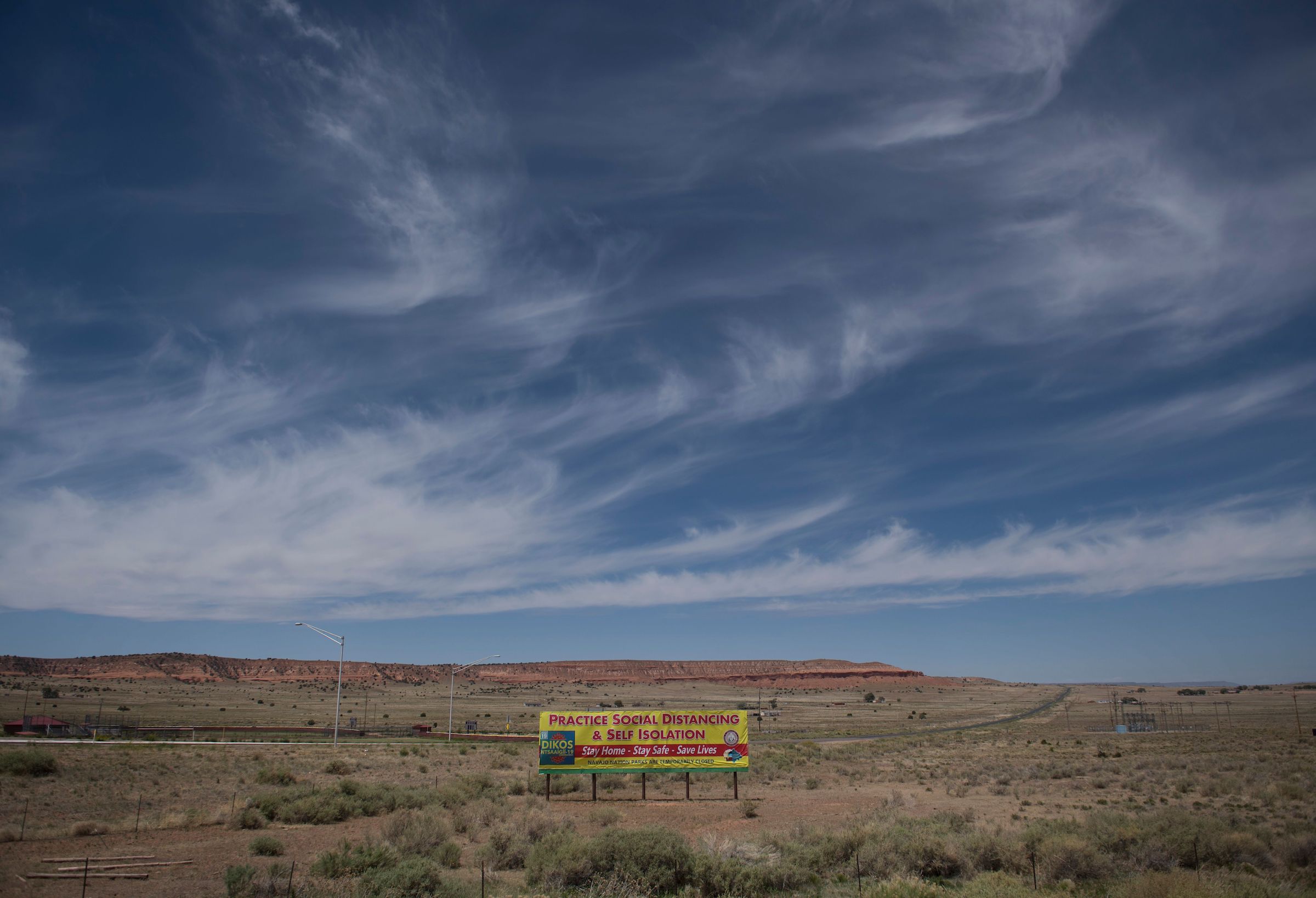
A sign promoting social distancing sits near the Navajo Nation town of Chinle during the 57 hour curfew imposed to try to stop the spread of the Covid-19 virus through the Navajo Nation, in Arizona on May 23, 2020.
Mark Ralston—AFP/Getty Images
Indigenous communities have long received worse care during pandemics and witnessed higher mortality rates than the rest of the population. The New Zealand MÄori mortality rate during the 1918 Spanish flu was 7.3 times higher than the non-Indigenous mortality rate. During the H1N1 Swine Flu outbreak in 2009, Indigenous Canadians accounted for 17.6% of deaths even though they account for only 4.3% of the country’s population.
“Historically, we have not been treated well when it comes to pandemics,†says Chief David Monias of the Pimicikamak Cree Nation in northern Manitoba. “While the rest of Canada received services [during previous pandemics], we were just left to die.â€
The lack of federal support for Indigenous communities is particularly dangerous, given that these communities—who face higher rates of chronic illnesses—are more vulnerable to COVID-19.
While experts say there is no single reason for why Indigenous populations face poorer health outcomes, Stephane McLachlan, a researcher looking into effective responses to COVID-19 for Indigenous populations says it can be explained by “the long standing impacts of colonization†which have left Indigenous people poorer on average and lacking access to nutritious food, clean water and adequate housing.
As well as higher rates of chronic illnesses that make them more vulnerable to the coronavirus, Indigenous communities often cannot implement precautionary measures to stop the virus spreading rapidly.
In Canada, at least 61 First Nations communities have not had access to safe drinking water for at least a year. While some non potable water sources can be effective for washing hands, the Canadian government says that communities on a “Do Not Use Advisory†should not use tap water for washing hands. “The government keeps telling people to wash their hands,†Meredith Raimondi, a senior manager from the United States National Council of Urban Indian Health. “But how are Indigenous people supposed to do that when they don’t have clean water?â€
For many Indigenous people living in overcrowded homes, social distancing or isolation is also impossible. Aboriginal and Torres Strait Islanders are 16 times more likely to be living in an overcrowded house than non-Indigenous Australians.
This was the case for Freeland, who like many Native Americans, lives with his extended family. Both his parents fell ill with the virus after he contracted it. “So many of us live in close quarters,†he says. “By the time my symptoms started to show, it was too late.â€
Keep up to date with our daily coronavirus newsletter by clicking here.
Indigenous people also disproportionately struggle to access medical services if they do fall ill with COVID-19. Some Indigenous communities live in remote areas where governments have not invested in health infrastructure, resulting in people having to travel hundreds of miles to reach the nearest medical facility. In Northern Canada, many communities cannot be accessed by road and require planes or boats. Some remote communities in Australia only have a single nurse present on the ground, with doctors consulting patients over the phone.
“So many Native Americans have to drive for hours to see a doctor or get to a grocery store,†Freeland says, noting that he is lucky he lives within close proximity to hospital facilities. “I wouldn’t have made it if, like other Native Americans, I had been a little further away.â€
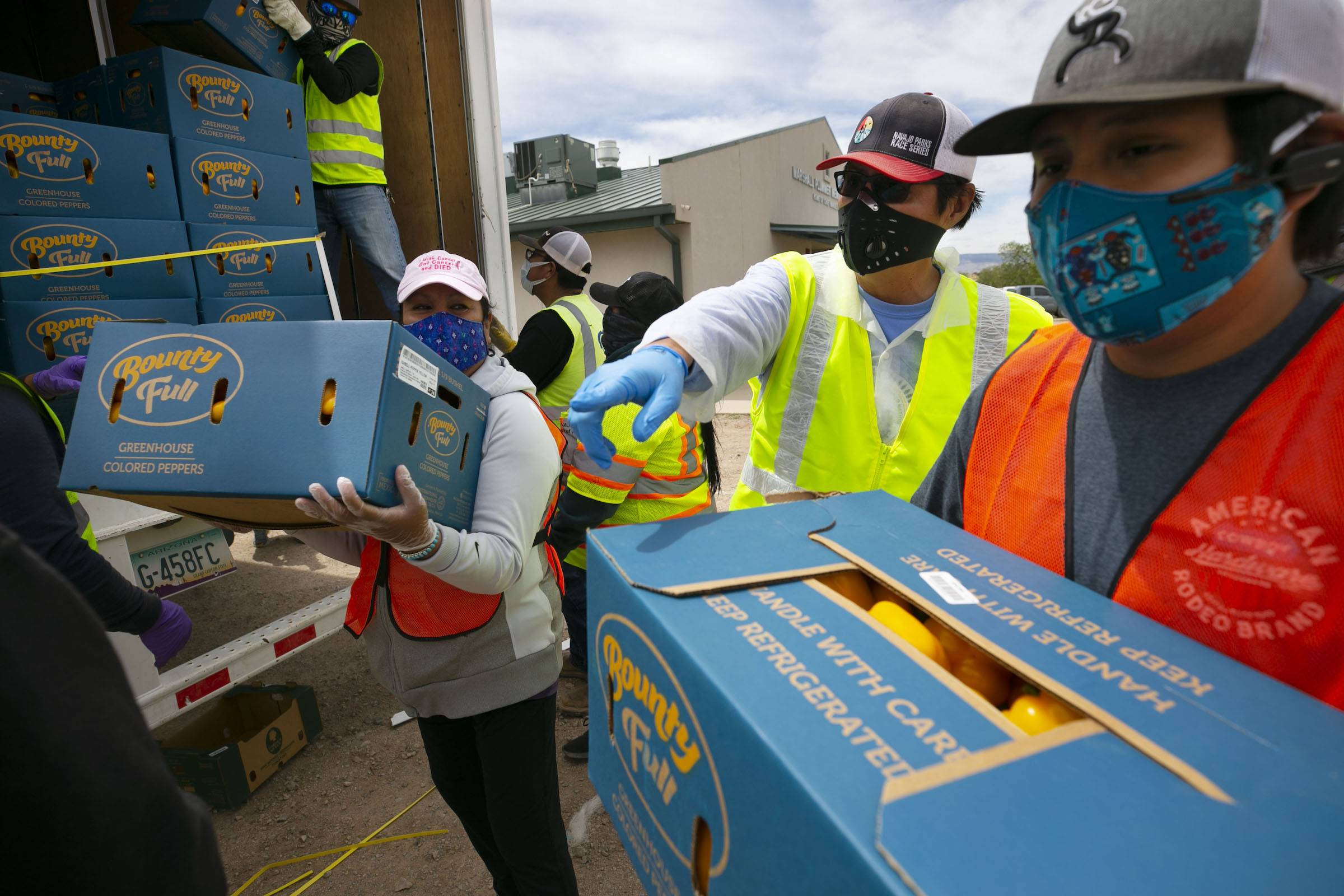
Navajo Nation President Jonathan Nez, center, and Isaiah Tsosie, right, an office specialist with the Coyote Canyon chapter, move food for distribution in Coyote Canyon, N.M., on the Navajo Nation on May 15, 2020.
David Wallace—The Republic/USA Today Network/Sipa USA
For all the challenges Indigenous communities face—from a lack of federal funding to higher rates of pre-existing comorbidities that increase vulnerability to COVID-19—these communities have taken matters into their own hands. They say Indigenous led-responses are the key to mitigating the impacts of the virus.
“Money is a good start but it’s not the whole story,†says Shannon MacDonald, a Canadian Indigenous physician and deputy chief medical officer for First Nations Health Authority, a health service delivery organization in British Columbia. “It’s about communities having the ability to respond within the communities.â€
Because Indigenous people often face systemic racism when seeking out medical attention, MacDonald says that “some of our community members are reluctant to access services unless it’s absolutely necessary.†Indigenous health providers, who understand Indigenous cultures, have proven to be better equipped to develop culturally-sensitive public health responses for these communities.
Indigenous-led responses have already proven to be successful, and in some cases, more effective than federal responses.
The Lummi Nation, a sovereign Native American community in the Pacific North-West have been preparing for COVID-19 since the virus appeared in China, gathering additional medical supplies including test kits and creating the country’s first field hospital. The Nation declared a state of emergency on March 3, 10 days before the Trump Administration did and has implemented health measures including social distancing, drive-through testing, essential good deliveries for the elderly and phone call consultation with doctors. The Lummi reservation, home to 5,583 people, has had 40 cases as of May 2—an infection rate in line with the national average.
In Australia, Aboriginal communities have been less affected by the virus than anticipated, which experts attribute to having Aboriginal and Torres Strait Islander public health practitioners and researchers play a pivotal role in leading response efforts that are culturally sensitive. Aboriginal-led health services ensured that public health messages were communicated to communities in their local languages. Aboriginal communities also protected themselves by camping out in the bush to protect elders. Like many Indigenous Nations in Canada, some Australian Aboriginal communities also shut their borders before the federal government did to avoid disease transmission.
“We can’t be waiting for the government to decide,†says Myrle Ballard, a Canadian Indigenous researcher studying effective health responses to COVID-19 for Indigenous communities. “We Indigenous people know what is best for us.â€
Please send any tips, leads, and stories to virus@time.com
The Coronavirus Brief. Everything you need to know about the global spread of COVID-19
Thank you!
For your security, we’ve sent a confirmation email to the address you entered. Click the link to confirm your subscription and begin receiving our newsletters. If you don’t get the confirmation within 10 minutes, please check your spam folder.
I always keep a backup supply of butter in my freezer — for baking emergencies, and in case the craving for freshly made scones hits. And this morning, it did. So, I whipped up a recipe from the delightful Dawn Perry that I’ve had my eye on, with a few personal tweaks.
The biggest change was that instead of using frozen fruit as she suggests, I used a black-streaked banana on the counter. There was only one, not enough for banana bread, but just right for eight scones.
To make them, heat your oven to 400 degrees. Ms. Perry calls for putting 2 cups/255 grams all-purpose flour in a big bowl. But to give the scones some depth and earthiness, I substituted ¼ cup/30 grams buckwheat flour for an equal amount of all-purpose. Whole-wheat flour would also work, and if you’re going that route, you could swap in even more (though I wouldn’t want any more buckwheat flour, it’s pretty intense).
Then add 1 tablespoon baking powder, ¾ teaspoon fine sea salt, ¼ cup/50 grams granulated sugar, and 2 tablespoons dark brown sugar. Or use all brown sugar or all granulated. This amount of sugar gives you a nicely sweet scone with a crisp crust, but you can also use less sugar.
Whisk it all up. Then, using the large holes on a grater, shred in 1 stick (1/2 cup/115 grams) frozen or very cold butter. Using frozen butter gives you slightly lighter scones, especially if your kitchen is warm, but there’s not a huge difference if you don’t keep butter stockpiles in the freezer.
Toss it with your hands so the butter distributes evenly, squeezing and pinching if it blobs together. Then add a diced ripe banana — or about a cup of any other fruit you like, fresh or frozen. Finally, mix in a teaspoon or so of vanilla extract and ¾ cup/180 milliliters dairy product — the richer, the better. Ms. Perry uses ½ cup/120 milliliters sour cream thinned down with ¼ cup/160 milliliters whole milk. I used Greek yogurt thinned down with heavy cream. Use what you’ve got, nondairy also works fine here.
The dough will be very sticky and clumpy, but don’t add flour if you can avoid it. The wetter the dough, the more tender the scones. Dump this almost unmanageable mess out on a floured countertop and squish it together with your very sticky hands, patting it into a 1-inch-thick round if you want wedge-shaped scones, or a rectangle if you want square scones. Then cut out eight pieces. If you have a metal bench knife, this is a good place to use it because you can measure the thickness (there’s usually a ruler on the edge). Cut with it, and use it like a spatula to move the scones to a parchment paper-lined or greased baking sheet.
Brush the scones with a beaten egg to make them glossy brown. (I threw the rest of the egg in my daughter’s smoothie.) Bake for 15 to 20 minutes, until golden-topped and just firm to the touch.
Then eat warm. I slathered mine with salted butter. But even I have to admit it might have been overkill … or then again, maybe it was just right.
This is part of a series in which Melissa Clark teaches you how to cook with pantry staples. See more.
At 7 a.m. on April 30, Pietro Demita and Silvana Persano, the owners of Diamond Couture, which specializes in wedding gowns, were already busy in their atelier in Veglie, Italy.
The business partners had chosen nine gowns from their latest collection, hung them on a rack and dragged them in front of their warehouse. Scissors in hand, Mr. Demita and Ms. Persano, each wearing face masks, cut through corsages of white lace and skirts of tulle, thrusting the shreds into a large yellow and blue bin. Mr. Demita set the pile on fire with a lighter.
The burning was filmed by a friend and used to address “people in power,†he said, about the plight of the country’s wedding industry.
According to the Italian National Institute of Statistics, 190,000 to 195,000 weddings are registered every year in Italy. When these are celebrated with a party, they sustain an industry worth an estimated 40 billion euros ($44 billion) employing 83,000 companies. Additionally, 540 million euros ($593 million) are generated by about 10,000 wedding celebrations organized by foreigners in Italy, who often purchase their wedding dresses in the country.
“If my dreams have to be turned into ashes, I prefer doing it myself,†Mr. Demita said.
Diamond Couture presented its latest collection in April 2019 at Sì Sposaitalia Collezioni, an international trade show in Milan for bridal and formal wear. The event showed 220 bridal collections in 2019. Orders for gowns were taken during the buying appointments at the fair and delivered between September and October. The company always agreed to start crafting the ordered dresses without a deposit. The payments would be sent in March of the following year.
Mr. Demita’s and Ms. Persano’s annual production grew from 49 gowns to more than 1,000 within 13 years.
But on March 9, the Italian government announced stringent quarantine measures. Eighty percent of the weddings for which Diamond Couture had orders for gowns were postponed with the rest being canceled. Mr. Demita and Ms. Persano faced empty cash registers.
Italy was the first Western country to impose a national lockdown, on March 4, which suspended all businesses. With 33,072 Covid-19-related deaths as of May 27, Italy has the third-highest figure, only ranking behind the United Kingdom (37,460) and the United States (101,392).
Restrictions in Italy were lifted May 18, but social-distance measures are still being enforced throughout the summer, pushing most weddings planned during the sought-after period from April through September to the fall or next year.
The practice of delayed payments is common among small businesses in Italy, and it is especially widespread in the wedding industry as it allows retailers to collect the payments for the gown in installments.
Larger companies and small outfits operating in the higher-end segment try to steer clear of it. Nicole Spose by Nicole Cavallo has asked brides to pay off dresses by the date on which the wedding was originally planned, not the newly scheduled date in the future. “The majority understands the situation and has agreed,†Ms. Cavallo said in a phone interview. But, she noted, “some aren’t that happy about it.â€
The payments are necessary, Ms. Cavallo said, to cover the cost of keeping gowns in her atelier for longer than originally planned.
Still, shops are without their usual orders and deposit money. To make up for the canceled fashion show in April, Ms. Cavallo offered future brides online consultations to jump-start new orders and deposits.
A similar service will be rolled out by Antonio Riva in Milan at the beginning of June. Mr. Riva, who starts producing only upon receipt of a deposit and delivers only when gowns are paid in full, hopes to be able to deliver his gowns by October, as usual. “We are in a lucky position because everything is made in Italy and our business partners understand our needs,†he said.
Larger losses were suffered by companies like Carlo Pignatelli in Turin, Italy, which specializes in formal attire for men. “While brides start looking for a gown nine to six months before the event, men start only three to two months before,†said Francesco Pignatelli, the creative director of the house. His company received all payments for its 2019 bridal dress collection in the fall of the same year. However, since 80 percent of the company’s total sales is generated by men’s suits, which typically sell between February and April, Mr. Pignatelli expects a 50 percent drop in the companies’ annual revenue.
To date, no company in Italy has received the government’s monetary aid to provide for furloughs. Businesses have had, instead, to advance salaries for about two months, putting their finances under further strain.
Wedding gown makers remain hopeful that they will recover in 2021; they expect to set a record in the production of gowns after social restrictions are lifted.
Yet, it seems inevitable that smaller businesses will suffer.
“The year 2020 is compromised,†said Serena Ranieri, the president of Feder Matrimoni ed Eventi Privati, a group that represents businesses involved in weddings and private events. “It is a collapse that the sector is unable to absorb and which will cause closures and bankruptcies, with consequent job losses and a devastating impact also for the companies in the supply chain which miss most of the customers.â€
Mr. Demita said he and Ms. Persano are using their savings to get by, “but sooner or later, the water in the well runs out.â€
In the meantime, in Milan, Emanuele Guido, the director of Sì Sposaitalia Collezioni, is working on the next edition of the fair, which has been postponed from April until September. “It is an experiment,†Mr. Guido said of how many exhibitors will actually show up in the month when they usually deliver gowns.
Will Diamond Couture attend? Mr. Demita sighed. “Frankly, I do not know.â€
PARIS — Signaling intentions to continue seeking to cultivate an inclusive working environment, Kering issued a statement Friday expressing support for the LGBTQ community, relaying the message at the outset of Pride month.
Pride month kicks off in June amid rising concern that respect for diversity could fall by the wayside in an environment of deep economic and social upheaval due to the coronavirus pandemic.Â
The luxury goods group’s comments indicate the topic will remain a priority for the company.
Kering listed a number of measures it has taken to promote inclusivity, including its group-wide family leave policy for new parents, signing a Friends of the Court brief in the U.S. calling for civil rights for LGBTQ communities, and setting up an internal group dubbed “All†that focuses on raising awareness on LGBTQ issues both inside the company and externally, in the U.S., Brazil, Qatar, Italy, France, the U.K. and Australia.Â
The luxury company also cited Balenciaga’s “Love Is for Everyone†campaign and Gucci’s Chime for Change initiative.
Minnesota Governor Tim Walz urged an end to the violence over George Floyd’s death that has shut down libraries, businesses and the light rail system, as it was taking attention away from the institutional racism that led to another loss of life.
“We have to restore order to our society before we can start addressing the issues,” Walz said at a Friday press conference. “Before we turn back to where we spend our energy, making sure justice is served swiftly and making sure we learn something from what George Floyd gave on Monday.”
Days-long unrest in response to Floyd’s death turned violent as protesters and law enforcement clashed and looters entered hundreds of businesses in the area. On Thursday night, rioters set the Minneapolis Police Departments’ 3rd Precinct building on fire.
Walz activated the National Guard, and more than 500 soldiers were brought in to “provide safety and protection” to people in the Minneapolis area. Minnesota National Guard Adjutant General, Major General Jon Jensen, said troops were trained to “protect life, preserve liberty and ensure people’s right to peacefully demonstrate.”
The governor acknowledged during Friday’s press conference that it’s difficult for people to differentiate between the Minneapolis Police Department–where the four officers were employed–and the National Guard. As a white man, he said he wouldn’t patronize people of color by claiming to understand their experiences, but asked that everyone help them to “use a humane way” to restore the streets to a place where people who are demanding justice can be heard.
“It’s time for us to clean our streets. It’s time for us to execute today in a way that shows respect and dignity to communities. I’m going to ask a lot of help today of the folks that want to see it,” Walz said. “It is my expectation that justice for the officers involved in this will be swift, that it will come in a timely manner and that it will be fair.”
Protesters throw objects into a fire outside a Target store near the Third Police Precinct on Thursday in Minneapolis, Minnesota, during a demonstration over the death of George Floyd. On Friday, Governor Tim Walz urged an end to the violence so that officials could address the institutional racism that caused Floyd’s death. KEREM YUCEL/AFP/Getty
Pursuing justice for Floyd’s death and addressing the institutional racism that allowed him to be killed in broad daylight cannot be done as the situation on the ground stands now, Walz said. He acknowledged that there is immense amounts of pain and change is needed. But Waltz also said the looting and burning of the city was taking attention away from building a future for Minnesota and answering the tough questions.
Minnesota Attorney General Keith Ellison also urged people to not take the anger they have at the Minneapolis Police Department out on the National Guard. He reminded them that a week ago, members of the National Guard were helping with COVID-19 testing. “Please remember this is not the group that you associate with unfair conduct,” he said.
Newsweek reached out to the Minneapolis Police Department for comment but did not receive a response in time for publication.
On Monday, officers were called to the scene after receiving a call that Floyd, a 46-year-old man, allegedly tried to use a fake $20 bill at a store. They arrived around 8 p.m. local time and handcuffed Floyd after asking him to get out of a car he was sitting in.
In a video posted on social media, Floyd is seen on the ground with his face pressed to the pavement as an officer, later identified as Derek Chauvin, presses his knee into the back of Floyd’s neck. Floyd repeatedly told officers he couldn’t breathe and when told by one of the officers to “get up,” the 46-year-old said, “I will, I can’t move.”
Officers called EMTS around 8:30 p.m., after Floyd stopped moving, and the 46-year-old was pronounced dead at the hospital an hour later.
All four officers–Chauvin, Thomas Lane, Tou Thao and J. Alexander Kueng–were fired from the Minneapolis Police Department on Tuesday. Minneapolis Mayor Jacob Frey called it “the right call,” but their termination did little to squelch calls for justice.
Demands are mounting for the officers to be charged, and while officials have promised to deliver justice, they’re also urging people to be patient. Ellison told CNN on Friday that without an “airtight case” it could fall apart. And while Hennepin County Attorney Mike Freeman was appalled by the video, he said police brutality cases can be complex and he needs to be able to prove an officer violated a criminal statute.
Walz thanked God during the briefing that someone was on the scene with a camera to videotape the encounter.
“There isn’t a person here or listening today that wonders how many times that camera’s not there,” he said. “These are tough questions, these are things that have been brewing in this country for 400 years.”
PARIS — French President Emmanuel Macron is hoping to use national and EU financial firepower to rescue crucial companies and bolster their roles as champions — that makes Renault a problem.
The French carmaker is bleeding red ink and on Friday announced a three-year restructuring plan, with 4,600 jobs set to go in France alone as part of a global effort to cut costs by €2 billion.
The pandemic, which saw Renault’s car sales in France fall by 83.8 percent in April, has only accelerated the carmaker’s decline to a struggling brand buckling under the weight of a costly transition to clean mobility while locked in a troubled alliance with Japanese automaker Nissan.
“The kind of [health] crisis we have just come through has forced us to act,” said Renault’s Chairman Jean-Dominique Senard at a press conference announcing the restructuring plan. He said the coronavirus had simply made the need to reform “more urgent.”
Jobs cuts, closing factories and angry workers are a problem for Macron.
“Today the company can longer take the weight of the expenses given the collapse of the market” — Jean-Dominique Senard, chairman of Renault
The French government has announced an €8 billion rescue package for the car industry, as well as a promised state guarantee for a €5 billion loan for Renault — as long as the carmaker strikes a deal with its unions over factory closures and joins fellow French carmaker PSA in the Commission-led project to build a European battery industry for electric cars.
On Friday, Senard said the company didn’t need the cash yet. He was also lukewarm on the need to invest in battery cell technology. “In batteries we are very well supplied for the years to come,” he said.
However, interim CEO Clotilde Delbos did say that electric motor production would be repatriated to France from China.
Saving companies like Renault — in which the French state has a 15 percent stake — is part of Macron’s post-pandemic vision of building up national and European champions able to do battle on global markets. The government gave Air France a €7 billion bailout, part of which involved assurances that the airline would continue to buy aircraft from Airbus — another industrial champion.
In comparison to PSA, which turned a profit and is gearing up to merge with Fiat Chrysler, Renault is in a much more difficult spot. It posted a €141 million loss last year, its alliance with Nissan is in tatters, and it needs to slash production.
The restructuring plan will see Renault cut 15,000 jobs worldwide, and start talks with its unions over what to do about excess production at some of its 14 French plants. “Today the company can longer take the weight of the expenses given the collapse of the market,” said Senard.
Renault is leaving the big decisions until after July 1 when Luca de Meo, the former boss of Volkswagen unit Seat, takes over as CEO.
“Why make a rather sad announcement like that of job losses without announcing a development plan,” asked Senator Olivier Jacquin, a French Socialist senator working on transport. “It’s a bit surprising from that point of view.”
Getting the job cuts out of the way now might clear the decks for new corporate leadership to set out long-term goals, but it does nothing help Macron steer his government through a major economic crisis. The prospect of mass redundancies also exposes him to political pressure.
We use cookies on our website to give you the most relevant experience by remembering your preferences and repeat visits. By clicking “Accept”, you consent to the use of ALL the cookies.
This website uses cookies to improve your experience while you navigate through the website. Out of these, the cookies that are categorized as necessary are stored on your browser as they are essential for the working of basic functionalities of the website. We also use third-party cookies that help us analyze and understand how you use this website. These cookies will be stored in your browser only with your consent. You also have the option to opt-out of these cookies. But opting out of some of these cookies may affect your browsing experience.
Necessary cookies are absolutely essential for the website to function properly. These cookies ensure basic functionalities and security features of the website, anonymously.
Cookie
Duration
Description
cookielawinfo-checbox-analytics
11 months
This cookie is set by GDPR Cookie Consent plugin. The cookie is used to store the user consent for the cookies in the category "Analytics".
cookielawinfo-checbox-functional
11 months
The cookie is set by GDPR cookie consent to record the user consent for the cookies in the category "Functional".
cookielawinfo-checbox-others
11 months
This cookie is set by GDPR Cookie Consent plugin. The cookie is used to store the user consent for the cookies in the category "Other.
cookielawinfo-checkbox-necessary
11 months
This cookie is set by GDPR Cookie Consent plugin. The cookies is used to store the user consent for the cookies in the category "Necessary".
cookielawinfo-checkbox-performance
11 months
This cookie is set by GDPR Cookie Consent plugin. The cookie is used to store the user consent for the cookies in the category "Performance".
viewed_cookie_policy
11 months
The cookie is set by the GDPR Cookie Consent plugin and is used to store whether or not user has consented to the use of cookies. It does not store any personal data.
Functional cookies help to perform certain functionalities like sharing the content of the website on social media platforms, collect feedbacks, and other third-party features.
Performance cookies are used to understand and analyze the key performance indexes of the website which helps in delivering a better user experience for the visitors.
Analytical cookies are used to understand how visitors interact with the website. These cookies help provide information on metrics the number of visitors, bounce rate, traffic source, etc.
Advertisement cookies are used to provide visitors with relevant ads and marketing campaigns. These cookies track visitors across websites and collect information to provide customized ads.