Saturday, April 25, 2026

Could There Be a More Difficult Time to Become an Arts Leader?

The Children’s Museum of Manhattan had planned to announce the appointment of Aileen Hefferren as its new chief executive and director on Tuesday. But the board decided to wait till Wednesday in deference to Blackout Tuesday, a social media action intended to show solidarity with the protests over the death of George Floyd.

The Children’s Museum is among a growing number of arts institutions from New York to Virginia to Colorado trying to navigate the sensitive, uncharted territory of making major appointments and initiating new cultural leaders in this difficult cultural moment.

And new appointees find themselves stepping into positions of leadership made much more complicated by questions such as when and how to safely reopen, how to stem financial losses caused by the pandemic and how to respond to a country convulsed by unrest.

Often, the announcements have been drowned out by the drumbeat of news that has accompanied the coronavirus outbreak — namely layoffs and furloughs — and by the more recent demonstrations in scores of American cities.

“They’re looking for people who are tested, with a level of competence and confidence that will inspire them to feel comfortable, as well as give the staff comfort that this person understands what they’re up against,” said Sarah James, who specializes in cultural executive searches at the firm Phillips Oppenheim. “Nobody really knows how to deal with this.”

Since Ms. Hefferren doesn’t take the position until Sept. 15, the Children’s Museum might have waited even longer, but it was eager to get things moving, in light of pressing matters like seeking public approval for its new home in a former church on Central Park West; the need to reconceive its interactive exhibitions with coronavirus considerations in mind; and the economic losses resulting from months of lockdown.

“We certainly expect her to lead and take charge of reimagining what our institution can and should be,” said Matt Messinger, a co-chairman of the museum’s board.

Over the last three months, Timothy R. Rodgers became the new director of the Phoenix Art Museum; Kathleen Bartels was named the next executive director of the Museum of Contemporary Art in Toronto and Nicola Lees was appointed head of the Aspen Art Museum.

Other new hires include Jaynelle Hazard, director at the Greater Reston Arts Center in Reston, Va.; Amanda Lahikainen at the Ogunquit Museum of American Art in Maine; and Matthew Clarke at the Design Trust for Public Space in Manhattan. Becca Hoffman is the new managing director of three art fairs — in Aspen, Chicago and Palm Springs.

“It’s a very unique time to accept a new role,” Ms. Hoffman said. “It’s been a challenge.”

While institutions might be expected to suspend hiring, some have accelerated or even initiated searches, given the current need for strong leadership. But candidates want to make sure that the boards doing the hiring aren’t looking for business as usual. “They don’t want to just come in and stabilize, because nobody believes in going back,” Ms. James said of candidates. “Everybody believes you’re going to die as an institution or you’re going to go forward as something better.”

Executives’ job descriptions are changing under their feet, requiring skills in handling not only a global health crisis but also issues of racial equity. Ms. Hefferren’s background would seem to make her well-equipped to lead the Children’s Museum, given that she comes from Prep for Prep, the nonprofit organization that offers promising New York City students of color access to a private school education.

She said she hopes to bring that experience to her new position, expanding the museum’s outreach to families in homeless shelters, for example, affordable housing residents and incarcerated parents. “It’s definitely a challenging time for our country and for New York,” Ms. Hefferren said. “But it also just makes the need for the Children’s Museum that much more apparent.”

The museum, on West 83rd Street in Manhattan, continues to move forward with its ambitious renovation of a former church that it bought for $45 million on Central Park West at 96th Street, which goes before the Landmarks Preservation Commission next month. Because its typically hands-on installations have yet to be designed, the museum will be able to make adjustments in light of social-distancing considerations.

Ms. Hoffman, the former director of the Outsider Art Fair — who now oversees Intersect Aspen (formerly Art Aspen); Sculpture Objects Functional Art and Design Chicago; and Art Palm Springs — has started her position at a time when the future of art fairs seems to hang in the balance with the current bans on large gatherings.

Many in the art market predict that the proliferation of art fairs over the last few years will shake out, leaving only the strongest standing, and that the pivot to online formats may force galleries to reassess whether the steep cost associated with a fair (including travel, shipping and insurance) is worth it.

But Ms. Hoffman remains optimistic. “I don’t think that they will ever go away,” she said. “But I believe there will be more of a regional focus moving forward and you will need to have a proper digital presentation. You need to have the connectivity for people who aren’t going to recover from this as quickly as others.”

The obstacles, she said, include trying to network in places like Aspen — where her first (now virtual) fair is coming up on July 22 — without being able to meet face-to-face. “It’s kind of like, ‘Please introduce me to this person, please introduce me to that person,’” Ms. Hoffman said. “It’s a big hurdle to ingratiate yourself in a community when it’s on the phone or on Zoom.”

Ms. Hazard was selected to run the Greater Reston Arts Center in Virginia just as the pandemic was descending. “The interview process was completely on Zoom — I still haven’t met my staff or my board of directors,” she said. “I’m focusing on what I have control over — my mind, my schedule, my well-being — rather than what I don’t have control over: the virus, the justice system.”

She has instead taken proactive steps such as bringing the museum’s exhibitions online and rewriting its diversity statement. “We have to constantly think about how to impact our communities and stand behind them,” Ms. Hazard said, “to confront hate, to use compassion, to use empathy.”

Mr. Rodgers in Phoenix has been thinking about how to be helpful to local galleries that are struggling — perhaps displaying (without selling) their artists’ work on the walls of the museum’s restaurant. “The museum exists within a larger community and ecology of art,” he said. “How is it that we can sustain and grow back what it is that we’re losing during this?”

To be sure, the moment has also been challenging personally. Ms. Bartels had to start her Toronto job while living in an Airbnb and has yet to be able to look for permanent housing. And none of these promotions is getting the usual laudatory attention. But appointees say acknowledgment is an afterthought; there is too much work to be done. “It’s a chance to be a leader and to lead on an issue we all care about — the importance of public space,” said Mr. Clarke of the Design Trust. “We need to lean into that.”

Above all, newly appointed cultural leaders say, they realize that the world has limited bandwidth right now, not to mention more urgent concerns.

“At the end of the day, I want everybody to be safe,” Ms. Hoffman said. “I don’t need to do my own celebration. I just want us to get to a place where we can all come out and actually feel comfortable seeing one another.”

Source link

Lidar reveals the oldest and biggest Maya structure yet found

0

Ancient Maya society got off to a monumentally fast start
around 3,000 years ago.

Excavations and airborne mapping at a previously unknown
site in Mexico, called Aguada Fénix, have uncovered the oldest and largest
known structure built by Maya people
, say archaeologist Takeshi Inomata of
the University of Arizona in Tucson and his colleagues. This raised ceremonial
area made of clay and earth was constructed from around 1000 B.C. to 800 B.C.,
the scientists report June 3 in Nature.

The new discovery adds to recent evidence that from its very
beginnings around 3,000 years ago, the
Maya civilization built monumental structures
(SN: 4/25/13). A similar but smaller ritual area previously
discovered by Inomata’s team at a Maya site in Guatemala called Ceibal dates to
950 B.C.

The finds run counter to the idea that Maya society developed
gradually from small villages to urban centers with pyramids and other massive buildings,
as some scientists have suggested. Those Maya cities and kingdoms of what’s
known as the Classic period didn’t flourish in parts of southern Mexico and
Central America until around A.D. 250 to 900.

What’s more, the study is yet another example of how an airborne remote-sensing technique called light detection and ranging, or lidar, is dramatically changing how archaeological research is done in heavily forested regions. The technique, which uses laser pulses to gather data on the contours of jungle- and vegetation-covered land, has uncovered other lost ruins at the Maya city of Tikal in Guatemala (SN: 9/27/18) and a vast network connecting ancient cities of Southeast Asia’s Khmer Empire (SN: 6/17/16), among other finds.

It’s difficult to see remains of Aguada Fénix from this aerial view of the landscape today. But laser technology gave researchers a look at the site’s causeways and reservoirs, in front, and ceremonial area, in back.T. Inomata

In the new study, researchers turned to lidar to peer
through forests in Tabasco, Mexico and uncover the previously hidden surface
remains of 21 ceremonial centers, including Aguada Fénix. Lidar maps showed that
each site contains a round or square mound near a long, rectangular platform,
running west to east. That layout characterizes similar structures in areas
where public rituals were held in many later Maya cities.

Inomata’s team then used the lidar maps to focus on Aguada Fénix.
There, the scientists found an elevated, rectangular plateau measuring about 1,400
meters long and nearly 400 meters wide. Within that space is a roughly 400-meter-long
platform — the length of more than four American football fields — positioned
east of a 15- to 18-meter tall earthen mound. Lidar revealed other structures
around the human-built plateau, including rectangular buildings, plazas and
several reservoirs.

Discoveries at Aguada Fénix challenge a traditional
assumption that only large settlements directed by kings and a ruling class could
organize and execute big building projects, Inomata says. No remnants of a royal
class that appear at later Maya sites, such as sculptures of high-ranking
individuals, have been found at the site so far. People living in the region
around Aguada Fénix, who were cultivating maize by 3,000 years ago, must
have banded together to create a ritual site suitable for large gatherings, he
suggests.

“Though there were probably some [Aguada Fénix]
leaders who played central roles in planning and organizing such work, the main
factor was people’s voluntary participation, which does not necessarily require
a centralized government,” Inomata says. Large crowds from surrounding areas
probably gathered at the ancient ceremonial site on special occasions, possibly
related to key calendrical dates and astronomical events, Inomata suspects.
Nine causeways connected to the site’s rectangular platform carried processions
of those participating in rituals, he suggests. A set of jade axes excavated in
the center of the platform may have been deposited during a ritual event.

Inomata’s conclusions make sense to anthropological
archaeologist Andrew Scherer of Brown University in Providence, R.I. “The
public spaces at Aguada Fénix are huge, and there is nothing to indicate that access
was limited to a privileged few,” says Scherer, who did not participate in the
new study.

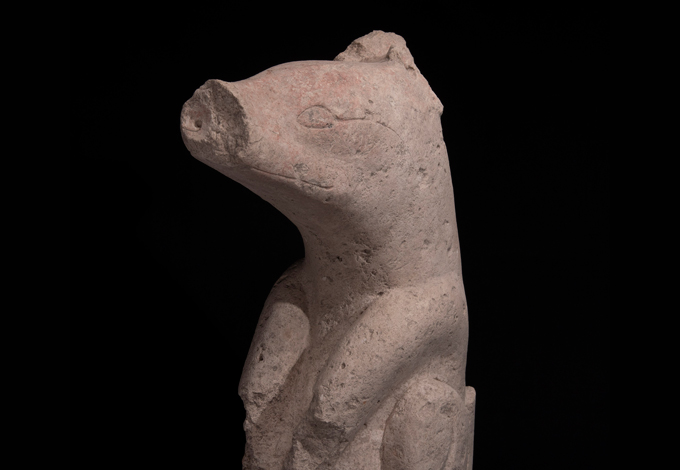
A limestone animal sculpture found at the site, possibly
representing a white-lipped peccary or a coatimundi, contrasts with sculptures
at later Olmec and Maya sites that celebrated supernatural beings and human
leaders who governed ranked societies, Scherer says. While the meaning of the
newly discovered sculpture to its makers is unknown, there is no evidence that
animal depictions such as this referred to high-ranking Maya individuals.

Maya animal sculpture
Excavations of the oldest and largest Maya ceremonial structure unearthed an animal sculpture, possibly representing a white-lipped peccary or a coatimundi, that the researchers nicknamed Choco.T. Inomata

Francisco Estrada-Belli , an archaeologist at Tulane
University in New Orleans, awaits further excavations at Aguada Fénix
before assuming its structures were built by a community without a social
hierarchy. But the large platform and surrounding plaza at Aguada Fénix
resemble those at a slightly older Olmec site, suggesting the two civilizations
developed in parallel, says Estrada-Belli, who was not part of the new
research.

Some researchers have argued that the Olmec society, which
was located west of Aguada Fénix near Mexico’s Gulf Coast and is
known for constructing giant stone heads, served as a “mother culture” for the
Maya. That mysterious culture arose around 3,500 years ago and lasted until
roughly 2,400 years ago. But Inomata suspects a more complicated situation
existed in which Maya and Olmec people influenced each other’s ritual practices
between around 3,000 and 2,800 years ago.

The Maya expanded on an Olmec tradition of building long
platforms and developed ritual areas featuring a western mound or pyramid and
an eastern long platform, Inomata says. That Maya practice then appeared at an
Olmec site called La Venta, which flourished between 800 B.C. and 400 B.C.

Inomata’s scenario suggests that the two ancient societies may have been more like older and younger siblings than mother and child.

Source link

Trump Claims He Went To White House Bunker During Protests ‘For An Inspection’

President Donald Trump on Wednesday denied that he was rushed to a White House bunker during anti-racism protests last week out of concern for his safety, claiming he had merely dropped by the underground shelter to inspect it.

“I was there for a tiny, little short period of time,” Trump said during a radio interview with Fox News’ Brian Kilmeade. “And it was much more for an inspection.”

He continued: “I’ve gone down two or three times ― all for inspection. And you go there, some day you may need it. … I went down, I looked at it.”

Secret Service reportedly rushed Trump to the bunker, known as the Presidential Emergency Operations Center, on Friday night as hundreds of protesters gathered outside the White House during nationwide demonstrations sparked by George Floyd’s death in Minneapolis.

Trump spent nearly an hour in the bunker, which was designed for use in emergencies like terrorist attacks, a Republican close to the White House told The Associated Press.

Then-President George W. Bush and Vice President Dick Cheney were brought to the bunker in the wake of the Sept. 11 terrorist attacks. The structure has been reinforced to withstand the force of a passenger jet crashing into the executive mansion above.

Trump and his family were rattled by their experience Friday night, The New York Times reported, citing multiple advisers.

Kilmeade asked Trump about whether he was brought to the bunker on Sunday. It’s unclear whether Kilmeade meant to ask about Friday, which is when Trump was reported to have been escorted to the bunker.

Either way, Trump denied going there at any time during the night.

“It was during the day,” he told Kilmeade. “It was not a problem. … We never had a problem. Nobody came close to giving us a problem.”

Asked if Secret Service wanted to bring him down there for safety reasons, Trump said no.

“They didn’t tell me that at all,” the president said. “But they said it would be a good time to go down, take a look because maybe sometime you’re going to need it.”

Protests outside the White House intensified over the weekend, with some demonstrators throwing rocks and trying to break through barricades.

In a dramatic speech Monday from the White House Rose Garden, Trump vowed a violent crackdown by the military on civil unrest in U.S. cities amid the anti-racism protests. He then walked with a group of aides to nearby St. John’s Episcopal Church for a photo-op.

Moments earlier, federal law enforcers sprayed tear gas and fired rubber bullets to disperse a crowd of peaceful protesters in front of the White House.

Trump wanted to be seen outside, in part, because he was angered by coverage that depicted him as hiding in a bunker during the protests, CNN reported.


Source by [author_name]

Nikil Saval, the N+1 Candidate

“Winning begets winning and the progressives have turned into a progressive machine that’s completely different from the old Philly machine,” she said. As if to illustrate her point, the powerful union led by Ms. Dicker’s other 2008 opponent, Mr. Dougherty, recently endorsed Mr. Saval’s campaign and contributed $25,000 to his campaign.

“​We were kind of holding our fire,” said Frank Keel, a spokesman for the union, who confirmed the endorsement. “In the last ten days or two weeks it really started to coalesce around Nikil.”

Asked about the union’s endorsement, Mr. Farnese’s campaign manager, Rajah Sandor, said: “Nikil Saval likes to hold himself up as some bastion of integrity, but when it comes down to it, he’s just a typical politician who will toss his moral code out the window for a chance at $25,000 from a political boss.”

Mr. Saval, in response, said that he was a labor candidate and the contribution represented union members’ dues. (Mr. Farnese has also been endorsed by a number of labor unions, including the Pennsylvania AFL-CIO.)

Some endorsements have arrived after the campaign dynamics may already have been scrambled by remote voting. Ben Waxman, a former spokesman for the Philadelphia District Attorney Larry Krasner who is friendly with both candidates, said that in normal circumstances, many voters would know little about down-ballot races. But those voting from home might have taken a moment to Google them.

If they did, they might find that earlier this month, Mr. Saval also received an endorsement from Bernie Sanders, giving his campaign new momentum. It’s an indication that Mr. Saval is seen by his allies as working on behalf of a national democratic socialist movement — one formed from a series of groundswells, including Occupy Wall Street and Black Lives Matter — that will push to tax the rich, focus on workers and address climate change, among other priorities.

Source link

Defense Secretary: ‘I Do Not Support Invoking The Insurrection Act’

Defense Secretary Mark Esper said Wednesday he doesn’t support invoking the Insurrection Act, an 1807 law that would allow President Donald Trump to send U.S. armed forces into states for the purpose of domestic law enforcement.

“I do not support invoking the Insurrection Act,” Esper said at a news conference at the Pentagon. “The option to use active-duty forces in a law enforcement role should only be used as a matter of last resort and only in the most … dire of situations. We are not in one of those situations now.”

This is a developing story. Please check back for updates.


Source by [author_name]

Trump Administration to Block Chinese Airlines From Flying to the U.S.

The Trump administration on Wednesday said it planned to block Chinese airlines from flying into or out of the United States starting on June 16, after the Chinese government effectively prevented U.S. airlines from resuming service between the countries.

The dispute stems from a March 26 decision by China’s aviation regulators that limited foreign carriers to one flight per week based on the flight schedules they had in place earlier that month. But all three American airlines that fly between China and the United States had stopped service to the country by then because of the coronavirus pandemic. As a result, the Chinese government had effectively banned them from flying there at all, even though airlines from that country continue to fly to American cities.

As ground zero of the pandemic, China was the first country to see aviation grind to a halt this year. In January, American and Chinese carriers operated about 325 weekly flights between the two countries. By mid-Feburary, only 20 remained, all of them run by Chinese airlines.

The March decision became a problem only in recent weeks, as Delta Air Lines and United Airlines had hoped to resume flights to China starting this month. Both carriers appealed to the Civil Aviation Authority of China, but did not receive a response. The U.S. also pressed Chinese officials to change their position during a call on May 14, arguing that the country was in violation of a 1980 agreement that governs flights between the two countries and aims to ensure that rules “equally apply to all domestic and foreign carriers” in both countries.

China’s aviation authority told American officials that it was considering amending its rule, but it has not said “definitively” when that might happen, the Transportation Department said in a statement. “In light of these facts, which present a situation in which the Chinese aviation authorities have authorized no U.S. carrier scheduled passenger operations between the United States and China, we conclude that these circumstances require the department’s action to restore a competitive balance.”

Tensions between the United States and China have escalated sharply in recent weeks as the countries scuffle over the origin of the pandemic and China’s recent move to tighten its authority over Hong Kong, a semiautonomous city. With the presidential election just five months away, President Trump and his campaign have taken a much tougher stand against China, blaming its government for allowing coronavirus to turn into a pandemic and wreck the American economy.

In mid-May, the Trump administration expanded restrictions on Huawei, the Chinese telecom firm, and blocked a government pension fund from investing in China. Last Friday, Mr. Trump announced that he was beginning the process of ending the American government’s special relationship with Hong Kong, and that his administration would place sanctions on officials responsible for Beijing’s rollback of liberties in the territory.

  • Updated June 2, 2020

    • Will protests set off a second viral wave of coronavirus?

      Mass protests against police brutality that have brought thousands of people onto the streets in cities across America are raising the specter of new coronavirus outbreaks, prompting political leaders, physicians and public health experts to warn that the crowds could cause a surge in cases. While many political leaders affirmed the right of protesters to express themselves, they urged the demonstrators to wear face masks and maintain social distancing, both to protect themselves and to prevent further community spread of the virus. Some infectious disease experts were reassured by the fact that the protests were held outdoors, saying the open air settings could mitigate the risk of transmission.

    • How do we start exercising again without hurting ourselves after months of lockdown?

      Exercise researchers and physicians have some blunt advice for those of us aiming to return to regular exercise now: Start slowly and then rev up your workouts, also slowly. American adults tended to be about 12 percent less active after the stay-at-home mandates began in March than they were in January. But there are steps you can take to ease your way back into regular exercise safely. First, “start at no more than 50 percent of the exercise you were doing before Covid,” says Dr. Monica Rho, the chief of musculoskeletal medicine at the Shirley Ryan AbilityLab in Chicago. Thread in some preparatory squats, too, she advises. “When you haven’t been exercising, you lose muscle mass.” Expect some muscle twinges after these preliminary, post-lockdown sessions, especially a day or two later. But sudden or increasing pain during exercise is a clarion call to stop and return home.

    • My state is reopening. Is it safe to go out?

      States are reopening bit by bit. This means that more public spaces are available for use and more and more businesses are being allowed to open again. The federal government is largely leaving the decision up to states, and some state leaders are leaving the decision up to local authorities. Even if you aren’t being told to stay at home, it’s still a good idea to limit trips outside and your interaction with other people.

    • What’s the risk of catching coronavirus from a surface?

      Touching contaminated objects and then infecting ourselves with the germs is not typically how the virus spreads. But it can happen. A number of studies of flu, rhinovirus, coronavirus and other microbes have shown that respiratory illnesses, including the new coronavirus, can spread by touching contaminated surfaces, particularly in places like day care centers, offices and hospitals. But a long chain of events has to happen for the disease to spread that way. The best way to protect yourself from coronavirus — whether it’s surface transmission or close human contact — is still social distancing, washing your hands, not touching your face and wearing masks.

    • What are the symptoms of coronavirus?

      Common symptoms include fever, a dry cough, fatigue and difficulty breathing or shortness of breath. Some of these symptoms overlap with those of the flu, making detection difficult, but runny noses and stuffy sinuses are less common. The C.D.C. has also added chills, muscle pain, sore throat, headache and a new loss of the sense of taste or smell as symptoms to look out for. Most people fall ill five to seven days after exposure, but symptoms may appear in as few as two days or as many as 14 days.

    • How can I protect myself while flying?

      If air travel is unavoidable, there are some steps you can take to protect yourself. Most important: Wash your hands often, and stop touching your face. If possible, choose a window seat. A study from Emory University found that during flu season, the safest place to sit on a plane is by a window, as people sitting in window seats had less contact with potentially sick people. Disinfect hard surfaces. When you get to your seat and your hands are clean, use disinfecting wipes to clean the hard surfaces at your seat like the head and arm rest, the seatbelt buckle, the remote, screen, seat back pocket and the tray table. If the seat is hard and nonporous or leather or pleather, you can wipe that down, too. (Using wipes on upholstered seats could lead to a wet seat and spreading of germs rather than killing them.)

    • How many people have lost their jobs due to coronavirus in the U.S.?

      More than 40 million people — the equivalent of 1 in 4 U.S. workers — have filed for unemployment benefits since the pandemic took hold. One in five who were working in February reported losing a job or being furloughed in March or the beginning of April, data from a Federal Reserve survey released on May 14 showed, and that pain was highly concentrated among low earners. Fully 39 percent of former workers living in a household earning $40,000 or less lost work, compared with 13 percent in those making more than $100,000, a Fed official said.

    • Should I wear a mask?

      The C.D.C. has recommended that all Americans wear cloth masks if they go out in public. This is a shift in federal guidance reflecting new concerns that the coronavirus is being spread by infected people who have no symptoms. Until now, the C.D.C., like the W.H.O., has advised that ordinary people don’t need to wear masks unless they are sick and coughing. Part of the reason was to preserve medical-grade masks for health care workers who desperately need them at a time when they are in continuously short supply. Masks don’t replace hand washing and social distancing.

    • What should I do if I feel sick?

      If you’ve been exposed to the coronavirus or think you have, and have a fever or symptoms like a cough or difficulty breathing, call a doctor. They should give you advice on whether you should be tested, how to get tested, and how to seek medical treatment without potentially infecting or exposing others.


“The Chinese government has continually violated its promises to us and so many other nations,” the president said at the time. “The world is now suffering as a result of the malfeasance of the Chinese government.”

Ana Swanson contributed reporting.

Source link

George Floyd’s 6-Year-Old Daughter In Viral Video: ‘Daddy Changed The World’

George Floyd’s 6-year-old daughter, Gianna, has a message for everyone: “Daddy changed the world!”

The video, shared on Instagram Tuesday by NBA veteran Stephen Jackson, a longtime friend of the late Floyd, shows Gianna sitting on Jackson’s shoulders.

“That’s right GiGi, ‘Daddy changed the world,’” Jackson wrote in the caption. “George Floyd, the name of change.”

“Love to all who have love for all,” he continued, adding multiple raised-fist emojis in different skin tones.

Gianna’s father was killed by police last month when Minneapolis officer Derek Chauvin knelt on his neck for nearly nine minutes during an arrest over an allegedly counterfeit $20 bill. Chauvin has since been charged with third-degree murder and manslaughter while the three other officers present during the incident have yet to be charged.

Floyd’s death has sparked nationwide daily protests against police brutality and racism that have drawn a violent response from law enforcement, which has attacked peaceful demonstrators with tear gas, rubber bullets and even vehicles, citing looters and rioters as justification. The Trump administration also deployed military police this week in a show of excessive force.

The video of Gianna on Jackson’s shoulders was reposted on Twitter on Tuesday and immediately went viral.

Jackson, who called Floyd his “twin” in another Instagram post, spoke at Minneapolis City Hall in a press conference on Tuesday. Alongside him were Gianna and Gianna’s mother, Roxie Washington, who said she wanted everyone to know “what those officers took.”

“At the end of the day, they get to go home and be with their families. Gianna does not have a father,” said Washington. “He will never see her grow up, graduate, he will never walk her down the aisle. If there’s a problem she’s having and she needs her dad, she does not have that anymore.”

In response to Washington’s emotional statement, Jackson said: “There’s a lot of stuff you said that he’s gonna miss — that I’m gonna be there for.”

“I’m gonna walk her down the aisle. I’m gonna be there for her. I’m gonna be here to wipe your tears. I’m gonna be here for you and Gigi. Floyd might not be here, but I’m here for her, I’m here to get justice, and we’re gonna get justice for my brother,” he said.


Source link

Easing stress and seeking normalcy in traumatic times – Harvard Health Blog

0

For most Americans, 2020 has already been a rough year — and it’s not even half over. A pandemic, natural disasters, economic decline, and, for many, the loss of a job have taken a toll on their mental health.

“Stress is particularly acute when you’re experiencing a situation that is outside of your control,” says Dr. Kerry Ressler, professor of psychiatry at Harvard Medical School. “You may feel stuck, frozen, or helpless.” After a traumatic period, even when things settle down, it can be difficult to move on and regain a sense of normalcy.

Reducing stress and regaining your footing

So, how can you reduce your stress and regain your footing after going through a bad time, whether that’s the result of a large-scale national emergency or even just a personal patch of bad luck?

Step back. When traumatic events are occurring, whether it’s a natural disaster, pandemic, or mass shooting, you need to stay abreast of the news, but at the same time avoid retraumatizing yourself by becoming immersed in round-the-clock coverage, says Dr. Ressler. Limit the time you spend in front of screens or reading about the events of the day. The goal is to stay informed without increasing your anxiety level. Turn off the notifications on your phone, and be particularly wary of spending too much time on social media. “People have the tendency to amplify each other’s panic,” says Dr. Ressler. “Instead, limit your exposure to checking in on the news a couple of times a day, and then turn it off. Listen to an unrelated podcast, or go for a run.”

Take action. “What we do know from research is that one of the biggest precipitators of anxiety is a feeling of helplessness, when everything seems out of your control,” says Dr. Ressler. To take back some control, get involved in activities that can help others or address the situation. Volunteer, or help with food drives. Even helping a friend or a neighbor with a problem can make you feel like you are in an active, not passive, role in the face of uncertainty. Taking on a hobby or self-improvement project can also help you move forward. If you lose your job, use some of the unexpected time to take a class or learn a new skill you’ve always wanted to master. For example, there are a lot of great apps you can use to learn a new language.

Reach out. Social connections are crucial in difficult situations. If you can’t see people in person, then connect with apps and technology, such as videoconferencing or even a simple phone call.

Get rose-colored glasses. While advice to look on the bright side in the face of hard times may seem trite and unhelpful, don’t scoff. Evidence shows that positive thinking and having the ability to reframe a situation in more positive terms can help people become more resilient in the face of problems, says Dr. Ressler. Look for silver linings whenever you can. A job loss, for example, may lead to new opportunities.

Be patient. Moving on from a traumatic event takes time. Give yourself permission to grieve. Grief doesn’t just occur when you experience a death; rather, people experience grief in many situations, says Dr. Ressler. This may include the loss of an opportunity or missing out on something you were looking forward to doing. Allow yourself time to grieve, but eventually try to ready yourself to move past it. “You can get into the habit of grief,” says Dr. Ressler. So, set small goals. Use behavioral rewards, and strategies such as deep breathing, mindfulness, aromatherapy, and physical activity to reduce your anxiety and start pushing yourself to move forward.

Seek help for depression

Get help. Make sure that sadness and stress don’t cross over into depression. “The symptoms of depression overlap with normal symptoms of stress and grief,” says Dr. Ressler. But if you start to experience significant alterations in appetite, energy, or motivation, or if you begin to get sad or tearful without knowing why — and these symptoms last for more than a week or two — these may be warning signs that you are experiencing depression and need to seek medical help.

“If you have a period of sadness that goes on for more than a couple of weeks and it’s really getting in the way of you moving on or functioning at work or home, it may be wise to reach out,” says Dr. Ressler.

Call your doctor, or healthcare plan, to learn about options. Additionally, in the US, the Disaster Distress Helpline (800-985-5990, or text “TalkWithUs” to 66746) offers emotional support and resources to people struggling in the wake of disaster, and the National Suicide Prevention Hotline (800-273-8255) offers free support for people who are in emotional distress or a suicidal crisis.

Source link

Cook to Connect

Good morning. Concentration is hard to come by these days, amid the nation’s strife. We are living through a tough and chaotic and wrenching time, filled with fury and an abiding sadness. We’re unsettled. We’re tense. We’re divided. The emotions arrange themselves in combinations that make it hard to work, to read, to watch, to listen, much less to think.

Cooking can help. The act of preparing food is a deliberate and caring one, even if you’re just making yourself a bowl of oatmeal at the end of a long night of worry. The way you sprinkle raisins over the top is an intentional act of kindness to yourself. So what I’m doing now, amid my restless skimming of nonfiction and news, thrillers and literature, poems that don’t bring solace: I read recipes, think about who in my family they might please, and I cook.

It might be something simple — the omelet that Ferran Adrià makes using only eggs, butter and potato chips. Or something more complex, like Melissa Clark’s new recipe for a spicy grilled salmon salad with lime, chiles and herbs (above).

Yewande Komolafe’s recipe for ginger-cauliflower soup would bring a smile to one of my children, as would, for another, Clare de Boer’s recipe for grilled chicken skewers with tarragon and yogurt. (Works great under the broiler if you don’t have a grill.)

Here’s Samantha Seneviratne with a fresh strawberry pie, and Colu Henry with linguine and clam sauce, and Kim Severson with the congrí she learned to make from Yolanda Horruitiner during a reporting trip to Cuba. One of those may bring you comfort, or provide a point of connection for you with someone else, or with the wider world.

But it’s worth pointing out, you don’t always need a recipe, to cook and cook well and make others pleased. Sometimes the muse just arrives and that’s that. The other night, there was a big bag of plain tortilla chips in the back of the pantry, and I had some ground beef and cheese, a can of beans, some lettuce and limes, some sour cream and hot sauce. A small smile came upon me then, unbidden. I sautéed the beef, cooked the beans with onions and garlic, cumin and orange juice, melted the cheese with cream, heated the chips. Nachos spark joy.

Thousands and thousands of actual recipes are waiting for you on NYT Cooking. (I love these sweet potatoes with tahini butter, from Samin Nosrat.) A lot more of them than usual are free to use even if you aren’t yet a subscriber to our site and apps. (But I’ll ask you anyway: Would you think about subscribing? Your subscription allows our work to continue.)

And if something goes wrong along the way, either with your cooking or our technology, please get in touch: cookingcare@nytimes.com. We will get back to you.

Now, it won’t make you happy nor teach you to cook, but it’s still an important read: Michael Pollan on America’s broken food system, in The New York Review of Books.

For Outside, Carrie Battan visited Serenbe, a wellness community south of Atlanta, and it’s a surreal thing to read right now, like a dispatch from another time.

Finally, here’s Latria Graham in Garden & Gun, “A Dream Uprooted,” an essay about her fight to save her family’s farm. I’ll return on Friday.

Source link

Photo gallery: Ben Crump, the lawyer taking on black families’ loss

Ben Crump has represented a number of families whose loved ones have been killed, some at the hands of police.


Source link