Wednesday, April 29, 2026

UFC 250: Amanda Nunes to take another step on the way to GOAT status – Sport360 News

0

When she steps into the Octagon at UFC 250 this weekend, it will have been 2,079 days since Amanda Nunes tasted defeat.

That third-round stoppage against Cat Zingano in September 2014 left her with a 9-4 professional MMA record, having just been handed her first UFC loss.

The defeat was no disgrace by any means, she was fighting the woman considered the biggest threat to Ronda Rousey’s 135lbs crown, and had dominated the first round.

Her rawness was exposed in rounds two and three where she struggled to get up off her back, ultimately being finished with some vicious ground and pound – but that opening stanza had shown a flicker of both where she was as a fighter, and the potential that was there.

Her previous UFC outings has both ended in the same way – but with Nunes’ hand being raised on those occasions, but at that point in time few could have predicted how the last almost six years have panned out.

Physically she is a different woman. The muscularity in the arms and shoulders is there for all to see, and the explosiveness in the legs have made her into a wrecking ball at both 135 and 145lbs.

Ten straight wins, two UFC titles at different weights, and a question of whether she can now be considered the best female fighter of all time.

Her style has evolved constantly over those years. We now see a fighter supremely well-rounded, with a multi-faceted arsenal. In those 10 wins, we have seen knockouts, head kick finishes, ground and pound finishes, and decisions that have shown the guts that it takes to go alongside all the glory she is rightly enjoying.

Standing up, her hands are fast and accurate, with genuine knockout power – the likes of which is something of a rarity in the women’s game. Her feet are educated whether that be with leg kicks, or as Holly Holm found out, to the head.

On the ground, we no longer see the startled Nunes from 2014, now, against the best opposition, we have a fighter who can just as quickly slip on an armbar as they can finish a fight with elbows.

Amanda Nunes truly puts the ‘mixed’ in mixed martial arts.

So where does she rank amongst her peers? Well her recent hit-list is a who’s who of women’s MMA.

Valentina Shevchenko (twice), Miesha Tate, Ronda Rousey, Holly Holm, Cris Cyborg, and Germaine de Randamie have all fallen to the Brazilian.

To be the best, you have to beat the best – and she has certainly done that.

Some might argue Cyborg’s star was perhaps not at its brightest when they fought, but she was still on a 13-year unbeaten run, and carried the most feared reputation in all of women’s combat sports.

Nunes’ first round demolition of her was as vicious as it was breathtaking.

As we stand today, Nunes is undoubtedly in the conversation for the greatest ever, but sadly in combat sports, while you are still active there will always be a risk of tarnishing legacies.

This weekend she takes on Canadian Felicia Spencer in Las Vegas with her 145lbs title on the line. Spencer’s only professional loss came at the hands of Cyborg, but on paper, it should be win number 11 for Nunes, and another step on the road to being written in the UFC annals.

The big thing lacking at the moment for her are super-fights – primarily because she has ploughed through many of the big names in both divisions she rules over.

Her place in the pantheon of women’s greats is assured, being named the GOAT may still take a little time – but not much.

You can see Amanda Nunes take on Felicia Spencer at UFC 250 on UFC Arabia from the early hours of Sunday morning.

Know more about Sport360 Application


Source link

Since Covid-19 shut his business, he’s made more than 500 shopping trips for senior citizens

0

He’s had this second job for almost 25 years, but since statewide stay-at-home orders forced him to close his frame shop in late March, it’s become his main source of income.

For the last two months, Dailey, 50, has kept himself busy delivering far more than newspapers. He’s become a lifeline for 120 senior citizens who are afraid to venture out because of Covid-19.

To date, Dailey has made more than 500 trips to the grocery store for them and delivered everything to their homes — for free.

This goodwill effort started when one of his elderly customers asked him to throw the paper closer to her door. A couple days later, while Dailey was in line at the grocery store, the 88-year-old woman popped into his mind.

“If she can’t walk 20 feet to get her newspaper, how is she getting groceries?'” he said. “So, I called her and asked if she needed anything.”

She gratefully accepted his offer and asked for a few items. Minutes later, she called back and asked whether he’d mind picking up some things for her neighbor across the street. After he dropped off their groceries, he had an epiphany.

“I deliver (newspapers) to 450 customers who live in senior developments,” Dailey said. “These are two people who live within a hundred feet of each other who can’t get out to get groceries. What about the rest of them?”

Two days later, all of Dailey’s customers found a note from him tucked in with their newspaper, offering his help.

“I understand during these trying times it is difficult for some to get out of their house to get everyday necessities,” the note read. “I would like to offer my services free of charge to anyone who needs groceries, household products, etc.”

Responses flooded in and word soon spread beyond the customers on his route. Since then, Dailey’s wife, two sons and his mother-in-law have all pitched in by answering the phone and helping with shopping trips.

His 24-year-old daughter, Erin, has become his partner in the effort. They’ve developed a system to keep track of the orders, which average between five to 10 a day. People are asked to fill out a spreadsheet with their contact information, any discount codes they have at various stores, as well as a detailed shopping list.

“For the most part, I try to keep it over e-mail,” Dailey said, admitting that isn’t always possible for his older customers. “Some people don’t have the ability to use technology like e-mail or texting. I have customers where I literally go to their house and pick up the notes off their door.”

After he gets home from his paper route around 7 a.m., Dailey and Erin organize the day’s orders. By 9 a.m., they’re usually at one of their two local supermarkets, where they split up the lists and get to work. Dailey often relies on a few helpful employees to locate any mystery items.

“The other day, I had a list that I was completely overwhelmed with. It had tons of fruits and vegetables and I had no idea what half of these vegetables were,” he said.

Once his car is loaded, they head out to make a round of deliveries. Dailey calls each house when he’s on the way, letting them know the total cost of their items. He drops the groceries in an agreed-upon place — be it the customer’s garage, the trunk of their car or on their doorstep — and picks up a check that reimburses him for the cost of the groceries.

After a quick lunch at home, they do a second round of shopping and deliveries, usually finishing between 6 p.m. and 7 p.m. Dailey goes to bed early so he can start over again the next morning.

Since starting this routine, they’ve only taken off Easter Sunday. But Dailey says the people he’s helping — he doesn’t like to call them ‘customers’ — make it well worth the effort.

“Some of them, honestly, want to talk. They’re lonely … while others just stand behind their door and give me the prayer hands,” he said. “It just melts your heart. The interaction just eliminates me being tired. It lifts you up and gives you energy because they’re so grateful.”

Joan Coppinger is one of his regulars. She suffers from emphysema, a respiratory disease that puts her at high risk for the virus, so she hasn’t left her home since March. Since her only daughter lives out of state, she says Dailey’s help has been a godsend.

“Without him, I don’t know how I’d get groceries,” she said. “The Instacarts and the people you call are all backed up for weeks.”

“He has a good heart and a great soul. He’s going straight to heaven.”

Dailey hopes to reopen his frame shop in early June, when restrictions are lifted, but knows that as long as Covid-19 remains a threat, there will still be need for his work.

“I thought it would slow down, but I am still getting new people,” he said. “A lot are really scared to go out. I’ve told them, ‘As long as you need me, I’m going to be here.'”

Dailey was recently approached by Love-A-Senior, a Florida-based organization that helps senior citizens, and he now plans to help establish a New Jersey chapter of the group. He knows the seniors he currently supports will remain a part of his life going forward.

“Everything’s been from a distance, but I’ve become very fond of a number of them,” Dailey said. “There’s a bond that’s been created.”

“I honestly can’t wait to give these people a hug.”

Source link

Airlines Are Setting Their Own Rules And Packing Flights

 This article is published in partnership with Newsy.

As America creeps — or in some cases, sprints — back to business amid an ongoing pandemic, there’s at least one industry that’s largely charting its own course through the crisis: airlines.

Like most industries, the coronavirus has hit airlines hard, and they are eager to return to normal. But unlike many others, the companies have received billions in dedicated relief funding with very little federal oversight on how to ramp up operations safely.

Most airlines suggest but don’t require that passengers wear masks. Some have encouraged social distancing by not filling middle seats. But others continue to pack passengers into all available seats. Ultimately, the need to fill seats, combined with limited regulation, means the number of people traveling on planes is rebounding.

“Load factor” is the industry measure of how full a plane is. Airlines report those numbers in quarterly financial filings and in monthly reports to the Bureau of Transportation Statistics. But those reports are typically not released until weeks or even months later. In late March, as the coronavirus ravaged the industry, the trade association Airlines for America began voluntarily posting daily data on its website that included average load factors.

In 2019, the average domestic flight was 85.1% full. In mid-April ― the height of the coronavirus pandemic in the U.S. ― that figure plummeted to 9.4%.

Airlines responded to the low demand in part by cutting the number of flights. That meant that, as people started to resume air travel, the available flights were carrying more passengers and the load factor began rising again. By the week of April 27, domestic flights were averaging 22.5% full. That’s when the industry group dropped the average load factor from its daily updates.

The organization said it stopped providing the figure because it was being “misconstrued with the financial health of the industry,” at a time when passenger numbers remain historically low and many planes sit idle.

But since then, other indicators show air travel has continued to recover. The number of travelers passing through Transportation Security Administration checkpoints has increased significantly since April 27. And data that Airlines for America continues to report shows the average number of passengers per plane rose to 54 as of June 3 from as few as 15 in April.

Upon request, Airlines for America provided updated load factor data to Newsy and HuffPost for the week ending May 31. That also showed a dramatic rise ― to 48.6% full. That’s still below pre-pandemic levels, but a more than fivefold increase from two months earlier.

Watchdogs say allowing airlines to dictate how full flights are should be cause for concern as the pandemic wears on ― and one that federal regulators should be addressing.

“The Department of Transportation hasn’t come out with any guidelines,” said Lauren Wolfe, counsel for Travelers United, a consumer advocacy group for travelers. “So airlines have set their own rules.”


Graph of airplane load factors.

Airlines Plot Their Own Course

As airlines decide how to navigate the pandemic, Airlines for America’s chief economist John Heimlich said they are weighing many factors.

“The goal is to maximize safety without going out of business,” Heimlich said. “It’s up to each carrier how they want to ensure public health.”

Some, like Southwest and Hawaiian Airlines, claim to have capped capacity at around two-thirds by not selling middle seats (though neither provided data to verify compliance). Delta said it’s adding flights to keep loads below 60%. But other carriers have announced no restrictions on how many people fly on their planes.

“We want to ensure that we have seats available for customers to get to their destinations,” Charles Hobart, a spokesperson for United, said of the company’s decision not to limit capacity.

Airlines for America data shows that U.S. carriers are operating nearly 500 flights a day that depart more than 70% full. Passengers are noticing, and complaints on social media have gone viral.

“Well silly me thinking that an airline would adhere to social distancing guidelines,” tweeted an American Airlines passenger in late April. A doctor on his way home from New York posted a picture of a crowded plane, writing, “I guess @united is relaxing their social distancing policy these days? Every seat is full on this 737.”

In response to the criticism, United began notifying passengers if their flights were expected to be more than 70% full — and giving them options to rebook. American Airlines later followed with a similar system. Southwest said its policy of keeping middle seats open is “preempting the need for us to message on individual flights.”

American Airlines is the only Airlines for America member that separately provides its own load data. Its domestic flights averaged 47.4% full in May, significantly higher than the trade group’s average of 37.5% for the month.

Even members of Congress have found themselves on unexpectedly packed planes. Rep. Jared Huffman (D-Calif.) took to Twitter last month to voice concern about his American flight. “Packed,” he wrote. “Not safe and not OK.” 

No Federal Oversight

Airlines and some academics argue coronavirus risk is greatly mitigated by the air filtration systems on planes, combined with safety measures encouraging face masks and extra cleaning.

“We have technology that does a really good job of controlling airborne bacteria and viruses,” United’s Hobart said.

But there remains little oversight of the airline industry’s response to the coronavirus.

“There’s no rules right now regarding coronavirus and capacity on airplanes,” said Wolfe, adding that she wouldn’t be surprised to see flights become even more packed. “Airlines make their money when the flight is full.”

Lawmakers have started to call on the Department of Transportation to do more.

“The Department guidance should clearly lead the airlines to either keep middle or adjacent seats open, or limit capacity of aircraft to a level that allows adequate social distancing,” wrote Sen. Maria Cantwell (D-Wash.) in a May 18 letter to Transportation Secretary Elaine Chao. “The traveling public deserves and should expect your leadership during this public health crisis.”

The Department of Transportation confirmed that it “has not issued any new regulations about how many seats airlines can sell,” but did not respond to repeated requests for more detailed comment.  The Federal Aviation Administration said it does not regulate how many people can be on a plane, beyond certifying the maximum number of seats on an aircraft.

The industry’s trade group pointed to the Centers for Disease Control and Prevention as the more appropriate regulator of virus-related issues such as middle seats and capacity.

“If they chose to regulate something like that, I think they could,” said Sharon Pinkerton, Airlines for America’s senior vice president for legislative and regulatory policy. “CDC hasn’t made any such pronouncements, but has said that because of how air circulates and is filtered on airplanes most viruses and other germs do not spread easily on flights.”

The CDC told Newsy/HuffPost that it “does not regulate the airline industry” and continues to recommend that people avoid nonessential travel. The CDC’s website says “social distancing is difficult on crowded flights, and you may have to sit near others (within 6 feet), sometimes for hours. This may increase your risk for exposure to the virus that causes COVID-19.”

Airlines for America continues to exclude load factor data from its daily COVID-19 updates. And Pinkerton insisted that flying on a full flight is completely safe.

“If it weren’t,” she said, ”we wouldn’t be doing it.”

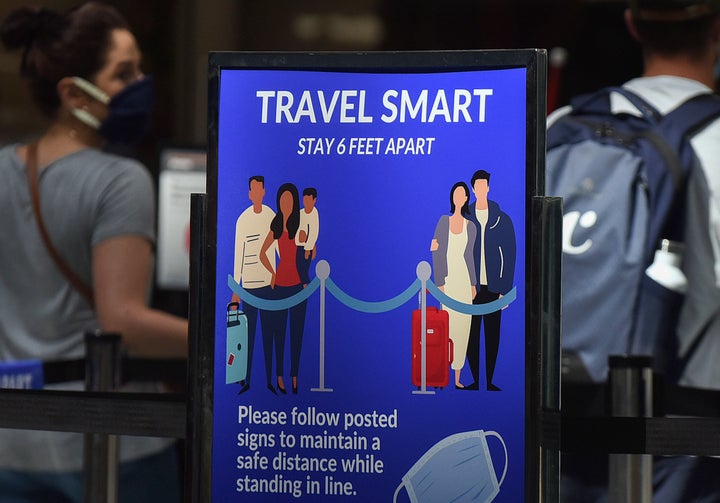
A sign reminding passengers to stay six feet apart is seen at a screening checkpoint at Orlando International Airport. 


A sign reminding passengers to stay six feet apart is seen at a screening checkpoint at Orlando International Airport. 

A HuffPost Guide To Coronavirus


Source link

White Person to White Person? You’re Doing It Wrong

I ran into a friend in the lobby of our building. (I thought we were friends, anyway.) She is black; I am white. And protests over racist policing have been raging in our city. First, I made sure her teenage son was safe. I was worried after seeing news reports. (He’s fine.) Then I told her I was sad to see the protests turn violent, that I sincerely believe violence and hatred only beget more of the same. At that point, she rolled her eyes, said she envied me and walked away. Did I do something wrong?

M.R.

I know you meant well when you spoke to your friend. And you were kind to ask about her son. But I think it’s time for white people to stop handing out bromides on “violence and hatred” to people of color, as if we were in the same boat. We’re not. Your friend and her son are far more likely to face hatred and violence than you.

For hundreds of years, the levers of society have pushed a harrowing portion of cruelty onto black people, especially in policing and criminal justice. As we reckon with this, yet again, in the wake of George Floyd’s death, let’s try to be the friends our communities of color deserve.

The first thing is to get smarter. Read “The New Jim Crow,” by Michelle Alexander, or “Heavy,” by Kiese Laymon. White people can’t know the hardship of anti-black racism firsthand, but we can try to deepen our understanding of it without forcing our already burdened black friends to educate us.

Even better, talk less and listen more. Black communities have lived the experience of inequality for generations. So, let’s be quiet and try to hear what people of color tell us they need. That may be the best way to become an ally who helps to achieve it. Apologize to your friend for being ham-handed. Then listen.

Credit…Christoph Niemann

My husband and I live in a coronavirus hot spot. We’ve been extremely careful. Recently, a relative stopped by our stoop to say hello. She brought a friend we’d never met. He asked if he could use our bathroom. Normally, I wouldn’t mind, but I didn’t feel comfortable. Still, I agreed because of social pressure. I gave him disinfecting wipes to use. Later, we cleaned the bathroom thoroughly and didn’t use it for a day. But I wish I had said no. Would that have been wrong?

ANONYMOUS

Be gentler with yourself! Sure, under normal circumstances you might extend hospitality to a stranger. But these aren’t normal times. I’m less concerned about viral transmission than your punishing stress after letting this guy into your home: your safe space. Self-care is important. It may be hard for you, but next time, tell him you aren’t comfortable with his coming inside.

I recently moved out of my first apartment, parting ways with my roommate of one year. She thinks we’re best friends and intends to remain close. She is a kind person, and I wish her well, but I don’t consider her a friend. She has many traits I find frustrating: She is too dependent on me, and we lack interests in common. I was friendly while we lived together, but I no longer want her in my life. New York is so big it would be easy never to see her again. But another part of me wants to express myself and tell her I don’t want to be friends with her. What should I do?

LIZ

I get your impulse to speak out. It seems to be tangled with some pent-up annoyance at your former roommate. But it would be cruel to tell her preemptively that you don’t want to be friends. She hasn’t asked for anything yet!

Take a break. Tell her you’re busy settling your new place when she asks to hang out. (New Yorkers have the best excuse in the world right now: social distancing.) You may be surprised, though. After a healthy absence, a kind person who cares about you may sound pretty good.

I am a 60-year-old man in great shape with a lean and muscular body. I have been sheltering in place with my younger girlfriend since March. We get along great. Since we’ve been together, she has adopted my ketogenic diet. The good news: She has gotten much leaner and looks amazing! The bad news: It’s getting harder to find enough keto friendly grass-fed beef, kimchi, macadamia nuts, pasture-raised eggs, organic greens and avocado oil at the supermarket. Because of Covid-19, I only shop once a week. How should I approach my girlfriend about not finding enough keto food for two?

JONATHAN

Your gratuitous bragging — about your foxy body and younger girlfriend — and even longer shopping list do not make me terribly sympathetic with your plight. (Surprise!) Consider modesty the next time.

For now, level with your girlfriend. Perhaps she can shop on a different day than you, after the market has been restocked, or she can explore shopping online. I hear young people are great with computers!


For help with your awkward situation, send a question to SocialQ@nytimes.com, to Philip Galanes on Facebook or @SocialQPhilip on Twitter.


Source link

South Africa voted as the ‘perfect post-Corona escape’

Tourlane, an online specialist for tailor-made dream trips, recently conducted a survey among its community of travellers to ask about people’s travel preferences. After tallying the votes, the results showed that South Africa is one of the most popular choices when it comes to those dreaming of a post-Corona escape.

“With borders beginning to slowly open back up and the possibility of travel starting to return, we were interested to find out if travellers’ preferences have changed and how they are thinking about their next trip,” the company said after the survey was conducted in April and May 2020. “Where do they want to go? Who do they want to go with? And when is the earliest they feel comfortable travelling?”

The perfect post-Corona escape

The results show that a majority of respondents (54%) would still like to go on vacation in 2020. Interestingly, one in four travellers would depart right now if they were given the opportunity. In contrast, 46% of travellers have no desire to travel in 2020.

It was found that South Africa, New Zealand, and Canada are the three most popular destinations within the Tourlane community of travellers, followed by Costa Rica and Namibia which close the top five.

Photo: Tourlane

The type of destination was also a surprise to the company. After many weeks of confinement indoors, an escape to the great outdoors is what travellers want the most. The second-most-popular coveted trip type by travellers right now is a safari vacation. And despite the social isolation that distancing and quarantine have imposed upon travellers around the world, solo travel remains a popular travel trend: 19% of travellers responded that they would like to travel alone on their next adventure. The most popular response was to travel with a partner. Only 13% selected friends as their desired companion.

TRAVEL INDUSTRY HARD-HIT

The local travel industry has been hard hit since early in 2020 as international visitors either cancelled or postponed their trips to South Africa due to the unfolding coronavirus problems in their own countries and concerns about the health risks posed by air travel.

This has since been exacerbated by President Cyril Ramaphosa’s declaration of a national state of disaster on Sunday 15 March.

Among the package of measures designed to reduce the spread of the virus within South Africa, are stringent travel restrictions and bans on certain foreign visitors, as well as the closure of a number of ports of entry. 

DMCA.com Protection Status


Source link

What’s old is new: Heirloom grains’ popularity soars amid push to eat healthy, cook at home

0

At Anson Mills, the producer of heirloom grains like Carolina Gold Rice and emmer wheat, has watched sales grow every year since the South Carolina company was founded in 1998. The coronavirus has significantly accelerated demand today for age-old grains that have been passed down for generations.

Similar to countless other heirloom ingredient suppliers, Anson Mills has seen sales turn “literally vertical,” Glenn Roberts, the founder of Anson Mills, told Food Dive. “We’re looking at demand we’ve never seen before.”

What was once a destination for chefs cooking in fancy restaurants before many of them closed because of the pandemic, Anson Mills has become a popular place for home-confined cooks.

Earlier this year, wholesale was responsible for 95% of its revenue with home cooks making up the rest. But with wholesale establishments largely closed, home sales at one point in April made up nearly all of the company’s revenue. In recent weeks, home demand has subsided and more wholesale users have reopened their businesses, pushing that total closer to 40%. By fall, home use will be around 30%, a sign that many consumers who turned to heirloom ingredients during the pandemic will continue to use them. 

Each day, Roberts gets between 150 and 200 calls from consumers, nearly a third of which he answers himself, asking to know if his product is clean, how it was produced, where it was grown and how it is raised in the field by farmers. Anson Mills doesn’t offer its heirloom ingredients, some dating back thousands of years ago and not present in agriculture after 1850, in retail. Instead, they are mailed directly to consumers at home.  


 Sales have turned “literally vertical. We’re looking at demand we’ve never seen before.”

Glenn Roberts

Founder, Anson Mills


“There is a lot of sophistication. There is a very big learning curve in people who are being quarantined and looking at their own creativity,” Roberts said. “People who normally call with very low-level questions are calling with pretty high-minded questions, and they’re home cooks, they’re not professional chefs. We’re used to dealing with the most demanding professional chefs in the world. Period. And [home cooks] ask quick questions and they want a real, honest answer.”

Until eight weeks ago, Anson Mills used to process grain 2 1/2 days a week and farm the rest for one shift a day; now they have extra workers to help pick and process the grain six days a week for three shifts, he said. 

Demand “has increased during [COVID-19] and we’re looking at it continuing to increase,” Roberts said.​

A sense of nostalgia

The exact definition of an heirloom grain, such as farro, einkorn, emmer, spelt and heirloom wheat​, can vary from grower to grower. Even the term can be used interchangeably with other words like heritage or ancient. But as the name implies, heirloom grains go back several generations, and in some cases, tens of thousands of years.

What is generally agreed upon, however, is that heirloom seeds have a feeling of nostalgia associated with them because of their age. They’re typically organic, able to reproduce the same seed from year to year when planted and lower in gluten than modern day wheat, making them more digestible for many consumers. The seeds also haven’t been genetically modified, a stigma that has dogged many foods that routinely use the controversial ingredient. 

“We have a lot of customers that are deliberately searching for heirloom seeds much more so than in the past,” Parker Garlitz, director of marketing with the Sustainable Seed Company in Utah, told Food Dive. “The events of the last two months have probably accelerated that to some degree.” 

Eli Rogosa, founder of the Heritage Grain Conservancy, a nonprofit in Massachusetts that restores and disseminates ancient wheat species on the verge of extinction, can’t consume modern versions of wheat because of their high gluten content — a factor she attributes to the fact that the grain has been bred to be dependent on agrochemicals to survive​. She’s also adamant that heirloom grains, which she can consume, have a deeper, more robust flavor profile and easier-to-digest gluten.

“The [heirloom] grains are more delicious, more nutritious,” she said.

Competition looming from other grains

Mark Sorrells, a professor of plant breeding and genetics at Cornell University, told Food Dive while there will always be a market for heirloom grains, it will likely remain a niche segment in the overall ingredients space. 

For all its advantages, its smaller scale production and marketing expenses makes it harder for growers to ramp up their output to a size where they can cover their costs. It’s also harder to grow the crops because the yield is lower, and they are usually grown organically without sprays like conventional crops, making them more susceptible to diseases and weeds.

Sorrells also said there are other specialty grains such as hulless oats or naked barley that are high in vitamins and minerals and do not have to be dehulled. Similar to many heirloom grains, they contain a unique and distinctive flavor.

Permission granted by Cornell Small Grains Program


I’m sure there will always be a market for heirloom wheat varieties, but I think as consumers discover the value in some of the other kinds of grains that it will take away some of the demand for some of the heirloom varieties,” Sorrells said.

Five years ago, Sorrells came across a 1924 description of several old heirloom varieties that over time have seen their taste altered after becoming mixed with modern varieties. 

To return the grains to their original form, he sorted out those that were “true to type” based on the 1924 description and assembled a sensory panel to evaluate sourdough mixes made from different varieties of wheat including Red Fife, a type of hard red wheat that produces herbaceous and nutty fresh wheat flavors. Despite its poor yield and other subpar characteristics, Red Fife remains very popular.

“It does have that one attribute that is sought after by bakers and consumers and that’s a good flavor in the bread-type products,” Sorrells said.

For now, heirloom grains are riding a wave of newfound popularity with consumers that’s unlikely to abate anytime soon. 

Garlitz with Sustainable Seed, which also sells herbs, flowers and vegetables, said demand for heirloom grains [removed for these since the focus is on grains and not herbs, etc.] were so strong that the company decided in mid-March to stop advertising online. It was getting more orders than it could handle. Sustainable Seed used to fill one UPS truck a day; now it’s filling two. 

“We have a lot of customers that are deliberately searching for heirloom seeds much more so than in the past,” he said. There is “a sense of safety in an heirloom seed.”

Source link

Campbell boosts ad spend as sales surge during pandemic

0

Dive Brief:

  • Campbell increased advertising spend during the first three months of the year as the coronavirus pandemic led to a surge in demand for comfort food like soup and snacks. Its marketing expenses jumped 26% from a year earlier, as spending on advertising and retailer promotions rose 29%, CEO Mark Clouse said in a conference call with analysts.
  • Marketing expenses for snacks rose 11%, and the company plans to boost that spending during the current quarter to retain new customers who have bought brands such as Goldfish crackers made by Campbell’s Pepperidge Farm division.
  • Campbell’s sales rose 15% to $2.24 billion from a year earlier while earnings doubled to $168 million, per its quarterly report. Sales of U.S. soup increased 35%, but the company lost market share in ready-to-eat soups because factory output couldn’t keep pace with demand.

Dive Insight:

Campbell’s boosted spending on advertising during the first quarter as the coronavirus pandemic led millions of consumers to stock their pantries with non-perishables and canned goods during lockdowns. The company seeks to maintain that sales momentum by ramping up its marketing spend during the remainder of the year, including campaigns planned for the current quarter.

“We have attracted new consumers to our brands during the COVID-19 demand surge, giving us access to millions of buyers who had not purchased our brands in the prior 52 weeks,” Clouse said during the earnings call. “Many of the households are younger and represent significant incremental growth for our brands. We are now mobilizing behind retaining these new consumers as we look ahead.”

Household penetration for Campbell Soup rose 10% during the first three months of the year, and millennials made up the biggest part of that growth, per IRI data cited in Campbell’s slide presentation. Its snack brands boosted household penetration 5.4 percentage points, including increases for what the company calls its “power brands:” Goldfish, Snyder’s of Hanover, Kettle, Lance, Milano, Cape Cod, Pretzel Crisps, Late July and Pepperidge Farm.

“This quarter, seven of our nine power brands grew or held share,” Clouse said during the call. Its Late July brand of organic snacks experienced the strongest growth with a gain of 2.5 percentage points in market share, followed by Lance’s 1.9 percentage point gain. Goldfish sales rose 11% but lost 0.7 percentage points of market share, while Hanover boosted consumption 21% and lost 0.5 percentage points, Clouse said.

The company expects snacks to be a significant driver of growth for remainder of the year, while consumer and retail trends will continue as people seek comfort food from wholesome brands, quick home-cooked meals, a focus on value and online shopping, per Clouse.

As an example of its recent marketing efforts, Campbell last month kicked off a social and digital campaign aimed at promoting home-cooked meals. Run across mobile video publisher Group Nine’s NowThis Food, Popsugar and Thrillist sites, the New Pantry campaign included custom content and Instagram Stories about how meals at home can bring people together during divisive times.

Source link

U.S. Jobless Claims Show Further Economic Strain: Live Updates

Jobless claims show continuing strain on the economy.

More than two million new unemployment claims came in last week, showing the persistent strain on the economy caused by the coronavirus pandemic.

The Labor Department reported that 1.9 million Americans filed new claims for state unemployment insurance last week, along with 623,000 new claims for federal aid available to the self-employed and others not normally eligible for state jobless benefits.

The overall number collecting state benefits increased by almost 650,000 to a seasonally adjusted total of 21.5 million, showing that even as some businesses reopen and workers come off the rolls, others are being newly laid off or belatedly starting to receive benefits.

The job market is “crawling out of the hole now,” said Torsten Slok, chief economist at Deutsche Bank Securities. “We do have the worst behind us,” he said.

At the same time, Ian Shepherdson, chief economist at Pantheon Macroeconomics, said the weekly claims “are not falling as fast as I’d like them to fall or thought they would be falling.”

“Let’s not kid ourselves,” he added. “This is still an astonishing rate of layoffs.”

The European Central Bank administered another dose of economic stimulus to the eurozone economy Thursday, saying it would nearly double the size of its purchases of government and corporate bonds.

The central bank will step up its bond purchases by another 600 billion euros, or $675 billion, a way of driving down market interest rates and making credit cheaper. The decision will push the total bond purchases promised by the central bank since the pandemic began to 1.35 trillion euros.

Christine Lagarde, the central bank’s president, raised expectations that the bank would do more when she said last week that the economic effects of the pandemic could fulfill worst case scenarios. Members of the bank’s Governing Council have also expressed concern about deflation, a ruinous downward spiral of prices.

The latest data on joblessness in the eurozone, released Wednesday, showed the unemployment rate in April was 7.3 percent, a number that reflects the government-backed furlough programs designed to curb mass unemployment. But many national financial support programs are set to begin scaling back soon, making it likely that joblessness will grow higher over the coming months, economists said.

Wall Street dips as global markets waver.

Stocks on Wall Street dropped, following European markets lower on Thursday, in a small retreat after days of back-to-back gains.

The drop came after the U.S. government said the overall number of workers on state jobless rolls increased last week, signaling continued strain on the economy even as some businesses reopen.

In Europe, the decline came despite new efforts by the European Central Bank to bolster the region’s economy. The E.C.B. said that it expanded its stimulus measures by more than expected, stepping up bond purchases by another 600 billion euros, or $675 billion, to address economic distress caused by the virus outbreak.

The S&P 500 fell about half a percent. The index had climbed for four consecutive days before Thursday’s dip.

Stocks have been buoyed by recovery hopes in recent weeks, with the S&P 500 rising to within 10 percent of its pre-pandemic highs, while stocks in Europe are back to where they stood in early March. Investors have been inspired by signs of a quick return of normal activity — even if not to levels seen before government-imposed shutdowns and social-distancing orders. Companies, from automakers to restaurants, have reported that sales are beginning to pick up.

Still, the bad news has been relentless, from unrest in the United States to continuing tensions between Washington and Beijing.

LVMH may be reconsidering its takeover of Tiffany.

When the French luxury giant LVMH agreed to buy Tiffany for $16.2 billion last November, many thought it was a high price at the time. It looks even more expensive amid the coronavirus pandemic, and LVMH is weighing whether to press for the deal to be re-priced.

LVMH’s chief executive, Bernard Arnault, is talking with advisers about his options, and the matter was discussed at a board meeting on Tuesday, according to today’s DealBook newsletter. Among the points the company could raise are whether Tiffany has suffered a “material adverse change” to its business, or whether the jewelry icon will miss financial projections agreed to in the deal.

Tiffany’s shares plunged after Women’s Wear Daily first reported LVMH’s on deliberations. LVMH said this morning that it would not buy Tiffany shares in the open market, ruling out a potential tactic to lower the overall price of the deal.

LVMH hasn’t approached Tiffany to discuss re-pricing the deal. For its part, Tiffany believes that its deal agreement is ironclad. And buying Tiffany would give LVMH another major luxury brand and landmark real estate on Fifth Avenue in Manhattan. Neither side expects LVMH to try to walk away from the deal — at least, not at this moment.

A number of deals agreed before the pandemic have been rescinded or revamped, including L Brands breaking off a sale of Victoria’s Secret to Sycamore Partners, Carlyle fighting to get out of buying a stake in American Express Global Business Travel, and BorgWarner and Delphi agreeing to cut the price of their deal after threatening lawsuits.

Germans will receive 300 euros, or about $336, per child, and pay a reduced value added tax on daily items and less for electricity, under a €130 billion stimulus plan announced by Chancellor Angela Merkel’s government.

Ms. Merkel called the package, which was agreed to late Wednesday, a “bold response” to the pandemic downturn.

The plan also includes €5.3 billion for the social security system, €10 billion to help municipalities cover housing and other costs and €1.9 billion for cultural institutions and nonprofits. It includes incentives to purchase electric vehicles, but none for gas- or diesel-fired engines, which Germany’s powerful automakers had sought.

The plan requires new borrowing. Ms. Merkel’s government abandoned its adherence to a balanced budget in March, when it passed a €750 billion rescue package that included taking on more than €150 billion of fresh debt. The latest package will also be financed by new borrowing, reflecting government concerns that millions of employees still need incentives to encourage spending.

“We need to get out of this crisis with an oomph,” the finance minister, Olaf Scholz said.

China steps back in airline dispute one day after U.S. vowed retaliation.

The Chinese authorities on Thursday appeared to retreat partially from an escalating dispute with the United States over air travel between the two countries, announcing that foreign airlines would be allowed to operate one flight per week in Chinese cities.

The announcement, from China’s civil aviation regulator, followed the Trump administration’s announcement on Wednesday that it would block Chinese passenger airlines from flying into or out of the United States starting on June 16. That move was a response to a similar ban by the Chinese government on American carriers, which had further stoked tensions between the world’s two biggest economies.

Foreign airlines that were barred from operating in China during the pandemic — which includes all American airlines except those carrying cargo — will be allowed to choose one Chinese city from an approved list to operate one flight each week, beginning June 8, the announcement said. The pandemic and Chinese restrictions had effectively halted passenger trips to China by United Airlines, Delta Air Lines and American Airlines.

Senate sends changes to the Paycheck Protection Program to the president.

The Senate gave final approval on Wednesday to a measure that would relax the terms of the Paycheck Protection Program, a federal loan program for small businesses struggling during the pandemic.

The bill, approved overwhelmingly by the House last week, would extend to 24 weeks from eight weeks the time that small businesses would have to spend the loan money. The eight-week period to spend the loan money was set to lapse within days for some businesses, leaving the Senate limited time to consider alternatives. The measure now heads to President Trump’s desk.

The bill also would give companies greater flexibility to use the loan money on other business expenses, like utilities and rent, by lowering the amount required to be spent on payroll to 60 percent, from 75 percent.

Republicans said that they generally favored revamping the program, which was created by the $2.2 trillion stimulus bill enacted in March. But an attempt to pass the bill by unanimous consent was delayed by Senator Ron Johnson, Republican of Wisconsin, who wanted a letter clarifying that the extension applied to the time frame to spend the loan money, not to the application period. Senator Mitch McConnell of Kentucky, the majority leader, submitted the letter just after 7 p.m.

The Paycheck Protection Program aims to help small businesses continue paying their workers by giving them access to government-backed loans that will be forgiven entirely if most of the money is spent on payroll costs.

As the pandemic upends work and home life, women have carried an outsize share of the burden, more likely to lose a job and more likely to shoulder the load of closed schools and day care. For many working mothers, the gradual reopening of the economy won’t solve their problems, but compound them, writes The New York Times’s Patricia Cohen and Tiffany Hsu.

If parents are called back to the workplace before day care and other support for family needs is available, they may need to limit their hours or leave the labor force altogether. And such choices are far more likely to face women than men.

Parents in the United States have nearly doubled the time they were spending on education and household tasks before the coronavirus outbreak, to 59 hours per week from 30, with mothers spending 15 hours more on average than fathers, according to a report from Boston Consulting Group.

The inequities that existed before are now “on steroids,” said Claudia Goldin, an economics professor at Harvard University. Since workplaces tend to reward hours logged, she said, women are at a further disadvantage. “As work opens up, husbands have an edge,” Ms. Goldin said, and if the husband works more, his wife is going to have to work less.

Catch up: Here’s what else is happening.

  • Senior executives at Quibi will take a 10 percent pay cut, with the company’s leaders calling it “the right thing to do.” Jeffrey Katzenberg and Meg Whitman raised $1.75 billion to start the short-form video service, but it has gotten off to a rocky start, which Mr. Katzenberg has blamed on the coronavirus.

  • The Federal Reserve announced on Wednesday that it will expand its municipal bond-buying program, allowing two cities or counties in each state to sell their debt to the central bank, regardless of their population. The change will affect sparsely populated states like Wyoming, and will also extend to bond issuers like New York’s subway system.

  • Sales of e-bikes jumped 85 percent in March from a year earlier, according to the NPD Group, a research firm. Amazon, Walmart and Specialized are sold out of most models. If you are contemplating an e-bike purchase, there are trade-offs to consider, writes Brian Chen.

  • Canada Goose, the seller of $1,000 down-filled jackets, reported on Wednesday a fourth quarter sales decline of 10 percent, after cutting about 20 percent of its corporate work force last month amid the pandemic. While the company said publicly that it cut just 2.5 percent of its global work force when it laid off 125 people last month, it said in internal communications obtained by The New York Times that the figure represented roughly 20 percent of corporate employees.

Reporting was contributed by Tiffany Hsu, Nelson D. Schwartz, Niraj Chokshi, Vivan Wang, Melissa Eddy, Jack Ewing, Matt Phillips, Michael J. de la Merced, Jeanna Smialek, Patricia Cohen, Mohammed Hadi and William Davis.

Source link

When She Hears a Crying Bride, ‘It’s All Over’

Dana Sliva and Paul Alcock, Jr., of Lynchburg, Va., had originally planned an intimate June ceremony followed by what Ms. Sliva, 36, called “a bash in the back yard.” The Glencliff wedding, with its sharp one-hour turnaround time and peaceful setting, may have worked out better.

“Paul is not much of a talker, and sometimes going out in public can be stressful for him,” Ms. Sliva said. Mr. Alcock, also 36, has autism. Their two-person wedding, officiated by Carol Tyree, a Glencliff staffer who is a marriage celebrant, felt manageable in a world that can often feel otherwise.

“I can’t handle being in big groups,” said Mr. Alcock, a massage therapist. “I’ve had trouble with social dynamics and friend dynamics.” His courtship with Ms. Sliva, a marketing writer who was previously married and has a 6-year-old daughter, Penelope Joy Sliva, happened almost by accident. Ms. Sliva had been on Tinder two days when she saw a profile whose tagline included the words “artistic and tattoos.”

“I was like, Oh my gosh, heck yeah, I’m going to check that out,” said Ms. Sliva, who was divorced after a yearslong separation in 2018. But she had misread the profile description. “It actually said, ‘autistic and tattoos.’” Ms. Sliva had no experience with people on the autism spectrum. But after she realized her mistake, she was still intrigued. “The first thing I said to him was, ‘What’s up, Buttercup?’ He said, ‘Comets.’ I was smitten.”

A monthslong process of getting to know each other via phone and text took place before an in-person date, in February 2018 at Rivermont Pizza in Lynchburg, could be arranged. “Paul needed time to get his pregame together a little bit,” Ms. Sliva said. Sensory issues like competitive noises and changes in light can leave him feeling disoriented.

By late spring, Mr. Alcock had become a fixture in Ms. Sliva’s life, and Penelope’s, too. Ms. Sliva was learning to experience the world from Mr. Alcock’s perspective. “The more questions I asked, the more I understood how he looked at things,” she said. “I can be impulsive, and when I met him I started thinking, ‘Oh my gosh, you’re the one,’ really fast. But what Paul had in his mind was that our relationship should develop in a slow, healthy way. He taught me to value pacing in a relationship.” Rethinking spontaneous displays of affection like hand-holding during movies was part of the learning process. “Like, maybe I reached for his hand and that sense of touch didn’t feel right to him at that moment,” Ms. Sliva said. “I started to understand that he needed space in that moment, not that he doesn’t care.”

Source link

Fakhar Zaman and other stars who need to make a big statement when cricket returns – Sport360 News

0

With West Indies given the green light to tour England in July, the resumption of international cricket is inching closer.

Several other cricket boards have announced tentative schedules too, as the sport’s brief hiatus veers towards its conclusion.

When cricket does ultimately get under way, there will be several players who will be itching to carry on the solid form they showed in 2019. The breakout stars of 2019 such as Marnus Labuschagne and Rassie van der Dussen are just some of the players who will be keen to prove that there is plenty more to come.

On the other hand, there are players who did not have the best of seasons. These players saw their performances dip significantly after a strong 2018, and they will be desperate to set the record straight once again when the sport returns.

Here, we look at five players with a huge disparity between their performances in 2018 and 2019.

JOS BUTTLER | ENGLAND

2018 Stats

Innings: 45

Runs: 1677

Average: 34

2019 stats

Innings: 44

Runs: 1324

Average: 31.52

2018 was a special year for Jos Buttler, with the England batting ace truly announcing his arrival as an all-format player. Recalled to the Test set-up after his dazzling displays in the limited-overs formats, Buttler immediately seized his opportunity.

He was pivotal to England’s 4-1 series triumph over No1 ranked India with his rearguard heroics alongside Sam Curran. A maiden Test century and six fifties rounded off an excellent year for Buttler, but he was unable to carry that momentum in the year to follow.

In 2019, Buttler was productive in the shorter formats again, though his Test performances suffered heavily. A poor Ashes series was at the centre of his red-ball woes, with two half-centuries on the tour of West Indies being his only saving grace.

If he wants to remain an integral part of the red-ball set-up, the right-hander cannot afford a repeat of his 2019 Test displays.

FAKHAR ZAMAN | PAKISTAN

2018 stats

Innings: 38

Runs: 1635

Average: 48.08

2019 stats

Innings: 30

Runs: 741

Average: 24.70

ZAMANA

No other batsman has gone through such a drastic slump in 2019 as Fakhar Zaman did. The swashbuckling opener seemed to have the world at his feet in 2018 as he became the first Pakistan batsman to smash an ODI double ton.

Unfortunately for the left-hander, the heights that he touched in 2018 were undone by the depths he plummeted to in the following year. While he had his moments in the ODI format, he still saw his average drastically drop from 67.31 to 34.15 between the two years.

The worst, though, came in the T20I format where Fakhar could not even manage to average in double figures. A paltry 17 runs across eight innings led to the batsman’s omission from the Pakistan T20 set up, and he has plenty of work to do if he wants to regain his place in time for the World Cup.

HENRY NICHOLLS | NEW ZEALAND

2018 stats

Innings: 24

Runs: 878

Average: 48.77

2019 stats

Innings: 34

Runs: 1087

Average: 35.06

HenryNichollsNewZealand (1)

While it wasn’t a dismal year overall for Henry Nicholls, it was quite the comedown from the lofty standards he set in 2018. In fact, the Kiwi batsman managed to improve his standing in ODI cricket while registering his maiden ton in the format.

However, all the gains that Nicholls made in white-ball cricket were offset by his poor form in the Test format. The left-hander started off 2019 on a strong note, with a century and fifty against Bangladesh at home.

He was unable to sustain those levels in the series to follow against Sri Lanka, England, Australia and India. His last 14 innings in Test cricket have only managed to yield 397 runs at an average of 33. Those numbers are substantially lower than 2018 during which Nicholls managed to average a staggering 73 in the Test format.

For a batsman who was ranked in the top 10 in 2019, Nicholls now finds himself languishing in 20th spot.

TEMBA BAVUMA | SOUTH AFRICA

2016-19 stats

Innings: 47

Runs: 1570

Average: 39.25

2019-20 stats

Innings: 19

Runs: 465

Average: 24.47

Bavuma

Between 2016 and 2019, Temba Bavuma made significant strides as a gritty middle-order batsman for South Africa. The diminutive batsman played several important knocks for the Proteas, including an unbeaten 95 against Australia at the Wanderers.

2019, though, wasn’t too kind to Bavuma whose fortunes took a giant beating. The right-hander kicked off the year with a fine 75 against Pakistan before being made to look ordinary in the months to follow.

Seven single-digit scores in his 12 subsequent innings, including three dismissals for ducks punctured Bavuma’s credentials greatly. His struggles, especially in the tour of India, mirrored that of his skipper Faf du Plessis. The poor returns from the two batsmen compounded South Africa’s woes as they limped to a home series defeat against Sri Lanka and were whitewashed emphatically by India.

When cricket does return, Bavuma will need to do more to justify a place in the squad which is already reeling with the retirements of senior stalwarts.

Know more about Sport360 Application


Source link