Eskom warned late Tuesday evening, 7 July that it would be implementing load reduction in Soweto, Vaal and the West Rand on Wednesday morning, starting at 5:00. These measures are put in place to “avoid network overloadingâ€.
“We are implementing load reduction […] to avoid network overloading in high-density areas that are prone to illegal connections, meter bypasses & vandalism of electricity infrastructureâ€
Eskom load reduction in Gauteng
According to Eskom, the following areas will be affected on Tuesday 8 July, from 05:00 to 09:00.
Soweto
Dobsonville
Dube
Central Western Jabavu
Klipspruit
Meadowlands East Zones 1 – 5
Meadowlands West Zones 6 – 10
Mofolo Central
Mofolo North
Mofolo South
Orlando East
Orlando West
Vaal
Boitumelo
Drieziek
Evaton Central
Evaton
Evaton West
Orange Farm
Poortjie
Sebokeng Zones 8, 12 – 14, 16, 19
Small Farms
Eskom urges users to switch off all electrical appliances during load reduction to avoid electrical surges when the power returns.
During the load reduction implementation, customers are urged to switch off all their electrical appliances to avoid power surges when power returns. Failure to do so may lead to transformer trips or failures and damages to household appliances when supply is restored.
One Dobsonville resident dryly remarked: “Dobsonville didn’t have electricity for 24 hours, are you actually mad?†while another pointed out that most people “are sleeping right now but you insist on sharing this at 22:00â€.
Eskom has yet to respond to any of the residents’ remark, despite several netizens providing reference numbers for logged queries.
Loss of units at two power stations
On Tuesday, Eskom also warned that it lost two generation units totalling 1 300 MW — one at Medupi and one at Tutuka power station. At the time, Eskom called on residents to switch off all non-essential appliances.
“Eskom requests the public to use electricity sparingly as the power generation system is severely constrained after two generation units tripped earlier his evening [7 July]â€.
Eskom warned that the constrained supply situation may continue into the weekend. However, the power utility later confirmed that the electrical grid was stable once again.
LOAD REDUCTION – GP
Tuesday, 7 July 2020: We are implementing load reduction from 05:00 – 09:00 (tomorrow morning, Wed, 8 July 2020) to avoid network overloading in high-density areas that are prone to illegal connections, meter bypasses & vandalism of electricity infrastructure pic.twitter.com/raLVxOQR1C
On a Friday evening in late June, three women in matching blue-and-white Hoka running shoes leaned over a starting line at Buffalo Park in Flagstaff, Ariz., each with one hand on their watches.
After a countdown and a yell of “go!†they bolted across the line. It was just like any other cross-country race — except their competition was invisible: A trio of rival runners raced them from a state away as thousands of fans watched on a split-screen live Instagram video feed.
Virtual races weren’t supposed to be the most exciting competition for runners in the summer of 2020. But with the coronavirus pandemic making large-scale gatherings difficult, runners are turning to technology as they search for ways to train, stay connected with teammates and compete.
Some have kept it simple, logging workouts and training plans in shareable Google documents or spreadsheets to stay in touch with their coaches. Other runners are using popular social fitness apps like MapMyRun and Strava, which saw a record 3.4 million downloads in May.
And some coaches and race organizers have innovated after being forced to scrap plans for prestigious track meets, massive marathons and the Tokyo Olympics, which were delayed from this summer to 2021. They’re making the best of a time without in-person competition by hosting virtual races and pitting runners in different states — or even continents — against each other.
“Everything’s pretty much been wiped off the table and we’ve had to regroup and reassess and find things to look forward to that aren’t traditional,†said Ben Rosario, the head coach of the Hoka Northern Arizona Elite professional distance running team.
While Arizona was under a stay-at-home order in April and May, Rosario’s small team of pro runners in Flagstaff went more than a month without training together, and he used an online training log called FinalSurge to send workout plans and stay connected with his athletes.
But that didn’t replace the thrill of racing. So when the team’s runners were able to train together again, Rosario hatched a plan.
He partnered with another professional team in Boulder, Colo., to host a time trial. The two teams would both run a two-mile course, starting at the exact same time, and compare results. As an added twist, both squads would livestream the race on Instagram on a split screen so fans could watch from home.
When Stephanie Bruce arrived at Buffalo Park, an expanse of meadow and grassland on top of a mesa, she felt pre-race nerves that she hadn’t experienced in months.
“I kind of got those butterflies, which was really nice to have,†said Bruce, a pro runner for Hoka Northern Arizona. “When we haven’t had the opportunity to race, it’s really hard. You’re in this cage where you just want to let out all the fitness and all the workouts that you’ve been pouring all of your heart into.â€
Bruce, the first woman to finish for either team, said it was difficult to imagine racing the Boulder runners while running the course. But fans enjoyed the competition — more than 15,000 people watched the videos after they were posted to Instagram.
Even for athletes who don’t rely on the sport to make a living, running with friends and competing in races was a steady, familiar part of life that was ripped away — and they’re looking for ways to reconnect.
Many of them are using Strava, an app that allows runners to interact with each other by giving “kudos†on a friend’s workout. They can also compare times on specific segments of a running route and join clubs and challenges.
“It’s the Instagram for runners,†said Kalea Chu, a sophomore runner at the University of Kansas. “It’s keeping up with your teammates, so you can get back together and be on the same page.â€
“We’ve loved seeing the Strava community become a place of refuge for runners to stay connected digitally either through indoor workout challenges, Strava Art runs mapping out words of encouragement or tons of ad hoc virtual competitions popping up through our clubs and athletes’ own communities around the world,†said Larissa Rivers, Strava’s senior marketing manager.
Caitlin Grant, a former collegiate swimmer who is a relative newcomer to running, planned to enter several races this spring before they were canceled. She tried simulating racing conditions, running a solo time trial 5K at her local park in Warwick, R.I., but said it was “disorienting.â€
On her second try, she used an app on her Apple Watch called iSmoothRun, which called out her times and pace and kept her on track. Grant is also active on Strava.
“The fact that there’s all this technology around the sport of running and such a strong virtual community only makes people feel stronger and more connected and gives people something to work toward, even if there’s not races right now,†she said.
Facing the possibility of no in-person races this fall, race organizers are also using technology to motivate runners. In June, the New York Road Runners, the organization that hosts the annual New York City Marathon, canceled this fall’s marathon — and moved a version of it online.
In October, marathon entrants will have a two-week window to run the 26.2 miles on their own and log the result on Strava as tracked by their phone or GPS watch. Times will be compiled on a N.Y.R.R. leaderboard.
Christine Burke, senior vice president for N.Y.R.R., acknowledged that the virtual races can’t recreate the strategy and tactics that come with an in-person competition. Nor can they adjust for different elevations, weather conditions or even GPS malfunctions around the world.
Still, she said, runners have embraced the concept. Some have even arranged to have family members meet them at the finish line of their personal marathon with a medal.
“The community that’s created through that and the sort of fun competition is really inspiring to watch,†Burke said.
J&A Racing, which hosts marathons in Virginia Beach, is challenging runners to hit 75.7 miles in August — a reference to the area’s 757 telephone area code — and track their progress on an online leaderboard. Other groups are creating music playlists online and digital racing bibs that runners can print and wear during their virtual races, according to Haku, an event management platform that partners with J&A and other race organizers.
“We’re creating a new kind of bucket of runners, because you have this whole group of people who are into wellness and into fitness, but they can’t go to their gyms, they can’t go to their group fitness class,†said Haku’s co-founder, Jackie Levi.
N.Y.R.R. has seen an increase in the number of participants in its virtual races for 2020. The group had about 22,000 finishers in its two virtual race events this year, up from about 15,000 in 2019. The organization also added two new virtual competitions this spring, each of which had more than 10,000 finishers.
And on Thursday, at least 30 athletes at seven different tracks on three continents, including star U.S. sprinters like Allyson Felix and Noah Lyles, will compete in the Inspiration Games, which includes five virtual short-distance running races and three field events. Felix will run alone at a track in California while two competitors race against her simultaneously thousands of miles away, synced up and timed using satellite technology.
But virtual racing can tide the pros over only for so long.
Emma Coburn, the 3,000-meter steeplechase world champion, Olympic bronze medalist and American record-holder, was able to let out some of her pent-up energy with a real race in June, when she ran a 4 minute, 32 second mile, breaking the Colorado state record in a miniature track meet limited to members of her professional track club.
“We can’t replace our competitive needs by just a virtual run,†Coburn said, adding that she does think virtual racing has “opened the world up†as runners from different countries race each other.
Bruce, the Hoka elite runner, is also itching to toe a real starting line again.
“If I’m being honest, the virtual stuff — it’s not the same thing,†Bruce said. “You’re missing the connection. And I think human connection is what keeps a lot of people motivated and inspired in life.â€
Canadian Prime Minister Justin Trudeau addresses a news conference last month in Chelsea, Quebec.
David Kawai/Bloomberg via Getty Images
hide caption
toggle caption
David Kawai/Bloomberg via Getty Images
Canadian Prime Minister Justin Trudeau addresses a news conference last month in Chelsea, Quebec.
David Kawai/Bloomberg via Getty Images
When Prime Minister Justin Trudeau turned down an invitation to the White House this week, it sent a message in line with the current mood in Canada: This is not a good time to travel between Canada and the United States — with the coronavirus still surging in parts of America — to meet with President Trump.
On Monday, Trudeau’s spokesperson, Chantal Gagnon, said in a statement that the prime minister would remain in Ottawa this week “for scheduled Cabinet meetings and the long-planned sitting of Parliament.”
Trudeau said last week that Canada was discussing with the United States whether a summit “makes sense.” His administration was troubled by the threat of new U.S. tariffs on Canadian steel and aluminum, he said, adding that “we’re also concerned about the health situation and the coronavirus reality that is still hitting all three of our countries.”
Canada has reported more than 107,000 confirmed cases of the coronavirus and more than 8,700 related deaths as of Tuesday, according to data compiled by Johns Hopkins University. However, new daily numbers have fallen to levels seen in March, while new cases in the United States are surging above the country’s April peak. On Tuesday, Canada counted 399 new cases, compared with nearly 50,000 in the U.S., according to Our World in Data, a research project at the University of Oxford.
The U.S. and Canada have partially closed their shared border since March to prevent the spread of the virus. The rules do allow for diplomatic trips and other travel deemed essential.
A large majority of Canadians, across a wide cross section of society, think the travel restrictions should stay in effect “for the foreseeable future,” according to Nik Nanos of Nanos Research, a public opinion firm. Its new poll shows 81% of Canadians want to maintain the partial border closure.
“Canadians looking south see chaos,” said Chris Sands, director of the Center for Canadian Studies at Johns Hopkins University, including confusion around the state-by-state reopening and rising case numbers. “They’re just nervous.”
That Trudeau’s not looking to travel to the United States “shouldn’t be a surprise,” Nanos said.
“The prime minister has put a very high premium on leading by example, everything from wearing a face mask at press conferences through to social distancing,” he said. Trudeau is looking “to avoid engaging in any activities which would be inconsistent with what he’s asking average Canadians to do.”
For example, most travelers arriving in Canada must self-quarantine for 14 days, and police have conducted spot checks to ensure compliance.
The border restrictions, extended until at least July 21, have also separated some families. On Monday, members of Congress from northern U.S. border states called for easing travel for people with relatives or property on the opposite side of the border.
Trudeau also has nothing to gain from a White House visit now, said Nelson Wiseman, political science professor emeritusat the University of Toronto.
“Trudeau loses in Canadian public opinion to be seen chumming around with a very unpopular Trump,” he said.
If Trump loses November’s election, Wiseman predicted, “I don’t expect they will ever meet again.”
Canadian Prime Minister Justin Trudeau addresses a news conference last month in Chelsea, Quebec.
David Kawai/Bloomberg via Getty Images
hide caption
toggle caption
David Kawai/Bloomberg via Getty Images
Canadian Prime Minister Justin Trudeau addresses a news conference last month in Chelsea, Quebec.
David Kawai/Bloomberg via Getty Images
When Prime Minister Justin Trudeau turned down an invitation to the White House this week, it sent a message in line with the current mood in Canada: This is not a good time to travel between Canada and the United States — with the coronavirus still surging in parts of America — to meet with President Trump.
On Monday, Trudeau’s spokesperson, Chantal Gagnon, said in a statement that the prime minister would remain in Ottawa this week “for scheduled Cabinet meetings and the long-planned sitting of Parliament.”
Trudeau said last week that Canada was discussing with the United States whether a summit “makes sense.” His administration was troubled by the threat of new U.S. tariffs on Canadian steel and aluminum, he said, adding that “we’re also concerned about the health situation and the coronavirus reality that is still hitting all three of our countries.”
Canada has reported more than 107,000 confirmed cases of the coronavirus and more than 8,700 related deaths as of Tuesday, according to data compiled by Johns Hopkins University. However, new daily numbers have fallen to levels seen in March, while new cases in the United States are surging above the country’s April peak. On Tuesday, Canada counted 399 new cases, compared with nearly 50,000 in the U.S., according to Our World in Data, a research project at the University of Oxford.
The U.S. and Canada have partially closed their shared border since March to prevent the spread of the virus. The rules do allow for diplomatic trips and other travel deemed essential.
A large majority of Canadians, across a wide cross section of society, think the travel restrictions should stay in effect “for the foreseeable future,” according to Nik Nanos of Nanos Research, a public opinion firm. Its new poll shows 81% of Canadians want to maintain the partial border closure.
“Canadians looking south see chaos,” said Chris Sands, director of the Center for Canadian Studies at Johns Hopkins University, including confusion around the state-by-state reopening and rising case numbers. “They’re just nervous.”
That Trudeau’s not looking to travel to the United States “shouldn’t be a surprise,” Nanos said.
“The prime minister has put a very high premium on leading by example, everything from wearing a face mask at press conferences through to social distancing,” he said. Trudeau is looking “to avoid engaging in any activities which would be inconsistent with what he’s asking average Canadians to do.”
For example, most travelers arriving in Canada must self-quarantine for 14 days, and police have conducted spot checks to ensure compliance.
The border restrictions, extended until at least July 21, have also separated some families. On Monday, members of Congress from northern U.S. border states called for easing travel for people with relatives or property on the opposite side of the border.
Trudeau also has nothing to gain from a White House visit now, said Nelson Wiseman, political science professor emeritusat the University of Toronto.
“Trudeau loses in Canadian public opinion to be seen chumming around with a very unpopular Trump,” he said.
If Trump loses November’s election, Wiseman predicted, “I don’t expect they will ever meet again.”
ISLAMABAD           -       Pakistan Air Force (PAF) on Monday released a short documentary to pay tributes to Muhammad Mahmood Alam (MM Alam), Pakistan’s brave son of the soil and hero of War 1965 on his birthday. The Directorate of Public Relations PAF released the short documentary, said a press release issued here. Born in Calcutta on July 6, 1935, Muhammad Mahmood Alam’s family moved to East Pakistan at the time of the establishment of Pakistan. In the spirit of protecting the country’s borders, Alam was commissioned in the Pakistan Air Force in 1953. In September, the Squadron Leader proved to be a death knell for the enemy. He performed an unforgettable feat by shooting down five Indian warplanes during a mission on September 7, 1965. In recognition of his bravery, the government of Pakistan twice awarded him the Star of Courage (Sitara-i-Jurat). Alam is one of the ghazis who gave the Pakistan Air Force a clear lead over the enemy and hoisted the national flag high with pride and honour. “MM Alam is a role model for Pakistan Air Force fighter pilots and will live on in our hearts forever.â€
64 min: Justin does well down the right – his impression of Ricardo Pereira is coming on impressively -, and then he digs out a useful cross from the corner. Barnes jumps to meet it and guide a header goalward from 10 yards. But not with enough power to worry Martinez.
63 min: Arsenal are in game management mode, which is something introduced by Arteta. They’re working diligently to keep Leicester at bay, while remaining primed to launch counters if they can.
61 min: From a central position midway inside the Arsenal half, Tielemans attempts to drop a curling freekick on to the head of a teammate. But his delivery is fractionally too long, and Martinez was ready for it.
59 min: Leicester substitutions: Fuchs and Barnes on, Iheanacho and Albrighton off. That suggests n overdue switch back to a 4-4-2. Not sure why Iheanacho was withdrawn rather than Perez.
55 min: Ndidi pinches the ball off Xhaka on half way. Then he rattles a pass to the feet of Vardy on the left wing. Vardy floats over a delicious cross for Iheanacho, who unloads a volley from 15 yards. Martinez makes the save!
Leicester City’s Kelechi Iheanacho shoots at goal. Photograph: Michael Regan/Pool/Reuters
53 min: When the corner is cleared to just outside the box, Ceballos wellies it towards goal. Perez sticks out a leg and deflects it behind for another corner.
52 min: David Luiz hits a knuckle ball that takes a nick off Saka at the end of the wall and flies towards the bottom corner. Schmeichel flings himself to his left to push it around the post!
51 min: Freekick to Arsenal about five yards outside the D, after Lacazette goes down under a tackle by Evans. David Luiz looks like he fancies a shot …
48 min: Albrighton cuts in from the left and sends over a dangerous cross with his right foot. But Martinez strides off his line to clasp it out of the air.
47 min: Vardy speeds down the left and then fires over a low cross. Justin, of all people, runs on it about eight yards out and tries to flick it first time towards goals. But it’s blocked by David Luiz.
Arteta’s team go into the beak with a deserved lead. Leicester had them flustered early on but once Arsenal opened the scoring with a lovely goal – featuring a brilliant pass by Ceballos, excellent work by Saka and a neat finish by Aubameyang – the home team took charge. Leicester, without some of their most creative players, have struggled to penetrate, while Arsenal have looked dangerous eery time they tear forward. Leicester’s back three look very uncomfortable when faced with the runs of Aubameyang and Saka, in particular. Change it, Brendan!
44 min: More bright prompting by Ceballos. This time his pass releases Bellerin, who skips away down the right, taking advantage of a slip by Soyuncu. But Evans cuts out his low cross.
43 min: Ceballos spanks a fetching pass out to the left despite pressure from Tielemans. Tierney takes up the baton and races down the wing, then lashes over a low cross. But it misses the two Arsenal players waiting for it.
40 min: Bellerin carries the ball in-field from the right. he looks up and arrows an inviting cross towards Lacazette near the back post. The striker meets it with a firm header, but it’s close enough to Schmeichel to enable the keeper to make a decent save.
Arsenal’s Alexandre Lacazette heads at goal. Photograph: Michael Regan/Pool/Reuters
38 min: There’s going to be more goals in this game, I fancy. Leicester look vulnerable every time Arsenal run at them – especially Aubameyang and Saka -, but they’ve also shown they carry a threat themselves, and there’s a whiff of brittleness about the Arsenal backline. It’s a pleasingly intense contest.
36 min: Leicester have the ball in the net as Iheanacho converts a cross from the left by Vardy. But it won’t count! Kolasinac fell dramatically at the edge of the Arsenal box in the buildup, and the officials reckoned he was pushed by Iheanacho. There’s little carping from Leicester, but the replay doesn’t reveal any foul play that I can see.
Kelechi Iheanacho finds the net but it’s chalked off due to a push earlier in the move by the Leicester City player. Photograph: Adam Davy/Reuters
34 min: There’s a good case for Rodgers making a substitution already: Perez has contributed little; Harvey Barnes would be a surer outlet for Leicester.
32 min: A midjudgement by Soyuncu at the edge of the area allows Saka to collects a backheel pass from Aubemayang. The youngster digs out a pass to Lacazette, who swivels swiftly and unloads a fierce low shot from 12 yards. Schmeichel reacts to make a terrific stop, showing sharp reflexes and a very strong right hand.
30 min: Arsenal are buoyant. They’re running at Arsenal from all angles now. Aubemeyang leads another charge, this time from a more central position. He feeds Lacazette at the edge of the box, and the Fnchman plays in Saka. Schmeichel spreads himself to make a decent save with his feet.
Kasper Schmeichel of Leicester City makes a save from Bukayo Saka of Arsenal. Photograph: Michael Regan/Getty Images
29 min: Kolasinac does well to win the back back for Arsenal and initiate another attack. Aubemeyang races down the left again and has two men waiting in the middle. But he overhits his cross on the run.
25 min: Aubameyang flies don the left and tries to repay Saka’s assist with a well-aimed cross of his own. But Soyuncu slides in to prevent it from reaching the teenager.
Arsenal have the lead thanks to a deadly counter-attack! Ceballos split Leicester’s defence with a pass from deep to Saka, who laid out Evans with a deft shimmy and then delivered a perfect low cross for Aubameyang, who finished with customary efficiency from eight yards. Arsenal have the lead thanks to the Gabonese striker’s 20th league goal of the season!
Arsenal’s Pierre-Emerick Aubameyang (centre) celebrates after opening the scoring. Photograph: Shaun Botterill/Pool/AP
20 min: That’s more like it from Arsenal! Saka, who has beautiful balance, wrongfoots Albrighton on the left and then plays a lovely one-two with Bellerin. but his low cross is cleared at the near post for a corner. When the setpiece is cleared, it reaches Tierney, who decides to have a ping from nearly 30 yards. He catches the bouncing ball beautifully and keeps it down well. But Schmeichel saves comfortably.
20 min: Leicester are putting heavy pressure on any Arsenal player who gets the ball. The home side haven’t been able to put together a notable move for a while now.
14 min: After Arsenal’s positive start, Leicester have come back at them hard. They’re full of zest and enterprise. This is shaping up to be a cracking contest.
13 min: Leicester work a clever short cornier routine, Albrighton rolling it to Perez and taking the return pass before pulling the ball back from the byline to Iheancho. The Nigerian sweeps a low first-time shot goalward. Martinez makes a fine save with his feet.
9 min: Perez nudges the ball towards Vardy at the edge of the box. David Luiz steps in front of the striker to intercept but somehow fails to do so, allowing Vardy to take possession, turn and crack off a fierce shot from 18 yards. Martinez gets down to make a solid save.
7 min: Leicester press high and hard as Arsenal try to play their way out from the back. Vardy charges down an attempted pass by Mustafi, but the ball ricochets out of play.
4 min: Tierney does well down the left and then hoiks over a high cross towards the back post. Saka takes it down and tries to shift the ball to the right and fire off a shot, but Soyuncu closes him down and clears.
1 min: Leicester kick off. An interesting subplot here is the race of the golden boot, with the leagues top two scorers facing off. Vardy leads the way with 21 goals so far this season, and Aubemeyang is two goals behind on 19.
If Leicester win here despite being deprived of Maddison, Chilwell and Pereira, it will be a humungous achievement. They will need a big game from Tielemans, who’s brilliant but has been off the boil for a while.
Arteta on his team selection, specifically starting Bellerin and Lacazette: “We have to rotate players, we need fresh legs. Everyone is doing well. “
Rodgers when asked whether his team are playing with three or four at the back: “You’ll see! But whatever way we set up it will always be the same style. We’ll always be aggressive and try to score goals whatever the shape …. [After the Palace result] You can see the confidence and smiles back in the players. Hopefully that will continue.â€
Chelsea’s 3-2 victory over Palace earlier today means Leicester have been shunted down to fourth in the table, with this match at the Emirates in hand.
“Yes, it’s all looking terrific for Arsenal,†booms Charles Antaki. “Even in the 2003-4 Invincible season, the team only managed 4 or more consecutive wins twice, so a victory here would put this lot right up there. The good times are certainly, unmistakably, definitely back. Surely?†I certainly can’t think of anything that could possibly go wrong now at Arsenal. Absolutely no reason to be nervous about Vardy v David Luiz …
Leicester have not won away to Arsenal since 1973 and today’s team news makes for ominous reading for them. James Maddison and Ben Chilwell have not made the fitness cut, two key absentees. Ryan Bennet’s first start suggests they’re going to play with a back three, as they did in the second half of the win against Palace, with the supreme utility man Marc Albrighton likely to act as a left wingback. On the plus side, that could be a potent front three if the service is right.
As for Arsenal, it looks like they’re also going with a back three, and why not, it has served them well in recent weeks. It’s the formation in which David Luiz looks most secure: it’ll be fascinating to see how he deals with Jamie Vardy today, as the the striker has bedazzled him in the past. Up front, Alexandre Lacazette gets the nod at centre-forward, with young Nketiah on the bench, along with Nicolas Pepe, who’s available again.
Hello. What a doozy of a game we have in store here. The relegation brawl has its appeal, but the race for Champions League qualification is the most intriguing unresolved story in this Premier League season. Today’s duel will have a big say in how it plays out: given the quality of the other teams challenging for the top four, neither Leicester or Arsenal can afford to lose.
That Arsenal are even being mentioned as top four contenders is a tribute to
media hype merchants the progress made in recent weeks under Mikel Arteta. Arsenal arrive at the King Power on the back of three straight Premier League wins and a victory over Sheffield United in the FA Cup. More than the results, it’s the manner that has impressed: they have shown steel, energy and structure; they have defended and pressed like … well, like nothing we’ve been used to seeing from Arsenal in recent years.
Once vilified players such as Granit Xhaka and Shkodran Mustafi suddenly look valuable and gifted youngsters such as Bukayo Sako and Eddie Nketiah have raised hopes of great things ahead. OK, it’s only four matches but it’s been enough to sow optimism in an Arsenal swamp of despond. Before the league resumed they were in ninth spot, eight points off the top four. Now they are seventh, seven off the top four. Small but tangible progress. Beat Leicester and belief would really swell.
The progress of Leicester, meanwhile, has been one of the feelgood stories of the season but, just as a top four finish started to look certain, their form has dipped. They got back on track with a 3-0 win over Crystal Palace last weekend but they have yet to truly sparkle in the way they did earlier in the campaign. Will that win over Palace help them get their back groove? Or will Arsenal make their nerves jangle even more? That is what we are here to find out. Humdinger ahoy!
The Trump administration notified the United Nations Tuesday that the U.S. is withdrawing from the World Health Organization. NPR discusses what it could mean for the WHO to lose its largest donor.
AILSA CHANG, HOST:
Today the Trump administration formally notified the United Nations that it is pulling out of the World Health Organization. For more on this move, NPR’s global health correspondent Jason Beaubien joins us now.
Hey, Jason.
JASON BEAUBIEN, BYLINE: Hey, Ailsa.
CHANG: Hey. So President Trump – I mean, he’s been talking about withdrawing from the WHO for quite some time now. So what is new about this announcement?
BEAUBIEN: Yeah. So with this administration, you know, sometimes when the president or others makes statements, it’s not entirely clear what’s going to happen, if it’s…
CHANG: Sure.
BEAUBIEN: …A negotiating tactic or what.
CHANG: Yeah.
BEAUBIEN: But more than a month ago, the president did say he was pulling out of the WHO. But then U.S. agencies, including, like, the CDC – they were continuing to work with the WHO as if nothing had happened. So it was sort of unclear what was going on with this relationship. And then today, the State Department took this formal step of notifying the U.N. that this is happening. And they also notified Congress.
CHANG: OK, making it crystal clear. But remind us – why does the president want to pull out of the World Health Organization?
BEAUBIEN: So, you know, he’s accused them of bungling the response to the coronavirus pandemic, and that’s what this is about. He’s accused the WHO of conspiring with China to downplay how infectious the virus is. He said that the WHO allowed this to spread around the world. You know, these are all accusations that the WHO denies.
I talked to Lindsay Wiley. She runs the Health Law and Policy Program at American University, and she questions whether President Trump has the authority to do this without Congress. And she says this is a distraction from the current U.S. response.
LINDSAY WILEY: It’s fairly clear that this is an effort to deflect attention away from the Trump administration’s failures in pandemic response within the U.S. and to try to suggest that the blame lies with the WHO or with the Chinese government or with anyone other than the administration.
BEAUBIEN: The U.S. – you know, by now, everyone knows the U.S. has the most cases in the world. Other countries in Europe and Asia – they’re getting their transmission down to quite low levels while the U.S. numbers are reaching all-time highs.
CHANG: I mean, the U.S. has been a member of the WHO since, like – what? – 1948. It’s the largest donor to the organization.
BEAUBIEN: Correct.
CHANG: So what is going to be the real-world impact of the U.S. pulling out now?
BEAUBIEN: You know, it would really be huge. The U.S., as you mentioned, is the largest donor. And if they leave, the second-largest donor right now would be the Bill and Melinda Gates Foundation. Again, professor Wiley at American University says that if U.S. does abandon the WHO, it could undermine the agency as it’s trying to coordinate the action against this pandemic right now.
WILEY: I mean, it would be a massive blow to the World Health Organization. There’s also talk that Brazil is threatening to withdraw as well. And if those two countries together took this step, it would certainly undermine the World Health Organization’s ability to respond to the global pandemic.
CHANG: OK. So the U.S. has made it crystal clear its intent to withdraw. But do you think this is really going to happen?
BEAUBIEN: So what is clear is that the administration isn’t letting go of this issue. They’re going to continue to lash out at the WHO, continue to blame the WHO and continue to put this out there as an issue that they’re pulling out of this organization. They, however, have said that they’re going to pull out a year from now, so that would be after the election. Joe Biden has said that if he’s elected, he would rejoin the organization as soon as he gets into office. So whether or not this is really going to happen is probably going to be determined by what happens at the polling places in November.
NPR transcripts are created on a rush deadline by Verb8tm, Inc., an NPR contractor, and produced using a proprietary transcription process developed with NPR. This text may not be in its final form and may be updated or revised in the future. Accuracy and availability may vary. The authoritative record of NPR’s programming is the audio record.
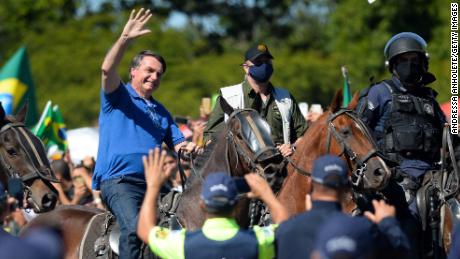
Bolsonaro himself announced the result, speaking on Brazilian TV channels Tuesday. “Everyone knew that it would reach a considerable part of the population sooner or later. It was positive for me,” he said, referring to the Covid-19 test he took Monday.
“On Sunday, I wasn’t feeling very well. On Monday, it got worse when I started feeling tired and some muscle pain. I also had a 38-degree [Celsius] fever. Given those symptoms, the presidential doctor said there was suspicion of Covid-19,” Bolsonaro said, adding that he then went to hospital to receive a lung scan.
He said that his wife, First Lady Michelle Bolsonaro was also tested.
In an interview with CNN Brasil following his diagnosis, Bolsonaro said he would steer clear of in-person meetings in the near future. “I’m not going to see anyone for meetings. Everything will be done via video conference and I will rarely meet people if I need to deal with more reserved matter,” he said.
He also acknowledged the grave risk posed by a virus that he has in the past dismissed as just a “little flu.” “We know the fatality of the virus for those of a certain age, like me, above 65, as well as for those with comorbidities, diseases, other issues. In those cases, the virus could be decisive and lead to death — everyone knew that,” he said.
“You can’t get very close [to me], OK? Recommendation for everyone,” he said.
‘I thought I had contracted it already’
Brazil is second only to the United States in numbers of coronavirus infections and deaths. But Bolsonaro has often appeared in public and at rallies without a face mask, even hugging supporters.
“I have to admit, I thought I had gotten it earlier, considering my very dynamic activity in the face of the people,” he said on Tuesday. “And I can tell you more, I am the President and I am on the front line, I don’t run away from my responsibility nor do I shy away from the people.”
“Because of my contact with the people, I thought I had contracted it already and not noticed it, like the majority of the Brazilian population that contracts the virus, and doesn’t know,” he continued.
More than 65,000 people have now died of the virus in Brazil, according to figures released by the country’s health ministry on Monday. So far, 1,623,284 cases have been confirmed. With coronavirus tests hard to come by in the country, some local experts say the real number of people infected could be 12 to 16 times higher.
The Brazilian leader struck a defiant note during his interview with CNN Brasil, defending his government’s management of the pandemic.
“No country in the world has managed to prevent deaths,” he said. “The whole world was unanimous in saying that the purpose of the isolation measures… was not to prevent people from contracting the virus but that the contraction was inevitable and it should happen over a longer time for hospitals to be equipped with ICU beds and respirators.”
Bolsonaro has long maintained that lockdowns will hurt the country more than the virus itself. “Our life has to go on. Jobs should be maintained,” he said during a March 24 speech broadcast on national television and radio.
He held onto that position as Brazil’s outbreak dramatically worsened, criticizing governors and mayors for introducing stringent lockdown measures in an attempt to curb cases.
Local targets of his ire included the mayor of Manaus VirgÃlio Neto, to whom Bolsonaro referred as a “piece of shit” for digging mass graves in his city during the pandemic. Neto is now being treated for Covid-19 at a prominent São Paulo hospital, according to a statement from his office.
During a Facebook Live session last month, Bolsonaro also implied that local politicians might be inflating the number of deaths from coronavirus in order to make the federal government response look bad. “No one lost their life, in most cases, due to the lack of ICU beds or ventilators,” Bolsonaro said, calling on citizens to enter hospitals to check “if the beds are occupied or not.”
Following his diagnosis on Tuesday, Bolsonaro emphasized that mayors and governors were responsible for the handling of the pandemic. “If it is going well or is going badly, it is a responsibility of governors and mayors, according to a decision of the Supreme Court,” he told CNN Brasil.
Like US President Donald Trump, Bolsonaro has boosted anti-malarial drug hydroxychloroquine as a potential treatment for the virus, though it has not been consistently proven effective and the World Health Organization (WHO) has discontinued a major trial with the drug.
Bolsonaro told CNN Brasil on Tuesday that he took both hydroxychloroquine and azithromycin while he awaited the result of his fourth Covid-19 test in four months, and credited the controversial drug for his well-being.
“I am feeling very well. I believe that the way they administered the hydroxychloroquine on, the effect was immediate,” he said.
The WHO on Tuesday wished Bolsonaro a “speedy recovery.” “It’s very important to understand the seriousness of this virus and to be really serious,” noted WHO Director-General Tedros Adhanom Ghebreyesus at a press briefing in Geneva.
“No country is immune, and no country is safe, and no individual can be safe.”
Contact-tracing the president
Bolsonaro has previously tested negative for coronavirus in at least three separate examinations. Those tests were administered between March 12 and March 17, after Bolsonaro returned from a bilateral meeting with US President Donald Trump in Florida and many in his entourage tested positive.
This week’s positive result comes just days after he attended a July 4th commemoration event with the US Ambassador to Brazil, Todd Chapman. According to a photo posted to the President’s official Facebook page, Bolsonaro was at the Ambassador’s residence with Chapman for the event.
Images from the gathering show Bolsonaro not wearing a mask or observing social distancing. In one picture, he stands next to several US and Brazilian officials, including Chapman, and Brazil’s foreign minister, Ernesto Araújo. Chapman and his wife have Janetta Chapman have since tested negative for Covid-19, according to a statement tweeted by the US Embassy in Brazil.
Despite his diagnosis, Bolsonaro on Tuesday emphasized that his priority is still to restart Brazil’s lagging economy. “I know that nobody can recover from dying, but the economy not working leads to other causes of death and suicide,” he said. “We have suffered very harsh criticism in this regard, but today it shows that we are right. The fact that I am infected shows that I am a human being like any other.”
At the end of his comments, Bolsonaro stepped back and removed his mask. “I’ll get away a little. Just so you all can see my face. I’m fine, I’m fine, thank God. Everything is ok,” he said. “Thank you to those who prayed for me. Those who criticized, no problem, they can continue to criticize if they want. After all, we preserve the freedom of speech and understand it as one of the pillars of our democracy.”
He then resumed the assurances that have become a hallmark of his attitude toward the virus, “So let’s take special care of the elderly, of course. Younger people: take care, but if you are affected by the virus, be assured that for you, the possibility of something more serious is close to zero.”
With reporting contributed by Shasta Darlington in Sao Paulo; Taylor Barnes, Flora Charner and Claudia Dominguez in Atlanta; and Ingrid Formanek in Spain.
From April 1 to June 24, which covers most of the quarter, Ms. Gideon raised $8.1 million, far more than Ms. Collins, who raised $3 million during that time, according to filings with the Federal Election Commission. At the end of that period, Ms. Gideon had about $5.5 million on hand, compared with $5 million for Ms. Collins.
In other closely watched races, Gov. Steve Bullock of Montana, a Democrat who is trying to unseat Senator Steve Daines, raised $7.7 million in the second quarter, his campaign said. That was more than Mr. Bullock raised in the entirety of his campaign for the Democratic presidential nomination, which he ended in December.
Cal Cunningham, a Democrat who is challenging Senator Thom Tillis, Republican of North Carolina, brought in $7.4 million in the quarter, his campaign said. Jon Ossoff, a Democrat running against Senator David Perdue, Republican of Georgia, raised more than $3.45 million, according to his campaign.
Republicans sought to minimize that fund-raising energy. “Democrats will need to spend every penny to defend records that are disqualifying in the eyes of mainstream voters who will decide the outcome in key Senate races,†Jesse Hunt, communications director for the National Republican Senatorial Committee, said Tuesday.
The most endangered incumbent Democrat, Senator Doug Jones of Alabama, has not yet disclosed his fund-raising for the most recent quarter. Mr. Jones had $8.3 million in cash on hand at the beginning of April.
One of the Republicans seeking to challenge him, Tommy Tuberville, the former Auburn University football coach who has been endorsed by Mr. Trump, raised roughly $670,000 from April 1 to June 24, according to a filing with the Federal Election Commission.
That was about 50 percent more than what Jeff Sessions — the former senator and attorney general who is Mr. Tuberville’s opponent in the Republican primary runoff, set for July 14 —raised in that same period as he fought to recapture what was once his seat.
As Black Lives Matter protests, triggered by the killing of George Floyd, spread across the world in response to systemic racism and police brutality, questions are being asked about how white people can lend their support.
Four lessons from the South Africa’s anti-apartheid movement
1. Use privilege to support the oppressed
The first lesson is that privilege, conferred to some by the system, can be used to support the oppressed.
The African National Congress (ANC) launched its Defiance of Unjust Laws Campaign in 1952. Although the campaign did not succeed in overturning repressive legislation, it boosted the membership of the ANC, cemented the leadership of people such as Nelson Mandela and Walter Sisulu, and created close cooperation between different racial groups against apartheid.
Black activists called on white activists for support, ranging from using their telephones, hosting meetings, to providing financial resources.
In 1961, activists Arthur Goldreich and Harold Wolpe used their financial privilege to buy Liliesleaf Farm, which became the secret headquarters of Umkhonto we Sizwe, the ANC’s armed-wing, where the banned leadership would secretly meet. Disguised in a white suburb, there was initially little suspicion that the farm was used for anti-apartheid activities.
A further tangible act of opposition to the regime was the refusal to serve in the armed forces. By the 1980s, more than 23,000 young men had refused to be conscripted into the South African Defence Force, which was increasingly deployed to suppress uprisings in townships.
As a constructive alternative to military service, the End Conscription Campaign proposed a range of community development programmes, such as painting a hospital ward or clearing a plot of land, in support of and in consultation with township civic groups.
In drawing on their privilege to support the struggle, white anti-apartheid activists were frequently ostracised by other white people. Bram Fischer is a prime example. Born into a prominent Afrikaner family, Fischer rejected Afrikaner nationalism. He later defended Mandela at the Rivonia Trial in 1963, where Mandela was convicted to life imprisonment, narrowly avoiding a death sentence. Fischer was later sentenced to life imprisonment for his anti-apartheid activities.
2. Educate others
The second lesson is that those with privilege have a responsibility to educate others who hold that same privilege.
While white allies did offer benefits to the movement, some black activists felt white activists were shirking the more difficult task of confronting racial attitudes in their own neighbourhoods. They preferred the excitement of travelling to the townships, where they were welcomed with “big cheers from the peopleâ€.
Steve Biko, the founder of the Black Consciousness Movement, rejected this perception that white people were allies. In 1971, he argued that it was “impossible†for white liberals to totally identify with oppressed black people “in a system that forces one group to enjoy the privilege and to live on the sweat of anotherâ€. Instead, he said: “The liberal must fight on his own and for himself.â€
In the 1980s, white activists, most notably through the Johannesburg Democratic Action Committee, an affiliate of the non-racial United Democratic Front, did pay greater attention to the white population. They made important gains in educating and mobilising white people against apartheid through the Call to Whites Campaign, which helped to weaken the power of the regime. They were also able to continue to mobilise when their black counterpart organisations were restricted.
Anti-apartheid artwork in the Apartheid Museum, Johannesburg, South Africa. Photo: Flickr/Kandukuru Nagarjun
3. Put your bodies on the line
The third lesson is that two people, in the same space, taking the same actions will not be treated the same. And that those with privilege can put their bodies on the line for the sake of others.
Throughout the anti-apartheid struggle, a number of white activists including Denis Goldberg, Jeremy Cronin, and Raymond Suttner were imprisoned for a range of activities in the struggle against injustice. Out of the 156 people charged at the Treason Trials which began in 1956, 23 were white, including prominent activists Joe Slovo, Ruth First, and Helen Joseph. Ironically, according to Lionel “Rusty†Bernstein, one of the accused, the trial strengthened the personal and political relationships across racial divides – the opposite purpose of apartheid legislation.
As one of us, Leonie Fleischmann, argued in research on Israel and Palestine, the physical presence of members of the ruling population at protests has clear advantages. Lethal weapons are less likely to be used when Jewish-Israelis are present at Palestinian protests and they are unlikely to be treated badly if detained. Parallels can be found in South Africa, where conditions for white prisoners were markedly better than those for their black counterparts.
Helen Joseph described her arrest in 1956 alongside her black partner in the Federation of South African Women, Lillian Ngoyi. Joseph describes how she had a bed, sheets and blankets, whereas Ngoyi slept on a mat on the floor. Joseph had a sanitary bucket with a lid, whereas Ngoyi had an open bucket covered with a cloth. As Ngoyi exclaimed to Joseph as they were carted off: “You are better off with your pink skinâ€. Apartheid remained even in prison.
Federation of South African Women: African, Hindu and Christian women gathered near Apartheid era prison to protest against Apartheid in 1955. The Hindu women can be seen in traditional sari. (Violet Weinberg is third from the right). Image via Wikipedia/ Creative Commons Attribution 2.0
The involvement of white activists in the anti-apartheid struggle was not universally welcomed. The Congress Alliance, a multi-racial coalition of anti-apartheid organisations was established in the 1950s. Yet, to mobilise the black population, the ANC initially felt it necessary for these congresses to remain separate.
At joint meetings of the Congress Alliance, the white Congress of Democrats was criticised for dominating. And in 1959, the Pan-Africanist Congress split from the ANC because it feared the struggle would be dominated by white communists. Others argued that there was no place for white people in their struggle.
Still, the adoption of the Freedom Charter in 1955 at the Congress of the People, a large multi-racial gathering of the Congress Alliance, had shown that most anti-apartheid activists recognised that “black and white†should “strive together†until “the democratic changes … have been won.†Alongside this message of non-racialism and joint struggle, it was made abundantly clear that freedom for the African people was at the heart of the movement.
As A B Ngcobo, a member of the ANC Youth League asserted in 1987: “The Africans, that is their struggle in the first place, and they’ve got to lead that struggle.â€
Those who do not experience oppression are not best placed to make decisions on how to overcome it.
As the anti-apartheid movement in South Africa shows, mobilising white privilege can be a useful tool for advancing the struggle against racism. Yet, the fight must be led by those who are oppressed by it. White allies must show up, listen and put their bodies on the line.
Leonie Fleischmann, Lecturer in International Politics, City, University of London and Matthew Graham, Senior Lecturer in History, University of Dundee. This article is republished from The Conversation under a Creative Commons license. Read the original article.
We use cookies on our website to give you the most relevant experience by remembering your preferences and repeat visits. By clicking “Accept”, you consent to the use of ALL the cookies.
This website uses cookies to improve your experience while you navigate through the website. Out of these, the cookies that are categorized as necessary are stored on your browser as they are essential for the working of basic functionalities of the website. We also use third-party cookies that help us analyze and understand how you use this website. These cookies will be stored in your browser only with your consent. You also have the option to opt-out of these cookies. But opting out of some of these cookies may affect your browsing experience.
Necessary cookies are absolutely essential for the website to function properly. These cookies ensure basic functionalities and security features of the website, anonymously.
Cookie
Duration
Description
cookielawinfo-checbox-analytics
11 months
This cookie is set by GDPR Cookie Consent plugin. The cookie is used to store the user consent for the cookies in the category "Analytics".
cookielawinfo-checbox-functional
11 months
The cookie is set by GDPR cookie consent to record the user consent for the cookies in the category "Functional".
cookielawinfo-checbox-others
11 months
This cookie is set by GDPR Cookie Consent plugin. The cookie is used to store the user consent for the cookies in the category "Other.
cookielawinfo-checkbox-necessary
11 months
This cookie is set by GDPR Cookie Consent plugin. The cookies is used to store the user consent for the cookies in the category "Necessary".
cookielawinfo-checkbox-performance
11 months
This cookie is set by GDPR Cookie Consent plugin. The cookie is used to store the user consent for the cookies in the category "Performance".
viewed_cookie_policy
11 months
The cookie is set by the GDPR Cookie Consent plugin and is used to store whether or not user has consented to the use of cookies. It does not store any personal data.
Functional cookies help to perform certain functionalities like sharing the content of the website on social media platforms, collect feedbacks, and other third-party features.
Performance cookies are used to understand and analyze the key performance indexes of the website which helps in delivering a better user experience for the visitors.
Analytical cookies are used to understand how visitors interact with the website. These cookies help provide information on metrics the number of visitors, bounce rate, traffic source, etc.
Advertisement cookies are used to provide visitors with relevant ads and marketing campaigns. These cookies track visitors across websites and collect information to provide customized ads.