Two Chefs Moved to Rural Minnesota to Expand on Their Mission of Racial Justice

ST. JOSEPH, Minn. — Krewe, a restaurant in this small central-Minnesota city, is a tribute to Mary Mackbee, a former high school principal who raised four children in a Twin Cities suburb on the cooking of her native New Orleans.

“More than anything, gumbo is the smell I remember,” said Mateo Mackbee, one of those children and the chef and co-owner of Krewe. “That’s one you would get outside the front door.”

Mr. Mackbee was in the dining room of Krewe, a window-lined restaurant in a new low-rise building in downtown St. Joseph, a community of 7,000 about 70 miles northwest of Minneapolis. His mother was there, too, sharing stories about her life and overseeing the jambalaya that Mr. Mackbee’s 21-year-old son, Makel, was cooking for takeout service later that day.

Krewe’s sign reads “est. 1944,” Ms. Mackbee’s birth year, even though it opened in late May, four days after George Floyd was killed while in the custody of the Minneapolis police.

Mr. Mackbee, 47, and Erin Lucas, 27, his girlfriend and business partner, moved to central Minnesota from Minneapolis two years ago. They were driven by a shared desire to bring awareness of racial inequities to rural communities, and to find an alternative to the limited career options available to them in Minneapolis and St. Paul.

“I had grown kind of weary of the restaurant scene in the Twin Cities, where it was hard for someone like myself,” Mr. Mackbee said. “I’m a little bit older and a little bit darker than most of the people on the line.”

The partners began with a successful pop-up restaurant in New London, a small city in a neighboring county. They sank deeper roots this spring, when they also opened Flour & Flower, a bakery in a cottage-style building behind Krewe. Ms. Lucas is the bakery’s chef.

On a sunny morning in mid-June, the line of customers waiting to buy her croissants, baguettes and pastries ran outside the bakery nearly to Krewe’s back door. Both businesses are a short bicycle ride from the Lake Wobegon Trail.

St. Joseph, though home to the small liberal-arts College of Saint Benedict, is not a cradle of racial diversity. It’s more than 90 percent white. Locals whose families have lived here for generations say Krewe is the city’s first brick-and-mortar business owned by an African-American. And the community is in a part of Minnesota known for its divisive politics around immigration and race.

But St. Joseph offered Mr. Mackbee an opportunity for ownership that he hadn’t received in the cities, despite his culinary degree and nearly a decade of experience in some of the area’s most respected restaurants. He proudly points out that three members of Krewe’s four-person kitchen staff are people of color.

“We’ve flipped the scenario that I’m normally used to,” he said.

Jon C. Petters, who owns the properties where Krewe and Flour & Flower are located, sold the couple hard on the potential of opening their businesses in St. Joseph. Mr. Mackbee and Ms. Lucas were first wooed to central Minnesota by Mark Kopka, whom Mr. Mackbee met in 2015 in a bar in a Twin Cities suburb. Mr. Kopka is the pastor of Nordland Lutheran Church in Paynesville, which, like St. Joseph, is in Stearns County.

The men bonded over Mr. Mackbee’s dream of starting a farm where he could bring students of color who didn’t otherwise have access to nature — a goal the couple plan to realize in September through Model Citizen, the nonprofit group they created.

“We talked about this larger vision to get kids connected to the land and to food,” Mr. Kopka recalled. “I said, ‘Dude, come check out Paynesville.’”

Mr. Kopka introduced Mr. Mackbee and Ms. Lucas to locals who were hungry for an alternative to the chain restaurants that proliferate in this region of farmland, rolling prairie and lakes. But the chefs were welcomed for reasons that went beyond their culinary talent.

“A lot of people who grew up here, they’ve never known a person of color,” said Steve Peterson, 62, a retired General Mills executive from Paynesville who attends Mr. Kopka’s church. “There’s something about these guys being here that helps.”

Stearns County, while still about 85 percent white, is home to some of the largest immigrant communities in Minnesota. Agriculture and food-processing jobs in central Minnesota towns like Willmar (home to Jennie-O Turkey, in neighboring Kandiyohi County), and St. Cloud, the Stearns County seat, have drawn workers, particularly from East Africa and Latin America, for three decades.

The demographic changes have touched off a rise in nativist politics and xenophobia in Stearns and bordering counties. In 2017, a St. Cloud City Council member proposed a moratorium on new immigrants. The motion failed, but it attested to the open white resentment over immigration. The same year, a Willmar man was arrested after placing a pig’s foot on the table of a farmers’ market booth operated by young Somali Muslims.

Growing up in Stearns County, Emma Ditlevson, a 21-year-old Krewe line cook, overheard friends’ parents as they criticized immigrants for failing to assimilate.

“I don’t think people here realize that it’s a beautiful thing to represent a different culture in a community that doesn’t have that much diversity,” said Ms. Ditlevson, who was born in South Korea and adopted by a white couple. “Instead of seeing the culture as something beautiful and something to embrace and something to understand more, they see it as something people should just give up.”

Mr. Mackbee said St. Joseph doesn’t feel far removed from the unrest and anger unleashed by Mr. Floyd’s killing. The St. Cloud police used tear gas to disperse a crowd of protesters three weeks after Mr. Floyd’s death.

He and Ms. Lucas were drawn to the region in part for the opportunity to confront issues of racial injustice with Model Citizen, just on prairie land instead of pavement — an impulse that is as much a tribute to his mother’s influence as Krewe’s menu.

“We’re probably worse here, as far as racial tension,” Mr. Mackbee said. “I feel like my mom prepared me for coming out here and facing whatever comes my way.”

Mr. Mackbee is soft-spoken, though blunt. Two years ago, he ran for City Council in New London. “I came in third,” he said.

Small-town life is not new to him. He attended college in rural Wisconsin on a soccer scholarship. While there, he recalled, he was asked to speak to a white student who had hung a noose over a Black student’s dorm-room door.

“They wanted me to be the one to tell this guy this was a bad thing,” he said. “I’ve been a token my entire life.”

Krewe’s opening would be notable even if it were in New Orleans, a majority-Black city where restaurants owned by African-Americans are still relatively rare. Equally unusual are restaurant chefs of Mr. Mackbee’s training who learned to cook New Orleans cuisine at home — through recipes that descend directly from African-American home cooks of the Jim Crow era.

Mr. Mackbee has never worked in a New Orleans-style restaurant. And the food Ms. Mackbee cooked for her children in the 1980s and ’90s was virtually untouched by the vagaries of contemporary restaurant trends. The first time she ate at a white-owned restaurant, she said, was on a visit to Commander’s Palace, in New Orleans, in the mid-60s. She moved to the Twin Cities a few years later.

“I never had a steak until I came up here,” she said. “I always thought steak was cooked with gravy.”

Mr. Mackbee talks about his mother’s 51-year career as an educator as much as he does about her cooking. Ms. Mackbee served 26 years as principal of Central High School, the state’s oldest high school and the largest in its capital, St. Paul.

She retired in 2019, two years after one of her former students, Melvin Carter III, was elected St. Paul’s first African-American mayor. Ms. Mackbee spoke at his inauguration, which was held at Central High.

“She was one of those principals who never sat in her office,” Mr. Mackbee said. “She’s broken her wrist and all that kind of stuff, breaking up fights at school.”

Ms. Mackbee, 76, leaned into adversity while growing up in segregated New Orleans. Her civil-rights activism occasionally drew her away from Louisiana as a young adult.

She recalled knocking on the door of a Roman Catholic bishop in Mobile, Ala., in 1965. She was there to voice her displeasure with the bishop’s removal of a priest who had provided shelter for her and other Black activists when they traveled to Selma to protest that summer.

Ms. Mackbee ended up taking her grievance to a higher authority. “We wrote a letter to the pope,” she said. “Never heard from him.”

She married Earsell Mackbee, a cornerback for the Minnesota Vikings, after moving to St. Paul in the late ’60s to become the only Black teacher at a nearly all-white public school. After the couple divorced, Ms. Mackbee raised their four children alone in suburban Bloomington.

She cooked her family large pots of the dishes she had grown up eating in New Orleans, except that she used sausage where her mother, struggling to make ends meet, used hot dogs.

“That was the economical way,” Ms. Mackbee said. “But I had a job, so I could afford some real sausage.”

Mr. Mackbee cooked dinner for a group of friends at Krewe in mid-June, when the restaurant was open only for takeout. (It will begin dine-in service on Thursday.)

The gumbo, inspired by Ms. Mackbee’s, is reminiscent of a style found in older, Creole restaurants in New Orleans: The broth is thin, stained by a light brown roux and loaded with shrimp and sausage.

A Midwestern twist came from the andouille sausage made by Johnsonville, a Wisconsin company famous for its bratwurst, and shrimp raised in aboveground pools by Paul Damhof on a former cattle farm outside Willmar. (“Our Willmar water is some of the best water for raising shrimp,” Mr. Damhof said.)

Similar ingredients enriched a spicy jambalaya Mr. Mackbee also learned from his mother. Instead of mixing the ingredients together as in a paella, the traditional method in southern Louisiana, the Mackbees’ jambalaya is a savory sauce spooned over plain rice. “The way I make it, you don’t have to fish out the shrimp,” Ms. Mackbee said of the idiosyncratic technique.

Matt Lindstrom, a friend of the chefs, sampled these dishes, along with red beans, barbecue shrimp and bread pudding, as New Orleans music played in Krewe’s dining room. Mr. Lindstrom, 50, is a political-science professor at Saint John’s University, a small liberal-arts college for men just outside St. Joseph that is closely affiliated with the all-woman College of Saint Benedict.

He struggled to explain his excitement over finding a place like Krewe in St. Joseph.

“When I was a kid, it was a big deal to go to Applebee’s,” said Mr. Lindstrom, who grew up in Willmar. “And you had to drive to St. Cloud for that.”

In September, Mr. Mackbee and Ms. Lucas hope to bring the first group of local students to the one-acre farm they are building with Mr. Kopka and other collaborators in Paynesville. It’s based on a project the chefs tried out in New London.

“One of the things we noticed is that all of these kids are literally surrounded by farmland,” Mr. Mackbee said, “but they literally don’t have the opportunity to step onto it.”

Ms. Lucas remembers how thrilled some young Somali students were by the sight of rhubarb, assuming it was tamarind. “They were like, ‘We haven’t seen this since we were home,’” Ms. Lucas said.

The new farm is near the north fork of the Crow River, on land donated to Model Citizen by the retired executive Mr. Peterson and his wife, Mary, through a partnership with Nordland church. Mr. Peterson spent his later years at General Mills trying to educate farmers on the virtues of regenerative agriculture, a sustainable farming practice that aims to improve the soil.

“We see this farm as a model for the area,” said Mr. Peterson, “to encourage other young people to be entrepreneurs, and to do what’s right for the land.”

By year’s end, Mr. Mackbee and Ms. Lucas plan to have a chicken coop, sheep and a wood-fired oven to cook for outdoor parties on the property. The ingredients will show up on their menus. And, ideally, the farm will enrich the community in other ways.

Standing outdoors on a windy afternoon last month, Mr. Mackbee looked toward a patch of forest at the edge of the still-unplowed farmland. “I need to get the kids out here to see it and to smell it,” he said.

His thoughts drifted toward a future when he can host children of color from the Twin Cities, like those his mother taught for so many years.

“If we can just get them out here for a while, away from the stress,” he said, “maybe we can help give them what they need, to be what they want to be, and not what society says they are.”

Source link

Brazil’s President Jair Bolsonaro Tests Positive for Coronavirus But Says He Feels ‘Perfectly Well’

0

Brazil President Jair Bolsonaro tested positive for Covid-19 in an escalation of the health crisis that has engulfed Latin America’s largest economy.

“I’m perfectly well,” Bolsonaro told CNN Brasil in a live interview, after announcing the result of his test. He added he is taking hydroxychloroquine, an anti-malaria medicine he’s been touting as being effective against the virus though its use hasn’t been authorized by most health experts globally and could carry dangerous side effects.

The 65-year-old president, who during his campaign to reopen the economy called the virus “just a little flu,” has repeatedly disobeyed medical recommendations to avoid contamination, mingling in crowds without a face mask and giving people handshakes.

Late on Monday, however, a video posted on YouTube showed a masked Bolsonaro trying not to get too close to supporters who awaited him in front of the presidential palace. He told them he was following social distancing orders from a doctor after showing symptoms of the virus, and added that an exam had shown his lungs were “clean.”

Brazil has become a global hotspot for the virus, trailing only the U.S. with more than 65,000 confirmed deaths and over 1.62 million total cases. It has implemented an erratic response to the pandemic, with the president often clashing with state governors and even his health minister over quarantine measures and possible treatments. Brazil’s health ministry is currently headed by an interim chief after Bolsonaro fired his first minister and a second resigned.

Bolsonaro could be seen coughing during a Thursday broadcast on his social networks, when he sat next to six other people, none of whom wore a mask. Officials who were present included Regional Development Minister Rogerio Marinho and the chief executive officer of state-owned bank Caixa Economica Federal, Pedro Guimaraes. Since then, he has mingled with members of his administration and the general public, and had lunch with the U.S. ambassador to Brazil on Saturday.

It is not the first time Bolsonaro has been tested for Covid-19. In March, after multiple members of his delegation to a U.S. visit contracted the virus, he said he tested negative.

On June 25, he said during a Facebook live broadcast that he thought he had already contracted the virus.

Bolsonaro joins other world leaders who have been contamined by the virus, including Honduran President Juan Orlando Hernandez and U.K. Prime Minister Boris Johnson, both of whom were hospitalized during the treatment.

Contact us at editors@time.com.

Source link

‘Clyde’s Spot,’ a new storm on Jupiter, discovered by amateur astronomer (photos)

0

‘Clyde’s Spot,’ a new storm on Jupiter, is visible in this image in the center as a white maelstrom, just below and to right of the Great Red Spot. Citizen scientist Kevin Gill created this image using data gathered by the JunoCam instrument aboard NASA’s Juno Jupiter orbiter on June 2, 2020. (Image credit: Image data: NASA/JPL-Caltech/SwRI/MSSS; image processing by Kevin M. Gill © CC BY)

NASA’s Jupiter-orbiting Juno probe has captured gorgeous imagery of a storm that recently cropped up on the giant planet and was spotted by an amateur astronomer.

Juno snapped a series of photos of the feature, dubbed “Clyde’s Spot” — named after its discoverer Clyde Foster of South Africa — on the morning of June 2, 2020. At the time, the probe was flying between 28,000 miles and 59,000 miles (45,000 to 95,000 kilometers) above Jupiter’s cloud tops, at latitudes ranging from 48 degrees south to 67 degrees south, NASA officials said.

Source link

Brazilian President Jair Bolsonaro Tests Positive For Coronavirus

Brazilian President Jair Bolsonaro has repeatedly doubted the severity of the virus since it first found a foothold in Brazil, reportedly in late February.

Andressa Anholete/Getty Images


hide caption

toggle caption

Andressa Anholete/Getty Images

Brazilian President Jair Bolsonaro has repeatedly doubted the severity of the virus since it first found a foothold in Brazil, reportedly in late February.

Andressa Anholete/Getty Images

Updated at 4:54 p.m. ET

Jair Bolsonaro has tested positive for the coronavirus.

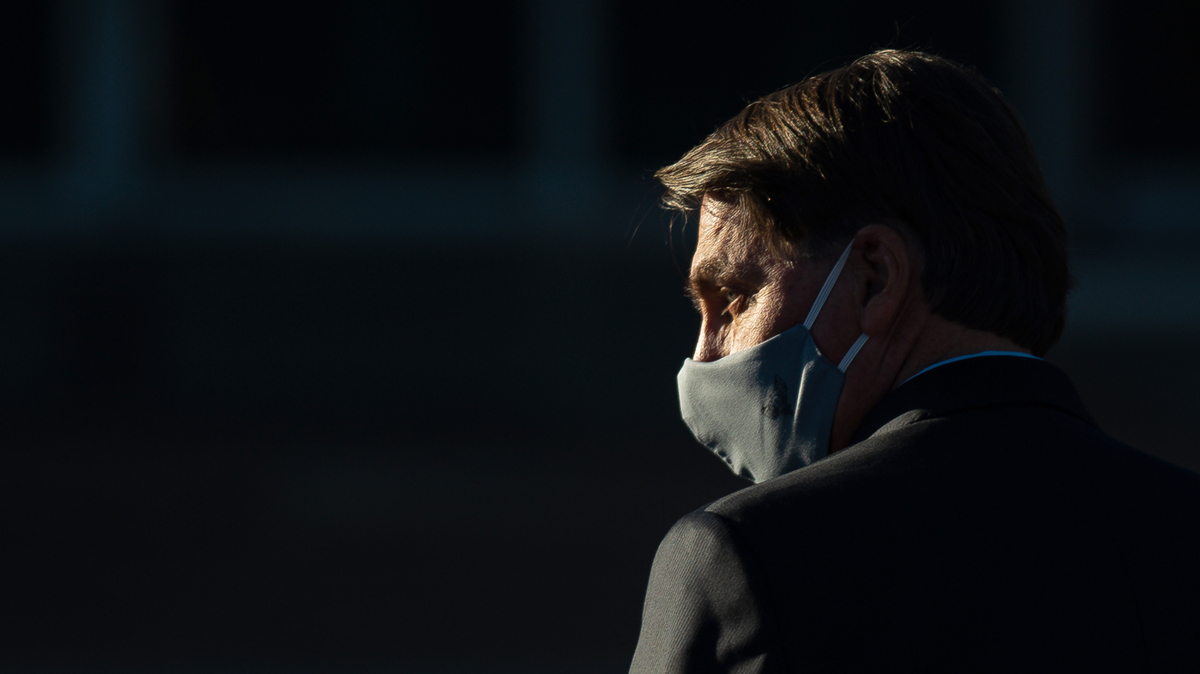
The Brazilian president, who has consistently downplayed the dangers of the virus, revealed his positive test result during nationally televised remarks Tuesday. “It came back positive,” he told reporters from behind a mask.

He is just the second major world leader, after British Prime Minister Boris Johnson, to confirm he contracted the virus.

With more than 1.6 million confirmed cases as of Tuesday, Brazil is in the throes of the world’s second-largest outbreak, behind only the U.S. More than 65,000 people there have died of complications linked to COVID-19 — a towering death toll that again stands second only to that of the U.S. And because of a significant lag in testing, Brazilian researchers believe the real numbers are much, much higher than the official tallies.

Yet Bolsonaro, 65, has repeatedly doubted the severity of the virus since it first found a foothold in Brazil, reportedly in late February. A key ally of President Trump, the right-wing Brazilian leader has called the coronavirus “a little flu,” accused the media of hysteria and campaigned against the shutdowns implemented by local leaders.

“I’m sorry,” Bolsonaro said in April, after the country’s death toll reached 5,000, “but what do you want me to do about it?”

Tens of thousands of deaths later, Bolsonaro has remained firmly supportive of reopening and skeptical of social distancing, both for others and himself.

Last week, he vetoed legislation that would have mandated the use of face masks in schools, churches and businesses. During a luncheon hosted last Saturday by the U.S. ambassador in Brazil, Bolsonaro was photographed embracing his foreign affairs minister, flashing a smile and a thumbs-up.

The American ambassador, Todd Chapman, was seated on the other side of the president. Bolsonaro, Chapman and all of the other men in the image weren’t wearing masks. The embassy said Tuesday that the ambassador had tested negative but is staying at home in quarantine.

It’s not the first personal run-in with the virus for Bolsonaro, who took office in early 2019.

The Brazilian leader says he has taken several tests, all of which came back negative before Tuesday’s result. During one such scare — in March, after a trip to Florida to visit Trump — several members of Bolsonaro’s delegation tested positive.

On Sunday, Bolsonaro says, he began experiencing symptoms such as fatigue, muscle pain and fever. He revealed to reporters Monday night that he had taken a coronavirus test and was awaiting results, adding that doctors had also taken a scan of his lungs that had come back “clean.”

On Tuesday, he said his medical team is now treating him, among other things, with hydroxychloroquine, the controversial anti-malaria drug that both he and Trump have touted as a means to prevent and treat COVID-19. Trump himself even declared that he had taken the drug to ward off the virus, despite the Food and Drug Administration’s warnings against its use for that purpose.

And once more, Bolsonaro urged Brazilians not to worry about the public health crisis that has been surging across the country in recent weeks. Now suffering from the early stages of the virus himself, he maintained that there is nothing to worry about.

“The fact I’ve been infected shows I’m a human like anyone else,” he told reporters. There’s no need to panic, he added. It’s time to get back to work.

NPR’s Philip Reeves contributed to this report.


Source link

The WHO Says Airborne Coronavirus Transmission Isn’t a Big Risk. Scientists Are Pushing Back

0

For months, the World Health Organization (WHO) has said COVID-19 spreads mainly via direct contact with large respiratory droplets, like those expelled in a sick person’s cough or sneeze. In a letter published this week in Clinical Infectious Diseases, 239 scientists say the agency may be wrong.

It’s only the latest chapter in an ongoing tug of war between the WHO and the rest of the public-health world. “This is one in a series of many miscues,” says Dr. Eric Topol, director and founder of the Scripps Research Translational Institute. “It’s really unfortunate how the WHO has led to all sorts of confusion.”

The new letter, which was co-written by a WHO consultant and reviewed by experts from more than 30 countries, argues the WHO and other health authorities are not paying enough attention to airborne COVID-19 transmission—that is, infection via inhaling tiny respiratory droplets that can linger in the air.

WHO officials acknowledged that possible route of transmission at a press conference Tuesday, after the letter was published, but said it continues to collect evidence. “We have been talking about the possibility of airborne transmission and aerosol transmission as one of the modes of transmission of COVID-19,” Maria Van Kerkhove, the WHO’s technical lead for COVID-19, said.

Studies of other viruses completed before the pandemic have “demonstrated beyond any reasonable doubt” that droplets expelled by sick individuals can “remain aloft in air and pose a risk of exposure at distances beyond 1 to 2 [meters] from an infected individual,” the letter says. More recent research suggests the same is true of SARS-CoV-2, the virus that causes COVID-19. In some reported cases, people have gotten sick after being in the same room as an infected individual, even if they didn’t have close or sustained contact.

Think of it like cigarette smoke, says Linsey Marr, a professor of civil and environmental engineering at Virginia Tech and one of the letter’s signatories. The cloud is most concentrated around the person smoking, but it also disperses and drifts throughout the room. Viral aerosol functions much the same way, she says.

The WHO’s COVID-19 guidance has addressed airborne spread in health care environments, since some procedures can aerosolize the virus, but stopped short of calling it a threat to the general public. A WHO spokesperson told TIME “the topic is presently being reviewed by our technical experts.”

The letter’s 239 signatories say that’s not good enough. “There’s been a lot of emphasis on hand-washing and on social distancing, but if they [the WHO] acknowledge that aerosol transmission is happening, we can have additional guidance” about things like ventilation techniques and wearing masks whenever people congregate indoors, Marr says. Even very simple guidance, like keeping doors and windows open when possible, could help, she adds.

There’s nothing to stop cities or countries from codifying these sorts of precautions on their own. But as the world’s preeminent global health authority, the WHO’s words—and silence—carry weight. If the WHO doesn’t publicly recognize risks like airborne transmission, “it just gives naysayers more fodder to deny the truth,” Topol says.

Related Stories

The letter is only the latest example of the roiling tension between the WHO and the wider scientific community.

The fast-moving COVID-19 pandemic has exposed the WHO’s weak spots. For one thing, the underfunded and overburdened global health agency cannot enter countries to do fieldwork without permission, and relies on its member states to provide much of the data used in its analyses.

The WHO also moves with the slow pace and risk aversion of a bureaucratic organization, even when the world is demanding new and better information about the coronavirus every day. “The evidence for aerosol transmission is there; it’s just maybe not as compelling as they would like,” Topol says. “I call it a purist view.”

That institutional caution helps explain why it took the WHO until June 5 to recommend that people in high-transmission areas wear fabric face masks in public—a recommendation that was, by then, already standard in many countries and cities. “Every recommendation that we put out needs to be applicable for every type of situation. That’s a blessing and a curse,” Van Kerkhove told TIME when the mask guidance came out.

Topol says that bar is sometimes too high. “What do you have to lose” by recommending extra precautions, he asks. “Go with the best evidence and the best expert opinion. Maybe it’s not perfect evidence. But it’s good enough.”

Despite holding press briefings almost every day, the WHO has also stumbled when communicating with the general public. In an oft-criticized tweet from January, for example, the WHO declared that, “Preliminary investigations conducted by the Chinese authorities have found no clear evidence of human-to-human transmission of the novel #coronavirus.”

To the WHO, that mean the threat of widespread human-to-human transmission—though possible—was still under investigation. To the average person, it meant human-to-human transmission wasn’t a big threat. So when it became clear that COVID-19 does pass from person to person, many people lost faith in the WHO.

For many, that feeling was compounded last month when Van Kerkhove called asymptomatic coronavirus transmission “very rare” during a press conference, despite several studies and months of expert warnings to the contrary. She later walked back the comment.

These incidents are more than communication slip-ups. Topol fears they’ll erode trust in the WHO—and in science more broadly—at the exact moment that confidence is critically important.

“WHO is a venerable institution, something that we need, that we rely on,” Topol says. “Each time one of these things happens, where there’s a serious misalignment with the truth and the science and the evidence, you wind up with another credibility titer reduction. We need to go the other direction.”

Write to Jamie Ducharme at jamie.ducharme@time.com.

Source link

Brazil’s President Jair Bolsonaro tests positive for COVID-19

The 65-year-old President has repeatedly played down the impact of the virus, even as Brazil has suffered one of the world’s worst outbreaks.

More than 65,000 Brazilians have so far died from COVID-19 and more than 1.5 million have been infected. Both numbers are the world’s second-highest totals, and are considered to be undercounts due to the lack of widespread testing.

The President has often appeared in public to shake hands with supporters and mingle with crowds, at times without a mask. He has said that his history as an athlete would protect him from the virus, and that it would be nothing more than a “little flu” were he to contract it.

Late on Monday, however, a video posted on YouTube showed a masked Bolsonaro trying not to get too close to supporters who awaited him in front of the presidential palace. He told them he was following social distancing orders from a doctor after showing symptoms of the virus, and added that an exam had shown his lungs were “clean.”

“I came from the hospital,” Bolsonaro said on Monday evening in comments broadcast by a pro-government YouTube channel. “But all is good,” he added.

Over the weekend, Bolsonaro attended several events and was in close contact with the US ambassador to Brazil during July 4 celebrations. Pictures of the event showed neither wearing a mask.

The US Embassy said on Twitter on Monday that Ambassador Todd Chapman was not showing any COVID-19 symptoms but would be tested.

Bolsonaro could be seen coughing during a broadcast on Thursday on his social networks, when he sat next to six other people, none of whom wore a mask. Officials who were present included Regional Development Minister Rogerio Marinho and the chief executive officer of state-owned bank Caixa Economica Federal, Pedro Guimaraes. Since then, he has also mingled with members of his administration and the general public.

Bolsonaro has repeatedly said that there is no way to prevent 70 per cent of the population falling ill with COVID-19, and that local authorities’ measures to shut down economic activity would ultimately cause more hardship than allowing the virus to run its course.

Loading

Brazilian cities and states last month began lifting restrictions that had been imposed to control the spread of the virus, as their statistical curves of deaths began to decline along with the occupation rate of its intensive-care units.

Brazil, the world’s sixth most populous nation, with more than 210 million people, is one of the global hotspots of the pandemic.

Get our Morning & Evening Edition newsletters

Most Viewed in World

Loading

Source by [author_name]

In the Twin Cities’ Robust Dining Scene, Few Black-Owned Businesses

In the wake of George Floyd’s killing, chefs and restaurateurs are looking for ways to fix the racial imbalance.

Source link

Travel Restrictions on Americans Erode a Sense of Passport Privilege

0

LONDON — Five American travelers who set out for a getaway on Sardinia were turned away last week after their private jet landed on the Mediterranean island. In Canada, two Americans were fined for flouting tougher entry restrictions imposed by their northern neighbor.

And in Mexico, governors are pleading with the central government to introduce tighter restrictions on travelers from the United States to help prevent the spread of the virus.

While coronavirus travel restrictions may vary from country to country, much of the world is united in one aspect of their current response: Travelers from the United States are not welcome.

A U.S. passport, long seen as a golden ticket to visa-free travel in much of the world, has long provided its holders with the ability to trot around the globe with ease. Now, that sense of passport privilege Americans are used to is fading.

“This is shocking, to see one of the most advanced countries in the world be put in the slow lane of the global reopening,” said Robin Niblett, director of Chatham House, the London research institution for international affairs.

Mr. Niblett said the fading power of the American passport was not surprising “given that America’s health care system is decentralized, unpredictable and unequal” and given how the virus continues to spread unabated in large portions of the country.

In a world where pandemic travel restrictions are excluding people from countries with uncontrolled coronavirus outbreaks, and where the United States continues to set daily records of new cases, the long-lauded American passport, once a symbol of power and exceptionalism, is becoming stigmatized.

Last week, when the European Union formalized a plan to restart travel from certain countries, visitors from the United States were notably left off the list, a stinging blow to American prestige. American citizens who live in countries on the approved list will be allowed to enter the European Union.

Travelers from the United States, like those blocked from the Italian island of Sardinia last week, are finding themselves unwanted.

The five Americans who had flown to Sardinia had come from Colorado, traveling with several people from other nations in a private jet to the Italian island. After five in the group were barred entry, everyone eventually left.

Dimitry Kochenov, a co-creator of The Quality of Nationality Index, which explores the benefits accorded to citizens of different countries, said the pandemic restrictions put into stark relief the restrictions that people of certain nationalities faced at international borders.

“Citizenship is the main factor behind preserving global inequalities today,” he said. “So of course the U.S. passport has always symbolized the ultimate level of this privilege.”

Mr. Kochenov, a professor of European constitutional law at the University of Groningen in the Netherlands, said the Sardinia incident showed that even the large sums of money needed to fly a personal plane to Europe could not “allow them to overcome the deficiency of the U.S. passport today.”

While a U.S. passport typically allows for visa-free movement in much of the world, Mr. Kochenov noted that European Union passports outrank it in quality because they grant holders the freedom to resettle anywhere in the European Union with full rights.

Until the recent restrictions, the U.S. passport had long provided its holders with an outsize sense of freedom that was the envy of others. The restrictions that Americans now face are “something that much of the rest of the world knows very well,” Mr. Kochenov said.

Some Americans say they have been surprised by the shift in perception toward American travelers during the pandemic, expressing concerns that it could be damaging, at least symbolically.

Vincent Rajkumar, a professor of medicine in Minnesota who became a U.S. citizen 15 years ago, said he has always been in awe of how the country’s passport had opened doors that were once shut to him.

During a trip to Australia in January, he was alarmed that passengers were being questioned extensively about whether they had been to China.

“I remember thinking, ‘Wow, I’m so glad I have a U.S. passport, this is never going to happen to me,’” he said. “And then in the past two months, this is dawning on me — ‘This is going to happen to us. This is happening to us.’”

ShaDonna Jackson, a photographer from Maryland who has been vocal on social media about seeking dual citizenship, said she was spurred to act in part by the new restrictions on U.S. travelers.

“The perception of the U.S. right now in terms of how safe people are with the coronavirus spreading — I see how it can be scary to other countries,” she said.

Mr. Niblett of Chatham House noted the turn of events was unsurprising after the United States issued a broad travel ban for European visitors in March, which gave implicit permission for other governments to do the same against Americans.

President Trump’s abrupt decision, which was made without consultation with European leaders and without any warning, established the climate for the current travel restrictions on the United States.

“When it’s done in that incredibly indiscriminate way, then it’s not surprising you get this counterreaction from American allies,” Mr. Niblett said, adding that Mr. Trump had “set the stage very much for this. And to be honest, it’s tragic.”

The travel restrictions reflect the eroding relationship between Europe and the United States.

Since Mr. Trump became president, the trans-Atlantic relationship is “becoming more shallow” despite the decades of cooperation after World War II, Mr. Niblett said. Diplomacy has “become more transactional” and focused on the short term.

“And Europe now feels they have a right to be equally transactional in return,” Mr. Niblett said.

But the sentiment is not coming only from Europe. American travelers to Canada who have attempted to skirt border restrictions that ban all but essential journeys have found themselves equally unwelcome. They face fines or being detained for failing to comply.

Nova Scotia’s leader expressed frustration about travelers from America trying to circumvent restrictions by coming into the Canadian province.

At the Mexican border, there has also been a stark reversal. Typically on the receiving end of border restrictions, Mexico, alarmed by the spiking infection rate in the United States, has moved to stem the flow of Americans into the country.

Mexican states set up “sanitary filters”along the border during the July 4 weekend to check visitors’ temperatures and turn away anyone whose trip was not deemed essential. Officials in Mexican border states have pushed for more aggressive steps to reduce crossings.

Mr. Kochenov pointed out that simply focusing on the erosion of freedoms for American travelers missed the bigger picture. Many countries have introduced internal travel restrictions that limit movement among regions, states or other local jurisdictions.

And most of the current restrictions are expected to be temporary. Americans may not like having their travels limited for now, but it is likely to be for the short term. Others will continue to face a tougher reality.

“The majority of the population of the world will never be able to fly to Europe no matter what,” Mr. Kochenov said, because of visa restrictions or lack of money.

“The pandemic simply demonstrates to Americans what the rest of the world has already known about the main function of nationality in the world.”

Natalie Kitroeff contributed reporting from Mexico City.

Source link

Three Mars missions poised to launch to the Red Planet in July

July is the month of Mars.

Three missions are poised to launch toward the Red Planet this month, including NASA’s car-sized Perseverance rover, which will hunt for signs of ancient Mars life and cache samples for future return to Earth.

The action will start next week, if all goes according to plan. The United Arab Emirates’ first-ever interplanetary effort, the Hope Mars mission, also known as the Emirates Mars Mission, is scheduled to launch on July 14.

Related: NASA’s Mars 2020 rover Perseverance in pictures

The Hope orbiter will reach Mars in early 2021, then use three science instruments to study the Red Planet’s atmosphere, weather and climate from above. The probe’s observations should help researchers better understand Mars’ long-ago transition from a relatively warm and wet world to the cold, desert planet we know today, mission team members have said. That transition was driven by the stripping of Mars’ once-thick atmosphere by the solar wind, the stream of charged particles flowing from the sun.

The Hope spacecraft was built by the UAE’s Mohammed bin Rashid Space Center, in partnership with the University of Colorado Boulder, Arizona State University and the University of California Berkeley. And the project is breaking ground for more than just the UAE: Hope is the first planetary science mission led by an Arab-Islamic nation.

China will follow with a landmark launch of its own a little more than a week after Hope takes flight. On July 23, China’s first-ever fully homegrown Mars mission, known as Tianwen-1, is scheduled to lift off atop a Long March 5 rocket. (China put a piggyback orbiter called Yinghuo-1 aboard Russia’s Mars mission Fobos-Grunt, which got stuck in Earth orbit shortly after its November 2011 launch.)

Tianwen-1 is an ambitious project that consists of an orbiter, a lander and a 530-lb. rover that’s the size of a small golf cart. Chinese officials have remained characteristically tight-lipped about the mission — they still haven’t publicly announced a final landing site for the lander/rover pair, for example — but these robots’ scientific gear suggests that Tianwen-1 will conduct a broad reconnaissance of the Martian environment.

The orbiter sports six instruments, including a high-resolution camera, a magnetometer and a mineral spectrometer, which will allow mission team members to determine the composition of surface rocks. The rover also has six instruments, including a weather station, a magnetic field detector and a ground-penetrating radar, which could spot subsurface water ice down to a depth of about 330 feet (100 meters).

If Tianwen-1 is successful, China will become just the third nation, after the Soviet Union and the United States, to land a spacecraft on Mars. And that epic touchdown may lead the way to even bigger things in the near future: Chinese space officials have voiced a desire to mount a Mars sample-return mission, which could perhaps launch as early as 2030.

Related: Occupy Mars: History of robotic Red Planet missions (infographic)

The United States and Europe also plan to bring pristine Red Planet material to Earth, and that project will really get up and running with Perseverance’s launch. The 2,315-lb. rover, the centerpiece of NASA’s $2.7 billion Mars 2020 mission, is scheduled to lift off atop a United Launch Alliance Atlas V rocket from Florida’s Cape Canaveral Air Force Station on July 30 and land inside Mars’ Jezero Crater on Feb. 18, 2021.

The United Launch Alliance Atlas V booster for NASA’s Mars Perseverance rover was lifted and moved into the Vertical Integration Facility at Launch Complex 41 at Cape Canaveral Air Force Station in Florida on May 28, 2020.Kimi Shiflett / NASA

Perseverance will use its seven onboard instruments to characterize the geology of Jezero and search for signs of ancient Mars life in the rocks of the 28-mile-wide crater, which hosted a lake and a river delta billions of years ago.

The six-wheeled robot will also collect and cache several dozen samples from particularly promising study sites. This material will be recovered and brought to Earth, perhaps as early as 2031, in a campaign conducted by NASA and the European Space Agency. Scientists in labs around the world will then scrutinize the Mars material in great detail, looking for signs of life and clues about the planet’s evolutionary history.

Mars 2020 also aims to lay groundwork for crewed missions to the Red Planet, the first of which NASA wants to launch in the 2030s. For instance, like the Tianwen-1 rover, Perseverance is outfitted with ice-hunting ground-penetrating radar. And another of the NASA rover’s instruments, the Mars Oxygen ISRU Experiment (MOXIE), will generate oxygen from the thin Martian atmosphere, which is 95% carbon dioxide by volume. (“ISRU” stands for “in situ resource utilization.”)

MOXIE isn’t Mars 2020’s only technology demonstration. A 4-lb. helicopter called Ingenuity will journey to the Red Planet on Perseverance’s belly. After touchdown, Ingenuity will drop free and make a few short test flights in the Martian sky — the first-ever aerial exploration of a world beyond Earth.

If Ingenuity is successful, future Mars missions could commonly incorporate helicopters, NASA officials have said. Such rotorcraft could serve a variety of purposes, from scouting out promising study sites for rovers to exploring hard-to-reach areas such as caves or steep-walled craters.

Hope, Tianwen-1 and Mars 2020 all must get off the ground this summer or be put in storage for more than two years, because Earth and Mars align favorably for planetary missions just once every 26 months. And the current launch window isn’t open for very long; Mars 2020’s closes on Aug. 15, NASA officials have said. (The mission’s window originally opened on July 17, but several technical issues have pushed things back to July 30.)

One Mars mission hoping to launch this year has already been packed away until 2022. The life-hunting rover Rosalind Franklin, part of the European-Russian ExoMars program, encountered parachute problems and several other issues that could not be resolved in time for a 2020 liftoff.

Mike Wall is the author of “Out There” (Grand Central Publishing, 2018; illustrated by Karl Tate), a book about the search for alien life. Follow him on Twitter @michaeldwall. Follow us on Twitter @Spacedotcom or Facebook.

Source link

Brazilian President Jair Bolsonaro Tests Positive For Coronavirus

Brazilian President Jair Bolsonaro has tested positive for the coronavirus after spending months flouting public health guidelines and dismissing the threat posed by a pandemic that has killed more than half a million people worldwide.

Bolsonaro, 65, said Monday that he had been tested for the virus and that an exam had showed his lungs were “clean.” Bolsonaro told reporters Tuesday that his test results came back positive, CNN Brazil reported.

The Brazilian president has long been dismissive of the virus even as hundreds of thousands of people in his country have tested positive. He has called COVID-19 a “little flu,” urged local governors to lift lockdown orders and continued to step out in public without any major precautions, venturing into crowds without a face covering and shaking hands with the public.

“We are sorry for all the dead, but that’s everyone’s destiny,” he said last month as cases rose dramatically.

Bolsonaro was tested at least three times for the virus in March after meeting with U.S. President Donald Trump, and all those tests came back negative. 

A Brazilian judge ordered the far-right president to wear a mask in public last month after he attended a spate of political rallies without one, even as cases surged throughout the country. At the time, the judge said no one was “above the law” and that Bolsonaro had a “clear intent to break the rules.”

More than 1.6 million people have tested positive for COVID-19 in Brazil, and at least 65,000 people have died there. Only the U.S. has more cases and more deaths.

In June, Brazil removed detailed numbers on coronavirus cases from the Health Ministry’s website, claiming without evidence that the figures had been inflated by local officials. The country’s Supreme Court ordered the data to be restored days later amid claims that Bolsonaro’s government had attempted to mask how severe the outbreak had grown in the country.

The government’s efforts to interfere with coronavirus data came even as positive tests spread through the top echelons of the Brazilian government. In March, Bolsonaro’s top press secretary tested positive for COVID-19.


Source by [author_name]