Thursday, April 30, 2026

Dolphins in the Louisiana Bayou Keep Dying. A Reconstruction Plan Might Make It Worse.

Barataria Bay is a marshy jewel in the heart of the vast Louisiana bayou. Its unparalleled natural ecosystem was once a hideout for smugglers and malcontents like Jean Lafitte, who ruled the labyrinth of marshlands and estuaries. By the early 20th century, oil and gas had taken over the marshlands, and levees reined in the mighty Mississippi River and redirected it toward the Gulf of Mexico.  

Now, pipelines and canals crisscross the bayou, but the 15-mile Barataria Bay that runs along the Mississippi River remains one of America’s richest fishing grounds, with an abundant assortment of shrimp, crab, oysters and commercial seafood that’s a big part of the state’s $2.4 billion fishing industry today.

As the fisheries expanded, Mississippi River levees constructed in the early 1900s stemmed the flow of natural land-building river sediment into the bay. The levees, along with oil development and sea-level rise due to climate change, contribute to one of the greatest land-loss rates on the planet: Land in Barataria Bay is disappearing under the rising tides at the rate of a football field every 100 minutes.

This article contains images of dead wildlife that some viewers may find upsetting.

Barataria Bay is also at the center of one of the biggest natural construction projects in history — a $50 billion plan to reverse this land loss that has pitted powerful state agencies and national environmental organizations against commercial fishing groups and independent marine mammal scientists worried about impacts on fisheries and wildlife. 

Stuck in the middle of this fight are two major populations of northern Gulf bottlenose dolphins.

The dolphins long flourished in the brackish waters of Barataria Bay and the Mississippi Sound. But the changing climate, pollution, and a flood of diverted Mississippi River water, which reduces salinity and increases nutrients, now imperil them. Last year, a record-setting torrent of river water led to a toxic algal bloom that left ocean waters in Mississippi off-limits for months last summer and were linked to painful, often deadly skin lesions on the dolphins. 

This week, federal officials closed their investigation of the more than 330 dolphin deaths last year, connecting the animals’ demise to low salinity levels caused by record flooding that poured trillions of gallons of nutrient-rich fresh river water into the Mississippi Sound and other coastal regions. Scientists say it’s likely to be a recurring nightmare as climate change increases rainfall and flooding along the Mississippi River and in the upper Midwest.  

The surge of river water may only get worse as Louisiana plans to build huge, land-building sediment diversions on both sides of the Mississippi River. Though smaller river diversions have been used to build up land for centuries, there’s never been an attempt on this scale or designed with this kind of modeling technology. The diversions will each pour as much as 75,000 cubic feet a second of sediment-laden Mississippi River water into the marshes in a massive attempt to build land. 


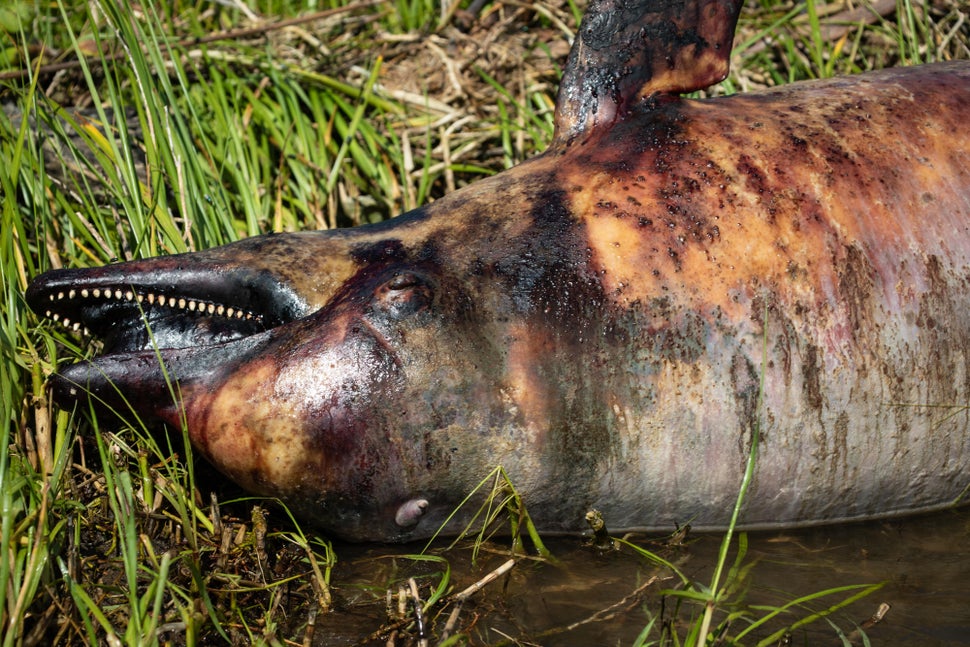
George Ricks next to a dead dolphin in Breton Sound off St. Bernard Parish. Dolphins began to die off without explanation in spring 2019, not long after the opening of the Bonne Carre Spillway. This week, the “unexplained die-off” was linked to river water flooding.

A Population Already At Risk

Barataria Bay’s 2,300 dolphins are especially vulnerable to river diversions, scientists say, because their health was so severely damaged in the 2010 Deepwater Horizon disaster 40 miles off the coast. Due to tidal action, a significant amount of BP’s oil and dispersant mix poured into Barataria Bay, which scientists say wiped out half the bay’s dolphin population. 

The dolphins that are left are still struggling, and their health will take decades to recover. Marine mammal scientist Lori Schwacke of the Marine Mammal Foundation published studies that found significant lung disease, reproductive problems, and in some cases, worsening health of the bay’s dolphins. She is worried about the potential harm a flood of freshwater could cause those populations.

“When the diversions happen, dolphins will still be in the early stages of recovery. Freshwater could kill hundreds of dolphins,” she said. “We don’t see any evidence they will move.” 

The legal settlements with BP directed billions of dollars to Louisiana to fight coastal erosion. The state has earmarked $1.4 billion to design a mid-Barataria Bay diversion on the west side of the Mississippi River, and it is in the early stages of designing another $800 million Breton Sound sediment diversion in St. Bernard Parish on the west side of the river. 

Freshwater could kill hundreds of dolphins. We don’t see any evidence they will move.
Lori Schwacke, marine mammal scientist

While these two sediment diversions are just a few of the hundreds of dredging and restoration projects in the state’s extensive coastal restoration master plan, they are two of the most important and most controversial.

Fishing groups, marine mammal scientists and community leaders have strongly objected to untested diversion projects of this scale, which they worry will flood the bayou with river water that carries nitrogen, fertilizers and chemicals that drain down from 31 states. They say the influx of water will kill off marsh grass and change salinity levels to a point at which the rich shrimp, oyster, crab, and dolphin populations will not survive. 

“It is ironic that the state of Louisiana received billions of dollars in compensation from BP for damages to its ecosystem, including endangered sea turtles and dolphins, and it now wants to negatively impact the same ecosystem and dolphins that they accused BP of harming in the first place,” said Moby Solangi, the president and executive director of the Institute for Marine Mammal Studies in Gulfport, Mississippi. “Not only will we lose the dolphins, but there will be a collapse of the ecosystem and its associated fisheries.”

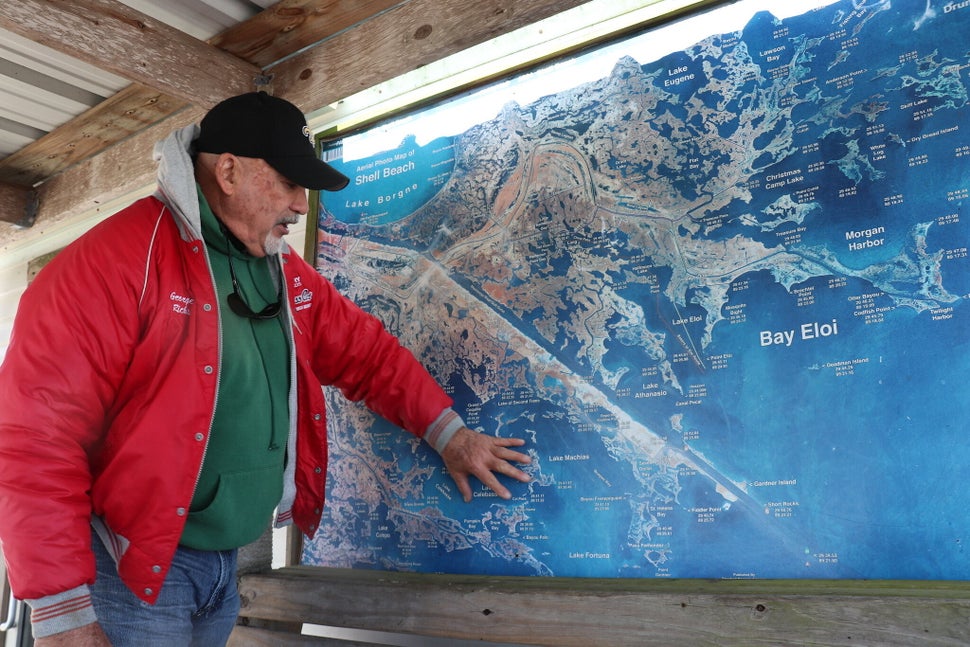
Capt. George Ricks views a map of the Louisiana bayou in St. Bernard Parish.


Capt. George Ricks views a map of the Louisiana bayou in St. Bernard Parish.

Solving the ‘Marine Mammal Protection Act Problem’

Many residents of the fishing communities bordering the planned diversions worry their future is at stake, too. 

Capt. George Ricks, a charter fisherman in St. Bernard Parish and president of the Save Louisiana Coalition, said the fishermen his group represents have long opposed the diversions.  

“All the other states are using BP money to help their fisheries,” Ricks said as he prepared to head out on his boat to inspect oyster reefs in St. Bernard Parish with other commercial fishermen. “Louisiana is using the money to destroy them.” 

Ricks says Exhibit A of that destruction is the state’s successful 2018 effort to get a rare congressional waiver for the Marine Mammal Protection Act, or MMPA, the comprehensive federal law that forbids harming, harassing or “taking” marine mammals such as dolphins.

The unusual waiver was part of a state-funded effort by the Washington, D.C.-based environmental lobbying firm Van Ness Feldman. Two of the firm’s top lobbyists, former Louisiana Sen. Mary Landrieu (D) and aide to former Sen. Bennett Johnson (D), Bob Szabo, published an article in June 2018 explaining how they successfully solved Louisiana’s “Marine Mammal Protection Act Problem.” 

“Without such a waiver, the project could not move forward,” they wrote. “Therefore, we were forced to approach Congress” to come up with “a very narrow amendment” with the assistance of “several national environmental and conservation NGOs.”

That amendment was inserted into the Bipartisan Budget Act in February 2018, just four days after the U.S. Marine Mammal Commission sent a strong letter of concern to a federal oil spill advisory group, noting that the health of the bay’s dolphins “is already compromised” from the spill and that “such projects have the capacity to injure marine mammals” in violation of the federal law.

According to participants in the waiver negotiations, several NGOs did support the waiver. But many did not ― including marine mammal scientist Naomi Rose with the Animal Welfare Institute. Rose said that getting an MMPA waiver established a “very troubling” precedent, as it was the first successful MMPA waiver that was not later overturned by the courts, “circumventing the careful process” Congress had put in place when it passed the act in 1972. 

“Doing it by a rider in a spending bill is not a precedent we wanted to see happen — other far less conservation-minded actors might seek the same kind of waiver, which could quite frankly be disastrous for marine mammals,” Rose said. 

St, Bernard Parish oysterman Brad Robin, owner of Robin Seafood, checking oysters damaged by fresh water flooding off St Bern


St, Bernard Parish oysterman Brad Robin, owner of Robin Seafood, checking oysters damaged by fresh water flooding off St Bernard Parish.

‘An Uncomfortable Place To Be’

A coalition of groups called the Restore the Mississippi River Delta ― which includes the Environmental Defense Fund, the National Wildlife Federation, the Audubon Society, the Lake Pontchartrain Basin Foundation and the Coalition to Restore Coastal Louisiana ― supported the waiver because they see river sediment diversions as a crucial way to solve the complex coastal erosion problem. 

The coalition has produced a variety of scientific white papers, economic studies and multimedia presentations on the topic of coastal restoration with the support of the Walton Family Foundation, the philanthropic arm of the family that founded Walmart. The foundation has also funded coastal reporting for the New Orleans Times-Picayune, The Lens and New Orleans public radio station WWNO. 

River diversions are the most efficient way to save the Louisiana bayou, said Steve Cochran, EDF’s associate vice president for coastal resilience and a New Orleans area native. Cochran says the environmental groups that backed the waiver had a good working relationship with the state and worked hard to come to an agreement with federal agencies such as the National Oceanic and Atmospheric Administration to negotiate an administrative process for river diversions, but it became clear there was no quick solution if dolphins could be harmed. Cochran says his coalition believed there was no time to waste given rapid coastal erosion taking place across the region.

When the state decided to push for a congressional waiver, it was an “uncomfortable place to be,” Cochran said, because marine scientists opposed going that route. But Cochran said the groups made sure the waiver required the state to come up with a “marine mammal science plan” to minimize and monitor the effects on dolphins and marine mammals. 

David Muth, National Wildlife Federation’s director of Gulf restoration and also a New Orleans native, has worked closely on many aspects of the state’s coastal restoration plan, including potential effects on dolphins. He said the BP money was a “game changer” for Louisiana’s comprehensive restoration plans. “The purpose of the act is the long-term health of marine mammals,” he said. “And the only way to do that is to build diversions to save southeast Louisiana.” 

Muth, who is not a marine mammal scientist, and his coalition colleagues submitted a memo to NOAA in 2016 arguing that dolphin populations could be harmed more in the long term by not building the river diversions: “We are concerned that a failure to think more broadly and confront on-going deltaic land loss and climate change by implementing sediment diversions will actually result in greater jeopardy to dolphins, and to a host of other wildlife and fishery resources, industries, communities, and people,” the memo stated. 

A dead dolphin in the Breton Sound off St. Bernard Parish. A dolphin die-off started in the spring of 2019 not long after the


A dead dolphin in the Breton Sound off St. Bernard Parish. A dolphin die-off started in the spring of 2019 not long after the opening of the Bonne Carre Spillway.

‘Not Building Strip Malls’

Louisiana state officials acknowledge river diversions could cause short-term harm to dolphin populations, but they say they are working closely with federal officials on a plan to monitor and protect marine mammals from the influx of river water, which they say will be part of the Environmental Impact Statements required by law. The EIS of the Mid-Barataria sediment diversion is expected in March 2021.  

“We’re working very closely with NOAA evaluating potential impacts of the projects to marine mammals,” said Bren Haase, Louisiana Coastal Protection and Restoration Authority’s executive director, in his Baton Rouge office, where the agency has built a 10,000-square-foot computer-enhanced model to explore diversion impacts on the bayou ecosystem. “That’ll be disclosed, and potential mitigation will be part of the EIS as it relates to those.” 

NOAA officials did not comment on the agency’s marine mammal monitoring and mitigation plans with the state. 

Federal agencies have a “myopic view” of the MMPA, said Chip Kline, the Louisiana Coastal Protection and Restoration Authority’s chairman and executive assistant to the governor for coastal activities. “We’re not building strip malls,” Kline said. “These are projects that will benefit the species in the long term.” 

Critics of the process point out that the former executive director of the Louisiana CPRA, Johnny Bradberry, is now running the engineering company that is doing the third-party environmental review. The CPRA requires that Bradberry be “walled off” from doing work on the authority’s contracts to avoid any conflicts of interest. 

Still, some groups are worried that dolphin waiver sends the wrong message. “This and any other waiver set a very bad precedent — setting the stage for other federal and state agency requests for waivers when they feel that a consultation on a species or compliance with the law would hinder construction of a project,” said Cyn Sarthou, the executive director of Healthy Gulf, a Louisiana nonprofit that works on environmental issues.

Solangi agrees: “The waiver was a political decision. It was not based on scientific information or properly vetted through public hearings or other required procedures.”

Louisiana Lt. Gov Billy Nungesser, president of hard-hit Plaquemines Parish during the BP spill, opposes the river diversions, which he considers a threat to fishing communities along the bayou. Nungesser said despite all the talk about science, money has overtaken the state’s coastal restoration process.

“People are worried more about construction contracts before there’s an environmental impact statement,” he said. “We’re going to destroy one of the richest estuaries in the world, and the seafood industry with it.”


Source by [author_name]

Rolling coverage of the coronavirus pandemic

The UK’s actual COVID-19 death toll is considered to be higher as the total only includes those who have tested positive for the virus.

In an open letter, the scientists urged the government to postpone any further easing of the lockdown. The scientists, many of whom work in infectious disease, biology and immunology, are particularly vexed by the level of community transmission.

“Despite a two-month lockdown, we are still experiencing unacceptable daily numbers of deaths, still in the hundreds, and an estimated 8000 new infections a day in England alone,” they wrote.

“There is a very high probability that relaxation of lockdown, coupled with a potential breakdown in public trust, will bring us back into a situation where the outbreak is once again out of control.”

Steps to ease the lockdown in England have included the reopening of some schools and allowing groups of six people from different households to meet. Scotland, Wales and Northern Ireland have also relaxed lockdown, but at a slower rate.

AAP

Source by [author_name]

Local Officials in Myanmar’s Rakhine State Resign, Fearing Arrest by Military

0

Dozens of village and ward administrators in a township in western Myanmar’s war-scarred Rakhine state submitted their resignations on Friday out of fear of arbitrary arrest by the Myanmar military, following the recent detentions of three of their colleagues on terrorism charges.

Government soldiers have stepped up their seizures and arrests of village officials and other civilians in the state amid the 17-month armed conflict against the Arakan Army (AA), charging them under Myanmar’s Counter-Terrorism Law for allegedly having ties to the outlawed rebel ethnic force.

Fifty-one village and ward administrators in Myebon township, one of several areas in northern Rakhine hit by heavy fighting, filed resignation letters at the township administration office, some of the officials told RFA. The township has 14 wards and 59 village tracts.

“We don’t live in the conflict area,” said one official in a section of the township, who requested anonymity out of concern for his safety. “We don’t have connections to AA troops. We never interact with terrorist organizations, and we don’t want them here.”

“But if the authorities keep arresting us on grounds of suspicion [about having links to the AA], we will not able to perform our administrative functions,” he added. “That’s why we are resigning.”

On Wednesday, military and police forces arrested Aung Than, a ward administrator from Myebon town, and villager Tin Tun believing them to have ties to the AA, officials said.

Four days earlier, security forces in Myebon township arrested Maung Zaw, administrator of A-ngu This village and Kyaw Myint, administrator of Ywa Thit Kay village, and charged them under two sections of the Counter-Terrorism Law for allegedly having connections to Arakan forces.

Family members of the two officials, who were remanded by Myebon Township Court on Wednesday, say the accusations against them are false.

Myebon township lawmaker Pe Than said he believes that authorities will prosecute the pair.

“Yesterday, the ward administrator from the Thae Tan area was asked to sign as witness to the discovery of two cell phones and documents as evidence from the two men,” he said. “I think the authorities are working on charging them.”

RFA could not reach Myebon township administrator Zarni Kyaw for comment.

Htay Maung, deputy director of Rakhine state’s administrative department, said he did not know about the arrests, while Aung Than Zaw, commander of Myebon Township Police Station, said he could not respond to media inquiries over the phone.

Rule of law weakened

Pe Than said Friday’s mass resignation of administrators would weaken the rule of law and order in the region.

“So far, three administrators have been arrested, and it has intimidated other village administrators,” he said. “Some are fleeing from their homes. If several administrators quit, no one will perform the administrative functions, and it will weaken the rule of law.”

“We need these administrators to secure peace and stability,” he added. “Their resignations, caused by fear, are not good for the region or for the government.”

Local residents said that Myanmar soldiers who have been posted to the police station in Myebon town since May have begun interrogations of administrators and others in the area, though the military was never previously in the region.

Myanmar military spokesman Brigadier Gen Zaw Min Tun told RFA on Wednesday that he interrogations of Htay Maung and Aung Than Zaw revealed that they have links to the AA, though a spokesman from the Arakan force denied it.

Scores of administrators resigned from their positions in Rakhine’s Kyauktaw, Rathedaung, Mrauk-U, and Minbya townships in 2019, following the arrests of administrative officials amid the armed conflict.

Reported by RFA’s Myanmar Service. Translated by Ye Kaung Myint Maung. Written in English by Roseanne Gerin.


Source link

Stadium-size asteroid will safely fly by Earth tonight

0

While 2020 continues to be a difficult year, there is a little good news to look forward to tonight (June 5): a near-Earth asteroid will whiz safely by our planet, and astronomers may be able to see the monster rock’s flight through telescopes.

The asteroid, known as 2002 NN4, is approaching Earth – but fortunately, not too closely. The space rock will fly by at the equivalent of 13.25 times the distance between Earth and the moon, which is roughly 3.2 million miles (5.2 million kilometers) from our planet. The asteroid’s closest approach to us will be at 11:20 p.m. EDT (0320 GMT June 6).


Source link

Sharks’ Logan Couture: Speaking up was ‘an easy decision’ – Sportsnet.ca

0

As more and more athletes across the sporting world speak out against racial injustices in the wake of the death of George Floyd, San Jose Sharks captain Logan Couture said his decision to join the conversation and speak up about racism in hockey was an easy one.

“Out here in San Jose, the way this organization has been, they encourage us to speak our minds and be ourselves,” Couture said Friday during a conversation on Hockey Central. “For me, personally, it was an easy decision.”

Hockey Central

Logan Couture: Sharks have the pieces, just need to put it together

June 05 2020

Last weekend, one day after Sharks forward Evander Kane called upon others to help create change, Couture issued a written statement on Twitter acknowledging racism in the game and thanking Kane and Akim Aliu for sharing their own stories.

In doing so, Couture is helping drive the conversation about racism in a league whose athletes don’t often use their platforms to speak out on social issues. In the days since, other prominent players have posted statements of their own and are vowing to be part of the solution.

“…When you have ethnicities other than the ones that are being affected step up and say something, that causes a real dialogue,” Kane said during an interview on Writers Bloc last Friday. “It can cause real change. And it can cause people to really open up their eyes and come together, and I think that’s the biggest thing. And we don’t have nearly enough of that, clearly.”

“I think what Evander has done with this movement, and he’s always supported the black community … I think for us, as players, out here in San Jose we can do a better job of supporting him and helping him out,” Couture said. “So that’s the main reason I made that statement.”


Source link

Trump’s Presidency Is Reaping What His White Grievance Politics Sowed

Donald Trump has not had a great year. It started with an impeachment trial, then a pandemic, and now widespread demonstrations against police brutality toward Black Americans. But hardly anyone protested outside the White House until this week. 

The president himself had no direct involvement with the murder of George Floyd, but it makes sense that Black Lives Matter protests would surge under Trump’s watch. 

He founded his political career on white identity politics, with his 1989 call for the execution of the Central Park Five, his questioning of President Barack Obama’s birthplace, his frequent invocation of “law and order,” his 2017 claim there were “very fine people” among white supremacist protesters in Charlottesville, Virginia, and of course, his constant attacks on immigrants. 

The Black Lives Matter movement, sparked by police murdering Black people, predates Trump’s presidency by several years, but the president personifies the kind of systemic racism the movement has always decried.

“He’s just shown blatantly over and over again that he’s a racist,” said Ashley Ezekieva, a 23-year-old protesting outside the White House on Thursday evening. “From Obama to the Central Park Five, he’s shown over and over again that he does not like Black or brown people.”

Overt anti-Black racism has been taboo in American politics for some time, which is why Trump still maintains that he’s “done more for the Black Community than any President since Abraham Lincoln.” He’s pointed to a criminal justice reform bill and a historically low unemployment rate for Black people, even though it remained nearly twice as high as the rate for white people ― at least until both unemployment rates skyrocketed in April. 

But racial resentment has remained a powerful political tool, one that Trump has harnessed more effectively than his recent Republican predecessors.

From Obama to the Central Park Five, he’s shown over and over again that he does not like Black or brown people.
Ashley Ezekieva, protester

One way researchers try to evaluate voters’ motivations is by looking at their voting patterns and studying their answers to survey questions on political topics. One such question, asked as part of the Annual National Election Studies, asks people how much they agree with the statement that “if blacks would only try harder they could be just as well off as whites.” The more strongly someone agrees with statements like that one, the more “racially conservative” they are. 

More than any other factor ― education, income, fear of missing a house payment ― voters’ racism correlated with their support for Trump, and the correlation was stronger than it had been for any candidate in the previous two elections, according to the 2018 book “Identity Crisis: The 2016 Presidential Campaign and the Battle for the Meaning of America” by political scientists John Sides, Michael Tesler and Lynn Vavreck.

While many white Obama voters had racist views, far fewer such voters supported Hillary Clinton in 2016, with Trump making it very clear he was on their side. 

Using a mountain of polling data, Sides, Tesler and Vavreck found stronger evidence for the racial grievance explanation of the electoral outcome in 2016 than for economic anxiety, Russian meddling, or the FBI’s investigation into Clinton’s emails. 

“The activation of racial issues helped Trump because there were so many Obama voters whose views on these issues were arguably closer to Trump’s than to Obama’s or Clinton’s ― and these voters were especially prevalent in battleground states,” the trio of researchers wrote. 

The mass protests could put Trumpism to a serious test. The president has urged police to come down hard on protesters, and now there’s an endless highlight reel of cops brutalizing people in the way Black Lives Matter activists have always said they do. 

“Trump, in his long-standing rhetoric and in his immediate response to the protests, has clearly demonstrated that the problem rises to the highest levels of American government,” said Vanessa Williamson, a scholar of public opinion with the Brookings Institution.

In a 2018 paper, Williamson and co-authors Kris-Stella Trump and Katherine Levine Einstein found that “Black Lives Matter protests are more likely to occur in localities where more Black people have previously been killed by police.” They counted more than 780 protests in the year after the 2014 police killing of Michael Brown in Ferguson, Missouri. 

White Americans nowadays are more likely to say Black people have been treated unfairly than they were when Richard Nixon won the White House with a “law and order” campaign in 1968. One tracking poll from a Democratic-affiliated firm even found that as of last month, more white people support than oppose Black Lives Matter. (Recent polls also show a modest decline in Trump’s overall approval rating.)

Nevertheless, Trump and other Republicans have tarred the protests as havens for terrorists intent on destroying property. 

“I want the organizers of this terror to be on notice that you will face severe criminal penalties and lengthy sentences in jail,” the president said in a speech from the White House this week. “This includes antifa and others who are leading instigators of this violence.”

It’s possible that Trump could turn the narrative into a referendum on respecting the flag and defunding police departments. “But so long as the focus remains on ruptured race relations and remedying glaring police brutality and discrimination against African Americans, it’s a big loser for Trump,” said Tesler, an associate professor of political science at the University of California, Irvine. 

Several protesters told HuffPost this week that Trump’s “law and order” rhetoric has been inflammatory. 

“It’s just kind of like we have a figure that usually uses his voice for hate,” said Natalie, a 24-year-old from Arlington, Virginia. “Having that as a leader just doesn’t help at all. And right now, all I see is just mutual hate everywhere.”

Raphael, a 25-year-old from Alexandria, Virginia, said Trump emboldens people who don’t like Black Lives Matter. “They’re like, ‘Hey, we got a leader, we’re good, like he’s gonna keep us protected,’” he said.

Ezekieva and two friends drove more than two hours to Washington from Snow Hill, Maryland, on Thursday after previously attending a small protest in Ocean City, Maryland.

“This stuff would still be happening, but just the things he’s been saying in general is just making the whole situation worse ― he’s escalating it,” Ezekieva said. 

“‘Shut up and die’ is basically what we’re being told, and we’re tired of it,” she said. “I’m doing this today so the next generation doesn’t have to do it, because our parents and grandparents did it so we didn’t have to do it, but here we are today. There needs to be bigger change.”


Source by [author_name]

Kashgar’s Old City Destruction Emblematic of Beijing’s Cultural Campaign Against Uyghurs: Report

0

China’s government has destroyed much of Kashgar’s Old City in the Xinjiang Uyghur Autonomous Region (XUAR) precisely because of its cultural significance for Uyghurs, according to a new report, which called the campaign key to understanding how Beijing seeks to control the ethnic group.

In its new report, entitled “Kashgar Coerced: Forced Reconstruction, Exploitation, and Surveillance in the Cradle of Uyghur Culture,” the Washington-based Uyghur Human Rights Project (UHRP) outlines what it calls the Chinese government’s “campaign to stamp out tangible aspects of Uyghur culture,” using the ancient Silk Road trading center as a model.

Kashgar serves as both the “cradle of Uyghur culture” because of its importance as a crossroads between civilizations, but also sits on what UHRP called the “front lines” of one of the world’s most aggressive, high-tech surveillance campaigns, while being targeted for a vast “modernization” effort that the group said seeks to eradicate its historical significance.

The Chinese government announced its intention to raze up to 85 percent of Old City in 2009, the same year in which some 200 people died and 1,700 were injured in a three-day rampage of violence in July in the XUAR capital Urumqi between Uyghurs and Han Chinese, according to China’s official figures. Uyghur rights groups say the numbers are much higher.

In a statement released alongside its report, UHRP executive director Omer Kanat called it “difficult to overstate the importance of Kashgar for the Uyghur people,” who revere the Old City for its unique and centuries old architecture.

“It has been horrifying to watch the city being decimated,” Kanat said. “Even worse, it is a deliberate government policy. Kashgar was the living heart of our culture. It is not something that we can get back.”

While several international organizations, including UNESCO, have voiced their concern at the potential loss of architectural legacy, UHRP said in its report that “it is precisely because of Kashgar’s uniqueness and its profound degree of cultural significance for Uyghurs that the Chinese government has gone to extraordinary lengths to co-opt the city’s symbolic heritage.”

“Kashgar’s reconstruction, exploitation, and surveillance have been mutually reinforcing, producing a new breed of totalitarian ‘smart city’ optimized for ethnic repression,” it said.

Destroying cultural touchstones

Kashgar’s Old City offers one of the clearest examples of Beijing’s efforts to reshape the Uyghur cultural narrative, but it is by no means the only one. RFA’s Uyghur Service has documented countless cases of official efforts to wipe away the historical and social touchstones of Uyghur civilization and replace them with symbols of loyalty to the ruling Chinese Communist Party (CCP).

One such report detailed a “rectification” campaign that kicked off in 2017 and led to the destruction of thousands of mosques by authorities citing dilapidated structures that posed a safety threat to the pious, but that Uyghur sources said was part of a bid to standardize and regulate the houses of worship. Though no official count has been given for the number demolished, RFA was able to determine that at least 5,000 were torn down over a period of just three months.

RFA has also reported on the destruction of Uyghur cemeteries throughout the region by officials claiming that they were disorderly or had encroached on government land. Historian Rian Thum believes such measures are aimed at controlling the wider Uyghur population, which views the sites as “a part of the historical landscape of the Uyghur region,” regardless of their religious significance.

An investigation by Agence France-Presse in October revealed that at least 45 cemeteries in the XUAR had been destroyed since 2014—30 of which were razed since 2017.

But the targeting of Uyghur cultural traditions goes far beyond the destruction of their physical manifestations. Heavy restrictions on religious practices, the teaching of the Uyghur language in schools, and even appearance and diet, are in place throughout the region under the guise of “modernization.”

Those who violate these rules are arbitrarily detained in the XUAR’s vast network of some 1,300 internment camps, where authorities are believed to have held up to 1.8 million Uyghurs and other Muslim minorities accused of harboring “strong religious views” and “politically incorrect” ideas since April 2017.

While Beijing initially denied the existence of the camps, China last year changed tack and began describing the facilities as “boarding schools” that provide vocational training for Uyghurs, discourage radicalization, and help protect the country from terrorism.

But reporting by RFA and other media outlets indicate that those in the camps are detained against their will and subjected to political indoctrination, routinely face rough treatment at the hands of their overseers and endure poor diets and unhygienic conditions in the often-overcrowded facilities.

Evidence also shows that as the Western world has increasingly called for Beijing to shut down the camps system, authorities have since 2019 shifted many detainees into forced labor at factories tied to the facilities as part of a bid to support the government narrative that they have “graduated” from vocational school.

UNESCO site list

UHRP said in its report that the use of mass internment camps and forced labor add to longer histories of forced reconstruction, economic exploitation, and surveillance that have been reshaping Kashgar since the early 2000s.

“Through such an unprecedented urban experiment conducted in the heart of Uyghur culture, the Chinese government has been able to impose its own coerced version of Uyghur society in the service of cultural genocide,” it said.

“In this sense, Kashgar can act as a prism through which to better understand current forms of Chinese government control over the Uyghur population and its unprecedented campaign of forced assimilation.”

In its recommendations, URHP called on the Chinese government to end the demolition of all Uyghur cultural sites; cease the destruction of mosques, graveyards, and other sites; and meaningfully engage the Uyghur community in plans for development.

It also urged Beijing to add Kashgar’s Old City to UNESCO’s Tentative List for consideration as a World Heritage Site and to shut down surveillance measures in the region.

UHRP also called on the United Nations to engage with the Chinese government on the status of the Old City, and for governments to raise private and public concern for continued destruction of cultural sites across the XUAR.

Additionally, the group requested that governments impose targeted sanctions, such as the U.S. Global Magnitsky Act, on senior officials responsible for abuses in the region, as well as export controls to deny the Chinese government and companies enabling government abuses access to technologies used to violate basic rights.


Source link

Propaganda Gift Horse Bites China Diplomat

0

Chinese state media and officials have tried to score easy propaganda points from U.S. racial tensions and social unrest in the wake of the police killing of George Floyd, but the tactic can backfire spectacularly, as Foreign Ministry spokeswoman Hua Chunying found out recently. When she tweeted “I can’t breathe” — using some of Floyd’s last words with a policeman’s knee on his neck — readers were quick to shoot back: “I can’t tweet,” reminding everyone that twitter is blocked by China.


Source link

Protest epicentre near White House renamed ‘Black Lives Matter Plaza’ [video]

Washington mayor Muriel Bowser on Friday 5 June renamed an area near the White House that has become the epicentre of anti-racism protests over the past week “Black Lives Matter Plaza” – unveiling a giant street mural.

What are the Black Lives Matters protests

The protests are focused on the May 25 death in Minneapolis of 46-year-old black man George Floyd while in police custody. A white officer kneeled on his neck until he lost consciousness.

That officer and three others are now in custody and facing charges – second-degree murder for the kneeling officer, and aiding and abetting that crime for his colleagues.

Just north of the White House, the words BLACK LIVES MATTER were painted in huge yellow letters along the street leading to the presidential mansion, along with the symbol from the DC flag.

After seven days of protests in DC over the death of George Floyd, DC Mayor Muriel Bowser has renamed that section of 16th street “Black Lives Matter Plaza” on 5 June 2020 in Washington, DC.. Photo: AFP/Getty Images/Tasos Katopodis

“The section of 16th street in front of the White House is now officially Black Lives Matter Plaza,” Bowser tweeted. A city worker put up a new street sign with the name.

“Determination to make America the land it ought to be,” she said on Twitter. The corner of 16th and H is significant; in a controversial incident on Monday, peaceful protesters gathered there were dispersed with tear gas. 

Dispute over the street

Shortly afterwards, Trump walked from the White House to a nearby church for a photo op, during which he held the Bible in his hand.

“There was a dispute this week about whose street this is. Mayor Bowser wanted to make it abundantly clear that this is DC’s street and to honor demonstrators” who protested on Monday, her chief of staff John Falcicchio tweeted.

Rose Jaffe, one of the artists in the collective that painted the BLACK LIVES MATTER sign, told AFP it was “about reclaiming the streets of DC.”

But she added that Bowser “has to do more than just a photo-op — she must carry on when this is washed away” on issues like police accountability.

Watch: Black Lives Matter Plaza

Stars Like LeBron James praised her move on Twitter. However, local chapter of the Black Lives Movement balked, calling the mural a “performative distraction from real policy changes.”

“This is to appease white liberals while ignoring our demands,” it said on Twitter; saying Bowser had “consistently been on the wrong side” of the movement.

‘We are well equipped’

The US government deployed a significant contingent of federal officers and National Guard troops from other states; many of them not wearing any identifying garb or badges – to handle protests in Washington.

Bowser had called up the local Guardsmen. However, the Justice Department moved to take partial control of peacekeeping; with Guard troops from as far away as Utah brought in.

In a letter to Trump dated Thursday and tweeted early Friday, Bowser called for “all extraordinary federal law enforcement and military presence” to be removed.

She said their deployment was “inflaming demonstrators and adding to the grievances of those who, by and large, are peacefully protesting for change and for reforms to the racist and broken systems that are killing black Americans.”

“These additional, unidentified units are operating outside of established chains of command. We are well equipped to handle large demonstrations and First Amendment activities,” including the right to assemble, Bowser said.

Trump reiterated on Friday that authorities need to “dominate the streets,” and has been unapologetic about the deployment of forces.

And on Twitter, he lashed out at Bowser; calling her “incompetent” and saying the National Guard had saved her from “great embarrassment.”

Senator Mike Lee of Utah accused Bowser of evicting Utah National Guard members from area hotels. She replied:

“DC residents cannot pay their hotel bills. The Army can clear that up with the hotel today, and we are willing to help.”

black lives matter plaza 3
Black Lives Matter Plaza. Image via Twitter: @DmvMusicPlug

Cyril Julien © Agence France-Presse

Also read – Watch: John Boyega delivers heartfelt speech against police brutality

DMCA.com Protection Status


Source link

Grandpa John couldn’t come to the wedding, so the wedding came to him

The Zoom screen opened at 10:45 a.m. Samantha Crowel’s mom and dad walked her into the frame. She wore a short white dress and held a bouquet of white roses. 

Friends and family of Crowel and her fiance, Austin Kiesel, squished themselves onto couches and plopped into desk chairs so they could see themselves in the frame. 

Some of the Zoom guests applied makeup or put on a dress shirt, while others wore quarantine casual.

The most important guest, Crowel’s 96-year-old grandpa, Santo Giovanni Melchiorre, wasn’t visible in the frame, but he had a great seat. 

He sat in his wheelchair 6 feet from his granddaughter, just inside the front entrance to the Skilled Nursing Facility – Gulf Coast Medical Center in Fort Myers, Florida. He wore a blue-and-white checkered mask. 

Crowel, 22, lost her grandmother in February and one of her grandfathers in March. 

Melchiorre, whom everybody calls John, is her last living grandparent. He is a dialysis patient at the nursing facility. Crowel says the family is lucky because they get to stand 6 feet away from him three times a week as he is transported to and from the center.

Every time he saw Crowel’s mom during those short visits, he asked, “When is Sam getting married?”

The white wedding was supposed to happen April 18. Grandpa John was supposed to be out of rehab. Then coronavirus hit, and they moved the wedding to July, but that didn’t work out either.

The wedding shifted back to April 18 but moved online – a Zoom wedding in Crowel’s backyard. Then Grandpa John got an infection. He couldn’t leave the rehab center, but Crowel was not about to do it without him.

When Sam was a year old, her parents quit their jobs and moved to Fort Myers, Florida, to live closer to her grandparents. 

When Sam would visit, she would sit on the kitchen table and put her feet in Grandpa John’s lap as he made up stories. They were all different, but her favorite ones were those about the Native American statue he had in his house.

Eventually, she had to be limited to one story per visit.

Grandpa John was a crier when it came to family matters. He even cried at his grandson’s hockey games, win or lose. 

Samantha Crowel, 22, married Austin Kiesel, 21, on April 18 at a rehab center in Fort Myers, Fla. Crowel didn't want her Grandpa John to miss the wedding, so they brought the wedding to him.

Samantha Crowel, 22, married Austin Kiesel, 21, on April 18 at a rehab center in Fort Myers, Fla. Crowel didn’t want her Grandpa John to miss the wedding, so they brought the wedding to him.
Handout

Five years ago, Grandpa John moved to the same neighborhood as Crowel’s family. He thought he was going to die soon, and he wanted his wife to be close to family when it happened. He was older and had always had issues with his kidneys, but it got worse, and he was too old for a transplant. Two years after the move, he started going to dialysis. 

His family expected him to die first, because his wife was 15 years younger. She died in February. 

Crowel used to see her grandfather almost every day. Now, she sees him about once a week for a few seconds as he gets on a bus. He still keeps tissues on him at all times. 

The flowers had been placed. A trash can and a bench were cleared away. 

Crowel wore a white lace dress she purchased online from LuLu’s. That was her something new. 

She borrowed a blue earring from her mom and pinned it to her dress. She wore a pair of old earrings from her grandmother. There was no aisle, no music, but her parents each took one arm and walked her to her waiting fiance. 

On the walk, the three joked about how Crowel’s dad needed to make sure not to faint, like he almost did at his own wedding.  

In the corner of the entrance to the rehab center were all the people Kiesel and Crowel had been quarantined with for the past few weeks, as well as some nurses and Grandpa John. 

The guests wore face masks. They stood 6 feet from everyone else. 

They had only a 15-minute window before Grandpa John had to get on a bus to get to dialysis. 

Their friend Jack gave a short speech, remembering the first time he met Kiesel – during a Little League baseball game in which they were on opposing teams – and about how Crowel played varsity lacrosse – which he joked was a “club” instead of a sport. 

The couple said their vows, kissed and finally unmuted everyone in the Zoom call. 

There was a unanimous uproar of “Congratulations!” 

It was hard for Grandpa John to hear Crowel over the 6-foot separation and the mask. He said he loved her. He blew her kisses. And Grandpa John cried.

Source link