Thursday, April 30, 2026

Protests show no sign of fading more than a week after the death of George Floyd

Americans hit the streets for a seventh day to decry the in-custody death of George Floyd in Minneapolis on May 25, a shocking incident caught on video that has reanimated a nation paralyzed by a pandemic.

Demonstrations that began in Minneapolis on May 26 spread across the nation over the following nights and, on Tuesday, found mass appeal for the fourth straight day in Lafayette Square in Washington, where protesters stayed past a 7 p.m. curfew.

Some of those in the park said they were taking to the streets for the first time, motivated by President Donald Trump’s walk to a nearby church Monday that was preceded with tear gas and flash bangs used to clear out dissenters.

A group of hundreds if not thousands marching in the area near the White House chanted, “No justice, no peace,” and “We want change.”

Demonstrators at the Lincoln Memorial were met with security forces in military-style uniforms.

New York City also saw people new to the demonstrations hit the streets.

Full coverage of George Floyd’s death and protests around the country

Bronx resident April Gopie said she saw fires Monday from her apartment window and was compelled to join the fray Tuesday.

“It’s an overwhelming feeling,” she said. “I’m just hoping that the same people that are here now are gonna ride with us to the end because this doesn’t make me any less worried about my brothers and sisters.”

People pass a closed and boarded up Nordstrom rack store in midtown Manhattan during protests in New York City on June 2, 2020.Mike Segar / Reuters

Sections of Manhattan’s Grand Central Terminal were boarded up Tuesday as shops and restaurants closed and only passengers were allowed to be there.

After night fell, the Empire State Building went dark “to recognize injustice in all its forms and all its victims, and to urge an end to the damage to our great city and its people,” its owners said in a statement.

Demonstrators marched on the Manhattan Bridge that leads to Brooklyn.

Brina Jeffries, a recent graduate of New York University, said it’s important for white people to stand up for justice for African Americans.

“They can also use their White privilege to stand in front of a black person when something happens,” she said. “I feel comfortable being out here.”

Fellow NYU alumnus Annabel Iwegbue, said she’s been impressed by the show of support for Floyd.

“Washington Square Park was essentially my campus, and I’ve never seen so many people there — that includes the protests after Trump was elected,” she said. “I thought that was beautiful. It’s the culmination of anger, frustration, violence and brutality.”

At Minneapolis City Hall, the mother of George Floyd’s 6-year-old daughter, Gianna, broke down crying during an emotional plea for justice.

“I wanted everybody to know that this is what those officers took from me,” Roxie Washington said, her voice breaking, while she stood with her daughter. “At the end of the day they get to go home and be with their families. Gianna does not have a father.”

Washington was referring to Minneapolis police Officer Derek Chauvin, charged with third-degree murder, and three other officers, Thomas Lane, Tou Thao and J. Alexander Kueng, who stood by as he pushed his knee into Floyd’s neck even as the victim said, “I can’t breathe.”

All four were immediately fired, but there are growing calls for Lane, Thao and Kueng to be charged in the case, as well.

“He will never see her grow up, graduate, he will never walk her down the aisle,” Washington said of Floyd and their daughter. “I want justice for him because he was good,” she said, adding that Floyd was a good father.

“He loved her, he loved her so much,” she said.

A group of demonstrators once again gathered past the state-mandated curfew of 10 p.m. at the Minneapolis intersection where Floyd was killed more than a week ago.

“One nation, one love,” a protester said into a microphone. “America where is your compassion for us? Where is your compassion for human rights?”

A small group of people climbed to the top of a boarded-up Speedway convenience store nearby and watched the demonstration below.

A makeshift memorial included dozens of bouquets of flowers, candles and signs that altogether formed a circle. A small group of demonstrators silently paid their respects.

In Boston on Tuesday, protesters held a “die-in” by lying down in silence for 8 minutes, 46 seconds, the time Chauvin had his knee to Floyd’s neck on May 25 after police responded to a report of someone trying to use counterfeit money at a market.

In Los Angeles County on Tuesday, demonstrators marched through Beverly Hills and occupied the streets of Hollywood. In Manhattan Beach, California they marched along a boardwalk lined with multimillion-dollar homes, chanting, “Martial law is wrong,” and carrying “Black Lives Matter” signs.

Protesters also gathered outside the residence of Mayor Eric Garcetti in the Windsor Square community. Garcetti said he joined demonstrators earlier downtown. “I hear you on the street loud and clear,” he said.

In Charlotte, North Carolina protesters gathered for the fifth straight day. Hundreds took a knee as a gesture against police violence against African Americans. Police later said some people were throwing bottles at officers.

Download the NBC News app for full coverage and alerts on this story

More than 1,000 people marched from City Hall to police headquarters in Orlando, Florida. Protests were also held in Chicago, Denver, and Portland, Oregon, among other cities.

Curfews in places like Los Angeles and Minneapolis don’t seem to have quelled the action. But some participants are thinking about what will happen when the demonstrations fade.

“Once this dies down, then we need to think about what’s next because the people killed by police are not just names and hashtags,” said Gopie of the Bronx. “That was somebody’s son, daughter, cousin, aunt or uncle — that could be me.”


Source link

How certification can promote responsible innovation in the algorithmic age

0

In an age of more and more powerful autonomous and intelligent systems (A/IS), how does industry retain trust with its customers?

Hardly any means has been available to organizations for credibly communicating to their customers—and maybe even their own employees—the trustworthiness of their operations and use of A/IS. In the absence of such a method, often uninformed fear, uncertainty, and doubt of A/IS has festered. Moving forward, concerns about the unintended consequences of artificial intelligence and A/IS and lack of trust could hold back the advancement of revolutionary technologies with tremendous, far-reaching potential for benefiting humanity—across application areas such as improving disease prevention and diagnosis, boosting agriculture and manufacturing efficiency, addressing climate change, enhancing security… even helping resolve the global COVID-19 crisis.

Certification to consensus criteria by an independent, globally recognized body of experts would serve as a crucial, sense-making tool. The industry has voiced an urgent need to easily and visually communicate whether their A/IS are deemed “safe” or “trusted” via a publicly available and transparent series of marks, and this is why IEEE created The Ethics Certification Program for Autonomous and Intelligent Systems (ECPAIS) in October 2018.

[Read: All you need to know about symbolic artificial intelligence]

One of the world’s first programs dedicated to the creation of an A/IS certification criteria and marking program supported by a global standards-development organization, ECPAIS has created certification criteria around transparency, accountability, and reduction in algorithmic bias in the development of A/IS. The criteria are intended to enable cities and public and private organizations in diverse vertical industries—healthcare and medical devices, financial services, automotive, manufacturing, elder services, etc.—to identify themselves as being trustworthy and beneficial in their development and operation of A/IS products, services, and systems.

Now, ECPAIS is moving forward to invite additional movers and innovators globally to utilize the ECPAIS criteria in their specific contexts, providing the basis to be applied in overall design frameworks for A/IS and leading toward trustworthy deployed systems in business-to-consumer, -business and -government environments.

Gathering global focus

Attention has intensified globally on questions around how algorithms are shaping society, influencing people, and changing the ways that power is exercised. In turn, governance of A/IS has become an area of growing focus.

In March 2019, for example, The IEEE Global Initiative on Ethics of Autonomous and Intelligent Systems (A/IS) launched the publication, Ethically Aligned Design, First Edition (EAD), a comprehensive in-depth document created by over 600 global experts outlining over 100 specific recommendations to guide design, development, deployment, and use of A/IS. EAD also inspired the creation of education programs, multiple standards working groups within IEEE, the world’s largest technical association dedicated to advancing technology for the benefit of humanity, and ECPAIS itself.

In September 2019, the World Economic Forum published guidelines for public procurement of AI, to help governments safeguard public benefit and well-being. “AI holds the potential to vastly improve government operations and meet the needs of citizens in new ways, ranging from traffic management to healthcare delivery to processing tax forms,” reads Guidelines for AI Procurement. “However, governments often lack experience in acquiring modern AI solutions and many public institutions are cautious about harnessing this powerful technology. Overall, the guidelines aim to guide all parties involved in the procurement life cycle—policy officials, procurement officers, data scientists, technology providers, and their leaders—towards the overarching goal of safeguarding public benefit and well-being.”

Similarly, the European Commission on 19 February 2020 launched a Consultation on Artificial Intelligence with the release of a white paper, On Artificial Intelligence – A European approach to excellence and trust. The white paper reads, “Given the major impact that AI can have on our society and the need to build trust, it is vital that European AI is grounded in our values and fundamental rights such as human dignity and privacy protection.”

The white paper also notes the necessity of “an objective, prior conformity assessment… to verify and ensure” conformance to requirements around training data, data, transparency, robustness and accuracy, and human oversight in high-risk AI applications. “The prior conformity assessment could include procedures for testing, inspection or certification. It could include checks of the algorithms and of the data sets used in the development phase.”

It was out of such globally shared need that the industry-driven ECPAIS program was launched in October 2018 by IEEE. The first year of ECPAIS work concentrated on defining certification criteria:

  • accountability criteria addressing issues such as an organization’s stated specifics of its A/IS in use, including tracking systems or product actions, risk parameters and how human agents are able to oversee and control the A/IS;
  • transparency criteria addressing issues such as awareness by the public of A/IS interaction across an organization and A/IS in use, confidence of A/IS system behavior and upholding of ethical integrity and clarity of the concept of operation, and
  • criteria associated with reduction of algorithmic bias, assessing acceptability of algorithmic bias in a product or system, and providing insights for reduction or avoidance of unacceptable levels.

Today, the ECPAIS community is expanding to encourage interested entities to take the next key steps toward practical applications of the criteria. Companies, governments, and other stakeholders globally are invited to contact IEEE to engage by championing an ECPAIS industry-vertical initiative, initiating a proof of concept or helping shape how ECPAIS criteria specifically honor human-driven values in the context of A/IS use with end-users and stakeholders around the world.

Ultimately, companies and public organizations would be able to leverage ECPAIS to demonstrate to their customers, employees, and the general public their commitment toward building trust in their A/IS—as validated by an independent third party. Governments could use the certification criteria to inform policy and provide a form of public-facing explainability. And educators could use ECPAIS to nurture a more ethics-oriented next generation of engineers, domain experts, and decision-makers.

Fostering trust, applying pressure

“We see great value in what ECPAIS is developing in the important field of ethics for autonomous intelligent systems. We think the results of the first phase of the program are very promising,” Dr. Dietmar Schabus, data scientist with Wiener Stadtwerke, Austria’s largest communal infrastructure provider, which is owned by the City of Vienna, said in a 26 February 2020 IEEE Standards Association press release. “… As a city that’s very human-centric and digitally enabled, we see the work on ethical aspects of A/IS such as ECPAIS as fundamental to this strategy.”

For those organizations already doing their due diligence in advancing responsible A/IS, certification will deliver a greatly needed tool for building trust with their stakeholders. For those organizations who are skirting the hard work necessary to secure citizen data, protect privacy and dignity and uphold human rights, certification will ramp up market pressure to take seriously the most pressing challenges of the algorithmic age.

This article was originally published by Meeri Haataja on TechTalks, a publication that examines trends in technology, how they affect the way we live and do business, and the problems they solve. But we also discuss the evil side of technology, the darker implications of new tech and what we need to look out for. You can read the original article here. 

Published June 3, 2020 — 10:49 UTC


Source link

LA Protesters Detained In Cruelly Ironic Location

UCLA and its faculty expressed outrage Tuesday that Los Angeles police detained people arrested during protests against George Floyd’s death at the university’s Jackie Robinson Stadium, named for Major League Baseball’s first Black player and a school alum.

“Last evening, UCLA students were arrested for engaging in the constitutionally protected right to peacefully protest against racial injustice, which is pervasive in American policing,” read a letter posted by UCLA urban planning professor, Ananya Roy, which she signed with more than a dozen other faculty members. “They were detained and processed at a stadium on their own campus named after Jackie Robinson, an icon of the long and unfinished struggle for Black freedom.”

The university, in a separate statement on Twitter, wrote that it was “troubled by accounts of Jackie Robinson Stadium being used as a ‘field jail.’ This was done without UCLA’s knowledge or permission. As lessee of the stadium, we informed local agencies that UCLA will NOT grant permission should there be a request like this int the future.”

The Los Angeles Police Department confirmed that it held arrested protesters at the stadium, but “was no longer using it,” Officer Mike Lopez told NBC News.


A 2019 game at Jackie Robinson Stadium.

Protests in LA and elsewhere have raged since the death of Floyd, an unarmed Black man who died after a white Minneapolis police officer kneeled into his neck for several minutes.

Robinson, a standout athlete at UCLA who played for the Brooklyn Dodgers, made his historic debut on April 15, 1947, against the Boston Braves. Robinson would go on to win the rookie of the year, the league MVP in 1949 and bat .311 over a 10-year career that landed him in the Baseball Hall of Fame. Every April 15, MLB players celebrate his pioneering exploits by wearing his number, 42. (This year MLB postponed its season amid the coronavirus pandemic.)

He died at age 53 in 1972.

Robinson was also active in advocating for civil rights and school integration.

Jackie Robinson marches in Washington during the 1960s.


Jackie Robinson marches in Washington during the 1960s.


Source by [author_name]

Washington Post Editorial Issues Dire Warning To Trump Aides ‘Enabling His Incitement’

The Washington Post editorial board on Tuesday warned Donald Trump’s top aides that the president’s threat to unleash the military on protesters demonstrating against the death of George Floyd could seriously backfire.

Instead, it may plunge the United States further into chaos and unrest, the newspaper wrote in an editorial headlined: “Trump’s threats to deploy troops move America closer to anarchy.”

The board suggested Defense Secretary Mark Esper and Gen. Mark Milley, chairman of the Joint Chiefs of Staff, must “surely know” that the deployment of military forces in American cities would be “counterproductive” and unsustainable.

“Yet they allowed themselves to be used as props in Mr. Trump’s march across Lafayette Square,” the editorial said, referencing how the men joined the president Monday posing outside a historic church after police had violently cleared peaceful protesters from the area using tear gas, stun grenades and rubber bullets.

Esper has since claimed he “didn’t know” where he was going on leaving the White House with Trump.

The editorial also noted their participation “in a phone call Monday in which the president demanded that governors use the National Guard to suppress protests.”


President Donald Trump pictured walking Attorney General William Barr, Defense Secretary Mark Esper and Chairman of the Joint Chiefs of Staff Mark Milley from the White House to visit St. John’s Church after the area was cleared of people protesting the death of George Floyd.

“In enabling his incitement, Mr. Trump’s aides are helping him to push the country closer not to order but to anarchy,” the editorial cautioned.


Source by [author_name]

Trump’s American carnage serves a grim purpose

And whether Mr Sexton likes it or not, it is that quest for “domination” and “overwhelming force” that puts a police officer’s knee on a man’s neck for more than eight minutes, with fatal consequences.

For as long as there has been a United States of America, there has been a belief that the armed white man on the frontier is the ultimate guarantor of liberty. This belief and the fears of “bad guys” that underpin it are still visceral for many American voters, and it is on them that Mr Trump, with his loose talk of “terrorism”, is relying to secure a second term.

But he is also relying on those who opt for looting and destruction instead of dialogue and construction at this moment. The last US president who raved about domestic “enemies” as much as Mr Trump does was Richard Nixon, but where Nixon sought to drive his enemies from the public sphere, Mr Trump needs them centre-stage for his continuing Punch and Judy show.

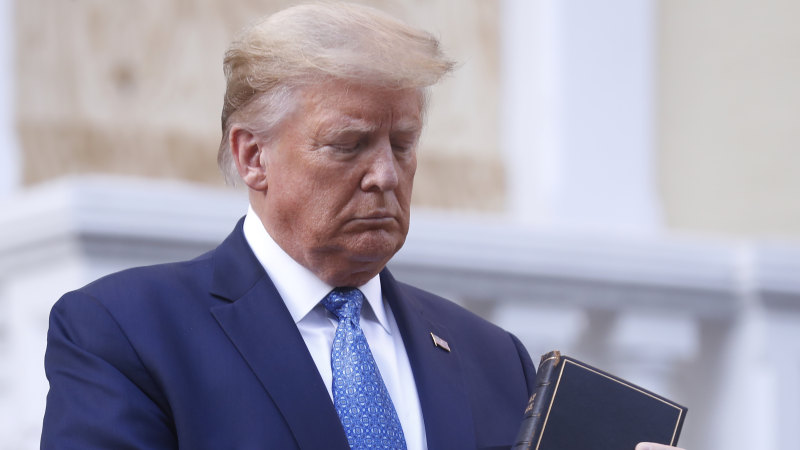
Donald Trump poses with a bible outside St. John’s Episcopal Church in Washington.Credit:Bloomberg

As Mr Trump’s predecessor Barack Obama pointed out, however, it is not only a question of the presidency but of those who turn out to protest turning up to vote when state and local officials – who actually wield authority over policing – run for election. “If we want to bring about real change, then the choice isn’t between protest and politics. We have to do both,” Mr Obama said.

The alternative is one that American and foreign journalists have seen unfold over the past few days: a terrain in which violence against “enemies” – including journalists, thanks to years of incitement by Mr Trump – is indiscriminate and unchecked, and a politics where photo opportunities and grandstanding replace the hard work of consultation and legislation.

It is difficult to see how Americans struggling with economic, health and social crises can emerge from this darkness, though surely removing Mr Trump from office in November would be a beginning. During his career he has presided over a string of bankruptcies, but he has never run a concern that so many people have invested so much in as the presidency. Let us hope it is now clear to enough voters that a second term for this man is more than their nation can afford.

Source by [author_name]

High-risk teachers vulnerable to Covid-19 now know how they will be treated – The Mail & Guardian

Unions have signed an agreement of procedures to follow when dealing with teachers who have underlying illnesses or those who are 60 years of age and older, who are at a higher risk of complications if they contract Covid-19.

This comes after teacher unions criticised the basic education department for not providing clarity on the matter.

At-risk teachers who want to return to school may do so, but the principal must agree to this and all safety measures must be in place. The agreement further says that the concession will only be applicable during levels three and two of the national disaster.

At a press briefing in Rustenburg on Monday, the basic education department’s director general, Mathanzi Mweli, said he had signed the Education Labour Relations Council’s collective agreement over the weekend. Heads of departments had contributed to it, he said. 

“It will be a protocol that determines the step-by-step processes of how teachers should go about dealing with comorbidities.” 

The agreement, Concession Process to Follow for Employees with Comorbidity, dated May 30, shows the signatures of Mugwena Maluleke, the general secretary of the South African Democratic Teachers’ Union, and Allen Thompson, the president of the National Teachers’ Union. Maluleke confirmed the document’s authenticity. 

“For employees with high-risk comorbidities, it is required of the employer to put appropriate measures in place to accommodate them in the work environment. Due consideration must be given to operational demands and circumstances of employees to accommodate either work from home or for special workplace arrangements to be made,” reads the document. 

These teachers must complete a risk assessment form for vulnerable employees. They will get their full pay while they are at home, but this will be subject to them meeting all requirements. 

Mweli said a medical doctor must write a report with supporting documents proving that the teacher is at risk if they go to school during this time. 

The document lists, among others, the following conditions as high risk: 


  • A person who is 60 and above with one or more diseases/conditions as listed;
  • Solid organ transplant recipients; 
  • People with specific cancers or receiving immunosuppressive treatment for cancer;
  • People undergoing chemotherapy and radical radiotherapy for lung cancer;
  • People with severe respiratory conditions including cystic fibrosis, severe and unstable asthma or tuberculosis of the lung; 
  • Chronic lung problems;
  • Pregnant women with significant heart disease, congenital or acquired;
  • Severe hypertension;
  • Severe obesity;
  • Type II diabetes, chronic kidney disease and liver disease; 
  • More than 27 weeks pregnant; and 
  • HIV with advanced immunosuppression.

If a medical condition is not listed in the document a teacher can ask a doctor to write a letter confirming vulnerability to the virus. But the head of department has the right to get an opinion from another doctor, and in the 30 days while waiting for the outcome the teacher will stay or work from home while receiving a salary.


Source link

Coronavirus Outbreak LIVE Updates: Chhattisgarh records second COVID-19 death as 55-year-old woman tests positive posthumously

0


Coronavirus Outbreak LATEST Updates: A 55-year-old woman from Chhattisgarh’s Durg district, tested positive for COVID-19 post her death at the All India Institute of Medical Sciences (Raipur), a health official said on Wednesday. This is the second COVID-19 death in the state, which has recorded 572 cases so far.


The administration at Delhi’s All India Institute of Medical Sciences has issued a show-cause notice to a senior resident doctor who had flagged safety concerns about the protective gears given to healthcare workers at the hospital

With 27 persons testing positive for COVID-19 in the last 24 hours, the case count in Madhya Pradesh’s Indore district rose to 3,597 on Wednesday, a health official said. Indore is one of the worst-affected districts in the country amid the coronavirus pandemic.

With over 1 lakh COVID-19 patients having recovered so far, India’s recovery rate has risen to around 48.31 percent, as per data from the Union Health Ministry.

The total number of containment zones in Delhi is now 158, reports ANI, while a total of 58 zones have been de-contained to date, according to the Delhi government. With 22,132 confirmed novel coronavirus cases, Delhi remains the third most-affected region in the country.

‘People are facing economic hardship of unimaginable proportions because of the pandemic. I appeal to Centre to transfer Rs 10,000 each as one-time aid to migrant labourers including people in the unorganised sector. A portion of PM-CARES could be used for this,’ said Mamata Banerjee, Chief Minister of West Bengal on Wednesday.

Cyclone Nisarga, which is expected to hit the coast near Alibag in Maharashtra this afternoon, has forced authorities in Mumbai to shift about 150 patients from the makeshift Covid-19 hospital in Bandra Kurla Complex to the NSCI Exhibition Centre in Worli and Sion Hospital, say reports.

A total of 41,03,233 samples have been tested till now, of which 1,37,158 samples have been tested in the last 24 hours, says ICMR according to ANI.

India’s total number of infections rises to 207,615, according to the Union Ministry of Health and Family Welfare. The toll has risen to 5,815. As many as 1,00,303 COVID-19 patients have been cured and discharged so far, with  1,01,497 active cases.

‘Out of 115 samples tested, 9 more returnees from Chennai tested COVID-19 positive. The total number of positive cases stands at 58,’ said S Pangnyu Phom, Nagaland Health Minister on Wednesday.

Chief Minister Uddhav Thackeray in a video address on Tuesday had told that he would be deferring the ‘Unlock 1’ reopening of the state from 3 June to 5 June in view of the Cyclone Nisarga, which is expected to make landfall in the city on Wednesday afternoon.

Even as the number of confirmed coronavirus cases in the country climbed to 1,98,706  and the death count rose to 5,598, the Indian Council of Medical Research (ICMR) said that the country was “very far away” from the peak of the infection and was better positioned than most other countries.

8,171 new cases, 204 deaths reported in 24 hours

In the 24 hours since 8 am on Monday, the country reported 8,171 cases, taking the number of confirmed cases to 1,98,706 while the toll climbed to 5,598 as 204 more deaths were recorded across the country, said the health ministry in its morning update.

As many as 95,526 people have recovered and one patient has migrated, and the number of active cases now stands at 97,581, according to the health ministry data.

Around 48.07 percent patients have recovered so far, a ministry official said.

Out of the 204 more deaths since Monday morning, 76 were in Maharashtra, 50 in Delhi, 25 in Gujarat and 11 in Tamil Nadu. Eight people each died of COVID-19 in West Bengal and Madhya Pradesh, followed by six in Telangana, and four each in Rajasthan and Uttar Pradesh.

With 2,362 deaths, Maharashtra accounts for the highest number of fatalities out of the total 5,598 deaths, followed by 1,063 in Gujarat, 523 in Delhi, 358 in Madhya Pradesh and 335 in West Bengal.

There have been 217 coronavirus deaths so far in Uttar Pradesh, while 198 succumbed to the infection in Rajasthan, 184 in Tamil Nadu, 88 in Telangana and 64 in Andhra Pradesh.

Confirmed cases in India crossed 1.98 lakh and the toll reached 5,598 on Tuesday. AP

The highest number of confirmed cases is 70,013 from Maharashtra, followed 23,495 in by Tamil Nadu, 20,834 in Delhi, and 17,200 in Gujarat. There are 8,980 cases of the viral infection in Rajasthan, 8,283 in Madhya Pradesh and 8,075 in Uttar Pradesh. The number of COVID-19 cases has gone up to 5,772 in West Bengal, 3,926 in Bihar and 3,783 in Andhra Pradesh.

The ministry said 6,414 COVID-19 cases were being reassigned to states, adding that the figures were being reconciled with the ICMR.

With a total of 1,98,706 cases, India is now seventh among the worst-hit nations by the COVID-19 pandemic after the US, Brazil, Russia, the UK, Spain and Italy.

Country very far away from peak, says ICMR

However, Joint Secretary in the Health Ministry Lav Agarwal, during a briefing on the COVID-19 situation in the country, said it is wrong to just look at the total number of cases and state that India has the seventh-highest number of cases as the population of countries also should be taken into account.

About 14 most affected countries with a cumulative population almost equal to that of India have reported 55.2 times more COVID-19 deaths and 22.5 times more cases, he said.

“Our COVID-19 fatality rate is 2.82 percent as against 6.13 percent globally. Our COVID-19 fatality rate is amongst the lowest in the world,” he said and attributed it to timely identification of cases and proper clinical management.

Presenting an age profile analysis of COVID-19 deaths, Agarwal said one in every two COVID-19 deaths in India has been of senior citizens who constitute 10 percent of the total population. This ten percent of India’s population accounts for 50 percent of India’s COVID-19 linked deaths, he said,  while 73 percent of COVID-19 deaths in the country are of people with comorbidities.

ICMR scientist Nivedita Gupta said that the country was far from approaching the peak of the infection.

“We are very far away from the peak. Our preventive measures to curtail the disease are very effective and we are better positioned in comparison with other countries. You will get to see the data in a week.”

The medical research body is conducting a sero-survey to assess the extent of spread of COVID-19 and almost 34,000 people are being tested as a part of it, she said, adding that its results will be out in the public domain by the end of this week or early next week.

When asked about the prevalence of community transmission in the country, Gupta said that instead of focusing on the term “community transmission”, it was important to understand the extent of spread of the contagion and where India stood in comparison with other countries.

Responding to a question on whether there is some amount of under-reporting of COVID-19 deaths with several states not testing bodies for the infection, Gupta said there was no under-reporting of COVID-19 deaths in India and states were doing causality assessment and attributing cause of death accordingly.

“None of us thinks that there is gross under-reporting of COVID-19 deaths. If you look at the figures, India has been very good with reduction in mortality, as compared with other nations,” she said. “A patient who comes to hospital and dies can be COVID-19 positive or negative and there are lot of factors which are responsible for a death. It is not fair to attribute every death to COVID-19,” Gupta said at a press conference.

In terms of the number of deaths getting reported in the country and also even in different mortuaries, Agarwal said “there was no abnormal increase in numbers rather they have gone down”.

“Let us feel reassured that the country is in safe hands and continued efforts are being done in the direction in terms of management of COVID-19,” he said at the briefing.

The health ministry also stressed on the importance of taking adequate precautions even as the country has begun to open up offices, shops and commercial activity under the ‘Unlock’ plan announced by the Centre.

“As we are in ‘Unlock-1’ situation, the challenge before us is how to follow COVID-appropriate behaviour, be it in terms of travel or office functioning. We have to think in terms of a new normal on how to live with the virus by taking adequate precautions so as to protect ourselves from it,” he said.

Many states have eased restrictions since Monday to revive the economy and achieve a semblance of normalcy, after a two-month-long coronavirus-induced lockdown. Domestic flights and trains have also begun to operate to a limited extent.

State-wise cases

Meanwhile, the number of cases and deaths has continued to rise in many states, especially among those coming from other states and abroad. A PTI tally based on the numbers reported by states and Union Territories till 10.05 pm put the total number of infections found in the country at 2,00,321 and deaths at 5,739. It also showed a higher count of recoveries at 99,613, leaving nearly 95,000 active cases across the country.

Gujarat on Tuesday reported 415 new COVID-19 cases and 29 deaths, taking the overall case count to 17,632 and fatalities to 1,092, the state Health department said. In Ahmedabad itself, 279 new cases and 24 deaths were recorded taking the total to 12,773 and toll to 888.

In neighbouring Maharashtra, the case count surged to 72,300 with  2,287 and 103 deaths recorded. With this, the death count in the state rose to 2,465. The number of active cases in the state stands at 38,493, said the state health department.

Karnataka recorded the biggest single-day spike of 388 COVID-19 cases, with returnees from neighbouring Maharashtra continuing to add to the state’s case count, taking the total number of infections to 3,796, according to the state health department. With 367 out of 388 new cases being returnees from other states, mostly from neighboring Maharashtra (357), the Karnataka government said it was mulling over increasing institutional quarantine for those returning from the western state.

Kerala also recorded a spurt in cases, with 86 testing positive in a single day and pushing the state’s total to 1,412. A 77-year-old Christian priest died at the Thiruvananthapuram Medical College Hospital on Tuesday, taking the toll in the state to 11.

Tamil Nadu reported more than 1,000 cases for the third straight day, pushing the infection count past the 24,000 mark. The toll has risen to 197 with 13 more deaths while the number of confirmed cases surged to 24,586.

In Telangana, twelve post-graduate students of a state-run medical college tested positive for COVID-19 while the fresh cases in Himachal Pradesh included a Delhi Police personnel, a SpiceJet passenger and a Delhi Transport Corporation (DTC) employee. The confirmed cases in the hilly state climbed to 346.

In Delhi, five police personnel from Anand Parbat area, taking the total number of those infected among the Delhi Police to over 500, reported ANI. Thirteen employees of Delhi Lt Governor Anil Baijal’s office and six other government officials have also tested positive for COVID-19, sources told PTI. They said junior assistants, drivers, peons are among the 13 people working at the Lt Governor Secretariat who have tested positive for the virus, leading to fear among other employees.

Meanwhile, the global toll due to the viral infection climbed to 3,76,320 and the number of cases reached 61,94,533, according to the World Health Organisation (WHO’s) coronavirus tracker.

With inputs from agencies

Updated Date: Jun 03, 2020 15:59:30 IST

Tags :

Coronavirus In India,

Coronavirus Lockdown,

Coronavirus Outbreak,

Coronavirus Pandemic,

COVID-19,

COVID-19 Outbreak,

COVID-19 Pandemic,

Guidelines For Lockdown,

Guidelines For Lockdown 5,

Health Ministry,

Home Ministry Guidelines,

India Domestic Flight Rules,

Lockdown,

Lockdown 5 Guidelines,

Lockdown 5 In Maharashtra,

Lockdown Guidelines,

Lockdown In Maharashtra,

Madhya Pradesh,

Maharashtra Lockdown,

Maharashtra Lockdown 5,

MHA,

Mha Guidelines On Lockdown,

NewsTracker


Source link

EU staved off unemployment spike in April

0

Governments across the region have doled out around €2 trillion in state aid to prevent mass bankruptcy and unemployment | Kenzo Tribouillard/AFP via Getty Images

Europe’s statistics office reports modest rise in jobless rate after government boosted aid.

European unemployment rose modestly in April as policymakers held the line with programs to stave off mass joblessness during the coronavirus pandemic.

The EU’s unemployment rate climbed to 6.6 percent and the 19 euro countries’ to 7.3 percent in April on seasonally adjusted terms, the bloc’s statistics office reported Wednesday. Both were an increase of 0.2 percentage points from March.

Governments across the region have doled out around €2 trillion in state aid to prevent mass bankruptcy and unemployment. The EU meanwhile has agreed to support national programs that compensate employees for lost income if companies shorten their working hours.

The European Central Bank also has pledged to buy up to €1 trillion of governments’ and companies’ bonds to cushion the coronavirus’ fallout.

The figures could still turn worse for May. Germany’s labor agency Wednesday reported a larger rise in unemployment to 6.3 percent in the month just concluded, according to news reports.


Source by [author_name]

China’s gigantic radio telescope to start searching for ‘alien civilisations’

0

China is going to start listening out for signs of alien civilisations (Getty)

Chinese state media has announced the country is set to start looking for aliens.

The tool for doing this is a gigantic radio telescope located in China’s Guizhou province.

The Five-hundred-metre Aperture Spherical Telescope – known as FAST – finally went operational in January and will begin sifting through the cosmos to find evidence of intelligent alien life. China has already claimed the telescope has picked out 99 pulsars (spinning neutron stars) since it went operational.

The telescope had been under construction for years, finally finishing in 2016. It’s the largest telescope of its kind in the world and Chinese state media announced it will begin searching for ‘extraterrestrial civilisations’ in September.

‘A radio telescope is like a sensitive ear, listening to tell the meaningful radio messages from white noise in the universe,’ said chief scientist of the FAST project, Nan Rendong while it was under construction.

An aerial view of the Five hundred meter Aperture Spherical Telescope (FAST) on June 10, 2016 in Qiannan Buyei and Miao Autonomous Prefecture, China. (Visual China Group via Getty Images/Visual China Group via Getty Images)

Alongside looking for aliens, researchers say FAST would search for gravitational waves and detect radio emissions from stars and galaxies

‘The ultimate goal of FAST is to discover the laws of the development of the universe,’ said Qian Lei, an associate researcher with the National Astronomical Observatories of the Chinese Academy of Sciences.

‘In theory, if there is civilisation in outer space, the radio signal it sends will be similar to the signal we can receive when a pulsar (spinning neutron star) is approaching us.’

The Five-hundred-metre Aperture Spherical Radio Telescope (FAST) is the biggest radio telescope in the world (Photo credit should read STR/AFP via Getty Images)

China is rapidly ramping up its space ambitions and has said it wants to launch a rover to Mars next month.


Source link

Scientists alarmed as Trump embraces fringe views and extreme theories amid pandemic

The early months of Donald Trump’s administration saw its approach to science routinely compared to George W Bush’s – both governments were highly sympathetic to large corporations, distrustful of anything to do with the climate crisis and enthused at the idea of delegating oversight to the states.

Trump’s version may have been more abrasive and bungling but it at least seemed a familiar extension of the last Republican administration.

More recently, however, scientists have been struck by Trump’s embrace of fringe beliefs and extreme, unsupported theories. Suddenly, it is not the profit-driven lobbyists and lawyers that are the worry, it is the quacks, cranks and conspiracy theorists.

“They have exceeded my imagination with their scientific denial,” said Gretchen Goldman, a research director at Union of Concerned Scientists. “Previous administrations at least gave the appearance of wanting scientific evidence and qualified people in positions of power. This administration clearly doesn’t care, which changes the game.”

Trump himself has a long history of defying mainstream scientific findings on the existence of climate change and the efficacy of vaccines, but his actions during the coronavirus pandemic have startled even his most vocal critics.

The president falsely claimed Covid-19 would evaporate in the April sunshine, expressed bewilderment that a vaccine wasn’t imminent and pondered the merits of injecting disinfectant as a treatment. Trump has also repeatedly touted the benefits of hydroxychloroquine, an anti-malarial drug he says he himself has taken as a precaution despite evidence it can cause heart problems in some patients. The World Health Organization recently halted trials to see if the drug could treat Covid-19, citing safety fears.

From its inception, the Trump administration has handed leadership of federal agencies to figures who have represented polluting industries. Andrew Wheeler, a former coal lobbyist, heads the Environmental Protection Agency, while David Bernhardt, another former energy lobbyist, is in charge of America’s public lands as secretary of the interior.

The deregulatory zeal of these agencies, often in the face of scientific advice, has seen droves of scientists leave the government. In a January estimate, 20% of high-level scientific positions within the government are vacant, with long-term officials complaining of being sidelined or silenced.

But the administration has also increasingly shown willingness to ally itself with groups far more fringe than the standard class of lobbyist that inhabits Washington DC.

The administration defended Trump’s use of hydroxychloroquine by pointing to supportive statements from the Association of Physicians and Surgeons, an outlier group that has questioned whether HIV causes Aids (it does), argued abortion causes breast cancer (it does not) and even alleged former president Barack Obama used hypnosis techniques to trick voters, especially Jewish people, into supporting him (there is no evidence of this).

In April, Trump unveiled advice from the Centers for Disease Control and Prevention that Americans should wear face masks to curb the spread of Covid-19, but has since echoed fringe rightwing views that masks are pointless or somehow unmanly. The president said on Tuesday it was “very unusual” that Joe Biden, the presumptive Democratic nominee, was seen wearing a mask, calling its use “politically correct”.

“The elevation of fringe views is even more vivid with coronavirus, the impacts are more evident,” said Goldman.

Meanwhile, the Trump administration has aligned itself with an anti-abortion lobbying group called the Center for Family and Human Rights, helping spread its message to the UN, while Trump’s own spiritual adviser Paula White has said she hopes abortion laws are overturned, declaring on a video that emerged in January: “We command any satanic pregnancies to miscarry right now!”

The pandemic has obscured a determined push by the Trump administration to further roll back regulations designed to prevent pollution and protect public health, with some of these efforts jarring uncomfortably with the federal government’s own analysis.

For example, the administration is scaling back fuel efficiency standards for cars and trucks, a process that has provoked a lawsuit from 23 aggrieved states and, according to a study of the EPA’s own figures, will cause an extra 18,500 deaths over the next three decades from air pollution, as well as $240bn more in extra fuel costs for Americans.

“This administration is antithetical to science, there is an ideological mandate to roll back regulations. Facts and logic doesn’t matter, even the law doesn’t matter,” said Chris Frey, a a professor of environmental engineering at NC State University.

Frey was part of an EPA clean air advisory panel that was dismantled as part of a revamp that has seen agency panels filled with industry-aligned and fringe characters – including an official who has argued air pollution is good for public health – and the process of considering science rerouted to bypass a large body of research that links pollution to harm such as asthma and heart disease.

“It will take years to undo the damage. This administration is honestly a threat to public health,” Frey said. “The past three years have hurt the US scientific community in a lot of ways. If this continues for another three years, I don’t know if it’s robust enough to take it.”

US politics’ problematic relationship with science doesn’t just hinge upon one administration, however. Until the election of a handful of people with scientific backgrounds in the 2018 midterms, Bill Foster was the only member of Congress with a scientific PhD. Foster has admitted the experience often felt lonely and frustrating.

“We’ve achieved a lot with science but I’m embedded in a culture that doesn’t value science,” said Foster, an Illinois Democrat. “The heroes we are looking for are the people who have spent their careers in science.”

Foster added that Trump’s reaction to mask wearing has cost lives.

“If he had said masks are very useful and then apologized for the fact the stockpile of masks was so low, many tens of thousands of Americans would be alive today,” he said. “That is the tragedy that bothers me more than anything.”

Source link