Thursday, April 30, 2026

Zoom booms as teleconferencing company profits from coronavirus crisis

The teleconferencing company Zoom has seen a massive increase in profits and has doubled its annual sales forecast, driven by a surge in users as more people work from home and connect with friends online during the coronavirus crisis. 

The once-obscure Zoom Video Communications, which has rapidly emerged as the latest Silicon Valley gold mine, released financial results on Tuesday showing the astronomical growth that has turned it into a stock market star.

Zoom’s boom has come despite privacy problems that enabled outsiders to make uninvited and sometimes crude appearances during other peoples video conferences. 

Zoom’s revenue for its fiscal first-quarter between February and April more than doubled from the same time last year to $328m, turning a profit of $27m compared with $198,000 a year ago.

The numbers exceeded analysts already heightened expectations, providing another lift to a rocketing stock that has more than tripled in price so far this year. After a big run-up leading up to Tuesday’s highly anticipated announcement, Zoom’s stock gained nearly 3% in extended trading to $213.60 – more than five times the company’s initial public offering price of $36 less than 14 months ago. 

The surge has left Zoom with a market value of about $59bn greater than the combined market values of the four largest US airlines, which have seen their businesses hammered by the coronavirus outbreak that has dramatically curtailed travel.

“We were humbled by the accelerated adoption of the Zoom platform around the globe,” said boss Eric Yuan, who co-founded the company nine years ago.

In a sign that its growth is not expected to be short lived, Zoom forecast revenue of roughly $500m for its current quarter ending in July, more than quadrupling from the same time last year. For its full fiscal year, Zoom now expects revenue of about $1.8bn, nearly tripling in a year.

Security issues prompted some schools to stop using Zoom for online classes that have become widespread since February, although the company’s efforts to introduce more security protection has brought some back to the service. More than 100,000 schools worldwide are now using Zoom for online classes, according to the company.

But the once-weak privacy controls also helped make Zoom extremely easy to use, one of the reasons it became such a popular way to hold online classes, business meetings and virtual cocktail hours after most of the US began ordering people to stay at home in effort to reduce the spread of the novel coronavirus that causes Covid-19.

Zoom also offers a free version of its service, another factor in its popularity at a time when about 40 million people in the US have lost their jobs since mid-March, raising the specter of the worst economic downturn since the Great Depression of the 1930s.

The San Jose, California-based company has always made most of its money from companies that subscribe to a more sophisticated version of its service that traditionally has been used for business meetings among employees working in offices far apart from each other.

But the pandemic-driven shutdown turned Zoom into a tool for employees who once worked alongside each other, but have been doing their jobs from home during the past few months.

Zoom ended April with 265,400 corporate customers with at least 10 employees, more than quadrupling from the same time last year.

Although Zoom remains focused on servicing its corporate customers, Yuan is hoping to figure out ways to make money from the all the socialising and education taking place on the service, too. Some analysts have speculated that Zoom may eventually show ads on the free version of Zoom, although the company has not given any indication it will do that. 

Source link

Intel: House Middle East panel chairman questions Trump’s commitment to two-state solution

Jun 2, 2020

The chairman of the House’s Middle East panel questioned the Donald Trump administration’s stated commitment to a two-state solution during a Zoom interview with the Israel Policy Forum today.

Rep. Ted Deutch, D-Fla., said that he “didn’t reject” Trump’s peace Israeli-Palestinian peace proposal “out of hand” and that he was initially “hopeful” that the president had started referring to it as a “two-state solution.” However, Deutch went on to add that the plan raised “lots of questions about the viability of a Palestinian state.”

“There was a realization it could lead more to unilateral annexation, and then we started seeing a response from the outside world,” said Deutch. “What’s confusing is the plan envisioned, at some point … negotiations between Israel and the Palestinians. It’s been everyone’s position that that’s how you get two states. But then we fast forward to where we are in this moment, and it doesn’t look like that commitment exists.”

Why it matters: While the Trump plan formally endorses a two-state solution, its proposal that Israel formally annex its West Bank settlements as well as the entire Jordan Valley would not allow for the creation of a contiguous Palestinian state. Prime Minister Benjamin Netanyahu has secured an agreement with his rival, Defense Minister Benny Gantz, that would allow Netanyahu to proceed with annexation as soon as July.  

“A directly negotiated two-state solution is a mainstream position and expressing concern about unilateral annexation isn’t extreme at all,” said Deutch. “It’s the position of most of the largest cross-section of the American Jewish community.”

What’s next: Deutch also reflected on the 2016 debate over whether to reference Israel’s occupation of the West Bank in the Democratic Party platform. While delegates loyal to former Secretary of State Hillary Clinton ultimately won out and blocked the reference to the occupation, delegates pledged to Sen. Bernie Sanders, I-Vt., may try to revive that fight when Democrats convene to draft the 2020 platform in August. Deutch said the platform should reflect language House Democrats already passed in a series of nonbinding resolutions.

“That’s support for the US-Israel relationship, it’s support for a two-state solution, it recognizes the importance of assistance to Israel, and it opposes the [boycott, divestment and sanctions] movement,” said Deutch.

Know more: Check out Al-Monitor’s Week in Review to learn about Netanyahu’s push for quick annexation.


Source link

Analysis: Is China Preparing to Declare an Air Zone Over the South China Sea?

0

Reports of Chinese plans to declare an Air Defense Identification Zone over the disputed South China Sea have resurfaced in news media amid rising tensions in the region. But experts remain skeptical that China would take such a provocative, hard-to-enforce measure.

The South China Morning Post reported this week that China has planned for an ADIZ over the South China Sea since 2010. It quoted an unnamed Chinese military source as saying the ADIZ would be announced at “the right time” and cover the entirety of the Spratly, Paracel, and Pratas Islands. China itself has not announced an ADIZ declaration is imminent.

China has, however, made a number of recent, unilateral moves to assert jurisdiction across the South China Sea. Through April and May, it sent a survey ship into Malaysian waters to pressure a Malaysian enterprise out of exploring for resources. In April, China announced two new administrative districts to govern the Paracel and Spratly Islands. It also named 80 new tiny features in waters claimed by Vietnam.

Declaring an ADIZ would be a major step, though. An ADIZ is an area where civilian aircraft are tracked and identified before further entering into a country’s airspace, although it does not restrict travel in and out of its limits, nor does it usually apply to military aircraft.

In practice, it would likely mean civilian planes would need to report their presence to Chinese air traffic control, and could potentially be intercepted if they didn’t – although China has yet to take such an action on the ADIZ it established seven years ago over the East China Sea, further north.

The proposed South China Sea ADIZ would cover a vast area. Experts say enforcing it would present huge logistical challenges for China’s air force and could provoke diplomatic backlash. Of late, the U.S. has upped the tempo of its military aircraft flights over Chinese-claimed features in the South China Sea. Other nations maintain airstrips on islands they occupy in the area.

“I don’t see how at this particular juncture it’s in China’s interest to declare something they cannot enforce,” said Bonnie Glaser, director of the China Power Project at the Center for Strategic and International Studies think tank in Washington.

How far would China go?

There is no international law or treaty specifically stating what can and can’t be a valid ADIZ. Technically the only limit is whether a country is willing to enforce compliance with it. This can, but does not always, include sending fighter jets to intercept or escort civilian aircraft that fail to identify themselves within the ADIZ. The question of how far China would go to enforce its ADIZs was a key concern for its neighbors in the past.

China declared an ADIZ over the East China Sea in 2013 in response to Japan’s government buying some of the disputed Senkaku islands – known as the Diaoyu Dao by China – from a private Japanese owner. This prompted protests by South Korea, the United States, Japan, and Taiwan.

“The language China used for its Air Defense Identification Zone in 2013 was different from what other countries used,” said Glaser, “because it warned of some consequences if aircraft did not identify themselves. So there was this little ‘threat’ language there that people objected to at the time.”

According to Brendan Mulvaney, Director of the Alabama-based China Aerospace Studies Institute, China would be likely to enforce a South China Sea ADIZ similarly to how they enforced the East China Sea one — by applying economic coercion and diplomatic pressure to air freight companies, passenger fleets, and the countries they come from. Today, most every country and company in the region complies with that ADIZ, although the U.S. and Japan still do not recognize it.

Neither Glaser nor Mulvaney thought it would be easy for China to effectively enforce an ADIZ over the South China Sea if one was announced soon.

“China has no hope of enforcing an ADIZ around airspace that is currently dominated by other powers. It’s just not going to be able to force an ADIZ in the Spratlys,” Glaser said. Multiple countries including Taiwan, Vietnam, and the Philippines have built airstrips on features in the Spratlys, and would regularly contest any such zone.

Mulvaney said enforcing an ADIZ through intercepts would be “feasible,” but would stretch China’s air force to its limit, as no aircraft is permanently based in the Spratlys – although military aircraft have been spotted periodically on its main base on Fiery Cross Reef, within that island chain.

“It will be a trade-off for how much they want to take away from training, exercises, and operations, in the name of escorting/intercepting aircraft that really are no threat to the PRC mainland,” he said.

‘Chipping away’ the global order

The concept of an ADIZ has been invoked by many other countries and is not unique to China. The United States maintains four of them around its overseas territories and North America, and Japan has one that is mostly aligned with its exclusive economic zone under the United Nations Convention on the Law of the Sea. The Philippines maintains an ADIZ over its part of the South China Sea, covering Scarborough Shoal.

Glaser said it is more plausible that China could announce such a measure over just a portion of the South China Sea.

“From my conversations with people, I think that either China waits, or as an interim measure in the near term could declare an ADIZ solely over the Paracels,” she said. China already occupies every feature in the Paracels — which lies closer to the Chinese mainland than the Spratlys – as well as rotated planes through its base at Woody Island before, and controls the airspace above them.

Mulvaney and Glaser said a new ADIZ could bring some modest strategic benefits for China by controlling yet another dimension of the South China Sea, and most civilian airliners or companies would likely comply.

Mulvaney said overlapping or disputed ADIZs, including the existing one in the East China Sea, are not really that difficult to comply with. Very little state-to-state interaction is necessary, and most civilian air carriers are willing to make the “few extra radio calls” necessary to continue flying through a country’s ADIZ without trouble.

But such a declaration over the South China Sea – which is already the focus of a six-way, seemingly intractable territorial dispute for waters, islands and reefs on the ocean itself – would reinforce the perception that China is writing its own rules.

Beijing has in recent years skirted international law with its sweeping claims and artificial island-building and used strong-arm tactics to bully the vessels of other claimants.

Mulvaney said it would be another example of China “chipping away” at the current world order and international norms. “Similar to the salami slicing technique of feature building, unless other nations protest and oppose this ADIZ, China hopes it will become just a fact of life over time,” he said.


Source link

Syria’s stock market stops trades of Rami Makhlouf’s telecom company

Jun 2, 2020

Syria’s stock market announced today that it would stop trading shares of Syriatel, the country’s largest telecommunications company, which is owned by Bashar al-Assad’s embattled cousin Rami Makhlouf.

Syria’s Commission of Financial Markets said the suspension would last indefinitely and was designed to protect shareholders, The Associated Press reported.

The move is the regime’s latest step in consolidating power over Makhlouf, who is believed to have at one point controlled as much as 60% of Syria’s economy, but has apparently fallen out of favor with Assad.

Makhlouf went public against the crackdown last month, posting videos to Facebook in which he appealed directly to the president.

Syria’s telecommunications regulatory body gave Syriatel four days’ notice May 1 to accept a repayment plan for some 230 billion Syrian pounds (about $450 million). The government then froze Makhlouf’s assets and imposed a travel ban on him.

With some 11 million subscribers, Syriatel is considered one of the prime assets of the regime, according to AP. Makhlouf also has large stakes in real estate, oil trade and construction.

The moves come as Syria’s government is under increasing financial strain from decades of corruption, nine years of civil war and unrelenting US and international sanctions.

The US State Department has taken a lead role in discouraging international economic cooperation with the Assad regime, hoping that Russia and Iran, which militarily propped up Assad during the war, will inherit a broken and dysfunctional ally.

The regime has a significant interest in normalizing international relations and attracting foreign investment. Syria is estimated to need between $250 billion and $400 billion for post-war reconstruction, some four to seven times the country’s prewar gross domestic product in 2010.


Source link

Britain to change immigration rules if China imposes security law on Hong Kong, Johnson says – Firstpost

0

(Reuters) – The United Kingdom is prepared to change its immigration rules if China imposes a national security law on Hong Kong, British Prime Minister Boris Johnson said on Wednesday in an op-ed for the South China Morning Post.

“Since the handover in 1997, the key has been the precious concept of ‘one country, two systems’, enshrined in Hong Kong’s Basic Law and underpinned by the Joint Declaration signed by Britain and China”, Johnson wrote.

The British prime minister added that China’s decision to impose a national security law on Hong Kong will “curtail its freedoms and dramatically erode its autonomy”.

He described China’s step as being in conflict with the obligations under the Joint Declaration.

“If China imposes its national security law, the British government will change our immigration rules,” Johnson said.

Under the change, holders of British National Overseas passports from Hong Kong would be allowed to enter the UK for a renewable period of 12 months and given further immigration rights, he added, “including the right to work, which could place them on a route to citizenship”.

About 350,000 of the territory’s people currently hold such passports and another 2.5 million would be eligible to apply for them, Johnson said.

China’s parliament last week approved a decision to create laws for Hong Kong to curb sedition, secession, terrorism and foreign interference. Mainland security and intelligence agents may be stationed in the city for the first time.

On Tuesday, Britain warned Beijing to step back from the brink over the national security law in Hong Kong, saying it risked destroying one of the jewels of Asia’s economy while ruining the reputation of China.

Last week, U.S. President Donald Trump ordered his administration to begin the process of eliminating special U.S. treatment for Hong Kong to punish China.

(This story has been refiled to fix punctuation in second paragraph)

(Reporting by Kanishka Singh in Bengaluru; Editing by Tom Brown)

This story has not been edited by Firstpost staff and is generated by auto-feed.


Source link

Does the militarisation of US police encourage excessive force?

Images and videos of police across the country allegedly beating and shooting demonstrators, members of the media, medics and bystanders with projectiles, tear gas and flashbangs have inflamed tensions after a George Floyd, an unarmed Black man, died in police custody in Minneapolis, Minnesota, last week

Many of these scenes feature police officers dressed in full body armour and carrying shields as vehicles that look more like tanks than cruisers flashing red and blue lights roll by.

More:

The US police force is heavily militarised, thanks to the transfer of surplus military goods to law enforcement departments across the US for decades.

The scenes playing out across the US today have renewed worries that the militarisation of police has created a climate among law enforcement that encourages excessive force.

“In city after city, we are witnessing actions that could be considered unnecessary or excessive force,” said Rachel Ward, national director of research at Amnesty International USA.

“Equipping officers in a manner more appropriate for a battlefield may put them in the mindset that confrontation and conflict are inevitable,” Ward said in a statement on Saturday. 

Some protesters experience this first-hand. Haley Pilgrim, a member of Resource Generation, a “multiracial membership community” of people aged 18-35 who aim to create a world that “is racially economically just”, was present at demonstrations in Philadelphia, Pennsylvania, on Friday.

Pilgrim told Al Jazeera she saw police using batons on demonstrators and was “whipped” to the ground as she filmed the demonstration.

“Without a doubt, there was more police force. I’ve never seen up close batons being used, multiple times, being used on protesters,” Haley, who has been active in organising for eight years, said.

While images of police cars burning were shared widely on social media, Pilgrim said, that did not occur until law enforcement began acting forcefully with demonstrators. 

“The protesters didn’t come to be violent,” she added. “We had posters and microphones … Cops came with shields and batons”.

Philadelphia police did not respond to Al Jazeera’s request for comment.

The police officers with whom Pilgrim dealt directly were not wearing riot gear, but law enforcement donned the equipment as protests escalated in the city and looting began.

1033 programme

The US has transferred excess military equipment to police forces under the current system since at least 1990. The National Defense Authorization Act of 1990’s section 1208 authorised transfer of military-grade to “federal and state agencies”, according to the law. The equipment was meant to be used in police actions against drug use and sales.

But the National Defense Authorization Act of 1997 saw the expansion of the programme to include “all law enforcement agencies to acquire property for bona fide law enforcement purposes that assist in their arrest and apprehension mission”, though counter-drug operations were still given preference.

A pile of burning rubbish set by demonstrators is seen during looting after marching against the death in Minneapolis police custody of George Floyd, in the Manhattan borough of New York City [Eduardo Munoz/Reuters]

Public outcry about the programme began in earnest in 2014, following the fatal police shooting of Michael Brown, an unarmed Black teen, in Ferguson, Missouri. As protests continued, images of police officers wearing advanced body armour and wielding hi-tech weapons were widespread.

The 1033 programme, headed by the Defense Logistics Agency (DLA), the Department of Defense’s combat logistics support agency, has given domestic law enforcement at least five billion dollars in “surplus military defensive equipment” since 1997, Human Rights Watch wrote in 2017. This equipment included “aircraft to battering rams and riot gear”, according to Human Rights Watch (HRW). 

The programme provided these weapons, at times without cost, to roughly 8,000 police departments across the US, according to the programme’s website.

In recent years, Granite City, Illinois, with a population of roughly 30,000 people, received 25 M16 and M14 rifles, an armoured truck and a robot for “explosive ordinance disposal”, according to Forbes. 

Leesburg, Florida, with roughly 22,000 residents, received a mine-resistant armoured vehicle.  

Former President Barack Obama signed an executive order in 2015 that limited what items could be given to police under the programme. Before that, “even bayonets and grenade launchers” were available, HRW wrote.

While Obama was lauded for this order, an investigation by left-leaning paper In These Times found that it did little to stem the flow of combat gear to police.

President Donald Trump, who has called for governors to handle the protests with more force, meanwhile, has continued to provide military equipment to police forces across the country. 

‘Transnational police force’

US police forces not only receive weapons from their own military, many also receive training from Israel’s military, which has been accused of grave rights abuses against Palestinians. 

Israel’s national police, military and intelligence services have provided training on crowd control, use of force and surveillance to thousands of members of US law enforcement over the years.

This training has occurred in the US, Israel and the occupied Palestinian territories.

This training placed US law enforcement employees “in the hands of military, security and police systems that have racked up documented human rights violations for years”, Amnesty International wrote in 2016, citing alleged extrajudicial killing, surveillance and excessive use of force, among other violations.

Israeli authorities deny these accusations.

“Hennepin County sheriffs from Minneapolis have been trained in Israel-US police exchange programmes, as have cops in every major police force in this country,” Randa Wahbe, an analyst with al-Shabaka, a Palestinian policy think-tank, said in an email to Al Jazeera. Hennepin County sheriffs were not involved in Floyd’s death. 

While the “structures of policing in the US and Israel are meant to ensure that Black and Palestinian people are never treated as fully human,” Wahbe said, the violent tactics seen today in the US extends beyond the Israel-US exchange programmes to “slave patrols in the Antebellum South, the Black Codes during Reconstruction, the Jim Crow era, the War on Drugs, and the Prison-Industrial Complex.”

Though policing is inherently anti-Black and in Israel, anti-Palestinian, Wahbe claimed, what is happening is not about “who teaches who the strategies of surveillance and violent policing … it’s about recognising the rise and entrenchment of a transnational police force that criminalises and violently suppresses any threat to its hierarchies of power – hierarchies that are predicated on anti-Blackness.”

She concluded: “The structures of law enforcement as we know them must be abolished.”

Source link

NFL Team Named For Racial Slur Gets Dragged For Blackout Tuesday Tweet

The Washington Redskins’ attempt to support the Blackout Tuesday campaign didn’t work out so well after numerous Twitter users pointed out the team’s name is a slur against Native Americans.

Like many teams, Washington’s NFL team promoted Blackout Tuesday, a day meant to mourn the police killing of George Floyd in Minneapolis last week and to call for racial justice, with a black square on its website. However, to say it didn’t go over so well severely understates the reaction. 

Although the team has received numerous requests to change its racist name, both from Native American groups and politicians, team owner Dan Snyder has been resistant. Very resistant.

Blackout Tuesday comes as people across the nation mourn and protest the death of George Floyd, a 46-year-old Black man who died when a white police officer knelt on his neck on a Minneapolis street on May 25. His death and other police killings of Black people in recent years have ignited days of unrest and urgent calls for an end to racism and police brutality. 


Source by [author_name]

Suit Claims Google’s Tracking Violates Federal Wiretap Law

0

OAKLAND, Calif. — Google violated federal wiretap laws when it continued to collect information about what users were doing on the internet without their permission even though they were browsing in so-called private browsing mode, according to a potential class-action lawsuit filed against the internet giant on Tuesday.

The lawsuit, filed in U.S. District Court for the Northern District of California, said Google tracked and collected consumer browsing history even if users took steps to maintain their privacy. The suit said Google also violated a California law that requires consent of all parties to read or learn the contents of private communication.

The complaint focuses largely on what the company does to collect and track online activity when users surf the web in private browsing mode. Even when a user opts for private browsing, Google uses other tracking tools it provides to website publishers and advertisers to keep tabs on what websites the user visits, according to the lawsuit.

“Google tracks and collects consumer browsing history and other web activity data no matter what safeguards consumers undertake to protect their data privacy,” said the complaint, which was filed by Mark C. Mao, a partner at the law firm Boies Schiller Flexner.

Google has faced other lawsuits over its data collection, but this one tries to use the Federal Wiretap Act. The statute provides users with the right to sue if their private communications are intercepted. The lawsuit claims that Google intercepts the contents of communication between users and websites by collecting browsing history, specific website addresses and search queries.

“We strongly dispute these claims, and we will defend ourselves vigorously against them,” a Google spokesman, Jose Castaneda, said. “Incognito mode in Chrome gives you the choice to browse the internet without your activity being saved to your browser or device. As we clearly state each time you open a new incognito tab, websites might be able to collect information about your browsing activity during your session.”

The lawsuit said users had a “reasonable expectation” that their communications would not be intercepted or collected when they were in private browsing mode. It also said Google’s practices “intentionally deceive consumers” into believing that they maintain control of the information shared with the company and encouraging them to surf the web in private browsing if they want to maintain their privacy.

However, Google fails to mention that other tracking tools used by the company may continue to track users by collecting information such as internet protocol addresses as well as browser and device information, according to the complaint.

The lawsuit was filed on behalf of three people with Google accounts: Chasom Brown and Maria Nguyen, both of Los Angeles, and William Byatt, a Florida resident. It seeks compensatory damages.

Source link

In Europe, we also can’t breathe

0

Yassine Boubout is a Brussels-based law student and activist.

The protests that have flared up across the world in response to the killing of George Floyd in Minneapolis are heartening: They are gestures of solidarity and powerful expressions of outrage at the brutality of systemic racism in the United States.

But, as someone working to raise awareness of police brutality in Europe, watching the hashtag “Black Lives Matter” trend outside the U.S. has also been bittersweet. It made me wonder: Why are people in Berlin, London and Auckland joining in the chorus of “Black Lives Matter” chants, but staying silent in the face of police brutality and racism in their own countries?

In Belgium, the death of Floyd has sparked more public displays of indignation than any instance of police brutality in our own country. Social media is full of expressions of solidarity, and every major political party has spoken out against the incident.

Many of the same policymakers who for years pushed for the militarization of our police forces and the criminalization of victims are now jumping at the chance to condemn a particularly egregious example of police violence — because it happened somewhere else.

French activists have been raising red flags about ethnic profiling by police for decades.

Europe is no stranger to police brutality. So why do we fail to show the same anger and willingness to protest when we are confronted with incidents of police violence at home?

It’s not for lack of tragic incidents. Just a few weeks ago, Adil — a 19-year-old teen of Moroccan descent — was killed during a police chase in Brussels while allegedly fleeing from a police check. His death sparked calls for justice and short-lived riots in his neighborhood, but it did not mobilize people in the way we’re seeing today.

Nobody organized mass protests or connected his death to the larger struggle to combat systemic racism. Hardly any politicians spoke out, and those who did were met with massive backlash from the public and police unions. Rather than host a debate around policing tactics and racial profiling, Belgian media discussed the question of Adil’s guilt, effectively criminalizing him.

In France, mass rallies are being held in the wake of Floyd’s death even as videos of violent and intrusive arrests of people of color by French police have become the new normal on our Twitter feeds. French activists have been raising red flags about ethnic profiling by police for decades.

If the problem is more pervasive — and more visible — in the U.S., Europe is not immune to discrimination and violence at the hands of police. And yet we are still far more reluctant to talk about it, and the result is that we have largely remained ignorant of the extent of the issue.

Compared with the U.S., Europe has taken far fewer practical steps to combat police violence. While the Senate introduced the End Racial Profiling Act in 2001 (thought it still hasn’t passed), for example, countries such as France, the Netherlands, and Belgium are still discussing whether racial profiling happens and should be formally recognized by law. The U.S. is also miles ahead when it comes to the use of bodycams and anti-bias training.

These measures in themselves are clearly not enough but the fact that they exist in the U.S. and are almost non-existent in Europe tells us something about where we stand on the issue.

The death of Floyd also highlighted the importance of video footage. Police brutality happens every day — it is those incidents that come with proof of wrongdoing that provoke public responses of disgust and anger.

That’s an issue in Europe, where filming police remains controversial. Although not strictly forbidden, the legislation in many countries is far from clear. In France, for example, protesters are allowed to take footage of police but could face legal action if members of certain police task forces are recognizable in videos. In Belgium, police officers have been known to confiscate or break phones to stop people from filming.

Media coverage of police brutality in Europe is also part of the problem. In reporting on deaths and arrests, news agencies tend to take police statements at face value, without investigating the whole incident. In these statements, the victim is typically treated as a perpetrator and receives the blame for his or her death or wounds.

A police statement in the case of Mitch Henriquez, a 42-year-old man from the Caribbean killed by police in The Hague, for example, stated that he was violent, intoxicated and resisted arrest. As in the case of Floyd, the official autopsy differed from an independent one, which found that Henriquez did not die from “acute stress” but from the chokehold for which the police officer was later convicted.

Solidarity protests in response to George Floyd’s death have kicked off in many European cities, including Berlin | Sean Gallup/Getty Images

Historical context also plays a role here. The U.S. has done more to reckon with its experience of colonialism, slavery and segregation laws than elsewhere. Its civil rights movement from the 1960s still inspires anti-racism groups in Europe. Although there is still much work to be done, the average U.S. citizen is aware of their country’s history and the systems of oppression and racism on which it was built.

The same can’t be said of Europe, where speaking about race and racism remains a major taboo and where countries — including Belgium, the U.K. and the Netherlands — are still struggling to come to terms with legacies of slavery and colonialism. Although debates about race and white privilege are starting to take place, they are still far from penetrating the mainstream.

Perhaps that is part of the reason it is easier to express outrage at incidents of racism abroad. It is much easier to condemn a problem on another continent than to admit to flaws at home.

Anger at what is happening in the U.S. is not misplaced. But it will be wasted if we do not also examine what is happening in Europe and apply those hard-learned lessons to how we police our streets.


Source by [author_name]

FIFA adds voice to sports world’s protests over Floyd death

Derek Chauvin, the officer who planted his knee on Floyd’s neck, has been charged with third-degree murder and second-degree manslaughter. Three other officers involved have not been charged.

“This past week has been so dark, I have failed to keep hold of my emotions,” said Formula One’s first black champion in his latest social media post to millions of followers.

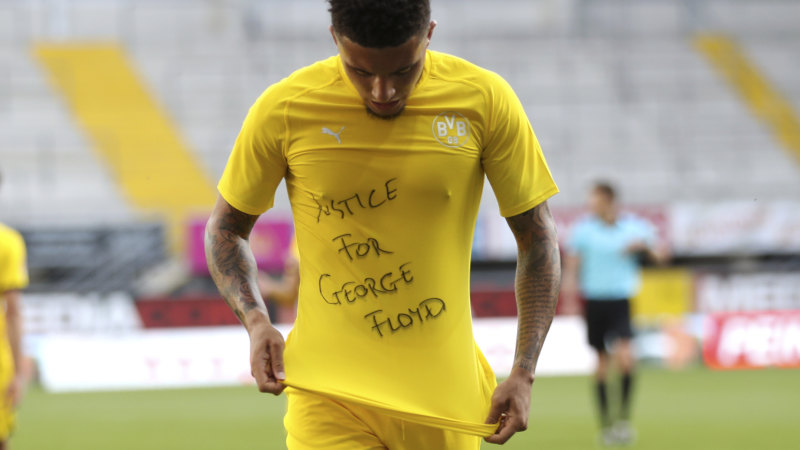
Borussia Dortmund’s Jadon Sancho took a stand against racism during a Bundesliga match.Credit:Getty Images

“I have felt so much anger, sadness and disbelief in what my eyes have seen,” added the Mercedes driver.

“I am completely overcome with rage at the sight of such blatant disregard for the lives of our people. The injustice that we are seeing our brothers and sisters face all over the world time and time again is disgusting, and MUST stop.”

Loading

Hamilton, who has homes in the United States, drew support from several other F1 drivers and his team after his comments on Sunday.

Formula One also broke its silence with a statement on Twitter: “We stand with you, and all people in the fight against racism. It is an evil that no sport or society is truly immune from,” it said.

“And it is only together we can oppose it and eradicate it. Together we are stronger.”

In Germany, England and Borussia Dortmund forward Jadon Sancho was booked after lifting his match shirt to reveal a “Justice For George Floyd” message on a T-shirt underneath.

Loading

It has been reported the German Football Association (DFB) is considering disciplinary action against Sancho, as well as a couple of others, for a technical breach of the game’s laws.

“For the avoidance of doubt, in a FIFA competition the recent demonstrations of players in Bundesliga matches would deserve an applause and not a punishment,” Infantino said.

“We all must say no to racism and any form of discrimination. We all must say no to violence. Any form of violence.”

FIFA urged governing bodies applying those laws to “use common sense and have in consideration the context surrounding the events”.

Loading

Players in England are unlikely to face any disciplinary action for taking the knee or other peaceful anti-discrimination protests if matches are able to resume this month.

On Monday, Liverpool players took a knee during training, while Manchester United’s Paul Pogba and Marcus Rashford also added their voices to protests against racism.

On Tuesday, fellow EPL clubs Newcastle and Chelsea players also took a knee before their training sessions.

Similar to FIFA’s message, the Football Association said it will adopt a “common sense approach” if there are any examples of players or staff supporting the #BlackLivesMatter cause.

Most Viewed in Sport

Loading

Source by [author_name]