Stay informed and up to date with the latest news in South Africa by reviewing the day’s major headlines on Friday 5 June.
As President Cyril Ramaphosa readies to tour the nation’s coronavirus epicentre, government remains resolute in its controversial lockdown strategy, despite mounting legal pressure. Meanwhile South Africa records its biggest-ever single-day rise in COVID-19 infections, casting doubt on recently-implemented regulatory reprieves.
TODAY’S LATEST NEWS IN SOUTH AFRICA, Friday 5 JUNE
Government heads to ConCourt to appeal ‘invalid’ verdict
President Ramaphosa, Cooperative Affairs Minister Nkosazana Dlamini-Zuma and Health Minister Zweli Mkhize will collectively appeal a damning High Court judgement which deemed certain lockdown regulations invalid and unconstitutional.
Addressing the media on Thursday afternoon, Minister in the Presidency, Jackson Mthembu, confirmed that Cabinet was in agreement with the appeal, noting that an urgent application would be lodged with the Constitutional Court. The verdict under review, handed down by Judge Norman Davis, ruled that regulations failed to pass the ‘rationality test’ and infringed on the Bill of Rights.
Mthembu argued that government had conformed with the Disaster Management Act and that all regulations implemented — no matter how controversial or restrictive — were implemented to prevent unnecessary loss of life.
Mthembu added that Cabinet had unanimously agreed to extend the current State of Disaster — which was expected to expire on 15 June — for a further 30 days.
Ramaphosa and ministers in the Western Cape
President Ramaphosa will be joined by a team of ministers during his oversight visit to the Western Cape today. Health Minister Zweli Mkhize, Defence Minister Nosiviwe Mapisa-Nqakula, Basic Education Minister Angie Motshekga, Police Minister Bheki Cele, Human Settlements, Water and Sanitation Minister Lindiwe Sisulu and Public Works and Infrastructure Minister Patricia de Lille have all been roped-in to assess the province’s readiness.
The Western Cape, which continues to be a grave concern, accounting for more than 66% of all coronavirus infections in South Africa, will come under first-hand presidential scrutiny, as Ramaphosa inspects the province’s healthcare facilities.
The president will be joined by Western Cape Premier Alan Winde. This presidential inspection comes just days after Minister Mkhize said he was “comfortable†with the province’s state of medical preparedness.
Winde has criticised an ever-growing testing backlog which continues to complicate tracing efforts in the province. According to the premier, at least Western Cape 27Â 000 tests, delivered to the National Health Laboratory Service, are still outstanding.
SASSA hauled before the Human Rights Commission
The South African Social Security Agency (SASSA), which continues to struggle under the immense weight of lockdown-related grant applications, will have to answer to the South African Human Rights Commission (SAHRC).
This comes after the Democratic Alliance’s (DA) Shadow Minister of Social Development, Bridget Masango, lodged an official complaint with the commission, citing ‘inhumane queuing conditions’ as a result of SASSA’s incompetence. The Social Security Agency, which has been tasked with delivering a special Social Relief of Distress Grant during lockdown, has only managed to process 2% of all applications received. Â
This, in turn, has resulted in a major backlog which has hampered SASSA’s ability to provide elderly and disabled beneficiaries with assistance. Masango noted that the country’s most vulnerable citizens were being forced to sleep outside SASSA offices in hopes of receiving assistance in the morning.
SASSA, which recently decided to reopen its offices with 30% staff capacity, has apologised for any inconveniences caused by the backlog.
Dlamini-Zuma determined to uphold tobacco ban
Despite facing several legal challenges and mounting public dissent, Minister Dlamini-Zuma remains determined to uphold the controversial ban on tobacco. After narrowly escaping contempt of court by missing a submissions deadline, Dlamini-Zuma supplied a responding affidavit in the legal battle with the Fair-Trade Tobacco Association (Fita).
The document, which cites scientific evidence and clinical research to support the ban on cigarettes, was submitted to the High Court ahead of the looming courtroom showdown on 9 and 10 June. The affidavit argues that smokers stood a greater a chance of being severely impacted by COVID-19 and that the tobacco ban fundamentally sought to ease strain on the public healthcare system.
Dlamini-Zuma also noted that the banning of tobacco products was an approach fitting of a “responsible governmentâ€.
LATEST WEATHER FORECAST, Friday 5 JUNE
Take a look at weather forecasts for all nine provinces here.
LIVE TRAFFIC UPDATES FOR CAPE TOWN, JOHANNESBURG AND DURBAN
Stay one step ahead of the traffic by viewing our live traffic updates here.
HOROSCOPE TODAY
Free daily horoscope, celeb gossip and lucky numbers for Friday 5 June.
Disturbing footage taken during a Buffalo, New York, protest shows police pushing a lone 75-year-old protester to the ground, causing him to hit his head on the concrete and bleed.
Videos of the incident captured by local media organizations show a large group of officers closing in on Buffalo’s Niagara Square to enforce an 8 p.m. curfew amid scattered anti-racism protests in the area. The graphic footage offers a close-up look at the force some officers use on protesters, even when they’re peaceful.
As seen in the clips, a single protester approached the officers and began speaking to them. Two of the cops moved toward him, and at least one shoved him with his hand. The protester, a white man, fell to the ground and audibly hit his head on the concrete, where he lay still and began to bleed from his ear. The officers stopped to look at him until another officer stepped in and directed them to keep walking.Â
Warning: The videos below contain graphic content. Â
Current situation in #Buffalo as police work to enforce the 8 p.m. curfew in Niagara Square. Caution: there is some vulgar language in the video. Tune to @SPECNewsBuffalo for the latest. Video Courtesy: Photojournalist Anthony Nelson pic.twitter.com/nP4AXgQGeR
Earlier Thursday, in a statement issued by the city, police said “one person was injured when he tripped & fell,†a description that doesn’t match up with the videos. Later, however, top Buffalo police officials told local news outlets that the commissioner of police had ordered an investigation into the incident and that both officers involved in the incident had been suspended.Â
Buffalo Mayor Byron Brown (D) issued a statement late Thursday saying he was “deeply disturbed†by the incident and said the officers had been suspended without pay.
He also said the protester, who was not identified, was in stable but serious condition at Erie County Medical Center Hospital in Buffalo.
— Byron W. Brown (@MayorByronBrown) June 5, 2020
The Buffalo Police Department did not immediately return HuffPost’s requests for comment on the incident.Â
Katie Gibas, a Spectrum News producer who captured some of the footage, said the injured man was taken away in an ambulance and appeared to be alert. Erie County Executive Mark Poloncarz, whose county contains Buffalo, confirmed on Twitter that the man was in stable condition and said the footage he saw “sickens†him.Â
The protest in Buffalo was part of the swarm of demonstrations across the country. The demonstrations were sparked by the police killing of George Floyd in Minneapolis last month and the outrage over the racism and violence in law enforcement that disproportionately affects Black people. Police have used tear gas and rubber bullets to disperse crowds, before and after curfews went into effect.Â
This is the second time this week Buffalo police have come under fire for aggressively responding to peaceful protesters. On Monday, video captured cops approaching a Black protester giving a TV interview with his hands up and tackled him to the ground.Â
Sarah Ruiz-Grossman and Liza Hearon contributed reporting.
Calling all HuffPost superfans!
Sign up for membership to become a founding member and help shape HuffPost’s next chapter
London: Germany striker Timo Werner could be headed to Chelsea from Leipzig.
File image of Timo Werner. Reuters
The Premier League club reportedly agreed to a deal in principle to sign Werner after meeting his release clause of around 60 million euros ($68 million), which expires on 15 June.
The 24-year-old Werner has also been linked with a move to Liverpool.
He has scored 31 goals in all competitions this season for Leipzig, which has reached the Champions League quarterfinals.
Werner, who moved to Leipzig from Stuttgart in 2016, will compete with Tammy Abraham and Olivier Giroud for the striker spot at Chelsea.
The London team has already agreed to sign Ajax winger Hakim Ziyech, who is set to join on 1 July.
Just before New York’s 8 p.m. curfew Thursday, heavily armored New York Police Department officers on bicycles rushed a group of protesters in the Bronx who were demonstrating against police brutality. The officers charged with their batons out, Jake Offenhartz, a Gothamist reporter, tweeted. “Multiple people hit. Someone bleeding from the head,†he reported. Offenhartz jumped over a car and was able to escape because of his press badge, he said. “This wasn’t even a confrontation it was a trap.â€Â
The protesters who had gathered in the Bronx were not violent, multiple journalists at the scene attested. But with the 8 p.m. curfew in place, NYPD officers took it as their mandate to arrest everyone in sight, using brutal force to make sure they got the message. Even people walking through the neighborhood who were not participating in the protests found themselves trapped by NYPD officers who blocked exits on both sides of a block, New Yorker staff writer Emily Witt tweeted. “They are arresting literally everyone at this protest,†Witt reported, including medics and legal observers.Â
At least 10 protesters were also arrested on Manhattan’s Upper East Side around 8:30 p.m., as they attempted to attend a peaceful demonstration at Gracie Mansion, the official residence of New York Mayor Bill de Blasio.
The New York City police crackdown on largely peaceful protests sparked by the death of George Floyd, a 46-year-old Black man who was killed May at the hands of Minneapolis police officers, has now entered its second week. Since his killing, law enforcement officials in New York City have arrested thousands of protesters and violently beaten many more.Â
Jails are one of the highest-risk environments to become infected with COVID-19 due to the lack of space to social distance and the number of people entering and leaving the holding cells each day. More than 200 demonstrators have been detained for more than 24 hours, a violation of New York State’s policy that requires arraignment within 24 hours of arrest, the New York Daily News reported. Â
The decision to extend New York City’s curfew, accompanied by the swift escalation in arrests and use of physical force against even peaceful protesters that the 8 p.m. hour brings, has created an acute crisis for Mayor de Blasio. The curfews are, as Rolling Stone noted, the first to be instituted in New York City since the Harlem Riot of 1943, which began after a white police officer shot a Black soldier. De Blasio has justified the curfews as necessary to curb looting and rioting but the policy has also provided a rationale for the NYPD to violently suppress nonviolent nighttime demonstrations.
In addition to endangering protesters, curfews make life harder for essential workers like medical personnel, grocery store employees and food delivery workers who now have to worry about getting beaten and arrested on their way home from work. Although technically exempt from curfews, the NYPD has conducted sweeping arrests without differentiating demonstrators from passerbys. On Saturday, police officers beat and kicked Rayne Valentine, a 32-year-old who was heading home from his job at a Brooklyn hospital. His hospital ID was smeared with his own blood.Â
When 8 p.m. struck Wednesday night, NYPD officers surrounded a group of nonviolent demonstrators who continued marching after the curfew, several with their hands up in the air, New York Times journalist Ali Watkins reported. If protesters had wanted to escape and head home, they wouldn’t have been able to. She witnessed riot police beat demonstrators with batons. When one protester touched the back of his head, his hand became “blood soaked,†Watkins reported. Police officers continued attacking the protesters, even the ones who were bloodied and yelling for help. The violence stopped only after it started raining. As Watkins left, she saw groups of riot police laughing together.Â
The next morning, de Blasio praised the NYPD for showing “a lot of restraint†in responding to protests. He praised police officers for “protecting us†and claimed falsely that “if protesters do not engage in violence, they’re given the opportunity to protest.â€Â
“Part of what is never given its credit is that the decades of NYPD handling protests where… in many ways, the approach is to give space,†de Blasio said, apparently unaware of the NYPD’s mass arrests of protesters at the 2004 Republican National Convention, a civil rights abuse that resulted in the city paying nearly $18 million to settle a class-action lawsuit.Â
Asked to respond to the numerous widely shared videos documenting police beating protesters with batons, de Blasio claimed he had not seen them. “If there’s anything that needs to be investigated,†he assured the reporter who asked the question, “it will be.â€
New York Gov. Andrew Cuomo (D) vehemently denied that NYPD officers had engaged in the conduct recorded on video. “If somebody’s standing there and they just walked up and hit somebody with a baton, that’s wrong. But I don’t believe that’s what happened,†Cuomo said Thursday during a press conference in Albany. “Police bludgeon peaceful protesters with batons for no reason? That’s not a fact. They don’t do that. Anyone who did do that would be obviously reprehensible if not criminal.â€
Hours later in Buffalo, New York, a man calmly approached police officers in riot gear, who shoved the man to the ground, WBFO journalist Mike Desmond reported. The man audibly hit his head on the concrete, and was recorded laying motionless on his back with blood pouring out of his head and ear. A Buffalo Police Department spokesperson said in a statement that “one person was injured when he tripped & fell†during a “skirmish†involving other protesters, a claim clearly contradicted by the recording. The officers involved in the attack were suspended, according to a local news reporter.
De Blasio’s adamant defense of the city’s police force is a stark reminder of the enduring power of the NYPD across Republican and Democratic administrations alike. In 2013, he catapulted to the top of a crowded Democratic primary by differentiating himself as the staunchest critic of what liberal New Yorkers saw as the twin legacies of Republican Mayors Rudolph Giuliani and Michael Bloomberg: crushing inequality and unchecked police brutality. A vocal opponent of stop and frisk, de Blasio promised to end to racial profiling and increase police oversight.Â
His campaign also leaned heavily on his racially diverse family, featuring his mixed-race, teenage son Dante in ads that touted de Blasio as the “only one who will end a stop-and-frisk era that unfairly targets people of color.†In November of that year, he won in a landslide, defeating his Republican opponent by almost 50 percentage points and, with his family by his side, gave a crowd-pleasing victory speech in which he called for a safer city where “police and residents work hand-in-hand.â€
On Thursday, at a memorial for George Floyd in Brooklyn’s Cadman Plaza, de Blasio once again framed himself alongside his family, appearing after remarks by his wife, Chirlane McCray, who is Black. This time, however, while McCray spoke mostly uninterrupted, her introduction to her husband was met with jeers, which continued unabated throughout his 90-second remarks. The crowd turned their backs on the mayor, while chants of “I can’t breathe†and calls for his resignation nearly drowned out his words.
The incident underlined what is undoubtedly the lowest point of de Blasio’s tenure yet. One former aide told the New York Times that “the most charitable assessment is that his mayoralty is currently on life support.â€
On Wednesday, a group of more than 400 former and current de Blasio staffers published a scathing open letter criticizing de Blasio’s record on policing. Signatories across multiple departments lamented that their time in his administration “showed us that the change we had hoped for, and fought for, might never come.†They pointed to de Blasio’s years-long refusal to fire the police officer who choked Eric Garner to death, the continuation of broken windows policing, and the refusal to end solitary confinement as examples.Â
The letter also notes that annual funding for the NYPD is $1 billion greater than when de Blasio took office. In April, his administration put forward a budget proposal with cuts across the board in anticipation of dips in tax revenue due to the coronavirus pandemic. But as Gothamist observed, while the city’s education budget is 5 times larger than the NYPD budget, it was subject to cuts 27 times larger.
Even protesters at demonstrations unmarked by police violence have been critical of de Blasio. At a pre-curfew rally in Brooklyn’s McCarren Park that ended without any altercations, one protester named Naomi O, told HuffPost that the NYPD is “escalating the situation on peaceful protesters just because they’re breaking curfew†and that the mayor is “siding with the NYPD.â€
Another, John K, summed up the mayor’s predicament:
“The protesters hate him. His constituents hate him. The people that voted for him hate him. And the police hate him,†he said. “So, where does that leave him? He’s a terrible leader right now. He dropped the ball as hard as he could possibly drop it.â€
As the NYPD processed arrestees Thursday night, Offenhartz, the Gothamist reporter asked an officer what the point was. “He shook his head and said ‘Eight o’clock.’â€
Calling all HuffPost superfans!
Sign up for membership to become a founding member and help shape HuffPost’s next chapter
Getty ImagesPremier of NSW, Gladys Berejiklian (Photo by Brendon Thorne/Getty Images)
NSW has lodged a legal application to stop a Black Lives Matter protest occurring in Sydney, Premier Gladys Berejiklian said on Friday.
About 20,000 people have pledged to attend a protest organised in Sydney on Saturday in the wake of the death of unarmed Black man George Floyd in US police custody.
The protest had secured permission as it originally planned to have fewer than 500 people present. But Berejiklian said when it became clear that thousands planned to attend, the legal application was made to the state’s Supreme Court.Â
“This is because the protesters could not guarantee adherence to the health orders,†she told reporters.Â
“They could not guarantee safe social distancing and simply the number of protesters far exceeds – far exceeds – the health orders and we can’t afford to have exceptions for anybody.
“I’m asking, appealing and pleading with those thousands of people who’ve indicated they’re turning up to a protest - please, do not do it.â€
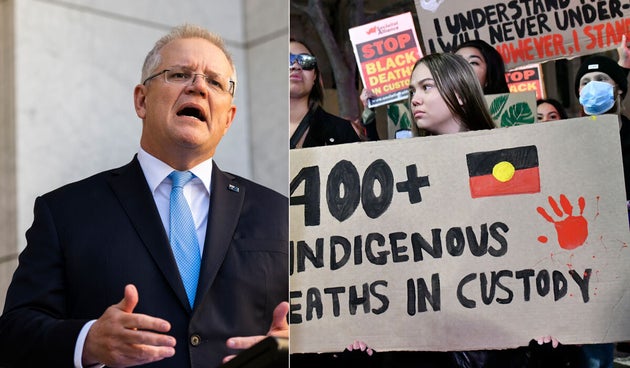
Prime Minister Scott Morrison on Friday also issued a stern health warning to those planning to attend Black Lives Matter protests around the country this weekend.Â
“The health advice is very clear, that it’s not a good idea to go,†he told reporters.Â
“The risks of people coming into close proximity are real,†he said adding that if people couldn’t honour veterans on ANZAC Day in the usual way this year, they should find an alternate way to support the Black Lives Matter movement.Â
“Let’s say to those who had the absolute agony of not being able to say goodbye to a loved one, let’s thank them by showing responsibility this weekend,†he said.Â
Award winning recording artist Briggs said that ANZAC Day, known for its dawn service and booze-fuelled 2-Up betting game, was quite different to protesting Black deaths in custody.Â
Protesting Indigenous deaths in custody isn’t a sanctioned national public holiday. https://t.co/15jZIrEisK
Cities across the United States have taken to the streets to protest racist police violence for more than eight days straight.Â
There have been 10,000 people arrested in the US alone.Â
People in Perth and Sydney have protested this week against police violence and mourned not just Floyd but Aboriginal and Torres Strait Islander lives lost at the hands of police (David Dungay, Kumanjayi Walker and Tane Chatfield to name a few).
Getty Scott Morrison On Black Lives Matter Protests Amid Coronavirus: ‘I Say Don’t Go’
“The risk is great, I don’t deny that. I am an at-risk person,†Indigenous academic Marcia Langton told ABC Radio.
“I do appeal to everybody to wear masks and social distance at the protest. But at the same time, every time an Aboriginal person goes out on the street we are at risk.â€
WASHINGTON — Muriel Bowser, the mayor of Washington, has had few options this week to hold back the overwhelming show of federal force in her city: the national guardsmen from outside D.C. whom she did not request, the Bureau of Prisons and Border Patrol officers the city rarely works with, the troops in unmarked uniforms who have upset residents.
Attorney General William P. Barr has directed all of this, making the nation’s capital the primary stage for President Trump’s vow to “dominate the streets†to quell protests. He has given Mr. Trump frequent updates since Monday on the efforts to restore order, a senior official said. Federal officials have not asked for consent, or even previewed many of their plans with local officials, who have at times also been unsure who is wielding riot gear on the city’s streets.
The District claimed a victory on Thursday as federal troops retreated from streets around the White House. But for many D.C. residents, this moment has made their longtime predicament all the more painful: They have no governor to turn to, no senators of their own who can go toe-to-toe with an attorney general. They have no power in the Capitol building, after decades of failed campaigns for statehood.
“People have to understand the root cause and be willing to do something about the root cause,†Ms. Bowser said at a news conference on Thursday. The city will continue to have limited control over what happens on its streets without statehood, she said.
“Until we fix that, we are subject to the whims of the federal government,†she said. “Sometimes they’re benevolent, and sometimes they’re not.â€
With the largest demonstration against police brutality expected to descend on Washington on Saturday, Ms. Bowser and Mr. Barr are locked in a delicate and fraught fight. House Speaker Nancy Pelosi on Thursday made clear that she was looking on, sending a letter to the president questioning the “increased militarization†on the capital’s streets.
Mr. Barr needs enough support from the mayor and the District’s chief of police for his actions not to be construed as a police state takeover of Washington, an overwhelmingly Democratic city that has come to symbolize the battle between Mr. Trump and some of the nation’s cities.
Ms. Bowser, for her part, could face consequences for protesting too loudly, unlike other mayors around the country who may be angered by the president’s posture toward protesters. Mr. Trump has not yet invoked his strongest lever of power over the city, an obscure provision allowing him to take control of the District’s police force in an emergency. But the White House floated the threat this week.
The District could be punished in other ways, too: The federal government could refuse to repay expenses the city has incurred policing areas around the White House and Capitol. The administration’s Republican allies in Congress could quash other city goals with the kind of appropriations riders that have blocked city laws addressing abortion and marijuana.
The federal government could also barricade off more streets and government properties that were once accessible to D.C. residents. Ms. Bowser lamented Thursday that areas on the White House and Capitol grounds she could visit growing up have become off-limits, and worried that today’s increasingly hardened barriers could become permanent.
Mr. Barr was attorney general under President George H.W. Bush when riots related to the beating of Rodney King, an unarmed motorist, broke out in Los Angeles. Mr. Barr considered using the military to restore order, and did not believe that permission from the governor was a “prerequisite.†Ultimately he chose to use F.B.I. agents in Los Angeles, and save the military as a last resort.
Nowhere has the fight for the streets of Washington played out more visibly than downtown, where the federal government oversees the park adjacent to the White House and where the mayor has control of the surrounding streets that are home to numerous federal government buildings.
After some people looted stores, set fires and vandalized the Treasury building on Saturday and Sunday evenings, Mr. Barr expanded the area controlled by federal officers beyond the border of the park, and he took control of the surrounding streets with checkpoints and roadblocks.
City officials objected to the move, and when federal officers pulled back from those streets on Thursday morning, the Metropolitan Police Chief, Peter Newsham, claimed a modest success for frustrated residents. Mr. Barr, in a news conference on Thursday, seemed to suggest that he had made the decision on his own.
“I felt that we could afford to collapse the perimeter and eliminate some of the checkpoints,†he said. “I think that we have seen the sharp reduction in violent episodes.â€
If that calm continues, there will inevitably be another fight over what prompted it. Federal officials say their overwhelming force has made a difference. District officials say it is peaceful protesters — there were few arrests in the city on Tuesday and none Wednesday — who have prevented the convergence of so many law enforcement agencies from turning dangerous.
“The people saved us from this confusion,†said Eleanor Holmes Norton, who represents the District but has no voting power in Congress.
Karl Racine, the Washington attorney general, objected to any appearance in Mr. Barr’s comments on Thursday that the District was on board with the deployment of federal officers to the city’s streets. “That simply is not the case,†Mr. Racine said.
“What the White House doesn’t want people to see is the multigenerational, multiracial, multiethnic, multigeographic, overwhelmingly peaceful nature of these protests,†Mr. Racine said. “This isn’t a few protests. This is a movement that believes justice should be for all; that policing should be fair and not disproportionately harsher for some.â€
Mr. Racine said he contacted the dozen-plus states that had been asked to send national guard forces to the District, and that none of them could recall that the Trump administration cited any legal basis for the request. The D.C. National Guard has been in the city, too, the only force the mayor has requested. But under home rule, she didn’t have the power to deploy them herself; only the president can do that.
Mr. Racine said in a letter to Mr. Barr, Defense Secretary Mark Esper and Mr. Trump’s chief of staff, Mark Meadows, that he was reviewing the legality of the federal government’s decision to ask out-of-state national guardsmen and federal law enforcement entities, including the Bureau of Prisons, to police Washington’s streets.
“We are seeking information regarding the legal authority for these entities’ presence in the District and their actions,†Mr. Racine wrote.
“Specifically, do they have authority to make arrests and, if so, for what offenses and in what geographical boundaries?â€
It has been hard this week to separate questions like who is telling which officers what to do from the ultimate question of statehood.
“It’s impossible to look at it any other way,†said Garry Young, a political scientist at George Washington University who has followed home rule fights in the city. “It’s utterly unlike if this was going on in a different city.â€
Near Lafayette Park on Wednesday, when city streets were still blocked by rows of officers wielding riot shields, protesters were furious at the incursion into streets and parks that they believed belonged to them and where the protests have been peaceful.
“Every day it’s a further perimeter, it’s a stronger presence, it’s a higher-ranked agency,†said Kris Pritchard, 37, a District resident. “And people are sick of it.â€
WASHINGTON — Former Vice President Joseph R. Biden Jr. told a group of black supporters on Thursday night that most Americans were good people who think the nation can be improved, while also declaring that “there are probably anywhere from 10 to 15 percent of the people out there that are just not very good people.â€
Mr. Biden offered his estimate during remarks in which he spoke about the importance of a president setting a positive example for the nation on racial issues. He accused President Trump of dividing the country while pledging that, as president, he would not.
“The words a president says matter, so when a president stands up and divides people all the time, you’re going to get the worst of us to come out,†Mr. Biden said during the discussion, which was moderated by the actor Don Cheadle.
“Do we really think this is as good as we can be as a nation? I don’t think the vast majority of people think that,†the former vice president said. “There are probably anywhere from 10 to 15 percent of the people out there that are just not very good people, but that’s not who we are. The vast majority of the people are decent, and we have to appeal to that and we have to unite people — bring them together. Bring them together.â€
Mr. Biden’s comments harked back to controversial statements by past presidential nominees who generalized in negative terms about portions of the population. In 2012, Mitt Romney, whose taped comments at a private fund-raising event were later leaked, said “47 percent†of voters would never support him because they were “dependent on the government.†And in 2016, Hillary Clinton said half of Mr. Trump’s supporters belonged in a “basket of deplorables.â€
At different points in his 70-minute conversation, Mr. Biden spoke about race and racism in America in stark terms. He repeated several times that he didn’t know what it’s like to be discriminated against on the basis of race, though he said his experience of being bullied for his childhood stutter helped him understand bullies and “what it’s like to be humiliated.â€
“I’m a white man,†he said. “I think I understand but I can’t feel it. I feel it but I don’t know what it’s like to be a black man walking down the street and be accosted, or to be arrested or, God forbid, something worse.â€
Mr. Biden suggested that his election wouldn’t eradicate the systemic racism that has sparked protests across the nation in the wake of the death of George Floyd after he was pinned down by Minneapolis police officers.
“Hate didn’t begin with Donald Trump, it’s not going to end with him,†Mr. Biden said. “The history of our country is not a fairy tale, it doesn’t guarantee a happy ending, but as I said earlier, we’re in a battle for the soul of this nation. It’s been a constant push and pull for the last 200 years.â€
Mr. Biden also acknowledged his own misjudgments about the progress the nation has made on race.
“I thought we had made enormous progress when we elected an African-American president, I thought things had really changed,†he said. “I thought you could defeat hate, you could kill hate. But the point is, you can’t. Hate only hides, and if you breathe any oxygen into that hate, it comes alive again.â€
Speaking to an activist who was planning a Friday night march in Mr. Biden’s hometown, Wilmington, Del., the former vice president offered a gentle warning against allowing the protest to lead to destruction.
“We can’t allow the protesting to overshadow the purpose of the protest,†Mr. Biden said. “So there’s going to be a lot of folks that are going to want to cause trouble. Some cops, but some folks too. It’s going to take young leaders like you to change things in the city.â€
Reverend Al Sharpton’s passionate speech at George Floyd’s memorial brought those in attendance to their feet.
USA TODAY
In Atlanta, Bernice King, daughter of the Rev. Martin Luther King Jr., addressed 1,000 people, many dressed in their Sunday finest, urging them not to stop “until there is never again the breath taken out of the life of any black or brown person in this nation and around the world.â€
In Fall River, Massachusetts, protesters lay on their stomachs in the grass, hands together behind their backs, replicating the position in which George Floyd was held before he died. Members of the Fall River Police Department joined protesters in taking a knee.
In Brooklyn, Mayor Bill de Blasio and his wife, Chirlane McCray, along with New Yord State Attorney General Letitia James, joined Floyd’s brother, Terrence Floyd, at a memorial that drew thousands. McCray and James drew loud responses by calling out “Say his name†and waiting for response: “George Floyd.â€
And in Washington, D.C., a normally bustling plaza packed with protesters went silent for eight minutes and 46 seconds, the amount of time Floyd spent under the knee of Officer Derek Chauvin, who has been charged with second-degree murder. On Capitol Hill, Senate Democrats took the same pause while on bended knee.
Across the nation Thursday, Americans stopped to commemorate the life and mourn the death of Floyd, 46, at the hands of Minneapolis police, with Floyd’s dying words, “I can’t breathe,†giving life to a searing moment in the nation’s fraught struggle for human rights.
Artists have painted murals of his image on city streets. Protesters across the world have yelled his name and demanded justice while facing off against police officers dressed in riot gear. Cities have come to a halt, enforcing curfews and closing down transit systems to discourage public gatherings and looting.
At one point, the White House sat in darkness, lights turned off, as Secret Service officials battled protesters who had gathered outside.Â
The demonstrations are unfolding at a time of extreme hardship for black Americans, who have disproportionately been hit by the coronavirus pandemic and its associated economic implosion, with more than 42 million Americans so far filing for unemployment.
The overwhelming chorus of outrage, fueled often by what some feel is an at times overly aggressive response by law enforcement, have formed a reality few Americans have witnessed before.Â
“We are at a tipping point, much as during the ‘60s when Dr. Martin Luther King said we are at a crossroads,†said Aaron Bryant, curator at the National Museum of African American History and Culture in Washington, D.C. “This moment is about the nation living up to its promise and the guarantees we all are given under the Constitution.â€
On Thursday, the focus returned to the life Floyd led as he was memorialized by family and friends at Minneapolis’ North Central University, an event included a “national eulogy†by the Rev. Al Sharpton and a “national criminal justice system address†by Floyd family attorney Ben Crump.
The tributes will continue Saturday in Raeford, North Carolina, where Floyd was born and where Floyd’s sister Bridgette lives. And on Monday and Tuesday, funeral services will take place in Houston, where Floyd lived before he left for better employment options in Minneapolis. There will be both a public and private viewing, and presumptive Democratic presidential nominee and former Vice President Joe Biden has announced he will attend.
Much as the protests in the wake of Floyd’s death have erupted in cities across the country, so, too, are his memorials echoing.
Re-enactments in the streets
Hundreds of people laid on their stomachs across Second Avenue in Pittsburgh, Pennsylvania, some silent, some chanting “Say his name,” and “This is what democracy looks like.†Organizers passed out baking soda packets to demonstrators in case police deployed tear gas, as occurred at several other protests this week.
In Sarasota, Florida, marchers assembled in a major intersection and re-enacted Floyd’s death under a heavy rain. Police blocked the streets to keep traffic away.
A protester laid down in the middle of intersection and another protester kneeled on his neck. The crowd repeatedly chanted “I can’t breathe,†and the demonstrator on the ground repeatedly called out “momma,” which Floyd also said before he died.
On Main Street in the Cape Cod town of Bourne, Massachusetts, some 400 protesters took a knee for eight minutes and 46 seconds to honor Floyd.
The silence broke hours of noise from protestors lining the street chanting and holding signs, “Black Lives Matter,†“I can’t breathe,†and “If you are not anti-racist, you are complicit, speak up!â€Â
As cars, trucks, and motorcycles drove up and down busy Main Street, most honked in solidarity with the protestors.Â
“We’ve seen it across the nation,†said Kunall Rajagopal, 22, who attended the rally. “Something needs to change. Until we see it at the very top, we need to start at our own communities.â€Â
CLOSE
A vigil for George Floyd was held in Belfast, Northern Ireland, and thousands gathered to protest his death in New Zealand.
Storyful
‘Please don’t kill me’
In Southern California, AaRone Fowler watched a live stream of the funeral of George Floyd from his friend’s house. The words of Dr. Scott Hagen, who prayed for those who are “crushed in body and spirit,†hit home.
Fifteen months ago, Fowler, now 24, was in Arizona, face down on the ground with two Phoenix police officers on top of him. He was begging, “please don’t kill me.â€
“I know what it’s like to have two grown adults on top of you,†Fowler said. “I was face down and had my face, the left side of my face, grinding into the ground.â€
Like Floyd, Fowler had trouble breathing, not just from the weight pressing down on him, but also because every time he tried to take a breath, he got a mouthful of dust from the ground.
He had been suspected of stealing his own car. After he’d been tackled and restrained and thrown in the back of a police car, he was released and told he could walk home.
Hearing Floyd’s brother talk Thursday during the memorial about their childhood made Fowler realize how abruptly a loved one could be taken. He realized Floyd’s daughter would never see her father again.
‘He didn’t deserve to lose his life’
At one of Los Angeles’ largest homeless shelters, the Union Rescue Mission, the house-made hamburgers and french fries in the dining room were competing for attention with the Floyd service playing on a large-screen TV in a recreation room. Â
Emotions were running high among residents, especially given the frequent interactions with police that are a daily part of life on tent-filled Skid Row.
Darcissha Bell, who has lived at the mission for about two months, said she was filled with dismay over Floyd’s death.
“He didn’t deserve to lose his life in that way,†she said. “Everybody’s life matters.â€
One of the volunteers, Dinah Raheem, said she hoped some good would come from the tragedy. The service came a day after Mayor Eric Garcetti proposed cutting the police budget to fund more services that can directly help the African American community.
“It is allowing our leaders to make a change now,” Raheem said.Â
National mourning a ‘new beginning’
In Dudley, Massachusetts, Abigail Cooper, 15, was planning a protest and meeting with Webster Police Chief Michael Shaw to map out an event Saturday to recognize Floyd’s death. She said she hopes Floyd’s memorial can bring some degree of closure.
“This is really the tip of the iceberg because this has happened so many times, and it was recorded and got to the media really fast,†said Cooper, who is black and resides in a predominantly white community of close to 12,000 people.
In New Hampshire, Lovey Roundtree Oliff, the first African American woman elected to Exeter’s Select Board, called the national memorial for Floyd “a new beginning of sorts.” She said she couldn’t help but think of the public outrage at San Francisco 49ers quarterback Colin Kaepernick protesting police brutality by taking a knee during the national anthem in 2016 and how critics portrayed his message as anti-American.Â
“A lot of the concerns and issues that people were feeling before, that in my opinion were being ignored, are now being heard,” Roundtree Oliff said. “If the nation as a whole had been listening more clearly in 2016, perhaps we wouldn’t be in the position we’re in today.”
Other vigils and marches anticipated big turnouts as well. In Las Vegas’ Kianga Isoke Palacio Park, roughly 150 people were expected at a Black Lives Matter: Solidarity event.
‘His last words mean so much to me’
In Chicago, hundreds of protesters marched through the North and South Sides Thursday evening as hundreds more gathered on a Zoom meeting to remember Floyd and coordinate future local protests in his name.
Alycia Kamil, 19, and Jalen Kobayashi co-organized the protest in the city’s Bronzeville neighborhood.
“Everything that has happened throughout the country—people coming together—has been super beautiful,†Kamil said.Â
Layci Muhammad, 14, joined hundreds of students and adults at a rally and march on Chicago’s South Side, donning a bright yellow shirt with George Floyd’s name and the words “I can’t breathe.†Muhammad said she had asked her cousin to make her the shirt so she could show her support at protests.
“(Floyd) is like a brother to me. He’s family. His life, and his last words mean so much to me,†Muhammad said.
Floyd was a ‘gentle giant,’ friends say
While Floyd may have quickly morphed into a symbolin his death, he was remembered by those who knew him as a “gentle giant,” said his friend Wallace White.
“He didn’t need to die like that. All the footage showed the man was not resisting him. He was loved by everyone around here. He was a real quiet guy, liked to have fun,” White told USA TODAY.
Floyd was detained on May 25 by Chauvin and three other policemen at around 8 p.m. after allegedly trying to pass a fake $20 bill at a local grocery store.Â
As protests erupted after his death, details about Floyd’s life emerged: A solid basketball player at 6-foot-4. A doting father to a young girl. A well-liked fixture as a security guard at the Conga Latin Bistro.Â
Jovanni Thunstrom, Floyd’s employer, said his killing was “just plain murder.”Â
“My employee George Floyd was murdered by a Police officer that had no compassion, used his position to commit a murder of someone that was begging for his life,” wrote Thunstrom, owner of the Conga Latin Bistro, in a Facebook post. “I will like to keep on writing, but my vision is blurry, from the tears coming out of my eyes. I am sorry, I usually don’t cry.”
Protesters have been moved by other recent examples of injustice, including the filmed killing of Ahmaud Arbery in Georgia, the shooting of paramedic Breonna Taylor by Kentucky police officers, and a viral video from Central Park in New York City showing a white woman threatening an African American man with police action after he asked her to leash her dog as required by law so he could bird-watch in peace.Â
Janai Nelson, associate director and counsel at the NAACP Legal Defense Fund, said protesters want to usher in societal changes in honor of Floyd. Â
“This is a multicultural movement that didn’t start as one, a moment that originated with the birth of Black Lives Matter in 2014, when that statement was controversial,” said Nelson.
“Now in 2020, you see young white people holding up signs saying that you’d have never seen that a mere five years ago,” she said. “So in that way it’s hugely different, this death has galvanized a group of allies in a short time.”
“The African American community, the Native American community, the Hispanic American community, and other immigrant communities are subjugated in this country,” she said. “Our country has lots of good points today after 400 years, but it was founded on oppression and when something is founded on conquest and oppression, it creates a hierarchy of domination that continues systems of oppression.â€
In Atlanta, Seletha Johnson stood next to her 18-year-old son Thursday at the Martin Luther King Jr. National Historic Park, both holding white flowers to honor Floyd.
Johnson, who is black, said she has been angered by Floyd’s death and wanted to take a stand against injustices toward black Americans. She said the killings of black males has forced her to have daily talks with her son about how to protect himself and respond to police.
“We are out here hoping that our work is not in vain and that we are able to make a change,†said Johnson, of Fayetteville, Georgia. “Blacks have been treated unfairly for years, hundreds of years. And we are just ready for a change.â€
Contributing: Kevin McCoy, Nicquel Terry Ellis, Chris Woodyard, Grace Hauck of USA TODAY and Brian Lee of the Telegram & Gazette, John D’Anna of The Arizona Republic​​​​​, Wayne Miller of The Providence Journal, Chrissy Suttles and Daveen Rae Kurutz of The Beaver County (Pennsylvania) Times, Zac Anderson and Timothy Fanning of the Sarasota Herald-Tribune, Beth Treffeisen of the Cape Cod Times.Â
Read or Share this story: https://www.usatoday.com/story/news/nation/2020/06/04/george-floyd-memorial-service-mourning-outrage/3139103001/
Welcome to the latest edition of Pardon The Intrusion, TNW’s bi-weekly newsletter in which we explore the wild world of security.
COVID-19 accelerated the use of Zoom for video calling. But so did the security problems and revelations that it didn’t actually support end-to-end encryption (E2EE), misleading users about the security of the platform.
In the aftermath, it promised to invest in E2EE on its platform, and acquired encrypted chat service Keybase in an attempt to secure its communications. All seemed well until yesterday: Zoom confirmed that it plans to offer stronger encryption features only for its paying users. It won’t be extended to the free tier.
“Free users, for sure, we don’t want to give that [end-to-end encryption] because we also want to work it together with FBI and local law enforcement, in case some people use Zoom for bad purpose [sic],†Zoom CEO Eric Yuan said in an earnings call this week.
The idea that encryption could hamper law enforcement’s ability to fight criminal acts — widely known as the “Going Dark†problem — is not new.
Last year, Facebook ran into troubled waters after governments in the US, UK, and Australia called on the company to delay its plans to implement E2EE across its messaging apps until “there is no reduction to user safety and without including a means for lawful access to the content of communications to protect our citizens.â€
But by putting a premium on privacy, Zoom seems to be aiming for a tricky balancing act that improves security but also minimizes the risk of abuse. The move also puts it at odds with wider attempts to embrace encryption on the web.
Alex Stamos, former Facebook’s chief security officer who’s now working as an outside consultant on Zoom’s security strategy, elaborated on this further in a Twitter thread:
Zoom is dealing with some serious safety issues. When people disrupt meetings (sometimes with hate speech, CSAM, exposure to children and other illegal behaviors) that can be reported by the host. Zoom is working with law enforcement on the worst repeat offenders.
In a climate where there’s no alternative that offers E2EE group calls (Signal and Jitsi‘s are limited to one-on-one), Zoom‘s proposed encryption model is in the right direction.
But by choosing to turn a basic security feature into a premium paid offering, Zoom is setting a wrong precedent wherein privacy is limited to those who can afford to pay for it.
What’s trending in security?
Apple fixed a critical security flaw in its “Sign In With Apple†feature, Google found more evidence of credential-stealing attacks exploiting COVID-19, and new details emerged about an iPhone spyware app, called Hide UI, used by law enforcement to unlock devices when it doesn’t have the user’s passcode.
Hacktivist group Anonymous has returned from the shadows, and has promised retribution against the Minneapolis Police Department (MPD) over the death of George Floyd. The MPD’s website was then temporarily taken offline in a suspected Distributed Denial of Service (DDoS) attack, but researcher Troy Hunt said the leaked data “has almost certainly been pulled out of existing data breaches in an attempt to falsely fabricate a new one.†[Troy Hunt]
For everyone who is protesting in support of Black Lives Matter and against George Floyd’s death at the hands of the Minneapolis Police Department — and those who are planning to attend one — here are some handy precautions to take before you go. Also make sure you turn off biometrics on your phone. [TNW]
The baddies behind REvil (Sodinokibi) ransomware launched an eBay-like auction site to sell data stolen from the companies they hack. [ZDNet]
Apple fixed a flaw in “Sign In With Apple†that could have allowed attackers to hijack any user’s accounts on third-party apps that offer the login option. [The Hacker News]
A hacking group that calls itself ShinyHunters has been selling 200 million stolen records on the dark web from over a dozen companies. [WIRED]
COVID-19 themed malware attacks are still on the rise. Google said it found new activity from Indian “hack-for-hire†firms that have been impersonating the WHO in credential-stealing email campaigns to target business leaders in financial services, consulting, and healthcare corporations across the US, Slovenia, Canada, India, Bahrain, Cyprus, and UK. [Google]
A vigilante hacker group called “CyberWare†has been targeting “scam†companies with ransomware and denial of service attacks. [Bleeping Computer]
New “Octopus Scanner†malware was found compromising open-source GitHub projects to spread to Windows, Linux, and macOS systems, and deploying malicious backdoor. [GitHub
A new study — (How) Do People Change Their Passwords After a Breach? — found that only around a third of users usually change their passwords following a data breach. [IEEE Security (PDF)]
Sandworm, the hackers working for Russia’s military intelligence agency, have been exploiting a vulnerability in Exim Mail Transfer Agent software since August of last year for malicious motives. The NSA recommends patching Exim servers immediately by installing version 4.93 or newer. [NSA / WIRED]
Kaspersky researchers uncovered a steganography-themed attack targeting industrial enterprises in Japan, Italy, Germany, and the UK to steal Windows account credentials. The hackers’ ultimate motive remains unclear. [Kaspersky]
An Android malware called Strandhogg 2.0 mimics apps’ login screens to hijack passwords and grant extensive permissions. It affects all versions of Android prior to 10. Google has already patched the flaw in a security update pushed last month. [Ars Technica]
A new version of Valak malware has been found targeting Microsoft Exchange servers in the US and Germany to steal enterprise mailing information and passwords. [Cybereason]
Amnesty International discovered a critical flaw in Qatar’s mandatory-to-use EHTERAZ contact-tracing app, which had it not been reported and fixed, could’ve allowed attackers access to highly sensitive data, “including the name, national ID, health status and location data of more than one million users.†[Amnesty International]
US authorities arrested a Ukranian national, Denys Iarmak, an alleged member of the FIN7 cybercrime group that’s been accused of hacking Chipotle, Whole Foods, and Trump Hotels. FIN7 (also called Carbanak Group) has been tied to a string of financially-motivated attacks since 2015 to conduct fraudulent wire transfers to offshore accounts. [Motherboard]
We use cookies on our website to give you the most relevant experience by remembering your preferences and repeat visits. By clicking “Accept”, you consent to the use of ALL the cookies.
This website uses cookies to improve your experience while you navigate through the website. Out of these, the cookies that are categorized as necessary are stored on your browser as they are essential for the working of basic functionalities of the website. We also use third-party cookies that help us analyze and understand how you use this website. These cookies will be stored in your browser only with your consent. You also have the option to opt-out of these cookies. But opting out of some of these cookies may affect your browsing experience.
Necessary cookies are absolutely essential for the website to function properly. These cookies ensure basic functionalities and security features of the website, anonymously.
Cookie
Duration
Description
cookielawinfo-checbox-analytics
11 months
This cookie is set by GDPR Cookie Consent plugin. The cookie is used to store the user consent for the cookies in the category "Analytics".
cookielawinfo-checbox-functional
11 months
The cookie is set by GDPR cookie consent to record the user consent for the cookies in the category "Functional".
cookielawinfo-checbox-others
11 months
This cookie is set by GDPR Cookie Consent plugin. The cookie is used to store the user consent for the cookies in the category "Other.
cookielawinfo-checkbox-necessary
11 months
This cookie is set by GDPR Cookie Consent plugin. The cookies is used to store the user consent for the cookies in the category "Necessary".
cookielawinfo-checkbox-performance
11 months
This cookie is set by GDPR Cookie Consent plugin. The cookie is used to store the user consent for the cookies in the category "Performance".
viewed_cookie_policy
11 months
The cookie is set by the GDPR Cookie Consent plugin and is used to store whether or not user has consented to the use of cookies. It does not store any personal data.
Functional cookies help to perform certain functionalities like sharing the content of the website on social media platforms, collect feedbacks, and other third-party features.
Performance cookies are used to understand and analyze the key performance indexes of the website which helps in delivering a better user experience for the visitors.
Analytical cookies are used to understand how visitors interact with the website. These cookies help provide information on metrics the number of visitors, bounce rate, traffic source, etc.
Advertisement cookies are used to provide visitors with relevant ads and marketing campaigns. These cookies track visitors across websites and collect information to provide customized ads.