Brazil’s coronavirus death toll exceeds 70,000: Live updates

  • The World Health Organization (WHO) reported a record daily increase in global coronavirus cases, with the total rising by 228,102 in 24 hours.

  • Iraqi legislator Ghida Kambash died after contracting the novel coronavirus, becoming the first member of Iraq’s parliament to succumb to the virus as its spreads across the country.

  • More than 12.5 million people around the world have been diagnosed with the coronavirus disease, known as COVID-19, and more than 559,000 have died, according to a tally by the Johns Hopkins University. More than 6.8 million patients have recovered.

Here are the latest updates.

Saturday, July 11

00:37 GMT – US welcomes WHO inquiry into virus origins in China

Andrew Bromberg, the US ambassador to the United Nations, said Washington welcomed the WHO’s probe into the origins of the novel coronavirus in China.

“We view the scientific investigation as a necessary step to having a complete and transparent understanding of how this virus has spread throughout the world,” he told reporters.

The United States, the WHO’s largest donor, this week notified the agency that it was withdrawing in a year’s time after accusing it of being too close to China and not doing enough to question Beijing’s actions at the start of the crisis.


WHO to trace COVID-19 origin in China (2:20)

00:20 GMT – Brazil’s death toll surpasses 70,000

Brazil exceeded 70,000 coronavirus deaths on Friday, the health ministry said, though the number of daily fatalities appears to be stabilizing.

The ministry said there had been 45,000 new infections and 1,200 deaths over the last 24 hours, taking the totals to 1.8 million cases and 70,400 deaths.

Brazil is the second worst affected country in the world after the United States.


INSIDE STORY | Will Brazil’s president be forced to take the coronavirus seriously? (24:32)

00:02 GMT – California to release 8,000 prisoners to slow pandemic

The US state of California will release up to 8,000 inmates early from state prisons to slow the spread of COVID-19 inside facilities, state authorities said.

Prisoners with a year or less left to serve will be eligible for release. Among prisoners excluded from early release are those convicted of violent felonies and sex crimes, the California Department of Corrections and Rehabilitation said.

California Governor Gavin Newsom said on Thursday nearly 2,400 people in California’s 35 prisons have tested positive for the coronavirus, including 1,314 at San Quentin State Prison north of San Francisco.


Hello and welcome to Al Jazeera’s continuing coverage of the coronavirus pandemic. I’m Zaheena Rasheed in Male, Maldives. 

You can find all the key developments from yesterday, July 10, here.


SOURCE:
Al Jazeera and news agencies

Source link

Tahira Kashyap completes her fourth book during lockdown: It’s been such an enriching experience

Image Source : INSTAGRAM/TAHIRAKASHYAP

Tahira Kashyap completes her fourth book during lockdown

Writer-filmmaker Tahira Kashyap Khurrana has completed her fourth book, “The 12 Commandments Of Being A Woman”, during the coronavirus lockdown. “I’ve finally finished writing ‘The 12 Commandments Of Being A Woman’ and it’s been such an enriching experience. I think a lot of women will relate with the book and men will find it an interesting read. The Lockdown period was perfect for me to finish and give enough time to it,” Tahira shared.

Tahira is planning to release her book by the end of this year. Apart from writing, Tahira has also tried to take proper care of her health during the lockdown. With ease in the lockdown restrictions, Tahira started doing cycling outside her home.

“I took to cycling as a sport and also to declutter mentally. But I realised I was viewing the same roads, trees and houses with a different perspective. I was finding beauty in nature that I had never before appreciated, let alone acknowledged. It is extremely therapeutic. Earlier on it meant only exercise for the physical aspect but now it has become a therapy for my mental well being and happiness too,” she had shared.

Tahira is currently spending time with her husband Ayushmann Khurrana’s family in Chandigarh. The actor recently shared a video with brother Aparshakti Khurana in which the two were seen playing the childhood game ‘Aao Milo Shilo Shalo.’ The video shows them dedicated to the game till the end as Tahira shoots them.

Aparshakti captioned the video saying, “If Aao Milo Shilo Shaalo was one of the categories of Olympic Games…..Innn 2 ladkon ka medal pakka tha…PS- some people call it Aao Milo Shilo Shaalo in bachpan but we always called it Aam Lelo Selam Saali”


More Bollywood stories and picture galleries

For all latest news and updates, stay tuned to our Facebook page

Fight against Coronavirus: Full coverage


Source link

A new world war over technology

0

The latest casualty is TikTok, a video app that is popular with teenagers and which has hundreds of millions of devoted fans across markets such as India and the United States. The app is owned by a Chinese company, but run by an American CEO.
The first major hit came last month, when TikTok was blocked in India after a heated border clash with China left at least 20 Indian soldiers dead. Then, on Monday, US authorities said they would look at banning the app because they consider it a possible threat to national security. That news broke as the company said it would leave Hong Kong because of concerns over a sweeping national security law China imposed on the city.

“It is becoming harder to be a truly global tech platform,” said Dipayan Ghosh, the co-director of the Digital Platforms and Democracy Project at the Harvard Kennedy School.

The fight right now between the world’s two largest economies cuts to the heart of that issue. The United States and China are competing over artificial intelligence, super-fast 5G mobile networks and other technology. Although the countries have long-running economic ties that enable some collaboration, recent tensions over national security have pushed their governments and businesses to reconsider those partnerships.

The conflict is bleeding over into the relationships those countries have with other global powers, too. The United Kingdom, for example, is re-examining its decision to grant Chinese tech company Huawei the ability to help build the country’s 5G network. That review comes after the United States, which has repeatedly targeted Huawei, imposed sanctions on the company that could prevent other firms from supplying it with the chipsets it needs to build its next-generation technology.

“My impression is that the tech companies are only now waking up to the fact that life in the future is going to be a lot less globalized,” said Michael Witt, a senior affiliate professor of strategy and international business at INSEAD, the international business school. “They are really on the horns of a dilemma.”

A bitter rivalry

The United States and China have for decades held opposing views on how to wield technology. While IBM (IBM) and Microsoft (MSFT) were driving American innovation in the 1980s, China was laying down the foundation for its Great Firewall — a massive censorship mechanism that shuts out content widely available elsewhere on the internet. In the years since then, China has created a closed and controlled internet that has found fans among other authoritarian countries: Russia, for example, has moved to restructure and rein in its once freewheeling internet with the assistance of Chinese tech.
China’s investments in technology have grown even more rapidly in recent years because of “Made in China 2025,” Beijing’s ambitious plan to shed the country’s reliance on foreign tech by spending billions of dollars in areas such as wireless communications, microchips and robotics. (Last year, for example, the country imported $306 billion worth of chipsets, or 15% of the value of the country’s total imports.)

The United States has responded by seeking to limit China’s advance.

The Trump administration has accused China of stealing US technology, an issue central to the damaging trade war that has colored the relationship between the two since 2018. Chinese officials have repeatedly denied such allegations and argued that any tech secrets handed over were part of deals that had been mutually agreed upon. The United States has also imposed sanctions on prominent Chinese tech firms and taken steps to limit Beijing’s access to America’s vast capital markets.

As Washington escalates its fight against Beijing, international technological cooperation looks increasingly likely to disappear.

“Beijing has concluded that decoupling is inevitable,” wrote Ian Bremmer and Cliff Kupchan, the president and chairman of Eurasia Group, in a report published earlier this year that noted how Chinese President Xi Jinping is calling for the country to break its technological dependence on the United States.

“China will expand efforts to reshape international technology, trade, and financial architecture to better promote its interests in an increasingly bifurcated world,” they wrote.

Huawei is a prime example of global tech tensions. Washington has for more than a year been pressuring its allies to keep the Chinese company's equipment out of their 5G networks.

The ‘virtual Berlin Wall’

As the relationship between the world’s two largest economies deteriorates, several analysts warned that the fallout will have major implications for every global power, along with the tech companies that operate across their borders.

The Eurasia Group analysts wrote that the “new virtual Berlin Wall” will push world economies to choose sides. They said traditional US allies such as Taiwan and South Korea, for example, may tilt toward China because they supply cutting-edge semiconductors that Chinese firms rely on to compete with global rivals.

“Both the US and China have demonstrated they’re willing to weaponize global trade and supply chains,” the analysts added.

Global tensions are also causing countries to view tech firms as “national sectors, and not global actors,” said Samm Sacks, a senior fellow at Yale Law School’s Paul Tsai China Center who studies cybersecurity and US-China relations.

“It’s the idea that a tech company is going into a market on the other side of the world, and now is being asked to carry the flag of the country,” she added. “This is a sea change from even a decade ago.”

Huawei has perhaps become the most prominent example of that shift.

How much trouble is Huawei in?
Washington has for more than a year been pressuring its allies to keep the Chinese company’s telecommunications equipment out of their 5G networks. That campaign may be producing some results in Europe: UK authorities said last week that US sanctions on the company will likely hurt Huawei’s viability as a 5G network provider there, while Reuters reported Thursday that Italy’s largest telecom firm is excluding the company from a bid for 5G equipment.

The advancement of technology in other parts of the world also suggests that there are “evolving, multiple playbooks” beyond the rivalry between the United States and China, according to Kislaya Prasad, a research professor at the University of Maryland’s Robert H. Smith School of Business.

He pointed to China’s neighbor India, which is pushing for growth among local industries while also enjoying a major internet boom. When New Delhi banned TikTok and other major Chinese apps in late June, local app developers like Indian-made Chingari rushed to fill the void.

Retreat or decentralize

For the tech companies stuck trying to navigate this world, there are no easy options.

Witt, the INSEAD professor, said firms must choose between giving up on part of the world, or decentralizing their operations to such a point that the company is essentially two or more different entities.

TikTok seems to be trying the second approach. While the app is owned by Beijing-based ByteDance, it has taken great pains to distance itself from its parent company. In May, it hired former Disney executive Kevin Mayer as its CEO, and it has repeatedly said that its data centers are located entirely outside of China where that data is not subject to Chinese law.
The company might be trying to make an even more dramatic break. The Wall Street Journal reported Thursday, citing a source familiar with the matter, that ByteDance is considering establishing a headquarters for the video app outside of China or a new management board to distance the service from the country. A TikTok spokesperson confirmed to CNN Business that its parent company is weighing changes to its corporate structure.
TikTok may undergo corporate changes to distance from China amid US scrutiny

“The close connection to the Chinese government is what has shut Huawei out of so many markets,” said Ghosh, of the Harvard Kennedy School. (Huawei maintains that it is a private firm owned by its employees.)

“I think TikTok sees that and wants to distinguish itself from Huawei,” he added.

But that might not be enough. US lawmakers have repeatedly piled on TikTok in recent weeks. And while the company says it doesn’t pose any threats to national security, US Secretary of State Mike Pompeo mentioned those concerns this week when he floated the idea of banning the app.

“The problem is, I think, for them it’s too late,” Witt said. “That light of public attention, that is already brightly shining on them. I think that’s not going to end well for them.”

— Brian Fung contributed to this report.
Source link

Edward Kleinbard, Tax Lawyer Turned Reformer, Dies at 68

0

Edward Kleinbard, a prominent tax lawyer who helped global corporations find creative ways to cut their taxes before he moved to academia and shined a light on the practices of the types of companies he had once advised, died on June 28 in Los Angeles. He was 68.

He had been treated for cancer for several years, a brother-in-law, Kris Heinzelman, said in confirming the death, at Keck Hospital of USC.

Mr. Kleinbard’s career cut an unusual arc. He spent more than 30 years as a corporate tax lawyer, helping companies and financial institutions on Wall Street and elsewhere cut their tax bills. He then devoted the last decade to the cause of raising taxes, as a means of combating inequality and poverty. As a member of the law school faculty at the University of Southern California, he used his insider’s expertise to show in particular how multinational companies avoid taxes.

Mr. Kleinbard began to publish a series of articles on the inequities in the tax system, especially how multinational corporations like Google, using techniques nicknamed “Double Irish” and “Dutch Sandwich,” dodged billions of dollars in taxes by pushing profits into tax havens offshore.

He coined the term “Stateless Income” and titled an article on Starbucks’s tax avoidance “Through a Latte Darkly.”

In 2013, after a Senate investigation into Apple’s offshore tax strategy, Mr. Kleinbard summarized the company’s aggressive moves this way: “There is a technical term economists like to use for behavior like this. Unbelievable chutzpah.”

He became a regular contributor to The New York Times in its Op-ed online feature “Room for Debate,” and in 2014 he published his first book, “We are Better Than This,” which explored how tax policy could be used to solve the country’s surging inequality.

Most tax policy discussions were “backward,” he contended. Policymakers should identify their spending priorities — ideally to invest in the country’s citizens — and then discuss the proper tax policies to pay for them.

“The starting point in every case,” he wrote, “should not be determined by establishing an arbitrarily small amount of tax to collect, and then treating government like an institutional Procrustes, whose only responsibility it is to amputate the welfare of our fellow citizens to suit that amount.”

Michael Schler, tax counsel at the law firm of Cravath, Swaine & Moore, who had known Mr. Kleinbard since the 1970s, said of him in an interview: “He was one of the smartest tax lawyers around. Having been in private practice as a lawyer, he understood how big corporations are getting around and taking advantage of various tax rules. And by being in academia and by being a good writer, he was able to bring all that to the public’s attention.”

Mr. Kleinbard was known as a demanding boss and a perfectionist who required much of his colleagues — and of himself. He was sometimes described as a curmudgeon, but with a biting sense of humor, often delivered deadpan.

In one 2016 email exchange with this reporter, he asked for help in publicizing a Tedx Talk he had given on poverty and inequality.

“Kendall Jenner’s latest YouTube contribution has 4.5 million hits,” he wrote, “and I am trying to catch up.”

Edward David Kleinbard was born on Nov. 6, 1951, in Manhattan and grew up in Rye, N.Y. His father, Martin Kleinbard, was a litigator with Paul, Weiss, Rifkind, Wharton & Garrison. His mother, Joan Kleinbard, is an author who writes under the name Joan Gould.

Mr. Kleinbard graduated from Rye Country Day School in 1969 and earned both bachelor’s and master’s degrees in history from Brown University in 1973, writing his master’s thesis on Renaissance Venice.

He received his law degree from Yale University in 1976 and spent a year at Cravath before moving to the international firm Cleary Gottlieb Steen & Hamilton, where he practiced tax law for 30 years and became an expert on structuring complex tax-reducing financial instruments for Wall Street. He was an adviser to some of the country’s biggest investment banks, including Goldman Sachs and Citigroup.

In 2007, in an unusual move for a senior corporate lawyer, he left Cleary Gottlieb and became the chief of staff for the Joint Committee on Taxation, a nonpartisan joint congressional committee that helps lawmakers on prospective tax policies.

But he grew frustrated with the slow pace of the legislative process and left the committee in 2009 to join the law school faculty at U.S.C., where he taught tax law. He also pursued his love for photography, hiking and long-distance bicycling, which took him across the United States, Canada and Europe.

In addition to his mother, Mr. Kleinbard is survived by his wife, Norma Cirincione, with whom he no longer lived; his son, Martin; his sister, Kathy Heinzelman; his brother, David; his partner, Suzanne Greenberg; and a granddaughter.

Mr. Kleinbard submitted to his publisher the manuscript for a book the day before he went into the hospital for surgery in March, said Leslie Samuels, a senior counsel at Cleary Gottlieb who had worked with Mr. Kleinbard there. The book, titled “What’s Luck Got to Do With It?,” explores the role luck plays — whether through inherited wealth, geography or racial heritage — in worsening inequality.

Mr. Samuels recalled how Mr. Kleinbard would roll his eyes at how many of his wealthy clients were oblivious to their good fortune. He recalled Mr. Kleinbard saying: “They’re not so smart — they are just lucky. I was lucky.”

Source link

Trump, in Florida, Seeks to Quell Doubts About His Opposition to Maduro

0

“I would maybe think about that,” Mr. Trump told Axios. “Maduro would like to meet. And I’m never opposed to meetings — you know, rarely opposed to meetings.”

The White House moved quickly to clean up those off-message comments, and Mr. Trump himself insisted on Twitter that he would “only meet with Maduro to discuss one thing: a peaceful exit from power.”

In scripted messages like Friday’s, Mr. Trump has expressed nothing but solid support for Mr. Guaidó. In February, Mr. Trump welcomed him to the White House and hosted him as a special guest at his State of the Union address, where Mr. Trump vowed that Mr. Maduro’s “grip on tyranny will be smashed and broken.”

That is the version of Mr. Trump’s views much preferred by both the White House and his campaign aides, who hope to rally Florida’s Hispanic voters with a tough anti-Maduro message, especially the roughly 700,000 Cuban-Americans in the Miami area who mostly oppose Cuba’s government and its close ally Mr. Maduro, who supplies oil to Havana. A much smaller number of the thousands of Venezuelans in Florida, 50,000 by some estimates, are eligible to vote.

Mr. Bolton also recounts that Mr. Trump repeatedly expressed interest in invading Venezuela, an idea he has hinted at publicly, though not recently. Mr. Bolton writes that, in August 2018, the White House chief of staff at the time, John F. Kelly, told him that Mr. Trump “says it would be ‘cool’ to invade Venezuela.”

Expanding his message to include new condemnations of Cuba, which the president denounces for its communist government and for its support of Mr. Maduro, Mr. Trump sought on Friday to depict Mr. Biden as sympathetic to their socialist policies and as a vehicle for the American left to carry them out in the United States.

“Joe Biden and the radical left are trying to impose the same system — socialism-plus — in America,” Mr. Trump said. “Biden is a puppet of Bernie Sanders, A.O.C. and the radical left,” he added, using an acronym for the liberal Democratic representative Alexandria Ocasio-Cortez of New York.


Source link

In CA: Can anyone or anything, even the coronavirus, take away your right to sing?

CLOSE

It’s Arlene with news to take you into the weekend.

But first, National Geographic asked engineers, physicists, psychologists and fashion designers whether a mask could be made that’s both stylish and effective. Here’s what they learned.

In California brings you top stories and commentary from across the USA TODAY Network and beyond. Sign up here for weekday delivery right to your inbox. 

Let’s start with some top headlines: 

In the murky water of Lake Piru in Ventura County, the search resumed Friday for the body of “Glee” actress Naya Rivera, 33, who disappeared while on a boat trip with her 4-year-old son. Authorities say there was no evidence of foul play.

People ages 25 to 44 comprise nearly 40% of coronavirus cases in Ventura County. One of them, 40-year-old Francisco Rodriguez, spent 12 days in the hospital: “I had to fight for my life.”

A former (Mission Viejo) Saddleback College football player and Marine caught a toddler thrown off a balcony by his mother as a raging fire consumed their apartment. The boy survived; his mother did not.

A constitutional right to sing: A church in Sacramento County will be praising the Lord via song, no matter what the state says, its pastor says. 

A growing number of voices are calling for the San Francisco Bay Area’s numerous and disjointed transit systems to join together for efficiency, cost savings and to improve access. 

A Fresno restaurant owner who kept his indoor dining open despite state orders to close it down last week took as much as $5 million in federal Paycheck Protection Program loans. 

Southwest and South become global epicenters of the virus 

America’s coronavirus epidemic is less a single war than a series of local or regional battles that have shifted across the country. Over the last month, it’s landed on California and the rest of the Southwest and the South. 

The virus is surging particularly where the weather is hot, contrary to claims made by President Donald Trump the heat would lessen the impact. 

Some of the biggest new health threats are in the nation’s most populous states. Texas went from 1,700 newly reported cases per day to 7,500 in four weeks.

And California leaped from 2,900 to 7,700 new daily case reports and patients from overwhelmed hospitals in SoCal are now sending patients to be treated near San Francisco.

See what’s happened over the last four months, as mapped by USA Today.

The debate over whether masks are “tools of oppression” continues to gain speed, along with rates of new coronavirus cases. 

Florida, Texas and Arizona are getting plenty of criticism for how they’re managing the coronavirus pandemic. Why isn’t California, where trends are similar to those states, getting the same attention? It is because Gov. Gavin Newsom is a Democrat? (Opinion)

Talking about my education

Latino students are underrepresented at seven of nine undergraduate UC campuses; Black students are underrepresented at all nine, a new study by the Washington, D.C.-based Urban Institute found. In the fall, California voters will decide whether to repeal a ban on using race, ethnicity and gender in consideration in the college admissions process. 

A Tulare County school district announces Fridayit’s ready to welcome back students in person five days a week. An Oxnard district gears up to host students on average one day per week.

Fact-check:Schools will require a COVID-19 vaccine. No and there isn’t one yet either so…

Amid deadly outbreaks, state prepares to release thousands of inmates

Up to 8,000 currently incarcerated people could be released by the end of August, the state’s Department of Corrections and Rehabilitation announced Friday.

Activists have repeatedly called on the governor to address the outbreak at San Quentin prison, where more than 200 staff and more than 1,300 prisoners have active cases, and at least six inmates have died.

“Too many people are incarcerated for too long in facilities that spread poor health,” Jay Jordan, Executive Director of Californians for Safety and Justice, said in a press release. “Supporting the health and safety of all Californians means releasing people unnecessarily incarcerated and transforming our justice system.”

Since the start of the pandemic, the state has released about 10,000 people, according to the state’s Department of Corrections. Many are being let out by having their sentences reduced by three to six months.

A heat advisory, why Indians is staying on as a nickname and Palm Springs, where did you go?

The heat is on in the desert, where an advisory warns temperatures could reach 120 degrees. 

With the full support of the Agua Caliente Band of Cahuilla Indians who for generations have called the land home, the Palm Springs High Indians’ nickname will remain.

Andy Samberg’s latest movie, “Palm Springs” is good and all, but where’s the Palm Springs? (Review)

I’ll leave you this week with this little round-up of “Hamilton” parodies. Obviously Weird Al Yankovic is there. See you Monday.

In California brings you top news and analysis from across USA TODAY Network newsrooms. Also contributing: Bloomberg News, Fresno Bee, CityLab, National Geographic

Read or Share this story: https://www.usatoday.com/story/news/nation/2020/07/10/california-church-rights-masks-naya-rivera-vaccines-friday-news/5415708002/


Source link

First confirmed COVID-19 case detected in northwest Syria

Jul 10, 2020

The first COVID-19 case has been confirmed in Syria’s war-torn Idlib province. Humanitarian organizations working in northwest Syria have long feared an outbreak could severely hurt the population there that is contending with massive displacement and the ongoing war between government and rebel forces.

Conditions in Idlib make it susceptible to a large outbreak, a nongovernmental organization official said. “The millions who live in this region are often residing in close quarters, may not have enough clean water for drinking and handwashing, and frequently lack the necessary resources to protect themselves,” Mercy Corps’ Syria director Kieren Barnes said in a statement sent to Al-Monitor today.

The first case of the novel coronavirus in Idlib was confirmed by local health authorities, Mercy Corps said, and reported by various local and international outlets.

Idlib is largely controlled by the Hayat Tahrir al-Sham rebel group. Hayat Tahrir al-Sham follows an extremist version of Islamism and used to be al-Qaeda’s affiliate in Syria. Idlib is one of the last rebel strongholds in Syria. Turkish-backed rebels also control parts of the north.

Throughout the war, people in rebel-held territories have been transferred to Idlib in evacuation deals between defeated rebels and victorious government forces. This happened with east Aleppo in 2016. The result has been hundreds of thousands of displaced people coming to the province.

The government’s bid to retake the province continues despite cease-fire efforts. Government and rebel forces clashed today in a rural part of Idlib, the pro-opposition Syrian Observatory for Human Rights reported.

Civilians there must contend with a health care system heavily damaged by years of war, attacks on civilians from the government, and Hayat Tahrir al-Sham’ harsh rule. Both the government and Hayat Tahrir al-Sham have killed civilians and committed human rights abuses in the area, a recent UN report found.

The conditions of war and displacement mean Idlib could experience an outbreak of the highly contagious virus. Hospitals in Idlib suspended non-emergency services after the first confirmed COVID-19 case was reported, The Associated Press reported today.

Adding to complications, Russia and China today vetoed for the second time this week a UN Security Council resolution that, by a 13-2 vote, would have allowed aid to continue to flow to northwest Syria via two crossing points with Turkey. Earlier, a Russian-drafted resolution that would have allowed one border crossing for a year received only four “yes” votes in the 15-member council, five short of the minimum of nine needed.

The resolution allowing the Turkish crossings expires today, and past crossings from Iraq and Jordan have also closed.

The head of the International Rescue Committee said the veto will hurt Idlib in light of its first COVID-19 case.

“In Idlib, civilians beleaguered by a decade of war live in cramped conditions and are in extremely poor health, putting them at increased risk of the worst effects of this disease,” David Miliband said in a statement.


Source link

Chinese company only foreign player to bid on Train-18 tenders

0

By: Express News Service | New Delhi |

Published: July 11, 2020 6:08:04 am


Chinese state-owned CRRC has entered into a joint venture with a Gurugram-based company to place its bid under the name CRRC Pioneer Electric (India) Private Limited. (Express Photo)

Chinese state-owned rolling stock major CRRC Corporation has emerged as the only foreign player to bid for the Railways’ global tender for its ambitious semi-high speed Train 18 project.

The development on bidding for these train sets — being promoted as indigenous products — comes amid heightened tensions between India and China over a violent face-off between their armies in eastern Ladakh’s Galwan Valley last month.

CRRC has entered into a joint venture with a Gurugram-based company to place its bid under the name CRRC Pioneer Electric (India) Private Limited.

It is one of the six contenders for the tender for procuring propulsion systems or electric traction kits for 44 trains — to be branded as Vande Bharat Express or Train 18. “We have got bids from six players for the train set tender,” Vinod Kumar Yadav, Chairman Railway Board, told reporters Friday.

The other contenders include Bharat Heavy Electricals Ltd, the Hyderabad-based Medha Group — one of the makers of the existing Vande Bharat rakes — Electrowaves Electronic Pvt Ltd and Mumbai-based Powernetics Equipments Pvt Ltd.

Officials said going by the cost of manufacturing the first Train 18, which was launched last year — Rs 100 crore, of which Rs 35 crore was for the propulsion system alone — the present tender for 44 such kits would be worth over Rs 1,500 crore.

This tender was floated on December 22, 2019, by the Integral Coach Factory (ICF), Chennai, and was opened on Friday. It is the third such tender floated for these trains.

Floated under the ‘Make in India’ initiative, the tender was for the supply of electrical equipment and other items for 44 train sets, of 16 coaches each.

The first one was for 43 sets. Orders for only three were given, including one to Spanish major CAF and the Medha Group.

A second tender, floated for 37 propulsion systems for these trains was cancelled.

Major players like Bombardier, Alstom, Siemens, CAF, Talgo and Mitsubishi did not participate in the bids.

Following the standoff, the national transporter had cancelled a Rs 471-crore signalling and telecommunication project for a 417-km stretch on the Kanpur-Deen Dayal Upadhyay (DDU), which had been assigned to a Chinese company. The Railways had also scrapped a tender for thermal screening cameras after Indian vendors complained of the bid document favouring the Chinese.

Officials say it might take at least two-and-a-half years for the next Train 18 to be manufactured, signalling a delay in the target set by Railways Minister Piyush Goyal — who had said that the plan was to produce 160 coaches in 2019-20, 240 coaches in 2020-21 and 240 coaches in 2021-22 at the ICF in Chennai.

📣 The Indian Express is now on Telegram. Click here to join our channel (@indianexpress) and stay updated with the latest headlines

For all the latest India News, download Indian Express App.

Source link

NSW authorities fear new virus outbreak after two cases linked to Sydney pub

0
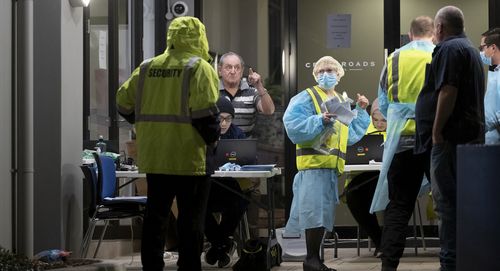
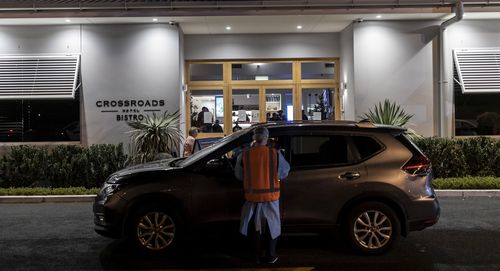
The NSW Health Minister Brad Hazzard yesterday revealed a 30-year-old woman and a 50-year-old man have both tested positive after visiting the Crossroads Hotel in Casula, in Sydney’s south-west.

The Health Department has asked anybody who attended the Crossroads Hotel on Friday evening a week ago (July 3), to self-isolate and to get tested for the virus if they develop even mild symptoms.

Contract tracing is underway after two poeple who attended the Crossroads Hotel have tested positive to COVID-19. (Brook Mitchell)
A pop-up testing clinic has opened at the Cross Roads Hotel to limit the spread of the virus. (Brook Mitchell)

“As we speak, NSW Health has been in contact this afternoon with the management of that particular hotel, the Crossroads at Casula, and has asked them, in fact directed them, to close and provide all necessary details,” Mr Hazzard said.

A pop-up clinic opened near the hotel opened yesterday afternoon and continued to test people until 9pm.

The testing clinic opened 45 minutes early this morning as a result of high demand.

A queue of cars stretching more than a kilometre has already formed as people arrive to be tested for COVID-19.

Many of this morning’s arrivals have told 9News they are returning after being turned away last night.

Authorities are urging anyone who attended the hotel to get self-isolate and get tested. (Brook Mitchell)

Some people were forced to wait for hours before being tested and eventually many were told they had to visit the local hospital.

Meanwhile, cleaners have arrived at the hotel covered head-to-toe in protective gear including face shields to begin the process of deep-cleaning the venue.

The two patrons who tested positive did not know each other and were at the Crossroads Hotel independently last Friday night, raising concerns of a third party who unknowingly spread the virus.  

Authorities are advising other businesses to take care as well.

Security and healthcare works stand outside the entrance of the Crossroads Hotel at a pop-up testing clinic. (Brook Mitchell)

Another Sydney pub has been fined $5500 for breaching social distancing rules.   A crowd of about 250 people were photographed standing outside the Golden Sheaf Hotel in Double Bay this week. The venue has now put new measures in place.

Authorities told 9News the success of contract tracing will depend on how clearly they wrote their name and of course whether they passed on the correct details.


Source by [author_name]

How the dramatic death of Seoul’s mayor left a country divided

0

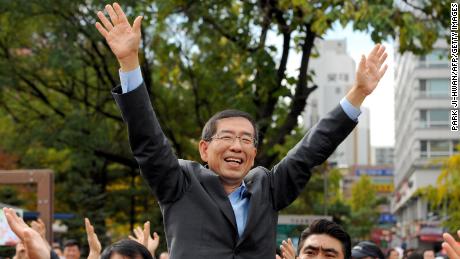
On the surface, Park certainly had an impressive resume. The 64-year-old former human rights lawyer had represented the victim in the first sexual assault case in South Korean history, before a shift to politics saw him serve as Seoul mayor for nine years.

But this week, his legacy was called into question. Local media reported Thursday that Park had himself been accused of sexual harassment, with police later confirming that a complaint had been lodged, although they didn’t specify the nature of the claim.

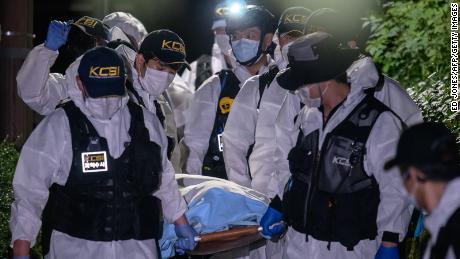
Park was reported missing by his daughter on Thursday evening. After a seven-hour search, he was found dead on a mountainside near his official residence, police said in the early hours of Friday.

Officials have not revealed how he died — but ruled out foul play.

“I am sorry to everyone,” Park said in a handwritten note found at his Seoul residence that was shared with media Friday. “Thank you for everyone who has been with me in my life. I am sorry to my family for I have only caused them pain.”

A stately career

Prior to his death, Park was widely seen as an energetic, personable leader. He was part of the team of lawyers to represent Kwon In-sook, a university student who said she had been sexually assaulted by police in the city of Bucheon in 1986. One officer was convicted.

According to Kwon’s office, she was the first woman to bring charges of sexual assault against authorities.

Park earned a diploma in international law at the London School of Economics and Political Science at the University of London, and was a visiting research fellow for the Human Rights Program at Harvard University’s School of Law.

He also had an interest in activism. As a young man, he was arrested for rallying against then-President Park Chung-hee, who many called a military dictator. He founded a number of organizations, including the People’s Solidarity for Participatory Democracy, which promotes democracy and human rights in South Korea.

Then, in 2011, Park was elected Seoul mayor in a landslide victory. It sparked a public frenzy — he was a political outsider, and his unexpected defeat of a candidate from the ruling party was seen as a sign that South Koreans were tired of traditional politics.

As mayor, Park championed city welfare projects and became a symbol of reform. He was re-elected in both 2014 and 2018, making him the city’s first elected mayor to serve three terms, and many voters even saw him as a possible presidential candidate when current President Moon Jae-in’s term finishes in 2022.

Mixed reaction

Park’s death prompted mixed reactions in the South Korean capital. Video on Yonhap, the country’s government-funded news agency, showed mourners outside the hospital where Park’s body lies crying and shouting “Mayor, you shouldn’t go like this,” and “I love you, Park Won-soon.”

Acting Mayor Seo Jung-hyup, who took over the role following Park’s death, also expressed his condolences. “I send my condolences to citizens who must be sad and confused by his sudden death,” he said in a press conference Friday. “The Seoul government should not stop and must keep going strongly, prioritizing safety and welfare following mayor Park Won-soon’s philosophy.”

A forensic team carries the body of Park Won-soon on July 10, 2020.

But others are angry that a court will never hear the allegations against Park. Under South Korean law, when a suspect dies, open investigations are closed as the prosecutors have no ground to make an indictment.

As of 9 a.m. local time Saturday, more than 344,000 people had signed a formal petition opposing Park’s city funeral, which has been set for July 13.

“What message do you want to send to the public?” the page says.

In a statement, a representative of Park’s family asked the public to show respect. “If repeated defamation of the deceased Park continues, we will have to take legal measures,” the statement said.

Bigger picture

Park’s death comes as South Korea confronts traditional domestic perceptions of sexual assault — notably a reckoning against what some see as a misogynist culture.

According to OECD data, South Korea has the highest suicide rate in the world. The country has been rocked by a series of high-profile sexual assault and harassment allegations in recent years, including against entertainment stars, sports coaches and a former top prosecutor.
Political leaders have not been immune. Last year, former governor and one-time presidential contender Ahn Hee-jung was sentenced to more than three years for the rape and assault of his former assistant. Earlier this year, Oh Keo-don, the mayor of South Korea’s second-largest city, Busan, resigned and apologized for sexual harassment.

Both Ahn and Oh were associated with the President Moon’s Democratic Party.

How to get help: In the US, call the National Suicide Prevention Lifeline at 1-800-273-8255. The International Association for Suicide Prevention and Befrienders Worldwide also can provide contact information for crisis centers around the world.

Source link