Thursday, April 23, 2026

San Francisco’s Oldest Gay Bar To Shutter Due To Coronavirus Pandemic

SAN FRANCISCO (AP) — One of the nation’s most celebrated gay bars is being forced from its home amid the financial fallout of the coronavirus pandemic.

The Stud is the longest continually running gay bar in San Francisco and known throughout the country as one of the bohemian, gender-bending, anything-goes institutions that made San Francisco into a gay mecca.

The 18-member collective that operates the club announced late Wednesday that they had decided to close the bar, though they will look for a new location.

“Because of a lack of revenue due to the COVID-19 pandemic, the historic bar will be announcing that they are permanently closing their location and will be holding a drag funeral to honor the end of an era of LGBT nightlife,” said one of the owners, Honey Mahogany, in a news release.

It’s at least the second time the 54-year-old bar has faced the prospect of full closure. But previous situations were due to gentrification in San Francisco, now one of the nation’s tech hubs.

In 2016 The Stud’s current location was sold, and the bar’s then-owner received was notified that monthly rent for the 2,800-square-foot space would leap from $3,800 to $9,500.

A cooperative group of 18 owners then bought the bar to keep it running.

Wedged into a space in San Francisco’s South of Market neighborhood — the epicenter of the city’s tech world — The Stud opened in 1966 and quickly gained a reputation as a spot with a hippie vibe and eclectic customers. Its current space features gilt mirrors, a disco ball and a small performance stage.


Source by [author_name]

Poll: Many Americans See Room For Some Middle Ground On Reopening

Most Americans continue to support measures to control the coronavirus outbreak, a new HuffPost/YouGov survey finds, with only about one-fifth chafing at the level of restrictions they personally face. A significant number, however, see room for some reopening.

As the coronavirus outbreak first ballooned across the U.S., dozens of polls found consistent, overwhelming support for a vigorous government response. Now, with states across the country reopening in partial and piecemeal fashion, the way pollsters measure Americans’ preferences could prove increasingly important.

The HuffPost/YouGov survey included three different questions about restrictions, each with a different number of options respondents could choose from. They include:

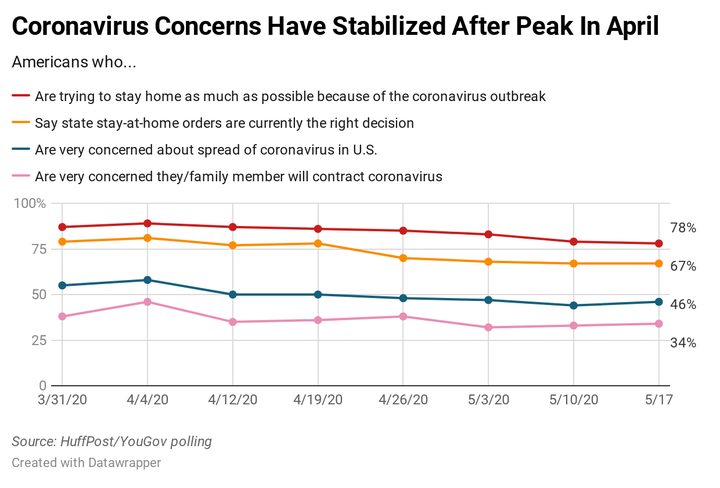
  • A binary question, which we’ve been tracking since late March, on whether state stay-at-home orders are currently the right or wrong decision. In response, 67% say these orders are the right decision and 21% that they are the wrong decision.

  • A question on Americans’ preferences for restrictions in their own area (asked of half the respondents), with one middle option. In response, 31% say there should be restrictions shutting down all nonessential businesses and activities. The lion’s share, 43%, say that there should be restrictions on some nonessential businesses and activities. Another 13% say that there shouldn’t be any restrictions.

  • A question on Americans’ preferences for restrictions in their own area (asked of the other half), with two middle options. In response, 26% say there should be restrictions shutting down all nonessential businesses and activities. Another 26% say there should be restrictions on most nonessential businesses and activities; 28% say there should be restrictions on a few nonessential businesses and activities. Just 11% want to see no restrictions at all.


Chart showing the results of a new HuffPost/YouGov survey on the coronavirus outbreak.

No single question is demonstrably the “right” way to ask about the restrictions, especially given the wide range of situations that Americans are currently living through. But taken together, the results suggest there’s some nuance in public opinion on how and when to reopen the country.

A 44% plurality of the public, meanwhile, says the level of restrictions in place where they live is about right, with 27% saying there aren’t enough restrictions and 19% that there are too many.

Americans’ worries about coronavirus, which peaked in early April, have since largely stabilized, with 46% currently saying they’re very concerned about the national outbreak, and about one-third that they’re very concerned they or a family member will catch the disease. A 78% majority currently say they’re trying to stay home as much as possible, down from a peak of 89%. 

Chart showing the results of a new HuffPost/YouGov survey on the coronavirus outbreak.


Chart showing the results of a new HuffPost/YouGov survey on the coronavirus outbreak.

About 44% of Americans currently say they’d continue to stay home as much as possible even if all restrictions are lifted, with about 25% saying they’d leave the house more but continue to take major precautions, and 6% saying they’d go back to living normally. Another 14% say they’re not currently making an effort to stay home. 

The public is closely split in its ratings of Trump’s handling of coronavirus, with 45% approving and 47% disapproving. Forty-three percent approve of the handling of the issue by the government as a whole, with 47% disapproving.

A 64% majority believe the outbreak will have a lasting effect on the United States, with just 21% expecting things to soon get back to normal.

Use the widget below to further explore the results of the HuffPost/YouGov survey, using the menu at the top to select survey questions and the buttons at the bottom to filter the data by subgroups.


The HuffPost/YouGov poll consisted of 1,000 completed interviews conducted May 15-17 among U.S. adults, using a sample selected from YouGov’s opt-in online panel to match the demographics and other characteristics of the adult U.S. population.

HuffPost has teamed up with YouGov to conduct daily opinion polls. You can learn more about this project and take part in YouGov’s nationally representative opinion polling. More details on the polls’ methodology are available here.

Most surveys report a margin of error that represents some but not all potential survey errors. YouGov’s reports include a model-based margin of error, which rests on a specific set of statistical assumptions about the selected sample rather than the standard methodology for random probability sampling. If these assumptions are wrong, the model-based margin of error may also be inaccurate.

A HuffPost Guide To Coronavirus


Source by [author_name]

Coronavirus updates LIVE: Morrison government reveals JobKeeper ‘error’ as global COVID-19 cases surpass 5.1 million, Australian death toll stands at 101

So often it’s the rats and mice that change the face of history, writes Elizabeth Farrelly. The sword glint that triggers the battle that ends a dynasty. The undercooked bat stew in some far-flung futuropolis that changes the shape of every life and city on the planet for a year, maybe forever.

Our cities will change, post-pandemic. No doubt about it. But as to how they will change, we have a choice. We can use this portal to change Sydney for the better or, via bad collective life choices, for the worse. Now is the moment.

Now is the time to choose whether COVID-19 will change Sydney for better or worse.Credit:Kate Geraghty

Most of us live in cities, so their future is our future. But their future shape is hard to see, not least because the two biggest threats to human survival – COVID and climate change – seem to point in opposite directions. Climate demands we live more densely, sharing more and consuming less. COVID, at first glance, seems to demand our spread. But maybe it’s not so simple.

Read the full opinion piece here.

Source by [author_name]

One American was aboard the plane that crashed in Karachi, official says

0

“We are monitoring the situation closely and are in touch with local authorities,” the official said. “Our staff in Pakistan and here in the United States are working tirelessly to provide all possible consular assistance.”

“We offer our sincerest condolences to the family and friends of all of those affected. Out of respect for privacy, we have nothing further to add at this time.”

A Pakistan International Airlines (PIA) flight crashed Friday in the southern Pakistani city of Karachi, according to Health Minister Azra Fazal. The airline’s CEO said at a news conference that the flight from Lahore was carrying 99 passengers and crew members in total. The plane did not hit any buildings and no one on the ground appears to have been killed, PIA CEO Air Vice Marshal Arshad Malik told reporters in Karachi Friday. The plane landed in a lane, he added.

At least 76 bodies have been recovered from the wreckage, according to a statement from the Sindh Health Department.

Secretary of State Mike Pompeo tweeted Friday afternoon he was “shocked and saddened to hear of the plane crash today in Karachi.”

“My prayers go out to those killed and injured, and their families,” he wrote. “The U.S. stands with Pakistan during this difficult time.”

Source link

Nurse Who Survived COVID-19 Shares Jaw-Dropping Photo Of What It Did To His Body

A nurse from San Francisco is shining a light on the severity of COVID-19 with a shocking photo of the effects it had on his body.

Last week, Mike Schultz shared side-by-side images of himself with his over 40,000 Instagram followers of the dramatic 50-pound weight loss he experienced during an eight-week hospital stay after suffering from the disease caused by the coronavirus.

The 43-year-old told Health that in the photo on the left, he’s about 190 pounds. He added that he exercised every day and had no underlying health conditions.

“I weighed myself the other day and I’m down to 140 pounds, and I probably weighed less than that when I first got into rehabilitation,” he told the magazine. “I’ve never been this skinny before in my life.”

Schultz explained to Buzzfeed News the reason he decided to post his now-viral photos. “I wanted to show it can happen to anyone. It doesn’t matter if you’re young or old, have pre-existing conditions or not. It can affect you,” he said.

Schultz told CNN that he contracted the coronavirus in early March, “before any of the restrictions were out” and likely got it while attending Miami’s Winter Music Festival. His DJ boyfriend, Josh Hebblethwaite,was working at the event.

“We knew it was out there,” Schultz told Buzzfeed, noting that no “lockdowns” had been ordered at this point. “We just thought, ‘Well, we gotta wash our hands more and be wary of touching our face.’”

The Miami Herald reported that 38 people who attended the LGBTQ-friendly music festival later got sick, and three men died, 

On March 14, about a week after the festival, Schultz flew to Boston, where Hebblethwaite lives.

He told CNN that when he first arrived in Boston, he had a cough but “it wasn’t really a big deal.” But on March 17, he found himself with a fever of 103 degrees and was having difficulty breathing.

When Schultz arrived at the hospital, he was given a swab test and chest X-rays. He tested positive for the coronavirus and was also diagnosed with pneumonia and severe repertory distress syndrome, per CNN.

Soon after, he was intubated and placed on a ventilator to aid his breathing.

“That was the last time I saw my boyfriend,” Schultz told Health. “I texted him, ‘I’m scared.’ Soon after, I was sedated, and I don’t remember much after that.”

He was on the ventilator for four-and-a-half weeks, according to CNN. He told Buzzfeed that during this time it was like he was “in a coma.”

Schultz said that when he woke up from his ordeal, he believed only a week had passed. “I still had a tracheostomy [tube], I couldn’t talk, and my hands were so weak that my phone felt like it was 100 pounds,” he told Health.

He also noticed he had lost weight, but nothing could prepare him for what happened when he finally saw himself in the mirror. “I didn’t even recognize myself,” he told CNN. “I pretty much cried when I looked in the mirror, I was like ‘Oh my God.’”

Schultz is now slowly recovering.

“I’m doing breathing exercises to get my lung capacity up, and plenty of exercises to stabilize my legs so I can finally walk without doing a penguin shuffle,” he joked to Health.

A HuffPost Guide To Coronavirus


Source by [author_name]

A Former Trump Official Won A $3 Million Contract To Supply Masks To Navajo Hospitals. Some May Not Work.

ProPublica is a nonprofit newsroom that investigates abuses of power. Sign up to receive our biggest stories as soon as they’re published.
 

A former White House aide won a $3 million federal contract to supply respirator masks to Navajo Nation hospitals in New Mexico and Arizona 11 days after he created a company to sell personal protective equipment in response to the coronavirus pandemic.

Zach Fuentes, President Donald Trump’s former deputy chief of staff, secured the deal with the Indian Health Service with limited competitive bidding and no prior federal contracting experience.

The IHS told ProPublica it has found that 247,000 of the masks delivered by Fuentes’ company — at a cost of roughly $800,000 — may be unsuitable for medical use. An additional 130,400, worth about $422,000, are not the type specified in the procurement data, the agency said.

What’s more, the masks Fuentes agreed to provide — Chinese-made KN95s — have come under intense scrutiny from U.S. regulators amid concerns that they offered inadequate protection.

“The IHS Navajo Area Office will determine if these masks will be returned,” the agency said in a statement. The agency said it is verifying Fuentes’ company’s April 8 statement to IHS that all the masks were certified by the Food and Drug Administration, and an FDA spokesperson said the agency cannot verify if the products were certified without the name of the manufacturer.

Hospitals in the Navajo Nation, which spans Utah, New Mexico and Arizona, have been desperate for protective supplies as the numbers of coronavirus infections and deaths have grown quickly. As of Friday, the Navajo Nation reported 4,434 COVID-19 cases and 147 deaths, a crisis that has prompted outcries from members of Congress and demands for increased funding.

Fuentes initiated email contact with officials at IHS, a division of the Department of Health and Human Services, the agency said. After the contact, the agency informally solicited prices from a handful of face mask providers and chose Fuentes of the six companies that responded because his firm offered the best price and terms, IHS said. Fuentes also benefited from government procurement rules favoring veteran- and minority-owned businesses, the procurement data shows.

Fuentes said political connections to the Trump White House played no role in his company’s selection. “Nobody referred me from the White House. It was nothing like that,” he said. “Emphatically no.”

The White House did not respond to a question about Fuentes’ contract.

IHS told ProPublica that Fuentes’ company reported that the masks were made in China, but the agency did not specify the manufacturer. Federal contracting records show without explanation that Fuentes refunded $250,000 to the IHS this month, and he said in an interview last week that he gave back money when he procured masks at a slightly reduced cost.

“We went back to IHS and said, ‘We were able to get this cheaper,’” Fuentes said. “We will never gouge our customers.”

Fuentes referred questions about the mask manufacturer and FDA certifications to his consultant, Sia N. Ashok, a business school classmate. In a phone interview, Ashok declined to name the manufacturer because it could violate the company’s contract, she said.

Ashok said the company lived up to the terms of its contract with IHS and has all the FDA certifications it needs in place.

“If the customer or IHS or anyone has any issues with anything, we would be more than happy to replace,” she said.

Fuentes’ contract price of $3.24 per mask is more expensive than the pre-pandemic rate of about $1 per mask, but far less than what some government entities have paid at the height of the crisis. Mask costs can vary widely depending on availability, demand, quality and exact specifications.

Fuentes is a retired Coast Guard officer and protege of former White House chief of staff John Kelly. He formerly served as Kelly’s military aide while he was secretary of the Department of Homeland Security, and Fuentes followed Kelly to the White House. In December 2018, as Kelly prepared to leave, The New York Times reported that Fuentes had told associates he planned to “hide out” in a vague role at the White House until he qualified for a Coast Guard early retirement program. Fuentes retired in January from the Coast Guard after 15 years of service. He said his retirement was for medical reasons.

He jumped into the federal contracting world in April at a time of great opportunity — and high risk. The coronavirus pandemic loosened many federal procurement rules as agencies scrambled to respond to a national emergency. But as supplies of personal protective equipment ran out and many countries restricted exports, delivering on contracts became more difficult, and agencies have wrestled with incomplete orders, cancellations and possible counterfeit goods.

N95 masks were so scarce that the FDA in April allowed the use of some Chinese masks that had not been certified by U.S. regulators. But in recent weeks, the FDA narrowed its guidance after tests indicated that some of the products were not as effective as they should be, and it tightened restrictions on the use of Chinese masks by hospital and medical personnel.

Fuentes formed Zach Fuentes LLC as the emergency regulations were evolving.

In April, the FDA authorized the use of masks made by close to 90 manufacturers in China.

But the masks made by some of those manufacturers did not pass CDC tests because they did not filter out enough fine particles. In some cases, the masks failed utterly.

This month, the FDA rescinded its authorization for the vast majority of the Chinese manufacturers, published a much smaller list of respirators made by 14 approved manufacturers and tightened the standards for evaluating Chinese masks.

Eleven federal agencies, including IHS, have reported buying either KN95 masks, or N95 masks made outside the United States, according to contract data. Of those, Fuentes’ contract with IHS is the second-largest that mentions KN95 masks specifically. The largest contract was struck by FEMA, for $3.9 million, on May 4.

Overall, IHS has spent $85.4 million to respond to COVID-19 as of May 22, signing 318 contracts with 211 vendors, according to federal procurement records. The masks provided by Fuentes went to five IHS medical facilities and to a government warehouse.

Fuentes’ new company has also received a much smaller contract from the Bureau of Prisons to provide 10,000 N95 masks for $1.31 each, according to a BOP statement to ProPublica and procurement documents.

One IHS hospital slated to receive masks from Fuentes is the Gallup Indian Medical Center in New Mexico. A doctor there, who declined to be named because he was not authorized to speak publicly, said the facility initially had a shortage of protective equipment. Conditions have improved thanks to federal purchases and donations, he said, though staffers still have to reuse masks up to five times each, he said.

“IHS facilities have sufficient quantities of N95 respirators at this time,” an agency spokesman said.

Do you have access to information about federal contracts that should be public? Email yeganeh.torbati@propublica.org. Here’s how to send tips and documents to ProPublica securely.

A HuffPost Guide To Coronavirus


Source by [author_name]

Dozens killed after Pakistani flight crashes  – CNN Video

0

Dozens of people are dead after a Pakistan International Airlines flight crashed in the southern Pakistani city of Karachi.


Source link

‘Stop kissing, snuggling poultry’, US health agency warns

Pet poultry like chicks and ducklings are at the centre of a recent salmonella outbreak that’s infected 97 people in 28 states, according to the Centers for Disease Control and Prevention. A third of the sick are children under five.

Among the CDC’s guidelines for preventing future infection: “Don’t kiss or snuggle backyard poultry”.

Pet poultry like chicks and ducklings are at the centre of a recent salmonella outbreak that’s infected 97 people in 28 states, according to the Centers for Disease Control and Prevention. (Getty)

Sure, planting a peck on your baby chick’s beak may sound sweet, if not a bit sharp. But chicks and ducks that seem healthy can harbour salmonella bacteria, and it can live in their environments, too, the CDC said.

It’s the second time within a year that the CDC’s pleaded with the public to end the snuggles. In a salmonella outbreak in September 2019, the agency issued the same advice – and during that outbreak, more than 1000 people were infected across 49 states.

So, yeah. The kissing stuff is serious.

Salmonella bacteria are commonly transmitted through contaminated food or, as in this case, through contact with infected animals. Though most people infected with salmonella run through symptoms like diarrhea and fever within a week, on occasion, the diagnosis requires hospitalisation, the CDC said.

So far, 17 people have been hospitalised in connection with this outbreak, which took off in March, and they’re spread out across the entire US.

California and Kentucky have the highest number of cases at nine each, but cases have appeared as far apart as Montana, Massachusetts and Florida.

In addition to the ban on kisses, the CDC recommends chick owners keep a separate pair of shoes to wear inside the birds’ habitat and only wear them outside.

It’s a good idea, too, to keep the birds out of homes, especially in kitchens or living rooms where they could come in contact with the food.

And, of course, some familiar advice: wash hands after interacting with the tiny birds and their environment, and make sure young children wash their hands thoroughly, too.

Source by [author_name]

Coronavirus cases top 100,000 across Africa, WHO says

0

There have been 3,100 deaths from the virus in Africa.

“For now Covid-19 has made a soft landfall in Africa, and the continent has been spared the high numbers of deaths which have devastated other regions of the world,” said Dr. Matshidiso Moeti, WHO regional director for Africa.

During a briefing on Friday, Dr. Mike Ryan, WHO executive director of Health Emergencies Programme, said: “On the one hand, good news — the disease hasn’t taken off in a very fast trajectory, but (there’s) a concern some countries are accelerating in the number of cases.”

Ryan said within Africa, there are “many, many highly vulnerable groups” and the bearing of coronavirus on those groups has yet to be seen.

“We don’t know what the impact of this will be in undernourished children with chronic malnutrition, we don’t know what the impact of this will be in in overcrowded refugee camps. So, there’s a lot still to be learned,” he said.

As a comparison, Europe reported 4,900 deaths when when cases reached 100,000 on that continent, according to the press release.

Africa’s lower mortality rate could be partly because Africa is the youngest continent demographically with more than 60% of the population under the age of 25, the WHO’s early analysis suggested.

The continent has conducted around 1.5 million Covid-19 tests, but testing rates remain low and many countries continue to require support to scale up testing, WHO said.

African governments were quick to impose confinement measures, including physical and social distancing, which WHO said had helped to slow the spread of the virus, along with contact tracing, isolation and increased hand washing.

A new modeling study by WHO predicts that if containment measures fail, even with a lower number of cases requiring hospitalization than elsewhere, the medical capacity in much of Africa would be overwhelmed.

With more than 18,000 cases, South Africa has the highest number of coronavirus patients on the continent. The country has imposed strict restrictions, including a five-week lockdown, which ended April 30, to combat the spread of the disease. The government plans to reopen schools June 1 and says the education department will roll out guidelines for the resumption.
South African health officials said that memories of failures with HIV — and the considerable resources the country has since built up — were driving their fight against this new virus.

CNN’s Bukola Adebayo, David McKenzie and Brent Swails contributed reporting.

Source link

Police investigated Dominic Cummings about lockdown breach: report

0

Dominic Cummings, special adviser to Prime Minister Boris Johnson | Peter Summers/Getty Images

Boris Johnson’s chief adviser accused of traveling from London to Durham despite having COVID-19 symptoms.

By

Updated

LONDON — U.K. police investigated allegations Prime Minister Boris Johnson’s chief adviser broke lockdown rules, the Guardian and Mirror reported in a joint investigation Friday.

On March 31, officers attended an address in Durham where a member of the public claimed to have seen Dominic Cummings, more than 250 miles from his north London home, the papers reported. At the time, the U.K government advised against all but essential travel.

The previous day, a No.10 official had told journalists at a regular briefing that Cummings was self-isolating after showing symptoms of the coronavirus. His wife later wrote about the couple’s experience of having COVID-19 in a piece for the Spectator magazine, where she works as a commissioning editor.

“Day six is a turning point, I was told: that’s when you either get better or head for ICU,” she wrote. “But was Dom fighting off the bug or was he heading for a ventilator? Who knew? I sat on his bed staring at his chest, trying to count his breaths per minute.”

Cummings had been seen running out of Downing Street a few days earlier, hours before it was announced that Johnson had tested positive for COVID-19.


Source by [author_name]