Saturday, May 2, 2026

Trump Defends Church Photo Op: ‘I Think It Was Very Symbolic’

President Donald Trump is standing by his decision to pose with a Bible outside St. John’s Church in Washington on Monday ― a stunt that drew swift and harsh rebukes from two of the city’s top prelates.

“Most religious leaders loved it,” Trump insisted in a Fox News radio interview about a photo shoot that took place after law enforcement officers forcefully dispersed a peaceful demonstration against the police killing of George Floyd.

“I think it was very symbolic. I did hold up a Bible. I think that’s a good thing, not a bad thing, and many religious leaders loved it,” Trump told the show’s host, Fox anchor Brian Kilmeade, on Wednesday.

“Why wouldn’t they love it? I’m standing in front of a church that went through trauma ― to put it mildly,” Trump said.

Trump pointed specifically to the support he’s received from evangelist Franklin Graham and Robert Jeffress, a Dallas pastor, for posing in front of the historic Episcopal church, which was damaged during Sunday protests against police brutality toward Black Americans.

Trump also tried to distance himself from the aggressive maneuvers used by police to clear protesters from Lafayette Square, a park near St. John’s Church, to allow Trump passage to the photo op. The president insisted that officers didn’t use tear gas on the protesters, although they did, at least according to the Centers for Disease Control and Prevention’s definition of tear gas and other riot control agents.

“They didn’t use tear gas. They didn’t use ― they moved them out,” Trump said. “Now when I went, I didn’t say move them out. I didn’t know who was there.”


President Donald Trump holds a Bible while visiting St. John’s Church on Monday.

In a Facebook post that avoided any mention of the force used on protesters, Graham said that he was “not at all” offended by Trump’s actions. Graham said Trump demonstrated that the “burning, looting, and vandalism of the nation’s capital — including this historic house of worship—mattered, and that the lawlessness had to end.”

Graham added that he found it “unbelievable” that members of the clergy have been some of the president’s harshest critics. They “should be thanking him rather than criticizing him!” Graham wrote.

Trump said “many other people” thought his display at St. John’s was great. “It’s only the other side that didn’t like it,” Trump said. “You know, the opposing ― the opposition party, as the expression goes.”

Both the Episcopal and Roman Catholic prelates of Washington put out scorching statements opposing Trump’s photo op.

Episcopal Bishop Mariann Budde told HuffPost on Monday that although she was upset about the parish building’s being damaged, it’s much more important to focus on the systemic pattern of racism that the protesters are trying to highlight.

The Rev. Gini Gerbasi, an Episcopal priest, told HuffPost that she was in the crowd of people that was tear-gassed and driven away by police. She called what happened “grotesque and offensive and sacrilegious.” 

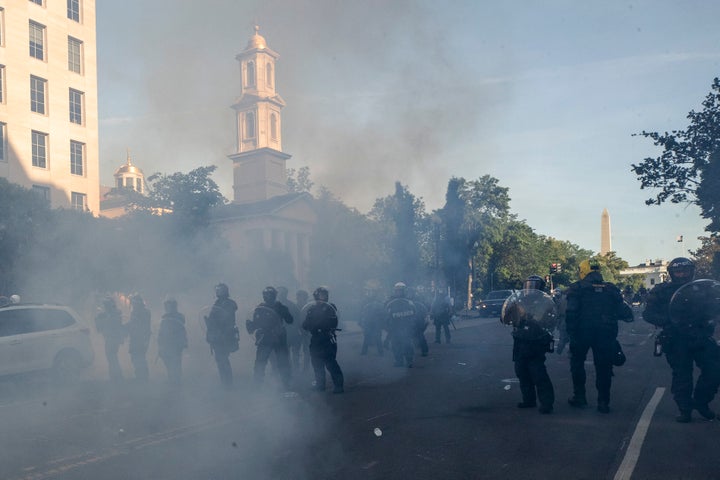
Tear gas floats in the air as a line of police moves demonstrators away from St. John's Church on Monday.


Tear gas floats in the air as a line of police moves demonstrators away from St. John’s Church on Monday.

But the president’s closest evangelical allies ― Family Research Council President Tony Perkins, Latino evangelical leader the Rev. Samuel Rodriguez, evangelical public relations consultant the Rev. Johnnie Moore ― have rallied around him. 

Perkins praised Trump for “sending a message that he’s not going to be intimidated, that our government is not in hiding,” according to the Associated Press. The only thing Perkins said he would have personally done differently is to ask a multiracial group of pastors to offer a prayer for the nation.

John Fea, a historian of American evangelicalism at Messiah College, said he thinks Trump’s closest advisers are looking at his actions through the lens of Romans 13, a Bible passage that exhorts Christians to submit to authority. These verses have been cited in the past by Trump’s close evangelical allies, whom Fea has nicknamed the “court evangelicals,” to justify support for policies that appear to contradict Jesus’s teachings about compassion.
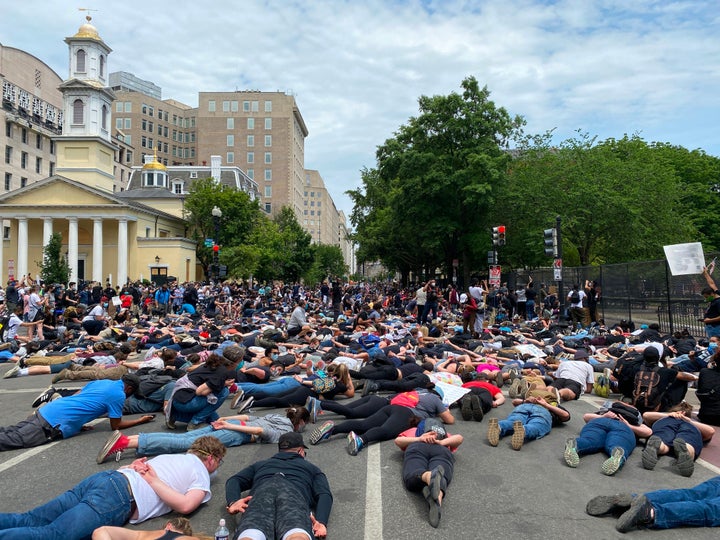
Protesters lie down in front of Lafayette Square and St. John's Episcopal Church on Tuesday.


Protesters lie down in front of Lafayette Square and St. John’s Episcopal Church on Tuesday.

In addition, conservative evangelicals have a tendency to believe that culture war issues and the goal of winning souls through evangelism are more important than questions of social justice, Fea said.

“Court evangelicals will always place abortion, religious liberty and conservative Supreme Court justices over care and concern for the poor, the marginalized, the stranger (immigrants) and those who are the victim of systemic racism,” Fea said. “They will condemn individual acts of racism, but they do not believe in systemic or structural racism.”

More broadly, even though some rank-and-file white evangelicals are disgusted by what Trump did at St. John’s Church, that won’t change how they vote, Fea said.

“They will still vote for Trump in 2020 because he holds the right views on the social issues … that many evangelicals believe are non-negotiables when it comes to choosing a candidate,” Fea said.


Source by [author_name]

Senate Passes Bill To Give Paycheck Protection Plan Loan Recipients More Flexibility

The Senate on Wednesday passed a bill that would give small businesses more time to use loans given to them to weather the ongoing coronavirus pandemic, as well as additional flexibility on how they can use the money.

The legislation cleared the House last week in a near-unanimous vote, passing 417-1. The measure briefly stalled in the Senate due to objections from some Republican senators who demanded changes, but the chamber reached an agreement Wednesday evening and sent it to President Donald Trump’s desk for his signature into law.

The bill would make key changes to the Paycheck Protection Program that Congress created earlier this year as part of its emergency response to the pandemic. The program gave small business owners forgivable loans so long as most of those funds were spent on their payrolls as part of efforts to keep millions of Americans employed.

The new legislation would extend the period small businesses are allowed to use loans to 24 weeks from eight weeks. It also would allow loan recipients to spend 60%, rather than 75%, of their loan proceeds on paying workers and still be eligible for loan forgiveness. The remaining portion of the loans can be used on other expenses need to keep businesses afloat.

Senate Democrats attempted to pass the bill via unanimous consent earlier Wednesday, warning that the eight-week period for borrowers who first received loans is set to expire next week before some states have fully re-opened and allowed many businesses to operate. According to a survey done by the National Federation of Independent Businesses, 23% of businesses that got loans will hit the eight-week deadline next week.

“Small businesses need predictability. We don’t have extra time,” Sen. Ben Cardin (D-Md.), the top Democrat on the Small Business Committee, said in a floor speech.

But Sen. Ron Johnson (R-Wis.) objected to the unanimous consent request.

Johnson expressed concern that the House bill requirement that businesses spend at least 60% of their loans on payroll is too high. He also questioned the provision to extend the loan program through December. 

Johnson said he hoped to enter a letter into the congressional record clarifying the intent of Congress that the program expire at an earlier date before approving the bill.

“We’re so close,” Johnson said, indicating that he and other lawmakers were working on such a resolution. “Maybe we pass this yet tonight or early tomorrow morning.”

Sen. Mike Lee (R-Utah) echoed Johnson’s concerns about the bill.

Democrats, meanwhile, argued that small businesses couldn’t afford a delay.

“It would be very wise and helpful to all business to pass this bill now and then we’ll work in good faith on the small change,” Senate Minority Leader Chuck Schumer (D-N.Y.) said.

The chamber reached a deal later in the day, however, and the bill passed unanimously after a request from Senate Majority Leader Mitch McConnell (R-Ky.).

The loan program, one key part of the Cares Act that Congress passed in March, has approved more than $500 billion out of $660 billion in loans to small businesses. The pace of lending has slowed considerably in recent weeks.

Democrats have called for further reforms to the program to make it more equitable, as well as more detailed data on its recipients, including race, geography, and gender.

This story has been updated with Senate passage of the bill after it had stalled in the chamber earlier on Wednesday.

A HuffPost Guide To Coronavirus


Source link

‘Tiger King’ update: Sheriff says will of Carole Baskin’s late husband Don Lewis was forged

The Tiger King drama never stops.

Two-and-a-half months after it debuted to phenomenal ratings on Netflix, the saga continues to play out. The latest is that Hillsborough County Sheriff Chad Chronister declared in a June 2 interview with Tampa, Fla., CBS affiliate WTSP that the will of Carole Baskin’s missing husband is “100 percent a forgery.”

In the series, formally titled Tiger King: Murder, Mayhem and Madness, multiple people speculate on the 1997 disappearance of Don Lewis. They allege that Baskin, the animal activist who runs Big Cat Rescue in the Florida city and married Lewis in 1991, was responsible.

Baskin has repeatedly said she has nothing to do with his disappearance, and Lewis was legally declared dead in 2002.

Asked about Chronister’s latest comments, Baskin directed Yahoo Entertainment to the detailed statement she’s previously given on the topic, where she refutes many points made in the documentary. “I don’t have any comments other than what is posted at BigCatRescue.org/netflix where you will find that all of the documents were authenticated by at least two expert firms and everyone involved in the conservatorship agreed by stipulation ratified by the court to their authenticity.”

There was similar speculation in May, when another news organization, the Clarion-Ledger newspaper in Jackson, Miss., reported that the notary listed on the multimillionaire’s will didn’t recall signing off on the document.

“I don’t remember a will at all,” Sandra Wittkopp told the Mississippi Center for Investigative Reporting. “I was the housekeeper.”

The newspaper said then that two handwriting experts concluded Lewis’s signature was “traced” from his 1991 marriage record.

Chronister explained to WTSP on Wednesday that, despite his suspicions, the statute of limitations in the case has expired.

“The will had already been executed at that point,” said Chronister, who is running for reelection. “But, it certainly cast another shadow of suspicion, by all means.”

The TV station reported that Chronister has previously told them he thinks Lewis was murdered by someone.

“Investigators have some great leads, they’re working through them,” Chronister said. “I hope something pans out.”

Chronister asked the public for new information on the case in March, just after Tiger King was released.

There was another Tiger King development earlier this week when a federal judge in Oklahoma sided with Baskin in a case against Joe Maldonado-Passage, who’s better known as Joe Exotic. She was given control of Exotic’s former Oklahoma zoo as part of a $1 million trademark lawsuit she won against Exotic that he never fully paid.

Exotic is serving a 22-year sentence for trying to hire someone to murder Baskin, among other crimes.

Read more from Yahoo Entertainment:

Source link

New suspect identified in 2007 disappearance of Madeleine McCann

0

The three-year-old vanished while sleeping in her family’s holiday apartment in Portugal on May 3, 2007, in a case that has since gained widespread media attention in the UK. She has never been found, and no one has ever been charged over her disappearance.

The new suspect is a 43-year-old German man, authorities from both countries said.

The suspect has previously been convicted for sexually abusing children, German State Prosecutor’s office of Braunschweig, State of Lower-Saxony said in a statement on Wednesday, which added that he is currently serving a “long” jail sentence “for an unrelated matter.” He is now being investigated for “possible murder” in connection with McCann, the office said.

The suspect had lived in Portugal’s Algarve region from 1995 to 2007, and also resided in a house in Praia de Luz, the resort from which McCann disappeared, according to the prosecutor’s office.

London’s Metropolitan Police on Wednesday also revealed details of two cars linked to the suspect around the time of the disappearance, and called on the public to step forward with any information about them.

“The first vehicle is a distinctive VW T3 Westfalia campervan. It is an early 1980s model, with two tone markings, a white upper body and a yellow skirting. It had a Portuguese registration plate,” the UK statement said.

“The suspect had access to this van from at least April 2007 until sometime after May 2007. It was used in and around the area of Praia da Luz.”

“The second vehicle is a 1993 British Jaguar, model XJR 6, with a German number plate and registered in Germany,” the statement added. “This car is believed to have been in the Praia da Luz and surrounding areas in 2006 and 2007. The car was originally registered in the suspect’s name. On 4 May 2007, the day after Madeleine’s disappearance, the car was re-registered to someone else in Germany.”

The Metropolitan Police began reviewing McCann’s disappearance in 2011, in an large-scale investigation known as Operation Grange that has cost at least £11.75m ($14.7) as of June 2019.

“Following the ten-year anniversary, the Met received information about a German man who was known to have been in and around Praia da Luz. We have been working with colleagues in Germany and Portugal and this man is a suspect in Madeleine’s disappearance,” Detective Chief Inspector Mark Cranwell said in a statement Wednesday.

The child’s parents, Kate and Gerry McCann, on Wednesday thanked the “police forces involved for their continued efforts in the search for Madeleine.”

“All we have ever wanted is to find her, uncover the truth and bring those responsible to justice. We will never give up hope of finding Madeleine alive but whatever the outcome may be, we need to know as we need to find peace.”

UK authorities are offering a £20,000 (about $25,000) reward for information leading to the conviction of those responsible.

CNN’s Fred Pleitgen in Berlin, Mia Alberti in Lisbon, Milena Veselinovic and Isa Soares in London contributed to this report.

Source link

Jimmy Carter calls out police injustice, but says violence is ’not a solution’

Many protests have been largely peaceful, though violent clashes have sprung up as police enforce curfews and clear streets. There have also been several major instances of looting in large cities, and state and municipal governments have reinforced police, at times calling in the National Guard.

Several observers, including President Donald Trump, have used the lootings as justification for employing military force to quell the protests. Some Defense Department officials have express dismay at the prospect of using the U.S. military on American citizens.

Many videos posted online have shown police using violent force against protesters and reporters, even when unprovoked. A notable example was Monday, when law enforcement used smoke canisters, pepper, rubber bullets and flash-bang shells to clear a crowd from Lafayette Square across the street from the White House so that Trump could pose for photos at a nearby church.

Carter’s statement also invoked his own experiences in the deep South, saying: “I know all too well the impact of segregation and injustice to African Americans. As a politician, I felt a responsibility to bring equity to my state and our country.”

Carter said that he has fought as governor of Georgia, president and former president for human rights, saying in his 1971 gubernatorial inauguration, “The time for racial discrimination is over.”

“With great sorrow and disappointment, I repeat those words today, nearly five decades later,” his Wednesday statement read.

Source link

The Takeaway: UAE official warns of ‘even more unstable’ region if Israel annexes West Bank settlements

In a wide-ranging interview for Al-Monitor’s On the Middle East podcast, Yousef Al-Otaiba, the United Arab Emirates Ambassador to the United States, discussed the impact of COVID-19 on the UAE and the region; Iran; Israeli-Palestinian issues and more.

Background: Otaiba has served as the UAE Ambassador to the United States since 2008. In addition to his role as ambassador, he was promoted to the rank of minister in 2017.

Here are just a few highlights of his interview on dealing with COVID-19, Iran and Israeli-Palestinian issues:

On COVID-19:

Whole of Government: With a population of approximately 10 million, the UAE has 35,788 coronavirus cases and only 269 deaths, a fatality rate of 0.7% compared to a global mortality rate among reported cases of 5.9%. Otaiba suggests that the UAE’s “whole of government” approach may be the reason for such a low percentage. The UAE began planning early to deal with the virus, engaging all relevant government agencies. The Emirates has implemented extensive testing (the UAE has already tested 20% of its population); hospitalization for all positive cases; extensive contact tracing; social distancing enforcement and daily cleaning at malls and public places; and stringent and flexible curfews.

Collective Action: The UAE has its own COVID diplomacy, emphasizing collective action and humanitarian aid. It has provided over 657 tons of medical supplies to 62 countries so far. “Unless the entire world is able to deal with the coronavirus, we will not overcome the coronavirus,” said Otaiba, adding, “The view from the [UAE] leadership is that we have to help these countries who don’t have the type of resources or capacity to test, identify and deal with the coronavirus…We have to do this together…We have to tackle the coronavirus everywhere if we are going to overcome this.”

UAE Post-COVID-19: “We were already marching toward a knowledge-based economy, investing in technology and AI and things that address the future. And I think what the coronavirus is doing for us is making these plans go much, much faster…We are accelerating whatever it is we were planning to do anyway.”

On Iran:

A UAE template for civil nuclear development? The US-UAE civil nuclear agreement, negotiated in 2009, has been referred to as the “gold standard” of such agreements. The UAE does not enrich uranium or reprocess nuclear fuel as part of the deal, which makes civil nuclear energy safer and cheaper while eliminating any concerns about weapons development. Iran, in contrast, has insisted on “the right to enrichment” in its civil nuclear program. “I don’t know if Iran’s receptive” to the UAE model, Otaiba said, “but I know it hasn’t really been positioned; it hasn’t been used as a template.”

On diplomacy with Iran: “We need to see what Iran is going to do…I think it’s important to try to de-escalate, to make sure things don’t get any more unstable in what has become a very unstable region. But I don’t know if we’re going to see any change of behavior between now and November,” when the United States holds presidential elections, with regard to negotiating a new nuclear agreement, as the Trump administration is seeking.

On Israeli-Palestinian issues:

Annexation: Otaiba warned that Israeli Prime Minister Benjamin Netanyahu’s plan to annex Jewish settlements in the West Bank and Jordan Valley would make the Middle East “even more unstable,” adding, “It will put an incredible amount of political pressure on our friends in Jordan.”

Trump Peace Plan: “It’s a starting point…and it may or may not produce anything…but we haven’t seen any negotiations,” he said. “Cooler heads need to prevail, and we need to get back to a place where there is some form of dialogue between the sides.”

Palestinian decision to end cooperation with US, Israel: “I don’t think it’s a good move, but I also think the Palestinians have very little options left at their disposal.”

On the PA rejecting UAE COVID-19 assistance: “I honestly don’t know what happened there,” Otaiba said, adding, “I wish I did…We’re trying to help people who desperately need help. I’m disappointed that help will not reach poor Palestinians who need that help…There are 100 ways that could have been handled better.”

Listen here: This is just a small taste of my conversation with Ambassador Otaiba, which also covered Libya, Syria, Yemen and Qatar. You can listen here to the full podcast and sign up for our Al-Monitor podcasts on your favorite platform.


Source link

Coronavirus live updates: Australian death in Bali investigated for Covid-19 as Nev Power appears before Senate – latest

Australia is well-placed to help meet India’s economic aspirations. India is our second-largest source of international students, and Australia benefits from a 700,000-strong Indian-Australian diaspora.

But next month marks two years since former DFAT secretary, Peter Varghese, presented this Government with the India Economic Strategy, which was intended as a blueprint to transform our economic engagement.

Since then the strategy has gathered dust, continuing years of failure by this Government to adequately diversify Australia’s trading economy.

Under Scott Morrison as Prime Minister and Treasurer, Australia has become increasingly reliant on a single trading partner. The only economy that depends more on China than Australia is Hong Kong.

Instead of trade diversification, Scott Morrison and his government have overseen the proportion of Australian trade with China increase by a third – from 19.8 per cent of Australia’s total trade to 26.4 per cent.

In the same period, the proportion of Australia’s trade with Japan, South Korea, Singapore and the US has declined and the proportion of Australia’s trade with India has increased by a measly 0.7 percentage points – from 2.7% to 3.4%.

We recognise that India alone does not provide a magical solution on diversification, but the fact is that India has barely rated a mention by this Government.

Labor launched negotiations with India for a Comprehensive Economic Partnership Agreement in May 2011. The most recent negotiation was 45 months ago, in September 2015.

We hope this week’s virtual summit yields more than headlines aimed at providing a distraction from recent trade issues with China, and instead marks a long overdue shift in emphasis and a serious plan for diversifying Australia’s interests.

Source link

401(k) Plans Move a Step Closer to Pooling With Private Equity

Everyday investors may soon be able to get a piece of private equity action.

The Department of Labor on Wednesday issued a letter that clarifies how, under existing rules, certain retirement plan sponsors, including 401(k)’s, can put money into private equity investments that are usually reserved for the super rich and big institutional investors.

Labor Secretary Eugene Scalia said the new guidance “helps level the playing field for ordinary investors and is another step by the department to ensure that ordinary people investing for retirement have the opportunities they need for a secure retirement.”

But it’s unclear how quickly the managers of big retirement plans will embrace private-equity investments. Vanguard, one of the largest managers of 401(k) plans in the country, declined to comment on the letter. Another major manager, Fidelity, did not respond to a request for comment.

Consumer advocates and some regulators have been wary of giving ordinary investors broader access to investments in businesses that do not adhere to the same disclosure rules as public companies and that could put them at risk.

Even without access to this untapped pool of capital, private equity managers have been able to raise record amounts in recent years. Fund managers in the United States had access to $914 billion as of mid-May, according to the investment data firm Preqin.

Many of those dollars come from wealthy clients, but big pension funds, such as the Texas County and District Retirement System, also put their money into funds managed by private equity firms.

But the move away from traditional pensions and into defined contribution plans means most retail investors don’t have access to those kinds of investments, which proponents say can provide added diversification to an investment portfolio.

“This is a positive step towards helping more Americans gain access to private equity investment,” Drew Maloney, the chief executive of the American Investment Council, which represents the private equity industry, said in a statement.

Private equity investments in new start-ups or in growth businesses can produce high returns. The private equity funds in the top 25 percent for performance earned at least 16.2 percent over the 10 years that ended in September 2018, according to PitchBook.

But that comes with myriad risks.

As the term “private equity” suggests, investments can be opaque. Companies in such portfolios don’t have to disclose as much information as publicly traded businesses. Investors also can’t cash out as easily as they can with public investments. Money is often locked up for eight to 10 years at a time.

And while private equity can score big by investing in the next Facebook, it can also lose money when a company doesn’t get off the ground. According to the same PitchBook data, the bottom 10 percent of funds had negative returns over 10 years.

In November, Andrea Seidt, the Ohio securities commissioner, told the federal Securities and Exchange Commission that a review of 100 enforcement actions over the prior two years — a partial snapshot — showed that more than 1,000 investors had lost in excess of $100 million in private offerings gone wrong.

The private marketplace has become increasingly important as start-ups stay private longer. Also, there are half as many public companies as there were two decades ago, leaving fewer places for everyday investors to store their money.

The Labor Department outlined the new guidance in coordination with the S.E.C. Jay Clayton, the commission’s chairman, said in the statement that the clarification “will provide our long-term Main Street investors with a choice of professionally managed funds that more closely match the diversified public and private market asset allocation strategies.”

The S.E.C. has supported giving smaller investors access to private equity through special investment vehicles that might work like mutual funds. Right now, only accredited investors — those with at least $1 million in assets not including their home, or $200,000 in annual income — can participate in private equity deals.

In December, the agency proposed rules that would relax the accredited investor rules, but it stopped short of figuring out a way to make private equity more widely accessible. The Labor Department’s guidance was a response to Partners Group, a private equity firm with $94 billion in assets under management, and Pantheon Group, which has $49 billion in assets under management and is controlled by Affiliated Managers Group, a publicly listed company that specializes in asset management.

Susan Long McAndrews, a partner at Pantheon, said in a statement that the change was “a critical step toward improving retirement outcomes.”

Tara Siegel Bernard contributed reporting.

Source link

50,000 people moved to safety in Mumbai ahead of Cyclone Nisarga

0


Nearly 50,000 people staying close to the seashore and landslide-prone areas in were either evacuated or they themselves moved to safer locations ahead of ‘Nisarga’, which hit the coast on Wednesday, although the country’s financial capital largely remained unscathed by it.


Nisarga hit the state coast near Alibaug in Raigad district with a wind speed upto 120 kmph on Wednesday afternoon, but weakened in the evening and moved towards north-east Maharashtra, sparing and other areas.


The (BMC) said that since Tuesday it evacuated nearly 20,000 citizens to the temporary shelters and other 30,000 shifted on their own to safer locations in response to its advisory.

Municipal workers use a bulldozer to clear uprooted trees from a road that fell during Nisarga, in Mumbai


The BMC said that the city witnessed 117 incidents of tree fall, nine incidents of wall or portion of house collapse, but there was no report of any casualty or injury due to the cyclone.


BMC sources said that the maximum number of people evacuated by the civic body were from slums and fisherfolk localities along the west coast, including areas like Colaba, Worli, Versova, Malad and Gorai.

mumbai, monsoon, rain, nisarga, clouds, women, shelter


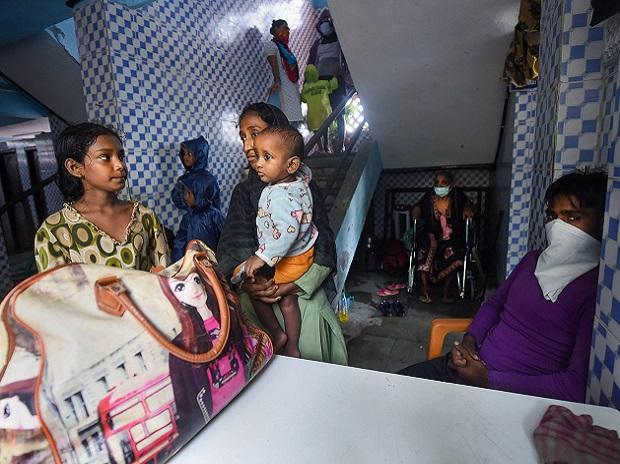
Residents of Geeta Nagar slum take shelter at a safer place during Cyclone Nisarga, in Mumbai


ALSO READ: Cyclone Nisarga LIVE: Worst is over, NDRF teams to stay deployed, says DG


The BMC said that all these evacuated people were moved into 35 schools that were converted into temporary shelters.


In its statement, the BMC said that Municipal Commissioner I S Chahal directed to keep all the evacuees under observation for one day and they will be permitted go to after being screened for temperature and oxygen levels to ensure that they do not have symptoms of Covid-19.

mumbai, monsoon, rain, nisarga, clouds, sea, ships, shipping, high tide


A vessel in the rough sea during Cyclone Nisarga, at Colaba in Mumbai


It said that between 8 am to 6 pm on Wednesday, 117 complaints of tree fall were reported in Mumbai, of which 39 were from south Mumbai, 40 from eastern suburbs and 38 from western suburbs.


It further said that 39 incidents of short-circuit were reported in the city during the same period and nine incidents of house fall, including three were from south and four from western suburbs, were reported on Wednesday.

mumbai, monsoon, rain, nisarga, clouds, marine drive


A group of people pose for pictures at Marine drive during Cyclone Nisarga, in Mumbai


A spokesperson of Ltd, which supplies piped cooking gas to the city, said that a pipeline supplying gas to a society in Ghatkopar West was ruptured due to tree fall, but it was immediately attended and gas supply stopped.


A purported video of falling of scaffolding around a building, said to be from suburban Bandra of Mumbai was being circulated on social media and another video about damage to a temporary rain shed on a building in South Mumbai was reported by the regional news channels.


mumbai, monsoon, rain, nisarga, clouds, tree, jcb


A corporation worker works to clear an uprooted tree that fell on a road during Cyclone Nisarga at Juinagar in Navi Mumbai


ALSO READ: Cyclone Nisarga: Threat to Mumbai has reduced, says Maharashtra minister


The civic body, however, said that no injuries were reported in any of these two incidents.


No other untoward incident was reported.


According to the statement, the BMC’s disaster response machinery will remain on high alert for the next few days until the cyclonic effect has passed from the city.


Quoting the (IMD), the civic body in its statement predicted moderate to heavy rain with strong gusty winds in the city and suburbs along with extremely heavy rainfall at isolated places for Thursday cloudy sky with light to moderate rain for the next 48 hours.


According to the BMC, a high tide of more than four meters is expected on Thursday at 10.57 am.


Source link

AP Top Stories June 3 P

Here are the top stories for Wednesday, June 3: More charges announced in George Floyd case; Esper breaks with Trump over military response to protests; Rosenstein defends role in Russia probe; Museum closed due to pandemic reopens in Florence.


Source link