National Cricket Academy (NCA) chief Rahul Dravid on Wednesday said that they have been addressing mental health issues of non-contracted and U-19 players amid the ongoing nationwide lockdown due to the COVID-19 pandemic.
It is an uncertain period for cricketers and it could affect them mentally.
“It’s something we tried in this lockdown (addressing mental health of players through professionals). We identified outside of the contract list and with the U-19 players. We have given the opportunity to connect to professionalism,” Dravid said during a Rajasthan Royals webinar on on Mental Health and Wellbeing.
File image of Rahul Dravid. AFP
“As a former cricketer I truly believe that former cricket players, cricket coaches rarely don’t have the expertise to deal with the issues that some of the youngsters have these days. The right thing for us to direct them to professionals and take it forward,” said the former India captain.
Stressing that mental health has been an in issue in cricket, Dravid said it’s heartening to see frequent conversations around it now.
“It is high-pressure environment. In the past there was a certain stigma associated to admit it but with a few players coming out definitely there has been some better conversation around it,” he said.
Dravid has been working on junior cricketers for a while, earlier as India U-19 and India A coach and now as NCA head.
Dealing with the insecurities in his younger days was challenging for him and that is one of the reasons why he loves nurturing the young talent.
“It’s quite unnerving for a lot of young players which is why I love working with the Under-19 boys or India A who I think going through the same amount of insecurities whether I make it or not.
“I kind of identify with them, that something I had experienced myself as a young boy,” said Dravid.
Dravid, who went on to become the ‘Wall of Indian Cricket’, holds a graduate degree in commerce and was doing MBA when he was picked for India as he had to go through a long phase in First-Class cricket.
“I think trying to get into the Indian team was one of the most challenging phases. I made my First-Class debut at the age of 17 or so… It took me about five years of First-Class cricket to play for India.
“If I look back the most complicated time for me would me before when I played for India when you had those risky decisions to take with doubts and insecurities around it.
“When you had the choices of going down with a career in something else and you commit to cricket and take that risky decision and going through it.
“You had to sacrifice your education in some ways to take a punt, take a gamble on cricket. It kind of worked out. I never used that degree ever luckily,” he recalled.
Updated Date: May 27, 2020 23:13:19 IST
Find latest and upcoming tech gadgets online on Tech2 Gadgets. Get technology news, gadgets reviews & ratings. Popular gadgets including laptop, tablet and mobile specifications, features, prices, comparison.
Washington: US Secretary of State of Mike Pompeo has notified Congress that the Trump administration no longer regards Hong Kong as autonomous from mainland China.
In a statement, Pompeo said China’s plan to impose new national security legislation on Hong Kong was “only the latest in a series of actions that fundamentally undermine Hong Kong’s autonomy and freedoms”.
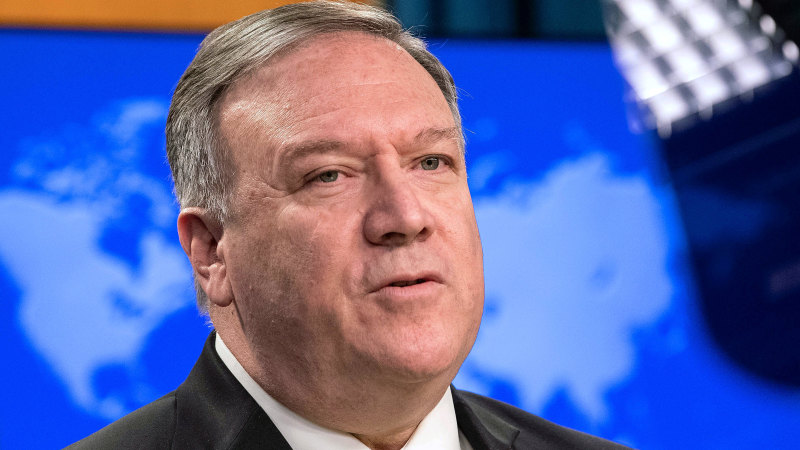
US Secretary of State Mike Pompeo, pictured, said it was “clear that China is modelling Hong Kong after itself”.Credit:AP
“No reasonable person can assert today that Hong Kong maintains a high degree of autonomy from China, given facts on the ground,” he said on Wednesday, local time.
“After careful study of developments over the reporting period, I certified to Congress today that Hong Kong does not continue to warrant treatment under United States laws in the same manner as US laws were applied to Hong Kong before July 1997.
TOKYO — Nissan and Renault, the quarrelsome main partners in the world’s largest automaking alliance, announced a plan on Wednesday to try to reset their troubled relationship as they seek to survive the coronavirus’s devastating impact on the car industry.
The plan seeks to more clearly delineate each company’s turf so they can better absorb catastrophic declines in sales while developing new technologies they need to remain competitive.
For example, Nissan will take the lead on development of autonomous driving technology and Renault will be in charge of developing electric vehicles.
Nissan will be the dominant partner in Japan, China and the United States, while Renault will take the lead in Europe, Russia, Africa and Latin America. Mitsubishi, which is also a member of the alliance, will be in charge of the rest of Asia.
However, there are no plans to merge the companies, said Jean-Dominique Senard, the chairman of the alliance. “We don’t need a merger to be efficient,†he said during an online news conference Wednesday.
The alliance has been in crisis since the arrest of its former chairman, Carlos Ghosn, in 2018 on accusations of financial wrongdoing, which he has denied. Without Mr. Ghosn’s dominant presence at the top, simmering tensions and jealousies burst into the open.
But breaking up was not an option. On the contrary, the pandemic has made it even more essential for the companies to cooperate and share the enormous cost of developing new models and technology. Global demand for automobiles has gone into free fall during the lockdowns to curb the spread of the virus, battering both companies when they were already in a weakened state.
Renault sales in the European Union, its most important market, fell almost 80 percent in April when dealerships were closed and most buyers were not leaving their homes. The French government, fearful that Renault will be forced to close factories, on Tuesday pledged 8 billion euros, or $8.8 billion, to encourage sales of electric cars and help companies develop new digital technologies. The French government is a significant shareholder in Renault.
Nissan, which reports its annual financial results Thursday, has seen a steady drop in sales and profit in the last year that accelerated in recent months. Shares of both companies have plunged by more than half in the last year.
Mr. Senard, who is also chairman of Renault, insisted Wednesday that the companies had buried old grievances, identified common strengths and planned to work together in harmony.
“There is absolutely no doubt about how it will work in the future,†Mr. Senard said during an online news conference. “If there had been some few doubts in the markets these days, well, this is over today.â€
The companies, Mr. Senard said, would seek to cut costs by reducing competition between them in product development and global markets. They will combine back office operations and some other functions while looking for other ways to cooperate in coming years.
“We looked back on the alliance activity, what is good activity where we can further continue to enhance, where are the areas that we are going to look to really reinforce,†said Makoto Uchida, Nissan’s chief executive.
But for years, the alliance has been promising benefits it failed to deliver, said Ferdinand Dudenhöffer, director of the Center Automotive Research in Duisburg, Germany.
“The main problem, which could be seen after the divisions of recent years, is unresolved in our view,†Mr. Dudenhöffer said in an email.
By improving the division of labor, the companies will aim to cut the costs of developing new models by up to 40 percent by 2025, they said in a joint statement. For example, Nissan will be in charge of developing larger SUVs while Renault will focus on compact SUVs.
The companies combined forces in 1999, when Nissan was on the brink of bankruptcy. Mitsubishi joined in 2016.
Nissan, which produces far more cars than Renault, has long bristled at French domination of the alliance. Renault holds a 43 percent stake in Nissan, while Nissan holds only a 15 percent share in Renault and has no voting rights.
The stresses blew wide open after the arrest in Japan of Mr. Ghosn, the architect and leader of the arrangement. Mr. Ghosn has described his arrest as a coup engineered by Nissan insiders who were afraid that he was planning to merge the company with Renault. In December, Mr. Ghosn fled Japan for Lebanon, where he has waged a media campaign to clear his name.
Mr. Senard sought Wednesday to put aside speculation he would push to combine the carmakers. “There is no plan for the merger of our companies,†he said.
Nissan has blamed its recent poor sales on decisions made under Mr. Ghosn’s leadership, including a drive to substantially expand the alliance’s market share at the expense of profits. Executives at the company have said that the push left them overstretched and diverted funds from the development of new cars.
“In the past few years, we focused too much on an expansion strategy,†Osamu Masuko, the chief executive of Mitsubishi said, adding that the strategy introduced by Mr. Ghosn had pushed the alliance’s costs to an unsustainable level.
Renault will not be searching for new partners, Mr. Senard said. Last year, Renault aggravated tensions in the alliance by pursuing a merger with Fiat Chrysler without Nissan’s knowledge. The deal eventually fell through, and Fiat later agreed to merge with PSA, Renault’s French rival, which makes Peugeot, Citroën and Opel brand cars.
“The priority is to strengthen the alliance,†Mr. Senard said. “That’s the top priority.â€
Ben Dooley reported from Japan, and Jack Ewing from Frankfurt.
U.S. Secretary of State Mike Pompeo | Mark Wilson/Getty Images
‘No reasonable person can assert today that Hong Kong maintains a high degree of autonomy from China, given facts on the ground,’ said the US secretary of state.
WASHINGTON — U.S. Secretary of State Mike Pompeo formally certified to Congress on Wednesday that the Trump administration no longer views Hong Kong as an autonomous region of China, a move that effectively terminates the city’s special status under U.S. law that has helped it flourish as destination for trade and investment.
The announcement comes as China says it plans to impose national security legislation on Hong Kong, a move that has raised worries that Beijing is doing away with the “one country, two systems” principle that has allowed Hong Kong to have its own legislative body, currency and trade status.
“Beijing’s disastrous decision is only the latest in a series of actions that fundamentally undermine Hong Kong’s autonomy and freedoms and China’s own promises to the Hong Kong people under the Sino-British Joint Declaration, a UN-filed international treaty,” Pompeo said in a statement.
The Hong Kong Policy Act passed by Congress last year in response to Beijing’s moves to increase control over the former British colony requires the State Department to assess whether Hong Kong continues to govern itself to sufficient degree to still be considered autonomous.
“After careful study of developments over the reporting period, I certified to Congress today that Hong Kong does not continue to warrant treatment under United States laws in the same manner as U.S. laws were applied to Hong Kong before July 1997. No reasonable person can assert today that Hong Kong maintains a high degree of autonomy from China, given facts on the ground,” Pompeo said.
Pompeo said the United States still stands with people of Hong Kong and he took “no pleasure” from the decision, which could jeopardize Hong Kong’s standing as a hub for international trade and investment.
“But sound policy making requires a recognition of reality. While the United States once hoped that free and prosperous Hong Kong would provide a model for authoritarian China, it is now clear that China is modeling Hong Kong after itself,” Pompeo said.
WASHINGTON, May 27 (Reuters) – Secretary of State Mike Pompeo said he had certified on Wednesday to Congress that Hong Kong no longer warranted special treatment under U.S. law in the same way that applied when the territory was still under British law before July 1997.
In a statement, Pompeo said China’s plan to impose new national security legislation on Hong Kong was “only the latest in a series of actions that fundamentally undermine Hong Kong’s autonomy and freedoms.â€
“No reasonable person can assert today that Hong Kong maintains a high degree of autonomy from China, given facts on the ground,†he said.
“After careful study of developments over the reporting period, I certified to Congress today that Hong Kong does not continue to warrant treatment under United States laws in the same manner as U.S. laws were applied to Hong Kong before July 1997,†Pompeo said.
“It is now clear that China is modeling Hong Kong after itself,†he added.
The “Hong Kong Human Rights and Democracy Act†approved by the U.S. Congress and President Donald Trump last year requires the State Department to certify at least annually that the former British colony retains enough autonomy to justify the favorable U.S. trading terms that have helped it maintain its position as a world financial center.
Under it, officials responsible for human rights violations in Hong Kong could be subject to sanctions, including visa bans and asset freezes.
It now falls to Trump to decide to end some, all or none of the economic privileges Hong Kong currently enjoys.
Trump said on Tuesday the United States was working on a strong response to China’s planned national security legislation for Hong Kong and it would be announced before the end of the week. (Reporting by Humeyra Pamuk and David Brunnstrom; Editing by Howard Goller)
Calling all HuffPost superfans!
Sign up for membership to become a founding member and help shape HuffPost’s next chapter
Secretary of State Mike Pompeo said Wednesday he had told the U.S. Congress that Beijing’s imposition of a draconian national security law in Hong Kong show that the former British colony is not autonomous from China, setting the stage for review of the city’s trade privileges.
“Today, I reported to Congress that Hong Kong is no longer autonomous from China, given facts on the ground. The United States stands with the people of Hong Kong,†tweeted.
Washington has been reviewing reviews the city’s separate trading status in the U.S. market under the Hong Kong Human Rights and Democracy Act, passed in November 2019. The separate status was based on China’s promises that the city would maintain “a high degree of autonomy” and a separate legal jurisdiction.
China’s ruling Chinese Communist Party on Monday said it will carry through its plan to impose a feared sedition and subversion law on Hong Kong, claiming it is part of a crackdown on “terrorism” in the city.
China’s National People’s Congress (NPC) — which usually rubber stamps any government proposal put before it — will “vote” on the plan on Thursday.
“Last week, the People’s Republic of China (PRC) National People’s Congress announced its intention to unilaterally and arbitrarily impose national security legislation on Hong Kong,†Pompeo said in a statement Wednesday.
“Beijing’s disastrous decision is only the latest in a series of actions that fundamentally undermine Hong Kong’s autonomy and freedoms and China’s own promises to the Hong Kong people under the Sino-British Joint Declaration, a UN-filed international treaty,†the statement said.
“After careful study of developments over the reporting period, I certified to Congress today that Hong Kong does not continue to warrant treatment under United States laws in the same manner as U.S. laws were applied to Hong Kong before July 1997. No reasonable person can assert today that Hong Kong maintains a high degree of autonomy from China, given facts on the ground,†added Pompeo.
“Hong Kong and its dynamic, enterprising, and free people have flourished for decades as a bastion of liberty, and this decision gives me no pleasure,†he said.
“But sound policy making requires a recognition of reality. While the United States once hoped that free and prosperous Hong Kong would provide a model for authoritarian China, it is now clear that China is modeling Hong Kong after itself.â€
“The United States stands with the people of Hong Kong as they struggle against the CCP’s increasing denial of the autonomy that they were promised,†Pompeo concluded.
Pompeo’s decision, which his spokeswoman said last week had been delayed to observe developments in Beijing, was published after Hong Kong police arrested more than 300 people amid renewed street protests ahead of China’s imposition of the sedition laws on the city, bypassing its Legislative Council (LegCo).
Adding to the concern about Beijing’s intervention, state security police from mainland China will be allowed to set up shop in Hong Kong to fulfill their duties under the new law, according to a precis of the decision supplied by state-run Xinhua news agency.
Boeing announced plans to lay off 6,770 workers this week, as the coronavirus crisis continues to hammer the aircraft manufacturer.
“We have come to the unfortunate moment of having to start involuntary layoffs. We’re notifying the first 6,770 of our U.S. team members this week that they will be affected,” Boeing CEO David Calhoun wrote Wednesday in a letter to employees.
The Chicago-based airplane manufacturer — the biggest exporter in the U.S. — already announced it would trim its workforce by around 10 percent. Boeing said Wednesday that 5,520 employees had been approved for voluntary layoff. Calhoun also said Wednesday that international locations would see “workforce reductions.”
Let our news meet your inbox. The news and stories that matters, delivered weekday mornings.
“I wish there were some other way,” Calhoun wrote.
Citing the “whipsawing” of the global pandemic, Calhoun said “it will take some years” for the airline industry to “return to what it was just two months ago.”
Air travel has seen a 95 percent decline in traffic since the coronavirus hit, with major airlines canceling flights, suspending nearly all international flights, pulling out of airports, laying off pilots and crew, and cutting worker pay and hours.
“The threat to the airline industry is grave. There’s no question about it. And apocalyptic does actually accurately describe the moment,” Calhoun said earlier this month in an interview with Savannah Guthrie on NBC’s “TODAY.”
That comment drew the ire of the major airlines, requiring some smoothing over of the relationship between Boeing and its key customers. A high-ranking airline executive at United Airlines complained to Calhoun about the comment, and American Airlines CEO Doug Parker was also upset about the Boeing CEO’s comment, a person familiar with the matter told CNBC.
Boeing has been battling its biggest ever crisis, after two fatal crashes involving its best-selling 737 Max jet. In March, the company saw a near-record number of order cancellations for its passenger jets, and zero new orders in April, exacerbating its financial woes. The troubled 737 Max has been grounded worldwide since last March.
Former CEO Dennis Muilenburg left his job in December, after a complete halt to production of the Max led to the company’s worst year in decades.
PARIS — In Greek mythology, a three-headed dog named Cerberus watches over the entrance to the underworld. At France’s finance ministry, at the height of the coronavirus lockdown, the equivalent was a small, undernourished cat.
For the past three months, the institution known as “Bercy†has been at the center of France’s efforts to offset the hellish impact of the coronavirus crisis. The question now — as countries around the world look toward life after lockdown — is whether the ministry and its top official, Finance Minister Bruno Le Maire, can bring the country’s economy back to life.
“We absorbed the shock, but we absorbed it with €110 billion of spending [and €315 billion of state-guaranteed loans] in France,†Le Maire told POLITICO in an interview late last month. “Now we are entering the second phase and it is going to be much harder.â€
It was the end of a long day, and Le Maire, sunk into a beige leather chair, seemed to have dropped his guard.
The finance ministryhad pushed through massive bailouts for French industrial flagships like Air France, expanded unemployment benefits for the country’s workers and put in place a €3.3 billion “solidarity fund†for small and medium-sized businesses affected by the coronavirus crisis.
“He’s a cold and analytical machine” — Former colleague on Bruno Le Maire
And yet, a wave of bankruptcies and layoffs — predictable but nonetheless painful — was putting intense pressure on the French economy and the man tasked with nursing it back to health.
“We’re moving into the phase which I think is the most difficult, the most complex: the transition period, where the patient comes out of the hospital, still can’t fully stand on his own two feet, but he’s all alone,†Le Maire said.
“There are no more nurses, no more caregivers, no more doctors, no more oxygen, no more hospital bed, no more support,†he added. “He’s all alone and he’s a bit hesitant about what he’s going to be able to do.â€
POLITICO was granted access to the minister and his entourage during two days in late April and mid-May as Le Maire was preparing to do battle — in France, against the devastation being wrought by the coronavirus, and in Europe, as he and French President Emmanuel Macron worked to close a deal on a pan-European response to the crisis.
What emerged was a portrait of a man — and an institution — struggling to counter the unprecedented economic impact of an unexpected pandemic, and painfully aware that whatever measures are put in place, they are unlikely to be enough.
Analytical machine
A chemically pure product of France’s elite education for top-level public servants, Le Maire has served as a diplomat, a political adviser, the secretary of state for European affairs and the minister for agriculture under former President Nicolas Sarkozy — who used to call him “Baby Bruno,†a swipe at a perceived rival.
“He’s a cold and analytical machine,” said a former colleague of Le Maire in a 2005 interview. Le Maire has silver hair and an aristocratic composure, but his dark blue eyes sometimes betray a tinge of amusement. Even when having casual conversations, he structures his arguments carefully. His preferred tone is a mix of polite distance, authority, attentiveness and paternalism — he’s a father of four boys.
“Politics has the gift of pulling you out of your narrow milieu,†he wrote in one of his 10 books, “Jours de pouvoirs.”
Nobody would mistake Le Maire for a rock-and-roller (he once saw Mick Jagger in the streets but did not recognize him). But as a student of French literature in university, he was an avowed fan of Marcel Proust and Arthur Rimbaud, and he began to favor friendly happy hours, with a glass of whisky or two, over early morning mass with his devout family.
At about the same time, to pay the bills, he started to write cheap romance novels, including one about a nurse madly in love, under the pseudonym Duc Williams.
As Le Maire has climbed the political ranks, his opponents have sometimes tried to use his writing against him, quoting for example an explicit autobiographical love scene with his wife in Venice in his book “Le Ministre.”
They haven’t had much success. Le Maire has used his image as a bon vivant who loves literature to distinguish himself in the fragmented political landscape created by Macron’s demolition of the traditional political parties.
Bruno Le Maire works at his desk in Bercy | Ludovic Marin/AFP via Getty Images
Before the coronavirus, Le Maire was one of France’s most visible public officials internationally, championing a digital tax on tech giants (a proposal now mired in technical discussions at the OECD) and building strong, high-profile relationships with his counterparts in Germany, Finance Minister Olaf Scholz and Economy Minister Peter Altmaier, whom he calls several times a week.
But with the French economy headed rapidly downward, he has also turned to the world of words for advice, consulting not only with economists but also literary luminaries like Michel Houellebecq, a controversial novelist known for his dark view of humanity.
“He has a slightly more pessimistic vision than mine, I’d say, but in general he’s quite lucid about the world and about people,” Le Maire said.
Higher office
The finance ministry’s feline guardian was the sole moving presence in late April outside what the French sometimes refer to as “La forteresse de Bercy†— a colossal office complex on the banks of the River Seine.
Odorless roses under a low-lidded sky offered the only other traces of life on the lonely 500-meter gravel-lined walk to the entrance of the Hôtel des Ministres where Le Maire has his office — and one of the best views of Paris.
President Macron, European Commissioner Thierry Breton, European Central Bank Chief Christine Lagarde and Sarkozy all once held the top job at Bercy, but only Lagarde stayed for more than a couple of years.
Le Maire is already into his fourth year as minister, and so far it has seemed his aim has been to stay in office as long as possible. “When your country is affected by the most serious economic crisis in its modern history, it is not time to leave, it is time to stay,” he said.
What will French President Emmanuel Macron do with his prime ministerial position? | François Mori/AFP via Getty Images
Statements like that haven’t stopped French commentators from speculating that the finance minister has his eyes on a higher office — if and when Macron decides to replace Prime Minister Édouard Philippe.
Le Maire’s relentless media presence has done little to quell the rumors.
The minister also has a team of international press advisers, who send him daily reports on how France’s actions are perceived in other EU countries. “He reads everything,” said a finance ministry official. He is also one of the few French officials who gives interviews to foreign media, most often to press for an EU-level response to the coronavirus crisis.
In Le Maire’s words, this outreach is simply a way of “remaining active on the field” and informing the public of the work of a ministry often little understood by the French.
Worried
With 42 kilometers of gray, office-flanked corridors and a lingering smell of cold tobacco (surprisingly, since smoking has been forbidden since 2007), the Bercy office complex epitomizes the aesthetics of 1980s French bureaucracy: cold, imposing, linear.
It’s a visual reflection of the staid, conservative, technocratic culture that Macron tried to disrupt during his time as finance minister with the vocabulary of the world of startups.
Macron’s disruption didn’t stick — aside from a foosball table in the marble hall, now covered in plastic to avoid the spread of the coronavirus. Bercy remains a top-down organization. That proved useful when its 5,000 people had to start working remotely as France went under lockdown.
Left: A malnourished cat at the entrance to Bercy. Right: A foosball table now covered in plastic to in the ongoing battle against the coronavirus| Photos by Elisa Braun/POLITICO
Even in Bercy’s well-oiled machine, the gloomy prospects of a post-coronavirus era have eroded the troops’ morale. “I’ve had this dream several times now where I’ve been deprived of my freedom,” said one finance ministry official. “It’s really something that worries me, the feeling of being constrained.â€
When POLITICO first spoke to Le Maire at the end of April, he was concerned. He was worried that France’s economic trajectory — still not fully recovered from the Yellow Jacket movement and a wave of strikes over a proposed pension reform — would suddenly deteriorate.
He was worried about his personal prospects, how they too could suddenly take a turn for the worse. “Political mistakes, in times like these, are paid for immediately,” he said. It’s a lesson he learned the hard way in 2016, according to a close political adviser, when a promising start during the French conservative presidential primary ended in a humiliating 2.4 percent showing.
“The real risk for the European Union is that it could break up†— Bruno Le Maire, French finance minister
Two weeks later, he was worried too about the pressures that an uneven recovery could have on the rest of the Europe, and what that would mean for a government that has put its continental ambitions at the center of its raison d’être.
“The real risk for the European Union is that it could break up,†he said. “Having countries that are doing very well economically and others that are lagging behind within the same monetary zone, that is simply unacceptable.â€
Three days later, Macron joined German Chancellor Angela Merkel by teleconference to jointly announce a Franco-German proposal for a €500 billion coronavirus recovery fund, financed by debt issued by the EU and backed by all 27 members.
Confinement
The economic shock that struck France marked the end of a period in which the finance ministry had put the country on a path to lower unemployment and faster economic growth.
Eight weeks of confinement have cost the French economy €120 billion, according to the French Observatory of Economic Conditions (OFCE), of which around €40 billion has been borne by businesses that have seen revenues collapse. France’s GDP is projected to drop by 8 percent this year, and its public debt is expected to reach unprecedented levels.
In addition to the layoffs and bankruptcies, France has profound narcissistic wounds to heal, as many of its reasons for pride — tourism, cuisine, wine, fashion — may not be compatible with the art de vivre under the coronavirus.
As Le Maire contemplated France’s next chapter, he veered into the literary.
“There are two topics that are extraordinarily interesting as reasons for reflection today, and that is distance and slowness — which are not, between you and me, my main personal characteristics,” he said.
“We had the tsunami. The levee held, but the sea will recede and we will see bankruptcies, layoffs” — Bruno Le Maire
The epidemic, he said — and its likely origins in wildlife — were a dramatic warning about the fragility of the earth’s ecosystem. “We put ourselves at risk by not reestablishing the distances between the worlds on the planet we inhabit,” he added.
“And then there is the slowness,” he said. “We were accustomed in our professions to having hectic lives, where we could do Paris-Rome, Rome-Berlin in the same day.”
That loss of ease of travel, he said, could have harmful implications when it comes to governing, especially at the EU level.
“Negotiation takes place around a table,” he said.” Sometimes we isolate ourselves in small groups, sometimes we come together. If we had such difficulty in concluding the agreement on economic support, I think that the fact that we were not together played a big part. We need to be together.”
The crisis, he said, has the potential to threaten the European democratic model.
Bruno Le Maire surveys an office which is under pressure like rarely before | Ludovic Marin/AFP via Getty Images
“We must be well aware of this: The hardest part is yet to come,†Le Maire said.
Pouring rain was falling on his office’s panoramic windows.
“We had the tsunami,” he said. “The levee held, but the sea will recede and we will see bankruptcies, layoffs. And that is when we will have to adapt our system and provide very strong responses.â€
Outside, in the complex’s deserted courtyard, even the small cat was gone.
In South Korea, 40 newly confirmed cases – the biggest daily jump in nearly 50 days – raised alarms as millions of children returned to school yesterday.
All but four of the new cases were in the densely populated Seoul region, where officials are scrambling to stop transmissions linked to nightclubs, karaoke rooms and a massive e-commerce warehouse. All were reopened last month when social distancing measures were relaxed.
The country’s top infectious disease expert said South Korea may need to reimpose social distancing restrictions because it’s becoming increasingly difficult for health workers to track the spread of COVID-19 amid warmer weather and eased attitudes on distancing.
“We will do our best to trace contacts and implement preventive measures, but there’s a limit to such efforts,” said Jeong Eun-kyeong, director of South Korea’s Centres for Disease Control and Prevention.
Object detection and tracking technology for people not wearing masks, developed by SK Telecom, is displayed on a screen at the company headquarters in Seoul, South Korea. (Source: Getty)
“Young people have a very broad range of activity, so at the point of diagnosis, there’s already a lot of exposure… the number of people or locations we have to trace are increasing geometrically,” he added.
Seoul and nearby cities had restored some control in recent weeks by reclosing thousands of bars, karaoke rooms and other entertainment venues to slow the spread of the virus.
We use cookies on our website to give you the most relevant experience by remembering your preferences and repeat visits. By clicking “Accept”, you consent to the use of ALL the cookies.
This website uses cookies to improve your experience while you navigate through the website. Out of these, the cookies that are categorized as necessary are stored on your browser as they are essential for the working of basic functionalities of the website. We also use third-party cookies that help us analyze and understand how you use this website. These cookies will be stored in your browser only with your consent. You also have the option to opt-out of these cookies. But opting out of some of these cookies may affect your browsing experience.
Necessary cookies are absolutely essential for the website to function properly. These cookies ensure basic functionalities and security features of the website, anonymously.
Cookie
Duration
Description
cookielawinfo-checbox-analytics
11 months
This cookie is set by GDPR Cookie Consent plugin. The cookie is used to store the user consent for the cookies in the category "Analytics".
cookielawinfo-checbox-functional
11 months
The cookie is set by GDPR cookie consent to record the user consent for the cookies in the category "Functional".
cookielawinfo-checbox-others
11 months
This cookie is set by GDPR Cookie Consent plugin. The cookie is used to store the user consent for the cookies in the category "Other.
cookielawinfo-checkbox-necessary
11 months
This cookie is set by GDPR Cookie Consent plugin. The cookies is used to store the user consent for the cookies in the category "Necessary".
cookielawinfo-checkbox-performance
11 months
This cookie is set by GDPR Cookie Consent plugin. The cookie is used to store the user consent for the cookies in the category "Performance".
viewed_cookie_policy
11 months
The cookie is set by the GDPR Cookie Consent plugin and is used to store whether or not user has consented to the use of cookies. It does not store any personal data.
Functional cookies help to perform certain functionalities like sharing the content of the website on social media platforms, collect feedbacks, and other third-party features.
Performance cookies are used to understand and analyze the key performance indexes of the website which helps in delivering a better user experience for the visitors.
Analytical cookies are used to understand how visitors interact with the website. These cookies help provide information on metrics the number of visitors, bounce rate, traffic source, etc.
Advertisement cookies are used to provide visitors with relevant ads and marketing campaigns. These cookies track visitors across websites and collect information to provide customized ads.