German exports rise as Covid-19 recovery begins – business live

Good morning, and welcome to our rolling coverage of the world economy, the financial markets, the eurozone and business.

As Europe’s powerhouse economy, Germany will play a huge role in leading the region out of its coronavirus slump. And today we can see that exports have picked up sharply as the lockdown eased – although there’s still a long way still to go.

Exports from German companies jumped by 9% in May, statistics body Destatis reports, to €80.3bn. Imports rose by a more modest 3.5%, to €73.2bn, widening Germany’s trade surplus.

David Madden
(@dmadden_CMC)

German trade balance (May): €7.6 billion vs €5.2 billion expected, prior €3.2 billion

Exports (May): 9% vs 13.8% expected, prior -24%

Imports (May): 3.5% vs 12% expected, prior -16.5%


July 9, 2020

Although encouraging, that still leaves imports over 21% lower than in May 2019, with exports a whopping 29.7% lower. But it’s a sign that economic demand has been picking up as companies struggled to return to work amid the pandemic.

Destatis points out that Germany’s trade position is much weaker than before the crisis began:


Compared with April 2020, exports were up 9.0% and imports 3.5% after calendar and seasonal adjustment. Compared with February 2020 – the month before the corona lockdown, exports decreased by a calendar and seasonally adjusted 26.8%, and imports by 18.2%.

Destatis news
(@destatis_news)

#Exports in May 2020:+9.0% seasonally adjusted on April 2020. However, exports are still by 26.8% below the pre-crisis level of February 2020. https://t.co/jo0V5AAGyz #foreigntrade pic.twitter.com/USoZV7x9nG


July 9, 2020

The figures also show that trade with the US and UK was particularly weak in May, while exports to China held up better — as the Chinese lockdown ended earlier, of course (more on that shortly..).

Also coming up today

European stock markets are expected to open higher, after China’s equities rallied to another five-year high, their eighth day of gains.

The latest unemployment figures from America are likely to show that more than a million people filed new welfare claims last week, extending a grim run which began in March.

This ‘initial claims’ figure is expected to dip from 1.42m to 1.37m, still alarmingly high, as some states reimposed lockdown restrictions as Covid-19 cases rose.

Euzone finance ministers are meeting today, to select their next leader. Spanish economy minister Nadia Calvino, Irish finance minister Pascal Donohoe and Pierre Gramegna of Luxembourg are all in the running to chair the eurogroup.

The vote comes at a crucial time, as European leaders struggle to agree the details of a massive recovery fund.

Michael Brown
(@MrMBrown)

Looking ahead, a rather quiet calendar awaits, the highlight being the weekly US initial & continuing jobless claims reports

Other than that, focus remains on the latest coronavirus headlines, and today’s eurogroup meeting


July 9, 2020

The agenda

  • 9am BST: Eurogroup meeting begins
  • 1.30pm BST: US weekly jobless figures


Source link

Tablighi Jamaat-Markaz Case: None of 956 Foreigners to be Charged for Culpable Homicide, Clarifies Police

0

File photo of Tablighi Jamaat members. (Representational Image: PTI)

Police, however, said the probe against other accused is pending under stringent provisions of the IPC. This means Tablighi Jamaat leaders, including Maulana Saad and his son, continue to be investigated for culpable homicide not amounting to murder.

  • CNN-News18
  • Last Updated: July 9, 2020, 12:51 PM IST

None of the 956 foreign nationals, who attended the Tablighi Jamaat’s congregation in Delhi for the Markaz event, will be tried for serious charges of culpable homicide not amounting to murder or the attempt to commit the crime.

In what may bring big relief to the foreigners, the Delhi Police have decided not to charge any of them under stricter offences. These nationals, belonging to 36 countries, can only be tried for violating Covid-19 rules and visa norms under relevant provisions of the law.

The police have made a categorical statement before a Delhi court that there is no evidence to link any of the 956 foreign national with graver charges under the Indian Penal Code (IPC).

In a report to Chief Metropolitan Magistrate Gurmohina Kaur, the investigating officer has stated that the chargesheets filed against 956 foreigners do not invoke charges under Sections 304, 308, 336 pr 120B of the IPC.

While Sections 304 and 308 relate to culpable homicide amounting to murder and the attempt to commit the crime, Section 336 is for acts endangering life or personal safety of others. Section 120B talks about criminal conspiracy.The maximum punishment under these charges could go up to 10 years in jail, apart from monetary penalty.

In the court, the police report submitted that 48 chargesheets and 11 supplementary chargesheets have been filed till date. “During investigation no evidence came against above foreigners under Sections 304/308/336/120B IPC, hence they were not charge sheeted in the above offences,” it read.

The report added that the investigation in 48 chargesheets and 11 supplementary chargesheets has been completed and that “no further investigation is pending against the 956 foreigners.”

The police, however, also maintained that the investigation against other accused persons is pending under stringent provisions of the IPC. This means Tablighi Jamaat leaders, including Maulana Saad and his son, continue to be investigated for culpable homicide not amounting to murder, but the foreign nationals are now off the hook.

The clarification was sought by the magistrate when these foreign nationals, belonging to countries such as Malaysia, Saudi Arabia, Australia, Fiji, Afghanistan, China, UK, Russia, USA etc, sought bail in their cases.

The magistrate wanted to know if the Delhi Police have invoked graver charges relating to culpable homicide against any of them. The clarification by the police opens up their possibilities to go back home without protracted trial or long incarceration.


Source link

Tablighi Case|956 Foreign Nationals Could Return Home As Delhi Police Won’t Press Serious Charges

0

None of the 956 foreign nationals, who attended Tablighi Jamaat’s congregation will be tried for culpable homicide.

Source link

Australia suspends extradition with Hong Kong and offers path to citizenship for city’s residents

0

“We have formally notified Hong Kong and advised the Chinese authorities,” he said.

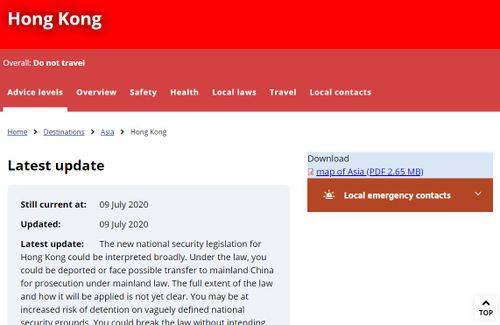
The Prime Minister said that Australia has also updated its travel advisory for Hong Kong, warning Australians of the possibility of detention in the city under the “vague” law.

Morrison also announced a pathway to permanent residency in Australia for Hong Kong citizens looking to leave the city due to the imposition of the law.

Current students or skilled visa holders in Australia from Hong Kong will be afforded an extra five years on their visa, with a pathway to permanent residency, he said, adding that future students or skilled visa applicants will also be granted those five extra years should their applications be successful.

“There will be citizens of Hong Kong who may be looking to move elsewhere, to start a new life somewhere else, to take their skills and their business and the things that they have been running under the previous set of rules and arrangement in Hong Kong,” Morrison said.

He also encouraged businesses based in Hong Kong to relocate to Australia.

Around 10,000 Hong Kongers are currently in Australia, Morrison said, adding that he doesn’t expect large numbers of applications for new visas in the short term.

The United Kingdom previously said it would provide a path to citizenship for up to three million Hong Kongers, those born before the city’s handover to Chinese rule in 1997 and are therefore eligible for British National Overseas passports. Taiwan has also said it will welcome Hong Kongers who wish to leave the city, though the island is not thought likely to take a large number of residents and is not a signatory to the United Nations Refugee Convention.
China has reacted angrily to moves by the international community to aid Hong Kongers, as well as widespread criticism of the security law, which it views as necessary to stop “terrorism” and “foreign interference” in the city. In an editorial published by the nationalist, state-backed tabloid Global Times this week, the paper warned Australia’s economy “will have a bitter pill to swallow” if it went ahead with the Hong Kong plan.
Last week, Canada was the first country to suspend its extradition treaty with Hong Kong. Around 20 countries have agreements with the city, including many that do not permit extradition to China due to human rights concerns.

New Zealand on Thursday said it was reviewing its relationship with Hong Kong following imposition of the security law.

“China’s decision to pass a new national security law for Hong Kong has fundamentally changed the environment for international engagement there,” Foreign Affairs Minister and Deputy Prime Minister Winston Peters said in a statement.

“This will be a deliberate, considered review across all of our settings, including extradition arrangements, controls on exports of strategic goods, and travel advice.”

Source link

#Coronavirus – Cohesion policy exceptional measures for #Poland approved in record time

0

The European Commission has approved in record time the modification of the Regional Operational Programme for Warmińsko-Mazurskie region in Poland to allow for further investments in health services and to compensate for enterprise financial loss related to the outbreak of COVID-19.

Cohesion and Reforms Commissioner Elisa Ferreira said: “The European Commission stands ready to work with all member states to ensure the quick adoption of exceptional measures necessary to tackle the outbreak of the virus. Hence, I welcome Poland’s request in line with this approach and I encourage other Polish and European regions to take advantage of Cohesion policy flexibility to react to COVID-19 sanitary and financial crises.”

The purpose of this regional programme amendment is to use around €15 million of EU Cohesion policy funds for the purchase of medical equipment. Among others, these include: 6 respirators, an ambulance, 11 defibrillators, 40 hospital beds for intensive care as well as establish disinfection and decontamination facilities in hospitals in Olsztyn, Ostróda, Elbląg, Ełk, Giżycko, Dobre Miasto and Węgorzewo and to support to the regional sanitary-epidemiological station.

Some additional €3.5m will be dedicated to the protection of social assistance homes, medical and nursing homes, care facilities and hospices against the virus. Regional companies suffering from financial loss as a consequence of the COVID-19 outbreak will also get nearly €120m of EU Cohesion policy funds. The SME support in form of subsidies and loans will aim at preservation of the jobs by subsidizing salaries and securing liquidity of the companies. Lastly, additional financial support will be granted to social economy companies and NGOs, which have played a crucial role during the pandemic, such as distributing the facemasks and setting up hotlines offering psychological support.

Source by [author_name]

Bone fragment reveals new species of dinosaur that roamed the Arctic

0

Artist impression of dromaeosaurids that used to roam the Arctic. (Credits: PA)

Scientists believe they may have stumbled on new species of dinosaur that lived in the Arctic 70 million years ago, when the region was warmer than it is now.

The findings are based on a ‘rare’ piece of dinosaur jawbone thought to belong to a juvenile dromaeosaurid dinosaur, predatory animals closely related to birds.

Dromaeosaurids, whose members include the velociraptor, lived during the Cretaceous period, between 145-66 million years ago.

Teeth remains of these creatures have previously been found in North America, South America, and Asia but lack of bone fossil records have made it hard for palaeontologists to trace the paths the domaeosaurids took as they dispersed between continents.

Many scientists believe the Arctic was a ‘migratory pathway’ for many dinosaurs when they crossed between Asia and North America.

But researchers now say the discovery of the jawbone fossil of a juvenile appears to contradict these suggestions and believe the animals lived there all year round.

A piece of a fossilised jaw which belonged to a dinosaur that may have lived in the Arctic. (Credits: PA)

The palaentologists say that the early developmental stage of the bone suggests the young dromaeosaurid was born nearby, strong evidence that some of dinosaurs were nesting there.

Anthony R Fiorillo, of Southern Methodist University, and one of the authors of the study published in the journal Plos One, said: ‘Years ago when dinosaurs were first found in the far north, the idea challenged what we think we know about dinosaurs.

‘For some time afterwards, there was a great debate as to whether or not those Arctic dinosaurs migrated or lived in the north year round.

‘All of those arguments were somewhat speculative in nature.

‘This study of a predatory dinosaur jaw from a baby provides the first physical proof that at least some dinosaurs not only lived in the far north, but they thrived there.

‘One might even say, our study shows that the ancient north was a great place to raise a family and now we have to figure out why.’

The 14mm long fossil, which was found near the Arctic Ocean, is preserved at the Prince Creek Formation of northern Alaska, which hosts the world’s largest collection of polar dinosaur fossils.

It is the first known non-dental dromaeosaurid fossil from the Arctic.

Artist’s impression issued by the Alfred Wegener Institute of what the South Pole in West Antarctica would have looked like 90 million years ago. (Credits: PA)

Scientists say bones belonging these dinosaurs are fragile and do not preserve well in the fossil record.

Alfio Alessandro Chiarenza, of Imperial College London, and lead author on the study: ‘Even with such an incomplete jaw fragment, our team was not only able to work out the evolutionary relationships of this dinosaur, but also to picture something more on the biology of these animals, ultimately gaining more information on this Ancient Arctic ecosystem.’


Source link

Chinese Embassy blasts Australia’s Hong Kong policy as ‘meddling’

The Chinese Embassy in Australia has published a scathing rebuke of Scott Morrison’s latest policy announcement which allows Hong Kong residents a five-year extension of their visas.

Mr Morrison said the introduction of new security legislation in Hong Kong that could see citizens deported to mainland China for prosecution was a “fundamental change” and undermined “basic law”.

In a statement today a spokesperson for the Chinese Embassy labelled Mr Morrison’s remarks as “groundless” and a “gross interference in China’s internal affairs”.

Pro-democracy supporters scuffle with riot police during an detention at a rally in Causeway Bay district on May 27, 2020 in Hong Kong, China. Chinese Premier Li Keqiang said on Friday during the National People’s Congress that Beijing would establish a sound legal system and enforcement mechanism for safeguarding national security in Hong Kong.(Photo by Anthony Kwan/Getty Images) *** BESTPIX *** (Getty)

“Hong Kong affairs are China’s internal affairs. The Australian side has been clanking that they oppose ‘foreign interference’,” a spokesperson for the embassy said.

“However they have blatantly interfered in China’s internal affairs by making irresponsible remarks on Hong Kong related issues. Its hypocrisy and double standard is exposed in full.”

The embassy said the new laws will “ensure social order”, “improve business environment” and contribute to Hong Kong’s long-term prosperity.

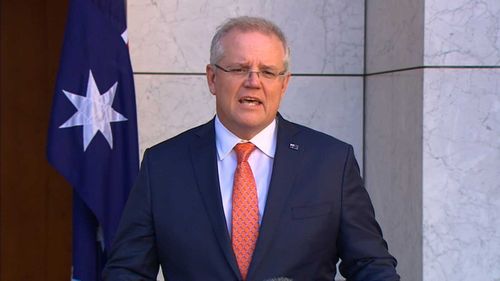
Prime Minister Scott Morrison addresses the media in Canberra.
Prime Minister Scott Morrison addresses the media in Canberra. (Nine)

It also refuted claims that the laws will affect legitimate rights and interests enjoyed by Hong Kong residents and foreign institutions.

In a cryptic sign-off, the embassy urged Australia to stop “meddling” in Hong Kong’s affairs.

“The Chinese government remains firm in its resolve to safeguard national sovereignty, security and development interests, and to oppose any foreign interference in Hong Kong affairsm” the spokesperson said.

“We urge the Australian side to immediately stop meddling in Hong Kong affairs and China’s internal affairs under any pretext or in any way.

“Otherwise it will lead to nothing but lifting a rock only to hit its own feet.”

Australia suspends extradition agreement with Hong Kong.
Australia suspends extradition agreement with Hong Kong. (Bloomberg)

Australia suspends extradition agreement with Hong Kong

From today, temporary visa holders from Hong Kong in Australia will be granted an additional five years on their visas, with a pathway to permanent residency at the end of those five years.

“We will also provide a five-year visa with a pathway to permanent residency for future Hong Kong applicants for temporary skilled visas, subject to meeting an updated skills list and appropriate marking testing,” Mr Morrison said.

“We will also put arrangements in place to ensure we focus on Hong Kong applicants to study and work in regional areas, to help address skills shortages in those areas, with express pathways to permanent residency, as already applies after three years.”

The updated advice on the Government’s Smart Traveller website. (Smart Traveller)

There are approximately 10,000 citizens of Hong Kong in Australia.

Acting Immigration Minister Alan Tudge said current and future students from Hong Kong will be eligible for a five-year temporary graduate visa once they complete their studies.

Former students already on a graduate visa will also receive five years from now. Hong Kong residents who fit the Australia skills shortage criteria will also be able to access a five-year temporary skilled visa.

For breaking news alerts and livestreams straight to your smartphone sign up to the 9News app and set notifications to on at the App Store or Google Play.

Source by [author_name]

#UrbanInnovativeActions – €45 million of EU funds for 11 projects from EU cities

0

The Commission and the French Regional Council des Hauts-de-France, as managing authority of the Urban Innovative Actions (UIA), have issued the results of the 5th and last call for proposals. The winning projects coming from Brussels, Ghent and Leiedal (Belgium), Sofia (Bulgaria), Chalandri (Greece), Budapest (Hungary), Ferrara and Verona (Italy), Tilburg (the Netherlands), Košice (Slovakia), and Almería (Spain) will receive more than €45 million from the European Regional and Development Fund. The projects cover culture and cultural heritage, air quality, circular economy and demographic change.

Cohesion and Reforms Commissioner Elisa Ferreira (pictured) said: “Today the EU helps 11 more cities to turn their ideas into life changing solutions. These cities will show us the way on engaging topics highly valued by citizens, such as the quality of their environment, and provide examples that can be replicated all over the EU.”

More details on the successful project proposals can be found here. They join the other 75 projects selected under the Urban Innovative Actions 2014-2020. For this call, the Hauts-de-France region received 222 applications from 23 Member States. Now that all the calls for proposals have been finalised, the Commission and the Hauts-de-France region will concentrate their efforts on valuing these experiences as sources of inspiration for Cohesion policy 2021-2027 through an Urban Innovative Actions Knowledge management strategy. In the future,the direct support for urban authorities to innovate and to shape the cities of tomorrow will be part of European urban initiative 2021-2027.

Source by [author_name]

FDA to link Samundri Road to Bypass via 1.6km dual carriageway

FAISALABAD – Faisalabad Development Authority (FDA) will construct 1.6 km dual carriageway along Baloch Canal distributory (Rajbah) from Sammundri Road to Bypass Road, under the city development programme.

FDA Director General (DG) Muhammad Suhail Khawaja visited the site to review on-ground situation of the project, FDA sources said here on Wednesday.  FDA Director General (DG) while reviewing the importance and significance of the proposed road project said that special attention had been focused on strengthening infrastructure for durable city development. He said the development features of the area would emerge with the construction of this dual road which would be proved as mini bypass to reduce the distance between Summandri Road and Bypass Road.

He appreciated the cooperation of private housing societies for spending special funds on the construction of road. He informed that major share of funds was being spent by the city housing scheme while the Four Season, Meadows and other housing societies of the area were also contributing funds in the project.

The DG said that community was being mobilized to seek the cooperation for initiating the public welfare projects, adding that the projects of Faisalabad Ring Road, Sitiana road Express Way and Techno Park had been proposed by FDA to complete on Public Private Partnerships mode.

He said the FDA was taking various measures to promote the construction sector for the development of allied Industries and generating the employment opportunities.  The representatives of private housing societies’ term the project of dual carriageway along Rajbah Baloach Canal would be very beneficial for the development of area, adding that the construction work was being started immediately to complete the project within a short span of time. Directors Town Planning Mehr Ayub and Asma Mohsin, Deputy Director Admn Yasir Ijaz Chatta and representatives of private housing societies were also present on the occasion.


Source link

Used Clothes Ban May Crimp Kenyan Style. It May Also Lift Local Design.

NAIROBI, Kenya — Catherine Muringo’s wardrobe consists of secondhand outfits shipped from all over the world: colorful blouses and jeans from Canada, floral dresses from the United States, trench coats from Australia and leather handbags from the United Kingdom.

For years, Ms. Muringo bought the used clothes and accessories at cheap prices in open-air markets in Nairobi and used them to fashion her own idiosyncratic style.

Seven years ago, she also started a business buying and selling such items, distributing castoff fur coats, hoodies and shoes to customers in Kenya and in foreign markets like Botswana, Uganda and Tanzania.

But in late March, the Kenyan government banned the importation of used garments in what it said was a precautionary measure to curb the spread of the coronavirus. Even though used clothes are fumigated before being shipped, Kenyan authorities said they were taking precautions because of the spike in infections in countries like the United States.

Now, businesses like hers are threatened, as well as the sartorial choices of millions of Kenyans who depend on low-cost imports to stay stylish.

“Kenyans love to go to the secondhand markets and spend hours looking and searching,” Ms. Muringo said. “Kenyans love the diversity of secondhand.”

Officials also said the banning of imported clothing — known as mitumba, the Swahili word for “bundles” — could have an unexpected benefit. It could help Kenya revive its own textile industry, which was wiped out in the late 1980s as the country started opening its markets to foreign competition.

“I think corona has shown not just for Kenya but for many countries to look inward a lot and try and fill some of the market gaps,” said Phyllis Wakiaga, the chief executive of the Kenya Association of Manufacturers. “The reality is that there’s a big opportunity for us to produce local clothes for the citizens.”

For years, Kenya, along with other countries in East Africa, had tried to phase out used clothing to boost local manufacturing. But the countries faced the threat of being removed from the Africa Growth and Opportunity Act, which promotes trade by providing reduced or duty-free access to the American market. Many countries backed off from instituting a ban on imported clothing, with the exception of Rwanda.

The coronavirus gave Kenya a chance to promote its own clothing manufacturing, but thwarted a lively trade.

In Nairobi, the combination of the import ban, plus lockdown measures and an overnight curfew introduced to stamp out the virus, have drastically lessened the hive of activity at the popular Gikomba and Toi thrift markets, mazes of narrow pathways packed with bellowing vendors and piles of clothes, shoes and household goods.

As the largest importer of used clothing in East Africa, Kenya, with its new ban, is expected to upend not just supply chains but also lead to a hemorrhage in jobs connected to the trade and the loss of millions of dollars from government coffers as tax revenue and import duties fall.

But where some see problems, others see opportunity.

Wagura Kamwana, the proprietor of a fabric shop, the Textile Loft, is seeking to capitalize on this moment.

Ms. Kamwana, 40, grew up wearing hand-stitched clothes from her mother, and later on, sought trendy outfits at secondhand markets. Kenyans like used clothes, she said, both for their affordability and because of the their high-quality fabrics.

In 2016, she opened her store, offering premium quality fabrics, sourced from Europe, to Kenyans who wanted to create high-end fashion locally.

In 2018, she started also offering production services to designers looking to develop smaller lines who were being turned away by factories only interested in bulk orders.

Ms. Kamwana has already worked with prominent local designers like Katungulu Mwendwa.

The pandemic has also offered the chance to start her own clothing line. Her new label is set to produce everyday clothing for women including dresses, scarves and trousers ranging from $25 to $150.

Ms. Kamwana said designers and manufacturers should collaborate and take baby steps to push the industry toward maturity.

“This whole value chain will take quite a few years to be feasible or to be seen,” she said, adding, “what we can do immediately is perfect our art of making.”

Other Kenyan companies are also responding to the challenges posed by the pandemic by focusing locally.

Frederick Bittiner Wear, which does fabric selection, design and tailoring for retailers in East Africa, Europe and the United States, has seen a reduction in orders because of the pandemic, so it has turned to producing leggings, T-shirts and vests for the local market, said Dominic Agesa, the managing director.

After approaching distributors with samples, Mr. Agesa said he got 50 orders in a week.

For too long, “Kenya has been reluctant” to incentivize local manufacturers, he said, but the import ban was one step toward making conditions more favorable for a local scene to eventually flourish.

“Are we able to satisfy the Kenyan market and beyond? Mr. Agesa said. “Gradually, the answer is yes.”

Suave Kenya is a brand that transforms secondhand clothes ranging from silk shirts to leather jackets into stylish and colorful tote bags, backpacks and wallets. With the import ban, its founder, Mohamed Awale, is looking into sourcing from local tanneries and textile factories.

“If the pandemic persists, we will have to adapt while still producing the type of bright bags that make us unique,” said Mr. Awale, 32. “When we source locally, we create jobs and make our industries grow.”

Nowhere is the shift to adapt to the changes brought on by the pandemic more visible than in the special export zones on Nairobi’s outskirts. Established in 1990, these zones offer companies less regulations plus tax incentives to promote export-oriented businesses.

But with borders closed and exports plunging, some of the clothing factories have begun servicing the Kenyan market, with the country temporarily allowing manufacturers to exceed the usual limit of supplying no more than 20 percent of their annual production to local markets.

Shona EPZ has 500 employees and makes reflective work clothes for companies like 3M and apparel for department stores like T.J. Maxx. But since the pandemic began, the firm has pivoted toward making personal protective equipment for Kenya, producing tens of thousands of masks and surgical gowns per day, said its director, Isaac Maluki.

Mr. Maluki said he has also partnered with secondhand importers and small-scale manufacturers, that, with the ban on used clothing, are increasingly considering collaborating with larger companies like his to make clothes for local consumption.

“We want to really encourage them to see the kind of quality that comes out of here that can be shared into the local market,” he said. “The local market is huge.”

But before a robust clothing sector takes hold, experts say local manufacturers will have to overcome a host of challenges, including inadequate access to finance, the high cost of electricity, and the lack of raw materials, including cotton.

The fact that powerful lobby groups for the secondhand clothing industry in the United States have already criticized Kenya’s move doesn’t bode well either, said Emily Anne Wolff, a researcher at Leiden University in the Netherlands who has studied plans to phase out used clothing in East Africa.

Kenya is aiming to be the first country in sub-Saharan Africa to negotiate a free-trade agreement with the United States, which could undermine Kenya’s will to retain the clothing ban.

Used clothes traders have appealed to the government in recent days to lift the ban, saying there is no public health risk associated with the trade. But officials have so far ruled that option out.

For now, Kenyan designers and manufacturers say the ban gives them a window of opportunity to start shaping the future of fashion in Kenya.

“Now is a good time to make choices and changes,” said Ms. Kamwana, the owner of Textile Loft. “You will be surprised by what comes out of this country.”


Source link