Everyone you know uses Zoom. That wasn’t the plan

0

Some cabinet secretaries’ Zoom screen names were visible, you could see which platform the cabinet was running its computers on, and most glaringly, the meeting ID was visible for all to see.

The significance of the moment was not lost on the team at Zoom.

“That was the big aha moment,” Zoom board member Santi Subotovsky told CNN Business.

Zoom grew into a vastly profitable business selling software to businesses that could enable a venture capital firm to seamlessly take virtual pitch meetings from around the globe or an executive to deliver an all-hands to a remote workforce. Powering British Cabinet meetings was never on the radar.

“Our company that used to be a 100% enterprise-focused, is now powering the world. It’s powering governments, education, social activities… And then when the other shoe dropped, it’s like we need to get ready for that,” Subotovsky said.

Zoom was already enmeshed in controversy. Less than two weeks earlier, The New York Times had raised the flag on “Zoombombing,” opening the door to a flood of scrutiny, from its feeding data into Facebook to the New York State Attorney General scrutinizing its data practices.

But for Eric Yuan, the 50-year-old founder and CEO of Zoom, it was the Johnson tweet that changed everything.

“This was our wake-up call,” Yuan told CNN Business over a Zoom interview from his San Jose home.

Yuan blames himself for not anticipating that users might want to share a screenshot of a meeting. For his business clients, sharing a screenshot of your board meeting would be unthinkable. But business clients weren’t his only worry anymore. The world had become his customer.

Within a week, Zoom pushed out an update that would hide the meeting ID from view. But for Yuan and his team at Zoom, the damage had only just begun.

Yuan built Zoom to please his customers — to use Zoom-speak he wanted to “deliver happiness” — and for years that meant giving his business clients a high-quality video conferencing platform that was easy-to-use. “Frictionless,” as the company likes to say.

But during a global pandemic that has transformed Zoom into an essential tool for schools, church groups, weddings, and the cabinet of a G7 economy, Yuan is trying to figure out how to make Zoom something it was never meant to be.

Now, “Zoom is not only a business communication company, suddenly it’s becoming an infrastructure company,” Yuan said.

Since the pandemic, Yuan has had little time to enjoy his family’s multiplying fortune ($8 billion at last count, according to Forbes). He refers to this time as the most stressful weeks of his life, which now consists of three things: Zooming, eating and sleeping, and he’s barely been doing much of the last one.

“I’ve had several sleepless nights” Yuan said in front of a virtual background with the words “WE CARE” hovering over a heart-shaped earth.

What is the question keeping the CEO of the company — one that is now worth more than General Motors —up at night?

Yuan takes a breath.

“How did we get here?”

Shandong to Silicon Valley

Yuan grew up in the Shandong Province in China in what he describes as a middle-class family. The child of geological engineers, Yuan was an average student who studied computer science, and after a stint working in Japan, decided he wanted to come to the center of technological innovation: Silicon Valley.

“I wanted to embrace that first wave of internet revolution,” Yuan said.

Yuan applied for an H-1B visa to come to America but was rejected. And then rejected again. And again. In what has now become part of his founder’s lore, Yuan applied eight times before being accepted into the United States.

Yuan entered Silicon Valley in 1997, during the first internet boom. Entranced by fast-growing companies like Netscape and Yahoo, who were revolutionizing the world’s communications, Yuan wanted to get in on the ground floor of a bustling startup. He found it at WebEx, a young company — he was among the first 20 hires — whose goal was to leverage rapidly increasing bandwidth capabilities into online meetings where you could share your desktop screen easily and cheaply.

Yuan, who was 27 years old at the time of his arrival, fit into the global workforce of WebEx — a significant number of Chinese immigrants were recruited alongside Yuan — but found himself stymied by his inability to speak English.

While he could understand the conversations around him, he says he couldn’t participate. “I couldn’t join a marketing team or a sales team,” said Yuan. “I had to go back to writing code.”

Yuan’s former colleagues associate Yuan’s limited English (he still has a thick Chinese accent) with him being repeatedly overlooked.

“I saw a tremendous amount of unconscious bias against Eric because he didn’t look the part, he didn’t sound the part,” says David Knight, a former VP of Product Management at WebEx. “We put so much stock in how people communicate. We ascribe their eloquence to be their intelligence.”

While Yuan couldn’t control how others understood his English, he focused on what he could control: his work.

“I knew two things from my father: keep working hard, stay humble, and someday you’ll be OK,” Yuan said.

Eric Yuan speaks before the Nasdaq opening bell ceremony on April 18, 2019 in New York City. The company's IPO priced at $36 per share, at an estimated value of $9.2 billion. (Kena Betancur/Getty Images)

The WebEx years

WebEx was founded by two immigrants: Subrah Iyar came from India and ran marketing and sales, while Min Zhu, a Stanford-educated immigrant from China, was in charge of technical development. Both became mentors for Yuan. WebEx’s early days were similar to many startups in the Valley: a flat, diffuse hierarchy that rewarded long hours from a loyal staff intent on changing the world.

“We were very scrappy,” said Ed Wong, a friend of Yuan who worked as a product manager with him at WebEx.

Unlike other product-focused companies, WebEx sold itself as a cheap cloud-based “SaaS” (software as a service) that only required you to download its product: no expensive hardware purchases necessary.

“Your economics had to be different,” explained Subrah Iyar to CNN Business. “The price point for SaaS meant that you didn’t get too much money upfront, you got it on a monthly basis.”

That SaaS model put tremendous pressure on the employees of WebEx to continually service and respond to their customer’s demands. Companies were taking risks moving meetings and events online and any disruption in that service was seen by the WebEx team as an existential threat.

“Nobody thinks of web conferencing as mission critical. But when a meeting goes south and you’ve got eight or ten executives on the call, it’s a big deal,” said Knight.

“If WebEx was down for five minutes, I would spend the next month traveling and meeting customers, explaining to them why it happened and why it wouldn’t happen again,” said Velchamy Sankarlingam who worked alongside Yuan as an engineer at WebEx. “If your service goes down, you’re going to get churn. People are going to switch away.”

Yuan proved his worth to Iyar and Zhu, rising to lead the engineering team as the company’s fortunes grew.

First there was the RuPaul Superbowl ad in 2000, then a successful IPO later that year. WebEx even received an unlikely boost after 9/11. Amid global panic, companies who didn’t want their employees flying unnecessarily instead turned to a service that could enable cheap and easy virtual meetings. And because WebEx was built on the cloud, Yuan and his engineering team’s software could scale and meet the increasing demand.
After first fielding an offer from IBM, Iyar and the WebEx board decided to sell their company in 2007 to Cisco for $3.2 billion.

Yuan, who was so attached to WebEx that he referred to it as “his baby,” now found himself an employee of the one of the largest technology companies in the world.
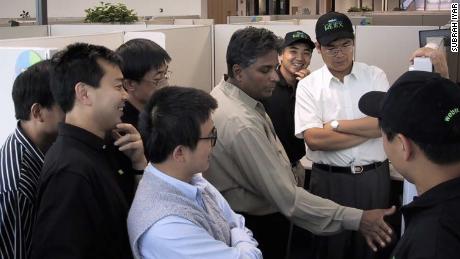
The WebEx team celebrates their IPO in 2000. WebEx cofounder Subrah Iyar, in a greige shirt, is flanked by Eric Yuan in a black polo shirt and hat. Yuan was an engineer for the company at the time. (Photo courtesy of Subrah Iyar)

From fast-growing startup to a ’rounding error’

Thanks to the Cisco acquisition, Yuan became a rich man. But while some WebEx employees took their earnings and split — wary of making the transition from fast-growing startup to cog in a Fortune 500 corporation — Yuan stuck around. It was still his baby after all.

“He wasn’t ready to leave yet. He had a lot of loyalty,” said David Knight, a VP at WebEx at the time of the acquisition. But, that loyalty was quickly tested.

“Almost immediately they started to dismiss everything that we did,” said Matt Sheppard, then a WebEx employee. “Eric was dismissed, along with the other leadership at WebEx, as being kind of second rate.”

But still, Yuan stayed. “Every time I felt like leaving, I just got emotional,” said Yuan, who worked at Cisco for four years.

Former WebEx employees who made the transition to Cisco describe a key philosophical difference in how the two companies handled their customers. While WebEx’s SaaS business model required them to serve their customers 24/7, Cisco made its billions selling physical routers and switches.

“It’s a completely different mindset,” said Sankarlingam. “Cisco just sells the gear. And after that it’s up to your network … if a company’s network goes down, nobody’s going to go blame Cisco.”

WebEx, once a fast-growing startup, now was a cog in a blue-chip behemoth. “We were a rounding error in Cisco’s business,” Knight said.

Yuan felt for the first time that he couldn’t satisfy his customers. He says his WebEx customers grew frustrated with the quality of the product. They wanted WebEx to work reliably and more intuitively. And above all else, they wanted video to run seamlessly.

“He was sincere, almost naïve in that he always cared about the WebEx customers and that they were not being attended to,” said Iyar, who was often told by Yuan that he should have never sold the company.

Yuan would confide in Iyar that he felt like he was betraying the customer-obsessed ideals he learned at WebEx.

“He had the advantage, in retrospect, that that’s the only thing he grew up with, right? In a sense, one of his strengths is that he’s a purist to that model,” said Iyar.

For Yuan, his time at Cisco turned out to be invaluable: it transformed him from engineer to entrepreneur. Yuan’s frustrations at Cisco “sparked the flames in his fire that he became very competitive,” said Sheppard. Founding Zoom “was purely a reaction to them not listening to him.”

A Cisco spokesperson told CNN Business in a statement that the WebEx acquisition was a “very important one for us and changed the way the world works. We thank Eric for his time at Cisco.”

Zoom founding

Yuan left Cisco in 2011, along with around 40 China-based WebEx engineers. Initial funding for his new company came from his acquaintances and former colleagues, including Subrah Iyar. “If he told me he was sending a person to Mars I would have put money in,” recalls Iyar. With funding and staff in place, Yuan could launch his new baby: Zoom.

The pitch was simple. Build a better WebEx.
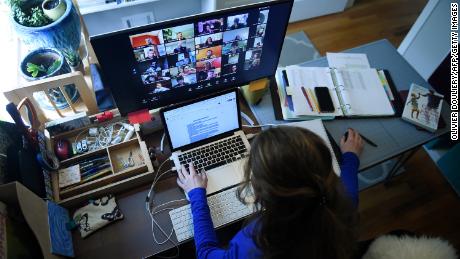
A substitute teacher works from her home in Arlington, Virginia, using Zoom to communicate with students and their families. (Olivier Douliery/AFP/Getty Images)

“He didn’t try and revolutionize it. He just made it better and cheaper and higher quality and simpler and video-centered,” said Knight, who left WebEx shortly before Yuan.

Yuan’s plan to capture WebEx’s enterprise market relied on building Zoom video-first. It would be cloud-based, run on Macs and PCs, iPhones and Androids, and you could make it work without downloading any software in your browser.

But above all else, Yuan wanted to make his customers happy.

“I wanted to join a company where I woke up every morning and felt happy: I wanted to build a better solution to deliver happiness to the WebEx customers,” said Yuan. “That’s it.”

AT&T, which owns CNN’s parent company WarnerMedia, offers business customers Cisco’s WebEx collaboration software, which competes with Zoom.

‘The Holy Grail’

It turns out, what makes the customers of video conferencing happy is the things they don’t have to think about. No one wants to download an app or sign up for an account if they don’t have to. They just want the thing to work.

But ask any engineer and they’ll tell you that making a simple product is never simple.

“You have to build a lot of discipline into the product,” Oded Gal, a former WebEx veteran who now works alongside Yuan at Zoom as its Chief Product Officer, told CNN Business.

Just as WebEx built a cutting-edge screensharing platform off the new bandwidth enabled by the DSL and T1 lines of the 1990s, Zoom would be built off the advanced data networks capable of streaming HD video. “Video was not possible in the 2000s because the bandwidth was not there,” said Iyer. “That was changing.”

In a Zoom call, each user can upload upwards of two streams (one for video, one for screensharing) to a cloud server which then compresses each stream, adjusts the output for the bandwidth and CPU capability of each computer or phone, and sends them back, with as low a latency as possible. Multiply that by up to 100 users, and the problem becomes exponentially more complicated.

“You don’t know what you don’t see, you just experience the end result,” said Iyar.

Alexis Garrod, CrossFit Potrero Hill partner and head coach, demonstrates an exercise to participants while instructing a class over Zoom in an empty gym in San Francisco in April. (Jeff Chiu/AP)

“Everybody thinks video conferencing is easy and it turns out the tech is really hard to do,” says Knight. “You don’t control the network, you don’t control the ISP, you don’t control whether somebody turns the microwave on and interferes with the WiFi.”

While figuring out how to make scalable video calls was a daunting challenge, for Yuan’s Zoom team, it was only half the battle. They also had to make Zoom frictionless enough that anyone could use it. So easy that it makes his customers happy.

Zoom could work in any browser. It wouldn’t need you to adjust your firewall settings. And unlike WebEx meetings, with their hard-to-remember pins and meeting IDs, Zoom would be accessible with a simple link.

“Getting rid of that user friction… in the tech world, it’s kind of the holy grail,” said Beth Kindig, technology analyst at beth.technology.

Zoom spreads

Yuan’s new baby was up and running.

Yuan’s plan for Zoom was to pilfer off WebEx’s customers. To attract new users, Zoom began offering a freemium version of its product. Meetings under 40 minutes with up to 100 users would be free to use. Yuan’s bet was that as more users tried Zoom, businesses would see that it worked better than WebEx, and would end up paying to switch to his new product.

Zoom’s freemium model gave it an entrance into a crowded marketplace where its competition were some of the largest companies in the world. Of course, there was Cisco’s WebEx, but Zoom was also up against Microsoft and Google. But while companies might have had established deals with WebEx, Zoom’s freemium accounts meant that the employees at those companies could just use Zoom.

“Everyone had Cisco WebEx, or they had Microsoft Suites,” said Kindig. “But everyone used Zoom because of how easy it was to just send out that link.”
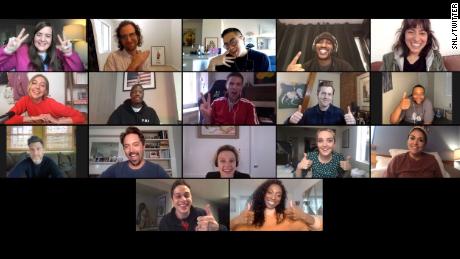
The "Saturday Night Live" cast has used Zoom to film the show from their homes. (SNL/Twitter)

Live from Zoom, it’s ‘Saturday Night Live!’

Zoom was winning.

Yuan’s freemium strategy worked and tech companies, entranced by Zoom’s simplicity and efficiency, signed up for premium Zoom subscriptions. In a few short years, Zoom found itself the video conferencing market leader, and, after a successful 2019 IPO, Yuan became a billionaire multiple times over. Yuan’s baby was all grown up.

But a funny thing happened on the way to dominating the B2B remote video conferencing market: a global pandemic turned Zoom into a household name.

With the world shutting down in a matter of weeks, every institution, every school, every college, every family now found themselves in desperate need of a way to communicate.
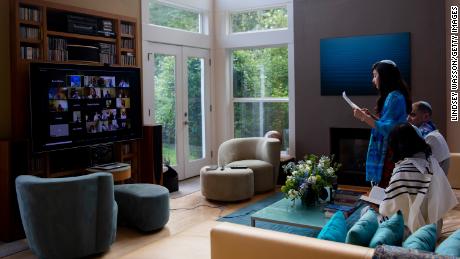
Yvonne Reiter performs a Torah reading over Zoom as she celebrates her bat mitzvah ceremony at home during the coronavirus pandemic. (Lindsey Wasson/Getty Images)

“You don’t go into a pandemic with the video conferencing solution you wish you had. You go into the pandemic with the video conferencing solution you have,” said Bill Marczak, a research fellow at the Citizen Lab.

Over a mindboggling month of coronavirus-fueled growth — according to Zoom, its traffic is up 3,000% since December — Zoom unexpectedly joined Google, Kleenex and Band-Aid in the hallowed branding pantheon of proprietary eponyms. “You free to Zoom?” a phrase that would have been incomprehensible to the vast majority of us a couple of months ago, became an invitation your grandparents understood.

And during an unprecedented spike in traffic, Zoom’s cloud network, built on AWS and Oracle, scaled up to meet the crushing demand.

Yuan’s obsessions — his focus on video, on ease-of-use, on building scalable architecture — all paid off, and amid a cratering global market, Zoom’s stock surged over 200%.

But as Zoom transitioned from IT departments to “Late Night with Jimmy Fallon” and 10 Downing Street, security researchers began to dig into this newly ubiquitous company.

Was this easy-enough-for-anyone-to-use product actually safe for any of us to use?

‘Speed at the expense of all else’

The hits came quick.

First it was “Zoombombing.” Then Zoom’s encryption was discovered to be inadequate and its data was found to be routed through Chinese servers. Its privacy policy was picked apart.
Lawsuits were filed, New York Attorney General Letitia James sent a letter asking whether the company “is taking appropriate steps to ensure users’ privacy and security,” and institutions like NASA, New York City schools, and SpaceX banned their employees from using Zoom.
Zoom says that the problems stem from its overnight transformation into an infrastructure company for the world. Before, Zoom expected its business customer base to have security teams who would enable best practices, like enabling passwords by default. Yuan wrote a blog stating that the servers located in China were an accident due to the surge in traffic, and Zoom data would not be routed through them again.

“[Yuan] realized that he has to be the IT department, the compliance department for the world, which I don’t think he signed up,” said Yuan’s old mentor, Iyar.

Zoom acted swiftly, quickly patching uncovered security vulnerabilities, purchasing Keybase, an encryption startup, instituting a 90-day product freeze, and hiring Alex Stamos, former chief security officer at Facebook, and Lea Kissner, formerly the global lead of privacy technology at Google to bolster its security team. It has since come to an agreement with Attorney General James, and New York City public schools are now permitting its use.

When you begin to examine Zoom’s security vulnerabilities, a theme emerges.

“A lot of the security issues we saw seem to be the result of choices made that privileged user experience over security,” said Marczak, who was part of the Citizen Lab team that uncovered security vulnerabilities in Zoom. “You get this clear pattern where it looks like there were these vulnerabilities that were caused by decisions made to increase speed at the expense of all else.”

Musician Tati Diaz Bonilla plays the keyboard as a student listens and watches through Zoom during an online lesson from his apartment in Buenos Aires, Argentina.  (Marcelo Endelli/Getty Images)

Marczak helped uncover a vulnerability in Zoom’s “waiting room.” The waiting room is the first step of a password protected meeting, where the host could choose to let people in. Marczak and his colleague John Scott-Railton discovered that Zoom was sending an encrypted stream of the meeting to those not-yet-accepted. A savvy user could scoop up that data and spy on the meeting, “presumably, so that when you were admitted the video would show instantly,” explains Marczak.

Or, take the Boris Johnson photo.

Having the meeting ID visible on the top-left corner of the screen was an intentional choice to make Zoom’s customers not have to dig around menus to find a meeting ID. “We wanted it to be easier for the end user to let others join,” Yuan said. But having a visible meeting ID meant that a screenshot posted on social media would allow anyone to enter the ID and join in (assuming that the meeting was not password protected). “Did we think about privacy? No, that’s the problem,” Yuan said.

‘His product did so well, it broke’

Zoom’s security and privacy problems aren’t Yuan’s only concerns.

After news that Facebook is entering the video conferencing game, Zoom’s stock dropped 12%, which was on the heels of news that Verizon was buying Zoom’s rival BlueJeans.
Zoom’s long-standing ties to China are also becoming an increasing liability. The company has utilized Chinese developers from its onset — its R&D department in China has over 700 employees — a practice that Zoom warned in its annual report “could expose us to market scrutiny regarding the integrity of our solution or data security features.” In April, Speaker of the House Nancy Pelosi erroneously referred to Zoom as a “Chinese entity,” while rejecting the idea of a Zoom enabled remote Congressional session. (Zoom is an American-based company, headquartered in San Jose).

Yuan admitted to CNN that as tensions between China and the United States rise, Zoom might have to adjust its long-standing ties to China, suggesting Denver, Ohio or Virginia as possible sites for a relocated Zoom R&D center. “If things get worse, we do have a plan,” said Yuan.

Portuguese Minister of State, Economy and Digital Transition, Pedro Siza Vieira, meets via Zoom video conference with members of the Portuguese Foreign Press Association AIEP to discuss the government's economic response to the coronavirus pandemic. (Horacio Villalobos/Corbis/Getty Images)

Meanwhile, the safety of Zoom has remained a controversial subject amongst security researchers.

Zoom is Malware,” reads one headline, while a trio of security researchers published “Zoom isn’t Malware,” offering a number of steps to bolster up security for the average user.

And while Zoom’s continued public lashing is ongoing, it could end up helping them in the long run.

“I think that probably a lot of CEOs are envious of his position,” said Kindig. “His product did so well, it broke.”

“Thank you, Zoom, for listening,” wrote Doc Searls, a technology journalist who had been highly critical of Zoom’s privacy policies. “At least in public, they’re taking all the right steps,” echoed Marczak.

Yuan says the scrutiny that Zoom has received has been a blessing in disguise, allowing him to improve his company in ways that he never could have imagined otherwise. He now devotes his entire day only to security and privacy matters. “The harshest criticism may be the best words you ever hear,” Yuan muses.

Even in response to Nancy Pelosi wrongly describing Zoom as a “Chinese entity” Yuan blames himself.

“If the world misunderstands us, then I don’t blame others, it’s our problem… We are a very proud American company. The company is a public Nasdaq company, headquartered in San Jose. I’m a Chinese American. I truly believe… as long as you do the right thing, sooner or later they will know it… just be patient.”

“In ten to twenty years, when people write the history of Covid-19, I want them to write that Zoom did the right thing for the world,” Yuan said.

Correction: An earlier version of this story incorrectly said that Zhu was still with WebEx when it was sold to Cisco.




Source link

Pakistan plane crashes with 99 on board

A Pakistan International Airlines jet with 99 people on board has crashed into a crowded residential district in the city of Karachi while approaching the airport.

At least 56 people are confirmed to have died, hospital officials say, though other officials gave different figures and authorities did not release an estimate of casualties on the ground.

Two passengers survived, including Bank of Punjab president Zafar Masood, a Sindh provincial government spokesman said.

The bank said he had suffered fractures but was “conscious and responding well”.

Smoke billowed from the scene where flight PK 8303 came down at about 2.45pm local time on Friday.

Twisted fuselage lay in the rubble of multi-storey buildings as ambulances rushed through chaotic crowds.

The crash happened on the eve of the Muslim festival of Eid, when Pakistanis travel to visit relatives.

“The aeroplane first hit a mobile tower and crashed over houses,” witness Shakeel Ahmed said near the site, a few kilometres short of the airport.

The Airbus A320 was flying from the eastern city of Lahore to Karachi in the south with 91 passengers and eight crew, civil aviation authorities said.

Pakistan has only just resumed domestic flights in the wake of the coronavirus pandemic.

A total of 56 dead bodies were brought to JPMC hospital and the Civil Hospital Karachi, officials from both institutions said.

The airline’s chief executive Arshad Malik told reporters he knew of 41 confirmed deaths.

The plane was on its second attempt to land after cancelling a previous one in a routine manoeuvre known as a go-around, one person familiar with the investigation said.

The pilot told air traffic controllers he had lost power from both engines, according to a recording posted on liveatc.net, a widely respected aviation monitoring website.

“We are returning back, sir, we have lost engines,” a man was heard saying in a recording released by the website.

The controller freed up both the airport’s runways but moments later the man called “Mayday! Mayday! Mayday!”.

There was no further communication from the plane, according to the tape, which could not immediately be authenticated.

“The last we heard from the pilot was that he has some technical problem … It is a very tragic incident,” the state carrier’s spokesman Abdullah H Khan said.

Another senior civil aviation official told Reuters it appeared the plane had been unable to lower its undercarriage for the first approach due to a technical fault, but it was too early to determine the cause.

Prime Minister Imran Khan tweeted that he was “shocked & saddened by the PIA crash”.

“Am in touch with PIA CEO Arshad Malik, who has left for Karachi & with the rescue & relief teams on ground as this is the priority right now,” he posted.

“Immediate inquiry will be instituted. Prayers & condolences go to families of the deceased.”

Indian Prime Minister Narendra Modi also offered condolences.

Pakistan’s worst plane disaster was in 2010, when an AirBlue flight crashed near Islamabad, killing 152 people.

Source by [author_name]

Outspoken Progressive Rashida Tlaib Is Facing A Major Primary Challenge

Rep. Rashida Tlaib was only elected to Congress in 2018, but she is already something of a household name. 

Tlaib, one of the first two Muslim women to ever serve in Congress, is a member of the “Squad” of four freshman women of color ― a kind of left-wing sub-caucus within the Congressional Progressive Caucus with celebrity to boot. The Michigan Democrat arrived in the House with a bang, calling for the impeachment of President Donald Trump, whom she labeled a “motherfucker,” on the day she was sworn in wearing a traditional Palestinian thobe dress.

Now Tlaib might be facing a formidable primary challenge from Detroit City Council President Brenda Jones on Aug. 4. Tlaib won in 2018 partly thanks to a crowded field of contenders who split the vote in a Detroit area district that is 54% Black. An early April poll showed Jones, who is Black, within striking distance of Tlaib, despite spending a minuscule amount of money.

In a Thursday interview with HuffPost, Tlaib skirted around the upcoming contest, focusing instead on the work she and her team are doing to address the needs of constituents suffering in one of the metropolitan areas that the coronavirus has hit hardest.

“I don’t want to become numb,” the congresswoman said. “I see a lot of my colleagues lacking that sense of urgency to move quickly to help people or not fully understanding the current pain and hurt that’s on the ground right now.”

Tlaib also discussed her work to contain the damage from COVID-19 in her district, her feelings about former Vice President Joe Biden’s stance on the Palestinian-Israeli conflict, why House Democrats’ response to the pandemic has disappointed her, and why she wants Biden to visit her district. 

The interview below has been edited for length and clarity. 


Rep. Rashida Tlaib is being challenged in the Democratic primary by Detroit City Council President Brenda Jones.

What is a typical day in the life of a member of Congress representing a city where COVID is raging?

Because we can’t physically go into offices, I check in with my team at 9:30 a.m. every morning. We go through what’s going on at my office’s four neighborhood service centers. The caseworker that manages the constituent services programs does a report on what’s happening on the ground. 

I would describe it almost like triaging where all kinds of emergencies are coming in. One person will say, “I can’t get unemployment benefits,” or even one senior said, “Is there a chance anyone can drop off Depends for me?” Another asked about what else we could be doing right now to get masks into nursing homes.

We’ve also been in constant contact with our steelworkers. We expect hundreds to be on a call today at 1 p.m. about what they need to know, [and we’ll try to] answer any questions they have.

I have a House Democratic Caucus call around 2 p.m. We’re doing a lot of those where we check in and go over what we just passed and what is the state of the HEROES Act, and what do we need to be looking out for and how can we work with outside organizations to get more support for it.

Later today, the freshman class is going to be having a call with our municipal leaders.

In between all of that, we’re doing these wellness check-in calls. My team gave me 50 to do. We all split it and we check in on neighbors. And at the end of the call, we ask them to check in on three other neighbors to make sure everyone is doing OK and that somebody out here cares about their well-being. That’s where we also hear about what the needs are ― from water shutoffs to folks worried about, “Hey, what are we doing to make sure Memorial Day weekend is not going to lead to more spread of COVID.” 

And in the middle of all of this, you’re also running for reelection. There have been polls that suggest that it’s close. How do you make time for that? What has your strategy been to address the lingering sense from some residents that the district should be represented by a Black person in Congress?

One of the things I center around is being rooted in community. What I mean by that is I come home every week. Unless there’s voting and committee hearings, I’m here at home and staying as close to my residents as possible. I actually think that it makes sure that I don’t become numb. 

I don’t want to become numb. I see a lot of my colleagues lacking that sense of urgency to move quickly to help people or not fully understanding the current pain and hurt that’s on the ground right now.

We’re trying to be as accessible as possible. When we show up for each other, we save lives. 

We were already doing that work, but now we’re laser-focused on it.

It sounds like you’re not doing traditional campaigning for reelection. It’s really just full-time service as a member of Congress and hoping it shines through to people.

Well, I hope it saves lives.

One of my team members sent a text message today and said, “Hey, it’s Carolina from Rashida for Congress. We just want to make sure you have the resources you need. Is there anything you need help with?” The woman said, “Thank you, you all were the only ones to call me back about who to call for my unemployment benefits.”

That’s how we show up for each other and that’s how we expose what we should be doing right now. In the midst of all of that, we are actually learning more about what our priorities on policy should be. That’s where I hear folks saying, “Did you know 60% of firefighters in Wayne County have COVID?” 

This is, again, triaging and bringing in these critical services to our residents that need help now. And they don’t have time to wait for [Senate Majority Leader Mitch] McConnell and others to understand how much pain is on the ground right now.

I just have this connection of what’s happening in Detroit and what’s happening in Palestine.
Rep. Rashida Tlaib

Biden’s plan for the Jewish community includes a promise to “firmly reject the BDS movement, which singles out Israel — home to millions of Jews — and too often veers into anti-Semitism, while letting Palestinians off the hook for their choices.” Do you have a reaction to that language on his website?

When I hear about various statements like that, I think of my grandmother, my sity, in occupied Palestine. 

Right now, during COVID, this is not helpful. This is not about choosing sides. I wrote an op-ed with [California Rep.] Alan Lowenthal, one of my colleagues, about making sure we do not leave Palestinians behind during COVID relief. You see the president of the United States not providing adequate funding, even drawing it back ― almost like they’re disposable. 

There’s a huge fear that we continue to brush them aside, that somehow Palestinians’ voices, their lives, are disposable. It is something that really puts my grandmother’s life in danger, when we’re so eager to choose a side instead of focusing on equality and freedom and these values that I really do think if we were centered around that, we would actually have peace there. People would have some sort of human dignity. And I’m talking about everybody ― Israelis, Palestinians, others. No one should live in fear, but no one should be told that they exist less because of who they are.

A majority of my residents who are African American don’t have access to equal testing, to quality health care. They live in polluted communities and neighborhoods where they have respiratory issues and asthma. So add the pandemic on top of it, and they are going to die at a higher rate. Even though a significantly lower number of African Americans live in Michigan, 40% of the deaths from COVID are African American. 

I feel like that is how I connect my roots as a Palestinian and hearing my grandmother and my cousins saying, “Who is out there really fighting for us?” 

These are incredibly strong people and I just have this connection of what’s happening in Detroit and what’s happening in Palestine. And for me, it just makes me more of a warrior when it comes to these issues and speaking the truth about it.

Detroit City Council President Brenda Jones poses with then-Rep. John Conyers Jr. (D-Mich.) in April 2016. Conyers' resignati


Detroit City Council President Brenda Jones poses with then-Rep. John Conyers Jr. (D-Mich.) in April 2016. Conyers’ resignation opened up the House seat that Tlaib now occupies.

You were a supporter of Bernie Sanders. Why do you think he fell short?

I don’t know. But I know this much: He put movement work on the national stage ― on “Medicare for All,” on immigration, on poverty. We talk about the middle class so much but nobody talks about the “p-word.” Nobody talks about poverty or the economic divide. Nobody says, “You know what? There’s something wrong where this many people are making more money than the majority of our neighbors.”

This is a person that finally spoke that kind of truth, where everybody else doesn’t want to speak that truth ― even though that is increasingly popular among so many people across the nation. 

Bernie showed us ― many people, myself and others ― that you can do it without selling out. People are talking about issues now that they never would have if he hadn’t run for president. That is something that I continue to draw that motivation and inspiration from. 

Is the Congressional Progressive Caucus effective? Would you like to see it act more as a bloc?

If you went to my district, in every single corner of my district, they wouldn’t be able to tell you who the Freedom Caucus, the New Dems caucus are or anything. They wouldn’t even understand it.

That’s the issue: There’s this dynamic that happens in the capital that’s very much disconnected from what’s happening in various communities. People don’t know these dynamics are happening and these dynamics are the reason that there’s a lack of urgency.

I don’t know all of these labels. I don’t understand them. Before I got to Congress, I never heard of them. 

OK, have progressives, have House Democrats done everything in their power to demand that urgency?

When you say “House Democrats,” it’s like we’re all under one umbrella. I don’t see it that way. You say you’re a progressive caucus member but there are also New Dems. You see that? We have people that say, “Oh, I’m a Democrat,” but they really vote with Republicans. There’s a lot of that I think.

Oh, I know what you’re saying. 

I came in and these structures were in place. On the floor, all I do is bring my district into my room and I demand action based on that, versus based on calculations, based on political relationships, based on things that I feel like can get away from the need of the people on the ground. 

I used to always wonder why every time I hear Congress is not popular. Now that I’m there, I can see. You can get anybody off the street and they would feel very much like they don’t have this strong connection to those that actually vote in D.C. on issues that are impacting their lives.

It’s very difficult sometimes when we’re saying, ‘We’re being bold, we’re being big in how we approach this,’ but we always seem to fall short when it comes to direct help for people.
Rep. Rashida Tlaib

There are a number of primary races left in the election cycle where progressive candidates are taking on incumbents, including Jamaal Bowman in the Bronx against Rep. Eliot Engel. It’s a majority-minority district with a white representative. Are you interested in backing any of those candidates to bring more urgency to Congress, including Bowman in the Bronx?

Right now, I’ve been very much focused on local electeds, some of them running for the first time, that are incredibly important. They’re just really important to the service center work that I’m doing. 

You voted first to defer a vote on the House’s most recent COVID relief bill, the HEROES Act, and then ultimately voted for the bill itself. Why did you do that?

I wanted to be bolder. Having recurring relief payments ― that’s the one issue that has overwhelming support. It’s ironic how much bipartisan support outside of Congress there is for recurring payments. 

In my bill it says, “Let’s do recharged debit cards,” because 25% of our neighbors are unbanked and even more are probably underbanked. We need to acknowledge and go to people where they’re at. Neighbors of mine are disconnected from these systems. 

These corporate bailouts, the corporations hoard them. But if you give it to my residents, they’ll pay down their debt, because one-third of folks across the nation couldn’t pay their rent in April.

I was very upset not to see recurring payments. I spoke to Speaker [Nancy] Pelosi about it. And I was taken aback by it.

I voted for the HEROES Act because there was $1.5 billion for water shutoffs. This is historic. I fought so hard prior to the pandemic and then now during the pandemic to create a permanent fix for a water shutoff. Fifteen million people are affected by water shutoffs right now. During a pandemic, they can’t wash their hands. It was important to me to see that work through and continue to fight for it in the Senate.

It’s very difficult sometimes when we’re saying, “We’re being bold, we’re being big in how we approach this,” but we always seem to fall short when it comes to direct help for people. I described it to leadership and others: There’s human dignity when you give people money. Let them decide. Direct payments work. Even small businesses have been advocating for it because they know that when folks are able to take care of themselves and their home, then they are able to take care of their community and their neighborhoods.

The Squad, from left: Reps. Ayanna Pressley (D-Mass.), Alexandria Ocasio-Cortez (D-N.Y.), Ilhan Omar (D-Minn.) and Tlaib, res


The Squad, from left: Reps. Ayanna Pressley (D-Mass.), Alexandria Ocasio-Cortez (D-N.Y.), Ilhan Omar (D-Minn.) and Tlaib, responding to President Donald Trump’s disparaging remarks in July 2019.

If you had an audience with Joe Biden, what would you tell him about what agenda he needs to run on and what he needs to do to win in Michigan?

Sen. [Elizabeth] Warren and Sen. Bernie Sanders both did a “toxic tour” of my district. They came and they smelled what my residents smell. They talked to a mother who had a sick child because they live in the shadow of the steel companies and Marathon petroleum refinery. They talked to community advocates who said, “Guess what? Flint still doesn’t have clean drinking water.”

I welcome anybody that wants to lead our nation to come to the third-poorest congressional district. To talk to workers who haven’t seen a wage increase but have seen their health benefits decrease. To talk to a mother, Carly, in Redwood Township in my district who has a daughter with all these conditions ― she’s this beautiful young child ― and they struggle every single month to get access to the prescription medications she needs to live.

For me, it’s not telling, it’s showing. I want to show whoever wants to be president of the United States the sense of urgency my residents have and do it now.

Do you think having a less war-oriented foreign policy is also something that resonates in your district? 

It’s so interconnected. When we allow one group of people to be completely oppressed and not feel like they can equally exist with others, that alone leads to this culture we create within our own country.

Go to the Department of Defense website every single day and watch the billions of dollars that are being pumped into defense, to wars. It’s billions of dollars, and you look at what goes into health and human services and you wonder why people are dying at a higher rate from COVID in the United States of America compared to any other country? 

The way we put our budgets is so reflective of our values. And I continue to see us giving a blank check to the Department of Defense, giving a blank check to these wars, but they don’t want to give any checks to residents.


Source by [author_name]

Home Sweet Home: What keeps Julia Zemiro busy in lockdown

What I’m listening to: A lot of podcasts, I’ve been finding that relaxing. Because we’re sort of stuck a little; music’s fine but I’m enjoying hearing stories and chat. I’m listening to a podcast called Films to be Buried With by Brett Goldstein. He interviews famous people such as Ricky Gervais and Jameela Jamil, through to people that you might not be familiar with. The premise is you die and when you get into heaven they judge you and they want to hear about your life through film. What was the first movie you saw? What’s the film everyone thinks is terrible that you love? He’s such a lovely interviewer, he gets something out of everybody.

And my other favourite is The Guilty Feminist with Deborah Frances-White. She does live shows and interviews with amazing performers and asks them about how hard it is to be a feminist. Like I can be a feminist on the one hand, but on the other hand I find myself loving lipstick. Because I’m not doing anything to audiences — I do my show RocKwiz Live and the Adelaide Cabaret Festival that I’m the artistic director of was cancelled — it’s great to hear The Guilty Feminist because you hear people cheering and laughing. It’s a sound I miss.

What I’m reading: See What You Made Me Do by Jess Hill won the Stella Prize. It’s a book about domestic abuse and power. I particularly wanted to read it now because I’m an ambassador at Our Watch, which is an organisation looking after women and their children in domestic violence situations, and we know that during this lockdown period, any kind of domestic abuse situation is really going to be amplified. It’s excellent journalism; she has really done her research.

What made me laugh this week: People are making some really fun things online. I have enjoyed that sports commentator from the BBC, Andrew Cotter, doing sports commentary with his dogs. He’s bored out of his mind because he’s not working, but he’s got two dogs and they do really innocuous things and he does the commentary. It’s never not funny. I just adore it.

During the crisis I’ve been thinking about: I think it would be typical of us as human beings to not take advantage of this great pause that we’ve had. It would be an absolute devastation if we don’t start going, OK, all of a sudden animals are coming back into areas, all of a sudden the air is cleaner. How can we keep as much of that happening as we can? Can we think about how our economy can be different? This is a great opportunity for people to be bold enough to make a better world. If we all go back to “normal”, I think that would be an absolute missed opportunity.

Julia Zemiro’s Home Delivery airs on Wednesdays at 8pm on ABC and iview.

Source by [author_name]

Trump Calls On Governors To Reopen Houses Of Worship

President Donald Trump announced Friday that he was designating churches, synagogues and mosques as “essential places that provide essential services” as the nation continues to combat the coronavirus, despite lacking legal power over state governance.

“Some governors have deemed liquor stores and abortion clinics as essential, but have left out houses of worship. It’s not right,” Trump said. “So I’m correcting this injustice by calling houses of worship essential.”

“If they don’t do it, I will override the governors,” the president threatened. 

Trump has previously attempted to wield his authority over state governors, particularly those who have criticized him, but legal scholars say he has little formal power to force governors or businesses to do what he wants.

The Centers for Disease Control and Prevention issued revised guidance to places of worship on how to reopen safely as early as this weekend. The agency’s recommendations change depending on how severely the virus has spread in the area.

Trump said he believes religious leaders will be able to keep their congregations safe.

Normal church services, however, can be ideal “superspreader” events, opening the gate for the virus to spread widely within the community. One church in 

Dr. Deborah Birx, a member of the White House’s coronavirus task force, clarified the president’s announcement, suggesting that the most at-risk worshippers should continue to stay home. Elderly people, for example, are significantly more likely to experience severe symptoms or to die from complications of COVID-19.

“Certainly people who have significant comorbidities, we want them protected,” Birx said.

For weeks, some churches have been protesting or choosing to ignore stay-at-home orders, with tragic consequences.

An evangelical pastor in Virginia who vowed to continue holding in-person sermons unless he was “in jail or in the hospital” died of COVID-19 in mid-April. In Northern California, someone who had tested positive for the virus attended a Mother’s Day service, potentially exposing some 180 people. And sudden spike in coronavirus cases and the death of a priest forced a newly reopened Catholic church in Texas to quickly change its plans.

A HuffPost Guide To Coronavirus


Source by [author_name]

US clears way for new arms sale to UAE, despite evidence it violated last one

0

Yemen is embroiled in a civil war that has pitted a coalition backed by Saudi Arabia and the UAE — both key US allies — against the Iran-backed Houthi rebels, and the presence of American-made weaponry has only helped to fuel the fighting.

Two US officials with knowledge of the joint State Department and Pentagon investigation told CNN it took over a year to complete because of what one source described as delaying tactics by the UAE.

While the probe concluded earlier this year, its findings have not been made public. But multiple government officials on both sides of the aisle and within the administration told CNN that the UAE has now been cleared.

The State Department has told some leaders in Congress that it is “satisfied no actual transfers were made,” and has “made sure the UAE fully appreciates the letter of their agreements” with the US, another source with knowledge of the investigation told CNN.

With that assurance, the lawmakers gave their blessing to a new proposed sale of US military hardware to the UAE, the source said.

On May 7, the US Defense Security Cooperation Agency (DSCA) announced that the Pentagon had approved the proposed sale of up to 4,569 surplus US-made Mine-Resistant Ambush Protected (MRAP) vehicles to the UAE for an estimated cost of $556 million. The sale would serve the US national interest by helping to support the security of “an important regional partner,” the DSCA news release said.
But a lack of transparency over the findings of the US investigation has raised questions about the propriety of the Trump administration’s decision to approve the proposed sale of MRAPs to the UAE, given the evidence of past unauthorized transfers and bipartisan Congressional opposition to several proposed arms sales last year. It also comes as Pompeo has been accused of pressuring officials to find ways to justify arms sales to Saudi.

In a statement to CNN last week, the UAE would not confirm or deny whether it had been cleared but said its “armed forces confirmed to the US government its continued adherence to the terms and conditions” of the arms sales.

An American-made MRAP in the hands of the Giants Brigade militia in Yemen in February 2019.

The Pentagon said it could not comment on the investigation or subsequent conversations with Congress, and directed CNN to the State Department for further comment.

The State Department confirmed to CNN that its investigation had concluded. “We believe that the UAE now has a better understanding of its EUM (End User Monitoring) obligations,” an official said, without providing further details.

But some US government officials told CNN they were concerned that the UAE was cleared of wrongdoing and that this contentious move was made while Congress was focused on the current coronavirus crisis. Two administration officials were willing to be quoted but asked not to be named due to fears of retribution.

“Look, the arms sales thing is really key for Trump personally and it’s been a real point of contention with Congress, even Republicans have been pushing back,” said one senior official with knowledge of the issue. “The Emirates is a key ally and we believe that this sale is in the US national interest. This felt like a good time to push this through.”

A second senior official familiar with the deal was much more concerned about the approval of the potential MRAP sales at the present time.

“We had real issues getting cooperation from them [the Emirates] on our investigation,” the official told CNN. “Their sense was that they didn’t feel they’d done anything wrong, which doesn’t really bode well for future compliance, but the message we got from the top was Trump wants this done and now is a good time to push through.”

The National Security Council did not respond to CNN’s request for comment.

Fears sale could undermine US national security

Congress and the Trump administration have been at loggerheads over the issue of US arms sales, with rare bipartisan unity shown in efforts to rein in the White House.
Elizabeth Warren and Chris Murphy, two Democratic senators who have led the push to stop arms sales to the UAE and Saudi Arabia, slammed the May 7 decision and called on the administration to make the findings of its investigation public.
The announcement was made only days before the State Department’s inspector general, Steve Linick, was fired by President Donald Trump at the recommendation of Secretary of State Mike Pompeo.
Allegations subsequently emerged that Pompeo had refused to cooperate with the inspector general, who was conducting an investigation into the administration’s attempt last year to fast-track arms sales to Saudi Arabia. Pompeo defended his push to have Linick dismissed in remarks Wednesday — saying he “should have done it some time ago” — but refused to explain his reasoning for the move. It was unclear whether the inspector general’s investigation spurred Pompeo to recommend his firing.
In May 2019, the Trump administration declared an emergency in an effort to bypass Congress and expedite $8.1 billion in arms sales to Saudi Arabia, the UAE and other countries, citing the need to deter what it called “the malign influence” of Iran throughout the Middle East.
Four sources told CNN this week that Pompeo had pushed State Department officials to find a way to justify the emergency declaration that he had already decided to implement in order to fast-track the arms sales, stunning career diplomats.
Pompeo ordered officials to find a way to justify Saudi arms sale being probed by fired watchdog
Lawmakers on both sides of the aisle came together last summer to pass a trio of Congressional resolutions blocking the sales, but Trump ultimately vetoed those resolutions.

The proposal approved on May 7 is the next phase of a $2.5 billion arms deal that was agreed with the UAE in 2014. The deal was put on hold last year pending the results of the US investigation.

An aide to Rep. Michael McCaul, the top Republican on the House Foreign Affairs Committee, said the State Department had briefed his committee on the probe.

“The Department of State repeatedly briefed Foreign Affairs Committee staff on its investigation into the unauthorized re-transfer of MRAPs that were sold to the UAE in 2014, which concluded earlier this year,” Leslie Shedd said in a statement.

Shedd added that McCaul and other top leaders of the House Foreign Affairs Committee and Senate Foreign Relations Committee had previously reviewed and approved the proposed sale. Shedd referred CNN back to the State Department when asked whether the investigation had cleared the UAE of wrongdoing.

Sen. James Risch, the Republican chairman of the Senate Foreign Relations Committee, declined to comment and referred questions to the State Department. Rep. Eliot Engel, the Democratic chairman of the House Foreign Affairs Committee, did not respond to CNN’s request for comment.

Warren slammed the State Department for not publicly sharing the findings of the investigation in a letter sent last week to Pompeo and Defense Secretary Mark Esper.

Elizabeth Warren slams US arms sales to Saudi Arabia and UAE after CNN report

“To my knowledge, there has been no unclassified publication or transmission of any kind to Congress of the findings of your visits to the UAE and Saudi Arabia to address the improper diversion of US military hardware that we sold to these governments, and the corrective actions, if any, taken to address these allegations,” the senator said in a letter dated May 14 seen by CNN.

“If your Departments’ investigation into the improper diversion of the same category of US military hardware by US allies has not concluded, or concluded without any actions taken to prevent these diversions in the future, then I am concerned that the continued sale of this equipment undermines US national security.”

Murphy, a member of the Senate Foreign Relations Committee, criticized the proposed sale and called on Congress to block it.

“Congress should not allow another arms sale to the UAE until the administration makes public its report regarding the Emiratis’ likely serious violations of previous arms sales agreements. We cannot allow our allies to take arms we sell them and pass them along to dangerous, extremist militias, as the Emiratis did. There should be accountability when there is a meaningful violation of [an] arms sale agreement, and this arms sale sends the opposite message,” Murphy told CNN.

‘Insufficient responses’

Multiple US officials confirmed to CNN that the UAE was investigated under Section 3 of the Arms Export Control Act (AECA), which prohibits the transfer of US armaments to third parties without prior authorization.

CNN revealed last February that the Emiratis had handed over American-made MRAPs to an ultra-conservative militia in Yemen called the Giants Brigades.

At the time, an Emirati official told CNN that the Giants Brigades was a “part of Yemeni forces” and under the UAE’s direct supervision, and therefore the equipment was in the “collective possession” of the coalition.

US sends investigators to UAE and Saudi to probe CNN weapons violations findings

But under the UAE and Saudi Arabia’s arms sales agreements with the US, American-made MRAPs are considered “proprietary technology,” which neither party is supposed to let out of its control. Recipients of US weaponry are legally obligated to adhere to end-use requirements which prohibit the transferring of any equipment to other parties without prior authorization. That authorization was never obtained.

The US Department of Defense, when asked specifically about the Giants Brigades last year, said it had not given the UAE or Saudi Arabia permission to hand over US weaponry to other factions on the ground.
In a letter obtained by CNN in November, the State Department admitted that the “continued insufficient responses” of the UAE and Saudi Arabia had delayed the probe.

The letter, from the State Department’s Bureau of Legislative Affairs, said that a joint State-Pentagon visit was carried out to the UAE in September to verify what had happened to the MRAPs the US supplied.

The letter added that another similar “oversight visit” to Saudi Arabia was planned for November, after which “the Department expects to have a full account of the circumstances related to the disposition of this equipment and any potential violation of the agreements.”

Saudi officials, when asked whether they had been similarly cleared, did not respond to CNN’s request for comment.

Mike Pompeo (R) pictured with the UAE's Crown Prince Mohammed bin Zayed in 2018.

UAE withdraws troops but maintains influence

CNN revealed in October that US MRAPs had again been distributed — in contravention of arms deals — to militia groups in Yemen, including the Giants Brigades. The militia had taken up the separatist cause and was using this equipment in the fight against government forces, who had also been armed with US weapons by Saudi Arabia. Adding another layer of chaos to an already fracturing conflict.

After five years of involvement in Yemen, the UAE announced last July that it would gradually withdraw all of its troops from the country, switching its strategy of involvement from boots on the ground to relying ever more heavily on its local proxies.

In its latest statement, the Emirates told CNN it has “largely drawn down its presence from Yemen and is concentrated on counter-terrorism efforts against AQAP, ISIS and other dangerous groups.”

But the UAE has maintained operational control of several militias or non-state actors, including the Southern Transitional Council (STC), a secessionist group based in the southern port city of Aden that has often fueled a war within the war between the various factions of the Gulf-backed coalition.

Saudi Arabia declares ceasefire in Yemen over coronavirus

Allied groups have time and again turned their guns on each other, detracting from their larger mission of dislodging the Houthi militia which controls the capital, Sanaa, and much of Yemen’s north.

There were signs of hope last November when, as the Emirati military came close to completing its drawdown, the STC signed an agreement with the Saudi-backed, internationally-recognized government of President Abd Rabbu Mansour Hadi. The Riyadh pact gave the STC the legitimacy it craved and guaranteed the UAE a foothold in the conflict even after the last Emirati soldier left Yemeni soil.

But political maneuvering has once again put the lives of ordinary Yemenis at risk.

On April 25, the STC turned its back on the Riyadh deal and announced it would establish self-rule in the areas under its control.

The move sparked another outbreak of violence in Yemen that has coincided with an increase in Covid-19 infections. The United Nations has warned the virus could spread rapidly in a country where the health care system is fragile and millions are on the brink of famine.

Roughly 80% of the population is already in need of humanitarian assistance or protection, according to the World Health Organization, which said 197 cases and 33 coronavirus-related deaths had been confirmed in Yemen as of Friday.

CNN’s Barbara Arvanitidis, Ryan Browne and Sarah Sirgany contributed to this report.

Source link

These Striking Photos Show What Quarantine Is Like Behind Closed Doors

New York City wedding photographer Priyanca Rao’s business came to a halt in March when weddings and other gatherings were canceled for the foreseeable future due to coronavirus. On top of the financial stress, Rao was quarantining in a small apartment with her husband — a health care worker — and their two young kids in one of the places hit hardest by the pandemic.

To cope with the anxiety, she created a Facebook group so she could connect and collaborate with other photographers in isolation. What came out of it was a photography project that captures a slice of life for the 1.5 billion people around the world who were ordered to stay home to slow the spread of COVID-19.

“My family after only one month of isolation,” Rao captioned this photo of herself, her husband and her two kids.

Since mid-March, the group has grown into a global community of nearly 800 members from the U.S., Canada, the Netherlands, Spain, New Zealand, Mexico, Uruguay and India, among other countries.

“You can find bored quarantine self-portraits, creative fort tents for kids, antsy pets, confinement proposals, kids on sugar highs and so many more stories,” Rao told HuffPost. “The photos span cultures and continents, and show how people are adapting to social distancing in their own unique ways.”

"I'm fine, hanging in there. Good days and bad. How are you?" the photographer captioned this chaotic shot. 
“I’m fine, hanging in there. Good days and bad. How are you?” the photographer captioned this chaotic shot. 

For Rao, the hardest part of the last several months has been balancing homeschooling a 3-year-old and 5-year old with work-related tasks and household chores.

“The kids are not at an age where they can learn independently,” she said. “When I leave the room, they are like cats in a yarn store. Getting them to focus and listen has been hard, because as a mother, I want them to reach their milestones academically. But I also don’t want their memories of this time to be of their mom yelling constantly.”

But in the midst of the challenges, there have been some sunny spots, too — like the friendships and support systems Rao has built virtually.

“Starting with my local mommy group, who are my pillars of strength, my cousins who I reconnected with and so many new photographers I connected with through online communities,“ she said. “I feel so supported and am constantly reminded that we are all in this together.”

Working on this project has also helped Rao find gratitude in the midst of a very challenging period.

“One of our members, Gaby Ermstrang, said that this time with her kids was ‘almost the perfect life’ if you remove the financial aspect,” Rao said. “She makes a valid point because we will probably never have dedicated family time like this ever again. It’s a great reminder to live in the present and enjoy what we have.”

To see how the photographers and their families are holding up, check out the images below with captions from the artists themselves:

"How hard working from home is." 
“How hard working from home is.” 
"Because we couldn't go to our families in person and tell them the good news, we decided to FaceTime everyone from our living room. This shot happened when Molly's aunt completely freaked out in excitement." 
“Because we couldn’t go to our families in person and tell them the good news, we decided to FaceTime everyone from our living room. This shot happened when Molly’s aunt completely freaked out in excitement.” 
"The end of the night is the most exhausting, physically and emotionally."
“The end of the night is the most exhausting, physically and emotionally.”
"He is our youngest of three boys. This guy sometimes needs social distancing from his oldest two brothers at home."
“He is our youngest of three boys. This guy sometimes needs social distancing from his oldest two brothers at home.”
"When you can wear makeup to (home)school LOL."
“When you can wear makeup to (home)school LOL.”
"Week two under full lockdown in Italy. We are adjusting to working from home as well as homeschooling our 6-year-old."
“Week two under full lockdown in Italy. We are adjusting to working from home as well as homeschooling our 6-year-old.”
"In a time of death and sickness, there is still a seed of life."
“In a time of death and sickness, there is still a seed of life.”
"This is how quarantine looks for my family; open windows so the cat can hear the birds, lots of midday snuggles for the dog and my husband working from his favorite chair."
“This is how quarantine looks for my family; open windows so the cat can hear the birds, lots of midday snuggles for the dog and my husband working from his favorite chair.”
"My parents don't live with me but they've moved in for this 21-day period. With my wife and I still having to get some work done she's spending a lot more time with them!" 
“My parents don’t live with me but they’ve moved in for this 21-day period. With my wife and I still having to get some work done she’s spending a lot more time with them!” 
"We all have to adapt to this 'new way' of living. Unfortunately for my little boy, there’s still homework to do."
“We all have to adapt to this ‘new way’ of living. Unfortunately for my little boy, there’s still homework to do.”
"Self-isolation. Might have spotted an animal in the garden."
“Self-isolation. Might have spotted an animal in the garden.”
"Self-isolation can make you feel trapped, but it can also open your eyes to the beauty all around you that you take for granted every day."
“Self-isolation can make you feel trapped, but it can also open your eyes to the beauty all around you that you take for granted every day.”

A HuffPost Guide To Coronavirus

Source by [author_name]

Dozens of Sydney residents evacuated after large factory fire breaks out

Approximately 25 residents were evacuated from their homes last night as a precaution after a large factory fire broke out in Sydney.

Emergency services were called to reports of a blaze at a factory on May Street in St. Peters, at approximately 9.25pm last night.

Firefighters managed to extinguish the blaze, however, the extent of the damage is unknown.

May Street, St Peters closed off due to factory fire (Supplied/CarinaRossi)

The cause of the fire is yet to be determined and a crime scene has been established.

Officers from the Inner West Police Area Command are assisting in the investigations, with specialist forensic officers and fire investigators set to examine the scene once it has been declared safe.

The premises and the businesses surrounding the factory were closed at the time of the fire and no injuries have been reported.

Anyone with information about this incident is urged to contact Crime Stoppers on 1800 333 000

Source by [author_name]

Could This Famous Economist From A Century Ago Solve Today’s Job Market Crisis?

A global pandemic ravages nations, sickening millions. International trade teeters on the brink of collapse. And around the world, authoritarian leaders loom large, peddling militarism and prejudice to those whose future has been stolen.

This is the state of affairs a still young and little-known John Maynard Keynes faced in 1919 as he headed to Paris to advise on negotiations for the Treaty of Versailles — conditions uncomfortably, jarringly close to our present reality.

As many of the world’s democratic institutions come under assault, there’s never been a more urgent need to reexamine the life and times of the economist who helped build them and ask: What would Keynes do?

Join us on Friday, May 29 at 12 p.m. Eastern for a live online Q&A about Keynes and his lessons for today. Register here for the virtual event. 

Leading this conversation will be HuffPost Senior Reporter Zach Carter, author of the just-published, critically acclaimed biography “The Price of Peace: Money, Democracy, and the Life of John Maynard Keynes.” Carter’s absorbing account captures the philosopher and idealist behind the economist, one who believed ardently in human freedom and democracy.

In an interview with HuffPost Enterprise Director Richard Kim, Carter will discuss not just Keynes’ economic theories, but the deeply held passions that animated them and how they might inform our struggles today. 


Source by [author_name]

53-Year-Old Tortoise Left Homeless By COVID-19 Has Hundreds Wanting To Adopt Her

Happier days are ahead for a beloved 53-year-old pet tortoise whose owner died of COVID-19.

Ms. Jennifer, a “very sweet” reptile, came to the Massachusetts Society for the Prevention of Cruelty to Animals’ Boston adoption center on May 9, communications director Rob Halpin told HuffPost.


Ms. Jennifer loves being outside in warm weather.

Her owner, who had become ill from the novel coronavirus and was unable to continue caring for her, died around two weeks later. Before falling sick, the woman had “absolutely doted” on the 4-pound tortoise and loved “showing her off to friends and strangers alike,” MSPCA said in a statement.

“We’re doing all we can for Ms. Jennifer both because she’s a very special animal and because we hope it brings some measure of comfort to the family of her former owner, who we know would want her in the best and most loving home that we can find,” Halpin told HuffPost in an email.

At 53 ― staff held a birthday party for Ms. Jennifer on Wednesday ― she’s believed to be MSPCA’s oldest adoptable animal ever. She also has a winning personality.

Ms. Jennifer, the "birthday queen," during her party held when she turned 53.


Ms. Jennifer, the “birthday queen,” during her party held when she turned 53.

“She loves attention from staff and volunteers at the adoption center,” said Halpin. “She’s social, loves to be outside. She’s just a really special turtle!”

Ms. Jennifer us still up for adoption, but there’s already been massive interest and MSPCA is confident she’ll have no trouble finding a home.

“The MSPCA’s adoption center has now received over 400 inquiries from potential adopters, all of whom have expressed a sincere interest in her, so it’s only a matter of time before we place her into a wonderful new home,” said Halpin. “We’re so excited about her future, especially given the sad nature of her surrender.”

MSPCA is prioritizing adopters who live “locally” in Massachusetts or neighboring states. Any adopter will also need to make sure they can meet her specific needs.

“Ms. Jennifer will need lots of fresh produce (and grass!) and she loves fresh fruit, too,” Halpin said. “And she thrives on time outside on warm days, so someone who is committed to providing her these essentials — along with some basic knowledge of caring for reptiles — is the ideal adopter for Ms. Jennifer.”

Since the pandemic started, MSPCA has received about 10 other animals “from homes in which their owners have either died, become too ill to care for them or have been financially devastated as a result of the economic fallout,” he added.

Animal shelters and rescue groups around the U.S. are working to care for pets who have lost their homes as a result of coronavirus. Many are also trying to help people keep their pets amid financial difficulties. New York City, the U.S. epicenter of the pandemic, has coordinated with multiple animal rescue groups to create a “COVID-19 Pet Hotline” to provide information and help connect people with resources like pet food or lower-cost veterinary care. MSPCA has distributed tens of thousands of pet meals to food pantries around Massachusetts, where Halpin noted the pandemic is having a “profound effect.”

“We believe there will be more animals coming to us in the weeks ahead as a direct result of the crisis that continues to unfold,” he said.


Source by [author_name]