The National Anthem’s Path to Fame Began With Little Fanfare

One of the most important articles ever published by a 19th-century newspaper called The Baltimore Patriot & Evening Advertiser didn’t even make the front page. It appeared on Page 2.

The article was about a new song, “The Defence of Fort M’Henry.” The title was anything but catchy or enduring, but the newspaper said the song itself was “destined long to outlast the occasion, and outlive the impulse, which produced it.”

For once, a prediction in a newspaper proved correct. The song caught on, and its author, Francis Scott Key, became famous for it after it was retitled “The Star-Spangled Banner.” Still, that issue of The Patriot took on historical significance, because it was the first printing of Key’s lyrics with a date — Sept. 20, 1814, three days after Key had completed the lines he had begun scribbling on the back of a letter he was carrying.

The issue was important enough to end up in the collection of the American Antiquarian Society, which concentrates on 18th- and 19th-century documents and memorabilia, especially newspapers. Its goal is to have one copy of every newspaper printed between 1640 and 1876 in the American colonies or, after the Declaration of Independence, the United States. It has two million newspapers on hand.

As it happened, it had two copies of that issue of The Patriot. Society officials decided to sell one, a copy acquired nearly 90 years ago from the York County Historical Society in York, Pa. Christie’s, which will sell that copy in an online auction that opens June 2 and runs to June 18, estimates that it will go for $300,000 to $500,000 — enough, the antiquarian society says, to buy something else that would make its collection more complete. Officials of the group would not say what they had their eyes on.

Ellen S. Dunlap, the president of the antiquarian society, said the editors who printed Key’s poem could not have known what it would become. “They were just putting something in there to fill up the column inches, in a way,” she said.

If they had not published it, would it have been forgotten or lost?

“No,” she said. “It touched an emotion. Somebody was going to publish it.” Newspapers often published poems and ballads in those days. “This one just became kind of a big deal,” she said. (But it took 117 years. It did not officially become the national anthem until 1931, by coincidence the year the society acquired the copy that Christie’s is selling)

For the patriots who ran The Patriot, Key’s song was not just stop-the-press news, it was start-the-press news. The paper had not come out in almost two weeks. With the British closing in on Baltimore, the staff had taken a hiatus from journalism and had “been engaged in the defence of the city, and thus in the service of our country,” the editors explained in an article adjacent to the one about Key’s song. As such, said Peter Klarnet, Christie’s senior specialist in Americana, the issue served as “a unique time capsule into the time in which it was printed.”

“And it was a great news day,” he said. The issue “really captures the mood after this absolutely miraculous victory.”

For the young nation, the War of 1812 had been going badly for the Americans. But, under the headline “Glorious News,” The Patriot reported on the American defeat of the British Navy in the Battle of Plattsburgh on Lake Champlain, between New York and Vermont. The Patriot also reported that Congress was meeting again, less than a month after the British had burned the United States Capitol and the President’s House, not yet famous as the White House. President James Madison had been forced to flee Washington.

And that was just Page 2.

Like most newspapers of the period, The Patriot filled the front page with advertisements — then as now, newspapers had to turn a profit to survive, and Page 1 was where The Patriot made its money. One ad offered 1,000 bushels of corn. Below that, someone was trying to sell “a fine young mare well calculated for our troops.”

“Because this was Baltimore at the beginning of the 19th century,” Mr. Klarnet said, “there are advertisements for runaway slaves, for slaves who had been found.” He said there were at least five such notices on Page 1.

But back to Page 2.

Key was a witness to the bombardment of Fort McHenry because he had sailed across the harbor there to negotiate the release of a prisoner held by the British, his friend William Beanes, a physician from what was then called Upper Marlborough, Md. Key had been sent by the president to accompany the American government’s prisoner-of-war exchange officer, John Stuart Skinner.

Beanes’s captors agreed to let him go but set one condition: The Americans could not sail back across the harbor and go ashore until after the attack.

That forced them to wait out 25 hours of shelling. They were on a sloop, which Key said later was “tossed as though in a tempest” as the night wore on.

Key wrote something during the night, and back in his hotel room, he did some rewriting and polishing of lyrics that could be sung to the English drinking tune “To Anacreon in Heaven.” Then Skinner stepped in, and proved to be an exceptional promoter. He said later that he had taken the song from Key and “passed it to the Baltimore Patriot, and through it to immortality.”

It is not clear who wrote the article, which did not carry a byline, although it was signed “Ed. Pat.” — which would suggest that one the owners, Isaac Munroe or Ebenezer French, had dashed off the paragraph about Key’s lyrics.

But there is a larger mystery than the story of the story: Did The Patriot land a scoop with the publication of Key’s song? Or had The Patriot already been scooped?

Historians say a handbill with the lyrics was probably printed on Sept. 17, three days before The Patriot hit the streets. According to some 19th-century accounts, the handbill was printed at a rival newspaper, The Baltimore American. But it was not dated, and The American itself did not get around to printing the song until Sept. 21.

Mr. Klarnet believes that The Patriot was first. He said that a survey of known newspaper printings of the song in the weeks and months after the Battle of Fort McHenry found that the majority followed the version printed in The Patriot rather than the one in The American, which had slight differences in a few phrases and in punctuation.

But there is no way to know. “As with the Declaration of Independence,” Mr. Klarnet said, “the details we obsess on now were so incidental to the people at the time that no one recorded it.”

Source link

WHO: Tobacco industry using ‘deadly’ tactics to hook kids

Tobacco companies are deliberately using “deadly” tactics to target children and get them hooked on smoking, the World Health Organization said Friday.

The WHO said cigarette firms were still trying out all manner of ways to get youngsters lighting up — and it was no accident that the vast majority of smokers start before they turn 18.

Ahead of its World No Tobacco Day on Sunday, the WHO said 44 million children aged 13 to 15 were smoking, while many more pre-teens could be added to that number.

“WHO calls on all sectors to help stop marketing tactics of tobacco and related industries that prey on children and young people,” the UN health agency said.

“The tactics are very mean by the tobacco industry,” said Rudiger Krech, the WHO’s director of health promotion.

“In some countries where it’s not regulated you find tobacco products close to candy in the supermarkets,” he told a virtual press briefing.

“You find ‘advisers’ going into schools to educate young children on using e-cigarettes; you find giving out free cigarettes in developing countries.

“They’re targeting these children and adolescents. Ninety percent of all smokers start before 18, and that’s deliberate: it’s not a mistake.

“What they do is deadly.”

Replacing dead users

Vinayak Prasad, coordinator of the WHO’s No Tobacco Unit, said the industry was spending $1 million per hour on marketing.

“They’re doing it to find replacement users: eight million premature deaths each year,” he said.

Data from 39 countries showed that around nine percent of children aged 13 to 15 were now using e-cigarettes, while a huge increase in their use had been witnessed in the United States, said the WHO.

As for claims that e-cigarettes are safer, Krech said: “All tobacco products are harmful.”

Adriana Blanco Marquizo, who heads the WHO Framework Convention on Tobacco Control, added:

“Smoking a cigarette is so dangerous, it’s very difficult to find something that is more dangerous.”

The physician said the prevalence of smoking was going down but also, the absolute number of smokers was declining for the first time, despite the global population increasing.

Logo on face masks

Krech said that during the coronavirus lockdown, there had been a “huge uptake” of people trying to give up smoking — and the industry had responded.

During the COVID-19 crisis, some tobacco companies have been putting their logo on free face masks.

The industry has offered doorstep delivery during quarantine and, in some countries, lobbied for tobacco products to be listed as “essential”, the WHO claimed.

“They see their market go, so that’s why they don’t leave anything open where they can interfere,” said Krech.

The WHO on Friday launched a classroom toolkit aimed youngsters aged 13-17 to show them how the tobacco industry tries to “manipulate them into using deadly products”.

It also called on social media platforms to ban the marketing of tobacco products.

Blanco Marquizo said that adolescents could be empowered to protect themselves “when they understand the intentions of an industry that really wants them hooked in an addictive behaviour just in order to keep their profits”.

Nicholas Martinez, a 17-year-old from Florida’s 6,500-strong group Students Working Against Tobacco, said it was “the only product that if you use it the right way — the way it’s intended — it will kill you.

“It’s a cool thing? It’s more cool to be smart, and alive when everybody else is dead,” he said.

by Robin Millard for Agence France-Presse (AFP)


Source link

Canadian funds giant Brookfield makes 11th hour bid for Virgin Australia

Canadian asset manager Brookfield has made an 11th hour pitch to re-enter the race to buy Virgin Australia ahead of administrators Deloitte choosing a final shortlist of bidders over the weekend.

Four bidders – private equity firm Bain Capital, Melbourne outfit BGH Capital, American ultra-low cost airline specialist Indigo Partners and the Richard Branson linked Cyrus Capital – had until today to submit second-round offers for the collapsed carrier.

Deloitte is expected to choose two final bidders over the weekend. Credit:Getty

Brookfield, which manages $US515 billion ($800 billion) of assets around the world, walked away from the sale process last Monday over concerns that Virgin could run out of cash before a new owner was installed.

But sources close to the administration said Brookfield had submitted another proposal to rescue the airline to Deloitte on Friday, and believes the administrators will consider its against what the other parties submit.

Source by [author_name]

Coronavirus Outbreak LIVE Updates: India registers as ninth worst-hit country with 1,65,799 cases; toll surpasses China at 4,706

0


Coronavirus Outbreak LATEST Updates: India is now the ninth worst-hit country, according to the Johns Hopkins University tracker. According to the tracker, the country’s tally is 1.65 lakh and the toll is 4,706 as of Friday morning. The toll is more than that of China where 4,638 people have died so far.

According to the Union Health Ministry, with 7466 new Covid-19 cases in 24 hours, ​the total cases have reached 1,65,799. The total active cases are now at 89,987, with  71,105 patients have recovered and 4,706 have deaths.

With 9 new positive cases for COVID-19 in Himachal Pradesh — five from Hamirpur and four from Kangra districts, total positive cases in the state rises to 290 including 208 active cases, said state health department.

US President Donald Trump is feeling ‘absolutely great’ after taking a two-week dose of antimalarial drug hydroxychloroquine and will take it again if he thinks he is exposed to the coronavirus, a top White House official has said.

The count of coronavirus cases in Dharavi in Mumbai rose to 1,675 on Thursday as 36 more people tested positive for the infection, an official of the Brihanmumbai Municipal Corporation (BMC) said. In good news, no death due to COVID-19 was reported in the slum-dominated area since Wednesday evening. The death toll in the area thus stands at 70.

On a day that the toll due to COVID-19 rose to 4,531 in India and the number of cases climbed to 1,58,333, the Supreme Court issued a slew of directives aimed at ensuring relief to stranded migrant workers across the country.

In the past 24 hours, the country reported 194 deaths and 6,566 cases, the Union health ministry said.

The number of active COVID-19 cases stands at 86,110 while 67,691 people have recovered and one patient has migrated, according to the ministry.

“Thus, around 42.75 percent patients have recovered so far,” a senior official said.

In the hearing on Thursday, the Supreme Court directed that no migrant worker should be charged for travelling to their home towns and made it obligatory for states to provide food and shelter for those languishing on roads.

Representational image. AP

SG lashes out at ‘armchair intellectuals’

Solicitor General Tushar Mehta complained to the Supreme Court that there are “arm chair intellectuals” acting as “prophets of doom” in the country by spreading negativity and not recognising the “humongous” efforts being made to deal with migrant workers’ crisis following the COVID-19-induced lockdown.

A bench of Justices Ashok Bhushan, Sanjay Kishan Kaul and MR Shah, hearing a suo motu case on the miseries faced by migrant workers during the lockdown, was also informed by Mehta, appearing for the Centre, about the steps taken by the government to deal with the crisis.

He said that around one crore migrant workers have been transported due to their native states, but there are some who do not want to shift due to the reopening of the activities.

“Migrants are walking because of anxiety or local level instigation where they are said ‘walk now, trains won’t run’,” he told the court.


The SC bench asked Mehta about the confusion over the payment of travel fare of stranded migrant workers and said that migrant workers should not be made to pay for their journey back home.

“What is the normal time? If a migrant is identified, there must be some certainty that he will be shifted out within one week or ten days at most? What is that time? There had been instances where one state sends migrants but at the border another State says we are not accepting the migrants. We need a policy on this,” the bench told Mehta.

The bench, questioning him over the travel-fare for the migrant workers, said: “In our country, the middlemen will always be there. But we don’t want middlemen to interfere when it comes to payment of fares. There has to be a clear policy as to who will pay for their travel.”

State-wise cases and deaths

Of the 194 deaths reported since Wednesday morning, 105 were in Maharashtra, 23 in Gujarat, 15 in Delhi, 12 in Uttar Pradesh, eight in Madhya Pradesh, six each in Tamil Nadu, Telangana and West Bengal, three each in Karnataka and Rajasthan, two each in Bihar and Jammu and Kashmir and one each in Andhra Pradesh, Haryana and Kerala.

Of the total 4,531 fatalities, Maharashtra tops the tally with 1,897 deaths followed by Gujarat with 938 deaths, Madhya Pradesh with 313, Delhi with 303, West Bengal with 289, Uttar Pradesh with 182, Rajasthan with 173, Tamil Nadu with 133, Telangana with 63 and Andhra Pradesh with 58 deaths.

On Thursday, the toll reached 47 in Karnataka and 40 in Punjab. Jammu and Kashmir has reported 26 fatalities due to the disease, Haryana has 18 deaths while Bihar has registered 15. Odisha and Kerala have reported seven deaths each, Himachal Pradesh five, while Jharkhand, Uttarakhand, Chandigarh and Assam have recorded four deaths each so far.

Meghalaya has reported one COVID-19 fatality so far, according to data from the Union health ministry.

According to the ministry’s website, more than 70 percent of the deaths are due to comorbidities.

As per the ministry’s data updated in the morning, the highest number of confirmed coronavirus cases in the country are from Maharashtra at 56,948 followed by Tamil Nadu at 18,545, Delhi at 15,257, Gujarat at 15,195, Rajasthan at 7,703, Madhya Pradesh at 7,261 and Uttar Pradesh at 6,991.

The number of COVID-19 cases has gone up to 4,192 in West Bengal, 3,171 in Andhra Pradesh and 3,061 in Bihar.

Whereas, it has risen to 2,418 in Karnataka, 2,139 in Punjab, 2,098 in Telangana, 1,921 in Jammu and Kashmir and 1,593 in Odisha.

Haryana has reported 1,381 coronavirus cases so far while Kerala has 1,004 cases. A total of 781 people have been infected with the virus in Assam and 448 in Jharkhand.

Uttarakhand has 469, Chhattisgarh has 369, Chandigarh has reported 279 cases, Himachal Pradesh has 273, Tripura has 230 and Goa has registered 68 cases so far.

Ladakh has reported 53 COVID-19 cases, Puducherry has 46 instances of infection, Manipur has 44, while Andaman and Nicobar Islands has registered 33 cases.

Meghalaya has registered 20. Nagaland has reported four infections, Dadar and Nagar Haveli and Arunachal Pradesh have reported two cases each while Mizoram and Sikkim have reported a case each till now.

367 domestic flights operated till 5 pm

A total of 367 domestic flights, carrying 30,136 passengers, operated throughout the country till 5 pm on Thursday, Civil Aviation Minister Hardeep Singh Puri said.

Airports in West Bengal also started operations on Thursday, three days after domestic air travel resumed in India after a gap of two months.

All scheduled domestic passenger services were suspended in India from 25 March to 24 May due to restrictions in the wake of the coronavirus pandemic.

Earlier in the day, Puri had said that 460 domestic flights carrying 34,336 passengers were operated on Wednesday.

In the case of West Bengal, the minister on Sunday had said that the state will handle domestic flights from Thursday.

A total of 428 domestic flights carrying 30,550 passengers and 445 domestic services carrying 62,641 flyers were operated in the country on Monday and Tuesday, respectively.

With inputs from PTI

Updated Date: May 29, 2020 10:11:05 IST

Tags :

Coronavirus In India,

Coronavirus Lockdown,

Coronavirus Outbreak,

Coronavirus Outbreak In Assam,

Coronavirus Outbreak In Mumbai,

Coronavirus Outbreak In West Bengal,

Coronavirus Pandemic,

COVID-19,

COVID-19 In Assam,

COVID-19 Outbreak,

COVID-19 Pandemic,

Health Ministry,

Himanta Biswa Sarma,

Lockdown,

Migrant Crisis,

Migrants,

NewsTracker,

Quarantine,

Supreme Court


Source link

#EUBudget – A green and just recovery

0

As announced by European Commission President Ursula von der Leyen (pictured) on 27 May, the Commission is proposing a new REACT-EU initiative to increase cohesion support to member states to make their economies more resilient and sustainable in the crisis repair phase. This will help to bridge the gap between first response measures and longer-term recovery. Programmes such as the European Social Fund and the Fund for European Aid for the Most Deprived can be topped-up using part of the €55 billion in fresh funding available.

Beyond the immediate crisis response, cohesion policy will be crucial to ensuring a balanced recovery in the longer term, avoiding asymmetries and divergences of growth between and within member states.

The Commission is therefore also adjusting its proposals for the future cohesion and social policy programmes to give even stronger support to recovery investments, for example in the resilience of national healthcare systems, in sectors such as tourism and culture, in support for small and medium-sized enterprises, youth employment measures, education and skills, and measures combatting child poverty.

Finally, the Commission is also strengthening the Just Transition Mechanism, a key element of the European Green Deal, to ensure social fairness in the transition towards a climate-neutral economy in the most vulnerable coal – and carbon-intensive regions.

More information

Memo: EU budget for recovery: Questions and answers on REACT-EU, cohesion policy post-2020 and the European Social Fund+

Memo: EU budget for recovery: Questions and answers on the Just Transition Mechanism

Factsheet: Cohesion policy at the centre of a green and digital recovery

Factsheet: Reinforcing EU social funds to help recover from the crisis

Press release: Commission proposes a public loan facility to support green investments together with the European Investment Bank

EU long-term budget 2021-2027: Commission Proposal May 2020

Source by [author_name]

Protests Erupt Nationwide Over Death Of George Floyd In Minneapolis

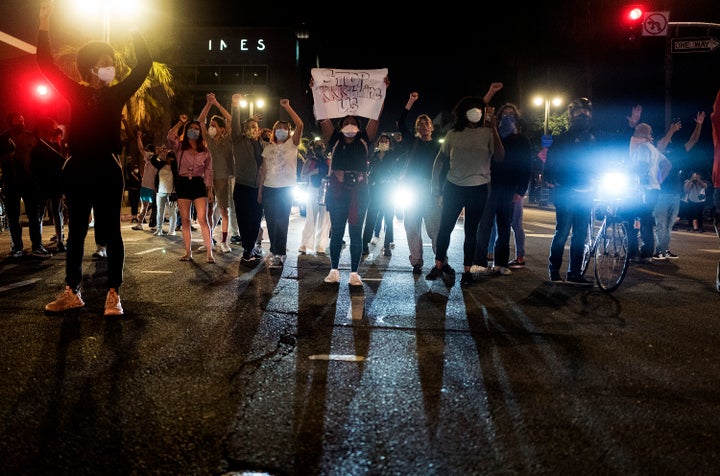
Protests erupted across the U.S. on Thursday following days of increasingly tense demonstrations in Minneapolis over the death of George Floyd, a handcuffed Black man who died after a white police officer knelt on his neck.

Floyd died on Monday after a police officer pinned him to the ground for several minutes while he repeatedly pleaded, “I can’t breathe.” The shocking incident, which was captured on video, has prompted a nationwide outcry. The four officers involved were fired, but Floyd’s family, community leaders and protesters are calling for their arrest and an end to police violence.

Demonstrations rocked Minneapolis on Tuesday, Wednesday and into Thursday night, leading to looting and violent clashes with police, who fired tear gas and rubber bullets. One person was fatally shot.

Floyd’s brother, Philonese Floyd, stressed on CNN on Thursday morning that protests should be peaceful, but he said people were acting out because they are “torn and hurt because they’re tired of seeing Black men die. Constantly, over and over again.”

“These officers, they need to be arrested right now. They need to be arrested and held accountable about everything because these people want justice right now,” he said. He called for the four officers to be “arrested, convicted of murder and given the death penalty.”

Videos on social media show protesters in cities across the U.S. calling for justice for Floyd.

In Minnesota, for the third consecutive night, groups rallied in St. Paul and in neighboring Minneapolis, scattered across the city on street corners, at the intersection where Floyd died and outside the Minneapolis 3rd Precinct police station, where the officers were believed to have worked. Reports indicated the precinct was breached by protesters Thursday night and nearby buildings were set alight. The Minneapolis Police Department released a statement that the precinct had been evacuated.

Earlier Thursday, Minnesota Gov. Tim Walz declared a state of emergency and activated the National Guard as the city braced for the night’s protests.

Earlier, groups also stood outside the home and government offices of Hennepin County Attorney Mike Freeman. who will handle the investigation, to demand criminal prosecution of the officers involved: Derek Chauvin, the man who pressed his knee into Floyd’s neck; Thomas Lane; Tou Thao; and J. Alexander Kueng. 


Protesters angered by the death of George Floyd stand Wednesday outside the home of Hennepin County Attorney Mike Freeman in Minneapolis. The mayor of Minneapolis called for criminal charges against the white police officer seen on video kneeling against the neck of a handcuffed Black man who died in police custody.

In New York, more than 40 people were arrested Thursday night in Manhattan as hundreds protested police violence. Floyd’s death particularly struck a nerve in the city as it drew grim comparisons to the death of Eric Garner, a Black man whose final words before he died in police custody were “I can’t breathe.”

Garner’s mother, Gwen Carr, told NBC News that hearing those words again was like “a recurring nightmare.”

Peaceful protests across Denver also escalated Thursday evening, after gunshots were fired near the Colorado State Capitol. 

“We do believe that the shots were towards the Capitol, but we do not at this point have any correlation to the protest or the protesters,” Denver police spokesman Kurt Barnes told the Denver Post. No injuries were reported.

Police also fired tear gas and pepper spray to disperse hundreds of protesters on the Capitol lawn and on Interstate 25, where protesters blocked traffic.

Several hundred protesters, some carrying signs reading “Black lives matter,” marched through downtown Denver.

A video also appeared to show a car drive through a crowd of protesters downtown and turn to knock over a protester.

In California, a protest in downtown Los Angeles on Wednesday grew fraught, leading to two police cars being vandalized and one demonstrator hurt, the Los Angeles Times reported.

In a statement to the newspaper, the Los Angles Police Department said, “We hear your anger and your pain. We will always facilitate freedom of speech. Period. All we ask is that protests are held in a safe and legal manner.”

A smaller protest was also held in Oakland on Thursday.

Demonstrators block traffic during a protest Wednesday in Los Angeles over the death of George Floyd in Minneapolis.


Demonstrators block traffic during a protest Wednesday in Los Angeles over the death of George Floyd in Minneapolis.

In Birmingham, Alabama, more than 100 people gathered to express their anger over Floyd’s death.

“We didn’t come here to be nice tonight. We didn’t come here to play around tonight. Hopefully we are here because we are tired of what’s happening,” Carlos Chaverst, one of the organizers, told local news site Al.com. “We should be fed up with seeing Black men and women being killed in the street by police.”

Meanwhile, in Louisville, Kentucky, more than 500 people gathered to protest the shooting death of Breonna Taylor. Taylor was killed by police on March 13 when they entered her apartment with a drug warrant looking for someone else.

According to the Louisville Courier-Journal, gunshots were reported just before 11:30 p.m. in downtown Louisville after several hours of peaceful demonstrations. Protesters had marched and chanted “No justice, no peace,” but the situation escalated when a crowd reportedly tried to flip a vehicle.

Peaceful protests in Columbus, Ohio, broke out into chaos Thursday night after people began throwing objects at police, prompting the officers to fire tear gas to push back crowds, NBC4i reported.

Protesters had chanted “Black lives matter” and “Say his name.”

The Ohio Statehouse was reportedly breached after windows were broken.


Source by [author_name]

Hilary Duff And ‘Cheaper By The Dozen’ Cast Reunite On TikTok To Make You Feel Old

Hilary Duff apparently won’t rest during lockdown until she’s reunited with every single one of her casts ― “Raise Your Voice” hive, our time is now ― and the latest one on her list is “Cheaper by the Dozen.”

The 2003 remake of the classic story about a couple with more children than a football team boasted an undeniably stacked cast (Steve Martin! Bonnie Hunt! Tom Welling! Those “Desperate Housewives” twins!) and even spawned a sequel.

But it has largely been forgotten in the jumble of charming but forgettable family-friendly films since, so imagine our surprise at the cast coming together for a TikTok reunion this week to raise funds for No Kid Hungry.

And that means they’re all grown up now and you’ll feel older than ever watching them re-create scenes from the film.

“Surprise! From the Baker family to yours. We are all in this together,” Stoner wrote alongside the video.

As for who’s on board, matriarch Bonnie Hunt, Piper Perabo, Alyson Stoner, Brent and Shane Kinsman, Kevin Schmidt, Morgan York, Blake Woodruff and more appear in the viral clip.

Notable absences include Tom Welling and, of course, Steve Martin, who we can only presume balked at the idea of appearing in a TikTok.

Each of the actors does their best to get back in touch with their characters of yesteryear, as Simple Plan’s “I’m Just A Kid” blares on. But major props go to Duff for committing to the endeavor with a green face mask and Bonnie Hunt for, well, just being Bonnie Hunt.

Duff also reunited with her “Lizzie McGuire” cast mates earlier this month for table-read of the show’s most memorable episodes.

But since that reboot might be DOA, we’ll happily take “Cheaper by the Dozen 3” in its place to quench our early-aughts nostalgia thirst.


Source by [author_name]

‘Why are we still struggling?’ ask Australia bushfire victims

When the Australian bush went up in flames over the southern hemisphere summer, the world pulled together in support. 

The Australian government established a two billion Australian dollar ($1.3bn) fund to assist fire-affected communities and wildlife.

More:

But now, several months down the line, as a royal commission this week began its investigation into what happened, many communities are little further forward than they were back then. People are still living in tents, waiting on loans, unable to rebuild their lives.

The fires ravaged Gloria Sutherland’s property in Yowrie, in southern New South Wales, at three in the morning, sweeping into the valley from the ridges above and into her back paddock. Nearby towns were hit too.

“It just had no mercy for anybody,” she said.

Sutherland recalls fireballs the size of her hand and bigger being spat out by the blaze as it raced towards her home.

“Where the fire went into our laundry it broke a window,” Sutherland said. “The fire actually smashed a pane of glass … the balls [were] like rocks being thrown.”

No one came to help the 63-year-old and her husband, Peter, 67, not even the fire brigade, because they were so far out of town. It was “just the two of us, two old people”, she remembers.

They defended their house until they ran out of water and then retreated inside, with nothing left but hope.

Come together

As pictures emerged of the scale of the devastation, money poured in for those affected. Hundreds of millions of dollars were raised for bushfire relief across the country.

The fire ‘had no mercy for anybody’ Gloria Sutherland told Al Jazeera. She and her husband battled the blaze alone when it swept down onto their property [Supplied/Al Jazeera] 

Among other charities, the Australian Red Cross raised 216 million Australian dollars ($142.8m), the Salvation Army 41 million Australian dollars ($27.1m) and the St Vincent de Paul Society 22.9 million Australian dollars ($15.1m).

A number of celebrities, sportspeople and businesses joined the cause too. 

In January, the Australian government announced its package for bushfire recovery, covering a range of initiatives such as mental health, local tourism, and grants for bushfire-affected farmers.

But in bushfire-hit communities, people say they have little to show for it.

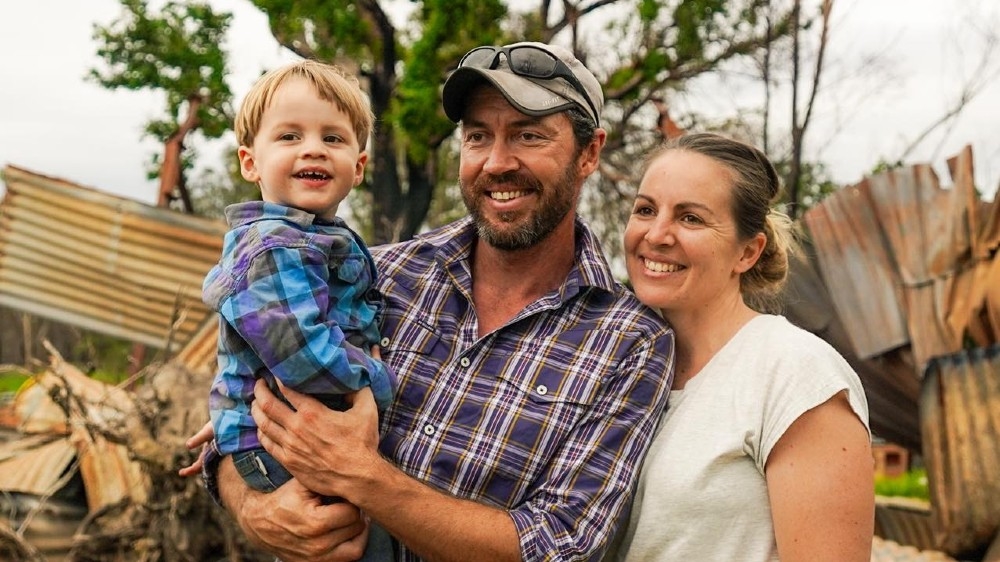
Dan Tarasenko lives in Quaama in southern New South Wales, one of the areas that was worst-hit by the fires. 

“I have a house, not much else,” Tarasenko told Al Jazeera.

Half of his sheds are gone, half his livestock and all of his fences. Just about everything is damaged to some degree.

He says that the government has been slow to deliver support.

Tarasenko applied for two government loans but on Monday – after a 13-week wait – was told that one of his applications had been rejected. The other was rejected on Tuesday after seven weeks of waiting.

Even if his loans had been approved he would still have had to wait for the funds to come through.

“[They] come in after the fact so we’re looking at six, eight months of lost income,” he said.

Without the loans he applied for, Tarasenko has no way to restart his business because only government loans allow farmers to use the money to replace livestock. 

He is appealing but has no idea how long the process could take.

“I’m fighting publicly,” he told Al Jazeera, saying he had highlighted his case to local politicians. “We are giving evidence to the royal commission on Thursday. What else can we do but keep fighting.”

Many other fire-affected communities are facing similar struggles. 

“[The government] want[s] financials, they want security, they want details … I can understand it but it is turning people away,” Tarasenko said. “and then delays, [people think] … why bother?”

Charities have also come in for criticism amid accusations that they have only delivered a small proportion of what they raised. 

As of the first week of May, the Australian Red Cross had used 40 percent of the money it had received since January, and The Salvation Army had spent 46 percent. The two are among Australia’s biggest civil society groups and received a large share of the funding. 

The St Vincent de Paul Society, which was one of the first on the ground in the aftermath of the devastation, has spent more than 13.5 million Australian dollars ($8.9m) – 59 percent of its donations.

The Red Cross says delays have been because of the large numbers of fraudulent applications they received, but also because they want to focus attention on long term recovery.

“Typically … for people to really get back to functioning in what we might call a “new normal” will take… anywhere up to … five to 10 years,” said Andrew Coghlan, Head of Emergencies for the Australian Red Cross. 

“We’ve allocated a small portion of the funds to be able to run our recovery programme  … and we’ll have people out on the ground for the next three years.”

There has also been speculation that charities have used the donations they received for administrative costs or initiatives other than the fires.

Australia

The fire tore through the Sutherland’s property reducing buildings and vehicles to charred wrecks [Supplied/Al Jazeera] 

The Australian Red Cross, Salvation Army and the St Vincent de Paul Society all told Al Jazeera that this was not the case and that all their funds are being used for bushfire recovery.

The physical clean-up has also been slower than expected. Part of the problem is COVID-19 – leaving the government overwhelmed under the weight of two crises at once.

In a recent news conference, Prime Minister Scott Morrison assured Australia that throughout the COVID-19 crisis, the National Bushfire Recovery Agency and other agencies had been “working on the ground to deliver the supports that we said would be there” in response to the bushfires as well as floods and drought.

Earlier this month, the government announced a 650 million Australian dollar bushfire recovery package – the final instalment of the $1.3bn pledged – to fund recovery plans, mental health support, the development of telecommunications, forest management, and wildlife and habitat recovery.

Morrison said South Australia’s clean-up was almost complete, and he expected NSW to be finished by the end of June and Victoria “sometime in August”.

Official inquiries

The Royal Commission into National Natural Disaster Arrangements – an inquiry into how Australia can prevent devastation from crises like the bushfires in the future and how we can help communities recover now – began its hearings this week, with a final report expected by the end of August.

Another investigation, the NSW Bushfire Inquiry, will deliver a report by July 31.

Australia

Dan Tarasenko with his family. This week, after months of waiting, he learned that his applications for two key loans to help him rebuild had been rejected [TBH Media/Al Jazeera]

But preparing for the next fire season is arguably just as important as moving recovery forward.

For Tarasenko, forest management is the key issue.

“You can’t have an overgrown forest that … loves fire,” he said.

Tarasenko argues that modern society has destroyed many of the factors that are essential to Australia’s forests.

“We have sent many animals extinct, and removed Indigenous input, and [we] scratch our heads whilst it incinerates,” he said.

The Sutherlands lost everything but their house to the fires.

Almost all of their cattle died and many of their sheep. Their sheds and fencing were left in charred ruins.

The saddest part was losing their prized bull – they only found its remains weeks after the blaze.

For now, the couple is struggling forward alone and Tarasenko is simply waiting, hoping for assistance after months of limbo.

For communities like theirs, progress cannot come soon enough.

Source link

Jennifer Lopez Explains That Creepy Face Spotted Behind Her In Viral Gym Selfie

Much of the buzz around the photo, however, focused on what appeared to be a man’s face in the background, positioned just above J-Lo’s shoulder.

Appearing on The Tonight Show With Jimmy Fallon last week, Jen revealed that the man in question was actually someone having a virtual conversation with her fiancé, Alex Rodriguez.

“That was a Zoom,” she said. “Where we have the Zoom set up is right by our garage. We didn’t have a gym in the house, so we got a bench and a few weights, and I have my rehearsal mirrors back there for dance rehearsal.”

As for the mystery man’s identity, Jen shrugged and explained: “It was some real estate guy Alex was on Zoom with.”

With most of Hollywood shut down due to the coronavirus, Jennifer’s career still remains in high gear. On Tuesday night, she returns as a judge for Season 4 of the US competition series World of Dance. 

Though she and Alex had planned to wed this summer, the pandemic has driven the couple to call off their nuptials for now. 

But she remains optimistic.

“There’s no planning right now,” she told the Today show on Tuesday morning. “I’m a little heartbroken because we did have some great plans, but I’m also like, you know what, God has a bigger plan. So we just have to wait and see. Maybe it’s going to be better. I have to believe that it will be.”

Watch Jennifer Lopez’s appearance on The Tonight Show With Jimmy Fallon below. 


Source by [author_name]

‘Feisty Old Polish Grandmother,’ 103, Beats Coronavirus Then Cracks Open A Beer

See the latest stories on the coronavirus outbreak.  

This Bud’s for her. Jennie Stejna, a 103-year-old great-great grandmother in Massachusetts, defeated the coronavirus in the best way possible: by knocking back a cold one. 

“She always had that feisty fighting spirit,” granddaughter Shelley Gunn told Wicked Local. “She didn’t give up.”

Family members told Wicked Local that the nursing home resident and “hardcore Boston sports fan” developed a fever, tested positive for the virus and quickly worsened. 

But she beat Covid-19 ― and the nursing home staff let her celebrate with a Bud Light:

Footage from TMZ, below, shows Stejna savoring her Bud Light and commenting on how cold it is. 

Adam Gunn ― Shelley’s husband ― told the website that it go so bad that at one point he asked if she were ready to go to heaven. 

She replied: “Hell, yes!”

“This feisty old Polish grandmother of ours officially beat the coronavirus,” Adam Gunn told Wicked Local.

The website said she has two children, three grandchildren, four great-grandchildren and three great-great-grandchildren.


Source by [author_name]